Hadamard Matrices,
d-Linearly Independent Sets
and Correlation-Immune Boolean Functions with
Minimum Hamming Weights
Qichun Wang∗
Abstract
It is known that correlation-immune (CI) Boolean functions used in the framework of side channel attacks need to have low Hamming weights. In 2013, Bhasin et al. studied the minimum Hamming weight ofd-CI Boolean functions, and presented an open problem: the mini-mal weight of ad-CI function innvariables might not increase withn. Very recently, Carlet and Chen proposed some constructions of low-weight CI functions, and gave a conjecture on the minimum Hamming weight of 3-CI functions innvariables.
In this paper, we determine the values of the minimum Hamming weights of d-CI Boolean functions in n variables for infinitely many
n’s and give a negative answer to the open problem proposed by B-hasin et al. We then present a method to construct minimum-weight 2-CI functions through Hadamard matrices, which can provide al-l minimum-weight 2-CI functions in 4k−1 variables. Furthermore, we prove that the Carlet-Chen conjecture is equivalent to the famous Hadamard conjecture. Most notably, we propose an efficient method to construct low-weightn-variable CI functions throughd-linearly in-dependent sets, which can provide numerous minimum-weight d-CI functions. Particularly, we obtain some new values of the minimum Hamming weights of d-CI functions in n variables for n ≤ 13. We conjecture that the functions constructed by us are of the minimum Hamming weights if the sets are of absolute maximumd-linearly inde-pendent. If our conjecture holds, then all the values for n≤ 13 and most values for generalnare determined.
Keywords: Boolean functions, Correlation-immune, Minimum-weight, Hadamard matrices,d-linearly independent sets.
MSC 2010: 94C10, 05B20, 11T71, 03E75.
∗
1
Introduction
Side-channel analysis is a very powerful technique which target implemen-tations of block ciphers [11, 12, 15, 16]. To resist side channel attacks, many possible countermeasures have been proposed, and correlation-immune (CI) Boolean functions with low Hamming weights can be used in the framework [5, 13, 14, 19]. To reduce the cost overhead of countermeasures, one needs to constructd-CI functions with the weight as small as possible, or maximizing dfor a given weight [2, 5].
In [2], Bhasin et al. studied the minimum Hamming weight of d-CI Boolean functions, and presented an open problem: the minimal weight of ad-CI function in nvariables might not increase withn. In [4], Carlet and Chen proposed some constructions of low-weight CI functions, and conjec-tured that the minimum Hamming weight of 3-CI functions in n variables is 8dn
4e.
In this paper, we prove that the minimum Hamming weight of 3-CI n-variable Boolean functions is lower bounded by 8dn4e, and then present a method to construct minimum-weight 2-CI functions through Hadamard matrices, which can provide all minimum-weight 2-CI Boolean functions in 4k−1 variables. We thus determine the values of the minimum Ham-ming weights for infinitely manyn’s and give a negative answer to the open problem proposed by Bhasin et al. Furthermore, we prove that the Carlet-Chen conjecture is equivalent to the famous Hadamard conjecture. Most notably, we propose an efficient method to construct low-weightn-variable CI functions through d-linearly independent sets, which can provide nu-merous minimum-weightd-CI functions. Particularly, we obtain some new values of the minimum Hamming weights of d-CI functions in n variables forn ≤13. We conjecture that the functions constructed by us are of the minimum Hamming weights if the sets are of absolute maximumd-linearly independent. If our conjecture holds, then all the values for n ≤ 13 and most values for generalnare determined.
2
Preliminaries
LetFn2 be the n-dimensional vector space over the finite fieldF2. We denote byBn the set of alln-variable Boolean functions, from Fn2 into F2.
Any Boolean functionf ∈ Bn can be represented by its truth table
[f(0,0, . . . ,0), f(1,0, . . . ,0), f(0,1, . . . ,0), f(1,1, . . . ,0), . . . , f(1,1, . . . ,1)].
Leta= (a1, . . . , an)∈Fn2. The Hamming weight ofa, denoted bywH(a),
is the cardinality of the set {1≤i≤n|ai = 1}.
LetSupp(f) ={x∈Fn
2|f(x) = 1} be the support of a Boolean function f ∈Bn, whose cardinality|Supp(f)|is called theHamming weightoff, and
will be denoted by wH(f). Clearly, f is determined by Supp(f) uniquely.
We say that f isbalancedifwH(f) = 2n−1.
Let f ∈ Bn. f is called correlation-immune of order d(in brief,d-CI) if and only if
X
x∈Fn2
(−1)f(x)⊕v·x= 0,
for any v = (v1, . . . , vn) ∈ Fn2 satisfying 1 ≤ wH(v) ≤ d, where v·x =
v1x1+· · ·+vnxn is the usual inner product [3, 6, 18, 21].
Clearly, for06=v∈Fn
2, we have
X
x∈Fn
2
(−1)f(x)⊕v·x= X
x∈Supp(f)
(−1)1⊕v·x+ X
x∈/Supp(f)
(−1)v·x=−2 X
x∈Supp(f)
(−1)v·x.
Therefore,f isd-CI if and only if
X
x∈Supp(f)
(−1)v·x= 0,
for any v∈Fn
2 satisfying 1≤wH(v)≤d.
A matrix H of order n is called a Hadamard matrix if HHT = nI n,
whereIn is the n×nidentity matrix andHT is the transpose ofH [9].
3
Hadamard matrices and minimum Hamming
weight-s of
d
-CI Boolean functions
3.1 On the minimum weight of 3-CI Boolean functions
Lemma 3.1 (Proposition 2.6 of [4]). Let d be an even integer such that n≥d≥2. Then wn+1,d+1= 2wn,d.
Theorem 3.2. Let n ≥ 3 be any integer. Then wn,3 ≥ 8dn4e. That is, wn,2≥4dn+14 e, for n≥2.
Proof. By Lemma 3.1, it is sufficient to prove thatwn,2 ≥4dn+14 e, forn≥2. Suppose there is an n ≥ 2 such that m = wn,2 < 4dn+14 e. Then there exists a 2-CI f ∈ Bn with the Hamming weight m. It is well known that
deg(f)≤n−2 andmis a multiple of 4. Therefore,m≤4dn+1
4 e −4< n+ 1. Let the support of f be {(ai1, ai2, . . . , ain)}, where 1 ≤ i ≤m. Let M be
the matrix
M =
a11 a12 · · · a1n
a21 a22 · · · a2n
· · · ·
am1 am2 · · · amn
= [p1, . . . ,pn],
where pj = (a1j, a2j, . . . , amj)T and 1 ≤ j ≤ n. Since f is 2-CI, we have
wH(pj) = m2 andwH(pj1⊕pj2) =
m
2, where 1≤j≤nand 1≤j1< j2 ≤n. Therefore,
pTi1pi2 =
m
2 if i1=i2,
m
4 otherwise. We construct an m×(n+ 1) matrix H as follows.
H =
1 (−1)a11 (−1)a12 · · · (−1)a1n
1 (−1)a21 (−1)a22 · · · (−1)a2n
· · · ·
1 (−1)am1 (−1)am2 · · · (−1)amn
.
Then
HTH =mI,
whereI is the identity (n+ 1)×(n+ 1) matrix. Therefore,
n+ 1 =rank(HTH)≤rank(H)≤m < n+ 1,
which is a contradiction, and the result follows.
Construction 1: LetH be any 4k×4kHadamard matrix. By negating columns ofH, we can get a matrix whose first row is (1,1, . . . ,1). We delete this row and denote the induced (4k−1)×4kmatrix as
e H =
(−1)a1,1 (−1)a1,2 · · · (−1)a1,4k
(−1)a2,1 (−1)a2,2 · · · (−1)a2,4k
· · · ·
(−1)a4k−1,1 (−1)a4k−1,2 · · · (−1)a4k−1,4k
,
whereai,j ∈F2, 1≤i≤4k−1 and 1≤j≤4k. Letqj = (a1,j, . . . , a4k−1,j),
where 1≤j ≤4k. Then we construct a function f ∈ B4k−1 whose support is{q1,q2, . . . ,q4k}.
We give an example to illustrate the construction.
Example 1: Take the Hadamard matrix
H =
1 1 1 −1 1 1 −1 1 1 −1 1 1
−1 1 1 1
.
Negate the last column and then delete the first row, we have
H→
1 1 1 1
1 1 −1 −1 1 −1 1 −1
−1 1 1 −1
→
1 1 −1 −1 1 −1 1 −1
−1 1 1 −1
. That is, e H =
(−1)0 (−1)0 (−1)1 (−1)1 (−1)0 (−1)1 (−1)0 (−1)1 (−1)1 (−1)0 (−1)0 (−1)1
.
Then the support off ∈ B3 defined in Construction 1 is
{(0,0,1),(0,1,0),(1,0,0),(1,1,1)}.
Proposition 3.3. Let H be any4k×4kHadamard matrix, and f ∈ B4k−1 be the function defined in Construction 1. Thenf is a 2-CI Boolean function with the minimum Hamming weight.
Proof. Since H is a Hadamard matrix, the rows of the induced matrix e
H = [(−1)ai,j] in Construction 1 are mutually orthogonal and they are all
1 ≤ i ≤ 4k−1. Then wH(pi) = 2k and wH(pi1 ⊕ pi2) = 2k, where
1 ≤ i ≤ 4k−1 and 1 ≤ i1 < i2 ≤ 4k−1. Therefore, f is 2-CI. Since wH(f) = 4k = 4d4k−1+14 e, by Theorem 3.2, f is a 2-CI Boolean function
with the minimum Hamming weight.
Corollary 3.4. If there exists a Hadamard matrix H of order 4k, then w4k,3 = 2k.
In [2], Bhasin et al. presented an open problem: the minimal weight of a d-CI function innvariables might not increase withn. By Corollary 3.4, we can give a negative answer to this problem, since there are infinitely many Hadamard matrices.
3.2 Equivalence of the Hadamard and Carlet-Chen conjec-tures
Hadamard conjectured that there exists a Hadamard matrix of order 4kfor every positive integerk. After more than one hundred years, this conjecture still remains open.
Conjecture 3.5 (Hadamard Conjecture). A Hadamard matrix of order 4k exists for every positive integer k.
There are many results on this conjecture (see e.g. [1, 7, 8, 10, 17, 20]). The smallest order for which no Hadamard matrix has been known is 668.
In [4], based on the numerical results, Carlet and Chen proposed the following conjecture.
Conjecture 3.6(Carlet-Chen Conjecture). Letn≥3be any integer. Then wn,3= 8dn4e.
We now prove that the above two conjectures are equivalent.
Theorem 3.7. The Carlet-Chen conjecture is equivalent to the Hadamard conjecture.
Proof. If the Carlet-Chen conjecture holds, then for any positive integer k, we have w4k,3 = 8k. Hence, w4k−1,2 = 4k. That is, there exists a 2-CI f ∈ B4k−1 with the Hamming weight 4k. Let the support of f be
H as follows.
H=
1 (−1)a1,1 (−1)a1,2 · · · (−1)a1,4k−1
1 (−1)a2,1 (−1)a2,2 · · · (−1)a2,4k−1
· · · ·
1 (−1)a4k,1 (−1)a4k,2 · · · (−1)a4k,4k−1
.
ThenHTH= 4kI, whereI is the identity 4k×4kmatrix. That is,HT is a Hadamard matrix of order 4k.
Now suppose the Hadamard conjecture is correct. Then for any positive integerk, there exists a Hadamard matrixHof order 4k. By Proposition 3.3, the function defined in Construction 1 is a 2-CI Boolean function with the Hamming weight 4k. Therefore,w4k−1,2≤4k. By Lemma 3.1 and Theorem 3.2, we havew4k,3= 8k. For 1≤t≤3, we havew4k+t,3 ≤w4k+4,3 = 8(k+1). Then by Theorem 3.2, 8(k+ 1) ≥ w4k+t,3 ≥ 8d4k4+te = 8(k+ 1), and the result follows.
From the proof of Theorem 3.7, for any minimum-weight 2-CI function f ∈ B4k−1, there always exists a Hadamard matrix of order 4k such that the function defined in Construction 1 is the same as f. In other words, our construction can provide all minimum-weight 2-CI Boolean functions in 4k−1 variables.
4
d
-linearly independent sets and
d
-CI Boolean
functions with low Hamming weights
4.1 d-linearly independent sets
We now introduce the notion,d-linearly independent set, which will be used in our construction ofd-CI Boolean functions with low Hamming weights.
Definition 4.1. A subset of Fm2 is said to be d-linearly independent if no vector in the set can be written as a linear combination of any other d−1
vectors in the set.
Definition 4.2. A subset S of Fm2 with k vectors is set to be a relative maximum d-linearly independent set if S is not a subset of any d-linearly independent set ofFm2 with k+ 1 vectors.
Definition 4.3. A subset of Fm2 with k vectors is set to be an absolute maximumd-linearly independent set if there is nod-linearly independent set of Fm2 withk+ 1vectors. We denote this maximum value k as vm,d.
It is easy to see that vm,2 = 2m−1 and vm,d1 ≥vm,d2 ford1 < d2. We
now determine other values ofvm,d.
Proposition 4.4. The cardinality of an absolute maximum 3-linearly inde-pendent set ofFm2 is2m−1. That is, vm,3 = 2m−1.
Proof. Suppose there exists a 3-linearly independent set{p1,p2, . . . ,p2m−1+1} ⊂
Fm2 . Then we construct a set
T ={pi, 1≤i≤2m−1+ 1}
[
{p1+pj, 2≤j≤2m−1+ 1}.
Clearly, the cardinality of the set T is 2m−1 + 1 + 2m−1 > 2m, which is contradictory to the fact that T is a subset of Fm2 . Therefore,vm,3≤2m−1. Clearly, the set
S={p∈Fm2 |wH(p) is odd}
is a 3-linearly independent set with 2m−1vectors, and the result follows.
Proposition 4.5. For m≥5 and d≥ 2m+2
3 , the cardinality of an absolute maximumd-linearly independent set ofFm2 ism+ 1. That is, vm,d =m+ 1,
for d≥ 2m+2 3 .
Proof. Let S={p1,p2, . . . ,pt} ⊂Fm2 be any absolute maximum d-linearly independent set. Take a basis ofS, say {p1,p2, . . . ,pm}. Then any vector
inS can be written as a linear combination of the basis vectors. We have
p1 p2 . . . pm
pm+1 . . . pt =
1 0 . . . 0 0 1 . . . 0 . . . .
0 0 . . . 1 cm+1,1 cm+1,2 . . . cm+1,m
. . . . ct,1 ct,2 . . . ct,m
p1 p2 . . . pm ,
where (ci,1, ci,2, . . . , ci,m)∈Fm2 , form+ 1≤i≤t. Therefore,
T ={(1,0, . . . ,0), . . . ,(0,0, . . . ,1),(cm+1,1, . . . , cm+1,m), . . . ,(ct,1, . . . , ct,m)}
is an absolute maximumd-linearly independent set. Sinced≥ 2m+2
Table 1: The values ofvm,d
d m
3 4 5 6 7 8 9
2 7 15 31 63 127 255 511 3 4 8 16 32 64 128 256
4 5 6 8 11 13 15
5 6 7 9 12 14
6 7 8 9 12
7 8 9 10
different vectorsq1,q2 ∈T such thatwH(q1)≥ 2m3+2 andwH(q2)≥ 2m3+2. Otherwise,q1⊕q2 is of the Hamming weight
≤ 2m−4
3 =
2m+ 2 3 −2
and it can be written as a linear combination of other 2m3+2 −2 vectors in T. Therefore, the cardinality ofT is at most m+ 1. Clearly, the set
S={p∈Fm2 |wH(p) = 1 or m}
is ad-linearly independent set withm+ 1 vectors, and the result follows.
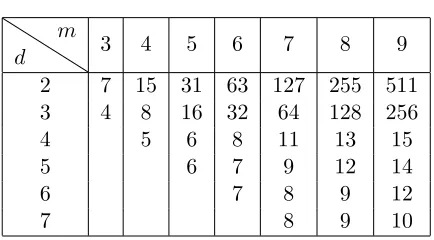
If m is small, it is quite easy to determine the values of vm,d. In Table
1, we list all the values of vm,d, form≤9.
4.2 An efficient method to construct d-CI Boolean functions with low Hamming weights
We now give a method to construct low-weight d-CI n-variable functions through d-linearly independent sets.
Construction 2: Let S ={u1, . . . ,uk} ⊂Fm2 be a d-linearly indepen-dent set. Let lj ∈ Bm be the linear function uj ·x, where x ∈Fm2 and “·” is the usual inner product. The truth table of lj is denoted by the column
vectorpj = (a1,j, a2,j, . . . , a2m,j)T. Let
M = [p1, . . . ,pk] =
a1,1 a1,2 · · · a1,k
a2,1 a2,2 · · · a2,k
· · · ·
a2m,1 a2m,2 · · · a2m,k
=
q1
q2
· · ·
q2m
whereqi∈Fk2 and 1≤i≤2m. Then we construct a functionf ∈ Bk whose
support is{q1,q2, . . . ,q2m}.
We give an example to illustrate the construction.
Example 2: Takem= 7 and
S ={(1,0,0,0,0,0,0),(0,1,0,0,0,0,0),(0,0,1,0,0,0,0),(0,0,0,1,0,0,0), (0,0,0,0,1,0,0),(0,0,0,0,0,1,0),(0,0,0,0,0,0,1),(1,1,1,1,0,0,0), (1,1,0,0,1,1,0),(1,0,1,0,1,0,1),(1,1,1,1,1,1,1)}.
Clearly,S is a 4-linearly independent set with 11 vectors. We have
l1 =x1, l2 =x2, l3 =x3, l4 =x4, l5 =x5, l6 =x6, l7 =x7, l8 =x1⊕x2⊕x3⊕x4, l9=x1⊕x2⊕x5⊕x6,
l10=x1⊕x3⊕x5⊕x7, l11=x1⊕x2⊕x3⊕x4⊕x5⊕x6⊕x7.
Then we can get the functionf ∈ B11by Construction 2 with the support
{(0,0,0,0,0,0,0,0,0,0,0),(1,0,0,0,0,0,0,0,0,0,0),(0,1,0,0,0,0,0,0,0,0,0), (1,1,0,0,0,0,0,0,0,0,0), . . . ,(0,1,1,1,1,1,1,1,1,1,0),(1,1,1,1,1,1,1,0,0,0,0)}
It is easy to check that f is a 4-CI Boolean function with the Hamming weight 128. Therefore, w11,4 ≤ 128. Since w11,4 ≥ w10,4 = 128, we have w11,4 = 128. This is a previously unknown value, thus a triple question mark ??? in Table II of [4] can be taken place by it.
Proposition 4.6. Let f ∈ Bk be the function defined in Construction 2.
Thenf is a d-CI Boolean function with the Hamming weight 2m.
Proof. Clearly,f is d-CI if and only if
X
x∈Supp(f)
(−1)v·x= 0,
for anyv= (v1, . . . , vk)∈Fk2 satisfying 1≤wH(v)≤d. That is,wH(v1p1⊕
. . .⊕vkpk) = 2m−1, for any v ∈ Fk2 with 1 ≤ wH(v) ≤ d. Since S is a
d-linearly independent set, for any v ∈ Fk2 with 1 ≤ wH(v) ≤ d, we have
v1u1+. . .+vkuk 6=0. Therefore,
v1l1⊕. . .⊕vklk = (v1u1+. . .+vkuk)·x
Table 2: The values ofwn,d
n d
1 2 3 4 5 6 7 8
1 2
2 2 4
3 2 4 8
4 2 8 8 16
5 2 8 16 16 32
6 2 8 16 32 32 64
7 2 8 16 64 64 64 128
8 2 12 16 64 128 128 128 256 9 2 12 24 128 128 256 256 256 10 2 12 24 128 256 512 512 512 11 2 12 24 128 256 512 1024 1024 12 2 16 24 256? 256 512 1024 2048 13 2 16 32 256? 512? 1024? 1024 4096
Theorem 4.7. Let vm,d be the cardinality of the absolute maximum d
-linearly independent set of Fm2 . Then
wvm,d,d≤2
m.
Proof. Let S = {u1, . . . ,uk} ⊂ Fm2 be an absolute maximum d-linearly independent set. Then k = vm,d. By Construction 2, we can generate a
functionf ∈ Bvm,d. By Proposition 4.6, f is a d-CI Boolean function with the Hamming weight 2m. Therefore,
wvm,d,d≤2
m.
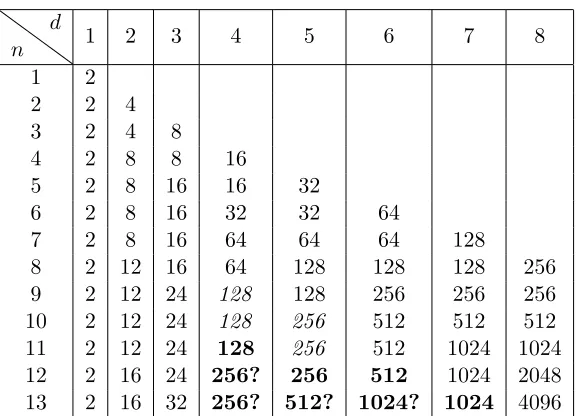
For n ≤ 13, there are 8 unknown values of wn,d (see Table II of [4]).
By Theorem 4.7 and Table 1, we can determine the exact values for half of them. That is, w11,4 = 128, w12,5 = 256, w12,6 = 512 and w13,7 = 1024. For other four unknown values, Theorem 4.7 provides an upper bound. In Table 2, we list the values of wn,d forn≤13. All values forn≤10 can be
Theorem 4.7. In Appendix A, we give an example of the 12-variable 6-CI Boolean function with the minimum Hamming weight.
By computingvm,dandwvm,d,d, for smallmandd, we find thatwvm,d,d=
2m always holds. So we propose the following conjecture.
Conjecture 4.8. Let vm,d be the cardinality of the absolute maximum d
-linearly independent set of Fm2 . Then
wvm,d,d= 2
m.
It is noted that if Conjecture 4.8 holds, then all the values of wn,d for
n≤13 and most values for generaln are determined. Moreover, the func-tions generated by Construction 2 using absolute maximumd-linearly inde-pendent sets are minimum-weight d-CI Boolean functions. Anyway, given an absolute maximumd-linearly independent setS, Construction 2 can pro-vide ad-CI Boolean function with low weight. That is, we have transformed the problem of finding low-weight correlation-immune Boolean functions to the problem of finding absolute maximumd-linearly independent sets, which can be done very efficient.
5
Conclusion
In this paper, we studied the relationships between Hadamard matrices, d -linearly independent sets and correlation-immune Boolean functions with minimum Hamming weights. We proposed two constructions of minimum-weight d-CI Boolean functions, and deduced some quite interesting results. The field is still open and there are many problems deserved to be studied.
Acknowledgment
The author would like to thank the financial support from the National Natural Science Foundation of China (Grant 61572189).
References
[1] L. Baumert, S. W. Golomb and M. J. Hall, “Discovery of an Hadamard Matrix of Order 92,”Bulletin of the American Mathematical Society
[2] S. Bhasin, C. Carlet and S. Guilley, “Theory of masking with code-words in hardware: low-weight dth-order correlation-immune Boolean functions,” IACR Cryptology ePrint Archive, Report 2013/303, 2013.
[3] C. Carlet, “Boolean Functions for Cryptography and Error Correct-ing Codes,” Chapter of the monography “Boolean Models and Meth-ods in Mathematics, Computer Science, and Engineering”, Cam-bridge University Press, pp. 257–397, 2010. Available: http://www-roc.inria.fr/secret/Claude.Carlet/pubs.html.
[4] C. Carlet and X. Chen, “Constructing low-weight dth-order correlation-immune Boolean functions through the Fourier-Hadamard transform,” to appear inIEEE Trans. Inform. Theory.
[5] C. Carlet and S. Guilley, “Side-channel indistinguishability,” Proceed-ings of HASP 13, 2nd International Workshop on Hardware and Ar-chitectural Support for Security and Privacy, 2013, pp. 9:1–9:8.
[6] T. W. Cusick and P. St˘anic˘a, Cryptographic Boolean Functions and Applications (2nd ed.), Elsevier–Academic Press, 2017.
[7] D. Z. Djokovic, “Hadamard matrices of order 764 exist,” Combinator-ica 28:4 (2008), 487–489.
[8] S. Georgiou, C. Koukouvinos and J. Seberry, “Hadamard matrices, orthogonal designs and construction algorithms,”Designs 563 (2003), 133–205.
[9] J. Hadamard, “R´esolution d’une question relative aux d´eterminants,”
Bull. Sci. Math.17 (1893), 240–246.
[10] H. Kharaghani and B. Tayfeh-Rezaie, “A Hadamard matrix of order 428,”Journal of Combinatorial Designs 13:6 (2005), 435–440.
[11] P. Kocher, “Timing attacks on implementations of Diffie-Hellman, R-SA, DSS, and other systems,”Advances in Cryptology–CRYPTO 96 , LNCS 1109, Springer–Verlag, 1996, pp. 104–113.
[12] P. Kocher, J. Jaffe and B. Jun, “Differential power analysis,”Advances in Cryptology–CRYPTO 99 , LNCS 1666, Springer–Verlag, 1999, pp. 388–397.
and Embedded Systems C CHES 2005, LNCS 3659, Springer–Verlag, 2005, pp. 157–171.
[14] S. Mangard, E. Oswald and T. Popp,Power Analysis Attacks: Reveal-ing the Secrets of Smart Cards (Advances in Information Security), Springer-Verlag New York, 2007.
[15] B. Mazumdar, D. Mukhopadhyay and I. Sengupta, “Constrained Search for a Class of Good Bijective S-Boxes with Improved DPA Resistivity,”IEEE Trans. Inform. Forensics and Security 8:12 (2013), 2154–2163.
[16] S. Picek, K. Papagiannopoulos, B. Ege, L. Batina and D. Jakobovic, “Confused by Confusion: Systematic Evaluation of DPA Resistance of Various S-boxes,”Progress in Cryptology – INDOCRYPT 2014, LNCS 8885, Springer–Verlag, 2014, pp. 374–390.
[17] B. Schmidt, “Cyclotomic integers and finite geometry,”Journal of the American Mathematical Society 12:4 (1999), 929–952.
[18] T. Siegenthaler, “Correlation immunity of Nonlinear Combining Func-tions for Cryptographic ApplicaFunc-tions,” IEEE Trans. Inform. Theory
30:5 (1984), pp. 776–780.
[19] E. Trichina, D. D. Seta and L. Germani, “Simplified adaptive multi-plicative masking for AES,” Cryptographic Hardware and Embedded Systems C CHES 2002, LNCS 2523, Springer–Verlag, 2002, pp. 187– 197.
[20] J. S. Wallis, “On the existence of Hadamard matrices,”J. Combinat. Theory A.21:2 (1976) 188–195.
A
A 12-variable
6
-CI Boolean function with the
minimum Hamming weight
Takem= 9 and
S ={(1,0,0,0,0,0,0,0,0),(0,1,0,0,0,0,0,0,0),(0,0,1,0,0,0,0,0,0), (0,0,0,1,0,0,0,0,0),(0,0,0,0,1,0,0,0,0),(0,0,0,0,0,1,0,0,0), (0,0,0,0,0,0,1,0,0),(0,0,0,0,0,0,0,1,0),(0,0,0,0,0,0,0,0,1), (1,1,1,1,1,1,0,0,0),(1,1,1,0,0,0,1,1,1),(0,0,0,1,1,1,1,1,1)}.
Clearly,S is a 6-linearly independent set with 12 vectors. We have
l1 =x1, l2 =x2, l3 =x3, l4 =x4, l5 =x5, l6 =x6, l7 =x7, l8 =x8, l9 =x9, l10=x1⊕x2⊕x3⊕x4⊕x5⊕x6,
l11=x1⊕x2⊕x3⊕x7⊕x8⊕x9, l12=x4⊕x5⊕x6⊕x7⊕x8⊕x9.