EFFECTIVENESS OF USING
STRUCTURED AIDS
IN LEARNING NUMBER CONCEPTS
FOR MIDDLE PRIMARY SCHOOL CHILDREN
JOHN W CARNEY
This thesis is submitted
to fulfill the requirements of the degree of Master of Education.
FTS THESIS
372.72044 CAR 30001005349065 Carney, John W
DEDICATION
This work is dedicated to children and teachers in their search for the truth and beauty and order of mathematics.
Special thanks are due to my parents who have aided me on my journey and also to m y dear wife Mary-Rose and our family w h o have been supportive at all times.
ACKNOWLEDGMENTS
The writer acknowledges the contributions of the following:
Jan Thomas, my principal supervisor for her patience and understanding.
Rosemary Mulraney, my second supervisor.
Brian Doig of ACER for advice and permission to use his material.
Neil Diamond for his advice on statistical methodology.
Linda Scott for her smiles.
Statement of Sources
I declare that the w o r k presented in this thesis is to the best of m y knowledge and belief original, except as acknowledged in the text and that the material has not been
Abstract
This study set out to evaluate the effectiveness of using Blockaid material for the teaching and learning of n u m b e r concepts and of operations in middle primary school.
Blockaid is base 10 material designed to model number in multiple representations.
T h e different representations facilitate the modelling of procedures which follow the same steps of the formal algorithms of addition, subtraction, multiplication and division.
The hypothesis is that the external connections formed through the manipulation of structured materials aids the construction of internal cognitive networks by the learner in the building of conceptual knowledge. Knowledge formed in this w a y is rich in relationships and leads to better understanding of n u m b e r and operational concepts.
While the results of the study indicate that the procedures with Blockaid improved performance only with subtraction, m o r e than the traditional direct instruction approach, the implications are that with improved modelling better procedures can be devised using structured materials to improve teaching and learning of all operations.
Ongoing research is needed the evaluate the benefits of using of multi-representational materials, rather than single unit structures, to represent the base 10 n u m b e r system.
CONTENTS
Acknowledgments. i Statement of sources ii
Abstract iii Contents. iv List of Photos. viii List of Figures ix List of Tables x List of Appendices xiii
CHAPTER ONE - INTRODUCTION
Introduction 1 A i m s of the project 2
CHAPTER TWO - LITERATURE REVIEW
Introduction 5
1. Historic perspective 6Manipulatives and structured aids 6 Advocates for structured aids in promoting mathematics learning. 18
2. Fundamentals of education 23
Psychology 25 Epistemology 29 Pedagogy 37 3. Concepts of number and algorithms 41
4. Current situation in Victoria. 45
CHAPTER THREE - METHODOLOGY
Introduction 46 A. Design of the study 46
Factors of reliability and validity 60
B. Procedure for data gathering 62
Attitudes 62 Knowledge of facts and skills 63
Understanding 65
C. Treatment 67 The role of the researcher and of the class teachers. 67
Knowledge content - number and operations 68 Cognition - procedural skills and conceptual (understandings) 68
Influence of motivation 69
CHAPTER FOUR - TREATMENT
Introduction 71 Teaching strategies 72
Time Table 73 Control Group 73 Experimental group 75
Discussion 78 Confounding Factors 81
Implications 81
CHAPTER FIVE -CHILDREN'S ATTITUDE TOWARDS MATHEMATICS
Introduction 83 Responses to questionnaire
Question 1 84 Question 2 88 Question 3 92 Question 4 96 Question 5 99 Question 6 107 Question 7 112
C H A P T E R SIX - T E S T R E S U L T S F O R A R I T H M E T I C S K I L L S .
Introduction 116 Comparison of control and experimental performance 117
a. Pre-tests 117 b. Post-tests 120 Comparison of pre-test and post-test results 123
a. The control group. 125 b. The experimental group 126
Conclusions 128
CHAPTER SEVEN - INTERVIEWS ON NUMBER AND OPERATIONS
Analysis of interview data. 13 2
Description of phases. 133 Computation and explanation 133
Demonstration 133 Connection 135 Verification 135 Analysis of Pre-Study Subtraction Task A. 135
Explanation 136 N o n standard procedure or invented strategies 138
Error Paths 140 Demonstration 142 Connection 145 Verification 146 Pre-Study Task B. 148
Explanation 148 Error Paths 149 Demonstration 150 Connection 151 Verification 152 Post-Study Subtraction Task A. 153
Connection Verification Conclusion.
CHAPTER EIGHT - CONCLUSIONS AND IMPLICATIONS.
Introduction.Factors affecting the project. Trial period.
Understanding understanding. Information processing load. Goodness" of fit.
Class selection. Teacher effect. John Henry Effect. Revision time. Teaching style.
E n d of year disruptions. Results.
Skill performance. Attitudes.
Understandings. T h e need for further research. Conclusion.
159
160
162
165
166
166
166
167
167
168
168
168
169
169
169
170
170
172
173
174
176
List of P h o t o s
Photo 1.
Photo 2.
Photo 3.
Photo 4.
Photo 5.
Photo 6.
Photo 7.
Photo 8.
Photo 9.
Photo 10.
Photo 11.
Photo 12.
Photo 13.
Photo 14.
Photo 15.
Variations of Chinese and Japanese Abaci showing 26,482.
Spike abacus set out for subtraction problem 351- 137.
Cuisenaire rods structured to display multiplication table to 5 x 5.
Montessori Golden Material.
Montessori place/face value cards in box and example.
Interlocking centimetre cubes to build base 10 structures.
Hill's Constructive Counters.
W o o d e n base 10 blocks.
Blockaid foam pieces.
Blockaid pictorial and numeral cards.
Junk-box for number ideas.
Structured number materials for modelling groups to 5.
7
7
10
10
12
12
14
14
16
16
19
19
Multiple embodiment or multi-unit structures for the number: 123. 54
Blockaid materials set out for subtraction problem: 232 - 123. 54
Beads on sticks and frames material to s h o w number: 167.
56
List of Figures
Figure 1. Fundamental elements of the learning situation. 24
Figure 2. Factors modifying teacher practice. 25
Figure 3. Contrasting Behaviourist theory and Piaget's theory of learning. 28
Figure 4. Dienes' mapping of mathematics concepts - simplified version. 35
Figure 5. The expositive - discovery dimension. 39
Figure 6. Strategies for teaching different kinds of knowledge. 40
Figure 7. Time table of topics for instruction for first ten weeks of programme. 53
Figure 8. Questionnaire on attitudes towards school and mathematics learning. 64
Figure 9. Blockaid Workcard 10, Subtraction on a 4 by 4 Grid. 134
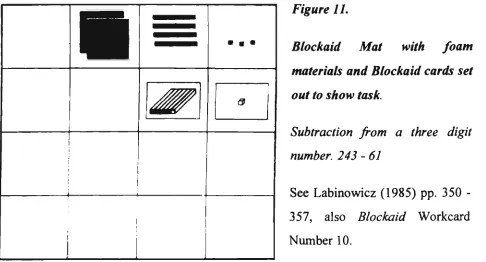
Figure 10. Subtraction from a three digit number. 243 - 61. 135
Figure 11. Blockaid mat to show task 243 -61. 142
Figure 12. Subtraction from a two digit number. 43 - 26 148
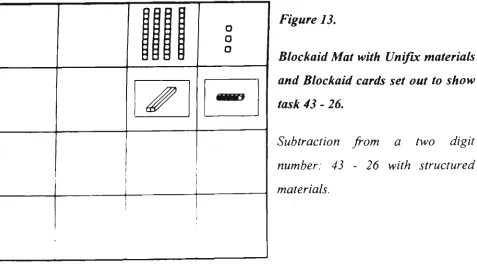
Figure 13. Blockaid mat with subtraction task set out for 43 - 26. 150
List of Tables.
Table 1. R a n k order of pupils on combined score of skills tested.
Table 2. Group activities for Control Group.
Table 3. Group activities program for first four weeks.
Table 4. N u m b e r of pupils completing the questionnaire on attitudes.
52
75
77
83
Table 5a. Pre-study responses to Question, W h a t do you like most about school? 85
Table 5b. Post-study responses to Question, What do you like most about school? 86
Table 5c. Comparison of Children's liking for 'play and 'formal' subjects. 87
Table 6a. Pre-study responses to Q. 2. What do you think is your best subject? 89
Table 6b. Post-study responses to Q. 2, What do you think is your best subject? 90
Table 6c. Frequency for choice of mathematics as best subject of respondents. 91
Table 7a. Pre-study responses - What subject do you think your teacher likes best? 93
Table 7b. Post-study responses - What subject do you think your teacher likes best? 93
Table 7c. Comparisons of Control Group responses to 'science as best'.
Table 7d. Frequency of choice for 'mathematics' as best subject.
94
95
Table 8a. Pre-study responses - H o w do you feel about your work in Mathematics? 97
Table 8b. Post-study responses - How do you feel about your work in Mathematics? 98
Table 8c. Control Group - How do you feel about your work in Mathematics? 98
Table 8d. Experimental Group - How do you feel about your work in Mathematics? 99
Table 9b. Post-study responses for the ranking of operations in order of difficulty. 102
Table 9c. Control Group responses ranking order of difficulty of operations.
105
Table 9d. Experimental Group responses ranking order of difficulty of operations. 106
Table 10a.
Table 10b. Table 10c. Table lOd. Table lOe. Table 11.
Table 12.
Table 13.
Table 14a.
Table 14b.
Table 15.
Table 16a.
Table 16b.
Table 17a.
Table 17b.
Table 18a.
Table 18b.
Pre-study responses to question regarding gender differences.
Post-study responses to question regarding gender differences.
Control Group responses to question regarding gender differences.
108
109
109
Experimental Group responses to question regarding gender differences. 110
Responses from the boys to question regarding gender differences. 111
Hypothesised effect on performance of balance of attitude.
Matrix elements of data for analysis.
Pre-test scores - Control and Experimental Groups.
Pre-test m e a n scores for four operations.
t test values for pre and post-test scores for Control Group.
Post-test scores - Control and Experimental Groups.
Post-test m e a n scores for four operations.
t test values comparing Post-test data for two independent groups.
Control Group m e a n scores for four operations.
t-test values comparing pre and post-test scores for Control Group.
Experimental Group m e a n scores for four operations.
t-test values comparing pre and post-test scores for Control Group.
114
116
117
118
119
120
121
123
125
126
127
Table 20. Comparison of pre and post-test performance based on t-test analysis. 129
Table 21. Comparisons for Division - Control, Experimental and Grade 5 Class. 130
Table 22. Comparison of Grades 4 pre-test and Grade 3 Post-test mean scores. 130
Table 23. Pre-study interviews for Control Group. 131
Table 24. Subjects interviewed. 133
List of Appendices
Appendix 1. Diagnostic Mathematics Profiles - ACER.
Appendix 2. Interview schedule check lists.
Appendix 3. Blockaid workcards- 4,5,6 and 7.
C H A P T E R O N E
INTRODUCTION
This study was driven by a passion to seek better ways to facilitate the effective teaching and learning of mathematical concepts in primary schools. T h e thesis is on mathematics education, in the field of children's cognition. It aimed to establish through an experimental study, whether knowledge of facts and skills, and of even more importance, understanding in learning, can be improved significantly w h e n pupils in middle primary school are exposed to a range of experiences using structured learning apparatus specifically designed by the researcher for modelling n u m b e r concepts.
This apparatus, called Blockaid, utilises modelling procedures based on historic representational forms and contemporary models of n u m b e r such as Dienes base 10 blocks. It w a s trialled and refined in the classroom over a period of about thirty years by the researcher. Blockaid is a complete teaching package consisting of multi-representational material for concept of n u m b e r development together with teachers' manuals, pupil w o r k cards and blackline masters (Carney 8c Barrow, 1993).
The approach planned utilised Blockaid and took full cognisance of the work by Montessori, Dienes, and Piaget. T h e research of Fuson, Hiebert and Carpenter relating to the effective use of structured materials for modelling base ten structures w a s of particular relevance to the study.
The need for this investigation was evidenced by the following:
1. Concern expressed in the media about lack of perceived number skills in primary school pupils. In the editorial in T h e A g e newspaper on April 8th., 1994:
"... the evidence, sketchy though it is, is that many students are slipping through the system without a functional grasp of the three basic skills: reading, writing and arithmetic."
parents and teachers o n this subject. T h e anxiety is often associated with fear about employment opportunities.
3. Demands for educational accountability and the recent trends in Australia to 'launch' head-long into state-wide testing programs in basic skill areas.
"... beginning next year. South Australian students will be assessed for basic literacy and numeracy skills" (Painter, 1994, p. 3).
In line with the Curriculum Frameworks to be introduced in Victoria in 1995, ... Last month the government announced details of its Learning Assessment Project in which young children will be assessed twice during their seven years of primary schooling" (MacLean, 1994, p. 10).
4. Debate in Australia, regarding national curricula for schools and, in particular, the need to design these in accord with sound educational principles based on proven research (Gaudry, 1994).
5. My own investigations regarding understanding of basic number concepts by children in Victorian schools, both private and state. These investigations over nearly thirty years, as a teacher and in the role of mathematics consultant, have revealed significant weaknesses in key areas of number concept development.
Aims of the Project
In mathematics education, there is a major gulf between the implications drawn from educational and psychological research, and actual classroom practice found in most schools (Copeland, 1979). This study aimed to utilise and build on previous research to design instruction to narrow this gap. Such research gives insight into the manner in which mathematical knowledge is constructed and strategies for facilitating the acquisition of conceptual knowledge that Hiebert and Carpenter (1992) associate with understanding.
The thesis aimed to establish whether learning of number concepts, and of operations on number, can be improved significantly w h e n pupils in middle primary school are
T h e basic need for concrete representations of number has a long history and is evident in the use of tallying devices from earliest times; in the evolving of a base ten number system that is structured o n the number of fingers on the h u m a n species; in the abacus as the earliest computing machine; in the educational approaches advocated by Pestalozzi in the late eighteenth century, Froebel in the early nineteenth century, and more recently in the base ten structures devised by Montessori, Dienes and Carney (Carney & Barrow, 1993).
The specific objective focused on the problem whereby basic number concepts are fundamental prerequisites to higher order mathematical skills such as operations on n u m b e r and fractional concepts. In this regard Dienes (1971a) w a s adamant that the concept of n u m b e r is perhaps one of the most difficult and elusive concepts that w e require young children to learn. Dienes (1971a), in elaborating the concept, identified three elements - the cardinal ordinal link, the idea of grouping and thirdly the concept of place value.
The above elements, constituting the concept of number, would seem to imply structure and it is this structure that w a s modelled in this study in an attempt to lead the pupils to internalise mathematical concepts through a guided discovery approach using concrete equipment. T h e study used models of the number system to demonstrate to children a system that orders relationships. While Dienes pointed out the complexities of this concept, he then established a hierarchy whereby the arithmetic operations on those n u m b e r concepts are at higher levels of conceptualisation again. Attempts were m a d e in the modelling to bring out this hierarchy and the interrelatedness of the operations of addition, subtraction, multiplication and division.
In attempting to facilitate the acquisition of these concepts by children, the learning process and resultant outcomes are categorised as either skills or understanding, or
perhaps more appropriately, as procedural knowledge and conceptual knowledge. Hiebert and Carpenter's (1992) notion of procedural and conceptual knowledge and h o w they relate to understanding will be dealt with in Chapter 2.
'multiple embodiment approach' and their representations (Dienes & Golding, 1971). T h e hypothesis of this thesis is that if the prerequisite models for concept building are varied and interconnected then the abstractions from the concrete models, and their alternative representations, are m o r e likely to be clearly constructed by the child with connected networks that facilitate understanding.
The nature of the discourse that maximises the communication of mathematical knowledge between teacher and child is central to this study. T h e factors of teacher, child and mathematical knowledge itself however need to be examined in the light of current research and in the light of the m o v e m e n t towards national curriculum and national standards in education.
The study attempted to assess the effectiveness of the Blockaid apparatus and the methodology advocated in the teacher's manual in using miltivariant base ten structures and in utilising such structures in modelling the formal algorithms of addition, subtraction, multiplication and division. Assessment of effectiveness w a s for both achievement and understanding. T h e study achieved this aim. T h e strengths and weaknesses of the approach advocated will be discussed in Chapter 8.
CHAPTER T W O
LITERATURE REVIEW
Introduction.
This review attempts to glean from the literature clues that should give direction to this quest for creating the best possible conditions for mathematics learning for all students. The focus is on the use of structured aids for representation of number concepts, and the action on such representations corresponding to the basic operations in arithmetic.
The National Statement on Mathematics for Australian Schools suggested that:
There is no definitive approach or style for the teaching of mathematics. The teaching of any particular mathematical concept will be influenced by the nature of the concept itself and by the abilities, attitudes and experiences of students. In general however, teaching should be informed by a thorough understanding of h o w learning occurs and of the nature of the mathematical activity (Australian Education Council, 1991, p. 18).
In his research investigating the effects of manipulative materials in mathematics instruction, Sowell (1989) obtained results that showed:
...mathematics achievement is increased through the long term use of concrete instructional materials and that students' attitudes towards mathematics are improved w h e n they have instruction with concrete materials provided by teachers knowledgeable about their use (p. 498)
These statements underpin the importance of an understanding of the nature of teaching and learning.
Analysis of the literature will be addressed under four headings:
• Historical perspective for the use of structured aids for number ideas;
• Fundamentals of education;
• Concept of number and algorithms; and
Emphasis in the first of the above sections will be on the work of Montessori, Hill and Dienes; the second section will focus largely on Piaget and Vygotsky; the third section will describe the work of Hiebert, Carpenter and Fuson; and the last section will touch on current curriculum statements.
1. Historical perspective for the use of structured aids for number ideas.
The manner by which early man constructed number systems may give insight into devising structured aids that allow young children to construct number concepts in permanent and meaningful ways. It was recognised by Sowell (1989) that the teaching of mathematics using manipulative materials has a long history. In the nineteenth century, Pestalozzi (Cubberley, 1948) advocated their use. Emphasis on using concrete materials w a s evident in primary schools in Victoria the 1960's.
As discussed below some of the main proponents advocating the use of such material for furthering mathematics learning in schools were Montessori, Hill and Dienes.
(a) Manipulative and structured aids.
Tallying devices. A range of methods for tallying, or recording numbers, have been
found in different ancient civilizations: knots in string, collections of pebbles, notches in bone or w o o d (Groza, 1968). According to Barrow (1992) one of the oldest examples o f a tallying device, dating back to Paleolithic times, was a tally stick found in Moravia. It w a s a piece of bone engraved with 57 deep notches, arranged in groups of five.
This extraordinary relic dating from about 30,000 B C , displays systematic tallying and perhaps s o m e appreciation of grouping in fives, inspired no doubt by the fingers on the hunters hand. Presumably the tally w a s a record of the hunter's kills (p. 31).
Abacus. T h e oldest computing machine k n o w n is the abacus. Around 450 B C , the
Photo 1. Variations of Chinese and Japanese abaci showing 26,482.
It is thought that the abacus w a s invented by the Greek mathematician, Pythagoras. While the Greek device required up to nine counters in each column the simplified R o m a n version utilised a sub-grouping of five, represented by a single button, which worked in an upper short groove at the top of each column on the counting board (Stephens, 1972). This sub-grouping structure, using a single button to represent a handful (five), is in direct relationship to the R o m a n system of notation that incorporates sub groupings of 5, 50, 500, ...symbolised by the letters V , L, and D, and so on. Although by convention the R o m a n symbols were written in order from those representing the largest groupings of the number to be represented first to the unit representation last, the early system of recording w a s categorised as a simple grouping numeral system (Groza, 1968).
The abacus is still used today in different forms: the Russians' choty, the Chinese suan pan (See Photo 1) and the Japanese soroban (Groza 1968). The Japanese abacus is a
bead frame generally with twelve rods and a crosspiece. Each rod has five beads arranged with one above the crosspiece and four below. Beads above are worth five times the beads below, while from right to left the beads increase in powers often. For a number to be displayed the appropriate beads are m o v e d to the crosspiece. This semi-abstract representational system links with the structure of the Chinese counting sticks and written numerals described below.
The Chinese abacus has an extra bead above and below the crosspiece in each column which acts as a m e m o r y bank, thus eliminating s o m e of the recall which is necessary in the Japanese version w h e n performing any of the arithmetic operations (Stephens,
1972).
M o s t of the abaci currently used in Victorian schools are either looped abacus or spike abacus varieties. T h e loop abacus allows the beads required to represent a number such as 275 to be looped over a board that hides the remaining counters from view.
Chinese stick numerals. According to Grozia (1968),
... the Chinese mathematician, Sun-Tsu Suan-Ching in his treatise of 100 AD., wrote 'In making calculations w e must first k n o w positions of numbers. Unity is vertical and ten is horizontal, the hundreds stand while the thousand lies; and the thousand and the ten look equally, and so also the ten thousand and the hundred' (p. 50).
The system of stick placement and the accompanying symbolisation uses a sub-grouping of five in a similar w a y to such sub-sub-grouping in the Chinese abacus called the suan pan. T h e digits one to nine are displayed with sticks or written as follows:
I II IN MM Mill I II III iTTl
123 4 5678 9
T h e written symbols that copy these stick positions, k n o w n as the Scientific Chinese Numerals, are a true place value or positional form of representation of number. The symbol " O " w a s used for zero.
Number rods. There have been various attempts to design sets of material to help
children represent the numbers one to ten by means of number rods. These materials attempt to represent the magnitude of the numbers 1 to 10 by rods of different length. Although of varying designs, these consist of a set of rods that form a series that can represent multiples of the smallest rod. Montessori was perhaps the first to design such apparatus with her material being based on a unit piece of two centimetre square cross-section and one decimetre in length. The ten rod w a s thus represented by a stick one metre in length. Her material w a s generally called the long stair (Montessori, 1917).
Photo 3. Cuisenaire rods structured to display multiplication table to 5 x 5.
Cuisenaire's material "Numbers in Colour' consisted of coloured rods, charts and cards (Gattegno, 1960). It became widely used throughout Australia and m a n y other countries and w a s generally k n o w n as Cuisenaire rods and associated material (Sealey, 1961a). The materials are still found in schools but they are generally no longer used by teachers for teaching number concepts. S u d a m and Weaver (1975) however, in reporting research focusing on the effectiveness of using Cuisenaire materials, claim that Crouder and Brownell found aspects of improved learning by those pupils participating in the Cuisenaire program w h e n compared to those taught by conventional means.
Gattegno argued that some teaching practice can do more to hinder learning than encourage and assist it. His published works include a series of texts on the coloured rods devised by Cuisenaire (Gattegno, 1960).
Bead apparatus. The literature suggests that Montessori's first design of equipment to
model the base ten number system consisted of chains of beads. (See Photo 4). All of the beads are the same colour, a beautiful translucent amber, leading to the n a m e 'golden materials'. Each link of the chains of beads was a wire on which were strung ten beads. Thus the components for the structuring of multi digit numbers up to 1999, consisted of one chain of beads containing 1000 beads strung in series of 100; nine 100
beads strung in tens; nine 10 bead links and nine single beads (Montessori, 1917).
These chains of beads were linked in such a manner to allow zig zag folding of the hundreds chain to form a square. T h e thousand chain could be folded in a similar manner to m a k e a rectangle, ten chains wide with 100 beads in each. This rectangle could then be folded in ten vertical layers to construct the cube. Thus the links can be established between exponents and powers, the square often being 100, and the cube of ten being 1000.
Permanently "folded structures" are available as an alternative to the chain structures and are simpler to use by children. The "folded structures" material (researcher's term)
i O 0 L + J 2 0
HWLWWLm
Photo 5. Montessori place/face value cards in box and example, 127.
to Hainstock (1971), an integral part of Montessori mathematics. T h e Montessori bead materials were also strung in multibase groupings.
Number symbol cards. These cards are used in Montessori schools in conjunction with
the golden material (Hainstock, 1971). They facilitate the labelling of representations of numbers that the children construct using the golden material.
The cards have the numerals printed in three different colours; green, blue and red and increase in size according to the power of ten (See photo 5). The unit cards coloured
green are numbered 1 to 9. The tens cards in blue are twice as long and are numbered 10 to 90. T h e hundreds cards coloured red are three times as long as the units cards and are numbered 100 to 900. T h e thousand cards numbered 1000 to 9000 are four times as long and are coloured the same as the units. These cards allow the children to construct multi-digit numbers such as 127, by using the following cards - 100, 2 0 and 7 and then placing them o n top of one another starting with the 100, to m a k e the numeral that is written as 127 in the conventional place value notation. It is of interest to note that that this dual strategy of symbolisation for number has historic roots. According to Stuart (1970), "...two forms in which a number such as 782 m a y have been written, even to the beginning of the fifteenth century, were .7.8.2. and .700.80.2. The latter form is often sighted in children's early attempts to record numbers" (p.78).
Interlocking cubes. Labinowicz (1980), in applying Piagetian principles to the
structuring of a hierarchy of levels of representation, advocated the use of a wide range of concrete materials leading to the abstract symbolic level required at the formal level of written symbols in the Hindu-Arabic notation. Interlocking plastic cubes such as Unifix can assist in bridging the gap between discrete collections such as bean seeds grouped in cake-cups and continuous structures such as Dienes' base ten blocks or
Blockaid, as described below. The blocks can be grouped in tens that have a unit
structure relating to the collection but within that structure there remain ten separate cubes that are in one to one correspondence with any collection often objects.
Although base 10 block materials were popularised in the early 1960's, by Dienes in his Adelaide Mathematics Project at Cowandilla, their immediate predecessors were almost certainly found prior to that time in schools using the Montessori approach. The structures are equivalent to the bead structures designed by Montessori and her later block material. F r o m the researcher's reading of the literature however, it is not evident w h e n her base ten block models were first devised. There is no mention of them in Montessori's writing up to 1917.
The closeness of this date to 1920, allows one to speculate whether the first such models of the base ten structure were devised in Australia by W . R . Hill prior to the marketing
of his Hill's Constructive Counters and the handbook "Mathematics Simplified". Although no date appears on his book published by George Philip and Son of 451 Pitt Street Sydney, Hill's Constructive Counters have printed on the w o o d e n box a patent n u m b e r and date, the latter being 1920.
Such speculation about Hill's material being the first of its type is of special interest to the researcher as a set of Hill's Constructive Counters w a s given to him by the Infant
Mistress at Albert Park Primary School in 1958, immediately prior to his appointment to his first rural school.
Since that time this set of apparatus has been used to demonstrate the structure of the n u m b e r system to hundreds of children and teachers. In 1995 w h e n talking about this
material to a group of mathematics educators, one amongst the group, D r Marj H o m e , declared that she had the book that w a s a teacher guide to the Hill's Constructive Counters. T h e question " W o u l d you like to see it"? w a s quickly answered in the affirmative. O n e of the reasons for indulging in discussion on this particular material is that there are features of this equipment and methodologies proposed by its author that have relevance to this study and indeed to all levels of primary and secondary education. Such relevance is indicated in the full title of the book; "Mathematics simplified: Arithmetic, Algebra, Geometry, Trigonometry and Calculus for Kindergarten, Infant, Primary and High Schools".
Arithmetic Blocks ( M A B ) . Supplementary to this material were the Multibase Extension Materials and Variations Material on Multibase which were used to represent number in the various bases. Dienes also developed an extensive array of other manipulatives across the whole mathematical field; Logic tracks and attribute blocks for logical reasoning, and algebraic experience material for algebraic notions, a m o n g these. O f the wide range of materials designed to develop number ideas, the only one remaining popular today in schools is the base ten set from the M A B range of
apparatus. This base ten set has generally become k n o w n in Victorian schools as M A B . Blockaid. (See Photo 9 and 10). Carney (1995a) claims that Blockaid is a
multi-purpose aid designed to give insight into the base ten number system and the four operations on number. It also has applications in practical measurement of length, area and volume and in developing fractional concepts. The apparatus contains three forms of representation of number; value related foam pieces that model the base ten system by volume, pictorial representations of the foam pieces and face value numeral cards in three sizes to represent the groupings of hundreds, tens and units. The foam pieces and the pictorial cards use a sub-grouping of fives and fifties which w a s used to advantage in s o m e early number systems. T h e use of these intermediate representations allows the material to be used without the necessity of counting, simplifies mental calculations and speeds up the use of the materials in the same w a y as intermediate coins and notes do such as the 50 cents and the $5 and $50 in our decimal currency system. (See section on equipment - Chapter 3).
Based on Dienes' claim that man performs no better than the chimpanzee in
"recognising" or subitizing the numerosity of small collections of objects, Carney and Barrow (1993) state " ... that the majority off us simply cannot recognise groups larger than five. Beyond five w e either combine subgroups such as 5 and 3 to m a k e 8, or w e count" (p. 6).
Subitizing (the instant recognition of the number associated with a configuration) is the first skill to be acquired and is part of the basis on which the child's understanding of n u m b e r develops ( Bergeron & Herscovics, 1990, p. 33).
M o n e y . W h e n introducing arithmetic, Montessori (1964) stresses the importance of
N o form of instruction is more practical than that tending to m a k e familiar with the coins in c o m m o n use, and n o exercise is more useful than that of making change. It is closely related to daily life that it interests all children intensely (Montessori, 1964, p. 326).
While Hiebert and Carpenter (1992) state that the values of particular pieces of m o n e y are assigned arbitrarily, and that children bring with them knowledge of the value of each piece, the researcher does not agree with their claim that children's familiarity with m o n e y suggests that it m a y be an especially useful representation of place value.
The coins have a face value arbitrarily established by convention but do not embody a concept of place value. This face value of course can be linked to and can reinforce the m o r e abstract concept of place value. T h e same is also true for block representations of n u m b e r as detailed under the above heading - 'Base 10 Blocks' which is value related material by volume.
Informal materials. (See Photo 11). Baratta-Lorton devised a wide range of activities
using simple materials to focus attention on a single concept in order to draw out the generalisation of that concept. She advocated that the children be given the opportunity to express something about their experiences with the manipulative materials (Baratta-Lorton, 1972. 1976). Carney and Barrow (in press) advocate the use of the number "junk b o x " using everyday materials such as sticks, stones, pegs and buttons from the child's world. T h e use of children's toys such as farm yard sets and toy trains was advocated by Carney and Carney (1993, 1994) as a means of structuring meaningful learning situations to promote learning of number concepts with understanding.
(b) Advocates for structured aids in promoting mathematics learning.
Montessori was the originator of a system of teaching young children by the use of
— • — u m u i w n i
Photo 11. Junk-box for number ideas.
X
Z4
^9m
• H M H n M H H H H H H B H H U H B B •••••••••••••••••••
According to Montessori (1964), her method offers a system of instruction in arithmetic which fits the child. A summary of its main principles are:
• no formal teaching until the child's mind is seen to be ready for it;
• the very clear presentation of the decimal principle of our number system;
• the free use of concrete material until the child elects to abandon it;
• individual progress limited only by individual capacity;
• learning by experiment and thought rather than from teacher instruction.
Osborne and Nibbelink (1975) list the materials common in most Montessori programs as follows:
Stairs (or number rods), sand-paper numerals, spindle box, counters, coloured bead
material, bead frames, addition board for rods, golden bead material (base ten), number cards (place or face value), block material (made of w o o d in base ten), multibase bead materials, multiplication board, abacus equivalent, division board (p. 276).
Hill designed material that would seem to have significant advantages compared with
present day designs of Base 10 apparatus. Its application extends beyond elementary arithmetic into algebra, geometry, trigonometry and calculus.
The constructive counter system is so arranged as to suggest the underlying principles of the n u m b e r system, and thus assist children to overcome m a n y of the main difficulties met with in arithmetic, ft helps the child until he can help himself (Hill, 1920, p. 8).
When elaborating the concept of construction, Hill (1920) quoted James:
Constructiveness is as genuine and irresistible an instinct in man as in the bee or beaver. Whatever things are plastic to his hands those things he must remodel into shapes of his o w n , and the result of the remodelling, however useless it m a y be, gives him m o r e pleasure than the original thing. T h e mania of young children for breaking and pulling apart whatever is given them is m o r e often the expression ofa rudimentary constructive impulse than a destructive one (p. 9).
emphasis from teaching to learning mathematics, from our experiences to the children's, in fact from our world to their world" (p.11).
In his works he examined the continuum of mathematics learning and in doing so took account of the following:
• The learner. Dienes' principles of pedagogy as well as his six stages of
learning were noteworthy. Integral to these stages of learning were the use of concrete representations that facilitate concept generalisation. H e took full cognisance of the work of Piaget and Bruner in his writings. In the examination of the psychological aspect of mathematics learning, Dienes (1971a) argued that educators were just beginning to understand the process of abstract thinking.
• Curriculum content. Dienes emphasised the two distinct aspects of
mathematical learning, namely the acquisition of techniques on the one hand and the understanding of ideas on the other:
There is, of course, a difference between understanding the workings of a technique and understanding its subject matter. A child m a y well be quite conversant with all the technicalities of linear equations without having m u c h idea of what sort of thing a linear equation is (Dienes, 1971a, pp. 3-4).
• Methodology or educational aspect - Dienes proposed the creation of self-motivating learning situations with children working either individually or in small groups (Dienes, 1971a). Dienes has been called the twentieth century's mathematics teaching genius (Message, 1971, p. 2).
Theory of Mathematics learning framed by Dienes. Dienes (1971a) acknowledged and
drew on the work of other educators such as Piaget, Bruner and Jeeves and worked in collaboration with Golding and Williams, in framing what he terms "a feasible skeleton theory of mathematics learning" (pp. 21-22) which he expounded in a number of principles.
encounters can not always be duplicated in the classroom, thus the need to structure situations and equipment (Dienes, 1965).
• The Dynamic Principle. - "Preliminary, structured and practice and/or reflective type of g a m e s must be provided as necessary experiences from which mathematical
concepts can be built" (Dienes, 1971a, p. 30).
• The Multiple Embodiment Principle. - Here Dienes suggested that the child be "provided with experiences whose structure is as near as possible to that of the concept he is intending to learn" (Dienes, 1965, p. 3). In a later account - "Multiple embodiment m e a n s that every concept should be presented in as m a n y different ways as possible" (Dienes and Golding, 1971, p. 55).
• The Mathematical Variability Principle. - "Concepts involving variables should be learnt by experiences involving the largest possible number of variables" (Dienes, 1971a, p. 31). For example, in the Multi-base Arithmetic Blocks the multiplicity of the different bases brings out the general structure of the concept of place value.
• The Deep End Theory. - This is based on the analogy of teaching a child to swim, where one method is to push the learner into the deep end of the pool. "This kind of presentation is at variance with traditionally accepted approaches, which required n e w structures to be presented simply and built through easy steps to the more complex forms" (Dienes and Golding, 1971, p. 57).
• The Constructivity Principle. - Children tend to think constructively, which means that they tend to build up their structures from separate components (Dienes and Golding, 1971, p. 58).
It was reported by Biggs in Collis and Biggs (1991)
Carney- T h e approach to number advocated by Carney and Barrow (1993; in press) and
Carney and Carney (1993, 1994) is very m u c h rooted in Piaget, Bruner, Dienes and certainly Hill, but it also considers the acquisition of number concepts in the light of an historical perspective in man's coming to k n o w such concepts. It also considers the advantages that m a y derive from other forms of representation evident in Asian cultures, particularly their oral counting word sequence and abbaci.
Carney and Barrow believe that:
...it is paramount for children to record in their o w n w a y the activities that they perform using the equipment and ideas set out in this series, and that they are allowed to suggest variations of the techniques involved (Carney & Barrow, in press, p. 8).
The approach is still in the process of development shaped very m u c h by the combination of children's individual constructions in operating with materials and will continue to be shaped as a result of this study.
2. Fundamentals of education.
Investigating whether mathematics learning at the middle primary school level can be improved by using structured materials, requires consideration of all the elements that effect teaching and learning.
The teacher on one side, pupil on the other side, knowledge between, discourse joining them. (The Upanishads, Vedic writings, 3000 B C ) .
Laborde and her colleagues (1990), in their concern for the relationship between language problems and the learning of mathematics, proposed a theoretical framework that takes into account the fundamental elements of the learning situation in the school: the content to be taught, the student viewed from a cognitive and social point of view, and the teacher.
T h e nature of the discourse that maximises the shared communication of mathematical
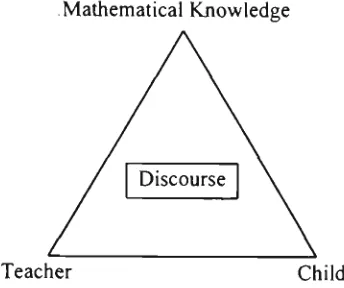
knowledge between teacher and child is central to this study. The hypothesis is that this dialogue is richer when structured learning apparatus is used to model the concepts and procedures to be learned. In drawing on Dienes' view the researcher shows the links between the fundamental elements in learning in Figure 1.
Mathematical Knowledge
Discourse
Teacher Child
Figure 1. Fundamental elements of the learning situation.
The question is whether the above model has relevance to the nature of discourse in the light of modern educational theory that considers the constructivist viewpoint:
Our epistemological conceptions of mathematical knowledge are closely linked to our
teaching practices. In relation to this there exists two possible conceptions: w e can think of mathematical knowledge as either a product or a process. In the first case, w e attribute importance to the mathematical discourse. In the second, w e give priority to the mathematical activity. T h e constructivist interpretation of mathematical teaching corresponds to the second conception (Barbin, 1993, p. 49).
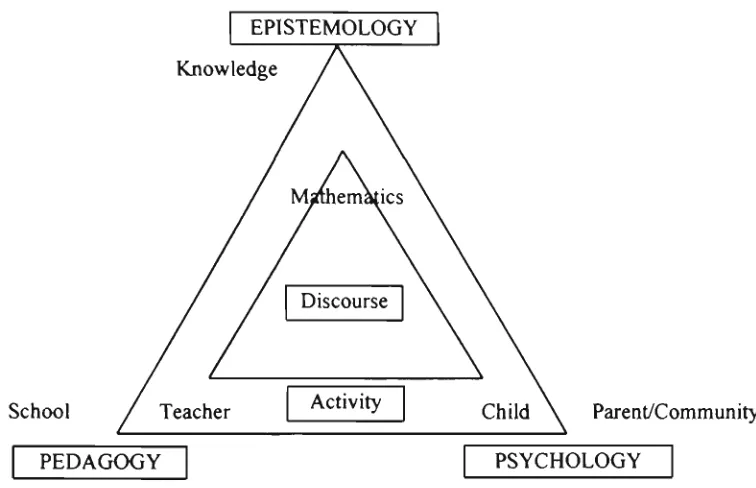
In the light of current worldwide trends towards national curricula it is necessary to extend the above diagram to include the constraining factors influencing educational practice. Constraining factors such as parent, community and school administration influences, will not be elaborated on in this review.
E P I S T E M O L O G Y
Knowledge
Parent/Community
Figure 2 Factors modifying teacher practice -from Clemson and Clemson (1994). (a) Psychology.
From the psychological perspective Vergnaud (1990) regarded the starting point to be Piaget, as he is probably the most important contributor to the epistemology of mathematics from the point of view of psychology. In giving an overview of educational psychology in Australia, Langford (1989) outlined five major theories in educational psychology, namely - behaviourism, humanistic psychology, Freudian depth psychology, information processing theory and cognitive structuralism.
While the influence of behavioural theory is still very evident in influencing classroom practice, the theory that would seem to have greatest relevance to mathematics
education in primary school is the work of Piaget and his theory on cognitive structure. While all of the above psychological theories deal with cognition (Langford, 1989), Piaget's structuralism is the element that contrasts his theory with that of all the others. It is also the element that gives rise to his views on constructivism (Miller, 1983). These views are more fully addressed under the heading epistemology.
relationships - between parts and the whole and between prior and subsequent states" (Miller, 1983, p. 38). Piaget belonged to this school of thought, and proposed that a small set of types of reasoning underlies a wide variety of thinking episodes (Miller,
1983). A m o n g s t the cognitive structures that Piaget identified are class inclusion, seriation (ordering), transitivity and topology (Copeland, 1974; Labinowicz, 1980).
In Piaget's view, m o m e n t to m o m e n t specific encounters with objects or people lead to general w a y s of understanding the world. This understanding changes during development as thinking progresses through various stages from birth to maturity (Miller, 1983, p. 30).
Piaget is probably best k n o w n in educational circles for his work in identifying four basic stages of intellectual development through which he suggested that children pass. Copeland (1979) identified these states by n a m e and approximate ages as:
Sensory-motor 0 to 2 years
Pre-operational 2 to 7 years
Concrete operational 7 to 11 or 12 years Formal operational 11 or 12 years on.
These stages should be regarded as flexible as children at any particular chronological age often demonstrate thinking characteristics of more than one stage (Labinowicz, 1985).
Development.
The mechanisms for development are functional invariance of cognitive organisation, cognitive adaptation, and equilibration. Cognitive organisation refers to the tendency for thought to consist of systems or 'schema'. Cognitive adaptation refers to the interaction between the organism and the environment. (Labinowicz , 1985).
Equilibration is the mechanism whereby every organism strives towards equilibrium with the environment and equilibrium within itself. This mechanism is facilitated by the dual processes of assimilation and accommodation. Assimilation occurs w h e n learners interpret inputs from the environment through previously built networks of ideas. The learner's organisation of ideas resists change causing discomfort and disequilibrium. The discomfort, confusion, or frustration of the disequilibrium state serves to motivate a search for better organisation of ideas to resolve the discrepancy resulting in accommodation (Palmer, 1970; Labinowicz, 1985).
For Piaget, equilibration is the process that combines the elements of maturation, experience with the physical environment, and experience with the social environment.
The cognitive adaptations resulting from such processes is what constitutes learning. Dienes (1971b) viewed learning as adaptation to the environment. His views were very m u c h in accord with Piaget's ideas on both cognition and the nature of knowledge.
Behavioural theory.
What is the relevance of behavioural psychology in today's mathematics education programs in primary school? According to Labinowicz (1980), Piaget believed that, "...the great danger today is the use of slogans, collective opinions, ready m a d e trends of thought" (p.266). In recent times the trends in education of d a m m i n g past practice and advocating total change have not met with a great deal of success in facilitating change in schools.
Despite challenges to change practice in school mathematics, educators and politicians in most countries, for most of the twentieth century have continued to accept the premise that school mathematics should be based on externally prescribed curricula, formal textbooks and written examinations (Clements, 1995, p. 2).
Contrasting Piaget's theory is that of the traditional behaviourists.
At the primary school level, the behaviourist theories of Thorndike and Skinner have
given direction to content based curriculum that is identified as traditionalist.
Traditional mathematics instruction is based on the transmission, or adsorption, view of teaching and learning. In this view students passively 'adsorb' mathematical structures invented by others. Teaching consists of transmitting sets of established facts, skills, and concepts to students (Clements & Batista, 1990, p. 34).
Traditional behaviourists, in their laboratory study of animals, found that a stimulus
from the external environment produced a predictable immediate response in the
animal. The advocates of this theory were Pavlov, Skinner and Thorndike (Lindgren,
1956). Behaviourists applied these findings to human subjects. According to
Labinowicz, (1980) however:
Piaget observed that man's responses to stimuli are much less predictable than those of lower animals. ... m a n has both the ability to choose his responses and to initiate changes in the environment. Piaget therefore focused on the intermediary processes between the stimulus and the response, which could explain man's behaviour (p. 147).
Traditional behaviourist's
S«--Stimulus
(observable)
»R
Response
(observable)
focus Piaget's focus
S « — Intermediary processes —»• R
Stimulus Response
(observable) (Unobservable) (observable)
Figure 3. Contrasting Behaviourist theory and Piaget's theory of learning.
L a b i n o w i c z ( 1 9 8 0 ) , in contrasting these t w o theories suggests that n o theory can be
applied universally:
Piaget (1970) recognised the potential of behavioural theory, and its application in programmed instruction in transmitting certain kinds of information, but saw it as irrelevant in areas such as the understanding of relationships in mathematics and science. "It is possible to envisage a balance being struck, varying from subject to subject, between different parts to be played by memorizing and free activity" (Piaget,
1971. p. 78).
(b) Epistemology.
According to Piaget, there are three kinds of knowledge: physical knowledge, logical-mathematical knowledge and social knowledge. Each requires the child's actions (Wadsworth, 1989; Labinowicz, 1985).
Bloom's (1956) threefold division of educational objectives: cognitive, affective and psychomotor are compared to the Greek philosophers use of a tripartite organisation of h u m a n behaviour: cognition, conation, and feeling; thinking, willing and acting. B l o o m (1956) in his T a x o n o m y of objectives in the cognitive domain lists the following: basic terms and facts, techniques and manipulative skills, understanding, application, analysis, synthesis, creativity, reasoning and evaluation.
Anderson's network model of memory discussed in Fox (1993) proposes a schema whereby knowledge is represented as a w e b or network. The network consists of nodes which are related by a series of links. A basic cognitive unit consists of a unit node. Cognitive units combine together in larger units k n o w n as 'tangled hierarchies'.
Hiebert and Carpenter (1992) define procedural knowledge, "...as a sequence of actions. The minimal connections needed to create internal representations of a procedure are
connections between successive actions in the procedure. Examples of procedures are standard written algorithms in arithmetic". They define conceptual knowledge "...in a w a y that identifies it with knowledge that is understood. It is rich in relationships. ...Conceptual knowledge is equated with connected networks that can be pictured in the form of hierarchies or w e b s " (p. 79).
understanding. T h e y contend that teaching for understanding is stressed in current
reform in mathematics teacher education. Hiebert (1986) suggested that it is an
extremely c o m p l e x process to teaching mathematics for understanding.
Romiszowski in Fox (1993) classified knowledge in four dimensions:
• Declarative - knowing about facts, events and people;
• Procedural - knowing what to do in a given situation;
• Concepts - knowing how to recognise and distinguish between groups of phenomena, or being able to define things;
• Principles - knowing how to link together concepts or facts in specific ways, thus enabling an explanation or prediction of events, (p. 193)
Piaget w a s concerned with the classical issues in epistemology with w h a t philosophers
have considered the basic categories of thought, n a m e l y time, space, causality and
quantity. Piaget (1972) claimed that k n o w l e d g e is a process rather than a state:
It is an event or a relationship between the knower and the known. ...In a sense a person 'constructs' knowledge. Cognitive man actively selects and interprets information in the environment. H e does not passively soak up information to build a storehouse of knowledge (Miller, 1983, p. 37).
It is the construction o f k n o w l e d g e with understanding that is central to this study. T h e
w o r k o f Hiebert and Carpenter (1992) suggests that the links that the child m a k e s
between the concrete m o d e l s that e m b o d y a concept, assist in the abstraction and
generalisation o f the concept.
Constructivism.
T h e early w o r k o n constructivism in mathematics teaching g r e w out of Piagetian
epistemology (Pateman, 1993). T o Piaget all k n o w l e d g e is a construction resulting from
the child's actions.
Biggs and Moore (1993) defined constructivism as:
Constructivism is knowledge building and thus it is also essentially epistemology. Interpretations of the views on constructivism vary greatly, with the extreme position held by the radical constructivists such as von Glasersfeld (1987). Acceptance of his view of knowledge "requires that w e shift the emphasis from the students 'correct' replication of what the teacher does, to the students successful organisation of his or her o w n experience" (von Glasersfeld, 1987, p.6). Jeong-Ho (1994) explained that radical constructivism is not generally supported by Piagetian followers in mathematics education, w h o trace their path to traditional constructivism.
The weaving together of actions, beliefs and thought in the constructivist paradigm allows one to understand mathematics in a very different w a y to the traditional approach (Malone, 1993).
Hill (1920) stated the case for an experiential, discovery approach:
The child already has the disposition to learn by doing. H e is by nature an observer and imitator. Nothing pleases him more than making things, and it is usually the constructions around him that he imitates. T o utilise the constructive instinct to an educational advantage is aimed at in the use of these counters. Each pupil in the early stages of construction and number work is busy doing something - experimenting, observing and discovering (Hill,
1920, p. 9-10).
Carney and Barrow (in press) view the role of the teacher as that of a guide w h o supports students' invention of viable ideas rather than allowing "free for all" discovery based on hope.
Role of affect.
Affective factors play a central role in mathematics learning and instruction (McLeod, 1991). According to Wadsworth (1989), Piaget's theory of intellectual development is seen as having two components, one cognitive and the other affective. "Until recently educators have focused largely on Piaget's work on cognitive development and overlooked the role of affective development in intellectual growth" (p. 29). Affect includes feelings, interests, desires, tendencies, values and emotions in general.
Piaget argued that all behaviour has both affective and cognitive aspects. There is no pure cognitive behaviour and no pure affective behaviour. T h e child w h o 'likes' mathematics typically m a k e s rapid progress, T h e child w h o 'dislikes' mathematics typically does not m a k e rapid progress (p. 31).
In considering the relationship between the affective and the cognitive domain Krathwohl, B l o o m and Masia (1956) cite Scheerer: " N o matter h o w w e slice behaviour, the ingredients of motivation-emotion and cognition are present in one order or another" (P-123).
Children assimilate experience to affective schemata in the same way as they assimilate experience to cognitive structures. Piaget contended that the basis of social interchange
is an interchange of attitudes and values between the child and others.
According to McLeod (1991) von Glasersfeld noted the powerful positive emotions that often go along with the construction of n e w ideas, and similarly he reports of C o b b having written of the importance of confidence and willingness to persist as students develop mathematical concepts. Hill (1920) asserted that the driving force throughout is the children's desire to learn. They like making discoveries. The teacher acts as the tactful guide, but the children lead the w a y and surmount each difficulty themselves.
Carney and Barrow (in press) in their approach to developing number ideas suggest that in adopting an activity approach using materials in small groups the teacher has the opportunity to learn along-side the child and to share in the sheer joy of discovery.
Role of language.
Language and thought are at the basis of mathematical thinking. Evidence suggests that mathematical thought and language are enhanced w h e n pupils interact with the physical world. T h e researcher believes that such interaction can be structured through the use of apparatus such as BlockaidTo promote dialogue that is rich in meaning.
theory, elaborated in Ernest (1991), hypothesised that for the individual, thought and language evolve together and that conceptual development depended on language experience.
Hiebert and Carpenter (1992) advanced the argument that concrete materials can provide a public representation to which attention can be drawn and be a focus for discussion:
Because the materials are public, they can be shared by all the students in the class. T o the extent that the s a m e mathematical features are perceived by the students, the language in the classroom can be about the s a m e things. Communication a m o n g the students and teachers is enhanced because all participants can focus their attention on the s a m e entities and relationships between entities (p. 720).
Fuson and Briars (1990) rightly distinguished between the named-value system of English spoken number words and the system of written multidigit number marks in which values are indicated only by the relative position of those marks. They claim that the connections between these two systems of coding are more difficult to establish with English speaking children than their Chinese, Japanese or Korean counterparts due to the irregularity of the n a m e d values in the former.
Carney (1995b) advocated the introduction of a supplementary counting sequence to assist young children in making the connections between spoken English number words and the linked conceptual structures of the grouping by tens and powers of ten, that the child needs to construct. This structure of the base ten number system frequently remains hidden for m a n y pupils. The grouping nature of our number system m a y be of more fundamental importance than the place value concept which is necessary only w h e n the child begins to record numbers in numeral form applying the Hindu/Arabic notation.
'five-tee'. Discussion centering on the "tee" or "ty" or "t" soon establishes that this is an abbreviation of "ten", and a regular n a m e d sequence of oral counting words is soon established. T h e "t-count" then becomes It, 2t, 3t, 4t, 5t and so on that gives structure and meaning to our number system. The emphasis should be on a meaningful oral count.
Thomas (1995) stated that the relationship between language and mathematics is now recognised in schools but it is also clear teachers have little idea what this means in practice and research to support better teaching is far from complete.
Mathematical knowledge
Mathematics is still generally thought of as a body of knowledge to be transmitted from one generation to the next, rather than as understandings which are constructed in the
minds of learners (Mousley, 1993).
The arithmetic of earlier course of study documents was defined as the study of space, number and time (Victorian Education Department, 1946). Biggs (1971) defined
mathematics as the study of truth and beauty and order. Mathematics is often defined as the science of space and number but according to the Australian Education Council (1991) a more apt definition in that same document is that mathematics is the science of patterns. T h e more open definition of mathematics as the structure of relationships (Dienes, 1971b) is one that connects the various strands of the study into a more coherent whole relevant at the primary school level.
A simplified version of Dienes mapping of the range of mathematical concepts is shown in Figure 4.
Overview of Mathematics
H o w m a n y ?
Discrete
H o w m u c h ?
Continuous
Compare
Sort
Describe
Order
Pattern
Seriate
Measure
I
fMEASUREMENTJ
OPERATE
T
OPERATIONS
Understanding.
B r o w n , Carpenter, K o u b a , Lindquist, Silver and Swafford (1989) clearly showed that, although most students are reasonably proficient in computational skills, the majority do not understand m a n y basic concepts and are unable to apply the skills they have learned in even simple problem-solving situations.
Fischbein (1990) suggested that the end product of the constructive process is a personal involvement leading into insight, a genuine intuitive understanding of the respective concepts. Vergnaud (1990) argued "that the meaning of mathematics comes essentially from problems to be solved, not from definitions and formulas" (p.21).
Although Bloom (1956) listed understanding at the third level in his hierarchy of educational objectives, it is an aspect of cognition that develops through the remaining higher levels of tliinking. Hiebert and Carpenter (1992) stated that m a n y of those w h o study mathematics agree that understanding involves recognising relationships between pieces of information.
Knowledge of Number Concepts.
In addressing the question, "What constitutes a number?" Bergeron and Herscovics (1990) suggested that such an epistemological consideration is of great importance if w e wish to understand the theories underlying research on the number concept.
Bergeron and Herscovics (1990) compared two opposing theories: Piaget's theory, which perceived logical reasoning as the basis for the construction of the number concept; and the contra view postulated by Klahr and Wallace that the acquisition of number concepts is through quantification processes.
1. Logical reasoning - Piaget viewed number as a logico-mathematical concept that is
constructed by the child rather than a physical concept that is discovered through sensory
perceptions. A n understanding of number requires a prior understanding of key logical
concepts such as conservation, class inclusion, and seriation (researcher's emphasis, p. 35).
Bergeron & Herscovics (1990) suggested that these two schools of thought m a y in fact be complementary and thus "hybrid" theories such as those of Ginsberg and of Gelman, have arisen. Cognitive psychology today recognises that higher mental processes are involved in the learning of early arithmetic.
Knowledge of Skills or Procedures of Four Basic Operations in Arithmetic.
In addressing the issue of learning and teaching with understanding, Hiebert and Carpenter (1992) investigated the understanding versus skill continuum which they equate to conceptual knowledge versus procedural knowledge. They cited the standard written algorithms in arithmetic as examples of procedural knowledge. Often in school mathematics, procedures prescribe the manipulation of written symbols in a step by step method. Hiebert and Carpenter proposed that one alternative method of giving meaning to algorithms is to connect the symbolic algorithm to other external representations that have meaning for students.
O n e of the most c o m m o n l y used materials for representing place value ...the blocks ...can be manipulated in a w a y that corresponds directly to the steps in standard addition and subtraction procedures by connecting each step in the algorithm to a corresponding action on the blocks. Because the connections are m a d e explicitly ...this approach contrasts with encouraging invented procedures and allowing students' attention to be distributed across a range of potential connections (Hiebert & Carpenter, 1992, p. 84).
(See researcher's c o m m e n t on place value versus value relations in section on m o n e y )
(c) Pedagogy.
Pedagogy is the function, or work or art of a teacher. Hiebert and Carpenter (1992) claimed that there is a close relationship between the ways teachers are taught and the instruction they implement in their classrooms. Teachers generally teach the w a y they were taught. Hiebert and Carpenter (1992) advocated that teachers develop strategies for integrating knowledge of mathematics and knowledge of children's thinking.
Teacher attitude and beliefs about mathematical knowledge and the nature of learning.