Collaborative filtering locations of users and web
services for improving QOS Prediction and accuracy
P.Sreenidhi1 Venkata Kishan2
P.Sreenidhi PG Scholar in Department of CSE .TKR College of Engineering And Technology Venkata Kishan Assoc Prof In Department of CSE .TKR College of Engineering And
Technology
.
ABSTRACT
Collaborative Filtering (CF) based Web service recommendation aims to predict missing QoS (Quality-of-Service) values of Web services. The proposed method leverages both locations of users and Web services while choosing similar neighbors for the target user or service. Collaborative Filtering (CF) is widely employed for making Web service recommendation. CF-based Web service aims to predict missing QoS (Quality-of-Service) values of Web services. Although several CF-based web service by using QoS prediction methods. However, the performance still needs development. Firstly, existing QoS prediction methods rarely considers personalized influence of users and services when measuring doing the comparison between users and between services. Secondly, Web service QoS factors, such as throughput and response time, usually depends on the locations of Web services and users. However, existing Web service QoS prediction methods very rarely took this observation into consideration. In this paper, we propose a location-aware personalized collaborative filtering method for Web service
leverages both locations of users and Web services when selecting similar neighbors for the target user or service. To evaluate the performance of our proposed method, we conduct a set of experiments using a real-world Web service dataset. The experimental result proves that our approach improves the QoS computational efficiency and prediction accuracy significantly, compared to previous CF-based methods.
KEYWORDS:
Web services, service recommendation, QoS prediction, collaborative filtering, location-aware.INTRODUCTION
making successful service-oriented applications, QoS based Web service discovery and selection of such services has grabbed much attention from both academia and industry [5], [6]. Web service QoS is highly depends on both users’ and Web services’ circumstances. QoS of Web service candidates is both time and resource-consuming. Some QoS properties are difficult for evaluation, since they require long observation duration and a large number of invocations [7],[8]. Based on the fact that a service user may only have invoked a small number of Web services, CF-based Web service
recommendation technique focuses on predicting missing QoS values of Web services for the user [9]. Employing CF technologies, Web services with optimal QoS can be identified and recommended to the user. The effectiveness of CF-based Web service recommendation is usually represented by the prediction accuracy, which measures the deviation of the real QoS value and the predicted QoS value of a Web service. Besides the prediction accuracy, the time efficiency of QoS prediction can be improved further.
RELATED WORK
In this section, we give a brief survey of CF algorithms, and summarize recent work on CF-based Web Service recommendation.
COLLABORATIVE FILTERING (CF): Collaborative filtering is a method of making automatic predictions about the interests of a user by collecting preferences or taste information from many users (collaborating)
CF techniques can be generally decomposed into two categories: model-based and memory-model-based [12],[13]. Depending on whether user neighborhood or item neighborhood is considered, neighborhood-based CF is classified in two ways, user-based and item based. WEB SERVICE RECOMMENDATION: Various recommendation techniques have recently been applied to Web service recommendation, such as the content based [23],[24], link prediction-based [25],[26], and
CF-based [7],[8],[9]. CF based
recommendation has attracted the most attention for its effectiveness and simplicity. Shao et al. [7] proposed a user-based CF
method for QoS, Web service
SYSTEM ARCHITECTURE
Overview of our Web service
recommendation method:
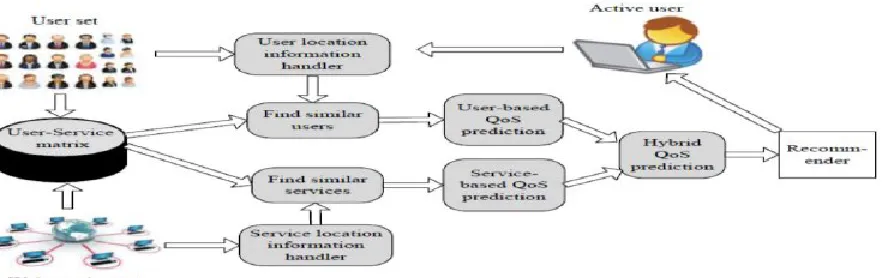
Fig. No.1 Overview of the implemented system.
We consider an active user is searching for high-quality Web services. Web service discovery system or the system is providing high-quality web services to an active user. This work focuses on predicting QoS values of Web services for recommendation. Our web service recommendation method consists of the following modules:
(1) User location information handler:
This unit gets location information of a user including the network and the country according to the user’s IP address. Apart from this It also works as support system for efficient user querying based on location.
(2) Service location information handler: The handler acquires additional
according to either their URLs or IP addresses. The location information includes the network and the country in which the Web service are located.
(3) Find similar users: This module is intended to find users who are similar to the active user by considering both the users’ QoS experiences and locations. For improvement in accuracy and scalable similar user selection, author has proposed a weighted user-based PCC via exploring QoS variation of Web services and incorporate user locations into similar user selection.
(4) Find similar services: This module
finds similar Web services for a target service, considering both QoS of Web services as well as service locations.
perceived on target Web services, and helps in prediction of the missing QoS values for the active user.
(6) Service-based QoS prediction: After a certain number of similar services are identified for a target Web service, this function aggregates their QoS values to predict the missing QoS values for the active user.
(7) Hybrid QoS prediction: This
function combines the user-based QoS prediction and the making final QoS predictions. The cold-start problem and data-sparsity problem in QoS predictions are also attended in this module
(8) Recommender: This function
recommends Web services with optimal QoS to the activeuser.
INFLUENCE OF USER LOCATION ON QOS PREDICTION:
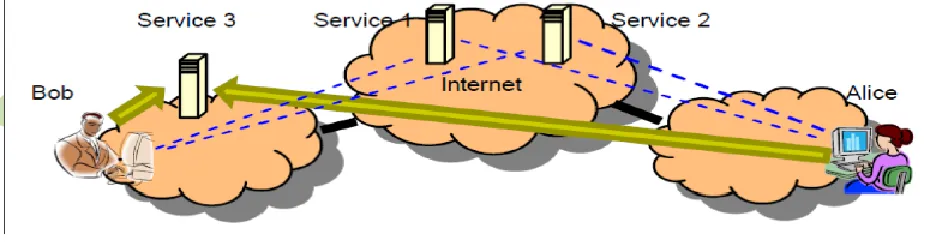
Fig. No.2. Model for Influence of user location on QoS prediction
There are various factors affecting the network performance between the target user and the target service. The most important factors include distance and bandwidth of network which are highly relevant to locations of the target user and the target service. When the user and the service are located at different networks which are far away from each other on the Internet, network performance is likely to be poor due to both the transfer delay and the limited bandwidth
Suppose Bob and Alice are two users located in different networks that are far from each other (see above fig.). Each observed similar QoS, such as response time and through-put, on two Web services, e.g., Service 1 and Service 2 (The two services might be deployed in some networks that have similar performance to Alice and Bob). According to conventional CF-based QoS prediction methods, the two users are somewhat similar. Thus, they are likely to ob-serve similar QoS on other Web services (e.g., Service 3). However, provided Service 3 was deployed in the same network as Bob, thus being close to Bob but far away from Alice, it’s highly likely that the two users will observe quite different QoS values on Service 3. This is in contradiction with the expectation of conventional CF-based prediction methods. Actually, Alice and Bob are not really similar, but happen to have similar QoS experiences on a few Web ser-vices. Conventional QoS prediction methods mishandle this case. By taking locations of users into consideration, we can avoid choosing inappropriate neighbors for the target user, thus improving the accuracy of QoS prediction.
LOCATION INFORMATION
REPRESENTATION, ACQUISITION, AND PROCESSING
This section discusses how to represent, acquire, and process location information of both Web services and ser-vice users, which lays a necessary foundation for implementing location-aware Web service recommendation method.
LOCATION REPRESENTATION:
triple (IPu, ASNu, Country IDu), where IPu denotes the IP address of the user, ASNu denotes the ID of the Autonomous System (AS)1 that IPu belongs to, and Country IDu denotes the ID of the country that IPu belongs to. Typically, a country has many ASs and an AS is within one country only. The Internet is composed of thousands of ASs that inter-connected with each other.
However, users located in the same AS are not always geographically close, and vice versa. Therefore, even if two users are located in the same city, they may seem to be at different ASs. This explains why we have chosen, AS instead of other geographic positions, such as latitude and longitude, to represent a user’s location.
LOCATION INFORMATION:
SIMILARITY COMPUTATION
AND SIMILAR NEIGHBOR
SELECTION
Here we have defined notations for the convenience of describing our method and algorithms. We implemented a weighted PCC for computing similarity between both users and Web services, which takes personal QoS characteristics into consideration. Finally, author has discussed incorporating locations of both users and Web services into the similar neighbor selection.
SIMILAR NEIGHBOR SELECTION:
This selection is a very important step of CF. In conventional type of user-based CF, the Top-K similar neighbor selection algorithm is used invariably [8]. It selects K users that are most similar to the active user as neighbors. Similarly, the Top-K similar neighbor selection algorithm can be employed to select K Web services that are most similar to the target Web service. Traditional Top-K algorithms ignore this problem and still choose the top K most ones. Because of the resulting neighbors are not actually similar to the target user (service), doing this will impair the prediction accuracy. Therefore, abandoning those neighbors from the top K similar neighbor set is better if the similarity is not greater than zero. Secondly, as previously mentioned, Web service users may happen to perceive similar QoS values on a few Web services.
Considering the location-relatedness of Web service QoS, authors have incorporated the locations of users and Web services into similar neighbor selection.
USER-BASED QOS VALUE
PREDICTION:
Authors presented a user-based location-aware CF method, named as ULACF. Traditional user-based CF methods usually adopted for finding value predictions. This equation, however, may be inaccurate for Web service QoS value prediction. As Web service QoS factors such as response time and throughput, which are objective parameters and their values vary large. Therefore, predicting QoS values based on the average QoS values perceived by the active user (i.e., r (u) ) is flawed. Intuitively, given two users that have the same estimated similarity degree to the target user, the user nearer to the target user should be placed more confidence in QoS prediction than the other.
ITEM-BASED QOS VALUE PREDICTION:
Author says, an item-based location aware CF method, named as ILACF. Based on the similar assumptions and finding of ULACF’s, author used Eq (14). from paper [26] to calculate the predicted QoS value.
INTEGRATING QOS PREDICTIONS: Due to the diversity of the user-item matrix, for finding predicted value as accurate as possible, it’s better to fully explore the information of similar users as well as similar services. Therefore, we develop a hybrid location- aware CF, named as HLACF, which incorporated the user-based QoS prediction with the item-based QoS prediction. The following four cases will be considered in integrating QoS predictions.
CONCLUSION & FUTURE
WORK
location-aware collaborative filtering method for QoS-based Web service recommendation. Aiming at improving the QoS prediction performance, we take into account the QoS characteristics of both users and web services for computation of
similarity between them. We also incorporate the locations of both Web services and
users into similar neighbor selection, for Web services and users. Comprehensive experiments conducted on a real database indicate that our method significantly outperforms previous CF-based Web service recommendation methods.
In the future, we will take more detailed location information into consideration for QoS prediction, such as the Internet’s AS topology. We will also consider incorporating the time factor into QoS prediction, and plan to obtain bigger datasets for evaluating our methods.
REFERENCES
[1] L.-J. Zhang, J. Zhang, and H. Cai, Service Computing. Springer and Tsinghua UniversityPress, 2007.
[2] M. P. Papazoglou and D. Georgakopoulos, “Service-Oriented
computing,” Communications of the
ACM, 2003, pp. 46(10):24–28.
[3] M. Alrifai, and T. Risse, “Combining Global Optimization with Local Selection for
Efficient QoS-aware Service Composition,”
in Proc. of the International World Wide Web Conference,
Apr. 2009, pp. 881- 890.
[4] Y. Zhang, Z. Zheng, M. R. Lyu,
“WSExpress: a QoS-aware search
engine for Web services”, in Proc. 8th IEEE International Conference on Web Services, Miami, FL, USA, July, 2010, pp.83-90.
[5] S. S. Yau, Y. Yin, “QoS-based service ranking and selection for service based
systems,” in
Proc. of the International conferenceon Services Computing, Washington DC, USA, July, 2011, pp. 56 - 63.
[6] G. Kang, J. Liu, M. Tang, X.F. Liu, and K. K. Fletcher, “Web Service Selection
for Resolving
Conflicting Service Requests,” in Proc. 9th Inter-national Conference on Web Services, Washington, DC, USA, July, 2011, pp. 387-394.
[7] L. Shao, J. Zhang, Y. Wei, J. Zhao, B. Xie, and H. Mei, “Personalized QoS prediction for
Web services via collaborative filtering, ” in Proc. 5th International Conference on Web
Services, 2007, pp. 439-446.
[8] Z. Zheng, H. Ma, M.R. Lyu, and I. King. “WSRec: A Collaborative Filtering Based Web
Service Recommendation System,” in Proc. 7th International Conference on Web Services , Los
Angeles, CA, USA, pp. 437- 444, 2009.
Collaborative Filtering”, IEEE Trans. on Services Computing, 2011, vol.4, no.2, pp.140-152.
[10] M. Tang,Y. Jiang, J. Liu,X. F. Liu: Location-Aware Collaborative Filtering
for QoS-Based Service
Recommendation. in Proc. 10th
International Conference on Web Services, Hawaii, USA, June 2012, pp.202-209.
[11] http://en.wikipedia.org/wiki/Collabor ative_filtering.
[12] J. L. Herlocker, J. A. Konstan, J. Riedl, “An Empirical Analysis of Design Choices in
Neighborhood- based Collaborative
Filtering Algorithms,” Information
Retrieval, No.5, 2002, pp.287-310.
[13] G. Adomavicius, and A. Tuzhilin,
“Toward the next generation of
recommender systems: a survey of the
state-of-the-art and possible
ex-tensions,” IEEE Trans. Knowledge and Data Engineering, 2005, pp.734 – 749.
[14] J. S. Breese, D. Heckerman, and C. Kadie, “Empirical analysis of predictive algorithms for collaborative filtering,” in Proc. of the UAI, 1998, pp.43-52.
[15] R. Jin, J. Y. Chai, and L. Si, “An
automatic weighting scheme for
collaborative filtering,” in Proc. of the 27th annual international ACM SIGIR
conference on Research and
development in information retrieval, 2004.doi: 10.1145/1008992.1009051.
[16] G. Xue, C. Lin, Q. Yang, W. Xi, H. Zeng, Y. Yu, and Z. Chen,”Scalable
Collaborative Filtering Using Cluster-Based
Smoothing,” in Proc. 28th Int’l ACM SIGIR Conf. Research and
Development in Information Retrieval, 2005, pp. 114-121.
[17] B. Sarwar, G. Karypis, J. Konstan, and J. Riedl, “Item-Based Collaborative Filtering Recommendation Algorithms,” in Proc. 10th Int’l Conf. World Wide Web, 2001, pp. 285-295.
[18] M. Deshpande and G. Karypis,
“Item-Based Top-N
Recommendation,” ACM Trans.
Information System, 2004, vol. 22, no. 1, pp. 143-177.
[19] G. Linden, B. Smith, and J. York,
“Amazon.com Recommendations:
Item-to-Item
Collaborative Filtering,” IEEE Internet Computing, 2003, vol. 7, no. 1, pp. 76-80.
[20] M. R. McLaughlin and J. L. Herlocker, “A collaborative filtering algorithm and evaluation metric that accurately model the user experience,” in SIGIR, 2004. [21] R. Liu, C.X. Jia, T.
Zhou, D, Sun, and B.H. Wang, “Personal recommendation via modified collaborative filtering,”
Physics and Society 388(4): 2009, pp.462-468.
[22] G. Adomavicius and A. Tuzhilin. Recommender Systems Handbook,
chapter Context-aware Recommender
Systems. Springer, 2010.
186–193.
[24] L. Liu, F. Lecue, and N. Mehandjiev, “Semantic content-based recommendation of software services using context,” ACM Trans. Web, vol. 7, no. 3, pp. 17–20, 2013.
[25] K. Huang, Y. Fan, W. Tan.
Recommendation in an Evolving Service
Ecosystem Based on Network Prediction.
IEEE T. Automation Science and
Engineering 11(3): 906-920 (2014).
[26] Jianxun Liu, Mingdong Tang,
Member, IEEE, Zibin Zheng, Member,
IEEE, Xiaoqing (Frank) Liu, Member, IEEE, Saixia Lyu, “Location-Aware and Personalized Collaborative
Filtering for Web Service