Pre-print of Hammond, V. And Musselwhite, C. (accepted). The attitudes, perceptions and concerns of pedestrians and vulnerable road users to shared space: a case study from the UK. Journal of Urban Design DOI:10.1080/13574809.2012.739549
The attitudes, perceptions and concerns of pedestrians and vulnerable
road users to shared space: a case study from the UK.
Victoria Hammond
Transport Planning Officer
Herefordshire Council, UK.
Plough Lane
Hereford
HR4 0LE
Tel: +44 14 32 261817
Fax: +44 14 32 383031
Charles Musselwhite (corresponding author)
Senior Lecturer in Traffic and Transport Psychology
Centre for Transport & Society
University of the West of England
Coldharbour Lane
Bristol BS16 1QY
Fax: +44 117 32 83002
The attitudes, perceptions and concerns of pedestrians and vulnerable
road users to shared space: a case study from the UK.
The concept of shared space is increasingly being incorporated into urban areas in the UK promoting a major change in the way streets are designed. Shared space is a design feature that aims to encourage pedestrians, cyclists and drivers to share the same deregulated space. However, there is a lack of evidence underpinning shared space, in terms of attitudes and usability, particularly for vulnerable road users including blind and partially sighted, elderly and wheelchair users. This research used street accessibility audits and focus groups with vulnerable pedestrians and 100 completed on-street questionnaires to investigate attitudes and behaviour towards a shared space scheme in Hereford, UK. The findings have shown that despite being very positive towards the scheme, particularly in terms of aesthetics, pedestrians and vulnerable road users had a number of issues and concerns with the design and usability of Widemarsh Street, in particular nuances of design including the kerbs and vehicular access to the street.
Introduction
What is shared space?
The concept of shared space, where ‘all street users move and interact in their use of space on the basis of informal social protocols and negotiations’ (Hamilton-Baillie, 2008; p166), has developed in urban areas over time as public dissatisfaction with the clutter and barriers associated with conventional traffic engineering has grown. Shared space is part of a wider series of policies to encourage vehicle drivers to reduce speeds, and to adjust their behaviour in ways that make streets safer and more pleasant places for people to use (Imrie and Kumar, 2010). Shared space involves the removal of the familiar characteristics associated with the highway such as kerbs, road markings, traffic signals, signs and barriers. In shared space, road user behaviour is controlled by interpersonal behaviour between street users, including non verbal negotiation and social interaction, with the idea that vehicle drivers slow down, take more care and rely on eye contact with other road users to negotiate movement and right-of-way. Examples from around the world suggest that shared space can improve the relationship between people, places and traffic (see Hamilton Baillie, 2008).
Building the Dutch concept Woonerf, which featured outside homes, Hans Monderman applied the principals of shared space in a variety of different types of streets with different levels of traffic flow (Hamilton-Baillie, 2008). The most notable examples are to be found in Denmark, Sweden and The Netherlands, although there are examples in almost all European countries (Hamilton-Baillie, 2008). There are a
number of shared space schemes currently in the UK, the most famous and publicised being the Ashford Ring Road in Kent, Seven Dials in London, and most recently the flagship scheme at Exhibition Road, London.
Research has suggested accidents are reduced when shared space is implemented (Dales, 2010; Hamilton-Baillie, 2008, Kent County Council, 2010; Swinburne, 2006), lower speeds are found amongst the traffic and there is an improved vehicle flow (Hamilton-Baillie, 2008). In addition, MVA (2010a) cite that reduced demarcation of kerb and carriageway by removal of kerbs or reduced colour contrast encourages pedestrians to share the space and cars to give way, giving more priority to pedestrians. However, this is greater in areas where there is lower traffic flow and higher pedestrian numbers. MVA (2010b) in a series of interviews and walkthroughs of shared space areas, found shared space appears to deliver pedestrian benefits but pedestrians need to feel comfortable and safe in the space if they are to make the most of it. In addition, pedestrians often tried to fit existing rules to the new situations they encountered in shared space and as such sharing of a street is generally limited to when pedestrians cross it, and on the whole pedestrians remain on the old footway area of the road. Pedestrians use the carriageway when traffic flow and speed is low. Hence, how far the pedestrian benefits from the situation would seem to vary based on (perceived)
dominance of the traffic. Indeed, work by Melia and Moody (2011) and Moody (2011) who observed pedestrian behaviour in Elwick Square, Kent, an area of high pedestrian movement but also high traffic use, found that in 72% of pedestrian/vehicle encounters the pedestrian gave way to vehicles and in 52% of interactions the pedestrian had to wait to cross. In addition, almost one in every five pedestrians hurried when crossing the street, which the authors suggest shows high levels of pedestrian anxiety.
Theoretical perspectives of shared space
Most proponents of shared space have, whether wittingly or unwittingly, set their arguments in a traditional environmental determinism perspective, suggesting that changes to the design of the street will encourage shifts in behaviour which will
assumption does an injustice to the individual agency of people. The principals of shared space utilises socio-cognitive psychological theory and models of behaviour, including risk homeostasis, arousal theory and environmental load and as such there is a wider need to understand how different road users might engage with shared space design.
Risk homeostasis theory, where humans shift the balance of risk according to their environment, can be used to explain the idea of shared space. When the
environment is perceived as uncomfortably risky, then a road user will take steps to reduce the risk, for example a driver reducing speed as the road environment becomes unpredictable (Adams, 1995). However, a key criticism of the model is that risk, including an individual’s perception of their own risk, does not involve only evaluating their own risk, but how their behaviour may impact on other people’s risk. Drivers of vehicles have typically been said to be ‘carcooned’ and thus are unaware of, or at best underestimate, the risk they impose on other users (for review see Musselwhite et al., 2010). In a street environment, risk is unequally dispersed amongst a variety of people and this should be considered when introducing changes to the street environment. In addition, the theory of risk homeostasis makes no claim as to knowing how far
increasing risk cannot be compensated for by reducing risk elsewhere. For example, if a shared space street became too complex even the greatest risk reduction elsewhere might not rebalance the situation, resulting in increased danger or avoidance of the street altogether (Musselwhite et al., 2010). Finally, risks may alter in nature for different users, for example changing from being hit by a car to breaking an ankle on a kerb which is too low or indistinct, for example.
both too little and too much arousal is undesirable and humans perform optimally with middling levels of arousal. With simple tasks, the optimum level is at the higher end of middle, whereas complex tasks the optimum level is at the lower end of the middle (Berlyne, 1960,1974). Shared space is a way of disrupting the lethargy that is seen by road users in a traditionally segregated space which creates insufficient arousal for road users by creating an environment which adds more arousal. Theoretically, this has especially been noted to improve vehicle drivers who in order to maintain optimum performance in shared space, it is hoped, will reduce arousal by reducing risk by, for example, driving slower and being more alert (Hamilton-Baillie, 2008) but little is known about how it changes the performance for other road users. For example, it is not known how increased arousal caused by shared space might influence pedestrian behaviour.
Environmental load approach (Broadbent, 1958; Milgram, 1970) suggests humans have a limited capacity to process incoming stimuli. When too much is needed to be processed, then a state of overload is found. In shared space the complexity and ambiguity created by design overloads people’s sensory channels. It is proposed that this will create greater attention to the scene, again especially for vehicle drivers (Hamilton-Baillie, 2008). However, the theory suggests people adapt in different ways to reduce overload which can also include avoidance of the stimuli altogether.
Socio-psychological perspectives of shared space
human expectations, social norms, values, attitudes and beliefs. Hence, it is likely that different people will exert different behaviours in the same setting and that people’s values and attitudes towards shared space are crucial in understanding this, though acknowledging that there is not always a perfect attitude-behaviour correlation.
Attitudes towards shared space vary amongst the public (Reid et al, 2009). Musselwhite et al. (2010) suggest there is little public support for the concept and it is often perceived as counter-intuitive in terms of safety to people unaware of how such schemes operate in practice. Several participants in Musselwhite et al. (2010) went as far as to say that shared space as a concept was incompatible with the driving culture on UK roads. It was felt that drivers would inevitably dominate the space, and just a small non-conforming minority would be enough to undermine the system. Kaparias (2010) concludes that young men show the most positive attitudes towards shared space, whereas people with disabilities, and older members of society were more negative towards the concept. Moody (2011) found pedestrian perceptions and attitudes towards the shared space area were poor, and further analysis suggests females and older people in particular were less positive in terms of perception and confidence of using shared space.
‘not all users are able to detect and recognise danger, and not all users may respond appropriately’ (pg1). There are strong concerns from disabled and blind and partially sighted pedestrians about the difficulty of navigating in such a space, especially the lack of or removal of physical street features which can create greater anxiety (Atkin, 2010; DfT, 2009; Keefe et al., 1998), which has implications for independence and can in some cases cause people to avoid shared space areas altogether (Thomas, 2008 a,b).
This paper reports research that aimed to explore the nature and origins of attitudes, perceptions and concerns of pedestrians towards the use of shared space in the public realm, while in particular considering the views of blind and partially sighted people and other vulnerable pedestrians. Findings are to inform the debate about how far redesigning streets for shared space affects pedestrian attitudes about the space. It particularly focuses on attitudes to safety, stemming from shared space utilising psychological theory that enhances ambiguity and confusion in order to improve alertness and performance within the space, and confidence with using the space, highlighting differences between gender and age that might be present, while highlighting viewpoints of especially vulnerable pedestrians.
Methodology
The methodology involved two data collection stages, a walkthrough and focus group stage to study in-depth concerns and perceptions of vulnerable pedestrians, and an on-street questionnaire to collect attitudes of a range of pedestrians, both within a case study area.
Selection of a case study area
context offered different responses in terms of attitudes and behaviour. In addition, using MVA (2010a) conclusions, shared space works best in areas with low vehicle intrusion and high pedestrian activity, and therefore concerns vulnerable groups might have in such an area are likely to be further exaggerated in other areas which might be less easy to negotiate. A selection of a street not previously examined in research was preferred to offer contrasting and novel viewpoints, previously untainted by findings from official reports. The street must be one that was recently redesigned so participants could offer a view contrasting with what the street was like prior to redesign. The street must adhere to the definition of Shared Space outlined by Manual for Streets 2: Wider Applications of the Principles (CIHT, 2010) where segregation between modes occurs with only small 40mm kerbs. The street must have a variety of uses and users, in particular is a street likely to be used by especially vulnerable pedestrians, for example older people and blind and partially sighted. To this end, Widemarsh Street in
Hereford was selected.
Widemarsh Street, Hereford: Design and context
Widemarsh Street in Hereford was redesigned as shared space and completed in December 2010, adhering to the definition of Shared Space outlined by Manual for Streets 2: Wider Applications of the Principles (CIHT, 2010). The aim of the street was
to both cope with low speed vehicular movement, whilst providing a distinctive public realm in keeping with the local area. Widemarsh Street is seen as a gateway into the cathedral city’s shopping district and the design was to reflect that. Hereford Cathedral built almost 1,000 years ago took ideas from Charlemagne’s Imperial Cathedral in Aachen, Germany. The new shared space design, programme managed by Amey, built by Alun Griffiths Construction Ltd and designed by Ben Hamilton-Baillie along with Powell Dobson Urbanists, once again borrows ideas from Aachen where shared space had been introduced to reduce barriers caused by an inner-ring road recreating
between modes with only minor 40mm kerbs providing distinctions between the safer walking areas for vulnerable road users and the areas used by vehicles. The design incorporates a low kerb (50mm high) with four flush crossing points and a flush central feature paving area allowing less mobile pedestrians to freely move around the area. The low kerb in a contrasting colour (silver grey granite) to the surrounding paving provides both a visual and tactile warning to partially sighted and Guide dog users. Stainless steel blister studs identify the flush crossing points and a band of silver grey granite hazard warning paving runs around the central flush feature which highlights these areas without detracting from the overall scheme appearance (Herefordshire Council, 2011).
in the findings, perhaps the dominance of pedestrians for the majority of the time is also reflected when vehicles re-enter the street for example. Analysis will examine this.
The Royal National College for the Blind is located in the city highlighting the importance of the requirement for inclusive design. Herefordshire also has an ageing population with over a quarter of the population currently over 60 years old and the population of people aged 85 is expected to double from 5,000 in 2007 to 10,200 by 2026 (Herefordshire Council, 2009). It is therefore important to ensure their mobility needs are considered with the increasing emergence of shared space schemes within Hereford and around the UK.
Street audits and focus groups with vulnerable pedestrians
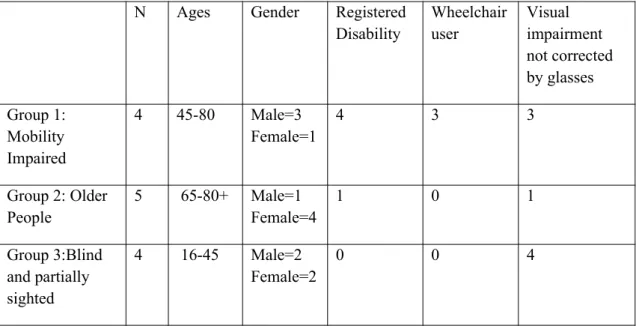
The primary research methods used in this study were street accessibility audits followed by focus groups with three groups of pedestrians selected as an especially vulnerable road user. Table 1 highlights the background details of the three groups. Group one involved those with mobility impairments, group two older people and group three blind and partially sighted people. The first group were recruited from Hereford Access for All, an advocacy group for mobility impaired in the area, and comprised of three mobility impaired wheelchair users and one who had a mobility impairment without the need for a wheelchair. The second group comprised of five older people recruited from a local Age UK day-care centre with four females and one male agreeing to take part; one who was registered disabled and one who had eyesight problems. The third group involved four blind or partially sighted participants; two male, two female, all aged between 18 and 45, recruited from the Royal National College for the Blind situated in Hereford.
Insert table 1 about here
manage them. They can be effective tools for providing support to residents and local authorities to make improvements happen. In order to facilitate focus group discussions in Widemarsh Street, accessibility audits were undertaken with two separate groups of vulnerable road users.
The street audit lasted approximately 30 minutes with participants and took place when the street was acting as shared space. Each participant walked the entire length of the route in a clockwise direction and the researcher observed their behaviour and made notes on what was observed. Prior to the start of the street audits, the
participants were prompted on what to consider during the audits, based on Living Streets (2009) audit guidance, including road safety, attractiveness of the street and how accessible the area was for them. Each participant was monitored by a qualified
assistant to ensure their safety at all times during the audit. At the end of the audit, the researcher asked participants to meet at Hereford Town Hall where the next stage of the research, the focus groups, took place.
used in previous research (e.g. MVA, 2010b; Moody, 2011). Questions relating to the materials used and maintenance of the street were then posed to establish whether the street improved access and whether the materials created any issues for users in terms of hazards or confusion. It is known, for example, that especially older pedestrians have issues with these elements (see Musselwhite, 2011 for review). Building on criticisms made by Moody and Melia (2011) concluding questions were aimed around comparing the new shared space area with the existing traditional pre-shared space layout to assess whether there has been an improvement for all road users. Finally, based on Imrie and Kumar (2010) and Thomas (2008a,b) questions related to consultation were also posed to establish whether such users believed they were consulted at an appropriate stage in the process..
On street questionnaires
must be considered when reading the findings and discussion. This was continued until 100 participants had taken part, which was assumed to be a realistic number for data analysis within the resources of the project.
Questions asked were around similar themes to those found in the focus groups. A number of questions come from MVA (2010a) and Moody (2011) to enable
comparisons with these previous studies. Participants were asked to compare the street now and before it was redesigned as shared space, developing questions asked by Moody (2011) and MVA (2010b). How people negotiate shared space was asked as it is a key concern for vulnerable pedestrians, such as blind and partially sighted (Imrie and Kumar, 2010: Thomas, 2008a,b), but is also asked of pedestrians more widely (Moody, 2011, MVA, 2010b). Key to improvements in the public realm at street level is the ability to dwell in the street environment (DfT, 2007; Hamilton-Baillie, 2008) and key questions in this were asked originating from MVA (2010b) and Moody (2011). Major concerns have been flagged up by the local community in Hereford with regards to the kerbs in the scheme (Herefordshire County Council, 2009). It is a particular issue to blind and partially sighted groups who use the kerbs to demarcate boundaries between traditional carriageway and footway (Imrie and Kumar, 2010: Thomas, 2008a,b; MVA, 2010a,b). Finally, materials and the aesthetic nature of the area are important to capture and can affect the walking environment (DfT, 2007).
It must be remembered that the survey is likely to be a snapshot of those who are probably more comfortable with using the shared space street. It does not capture non-users which might include a number of vulnerable road non-users as was highlighted in the focus groups where participants cited they themselves tended to avoid the area or certainly knew of other people who did. In addition, those who were happy to stop in the area and answer questions are likely to be those more relaxed.
Analysis of Data
The data collected was analysed in a number of different ways. The qualitative data obtained through the focus groups was analysed and sorted into key themes using a thematic analysis. This allowed for similar comments related to a particular theme to be grouped together. The positive comments were analysed separately to negative
comments but both were coded in the same way. Themes were matched within-case to detect consistency and discrepancies followed by between-case analysis in order to further note consistency, similarities, differences and discrepancies (Aronson, 1994). The data from each wave was then subjected to a further level of scrutiny at the end through comparing themes across the different fields highlighting themes that were similar and distinct and these are reported in the findings (Aronson, 1994).
The quantitative data obtained from the on-street interviews was analysed through the use of the Statistical Package for Social Sciences (SPSS). The program assisted with the interpretation of data by analytically testing whether there were significant differences between different variables. In particular statistical tests were used to compare differences to attitudes on key questions
(2) Age: different age groups. Ages were split into categories, 18-25, 26-35, 36-45, 46-55, 56-65, 66-75 and 76+. An ANOVA was used to test for significance between these groups and answers that were formed of continuous data, using a post-hoc test to search for where the differences were to be found. Chi-squared tests were used to test differences when categorical data was present.
(3) Especially vulnerable users. A pedestrian was placed in to the vulnerable road user category based on one of two criteria: they were registered disabled and/or they were aged 76+. A total of 19 individuals fitted this category, leaving 81 not seen as a particularly vulnerable pedestrian. Again t-tests were used to test for significance on questions using continuous data and a chi-squared test to test between differences on categorical data.
Findings
This section presents the qualitative findings from the street audits and focus group discussions and places them into positive and negative categories. It then presents the quantitative data from the on-street interviews.
Positive Comments from the street audits and focus groups
Themes generated covered improved feelings of safety and access as a
pedestrian since the implementation of shared space. In addition, people noted incidents of social interaction that had improved since shared space had been implemented. Finally, people liked the practical nature and the aesthetic quality of the new materials used in the shared space design.
Theme 1: Safety
before the changes were made.
‘Its safer for pedestrians, us, and everybody in general’ (Participant 7, Mobility impaired group)
‘ There is an improvement on what was there. It was hard to go down there without being run over before’ (Participant 4, Older person group)
However, one participant noted that despite there being a feeling of improved safety, pedestrians still need to be aware of vehicles.
‘I do feel safer; it’s just a matter of trying to remain conscious of the fact traffic can and does pass through’ (Participant 3, Older person group)
Despite having to remain conscious of the fact vehicles can drive through the area, there was a feeling that car drivers now drive a lot slower through the area than before.
It was clear from both discussions with the wheelchair user group and the blind and partially sighted group that they felt the new shared space area had improved access in some respects.
‘Partially sighted people find it easier to navigate the street now’ (Participant 11, Blind and partially sighted group)
‘There are a lot less ‘A’ boards about now, which eases access as they used to block our path’ (Participant 10, Blind and partially sighted group)
Participants in the wheelchair user group in particular also liked the new loading bays which now help to prevent vehicles blocking access for pedestrians.
‘One thing I think is a lot better is the fact they’ve got loading bays for vehicles, because at one time, especially in the narrower end of the street, cars and vehicles used to obscure the space for pedestrians’ (Participant 6, Mobility impaired group)
Theme 2: Social interaction
‘I mean socially it frees you up in terms of social interaction with the new shared space arrangement. If you saw someone you knew, you could just wander over and have a chat in the middle of the street’ (Participant 7, Mobility impaired group)
This also extended to increased opportunities for browsing in shops,
‘If there was a shop you wanted to have a look in, you don’t have to stand on the kerb and wait for traffic to clear now, you can just wander in and out of the area’ (Participant 4, Older person group)
Theme 3: Attractiveness and materials used
In terms of attractiveness, participants liked the paving materials in Widemarsh Street which created a more attractive area than before,
‘The street is attractive, especially the cobbles in the carriageway’ (Participant 7, Mobility impaired group)
Participants from the Blind and Partially Sighted Group also commented on the materials used in the street stating that the footway pavement surfaces are ‘lovely and smooth’. Wheelchair users were also complimentary about the ease of use of the material,
‘I love the pavement slabs, I wish they were used more as they are so easy to wheel over’ (Participant 9, Mobility impaired group)
‘The pavement slabs are good because they are so flat and there are no gaps in between them’ (Participant 8, Mobility impaired group)
Negative Comments from the street audits and focus groups
design could prevent these principals being achieved. Participants in particular cited issues with kerbs; a sense of ambiguity for the pedestrian, how social interaction still might not occur in shared space areas and an overall lack of consultation when the scheme was introduced.
Theme 1: Kerbs
A dominant concern across all three groups was the issue of the kerbs associated with shared space. A particular concern was the lack of consistency with the height of kerbs,
‘There are too many different levels. If it was all one level it would be better as at the moment it dips and then goes back up, then dips again’ (Participant 2, Older person group)
‘I don’t like the inconsistency of the height of kerb. I would prefer no kerb at all’ (Participant 9, Mobility impaired group)
In terms of the kerbs being a potential trip hazard, blind and partially sighted participants had particular concerns,
‘ In some places there is hardly any edge to the kerb at all and I came out of a shop on Saturday and my ankle went down off the edge of the kerb . Luckily enough I didn’t hurt it badly but potentially it could have been hazardous you know’ (Participant 11, Blind and partially sighted group)
Participants also had concerns about being able to perceive the kerbs resulting in confusion
‘My guide dog struggles sometimes to detect any kerb at all. I have quite often found myself at the wrong end of Widemarsh Street because my dog has got a bit confused’ (Participant 12, Blind and partially sighted group)
Blind and partially sighted users stated that the confusion is made worse by the poor colour contrasts of the materials used,
The contrast between the kerb and the carriageway is too similar and its hard to distinguish which is kerb and which is the carriageway’ (Participant 13, Blind and partially sighted group).
Blind and partially sighted participants tended to favour having no kerb at all but to place a tactile edge to delineate traditional footway to carriageway demarcations.
Theme 2: Ambiguity
A key theme emerged from the participants that the shared space area causes some level of ambiguity and confusion, because people use the street in a more ambiguous way, meaning movement is more difficult to predict,
‘Random pedestrian movements now occur in the street and its now harder to negotiate the space. People stand in random places, blocking the way for us’ (Participant 11, Blind and partially sighted group)
It was common for people in all groups to note they tended to walk on the area that traditionally was the footway rather than in the road carriageway despite the reduction in delineation,
‘I feel that less people are willing to give way to you now as they think that you have plenty of space to move around them whilst before, with a normal pavement they gave way’ (Participant 5, Older person group)
‘I always tend to keep to the bit that looks like a pavement, I don’t know how to use it as shared space’ (Participant 7, Mobility impaired group)
Theme 3: Social interaction
‘The street could be a place where I would stop and socialise and spend more time but only if it was closed to traffic permanently’ (Participant 12, Blind and partially sighted group)
‘If traffic was banned, I would definitely spend more time there’ (Participant 9, Mobility impaired group)
Theme 4: Consultation
Finally, a key concern amongst participants from all three groups was around consultation with many feeling they had not been consulted or had not been consulted early on enough in the process.
‘We provided comments during the consultation, but it is hard to know if your comments made a difference or not, we never got any feedback’ (Participant 8, Mobility impaired group)
‘I think we were more of an afterthought in the fact that they’d already bought the materials so they thought they had better be seen to ask us what we thought’ (Participant 13, Blind and partially sighted group)
On-Street Questionnaire Findings
The majority of participants were frequent users of Widemarsh Street. The majority used it at least weekly (72%) and almost a quarter of the sample (24%) used it daily. The large majority of respondents (89%) had experienced the previous layout of Widemarsh Street and 14% stating they had not previously shared the street with traffic (so they were doing so for the first time). Findings are reported in terms of concerns in sharing the street with traffic, confidence in using the street, how people compare it to before it became shared space and using the street as a social space.
Concerns about sharing with traffic
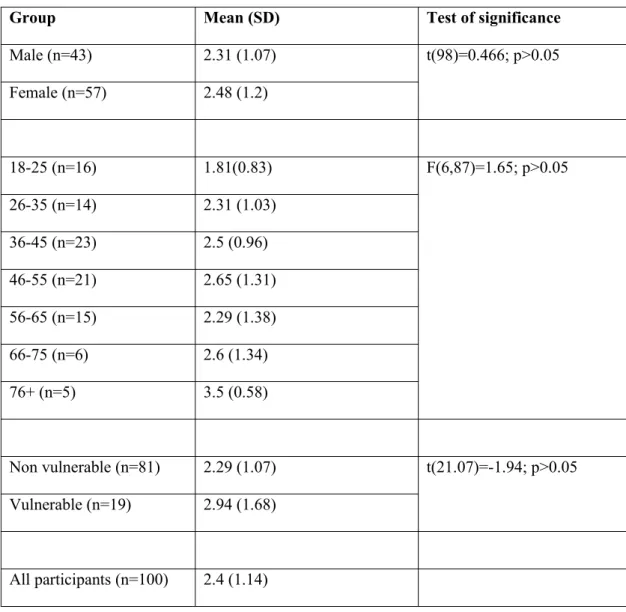
street with traffic (the youngest group 18-25 have a mean average of 1.9, where 5 is highly concerned through to 1 being not at all concerned, compared to 46-55 having a mean average of 2.9 and 75+ having a mean average of 3.5), suggesting the older the participant is the more concern they have for sharing the street with traffic (see table 2). However, an ANOVA showed no significant differences were found between age groups (F(6,87)=1.65; p>0.05). Males were slightly less concerned (mean average= 2.31) than females (mean average=2.48) about sharing the street with traffic, but this was not significantly different (t(98)=0.466; p>0.05). Vulnerable road users were more likely to be concerned on average (mean average=2.9) compared to less vulnerable pedestrians (mean average=2.2), but the difference was not significant (t(21.07)=-1.94; p>0.05).
Insert table 2
Confidence in using the space
Confidence in having priority over traffic was not high, with only 15% of pedestrians citing they have more priority over vehicles in the street and 50% stating they have less priority (28% felt that they have equal priority). Female respondents were more likely to state they either have more or less priority over traffic as a pedestrian, with males more likely to state they have equal priority, but these
differences were not statistically significant (x2(3, N=97)=1.542; p>0.05). There is also
little pattern between age and whether people felt they had priority over the traffic, and a statistical test reveals no significance between age groups and whether they felt they had priority over traffic or not when sharing the road (x2(18, N=97)=16.716; p>0.05).
Participants were asked how confident they were to move around the shared space street, testing to see if people felt confident to use areas not traditionally allocated as pedestrian. The majority of respondents (71%) stated that they felt they could move freely around Widemarsh Street, with a mean average across all participants of 3.89 (where 5 signifies they can move very freely around the street and 1 is stating they feel unable to move freely around the street; see table 3). No significant differences were found between male (mean average 3.95) and female participants (mean average=3.85), showing that gender makes no difference to how freely someone moves around the shared space street (t(92.37)=-0.373; p>0.05). There were significant differences between age groups and how freely they felt they could move in the street
(F(6,99)=2.632; p<0.05). A post-hoc test (Tukey’s Honestly Significant Test) revealed significant differences were found between the oldest age category (ages 76+) (mean average=3) and the two youngest age groups (18-25; mean average=4.13 and 26-35; mean average=4.21), where those in the oldest age group were significantly more likely to state that they felt less able to move freely in the street than the two youngest groups. On average non-vulnerable road users (mean average=4) were more likely than
vulnerable road users (mean average=3.42) to have felt they can move freely on the shared space street; a difference which was statistically significant (t(25.23)=3.01; p<0.05). Those more vulnerable as pedestrians stated they were less able to move around the shared space street.
Insert table 3
Self-report before and after comparison
(x2(2, N=87)=1.239; p>0.05). There was a significant difference between age and
whether people prefer the old or the new design in Widemarsh Street (x2(12,
N=87)=23.193; p<0.05). Age was a factor in determining whether people prefer shared
space, up to the age of 46 years, participants almost exclusively prefer the new design, but there was much more of a mixed response beyond that age. There were very similar percentages of both vulnerable and non-vulnerable participants who liked the new shared space design, with slightly more non-vulnerable than vulnerable preferring the older design, with statistical tests revealing that any differences were due to chance (x2(2, N=87)=0.626; p>0.05).
Using the street as a social space
The majority of respondents (57%) felt that they were able to stop and socialise within the shared space street. The mean average across all participants was 3.64 (where 5 refers to full agreement that it is an area to stop and socialise in and 1 is fully
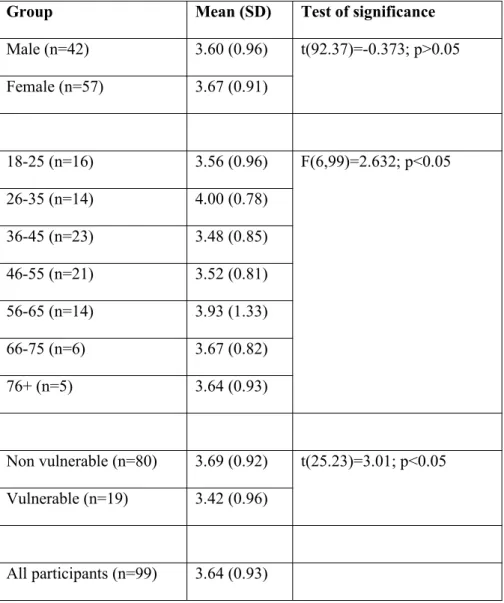
disagreeing with that statement) (see table 4). There were almost no gender difference in response (mean average female: 3.67; male= 3.6), suggesting no significant differences between males and females in their answer to whether they felt they could stop and socialise (t(85.68)=0.373;p>0.05). An ANOVA revealed no significant differences were found between age groups and whether people felt they could stop and socialise in the street (F(6,92)=0.946; p>0.05). Non-vulnerable pedestrians give a higher rating for being able to stop and socialise in the street (mean average=3.6) compared to that given by vulnerable pedestrians (mean average 3.47) but this was not a significant difference (t(26.44)=1.1; p>0.05).
Insert table 4
Discussion
the whole positively received. The majority of participants stated that they were not worried about sharing the street with traffic, and people using the street were not, on the whole, worried about safety and although concerns over safety increased with the age of the pedestrian, this was not found to be statistically significant. Vulnerable pedestrians were also no more likely to worry about safety on the street and findings from the focus groups with vulnerable groups suggested that on the whole people felt safety had improved in Widemarsh Street following the introduction of shared space. There was a general feeling that vehicles still dominated the street, but people were generally not concerned by this, especially in safety terms. Hence, there was a need to be aware of traffic, but people tended to feel traffic was far slower than before shared space was introduced and there was no need to be any more aware than previously. As such, it seems pedestrians continued to dominate the space in perceptual terms, even when vehicles take the space over physically outside of the restricted vehicle times. As noted in the methodology, it is important to remember that in the street survey around one in every two people approached did not wish to take part. As such, findings may be
skewed towards those more comfortable using the space. There may, however, be many other reasons for not taking place not related to feelings of discomfort and indeed the findings show those who do not feel comfortable also did take part in the survey. However, the potential for those more comfortable and hence more positive with the space must be taken into account when interpreting these findings.
and not for all streets is not known from these findings. It could be suggested, for example, that moving freely and feeling somewhat intimidated by traffic would be more of an issue for older people and vulnerable pedestrians on any street, not just a shared space street per se. Vulnerable pedestrians are not noticeably avoiding the area, even when it is shared with traffic, but show signs of anxiety in using the space.
Commensurate with risk homeostasis theory (Adams, 1995), vulnerable users still tended to keep to the area traditionally designated as a footway, to reduce anxiety associated with risk of coming into conflict with a vehicle. This has been found in previous work amongst all pedestrians (Kaparias, 2010), particularly on shared space streets with high numbers of vehicles (MVA, 2010a,b; Moody and Melia, 2011) and appears to be linked to confidence to use the wider space available. It may also be linked to pedestrian’s habitual behaviour and over time pedestrians may become accustomed to the shared street environment and confidence in sharing the space might change. However, this may take longer for those more anxious about sharing space, for example vulnerable pedestrians.
Overall, with regards to arousal theory (Berlyne, 1960, 1967) any changes in arousal amongst the participants have had no detrimental effect on pedestrian behaviour. It could be argued that any increased complexity of the space for pedestrians is being offset with the slower, more cautious vehicles or indeed perhaps the space is no more complex for pedestrians or drivers. Any increase in arousal, shown by an increase in anxiety amongst more vulnerable pedestrians for example, results in them engaging in arousal reducing behaviour, such as using the traditional footway areas more often than less vulnerable pedestrians. Similarly, with the environmental load approach
(Broadbent, 1958; Milgram, 1970), confident pedestrians sharing the traditional carriageway space, it could be argued, have potentially become part of the
pedestrians in the street. Further research, examining driver behaviour and attitudes alongside pedestrian behaviour and attitudes, is needed to examine these relationships more closely.
Almost three quarters of pedestrians surveyed preferred the shared space design to the old design, with no noticeable differences between gender and vulnerability. Older pedestrians are more mixed in their response than younger pedestrians however, and findings from the focus groups suggested that older people preferred the traditional layout because of aesthetic qualities, feeling the traditional street design (pre shared space) was more in keeping with the locality of Hereford and England.
The findings contrast many of those from Moody (2011) and reported in Moody and Melia (2011) who found pedestrians felt much less safe in the shared environment. However, there is a large contrast between the contexts; Moody and Melia (2011) studied a main through road in Kent (Elwick Square), whereas this study used Widemarsh Street which has only light traffic in late morning (9-10.30) and early evening (4.30-6) during the time of the survey, and is pedestrianised between other times. Hence, perhaps the overarching physical dominance of pedestrians during the day is easily translated into psychological dominance in shared space times. It can be
concluded perhaps that context with regards to shared space is crucially important and that different areas require different urban form or infrastructure changes. The focus should perhaps move away from shared space as a singular concept to a term that encapsulates many different designs bespoke for the relevant context. The findings suggest that a street does not have to be either pedestrianised or shared space and that restrictions for vehicles at different times of the day does not necessarily make any difference to how far the space works for pedestrians, vulnerable or otherwise.
sighted people, about the kerbs in the shared space design. The layout in Widemarsh Street has a kerb in place much smaller than is found in a traditional layout, which also varies in height along the street. This was disliked by vulnerable pedestrians across all the focus groups. People cited stories where they themselves, or others they knew, had tripped and fallen as a result of the kerb. It was this more than anything else that made people wary of the street and in some cases even put people off using the street
altogether. The kerb edge problem was further compounded by poor contrast in material colour. The issue of the elimination of the kerb in shared space has long been cited as a problem for blind and partially sighted pedestrians who use a long-cane or a guide dog for navigation (Musselwhite et al., 2010; Parkin and Smithies, 2012; Reid, et al., 2009). However, findings from this research suggest blind and partially sighted people
concluded that a kerb was not necessary but that a tactile edge could be used instead. Hence, it is not shared space per se that might stop vulnerable pedestrians, including blind and partially sighted people, from using the space, reducing their independence, but nuances of design which can be changed as appropriate.
A shared space design also aims to help promote the place element of the street. The focus groups with vulnerable people suggest that the social element of the street has improved, with more opportunity for stopping and talking to people, and also for
looking and browsing in shops, especially navigating from one side of the road to the other. This suggests people perceive greater psychological space and room to use the space for more social options. The survey findings suggest that on the whole the street is somewhere to stop and socialise for all age groups and users. However, it was noted in the focus groups that vulnerable pedestrians sometimes find it difficult to navigate around other pedestrians, whose movements are less predictable and random than in a traditional segregated street space.
issue of consultation. Many vulnerable road users felt that they were not consulted at all during the design and implementation of Widemarsh Streets shared space scheme and stated that if they had been consulted early on in the process, they would have raised a number of concerns with the proposed design of the street and the materials used. These findings support research undertaken by Thomas (2008a,b) who found similar concerns in terms of consultation with vulnerable road users.
It is acknowledged that findings may be slightly distorted towards those more positive with shared space in Widemarsh Street due to the nature of the way participants were recruited in the shared space environment itself. Future studies should perhaps combine this method with survey work deliberately targeting non-users. In addition, motorists are needed to be included in the study to address how far risk homeostasis is occurring. In addition, it could be argued that some of the findings from the survey might be attributable to any street, for example vulnerable road users finding they have less priority over vehicles and find it more difficult to move freely across the space. How far this is due to the shared space re-design or would be attributable to any street space is not known. It is suggested future research would be best to study a street before and after introduction of changes, such as shared space, using, where possible, a similar street as a control group.
Conclusion
variety of schemes need to be addressed against their aims and objectives, taking into account number of pedestrians and vehicles sharing the space.
Results of the study show that although a considerable number of participants held a positive attitude towards the scheme, particularly in terms of aesthetics, results in general showed pedestrians and vulnerable road users had a number of issues and concerns with the design and usability of shared space, in particular the kerbs and vehicular access to the street. Although shared space can represent a significant
improvement to the aesthetic quality of the public realm, it appears that vehicular access to Widemarsh Street is somewhat detrimental to encouraging social interaction and causes confusion in terms of user priority, especially for vulnerable users. Various aspects of the design and materials used, and the lack of effective consultation during the design process also seem to encourage negative attitudes towards certain aspects of the scheme.
It is therefore suggested that there needs to be clarification of the meaning of ‘shared space’ and how and when the term should be used and in what contexts shared space works well. More detailed guidance is also required on the development and
implementation of shared space and in particular in relation to vulnerable road users in mind. The ‘evidence gaps’ need to be addressed, particularly in relation to how
Table 1-Summary of participants who took part in street audit and focus groups
N Ages Gender Registered Disability
Wheelchair user
Visual impairment not corrected by glasses
Group 1: Mobility Impaired
4 45-80 Male=3 Female=1
4 3 3
Group 2: Older People
5 65-80+ Male=1 Female=4
1 0 1
Group 3:Blind and partially sighted
4 16-45 Male=2 Female=2
Table 2: Mean average responses for how concerned pedestrians were sharing with traffic in Widemarsh Street (1=not at all concerned to 5 very concerned)
Group Mean (SD) Test of significance
Male (n=43) 2.31 (1.07) t(98)=0.466; p>0.05
Female (n=57) 2.48 (1.2)
18-25 (n=16) 1.81(0.83) F(6,87)=1.65; p>0.05
26-35 (n=14) 2.31 (1.03)
36-45 (n=23) 2.5 (0.96)
46-55 (n=21) 2.65 (1.31)
56-65 (n=15) 2.29 (1.38)
66-75 (n=6) 2.6 (1.34)
76+ (n=5) 3.5 (0.58)
Non vulnerable (n=81) 2.29 (1.07) t(21.07)=-1.94; p>0.05
Vulnerable (n=19) 2.94 (1.68)
Table 3: Mean average responses for how freely pedestrians feel they can move in Widemarsh Street (1=not freely at all to 5 very freely)
Group Mean (SD) Test of significance
Male (n=43) 3.95 (0.82) t(92.37)=-0.373; p>0.05
Female (n=57) 3.85 (1.27)
18-25 (n=16) 4.13 (0.62) F(6,99)=2.632; p<0.05* post hoc tests show significant differences between 18-25 and 76+ and; 26-35 and 76+ 26-35 (n=14) 4.21 (0.70)
36-45 (n=23) 3.70 (0.70)
46-55 (n=21) 3.81 (0.68)
56-65 (n=15) 4.07 (0.80)
66-75 (n=6) 3.83 (0.75)
76+ (n=5) 3.00 (0.71)
Non vulnerable (n=81) 4.00 (0.69) t(25.23)=3.01; p<0.05*
Vulnerable (n=19) 3.42 (0.77)
Table 4: Mean average response for how far participants agreed this was an area they could stop and socialise in (1=totally disagree at all to 5 totally agree)
Group Mean (SD) Test of significance
Male (n=42) 3.60 (0.96) t(92.37)=-0.373; p>0.05
Female (n=57) 3.67 (0.91)
18-25 (n=16) 3.56 (0.96) F(6,99)=2.632; p<0.05
26-35 (n=14) 4.00 (0.78)
36-45 (n=23) 3.48 (0.85)
46-55 (n=21) 3.52 (0.81)
56-65 (n=14) 3.93 (1.33)
66-75 (n=6) 3.67 (0.82)
76+ (n=5) 3.64 (0.93)
Non vulnerable (n=80) 3.69 (0.92) t(25.23)=3.01; p<0.05
Vulnerable (n=19) 3.42 (0.96)
References
Adams, J. (1995) ‘Risk’. London: Routledge
Aronson, J. (1994) A pragmatic view of thematic analysis. The Qualitative Report, 2(1). Found at http://www.nova.edu/ssss/QR/BackIssues/QR2-1/aronson.html (last accessed 23rd March 2012)
Atkin, R. (2010). Sight Line. Designing Better Streets for People with Low Vision. Helen Hamlyn Centre, Royal College of Art, London.
Avineri, E., Shinar, D. and Susilo, Y.O. (2012), Pedestrians' Behaviour in Cross Walks: The Effects of Fear of Falling and Age. Accidents Analysis and Prevention, 44(1), 30-34.
Barker, P (2005) ‘Shared Space in the Public Realm, Policy Statement. Joint Committee on Mobility of Blind and Partially Sighted People’. Available at
http://www.jcmbps.org.uk/fileadmin/gdba/downloads/JCMBPS/JCMBPS_Shared_
Space_October_2005.pdf [Accessed on 23rd March 2012]
Bean, C., Kearns, R., Collins, D. (2008) Exploring social mobilities: Narratives of walking and driving in Auckland, New Zealand. Urban Studies. Vol. 45 (13) Berlyne, D.E. (1960). Conflict, arousal, and curiosity. New York: McGraw-Hill Berlyne, D.E. (1974). Studies in the new experimental aesthetics: Steps toward an
objective psychology of aesthetic appreciation. New York: Academic Press
Broadbent, D.E. (1958). Effects of noise on an intellectual task. Journal of the Acounstical Society of America, 30, 824-827
CIHT (Chartered Institute of Highway Transportation) (2010). Manual for Streets 2: Wider Applications of the Principles.
DfT (Department for Transport, UK) (2001) Older Drivers: A Literature Review. DfT (Department for Transport, UK) (2007) Manual for Streets.
DfT (Department for Transport, UK) (2009) DfT Shared Space Project: Stage 1- Appraisal of Shared Space.
DfT (Department for Transport, UK) (2011b) Local Transport Note 1/11: Shared Space. London TSO. Available at http://www.dft.gov.uk/publications/ltn-01-11 [Accessed on 23rd March 2012]
Hamilton-Baillie, B (2008) Towards Shared Space Urban Design International (13) p130-138.
Herefordshire Council (2011) LGN Street Design Awards 2011: Widemarsh Street, Hereford Refurbishment Scheme Report.
Imrie, R and Kumar, M (2010) ‘Shared Space and Sight Loss: Policies and Practices in English Local Authorities’. Thomas Pilkington Trust. January 2010
Kaparias, I. Bell, M.G.H. Miri, A. Cheng, S. Greensted, J. Taylor, C (2010) Modelling the Willingness of Pedestrians to Share Space with Vehicles. UTSG Conference, Imperial College London. pp1-12
Keefe, J., Lam, D., Cheung, A., Dinh, T., and McCarty, C. (1998) Impact of Vision Impairment on Functioning. Clinical and Experimental Ophthalmology, S16-S18. Kent County Council (2010) Ashford Shared Space Monitoring. Joint Transport Board.
June 2010
Living Streets (2009) Putting people at the hearts of your improvements. Milgram, S. (1970). The experience of living in cities. Science, 167, 1461-1468.
Moody, S. (2011). How do pedestrians move in a Shared Space scheme with high traffic flows? Is the pedestrian empowered or does a perception of risk give rise to anxiety and a disincentive to share the street with vehicles?.MSc Transport Panning dissertation.
Moody, S., and Melia, S. (2011) ‘Shared Space- Implications of recent research for transport policy’. Working paper. Available online at
http://eprints.uwe.ac.uk/16039/1/Shared%20Space%20-%20Implications%20of
%20Recent%20Research%20for%20Transport%20Policy.pdf [Accessed on 23rd
March 2012]
Musselwhite, C. (2011) Successfully giving up driving for older people. Discussion Paper. International Longevity Centre - UK.
Musselwhite, C.B.A., Avineri, E., Fulcher, E. and Susilo, Y.O. (2010). Understanding public attitudes to road-user safety - literature review: Final report. Road safety research report No.112. DfT: London.
MVA Consultancy, (2010a) Designing the Future: Shared Space: Operational Research. MVA: London
MVA Consultancy, (2010b) Designing the Future: Shared Space: Qualitative Research .MVA: London
Parkin, J and Smithies, N (2012) Accounting for the Needs of Blind and Visually Impaired People in Public Realm Design. Journal of Urban Design, 17(1), 135-149 Quimby, A., and Castle, J (2006) A Review of Simplified Streetscape Schemes. TRL
Limited. Published Project Report PPR292.
Swinburne, G. (2006). Report of Road Safety on Kensington High Street. Report. Found at http://www.hamilton-baillie.co.uk/_files/_projects/13-1.pdf [accessed 23rd March 2012]
Thomas, C. (2008a) Discussion: shared space—safe space?, Proceedings of Institution of Civil Engineers Municipal Engineer, 161(2), pp. 59–60.