Proceedings of the 2019 Conference on Empirical Methods in Natural Language Processing
3904
Induction Networks for Few-Shot Text Classification
Ruiying Geng1,2, Binhua Li2, Yongbin Li2∗, Xiaodan Zhu3, Ping Jian1∗, Jian Sun2
1School of Computer Science and Technology, Beijing Institute of Technology
2 Alibaba Group, Beijing
3ECE, Queen’s University
{ruiying.gry,binhua.lbh,shuide.lyb,jian.sun}@alibaba-inc.com
[email protected] [email protected]
Abstract
Text classification tends to struggle when data is deficient or when it needs to adapt to unseen classes. In such challenging scenarios, recent studies have used meta-learning to simulate the few-shot task, in which new queries are compared to a small support set at the sample-wise level. However, this sample-sample-wise com-parison may be severely disturbed by the var-ious expressions in the same class. Therefore, we should be able to learn a general repre-sentation of each class in the support set and then compare it to new queries. In this pa-per, we propose a novel Induction Network to learn such a generalized class-wise repre-sentation, by innovatively leveraging the dy-namic routing algorithm in meta-learning. In this way, we find the model is able to induce and generalize better. We evaluate the pro-posed model on a well-studied sentiment clas-sification dataset (English) and a real-world di-alogue intent classification dataset (Chinese). Experiment results show that on both datasets, the proposed model significantly outperforms the existing state-of-the-art approaches, prov-ing the effectiveness of class-wise generaliza-tion in few-shot text classificageneraliza-tion.
1 Introduction
Deep learning has achieved a great success in many fields such as computer vision, speech recognition and natural language processing (Kuang et al., 2018). However, supervised deep learning is notoriously greedy for large labeled datasets, which limits the generalizability of deep models to new classes due to annotation cost. Hu-mans on the other hand are readily capable of rapidly learning new classes of concepts with few examples or stimuli. This notable gap provides a fertile ground for further research.
∗ ∗
Corresponding authors: Y.Li and P.Jian.
Few-shot learning is devoted to resolving the data deficiency problem by recognizing novel classes from very few labeled examples. The limi-tation of only one or very few examples challenges the standard fine-tuning method in deep learning. Early studies (Salamon and Bello, 2017) applied data augmentation and regularization techniques to alleviate the overfitting problem caused by data sparseness, only to a limited extent. Instead, re-searchers have explored meta-learning (Finn et al., 2017) to leverage the distribution over similar tasks, inspired by human learning. Contempo-rary approaches to few-shot learning often decom-pose the training procedure into an auxiliary meta-learning phase, which includes many meta-tasks, following the principle that the testing and train-ing conditions must match. They extract some transferable knowledge by switching the meta-task from mini-batch to mini-batch. As such, few-shot models can classify new classes with just a small labeled support set.
represen-tations of samples in the support set. In doing so, essential information may be lost in the noise brought by various forms of samples in the same class. Note that few-shot learning algorithms do not fine-tune on the support set. When increasing size of the support set, the improvement brought by a bigger data size will also be diminished by more sample level noises.
Instead, we explore a better approach by per-forming induction at the class-wise level: ignor-ing irrelevant details and encapsulatignor-ing general se-mantic information from samples with various lin-guistic forms in the same class. As a result, there is a need for a perspective architecture that can reconstruct hierarchical representations of support sets and dynamically induce sample representa-tions to class representarepresenta-tions.
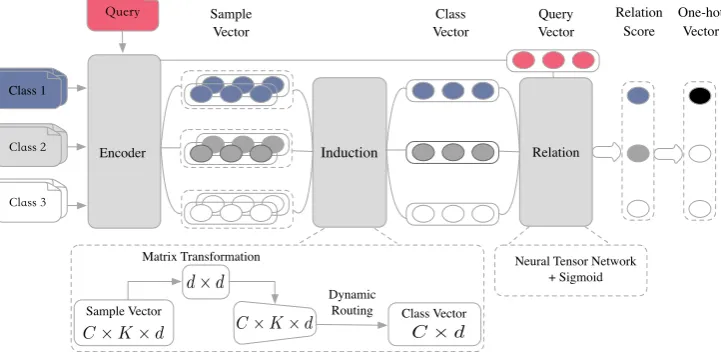
Recently, capsule network (Sabour et al.,2017) has been proposed, which possesses the exciting potential to address the aforementioned issue. A capsule network uses “capsules” that perform dy-namic routing to encode the intrinsic spatial re-lationship between parts and whole that consti-tutes viewpoint invariant knowledge. Following a similar spirit, we can regard samples as parts and class as a whole. We propose the Induc-tion Networks, which aims to model the ability of learning generalized class-level representation from samples in a small support set, based on the dynamic routing process. First, an Encoder Mod-ule generates representations for a query and sup-port samples. Next, an Induction Module executes a dynamic routing procedure, in which the ma-trix transformation can be seen as a map from the sample space to the class space, and then the gen-eration of the class representation is all depend-ing on the routdepend-ing-by-agreement procedure other than any parameters, which renders a robust induc-tion ability to the proposed model to deal with un-seen classes. By regarding the samples’ represen-tations as input capsules and the classes’ as output capsules, we expect to recognize the semantics of classes that is invariant to sample-level noise. Fi-nally, the interaction between queries and classes is modelled—their representations are compared by a Relation Module to determine if the query matches the class or not. Defining an episode-based meta-training strategy, the holistic model is meta-trained end-to-end with the generalizability and scalability to recognize unseen classes.
The specific contributions of our work are listed
as follows:
• We propose the Induction Networks for few-shot text classification. To deal with sample-wise diversity in the few-shot learning task, our model is the first, to the best of our knowledge, that explicitly models the abil-ity to induce class-level representations from small support sets.
• The proposed Induction Module combines the dynamic routing algorithm with typical meta-learning frameworks. The matrix trans-formation and routing procedure enable our model to generalize well to recognize unseen classes.
• Our method outperforms the current state-of-the-art models on two few-shot text classifi-cation datasets, including a well-studied sen-timent classification benchmark and a real-world dialogue intent classification dataset.
2 Related Work
2.1 Few-Shot Learning
The seminal work on few-shot learning dates back to the early 2000s (Fe-Fei et al., 2003; Fei-Fei et al., 2006). The authors combined generative models with complex iterative inference strate-gies. More recently, many approaches have used a meta-learning (Finn et al.,2017; Mishra et al., 2018) strategy in the sense that they extract some transferable knowledge from a set of auxiliary tasks, which then helps them to learn the tar-get few-shot problem well without suffering from overfitting. In general, these approaches can be divided into two categories.
Optimization-based Methods This type of ap-proach aims to learn to optimize the model param-eters given the gradients computed from the few-shot examples. Munkhdalai and Yu (2017) pro-posed the Meta Network, which learnt the meta-level knowledge across tasks and shifted its in-ductive biases via fast parameterization for rapid generalization. Mishra et al.(2018) introduced a generic meta-learning architecture called SNAIL which used a novel combination of temporal con-volutions and soft attention.
shot problem. The core idea in metric-based few-shot learning is similar to nearest neighbours and kernel density estimation. The predicted probabil-ity over a set of known labels is a weighted sum of labels of support set samples. Vinyals et al. (2016) produced a weighted K-nearest neighbour classifier measured by the cosine distance, which was called Matching Networks.Snell et al.(2017) proposed the Prototypical Networks which learnt a metric space where classification could be per-formed by computing squared Euclidean distances to prototype representations of each class. Differ-ent from fixed metric measures, the Relation Net-work learnt a deep distance metric to compare the query with given examples (Sung et al.,2018).
Recently, some studies have been presented fo-cusing specifically on few-shot text classification problems.Xu et al.(2018) studied lifelong domain word embeddings via meta-learning. Yu et al. (2018) argued that the optimal meta-model may vary across tasks, and they employed the multi-metric model by clustering the meta-tasks into several defined clusters.Rios and Kavuluru(2018) developed a few-shot text classification model for multi-label text classification where there was a known structure over the label space. Xu et al. (2019) proposed a open-world learning model to deal with the unseen classes in the product classi-fication problem. We solve the few-shot learning problem from a different perspective and propose a dynamic routing induction method to encapsu-late the abstract class representation from sam-ples, achieving state-of-the-art performances on two datasets.
2.2 Capsule Network
The Capsule Network was first proposed by Sabour et al.(2017), which allowed the network to learn robustly the invariants in part-whole relation-ships. Lately, Capsule Network has been explored in the natural language processing field. Yang et al. (2018) successfully applied Capsule Net-work to fully supervised text classification prob-lem with large labeled datasets. Unlike their work, we study few-shot text classification. Xia et al. (2018) reused the supervised model similar to that of Yang et al. (2018) for intent classification, in which a capsule-based architecture is extended to compute similarity between the target intents and source intents. Unlike their work, we propose In-duction Networks for few-shot learning, in which
we propose to use capsules and dynamic rout-ing to learn generalized class-level representation from samples based. The dynamic routing method makes our model generalize better in the few-shot text classification task.
3 Problem Definition
3.1 Few-Shot Classification
Few-shot classification (Vinyals et al.,2016;Snell et al., 2017) is a task in which a classifier must be adapted to accommodate new classes not seen in training, given only a few examples of each of these new classes. We have a large labeled train-ing set with a set of classesCtrain. However, after
training, our ultimate goal is to produce classifiers on the testing set with a disjoint set of new classes Ctest, for which only a small labeled support set
will be available. If the support set containsK la-beled examples for each of theC unique classes, the target few-shot problem is called aC-wayK -shot problem. Usually, theKis too small to train a supervised classification model. Therefore, we aim to perform meta-learning on the training set, and extract transferable knowledge that will allow us to deliver better few-shot learning on the sup-port set and thus classify the test set more accu-rately.
3.2 Training Procedure
Algorithm 1Episode-Based Meta Training 1: foreachepisode iterationdo
2: Randomly select C classes from the class space of the training set;
3: Randomly select K labeled samples from each of the C classes as support setS =
{(xs, ys)}ms=1(m=K×C), and select a
fraction of the reminder of thoseCclasses’ samples as query setQ={(xq, yq)}nq=1;
4: Feed the support setSto the model and up-date the parameters by minimizing the loss in the query setQ;
5: end for
159 5
!
= 794,747,031possible5−waytasks.
4 The Models
Our Induction Networks, depicted in Figure1(the case of 3-way 2-shot model), consists of three modules: Encoder Module, Induction Module and Relation Module. In the rest of this section, we will show how these modules work in each meta-episode.
4.1 Encoder Module
This module is a bi-direction recurrent neural net-work with self-attention as shown in Lin et al. (2017). Given an input textx= (w1, w2, ..., wT),
represented by a sequence of word embeddings. We use a bidirectional LSTM to process the text:
− →h
t = −−−−→LST M(wt, ht−1) (1)
←h−
t = ←−−−−LST M(wt, ht+1) (2)
And we concatenate−→htwith←h−tto obtain a hidden
stateht. Let the hidden state size for each
unidi-rectional LSTM beu. For simplicity, we note all theT htsasH = (h1, h2, ..., hT). Our aim is to
encode a variable length of text into a fixed size embedding. We achieve that by choosing a linear combination of the T LST M hidden vectors in H. Computing the linear combination requires the self-attention mechanism, which takes the whole LSTM hidden statesHas input, and outputs a vec-tor of weightsa:
a=sof tmax(Wa2tanh(Wa1HT)) (3)
hereWa1 ∈ Rda×2u andWa2 ∈ Rda are weight
matrices anddais a hyperparameter. The final
rep-resentationeof the text is the weighted sum ofH:
e= T
X
t=1
at·ht (4)
4.2 Induction Module
This section introduces the proposed dynamic routing induction algorithm. We regard these vectors e obtained from the support set S by Eq4as sample vectorses, and the vectorsefrom
the query set Q as query vectors eq. The most
important step is to extract the representation for each class in the support set. The main purpose of the induction module is to design a non-linear mapping from sample vectores
ij to class vectorci:
n
esij ∈R2uo
i=1,...C,j=1...K 7→
n
ci ∈R2u
oC
i=1.
We apply the dynamic routing algorithm (Sabour et al.,2017) in this module, in the situa-tion where the number of the output capsule is one. In order to acceptany-wayany-shot inputs in our model, a weight-sharable transformation across all sample vectors in the support set is employed. All of the sample vectors in the support set share the same transformation weightsWs ∈ R2u×2u and
biasbs, so that the model is flexible enough to
han-dle the support set at any scale. Each sample pre-diction vectoreˆs
ij is computed by:
ˆ
esij =squash(Wsesij+bs) (5)
wheresquashis a non-linear squashing function through the entire vector, which leaves the di-rection of the vector unchanged but decreases its magnitude. Given input vector x, squash is de-fined as:
squash(x) = kxk
2
1 +kxk2 x
kxk (6)
Eq 5 encodes important invariant semantic rela-tionships between lower level sample features and higher level class features (Hinton et al., 2011). To ensure the class vector encapsulates the sam-ple feature vectors of this class automatically, dy-namic routing is applied iteratively. In each itera-tion, the process dynamically amends the connec-tion strength and makes sure that the coupling co-efficientsdisum to1between classiand all
sup-port samples in this class by a “routing softmax”:
Induction
Class 1
Relation Score Query
Vector Class
Vector Sample
Vector
Encoder
One-hot Vector
Neural Tensor Network + Sigmoid Relation
Dynamic Routing Matrix Transformation
Sample Vector Class Vector
C<latexit sha1_base64="sEVDM1RosqZVg34KUxl5lp6fQ4I=">AAAC13icjVHLSsNAFD2Nr/qudekmWARXJRFBl0U3gpsK9iFVSpKOOpgXMxNRRNyJW3/Arf6R+Af6F94Zp+AD0QlJzpx7z5m594Z5zKXyvJeSMzI6Nj5Rnpyanpmdm68sVNsyK0TEWlEWZ6IbBpLFPGUtxVXMurlgQRLGrBOebet455wJybN0X13m7CgJTlJ+zKNAEdWvVLcPFU+YdHddCwb9Ss2re2a5P4FvQQ12NbPKMw4xQIYIBRIwpFCEYwSQ9PTgw0NO3BGuiBOEuIkzXGOKtAVlMcoIiD2j7wntepZNaa89pVFHdEpMryClixXSZJQnCOvTXBMvjLNmf/O+Mp76bpf0D61XQqzCKbF/6YaZ/9XpWhSOsWlq4FRTbhhdXWRdCtMVfXP3U1WKHHLiNB5QXBCOjHLYZ9dopKld9zYw8VeTqVm9j2xugTd9Sxqw/32cP0F7re57dX9vvdbYsqMuYwnLWKV5bqCBHTTRIu8LPOART86Bc+PcOncfqU7JahbxZTn375Ppli4=</latexit><latexit sha1_base64="sEVDM1RosqZVg34KUxl5lp6fQ4I=">AAAC13icjVHLSsNAFD2Nr/qudekmWARXJRFBl0U3gpsK9iFVSpKOOpgXMxNRRNyJW3/Arf6R+Af6F94Zp+AD0QlJzpx7z5m594Z5zKXyvJeSMzI6Nj5Rnpyanpmdm68sVNsyK0TEWlEWZ6IbBpLFPGUtxVXMurlgQRLGrBOebet455wJybN0X13m7CgJTlJ+zKNAEdWvVLcPFU+YdHddCwb9Ss2re2a5P4FvQQ12NbPKMw4xQIYIBRIwpFCEYwSQ9PTgw0NO3BGuiBOEuIkzXGOKtAVlMcoIiD2j7wntepZNaa89pVFHdEpMryClixXSZJQnCOvTXBMvjLNmf/O+Mp76bpf0D61XQqzCKbF/6YaZ/9XpWhSOsWlq4FRTbhhdXWRdCtMVfXP3U1WKHHLiNB5QXBCOjHLYZ9dopKld9zYw8VeTqVm9j2xugTd9Sxqw/32cP0F7re57dX9vvdbYsqMuYwnLWKV5bqCBHTTRIu8LPOART86Bc+PcOncfqU7JahbxZTn375Ppli4=</latexit><latexit sha1_base64="sEVDM1RosqZVg34KUxl5lp6fQ4I=">AAAC13icjVHLSsNAFD2Nr/qudekmWARXJRFBl0U3gpsK9iFVSpKOOpgXMxNRRNyJW3/Arf6R+Af6F94Zp+AD0QlJzpx7z5m594Z5zKXyvJeSMzI6Nj5Rnpyanpmdm68sVNsyK0TEWlEWZ6IbBpLFPGUtxVXMurlgQRLGrBOebet455wJybN0X13m7CgJTlJ+zKNAEdWvVLcPFU+YdHddCwb9Ss2re2a5P4FvQQ12NbPKMw4xQIYIBRIwpFCEYwSQ9PTgw0NO3BGuiBOEuIkzXGOKtAVlMcoIiD2j7wntepZNaa89pVFHdEpMryClixXSZJQnCOvTXBMvjLNmf/O+Mp76bpf0D61XQqzCKbF/6YaZ/9XpWhSOsWlq4FRTbhhdXWRdCtMVfXP3U1WKHHLiNB5QXBCOjHLYZ9dopKld9zYw8VeTqVm9j2xugTd9Sxqw/32cP0F7re57dX9vvdbYsqMuYwnLWKV5bqCBHTTRIu8LPOART86Bc+PcOncfqU7JahbxZTn375Ppli4=</latexit> ⇥K⇥d C⇥d
<latexit sha1_base64="oPE6sSkasJdBLSZjbGAxTRLvZTU=">AAACzXicjVHLSsNAFD2Nr1pfVZdugkVwVRIRdFnsxp0V7ANrkWQ6rYN5MZkIperWH3CrvyX+gf6Fd8YU1CI6IcmZc+85M/dePwlEqhzntWDNzM7NLxQXS0vLK6tr5fWNVhpnkvEmi4NYdnwv5YGIeFMJFfBOIrkX+gFv+9d1HW/fcJmKODpTo4T3Qm8YiYFgniLqvG5fKBHy1O5flitO1THLngZuDirIVyMuv+ACfcRgyBCCI4IiHMBDSk8XLhwkxPUwJk4SEibOcYcSaTPK4pThEXtN3yHtujkb0V57pkbN6JSAXklKGzukiSlPEtan2SaeGWfN/uY9Np76biP6+7lXSKzCFbF/6SaZ/9XpWhQGODQ1CKopMYyujuUumemKvrn9pSpFDglxGvcpLgkzo5z02Taa1NSue+uZ+JvJ1Kzeszw3w7u+JQ3Y/TnOadDaq7pO1T3dr9SO8lEXsYVt7NI8D1DDMRpokneERzzh2TqxMuvWuv9MtQq5ZhPflvXwAcEJksQ=</latexit>
<latexit sha1_base64="oPE6sSkasJdBLSZjbGAxTRLvZTU=">AAACzXicjVHLSsNAFD2Nr1pfVZdugkVwVRIRdFnsxp0V7ANrkWQ6rYN5MZkIperWH3CrvyX+gf6Fd8YU1CI6IcmZc+85M/dePwlEqhzntWDNzM7NLxQXS0vLK6tr5fWNVhpnkvEmi4NYdnwv5YGIeFMJFfBOIrkX+gFv+9d1HW/fcJmKODpTo4T3Qm8YiYFgniLqvG5fKBHy1O5flitO1THLngZuDirIVyMuv+ACfcRgyBCCI4IiHMBDSk8XLhwkxPUwJk4SEibOcYcSaTPK4pThEXtN3yHtujkb0V57pkbN6JSAXklKGzukiSlPEtan2SaeGWfN/uY9Np76biP6+7lXSKzCFbF/6SaZ/9XpWhQGODQ1CKopMYyujuUumemKvrn9pSpFDglxGvcpLgkzo5z02Taa1NSue+uZ+JvJ1Kzeszw3w7u+JQ3Y/TnOadDaq7pO1T3dr9SO8lEXsYVt7NI8D1DDMRpokneERzzh2TqxMuvWuv9MtQq5ZhPflvXwAcEJksQ=</latexit><latexit sha1_base64="oPE6sSkasJdBLSZjbGAxTRLvZTU=">AAACzXicjVHLSsNAFD2Nr1pfVZdugkVwVRIRdFnsxp0V7ANrkWQ6rYN5MZkIperWH3CrvyX+gf6Fd8YU1CI6IcmZc+85M/dePwlEqhzntWDNzM7NLxQXS0vLK6tr5fWNVhpnkvEmi4NYdnwv5YGIeFMJFfBOIrkX+gFv+9d1HW/fcJmKODpTo4T3Qm8YiYFgniLqvG5fKBHy1O5flitO1THLngZuDirIVyMuv+ACfcRgyBCCI4IiHMBDSk8XLhwkxPUwJk4SEibOcYcSaTPK4pThEXtN3yHtujkb0V57pkbN6JSAXklKGzukiSlPEtan2SaeGWfN/uY9Np76biP6+7lXSKzCFbF/6SaZ/9XpWhQGODQ1CKopMYyujuUumemKvrn9pSpFDglxGvcpLgkzo5z02Taa1NSue+uZ+JvJ1Kzeszw3w7u+JQ3Y/TnOadDaq7pO1T3dr9SO8lEXsYVt7NI8D1DDMRpokneERzzh2TqxMuvWuv9MtQq5ZhPflvXwAcEJksQ=</latexit>
C<latexit sha1_base64="sEVDM1RosqZVg34KUxl5lp6fQ4I=">AAAC13icjVHLSsNAFD2Nr/qudekmWARXJRFBl0U3gpsK9iFVSpKOOpgXMxNRRNyJW3/Arf6R+Af6F94Zp+AD0QlJzpx7z5m594Z5zKXyvJeSMzI6Nj5Rnpyanpmdm68sVNsyK0TEWlEWZ6IbBpLFPGUtxVXMurlgQRLGrBOebet455wJybN0X13m7CgJTlJ+zKNAEdWvVLcPFU+YdHddCwb9Ss2re2a5P4FvQQ12NbPKMw4xQIYIBRIwpFCEYwSQ9PTgw0NO3BGuiBOEuIkzXGOKtAVlMcoIiD2j7wntepZNaa89pVFHdEpMryClixXSZJQnCOvTXBMvjLNmf/O+Mp76bpf0D61XQqzCKbF/6YaZ/9XpWhSOsWlq4FRTbhhdXWRdCtMVfXP3U1WKHHLiNB5QXBCOjHLYZ9dopKld9zYw8VeTqVm9j2xugTd9Sxqw/32cP0F7re57dX9vvdbYsqMuYwnLWKV5bqCBHTTRIu8LPOART86Bc+PcOncfqU7JahbxZTn375Ppli4=</latexit><latexit sha1_base64="sEVDM1RosqZVg34KUxl5lp6fQ4I=">AAAC13icjVHLSsNAFD2Nr/qudekmWARXJRFBl0U3gpsK9iFVSpKOOpgXMxNRRNyJW3/Arf6R+Af6F94Zp+AD0QlJzpx7z5m594Z5zKXyvJeSMzI6Nj5Rnpyanpmdm68sVNsyK0TEWlEWZ6IbBpLFPGUtxVXMurlgQRLGrBOebet455wJybN0X13m7CgJTlJ+zKNAEdWvVLcPFU+YdHddCwb9Ss2re2a5P4FvQQ12NbPKMw4xQIYIBRIwpFCEYwSQ9PTgw0NO3BGuiBOEuIkzXGOKtAVlMcoIiD2j7wntepZNaa89pVFHdEpMryClixXSZJQnCOvTXBMvjLNmf/O+Mp76bpf0D61XQqzCKbF/6YaZ/9XpWhSOsWlq4FRTbhhdXWRdCtMVfXP3U1WKHHLiNB5QXBCOjHLYZ9dopKld9zYw8VeTqVm9j2xugTd9Sxqw/32cP0F7re57dX9vvdbYsqMuYwnLWKV5bqCBHTTRIu8LPOART86Bc+PcOncfqU7JahbxZTn375Ppli4=</latexit><latexit sha1_base64="sEVDM1RosqZVg34KUxl5lp6fQ4I=">AAAC13icjVHLSsNAFD2Nr/qudekmWARXJRFBl0U3gpsK9iFVSpKOOpgXMxNRRNyJW3/Arf6R+Af6F94Zp+AD0QlJzpx7z5m594Z5zKXyvJeSMzI6Nj5Rnpyanpmdm68sVNsyK0TEWlEWZ6IbBpLFPGUtxVXMurlgQRLGrBOebet455wJybN0X13m7CgJTlJ+zKNAEdWvVLcPFU+YdHddCwb9Ss2re2a5P4FvQQ12NbPKMw4xQIYIBRIwpFCEYwSQ9PTgw0NO3BGuiBOEuIkzXGOKtAVlMcoIiD2j7wntepZNaa89pVFHdEpMryClixXSZJQnCOvTXBMvjLNmf/O+Mp76bpf0D61XQqzCKbF/6YaZ/9XpWhSOsWlq4FRTbhhdXWRdCtMVfXP3U1WKHHLiNB5QXBCOjHLYZ9dopKld9zYw8VeTqVm9j2xugTd9Sxqw/32cP0F7re57dX9vvdbYsqMuYwnLWKV5bqCBHTTRIu8LPOART86Bc+PcOncfqU7JahbxZTn375Ppli4=</latexit> ⇥K⇥d
d⇥d
<latexit sha1_base64="WTMnVYNfMUrqj77Ec5NTiU1vDNg=">AAACzXicjVHLSsNAFD2Nr1pfVZdugkVwVRIR7LLgxp0V7ANbkSSd1qF5MZkIperWH3CrvyX+gf6Fd8YpqEV0QpIz595zZu69fhryTDrOa8Gam19YXCoul1ZW19Y3yptbrSzJRcCaQRImouN7GQt5zJqSy5B1UsG8yA9Z2x8dq3j7homMJ/G5HKfsMvKGMR/wwJNEXfTtnuQRy+z+VbniVB297FngGlCBWY2k/IIe+kgQIEcEhhiScAgPGT1duHCQEneJCXGCENdxhjuUSJtTFqMMj9gRfYe06xo2pr3yzLQ6oFNCegUpbeyRJqE8QVidZut4rp0V+5v3RHuqu43p7xuviFiJa2L/0k0z/6tTtUgMUNM1cKop1YyqLjAuue6Kurn9pSpJDilxCvcpLggHWjnts601ma5d9dbT8TedqVi1D0xujnd1Sxqw+3Ocs6B1UHWdqnt2WKnXzKiL2MEu9mmeR6jjBA00yTvGI57wbJ1auXVr3X+mWgWj2ca3ZT18AA2fkts=</latexit>
<latexit sha1_base64="WTMnVYNfMUrqj77Ec5NTiU1vDNg=">AAACzXicjVHLSsNAFD2Nr1pfVZdugkVwVRIR7LLgxp0V7ANbkSSd1qF5MZkIperWH3CrvyX+gf6Fd8YpqEV0QpIz595zZu69fhryTDrOa8Gam19YXCoul1ZW19Y3yptbrSzJRcCaQRImouN7GQt5zJqSy5B1UsG8yA9Z2x8dq3j7homMJ/G5HKfsMvKGMR/wwJNEXfTtnuQRy+z+VbniVB297FngGlCBWY2k/IIe+kgQIEcEhhiScAgPGT1duHCQEneJCXGCENdxhjuUSJtTFqMMj9gRfYe06xo2pr3yzLQ6oFNCegUpbeyRJqE8QVidZut4rp0V+5v3RHuqu43p7xuviFiJa2L/0k0z/6tTtUgMUNM1cKop1YyqLjAuue6Kurn9pSpJDilxCvcpLggHWjnts601ma5d9dbT8TedqVi1D0xujnd1Sxqw+3Ocs6B1UHWdqnt2WKnXzKiL2MEu9mmeR6jjBA00yTvGI57wbJ1auXVr3X+mWgWj2ca3ZT18AA2fkts=</latexit>
[image:5.595.118.479.67.243.2]<latexit sha1_base64="WTMnVYNfMUrqj77Ec5NTiU1vDNg=">AAACzXicjVHLSsNAFD2Nr1pfVZdugkVwVRIR7LLgxp0V7ANbkSSd1qF5MZkIperWH3CrvyX+gf6Fd8YpqEV0QpIz595zZu69fhryTDrOa8Gam19YXCoul1ZW19Y3yptbrSzJRcCaQRImouN7GQt5zJqSy5B1UsG8yA9Z2x8dq3j7homMJ/G5HKfsMvKGMR/wwJNEXfTtnuQRy+z+VbniVB297FngGlCBWY2k/IIe+kgQIEcEhhiScAgPGT1duHCQEneJCXGCENdxhjuUSJtTFqMMj9gRfYe06xo2pr3yzLQ6oFNCegUpbeyRJqE8QVidZut4rp0V+5v3RHuqu43p7xuviFiJa2L/0k0z/6tTtUgMUNM1cKop1YyqLjAuue6Kurn9pSpJDilxCvcpLggHWjnts601ma5d9dbT8TedqVi1D0xujnd1Sxqw+3Ocs6B1UHWdqnt2WKnXzKiL2MEu9mmeR6jjBA00yTvGI57wbJ1auXVr3X+mWgWj2ca3ZT18AA2fkts=</latexit>
Figure 1: Induction Networks architecture for aC-wayK-shot (C= 3,K= 2) problem with one query example
wherebi is the logits of coupling coefficients, and
initialized by 0 in the first iteration. Given each sample prediction vectorˆes
ij, each class candidate
vectorˆci is a weighted sum of all sample
predic-tion vectorsˆes
ij in classi:
ˆ
ci=
X
j
dij ·eˆsij (8)
then a non-linear“squashing”function is applied to ensure that the length of the vector output of the routing process will not exceed1:
ci =squash(ˆci) (9)
The last step in every iteration is to adjust the logits of coupling coefficientsbij by a “routing by
agreement” method. If the produced class candi-date vector has a large scalar output with one sam-ple prediction vector, there is a top-down feedback which increases the coupling coefficient for that sample and decreases it for other samples. This type of adjustment is very effective and robust for the few-shot learning scenario because it does not need to restore any parameters. Eachbijis updated
by:
bij =bij + ˆesij·ci (10)
Formally, we call our induction method as dy-namic routing induction and summarize it in Al-gorithm 2.
4.3 Relation Module
After the class vector ci is generated by the
In-duction Module and each query text in the query set is encoded to a query vectoreqby the Encoder
Algorithm 2Dynamic Routing Induction
Require: sample vectores
ij in support setS and
initialize the logits of coupling coefficients bij = 0
Ensure: class vectorci
1: for all samplesj= 1, ..., Kin classi: 2: ˆes
ij =squash(Wsesij+bs)
3: for iteriterations do
4: di=sof tmax(bi)
5: ˆci =P j
dij ·ˆesij
6: ci =squash(ˆci)
7: for all samplesj= 1, ..., K in classi: 8: bij =bij + ˆesij·ci
9: end for
10: Returnci
Module, the next essential procedure is to mea-sure the correlation between each pair of query and class. The output of the Relation Module is called the relation score, representing the correla-tion betweenci andeq, which is a scalar between 0 and 1. Specifically, we use the neural tensor layer (Socher et al.,2013) in this module, which has shown great advantages in modeling the rela-tionship between two vectors (Wan et al., 2016; Geng et al.,2017). We choose it as an interaction function in this paper. The tensor layer outputs a relation vector as follows:
v(ci, eq) =f
ciTM[1:h]eq
(11)
where Mk ∈ R2u×2u, k ∈ [1, ..., h]is one slice
The final relation scoreriq between the i-th class
and the q-th query is calculated by a fully con-nected layer activated by a sigmoid function.
riq =sigmoid(Wrv(ci, eq) +br) (12)
4.4 Objective Function
We use the mean square error (MSE) loss to train our model, regressing the relation scoreriq to the
ground truth yq: matched pairs have similarity 1
and the mismatched pair have similarity0. Given the support setSwithCclasses and query setQ=
{(xq, yq)}nq=1 in an episode, the loss function is
defined as:
L(S, Q) = C
X
i=1
n
X
q=1
(riq−1(yq ==i))2 (13)
conceptually we are predicting relation scores, which can be considered as a regression problem and the ground truth is within the space{0,1}.
All parameters of the three modules are trained jointly by backpropagation. The Adagrad (Duchi et al.,2011) is used on all parameters in each train-ing episode. Our model does not need any fine-tuning on the classes it has never seen due to its generalization nature. The induction and compar-ison ability are accumulated in the model along with the training episodes.
5 Experiments
We evaluate our model by conducting experiments on two few-shot text classification datasets. All the experiments are implemented with Tensorflow.
5.1 Datasets
Amazon Review Sentiment Classification (ARSC) FollowingYu et al.(2018), we use the multiple tasks with the multi-domain sentiment classification (Blitzer et al., 2007) dataset. The dataset comprises English reviews for 23 types of products on Amazon. For each product domain, there are three different binary classification tasks. These buckets then form 23 × 3 = 69 tasks in total. Following Yu et al. (2018), we select
12(4× 3) tasks from 4 domains (Books, DVD, Electronics and Kitchen) as the test set, and there are only five examples as support set for each label in the test set. We create 5-shot learning models on this dataset.
Training Set Testing Set
Class Num 159 57
Data Num 195,775 2,279 Data Num/Class ≥77 20∼77
Table 1: Details of ODIC
Model Mean Acc
Matching Networks (Vinyals et al.,2016) 65.73 Prototypical Networks (Snell et al.,2017) 68.17 Graph Network (Garcia and Bruna,2017) 82.61 Relation Network (Sung et al.,2018) 83.07 SNAIL (Mishra et al.,2018) 82.57 ROBUSTTC-FSL (Yu et al.,2018) 83.12 Induction Networks (ours) 85.63
Table 2: Comparison of mean accuracy (%) on ARSC
Open Domain Intent Classification for Dialog System (ODIC) We create this dataset by fetch-ing the log data on a real-world conversational platform. The enterprises submit various dialogue tasks with a great number of intents, but many in-tents have only a few labeled samples, which is a typical few-shot classification application. Fol-lowing the definition of the few-shot learning task, we divide the ODIC into a training set and a testing set and ensure that the labels of the two sets have no intersection. The details of the set partition are shown in Table1.
5.2 Experiment Setup
Baselines In this section, the baseline models in our experiments are introduced as follows.
• Matching Networks: a few-shot learning model using a metric-based attention method (Vinyals et al.,2016).
• Prototypical Networks: a deep metric-based method using sample average as class proto-types (Snell et al.,2017).
• Graph Network: a graph-based few-shot learning model that implements a task-driven message passing algorithm on the sample-wise level (Garcia and Bruna,2017).
• Relation Network: a few-shot learning model which uses a neural network as the distance metric and sums up sample vectors in the sup-port set as class vectors (Sung et al.,2018).
combi-Model 5-way Acc. 10-way Acc.
5-shot 10-shot 5-shot 10-shot
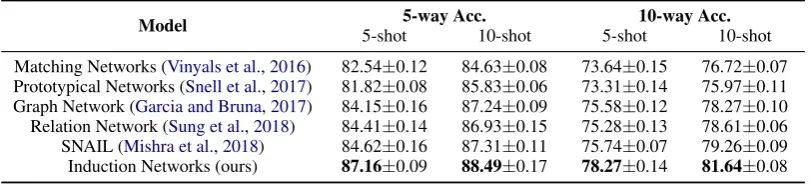
[image:7.595.97.503.63.155.2]Matching Networks (Vinyals et al.,2016) 82.54±0.12 84.63±0.08 73.64±0.15 76.72±0.07 Prototypical Networks (Snell et al.,2017) 81.82±0.08 85.83±0.06 73.31±0.14 75.97±0.11 Graph Network (Garcia and Bruna,2017) 84.15±0.16 87.24±0.09 75.58±0.12 78.27±0.10 Relation Network (Sung et al.,2018) 84.41±0.14 86.93±0.15 75.28±0.13 78.61±0.06 SNAIL (Mishra et al.,2018) 84.62±0.16 87.31±0.11 75.74±0.07 79.26±0.09 Induction Networks (ours) 87.16±0.09 88.49±0.17 78.27±0.14 81.64±0.08
Table 3: Comparison of mean accuracy (%) on ODIC
nation of temporal convolutions and soft at-tention (Mishra et al.,2018).
• ROBUSTTC-FSL: This approach combines several metric-based methods by clustering the tasks (Yu et al.,2018).
The baseline results on ARSC are reported in Yu et al.(2018) and we implemented the baseline models on ODIC with the same text encoder mod-ule.
Implementation Details We use 300-dimension Glove embeddings (Pennington et al., 2014) for ARSC dataset and 300-dimension Chinese word embeddings trained byLi et al.(2018) for ODIC. We set the hidden state size of LSTMu= 128and the attention dimension da = 64. The iteration
numberiterused in dynamic routing algorithm is
3. The relation module is a neural tensor layer with h = 100followed by a fully connected layer ac-tivated by sigmoid. We build2-way5-shot mod-els on ARSC followingYu et al.(2018), and build episode-based meta training withC = [5,10]and K = [5,10]for comparison on ODIC. In addition toKsample texts as support set, the query set has 20 query texts for each of theCsampled classes in every training episode. This means, for example, that there are20×5 + 5×5 = 125texts in one training episode for the5-way5-shot experiments.
Evaluation Methods We evaluate the perfor-mance by few-shot classification accuracy follow-ing previous studies in few-shot learnfollow-ing (Snell et al., 2017;Sung et al., 2018). To evaluate the proposed model with the baselines objectively, we compute mean few-shot classification accuracies on ODIC over 600 randomly selected episodes from the testing set. We sample 10 test texts per class in each episode for evaluation in both5-shot and 10-shot scenarios. Note that for ARSC, the support set for testing is fixed byYu et al.(2018). Consequently, we just need to run the test episode
once for each of the target tasks. The mean accu-racy of the 12 target task is compared to the base-line models followingYu et al.(2018).
5.3 Experiment Results
Overall Performance Experiment results on ARSC are presented in Table 2. The proposed Induction Networks achieves a 85.63% accuracy, outperforming the existing state-of-the-art model, ROBUSTTC-FSL, by a notable 3% improve-ment. We due the improvement to the fact that ROBUSTTC-FSL builds a general metric method by integrating several metrics at the sample level, which faces the difficulty of getting rid of the noise among different expressions in the same class. In addition to that, the task-clustering-based method used by ROBUSTTC-FSL must be found on the relevance matrix, which is inefficient when applied to real-world scenarios where the tasks change rapidly. Our Induction Networks, how-ever, is trained in the meta-learning framework with more flexible generalization and its induction ability can hence be accumulated through different tasks.
Iteration Accuracy
Routing+Relation 3 85.63
[image:8.595.91.270.63.144.2]Routing+Relation 2 85.41 Routing+Relation 1 85.06 Routing + Cosine 3 84.67 Sum +Relation - 83.07 Attention + Relation - 85.15
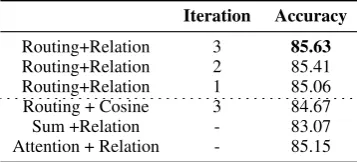
Table 4: Ablation study of Induction Networks on ARSC dataset
addition, the performance difference between our model and other baselines in the 10-shot scenario is more significant than in the 5-shot scenario. This is because in the 10-shot scenario, for the baseline models the improvement brought by a bigger data size is also diminished by more sample level noises.
Ablation Study To analyze the effect of vary-ing different components of the Induction Module and Relation Module, we further report the abla-tion experiments on the ARSC dataset as shown in Table4. We can see that the best performance is achieved when we used3 iterations, correspond-ing to the best result reported in Table 2 (more rounds of iterations did not further improve the performance), and the table shows the effective-ness of the routing component. We also changed the Induction Module with sum and self-attention and changed Relation Module with cosine dis-tance. Changes in the performances validate the benefit of both the Relation Module and Induc-tion Module. The AttenInduc-tion+RelaInduc-tion models the induction ability by self-attention mechanism, but the ability is limited by the learnt attention param-eters. Conversely, the proposed dynamic routing induction method captures class-level information by automatically adjusting the coupling coeffi-cients according to inputted support sets, which is more suitable for the few-shot learning task.
5.4 Further Analysis
We further analyze the effect of transformation and visualize query text vectors to show the ad-vantage of the Induction Networks.
Effect of Transformation Figure 2 shows the t-SNE (Maaten and Hinton, 2008) visualization of support sample vectors before and after matrix transformation under the 5-way 10-shot scenario. We randomly select a support set with 50 texts (10 texts per class) from the ODIC testing set, and
[image:8.595.323.508.69.137.2]ob-(a) Before transformation (b) After transformation
Figure 2: Effect of Transformation under the5-way10
-shot scenario. (a) The support sample vectors before matrix transformation. (b) The support sample vectors after matrix transformation.
[image:8.595.328.508.216.285.2](a) Relation Network (b) Induction Networks
Figure 3: Query text vector visualization learnt by (a) Relation Network and (b) Induction Networks.
tain the sample vectors nes ij
o
i=1,...5,j=1...10 after
the encoder module and the sample prediction vec-tor neˆs
ij
o
i=1,...5,j=1...10 after transformation. We
can see that the vectors after matrix transformation are more separable, demonstrating the effective-ness of matrix transformation to encode semantic relationships between lower-level sample features and higher-level class features.
Query Text Vector Visualization We also find out that our induction module does not only work well in generating effective class-level features, but also helps the encoders to learn better text vec-tors, as it can give different weights to instances and features during backpropagation. Figure 3 shows the t-SNE (Maaten and Hinton,2008) visu-alization of text vectors from the same randomly selected five classes, learnt by the Relation Net-work and our Induction NetNet-works. It is clear that the text vectors learnt by Induction Networks are better separated semantically than those of Rela-tion Network.
6 Conclusion
routing mechanism makes our model more gen-eral to recognize unseen classes. The experiment results show that the proposed model outperforms the existing state-of-the-art few-shot text classi-fication models. We found that both the matrix transformation and routing procedure contribute consistently to the few-shot learning tasks.
Acknowledgments
The authors would like to thank the organizers of EMNLP-IJCNLP2019 and the reviewers for their helpful suggestions. This research work is sup-ported by the National Key Research and De-velopment Program of China under Grant No. 2017YFB1002103, the National Natural Science Foundation of China under Grant No. 61751201, and the Research Foundation of Beijing Municipal Science & Technology Commission under Grant No. Z181100008918002.
References
John Blitzer, Mark Dredze, and Fernando Pereira.
2007. Biographies, bollywood, boom-boxes and
blenders: Domain adaptation for sentiment
classifi-cation. InProceedings of the 45th annual meeting of
the association of computational linguistics, pages 440–447.
John Duchi, Elad Hazan, and Yoram Singer. 2011. Adaptive subgradient methods for online learning
and stochastic optimization. Journal of Machine
Learning Research, 12(Jul):2121–2159.
Li Fe-Fei et al. 2003. A bayesian approach to unsu-pervised one-shot learning of object categories. In
Computer Vision, 2003. Proceedings. Ninth IEEE International Conference on, pages 1134–1141. IEEE.
Li Fei-Fei, Rob Fergus, and Pietro Perona. 2006.
One-shot learning of object categories. IEEE
transac-tions on pattern analysis and machine intelligence, 28(4):594–611.
Chelsea Finn, Pieter Abbeel, and Sergey Levine. 2017. Model-agnostic meta-learning for fast adaptation of
deep networks. InProceedings of the 34th
Interna-tional Conference on Machine Learning-Volume 70, pages 1126–1135. JMLR. org.
Victor Garcia and Joan Bruna. 2017. Few-shot
learning with graph neural networks. CoRR,
abs/1711.04043.
Ruiying Geng, Ping Jian, Yingxue Zhang, and Heyan Huang. 2017. Implicit discourse relation
identifica-tion based on tree structure neural network. In2017
International Conference on Asian Language Pro-cessing (IALP), pages 334–337. IEEE.
Xavier Glorot, Antoine Bordes, and Yoshua Bengio.
2011. Deep sparse rectifier neural networks. In
Pro-ceedings of the fourteenth international conference on artificial intelligence and statistics, pages 315– 323.
Geoffrey E Hinton, Alex Krizhevsky, and Sida D
Wang. 2011. Transforming auto-encoders. In
Inter-national Conference on Artificial Neural Networks, pages 44–51. Springer.
Shaohui Kuang, Junhui Li, Ant´onio Branco, Weihua Luo, and Deyi Xiong. 2018. Attention focusing for neural machine translation by bridging source and
target embeddings. InProceedings of the 56th
An-nual Meeting of the Association for Computational Linguistics (Volume 1: Long Papers), volume 1, pages 1767–1776.
Shen Li, Zhe Zhao, Renfen Hu, Wensi Li, Tao Liu, and Xiaoyong Du. 2018. Analogical reasoning on
chi-nese morphological and semantic relations. In
Pro-ceedings of the 56th Annual Meeting of the Associa-tion for ComputaAssocia-tional Linguistics (Volume 2: Short Papers), pages 138–143.
Zhouhan Lin, Minwei Feng, Cicero Nogueira dos San-tos, Mo Yu, Bing Xiang, Bowen Zhou, and Yoshua Bengio. 2017. A structured self-attentive sentence
embedding. arXiv preprint arXiv:1703.03130.
Laurens van der Maaten and Geoffrey Hinton. 2008.
Visualizing data using t-sne. Journal of machine
learning research, 9(Nov):2579–2605.
Nikhil Mishra, Mostafa Rohaninejad, Xi Chen, and Pieter Abbeel. 2018. A simple neural attentive
meta-learner. In Proceedings of ICLR.
Tsendsuren Munkhdalai and Hong Yu. 2017. Meta
networks. InProceedings of the 34th International
Conference on Machine Learning-Volume 70, pages 2554–2563. JMLR. org.
Jeffrey Pennington, Richard Socher, and Christopher
Manning. 2014. Glove: Global vectors for word
representation. InProceedings of the 2014
confer-ence on empirical methods in natural language pro-cessing (EMNLP), pages 1532–1543.
Hang Qi, Matthew Brown, and David G Lowe. 2018.
Low-shot learning with imprinted weights. In
Pro-ceedings of the IEEE Conference on Computer Vi-sion and Pattern Recognition, pages 5822–5830.
Anthony Rios and Ramakanth Kavuluru. 2018. Few-shot and zero-Few-shot multi-label learning for structured
label spaces. In Proceedings of the 2018
Confer-ence on Empirical Methods in Natural Language Processing, pages 3132–3142.
Sara Sabour, Nicholas Frosst, and Geoffrey E Hinton.
2017. Dynamic routing between capsules. In
Justin Salamon and Juan Pablo Bello. 2017. Deep con-volutional neural networks and data augmentation
for environmental sound classification. IEEE Signal
Processing Letters, 24(3):279–283.
Jake Snell, Kevin Swersky, and Richard Zemel. 2017.
Prototypical networks for few-shot learning. In
Ad-vances in Neural Information Processing Systems, pages 4077–4087.
Richard Socher, Danqi Chen, Christopher D Manning, and Andrew Ng. 2013. Reasoning with neural
ten-sor networks for knowledge base completion. In
Advances in neural information processing systems, pages 926–934.
Flood Sung, Yongxin Yang, Li Zhang, Tao Xiang, Philip HS Torr, and Timothy M Hospedales. 2018. Learning to compare: Relation network for few-shot
learning. In Proceedings of the IEEE Conference
on Computer Vision and Pattern Recognition, pages 1199–1208.
Oriol Vinyals, Charles Blundell, Tim Lillicrap, Daan Wierstra, et al. 2016. Matching networks for one
shot learning. In Advances in Neural Information
Processing Systems, pages 3630–3638.
Shengxian Wan, Yanyan Lan, Jiafeng Guo, Jun Xu, Liang Pang, and Xueqi Cheng. 2016. A deep ar-chitecture for semantic matching with multiple
po-sitional sentence representations. In AAAI,
vol-ume 16, pages 2835–2841.
Congying Xia, Chenwei Zhang, Xiaohui Yan,
Yi Chang, and Philip Yu. 2018. Zero-shot user
intent detection via capsule neural networks. In
Proceedings of the 2018 Conference on Empirical Methods in Natural Language Processing, pages 3090–3099.
Hu Xu, Bing Liu, Lei Shu, and P Yu. 2019. Open-world learning and application to product
classifi-cation. InThe World Wide Web Conference, pages
3413–3419. ACM.
Hu Xu, Bing Liu, Lei Shu, and Philip S Yu. 2018. Life-long domain word embedding via meta-learning.
arXiv preprint arXiv:1805.09991.
Min Yang, Wei Zhao, Jianbo Ye, Zeyang Lei, Zhou Zhao, and Soufei Zhang. 2018. Investigating cap-sule networks with dynamic routing for text
classifi-cation. InProceedings of the 2018 Conference on
Empirical Methods in Natural Language
Process-ing, pages 3110–3119.
Mo Yu, Xiaoxiao Guo, Jinfeng Yi, Shiyu Chang, Saloni Potdar, Yu Cheng, Gerald Tesauro, Haoyu Wang, and Bowen Zhou. 2018. Diverse few-shot text
clas-sification with multiple metrics. In Proceedings of