Volume 2006, Article ID 96247, Pages1–12 DOI 10.1155/ASP/2006/96247
Sparse Representations Are Most Likely to
Be the Sparsest Possible
Michael Elad
Computer Science Department, The Technion – Israel Institute of Technology, Haifa 32000, Israel
Received 5 September 2004; Revised 23 January 2005; Accepted 27 January 2005
Given a signalS∈RNand a full-rank matrixD∈RN×LwithN < L, we define the signal’s overcomplete representations as allα∈
RLsatisfyingS=Dα. Among all the possible solutions, we have special interest in the sparsest one—the one minimizingα0. Previous work has established that a representation is unique if it is sparse enough, requiringα0 <Spark(D)/2. The measure Spark(D) stands for the minimal number of columns fromDthat are linearly dependent. This bound is tight—examples can be constructed to show that with Spark(D)/2 or more nonzero entries, uniqueness is violated. In this paper we study the behavior of overcomplete representations beyond the above bound. While tight from a worst-case standpoint, a probabilistic point of view leads to uniqueness of representations satisfyingα0 <Spark(D). Furthermore, we show that even beyond this point, unique-ness can still be claimed with high confidence. This new result is important for the study of the average performance of pursuit algorithms—when trying to show an equivalence between the pursuit result and the ideal solution, one must also guarantee that the ideal result is indeed the sparsest.
Copyright © 2006 Hindawi Publishing Corporation. All rights reserved.
1. INTRODUCTION
1.1. General—sparse representations
In signal processing we are often interested in a replacement of the representation, seeking some simplification for an ob-vious gain. This is the rational behind the so many trans-forms proposed over the past several centuries, such as the Fourier, cosine, wavelets, and many others. The basic idea is to “change language,” and describe the signal differently, in the hope that the new description is better for the ap-plication in mind. A natural justification for a transform is that given a signal, a representation has already been im-posed due to the use of the trivial basis (e.g., samples as a function of time/space), and there is no reason to believe that this representation is the most appropriate one for our needs.
The ease with which linear transforms are operated and analyzed keeps those as the first priority candidates in defin-ing alternative representations. It is therefore not surprisdefin-ing to find that linear transforms are the more popular ones in theory and practice in signal processing. A linear transform is defined through the use of a full-rank matrixD∈RN×L,
whereL≥N. Given the signalS∈RN, its representation is
defined by
S=Dα, (1)
whereα ∈ RL. For the case ofL =N (and a nonsingular
matrixDdue to the full-rank property), the above relation-ship implies a linear operation both for the forward trans-form (from S to α) and its inverse. Many of the practical transforms are of this type, and many of them go further and simplify the matrixDto be structured and unitary, so that its inverse is easier to operate and both directions can be com-puted with nearlyO(N) operations. Such is the case with the DFT, DCT, the Hadamard, orthonormal wavelet, and other transforms.
In this paper we are interested in the case ofL > N, re-ferred to as the overcomplete transforms. WhenL > N, the relationship in (1) is an underdetermined linear set of equa-tions, and thus in general it leads to an infinite number of possible solutions. Further information is therefore needed in order to uniquely define the transform, and this is typi-cally achieved by defining the representation as the solution of
min
α αp subject toS=Dα. (Pp)
A different and far more complicated approach advo-cated strongly in recent years is to consider p = 0. The0 notation is an abusedp-norm withp→0, effectively count-ing the number of nonzeros in the vectorα. In such an ap-proach we seek among all feasible representations (satisfying the constraint in (Pp)) the one with the fewest nonzero en-tries, this way achieving an ultimate simplicity in represen-tation. Referring to the matrixDas a dictionary of signal-prototypes as its columns, we buildsas a linear combination of only few of these columns, typically referred to as atoms. Thus, we can think of our signal as a molecule, and the for-ward transform decomposes it to its building atoms, where we try to use the fewest in this construction [1].
From the numerical standpoint, the forward transform, defined as (P0), is a nonconvex and highly nonsmooth op-timization problem, with many possible local minimum points. Prior work has established that this problem is an NP-hard one, its complexity grows exponentially with the number of columns in the dictionary [2,3]. Recent study of this problem and methods to approximate its solution give promising new results, indicating that even though com-plicated, means exist to solve it at least in some cases us-ing either greedy [4–13] or convex programming approaches [1,10,14–20]. One aspect of these recent works is the result of uniqueness which will be the focus of this paper.
1.2. The uniqueness result—worst-case analysis
We consider the problem
min
α α0 subject toS=Dα. (P0)
As explained above, the termα0 stands for the count of the nonzero entries inα. Previous work has shown that if a feasible solutionα0 is sparse enough, it can be guaranteed to be the solution of (P0) [18,19]. The argument is
sur-prisingly simple and has the following reasoning: for a given dictionary D, its Spark is defined as the smallest number of columns fromDthat are linearly dependent. This scalar characterizes the dictionary with respect to sparse represen-tations from a worst-case standpoint. By definition, the vec-tors in the null space of the dictionaryDδ =0 must satisfy
δ0≥Spark(D), since they linearly combine columns from
Dto give the zero vector, and at least such Spark columns are necessary.
Ifα0 representsS, that is, S = Dα0, it implies that all the alternative representations of the same signal are char-acterized asα0+δ, forδ ∈ Null(D). Ifα0satisfiesα0 < Spark(D)/2, no vectorδfrom this null space exists such that it could be added toα0, nulling more entries than the newly introduced ones. Thus, this representation must be the spars-est one possible.
This result is very elementary and yet quite surprising, bearing in mind that (P0) is a highly complicated
optimiza-tion task of combinatorial flavor. In general, one cannot ex-pect to successfully solve it unless a brute-force search is used. The above uniqueness result, while not constructive, implies that if a sparse enough solution is found via some approxi-mation method, it can be guaranteed to be the desired global
optimizer. In general, when solving such complicated opti-mization problems, even if a solution is proposed, one can at best guarantee that locally it is optimal, by searching a feasi-ble descent direction and finding none. Here we are afeasi-ble to guarantee globally that this is the best solution, and hence the surprise.
Clearly, we can show that the above result is tight by def-inition. Suppose that we have a null-space vectorδsuch that
Dδ=0 with δ0=Spark(D)—this vector is realizing the Spark, and thus its existence is guaranteed. Then, taking its first Spark(D)/2 nonzero entries and zeroing the rest, we get
a new vectorαwithα0=Spark(D)/2 being the representa-tion of a necessarily nonzero signalDα=S. For this specific signal we have yet another representation of the same car-dinality, becauseα−δhas Spark(D)/2 nonzeros too, repre-senting the same signal. Similarly, when choosing more than half of the nonzeros in δ to α, the remaining entries will form an alternative sparser representation. This way we have constructed a special signal for which uniqueness cannot be guaranteed.
1.3. Behavior beyond the bound
Does the above example imply that beyond the Spark(D)/2
bound we are destined to nonuniqueness? The answer is yes, if we think in terms of worst case. Does the above example imply that a randomly chosen representation with cardinal-ity beyond the bound is necessarily not unique? Definitely not! In fact, given an arbitrary sparse representation with a number of nonzeros beyond this bound but still relatively low, chances are that this is the sparsest possible representa-tion for the signal it forms. Said differently, examples show-ing the tightness of the uniqueness theorem, as constructed above, are very few and rare, and when a probabilistic point of view is adopted, their relative weight is expected to dimin-ish entirely.
Thus, the question we pose here is more general and ad-dresses the uniqueness property of candidate solutions to (P0), hoping to enable some guarantees even beyond the
worst-case bound mentioned above.
1.4. This work and prior art
In this paper we study the behavior of overcomplete rep-resentations beyond the known uniqueness bound. When adopting a probabilistic point of view, we show both em-pirically and theoretically that uniqueness can be guaranteed with high confidence with Spark(D)/2 and more nonzero
en-tries. We show that the above-mentioned counter examples to uniqueness are of zero measure for representations satis-fyingα0<Spark(D). Furthermore, we show that even be-yond this point, uniqueness can be still claimed with reason-able probability.
In order to build these results, we propose to characterize the dictionary in a way that extends the Spark, forming the
signatureof the matrix. Whereas the Spark “thinks”
This signature is used to analyze the uniqueness and compose the results presented.
At the heart of the analysis proposed here is a specific probability density function (PDF) assumed on the signal space. However, instead of specifying this PDF directly with respect to the signals, it is driven via the representations. A commonly used regularization in inverse problems forces sparsity of the representation of the unknown signal, and assumes independence in its coefficients [1]. Such regular-ization is essentially the manifestation of a PDF on the un-known signal. Thus, generating representations following these rules, signals emerge with a PDF being a mixture of Gaussians. Thus, motivated by how sparsity is used in inverse problems, we propose a simple signal source model. The bot-tom line to this work is the claim that when a sparse repre-sentation is given from this source, it is most likely to be the sparsest one possible. The bound for measuring how sparse is sparse enough for this claim to be true is less restrictive than previously believed.
One word of caution is necessary here:we use here a prob-abilistic model to describe how signals and their originating representations are constructed. For those signals once gen-erated, the rules of uniqueness apply as indicated here. How-ever, when a candidate representation describing a signalS is given from a different source, we cannot apply the given analysis. The reason is that the proposed representation may be drawn from a different distribution, with more empha-sis on the “dark zone” of nonuniqueness. This, for example, explains why we cannot use the uniqueness results we obtain and impose them on the output of the pursuit algorithms as a simple test of success. Pursuit algorithms may (and will) tend to generate nonunique representations, which explains why a separate analysis for them is required. Still, for such analysis to take place, we must start with representations known to be unique, at least in probability, in order to carry out the study. Such analysis will benefit from the results given here.
Indeed, in a very recent pioneering work by Cand`es and Romberg (see [21]) and a parallel work by Donoho [22], the average performance of the basis pursuit has been studied, using the same signal source model as described above. A vi-tal part of their analysis is the uniqueness claim: when trying to show an equivalence between the pursuit result and the ideal solution, one must also guarantee that the ideal result is indeed the sparsest one possible. In their work, the authors considered a special dictionary structure built of two uni-tary matrices, and focused on asymptotic results. Here we discuss the uniqueness for general dictionaries of arbitrary finite sizes, and take a completely different route.
1.5. This paper
In the next section we start with a simple experiment that explains what is the goal of this work. We show that the em-pirical probability for obtaining uniqueness is far better than theoretically suggested so far. In Section 3 we propose an analysis to explain this behavior.Section 4summarizes some of our thoughts about the role of the pursuit algorithms in seeking approximate solutions to (P0), and our expectations
regarding their average performance, compared to the exist-ing worst-case analysis.Section 5summarizes and concludes this paper.
2. EMPIRICAL EVIDENCE
Before proving new properties on sparse representations, let us start by simple yet illustrative experiments that will demonstrate the results we expect to theoretically document later on. We start with the construction of the dictionary. Assume thatD∈R8×20 is built by a concatenation of ran-dom white and zero-mean multivariate Gaussian vectors as its columns. We obtain a full-rank matrix and its Spark is 9, that is, no 8 columns in this matrix can be found to be linearly dependent. This is a general property for such ran-dom matrices, stemming from the fact that square ranran-dom matrices are nonsingular with probability 1 (see the seminal work by Edelman and later by Shen [23,24] on the proba-bilistic behavior of the extreme singular values of such ma-trices). Based on the known uniqueness result, every repre-sentation with less than Spark(D)/2=4.5 nonzeros must be
unique. Thus, we are interested in studying the representa-tions withα0>4. Clearly, there is no point in considering representations withα0>8, since those cannot be unique by definition.
Studying representations withα0 =8 is also expected to give nonuniqueness, although of a weaker form. Any such representation could be at least replaced by equally good rep-resentations coming from allL8column combinations from
D. Nevertheless, it is interesting to see whether better rep-resentations (with cardinality strictly fewer than 8) could be found in such cases. Thus, the rangeα0∈[5, 8] is to be ex-perimented on. In our experiment we cover the interval [1, 8] disregarding the lower part being theoretically guaranteed by a known result. We can generate many such representations by first choosing theknonzero locations at random with uni-form probability, and then assigning values to thesek loca-tions independently, using some scalar distribution rule. In our experiment we assume that these values are drawn from a zero-mean, unit variance, and independent Gaussian dis-tribution.
In the above process we actually induce a probability density function on the representations of cardinalityk, and through it a distribution on the signal family that has repre-sentations of that cardinality. This is a key feature that will be repeated in our theoretical analysis—rather than starting from the signal PDF, we choose to embark from the represen-tation vectors. As sparsity of represenrepresen-tations has been shown to be a powerful signal prior used in inverse problems, gen-erating signals this way makes a lot of sense, not just due to the ease of analysis it brings along here.
Given such a random representation,α, the signal it rep-resents is given byDα=s. We can now search exhaustively
through all other combinations ofk or less columns from
1 2 3 4 5 6 7 8 Cardinality of representation
0 0.2 0.4 0.6 0.8 1 1.2
R
elati
ve
n
u
mber
of
ex
per
iments
Success (same cardinality solutions) Total uniqueness
Figure1: Results of the first experiment: a random dictionary of size 8×20 with Spark=9. Dark gray: relative number of examples giving equally sparse alternatives. Light gray: relative number of ex-amples giving no alternatives with equal or lower cardinality.
Din this experiment. Per each such candidate set of columns, the least-squares (LS) solution with the submatrix containing the chosen columns dictates the most suitable coefficients, and if the LS error is below the arithmetic accuracy thresh-old, a candidate representation is assumed found.
We have conducted this experiment as described, and
Figure 1documents its results. Per every cardinality in the range [1, 8] we performed 100 experiments and we present the relative number of experiments that ended with perfect success (no sparser solution is found) and also the relative number of experiments that ended with partial success (rep-resentations with the same cardinality could also be con-sidered as acceptable). We see that uniqueness can be em-pirically guaranteed for all representations with cardinality smaller or equal to 7. For representations with 8 nonzero entries, while there are other equivalently sparse representa-tions, there were no better (sparser) ones found.
A second experiment was performed following the same structure, but with a modified dictionary. After creating the random matrix as before, we replaced the first column with a linear combination of the last five. This way we have changed the dictionary’s Spark to 6 (or below, if we are re-ally unlucky—again, probabilistic results on random ma-trices suggest that in this case finding a group of less than 6 columns being linearly dependent is of probability zero).
Figure 2presents the results obtained this time. We see sev-eral interesting effects.
(1) The existing uniqueness bound suggests that unique-ness can be guaranteed for 2 nonzero entries and below. We see that up to 5 =Spark(D)−1 entries, we empirically get that the representations are unique.
(2) Even beyond this cardinality we can still get unique-ness with high probability—a phenomenon we will explain
1 2 3 4 5 6 7 8
Cardinality of representation 0
0.2 0.4 0.6 0.8 1 1.2
R
elati
ve
n
u
mber
of
ex
per
iments
Success (same cardinality solutions) Total uniqueness
Figure2: Results of the second experiment: a random dictionary of size 8×20 with Spark=6. Dark gray: relative number of exam-ples giving equally sparse alternatives. Light gray: relative number of examples giving no alternatives with equal or lower cardinality.
later on. For representations with 6 and 7 nonzero entries, even in cases of violated uniqueness, this violation is due to other representations of the same cardinality and not ones with a strictly sparser form.
(3) As in the previous experiment, for representations with 8 nonzero entries we can find equivalently sparse repre-sentations but not better ones, so this is a weaker uniqueness success.
The obvious question raised by the above two experi-ments is whether we can theoretically explain such results, and in this way discuss average uniqueness performance, rather than let extreme cases dictate the analysis of unique-ness. The next section provides this theoretic explanation, and as we will see, it is almost straightforward.
3. THEORETICAL STUDY OF UNIQUENESS BEYOND THE BOUND
3.1. Some ugly preliminaries
Since our analysis is of a probabilistic flavor, it is clear that it has to be built on a specific random distribution of the signals, and the results will be different for different signals’ source models. As we have already indicated in the previous section, instead of specifying this signal’s PDF directly, it will be implied indirectly by the representation’s PDF we eff ec-tively use. We assume the following on the PDF of the repre-sentation vectors.
(1) The probability for each cardinality is fixed and known:
pk=Probα0=K
For example,pkcould be inversely proportional toKin some way, to indicate that signals tend to have sparse representa-tions, or it could be uniform in the range [1,N] and zero elsewhere.
(2) The nonzeros in the representation vector are uni-formly spread with no preference to one zone over another:
∀j1=j2, Probαj1
=0| α0=K
=Probαj2
=0| α0=K
forK,j1,j2=1, 2,. . .,L. (3)
In fact, this condition can be relaxed substantially and replaced by a nonuniform probability, as long as we avoid degeneracy, that is,
∀j, Probα(j)=0| α0=K
>0. (4)
(3) The locations of the different nonzero entries in a given representation are statistically independent:
∀j1=j2, Probαj1
,αj2
=0| α0=K
=Probαj1
=0| α0=K
·Probαj2
=0| α0=K
forK,j1,j2=1, 2,. . .,L. (5)
Thus, theKlocations are chosen at random with equal and independent probability, and this means that every com-bination of K entries has an equal chance to be selected. Again, this condition could be relaxed to allow statistical de-pendencies, as long as no degeneracies are encountered.
(4) TheKnonzero entries in an representation are ran-domly generated from a Gaussian distribution with zero-mean and unit variance:
Probα(j)| α0=K,α(j)=0
=√1
2πexp
−α(j)2
2 forK,j=1, 2,. . .,L. (6)
There is no special reason for the Gaussianity, and any rea-sonable nondegenerate alternative distribution can be as-sumed in replacement.
(5) The nonzero entries in a representation are mutually independent:
∀j1=j2, Probαj1
,αj2
| α0=K,α
j1
=0,αj2
=0
=Probαj1
| α0=K,α
j1
=0
·Probαj2
| α0=K,α
j2
=0 forK,j1,j2=1, 2,. . .,L.
(7)
We refer hereafter to representations coming from the above distribution as the output of the machineM. Those are
first generated by randomly choosing the cardinality based onpk, then by choosing the involved columns, and finally by choosing the nonzero coefficients’ values.
When considering representations of cardinalityK, there areKspecific columns fromDmultiplied by a random vector of lengthKbeing a white multivariate normalized Gaussian. Thus, referring to the dictionary as deterministic, the PDF Prob{s/support{α}}is of a multivariate Gaussian distribu-tion of dimensionality dictated by both the rank of the sub-matrix of chosen columns fromD, andα0. For example, forα0=Spark(D)−1=K, the rank of the subdictionary is necessarily full (otherwise we contradict the definition of the Spark), and thus we get an ellipsoid in theKth dimen-sions describing the spread of the signals related to such rep-resentations. For more than Spark columns, the rank of the submatrix used could be smaller, and then the dimensional-ity of the signal space is degenerate.
Due to the above, the distribution of the signals Prob{s/α =K}is expected to be a mixture ofKLequally probable Gaussians of the above form, each referring to a dif-ferent choice ofKcolumns from the dictionary. Similarly, the signal source model Prob{s}is also a mixture of Gaussians, this time with mixtures of different cardinalities and different weightspk.
In the coming subsections we will study the uniqueness behavior for different cardinalities. We start with the easier case where Spark(D)=N+ 1 and then turn to discuss the more general case of Spark(D)≤N. Throughout our anal-ysis we assume that L, the number of columns inD is fi-nite.
3.2. Part 1:Spark(D)=N+ 1
We start our analysis by treating the special case where the Spark of the dictionary is at its peak, being Spark(D)=N+1. In this case we can guarantee uniqueness for representa-tions satisfyingα0 < (N+ 1)/2. This case could refer to dictionaries generated as Grassmanian frames [25,26], ran-dom dictionaries as discussed before, and possibly other con-structions. This is the most optimistic scenario, paralleling the first experiment from Section 2. In the coming analy-sis we consider the following ranges of interest:α0 > N,
α0=N, andN/2<α0< N.
3.2.1. Top interval:α0> N
Assume a representation α is drawn from the above-described random sourceM, withα0> N. Clearly, we can-not claim it is the sparsest one describing the signals=Dα.
Since Spark(D)=N+1, every subset ofNcolumns fromDis linearly independent. This implies thatscan be represented by alternative representations with each of thoseNcolumn combinations, having onlyNnonzeros. Thus we have the fol-lowing result.
Theorem 1(Spark(D)=N+ 1,α0 > N). Assume a dictio-naryD∈RN×L is fixed withSpark(D)=N + 1, and a
Then, the probability to find an alternative representation for swith cardinality smaller thanα0is1.
The above result implies that the given representation is necessarily nonunique, implying that for the signals =Dα
an alternative representation can be found with cardinality Nat most.
3.2.2. Middle interval:α0=N
We now treat the case where the candidate representation drawn from M is of cardinality N. As before, all the sub-groups ofNcolumns inDmust be linearly independent and thus, whatever signal we get, it can be generated alternatively by allNL−1 other combinations ofNcolumns from the dic-tionary, leading to alternative representations with the same cardinalityN.
Could we do better? Can we find a group of N −1 columns realizing the signals=Dα? The answer to this
ques-tion is the essence of this paper, and its raques-tional will be used repeatedly in later cases as well. We will therefore try to mo-tivate our reply from both algebraic and geometric consider-ations.
The signal in mind is originally generated as a linear combination ofNlinear independent columns (α0=N). Let us fix those columns and denote them as the subma-trix DN ∈ RN×N. The N nonzero coefficients in α are of
random white normalized Gaussian values, implying that as far as those coefficients are involved, the spread of the representation vectors is spherical in this N-dimensional space.
Multiplying the “cloud” of possible representations shar-ing the same support by the matrixDN, we get that the signal is also a Gaussian random vector with zero-mean and a full-rank autocorrelation matrix beingDNDHN. This signal occu-pies theN-dimensional space with nondegenerate ellipsoidal density. By nondegenerate we mean that the volume of this ellipsoid is nonzero, and this is an immediate consequence of the positive definiteness of the autocorrelation matrix we have formed.
Due to the value of the Spark, every subgroup ofN−1 (or smaller) columns fromDis linearly independent, and as such, spans a subspace of dimensionN−1 (and below, resp.). Multiplied by normalized Gaussian random vectors repre-senting the nonzero part in candidate representations, ran-dom signals are generated in an (N−1)-dimensional space. Since there are finite numbers of such subspaces to consider, being all the combinations of 1, 2, 3,. . .,N−1 columns from
D, their union cannot cover the entireN-dimensional space. Actually, this amalgam of subspaces has a zero volume in theN-dimensional space. Thus, chances that the signal we started with will be covered by one of those subspaces is zero. This leads to the conclusion that a representation sparser thanNfor the discussed case cannot be found. We conclude with the following result.
Theorem 2(Spark(D)= N+ 1,α0 = N). Assume a dic-tionaryD ∈ RN×L is fixed withSpark(D) = N+ 1, and a
representationαgenerated fromMwith cardinalityα0=N. Then, considering the signals=Dα,
(1) there are NL−1 alternative representations fors with the same cardinalityN, and thus the probability to find such alternative is1,
(2) the probability to find an alternative representation forswith cardinality smaller thanNis0.
This is a weak form of uniqueness, but nevertheless one of interest, saying that we could find similarly sparse alter-natives and not better ones. Let us give a very simple and intuitive example to better explain our result. Suppose that the dictionaryDis of size 2×5, implying that our signals are points in 2D. We further assume that the Spark ofDis 3, meaning that every 2×2 submatrix fromDis full rank. Suppose that a specific signal is constructed by linear combi-nation of the first two columns. Since the 2 coefficients used by the linear combination are random normalized Gaussian ones, the signals we can possibly generate are also Gaussian and occupy the 2D space, although with a distorted spread from spherical to ellipsoidal distribution. The shape of the 2D ellipsoid is dictated by the two eigenvalues of the 2×2 matrix formed by the first two columns used to build the sig-nal.
In our analysis we concentrate on the 2D space of signals, and we have just found out that every point in the plane is a possible signal (with varying nonzero probability).
Now let us try building the same signal using only one column, in an attempt to find a sparser representation. Con-sider a specific column, and by randomly choosing the rep-resentation coefficient, consider the signals this can gener-ate. We get a set of 2D Gaussian vectors all on a specific line passing through the origin, in a direction dictated by the col-umn used. By considering all5
1
= 5 columns, we have 5 such lines where the signals with representation cardinality 1 could reside. Any finite number of lines cannot cover more than zero volume in the 2D plane, and thus chances are that our signal can never find a sparser representation with cardi-nality 1.
Note that this analysis suggests that if we are to approx-imate a signal with some inaccuracies, rather than exactly represent it, the same approach could be used. This time, however, every such line should be replaced by a thick-ened version of it, increasing chances of failure (i.e., finding sparser representation alternatives). We leave such analysis for future work.
3.2.3. Bottom interval:N/2<α0< N
The analysis required for the N/2 < α0 < N case is quite similar to the one we presented earlier, with one ma-jor difference—whereas the previous case led to a weak ver-sion of uniqueness, here we will get more conclusive, strong uniqueness.
those chosen columns and denoting them as the subma-trixDK ∈RN×K, due to the normalized Gaussianity of the K nonzero coefficients in α, the signal obtained is also a Gaussian random vector with zero-mean and a rankK auto-correlation matrix beingDKDHK. These signals reside in the
N-dimensional space, but fill only K < N dimensions of
it.
Due to the value of the Spark, every subgroup ofK−1 (or smaller) columns fromDis linearly independent, and as such, spans a subspace of dimensionK−1 (and below, resp.). As before, those finite number of subgroups of columns de-fine signal subspaces of dimensionalityK−1 and below, and their union has zero volume in the overlap with the subspace the original signals can be found in.
What about similarly sparse alternative representations? There areKLcombinations ofKcolumns fromDthat could build a competing representation. Choosing one such candi-date group, it creates a “cloud” of signals of the same dimen-sionalityKin theN-dimensional space. How overlapping are the original and the newly formed subspaces? We will show that this overlap could either be complete or empty (in mea-sure of volume).
The complete overlap implies that the two different groups ofKcolumns are spanning the same subspace. Thus, a group of K + 1 linear dependent columns can be built by taking the firstK-column group, and adding any of the columns from the second group. Since theseK+ 1 columns span aK-dimensional space, they must be linearly depen-dent, and this contradicts the Spark. Thus, complete overlap is impossible.
The alternative case where the two subspaces of dimen-sionalityK are different implies that their overlap is of di-mensionalityK−1 at most (as an example, for a 3D space with two subspaces of dimensionality 2, the complete over-lap implies that the two planes passing through the origin are the same, and if they are not so, their intersection is a line). As we have already stated, a subspace of dimensionalityK−1 has zero volume in theK-dimensional space. Even union of many such subspaces will not change this fact, if finite num-ber of memnum-bers participate in this union. This all leads to the conclusion that even equivalently sparse representations will not be found with probability 1. We thus have the following result.
Theorem 3(Spark(D)=N+ 1,N/2< α0 < N). Assume a dictionaryD∈RN×Lis fixed withSpark(D)=N+ 1, and
a representationαgenerated fromMwith cardinalityα0in the range(N/2,N). Then, considering the signals =Dα, the probability to find an alternative representation forswith car-dinalityα0or smaller is0.
This is a strong form of uniqueness, but as opposed to the classic result, it leans on probabilistic considerations, mean-ing that while counter examples to this uniqueness result can be created, their overall weight is negligible in the space of signals we have formed.
3.2.4. Relation to the empirical results
In the first experiment in Section 2 we had N =8 and Spark(D)=9, matching the case studied here. Due to
Theorem 1it is clear that there is no uniqueness forα0>8, and this range was not part of the simulation. Theorem 2
gives us a weak guarantee of uniqueness forα0 =8, with 20
8
−1 alternative representations with the same cardinal-ity and no sparser ones. This aligns well with the result doc-umented inFigure 1.Theorem 3supplies us with the results forα0<8, guaranteeing uniqueness, as indeed empirically obtained.Figure 3presents a graph parallel toFigure 1, as we expect to obtain for generalN (assumed for convenience to be even).
3.3. Part 2:Spark(D)≤N
We now turn to discuss the more common case where Spark(D)≤N. This case refers to dictionaries generated from overcomplete wavelets, ridgelets, curvelets, many other types of frames, and amalgams of them [15–17,19,27,28]. This is the more realistic scenario, paralleling the second ex-periment fromSection 2.
In this case we can guarantee uniqueness for representa-tions satisfyingα0 <Spark(D)/2. This time the ranges of interest to consider areα0 > N, Spark(D) ≤ α0 ≤ N, and Spark(D)/2≤ α0≤Spark(D)−1. As we will see next, the analysis here is similar but more involved. The range Spark(D) ≤ α0 ≤Nin particular is problematic and re-quires a definition of thesignatureof a dictionary in order to get an evaluation of the uniqueness probability.
Definition 1(signature). For a matrixD∈RN×L, its signa-ture is defined as the discrete function SigD(K), forK = 1, 2, 3,. . .,L, counting the relative number1ofK-column com-binations inDthat are linearly dependent.
Here are some properties of the signature.
(i) Due to the definition of the Spark, SigD(K) is zero for allK <Spark(D).
(ii) ForK ≥Spark(D) there areKLpossible combina-tions and at least one is linearly dependent, thus leading to strictly positive values, SigD(K)>0.
(iii) ForK > Nwe necessarily have SigD(K)=1 since all groups ofKsuch columns are linearly dependent.
(iv) We conjecture that the signature is monotonic non-decreasing. This property should be proven, but we leave this as an open problem at the moment, as we do not need to use it in the analysis that follows.
(v) For the case Spark(D)=N+ 1, the signature is nec-essarily a simple step function, being zero forK ≤N, and 1 forK > N. This will explain the ease with which the pre-vious analysis was carried out, and the reason for separating the study of this case.
1By relative we mean that the values Sig
1 2
(
N/
2)
−
2
(
N/
2)
−
1
(
N/
2)
(
N/
2)
+
1
N
−
2
N
−
1 N
Cardinality of representation
· · · · · ·
1
R
elati
ve
n
umber
of
ex
per
iments (a) (b) (c) (d)
Success (same cardinality solutions) Total uniqueness
Figure 3: A schematic graph of the probability of uniqueness for Spark(D) = N + 1. The different zones are (a) the classic known uniqueness result, (b)Theorem 3, (c)Theorem 2, and (d)
Theorem 1.
(vi) The signature is NP-hard to compute, just as the Spark. Still, bounds on it can be derived. One such inter-esting bound based on known Spark is described in the ap-pendix, based on result due to Bj¨orner, related to analysis of matroids [29].
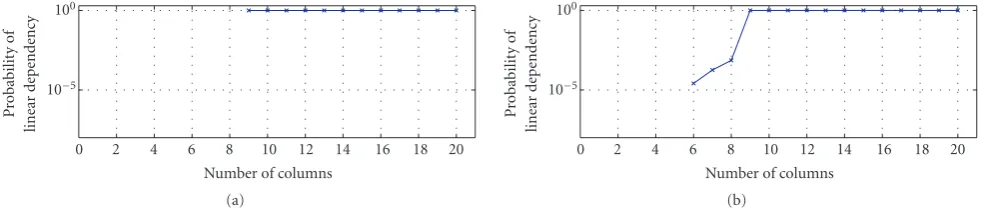
While for the worst-case analysis the exact value of SigD(K) has no consequence, this value becomes of extreme importance in evaluating probabilities of uniqueness under our probabilistic regime of signals. For illustration, the sig-natures of both dictionaries used inSection 2are given in
Figure 4.
3.3.1. Top interval:α0> N
Assume a representation α is drawn from the above-de-scribed random sourceM, withα0> N. Just as inSection
3.2.1, we cannot claim it is the sparsest one describing the signals=Dα. No matter what Spark(D) is, a subset of lin-early independent N columns from Dcan be found, since we assume thatDis full rank. Thus,scan be represented by alternative representations withNnonzeros only, leading to the following result.
Theorem 4(Spark(D)≤N,α0> N). Assume a dictionary
D∈RN×Lis fixed withSpark(D)≤N, and a representationα
generated fromMwith cardinalityα0> N. Then, the proba-bility to find an alternative representation forswith cardinality smaller thanα0is1.
This case resembles the case ofα0> N with the max-imal Spark, as discussed inSection 3.2.1. There is one ma-jor but unimportant difference here—whereas in the max-imal Spark case we could have claimed that any group ofN columns is linearly independent, here we can just say that one
such group exists. Again, this difference has no influence on the outcome, being a complete and certain loss of unique-ness, as expected.
3.3.2. Medium-low interval:Spark(D)≤ α0≤N
Given a candidate representation withα0=Kin the range [Spark(D),N], if theKcolumns chosen are linearly depen-dent, an immediate reduction can lead to an alternative rep-resentation with a smaller cardinality. By replacing one col-umn in this group with a linear combination of theK−1 others, uniqueness is lost. Thus, at least a SigD(K) portion of the cases lead to loss of uniqueness this way. Note that all the K-column combinations are equally probable due to prior assumptions, and thus the signature value is applicable di-rectly without weighting.
If theK columns pointed to byαare linearly indepen-dent, alternative sparser representations cannot be found, leaning on the same rational we have exercised earlier. Any other group of K −1 columns or smaller could po-tentially create a competing representation for the signal in mind. However, the union of all the volumes of these subspaces will not cover a substantial portion of the K -dimensional signal space, and thus no sparser solutions will be found. Thus, in the search for sparser representations, the probability that the given representation is the sparsest is 1−SigD(K), with problems encountered only with linear dependent groups.
When addressing the quest for the same cardinality al-ternatives, we focus on the linearly independent cases since those have no sparser alternatives. For a given such set ofK columns used by the original representation, assume that the firstK−1 of them together with another column form a lin-early dependent set. This implies thatK−1 alternative repre-sentations with the same cardinality are possible by replacing each of theK−1 first columns with the external one, and those combinations lead to a weak uniqueness result.
Similarly, if the firstK−2 columns in the original group can be merged with a different column to give a linear de-pendency, we get K −2 alternative representations of the same cardinality. This could continue with small groups with K−3,K−4,. . ., Spark(D)−1 alternatives. Going below this set leads to no other alternatives.
Let us look closely into the first case generating the com-peting solutions, and count the number of combinations that may lead to this problem. We consider SigD(K)·KLgroups ofKlinearly dependent columns. Choosing one such group and replacing one of its columns by a different column from the remainingL−Kones, we getK(L−K) such replacements, all leading to the weak uniqueness result.
Similarly, taking the SigD(K −1)·KL−1 groups of K−1 linearly dependent columns, we can propose per each (K−1)(L−K+1) replacements, and per each of those add an arbitrary column among the remainingL−K+ 1 ones, get-ting a total of (K−1)(L−K+ 1)L−K1+1SigD(K−1)·KL−1
0 2 4 6 8 10 12 14 16 18 20 Number of columns
10−5 100
P
robabilit
y
o
f
linear
dependency
(a)
0 2 4 6 8 10 12 14 16 18 20
Number of columns 10−5
100
P
robabilit
y
o
f
linear
dependency
(b)
Figure4: The signatures of the two dictionaries used inSection 2: (a) first experiment and (b) second experiment.
dependent groups, giving that there are no more than
N =
K−Spark( D)
j=0
(K−j)(L−K+j) SigD(K−j)
·
L
K−j
·
L−K+j
j
(8)
possible combinations of K columns that lead to the ex-istence of alternative representations. The last term in the above expression takes all the groups of jcolumns from the remainingL−K+jones in order to finally getKcolumns. Clearly, in gathering all those, we should count only the lin-early independent ones, and discard of repetitions. Thus, the above number is an upper bound on theK-column combi-nations that lead to the weak uniqueness. Divided byKL we get a bound on the probability for weak uniqueness. We summarize with the following result.
Theorem 5(Spark(D)≤N, Spark(D)≤α0≤N). Assume a dictionaryD∈RN×Lis fixed withSpark(D)≤N, and a rep-resentationαgenerated fromMwith cardinalitySpark(D)≤ α0=K≤N. Then, considering the signals=Dα,
(1) the probability that the given representation is the sparsest of all (disregarding equally sparse alternatives) is1−SigD(K),
(2) the probability to find an alternative representation of the same cardinality is
K−Spark( D)
j=0
(K−j)(L−K+j)
K j
SigD(K−j) (9)
or lower.
3.3.3. Bottom interval:Spark(D)/2≤ α0<Spark(D) Suppose that a representation drawn fromMis of cardinal-ityα0=K, in the range Spark(D)/2≤ α0<Spark(D). This implies that the signal in mind is originally generated as a linear combination ofK linear independent columns. The same reasoning leads us to the interpretation of those signals as aK-dimensional Gaussian cloud of signals in the
N-dimensional signal space. Every subgroup of K −1 (or
smaller) columns fromDis linearly independent as well, and
as such, all those together span subspaces of dimensionK−1 (and below, resp.), thus leading to the conclusion that with probability 1 no sparser representation can be found.
As to similarly sparse alternatives, the same analysis as in Section 3.2.3 gives that no such alternatives can be found. Thus we have the following strong uniqueness re-sult.
Theorem 6(Spark(D)<N+1, Spark(D)/2≤α0<Spark(D)). Assume a dictionaryD∈RN×Lis fixed withSpark(D)<N+1,
and a representation α generated from M with cardinality
α0in the range(Spark(D)/2, Spark(D)). Then, considering the signals=Dα, the probability to find an alternative repre-sentation forswith cardinalityα0or smaller is0.
3.3.4. Relation to the empirical results
In the second experiment inSection 2we hadN = 8 and Spark(D) = 6, matching the case studied here. Due to
Theorem 4it is clear that there is no uniqueness forα0>8.
Theorem 5supplies the results for 6 ≤ α0 ≤ 8, sug-gesting that the probability to get a strong uniqueness is 1−SigD(α0). Since this number is very close to 1 (e.g., forα0=8 this value is 1−7.2e−4), the 100 experiments found no such cases, as can be seen inFigure 1.
As to equally sparse alternatives, the probability of find-ing those forK=6 is 6·14/206=0.0022, and forK=7 it is 0.0316—in both cases quite low but possible to encounter, as indeed displayed in the shown results.
Figure 5presents a graph parallel toFigure 2, assuming that Spark(D) is even for convenience.
4. RELATION TO AVERAGE PERFORMANCE OF PURSUIT ALGORITHMS
Given a signal S ∈ RN known to have a sparse
represen-tation over the dictionary D, we are interested in finding its representation faithfully, and with a reasonable amount of computations. We assume that the signal is drawn from the presented source model, by generating first a repre-sentation α at random from M and computingS = Dα. This way we have characterized in full how signals are dis-tributed.
1 2
(
σ/
2)
−
1
(
σ/
2)
(
σ/
2)
+
1
σ
−
1 σ
N
−
1 N
N
+1 L
Cardinality of representation
· · · · · · · · · · · ·
1
R
elati
ve
n
umber
of
ex
per
iments (a) (b) (c) (d) (e)
Success (same cardinality solutions) Total uniqueness
Figure5: A schematic graph of the probability of uniqueness for Spark(D) < N + 1. The different zones are (a) the classic known uniqueness result, (b)Theorem 6, (c)Theorem 5, (d)Theorem 5, and (e)Theorem 4.
(sparsest) representation ofS, there is no point to this ques-tion, since we do not want to recoverαin those cases. So, our question focuses on the cases where uniqueness holds true, and ask whether the pursuit algorithms succeed.
Previous work analyzed this question for several variants of the greedy algorithm [6–13]. Other work studied the basis pursuit algorithms [10,14–20]. All these works concentrated on the worst-case scenario, just as described above with re-spect to the uniqueness property, showing that if the sig-nal has a sparse enough representation, the pursuit will suc-ceed. The bound on sparsity is more restrictive compared to the uniqueness one, and its development is far more com-plicated in general. This bound is built on the definition of themutual incoherence (M(D)), as the maximum over-all absolute off-diagonal entries in the Gram matrixDHD. In order to guarantee successful recovery of the represen-tation, it should have smaller than 0.5(1 +M−1) nonze-ros.
Thus, parallel to the results summarized in the previous section, there is great interest in knowing whether the pur-suit algorithms are successful beyond this bound in proba-bility. As we have mentioned earlier, the works in [21,22] are the first to address this question directly, with results for a specific structure of dictionaries, and with an asymptotic formulation. Here we offer some empirical results that will set the stage for a theoretical analysis that will study the be-havior of the pursuit algorithms using general dictionaries.
Figures6and7present the results for two dictionaries of size 30×80. The first, being completely random leads to the maximal Spark, and its mutual incoherence is 0.5575. Thus, success of the pursuit algorithms is guaranteed for rep-resentations with one nonzero entry. Similarly, the second graph corresponds to a dictionary of the same size, but with
0 5 10 15
Cardinality of representation 0
0.1 0.2 0.3 0.4 0.5 0.6 0.7 0.8 0.9 1
P
robabilit
y
o
f
suc
ce
ss
Basis pursuit
Orthogonal matching pursuit
Figure 6: The probability of success (recovering at least equally sparse solution in 1000 random examples) of the basis pursuit and the orthogonal matching pursuit algorithm. The dictionary is a ran-dom matrix of size 30×80, its Spark is 31, and its mutual incoher-ence is 0.5575.
0 5 10 15
Cardinality of representation 0
0.1 0.2 0.3 0.4 0.5 0.6 0.7 0.8 0.9 1
P
robabilit
y
o
f
suc
ce
ss
Basis pursuit
Orthogonal matching pursuit
Figure 7: The probability of success (recovering at least equally sparse solution in 1000 random examples) of the basis pursuit and the orthogonal matching pursuit algorithm. The dictionary is a ran-dom matrix of size 30×80, its Spark is 15, and its mutual incoher-ence is 0.7075.
a deliberate reduction of the Spark to 15. This dictionary’s mutual incoherence is 0.7075 again implying that only one nonzero representation can be recovered well by the pursuit algorithms. As can be seen from the results,
(2) although the two dictionaries have very different Spark, the results of the pursuit algorithms in both cases are very similar,
(3) the two pursuit algorithms perform very similarly with weaker performance of the greedy algorithm for small cardinalities, and slower decay in performance as the cardinality grows.
An analysis of these results from a theoretical point of view is valuable and should be carried out. In particular, it is interesting to ask whether the Spark or the signature have any role in dictating the pursuit results in probability.
5. CONCLUSIONS
In this paper we have studied the uniqueness of sparse rep-resentations of signals over a given overcomplete dictionary. We saw both empirically and theoretically that such repre-sentations are likely to be the sparsest ones for the signal they form if they are sparse enough. Previous work has shown that below half the Spark of the dictionary, the representa-tion is necessarily the sparsest. Here we have extended this result and showed that representations with less than Spark nonzero entries are the sparsest with probability 1, and even beyond this cardinality, uniqueness can be still claimed with high probability.
A very helpful tool in our analysis is the signature of the dictionary. Further work is required in order to find ways to approximate or bound this function. Another promising direction for future research is the analysis of pursuit algo-rithms using the same probabilistic model drawn here, ex-tending the results in [21,22]. Simulation results here and in [15] indicate that these algorithms are expected to per-form far better than the worst-case bounds suggest. A similar analysis could shed light on this behavior.
Approximate representations rather than exact ones are appealing as well for many applications. A parallel study of the uniqueness of such representations is of great importance as well, extending prior results given in [10].
APPENDIX
AN UPPER BOUND ON THE SIGNATURE
We have given the following definition.
Definition 2(signature). For a matrixD∈RN×L, its
signa-ture is defined as the discrete function SigD(K), forK=1, 2,
3,. . .,L, counting the relative number ofK-column
combi-nations inDthat are linearly dependent.
The signature is NP-hard to compute, just as the Spark (and actually harder). Still, bounds on it can be derived. One such interesting bound that we will show here is based on the assumption that the Spark is known. This result is due to Bj¨orner, who analyzed and bounded matroids properties [29]. This was adapted to the bounding of the signature by Goldberg [30]. We will state the result here without proof or discussion. Further work is required in order to bound
the signature better, taking into account known interactions between the dictionary’s columns, and more.
Theorem 7(upper bound on the signature). For a full-rank dictionaryD∈RN×L(rankN) withSpark(D)=σ≤N+ 1,
the signature of the dictionary is upper bounded by
SigD(K)≤1−
σ−1
i=0
L−N+i−1
i NK−−ii
L
K ,
K=1, 2,. . .,N.
(A.10)
The rational behind this result is that if Spark(D) =σ, it does not necessarily mean that every σ combination of columns fromDis linearly dependent. In fact, only a lim-ited number of such sets can be dependent without violating the rank of the matrix. As a simple example, for a full-rank dictionary of size 3×4 and Spark(D) = 3, if every triplet is linearly dependent, then the rank must be 2. This can be proven by construction of the column space representation: we drop the first column as it is spanned by the next two. The remaining triplet is also dependent and thus we can drop one more column without affecting the columns space spanned. Thus the rank is 2, violating the initial assumption about
D being full rank. In such case, only one of the 4 possible triplets can be linearly dependent. The above theorem gener-alizes this idea.
ACKNOWLEDGMENTS
The author would like to thank Professor Alfred M. Bruck-stein (Computer Science Department, the Technion), Joel Tropp (Mathematics Department, University of Michigan), and Justin Romberg (Applied and Computational Mathe-matics Department, California Institute of Technology) for the long and helpful discussions. Thanks are also to Felix Goldberg from the Mathematics Department at the Technion for the helpful reference to the work on matroids and its rel-evance to the signature.
REFERENCES
[1] S. S. Chen, D. L. Donoho, and M. A. Saunders, “Atomic de-composition by basis pursuit,”SIAM Review, vol. 43, no. 1, pp. 129–159, 2001.
[2] B. K. Natarajan, “Sparse approximate solutions to linear sys-tems,”SIAM Journal on Computing, vol. 24, no. 2, pp. 227–234, 1995.
[3] G. Davis, S. G. Mallat, and M. Avellaneda, “Adaptive greedy approximations,”Constructive Approximations, vol. 13, no. 1, pp. 57–98, 1997.
[4] S. G. Mallat and Z. Zhang, “Matching pursuits with time-frequency dictionaries,”IEEE Transactions on Signal Process-ing, vol. 41, no. 12, pp. 3397–3415, 1993.
[6] C. Couvreur and Y. Bresler, “On the optimality of the back-ward greedy algorithm for the subset selection problem,”
SIAM Journal on Matrix Analysis and Applications, vol. 21, no. 3, pp. 797–808, 2000.
[7] A. C. Gilbert, S. Muthukrishnan, and M. J. Strauss, “Approxi-mation of functions over redundant dictionaries using coher-ence,” inProceedings of 14th Annual ACM-SIAM Symposium on Discrete Algorithms (SODA ’03), pp. 243–252, Baltimore, Md, USA, January 2003.
[8] J. A. Tropp, A. C. Gilbert, S. Muthukrishnan, and M. J. Strauss, “Improved sparse approximation over quasi-incoherent dic-tionaries,” inProceedings of IEEE International Conference on Image Processing (ICIP ’03), vol. 1, pp. 37–40, Barcelona, Spain, September 2003.
[9] J. A. Tropp, “Greed is good: algorithmic results for sparse approximation,” IEEE Transactions on Information Theory, vol. 50, no. 10, pp. 2231–2242, 2004.
[10] D. L. Donoho, M. Elad, and V. N. Temlyakov, “Stable recov-ery of sparse overcomplete representations in the presence of noise,” to appear inIEEE Transactions on Information Theory, February 2004.
[11] J. A. Tropp, “Just relax: Convex programming methods for subset selection and sparse approximation,” ICES Report 04-04, University of Texas at Austin, Austin, Tex, USA, February 2004.
[12] V. N. Temlyakov, “Greedy algorithms andm-term approxima-tion with regard to redundant dicapproxima-tionaries,”Journal of Approx-imation Theory, vol. 98, no. 1, pp. 117–145, 1999.
[13] V. N. Temlyakov, “Weak greedy algorithms,”Advances in Com-putational Mathematics, vol. 12, no. 2-3, pp. 213–227, 2000. [14] I. F. Gorodnitsky and B. D. Rao, “Sparse signal
reconstruc-tion from limited data using FOCUSS: A re-weighted mini-mum norm algorithm,”IEEE Transactions on Signal Processing, vol. 45, no. 3, pp. 600–616, 1997.
[15] D. L. Donoho and X. Huo, “Uncertainty principles and ideal atomic decomposition,” IEEE Transactions on Information Theory, vol. 47, no. 7, pp. 2845–2862, 2001.
[16] X. Huo,Sparse image representation via combined transforms, Ph.D. thesis, Stanford University, Stanford, Calif, USA, 1999. [17] M. Elad and A. M. Bruckstein, “A generalized uncertainty
principle and sparse representation in pairs of bases,”IEEE Transactions on Information Theory, vol. 48, no. 9, pp. 2558– 2567, 2002.
[18] D. L. Donoho and M. Elad, “Optimally sparse representa-tion in general (non-orthogonal) dicrepresenta-tionaries via 1 mini-mization,”Proceedings of the National Academy of Sciences of the United States of America, vol. 100, no. 5, pp. 2197–2202, 2003.
[19] R. Gribonval and M. Nielsen, “Sparse representations in unions of bases,”IEEE Transactions on Information Theory, vol. 49, no. 12, pp. 3320–3325, 2003.
[20] J.-J. Fuchs, “On sparse representations in arbitrary redundant bases,”IEEE Transactions on Information Theory, vol. 50, no. 6, pp. 1341–1344, 2004.
[21] E. J. Cand`es and J. Romberg, “Quantitative robust uncertainty principles and optimally sparse decompositions,” to appear in
Foundations of Computational Mathematics, 2004.
[22] D. L. Donoho, “For most large underdetermined systems of linear equations the minimal 1-norm solution is also the sparsest solution,” Tech. Rep. 2004-10, Department of Statis-tics, Stanford University, Stanford, Calif, USA, September 2004.
[23] A. Edelman, “Eigenvalues and condition numbers of random matrices,”SIAM Journal on Matrix Analysis and Applications, vol. 9, no. 4, pp. 543–560, 1988.
[24] J. Shen, “On the singular values of Gaussian random matrices,”
Linear Algebra and its Applications, vol. 326, no. 1–3, pp. 1–14, 2001.
[25] T. Strohmer and R. W. Heath Jr., “Grassmannian frames with applications to coding and communication,”Applied and Computational Harmonic Analysis, vol. 14, no. 3, pp. 257–275, 2003.
[26] J. A. Tropp, I. S. Dhillon, R. W. Heath Jr., and T. Strohmer, “Designing structured tight frames via an alternating pro-jection method,” IEEE Transactions on Information Theory, vol. 51, no. 1, pp. 188–209, 2005.
[27] E. J. Cand`es and D. L. Donoho, “New tight frames of curvelets and the problem of approximating piecewiseC2images with piecewiseC2 edges,” 2002, to appear inCommunications on
Pure and Applied Mathematics.
[28] J.-L. Starck, E. J. Cand`es, and D. L. Donoho, “The curvelet transform for image denoising,”IEEE Transactions on Image Processing, vol. 11, no. 6, pp. 670–684, 2002.
[29] A. Bj¨orner, “Some matroid inequalities,”Discrete Mathematics, vol. 31, no. 1, pp. 101–103, 1980.
[30] F. Goldberg, “Overcomplete Bases, Spark, and Matroids,” 2004,personal communication.
Michael Elad received his B.S., M.S., and D.S. degrees from the Department of Elec-trical Engineering at the Technion, Israel, in 1986, 1988, and 1997, respectively. From 1988 to 1993 he served in the Israeli Air Force. From 1997 to 2000 he worked at Hewlett-Packard Laboratories as an R&D Engineer. From 2000 to 2001 he headed the Research Division at JiGami Corporation, Israel. During the years 2001 to 2003 Elad