Measuring Word Relatedness Using Heterogeneous Vector Space Models
Wen-tau Yih Microsoft Research One Microsoft Way
Redmond, WA
Vahed Qazvinian∗ Department of EECS University of Michigan
Ann Arbor, MI
Abstract
Noticing that different information sources of-ten provide complementary coverage of word sense and meaning, we propose a simple and yet effective strategy for measuring lexical se-mantics. Our model consists of a committee of vector space models built on a text cor-pus, Web search results and thesauruses, and measures the semantic word relatedness us-ing the averaged cosine similarity scores. De-spite its simplicity, our system correlates with human judgements better or similarly com-pared to existing methods on several bench-mark datasets, including WordSim353.
1 Introduction
Measuring the semantic relatedness of words is a fundamental problem in natural language process-ing and has many useful applications, includprocess-ing textual entailment, word sense disambiguation, in-formation retrieval and automatic thesaurus discov-ery. Existing approaches can be roughly catego-rized into two kinds: knowledge-based and corpus-based, where the former includes graph-based algo-rithms and similarity measures operating on a lexical database such as WordNet (Budanitsky and Hirst, 2006; Agirre et al., 2009) and the latter consists of various kinds of vector space models (VSMs) constructed with the help of a large collection of text (Reisinger and Mooney, 2010; Radinsky et al., 2011). In this paper, we present a conceptually simple model for solving this problem. Observing that various kinds of information sources, such as
∗
Work conducted while interning at Microsoft Research.
general text corpora, Web search results and the-sauruses, have different word and sense coverage, we first build individual vector space models from each of them separately. Given two words, each VSM measures the semantic relatedness by the co-sine similarity of the corresponding vectors in its space. The final prediction is simply the averaged cosine scores derived from these VSMs. Despite its simplicity, our system surprisingly yields very strong empirical performance. When comparing the predictions with the human annotations on four dif-ferent datasets, our system achieves higher correla-tion than existing methods on two datasets and pro-vides very competitive results on the others.
The rest of this paper is organized as follows. Sec-tion 2 briefly reviews the related work. SecSec-tion 3 de-tails how we construct each individual vector space model, followed by the experimental evaluation in Section 4. Finally, Section 5 concludes the paper.
2 Background
Prior work on measuring lexical semantics can be categorized as knowledge-based or corpus-based. Knowledge-based methods leverage word relations encoded in lexical databases such as WordNet and provide graph-based similarity measures. Detailed comparisons of these methods can be found in (Bu-danitsky and Hirst, 2006). Corpus-based methods assume related words tend to co-occur or to ap-pear in similar context. For example, Gabrilovich and Markovitch (2007) measure word relatedness by whether they tend to occur in the same Wikipedia topic. In contrast, Reisinger and Mooney (2010) use the conventional “context vector” – neighboring
terms of the occurrences of a target word – as the word representation. In addition, they argue that it is difficult to capture different senses of a word with a single vector, and introduce a multi-prototype rep-resentation. More recently, Radinsky et al. (2011) analyze the temporal aspects of words and argue that non-identical terms in two term vectors should also be compared based on their temporal usage when computing the similarity score. They construct the vectors using Wikipedia titles, Flickr image tags, and Del.icio.us bookmarks, and extract the temporal frequency of each concept from 130 years of New York Times archive. Methods that combine models from different sources do exist. For instance, Agirre et al. (2009) derive a WordNet-based measure us-ing PageRank and combined it with several corpus-based vector space models using SVMs.
3 Vector Space Models from Heterogeneous Sources
In this section, we describe how we construct vari-ous vector space models (VSMs) to represent words, including corpus-based, Web-based and thesaurus-based methods.
Corpus-based VSMs follow the standard “distri-butional hypothesis,” which states that words ap-pearing in the same contexts tend to have simi-lar meaning (Harris, 1954). Each target word is thus represented by a high-dimensional sparse term-vector that consists of words occurring in its con-text. Given a corpus, we first collect terms within a window of [−10,+10] centered at each occur-rence of a target word. This bag-of-words repre-sentation is then mapped to the TF-IDF term vector: each term is weighted by log(f req)×log(N/df), wheref reqis the number of times the term appears in the collection,df the document frequency of the term in the whole corpus andN the number of total documents. We further employed two simple tech-niques to improve the quality of these term-vectors: vocabulary and term trimming. Top 1,500 terms with high document frequency values are treated as stopwords and removed from the vocabulary. Moreover, we adopted a document-specific feature selection method (Kolcz and Yih, 2007) designed originally for text classification and retain only the
top 200 high-weighted terms for each term-vector1. The corpus-based VSMs are created using English Wikipedia (Snapshot of Nov. 2010), consisting of 917M words after preprocessing (markup tags re-moval and sentence splitting).
Web-based VSMs leverage Web search results to form a vector of each query (Sahami and Heilman, 2006). For each word to compare, we issue it as a query and retrieve the set of relevant snippets (top 30 in our experiments) using a popular commercial search engine, Bing. All these snippets together are viewed as a pseudo-document and mapped to a TF-IDF vector as in the corpus-based method. We do not allow for automatic query expansion in our ex-periments to ensure that the retrieved snippets are di-rectly relevant to the target word and not expansions based on synonyms, hypernyms or hyponyms. We apply vocabulary trimming (top 1,000 terms with high DF values), but not term-trimming as the vec-tors have much fewer terms due to the small number of snippets collected.
Both the corpus-based and Web-based VSMs rely on the distributional hypothesis, which is often criti-cized for two weaknesses. The first is that word pairs that appear in the same context or co-occur are not necessarily highly semantically related. For exam-ple, “bread” and “butter” often have cosine scores higher than synonyms using corpus-based vectors because of the phrase “bread and butter”. The sec-ond is that general corpora often have skewed cov-erage of words due to the Zipf’s law. Regardless of the size of the corpus, the number of occurrences of a rarely used word is typically very low, which makes the quality of the corresponding vector unre-liable. To address these two issues, we include the thesaurus-based VSMs in this work as well. For each group of similar words (synset) defined in the thesaurus, we treat it as a “document” and create a document–word matrix, where each word is again weighted using its TF-IDF value. Each column tor in this matrix is thus the thesaurus-based vec-tor of the corresponding word. Notice that given two words and their corresponding vectors, the co-sine score is more general than simply checking
1
whether these two words belong to a group of sim-ilar words, as it judges how often they overlap in various documents (i.e., sets of similar words). We explored using two different thesauri in our exper-iments: WordNet and the Encarta thesaurus devel-oped by Bloomsbury Publishing, where the former consists of 227,446 synsets and 190,052 words and the latter contains 46,945 synsets and 50,184 words. Compared to existingknowledge-based approaches, our VSM transformation is very simple and straight-forward. It is also easy to extend our method to other languages as only a thesaurus is required rather than a complete lexical database such as WordNet.
4 Experimental Evaluation
In this section, we evaluate the quality of the VSMs constructed using methods described in Section 3 on different benchmark datasets, as well as the perfor-mance when combining them.
4.1 Benchmark datasets
We follow the standard evaluation method, which di-rectly tests the correlation of the word relatedness measures with human judgements on a set of word pairs, using the Spearman’s rank correlation coeffi-cient. Our study was conducted using four differ-ent datasets, including WS-353, RG-65, MC-30 and MTurk-287.
The WordSim353 dataset (WS-353) is the largest among them and has been used extensively in re-cent work. Originally collected by Finkelstein et al. (2001), the dataset consists of 353 word pairs. The degree of relatedness of each pair is assessed on a 0-10 scale by 13-16 human judges, where the mean is used as the final score. Examining the relations between the words in each pair, Agirre et al. (2009) further split this dataset into similar pairs (WS-sim) andrelated pairs (WS-rel), where the former contains synonyms, antonyms, identical words and hyponyms/hypernyms and the latter cap-ture other word relations. Collected by Rubenstein and Goodenough (1965), RG-65 contains 65 pairs of words that are either synonyms or unrelated, as-sessed on a 0-4 scale by 51 human subjects. Taking 30 pairs from them, Miller and Charles (1991) cre-ated the (MC-30) dataset by reassessing these word pairs using 38 subjects. These 30 pairs of words
are also a subset of WS-353. Although these three datasets contain overlapping word pairs, their scores are different because of the degree of relatedness were given by different human subjects. In addition to these datasets, we also evaluate our VSMs on the Mturk-287 dataset that consists of 287 word pairs collected by (Radinsky et al., 2011) using Amazon MTurk.
4.2 Results and Analysis
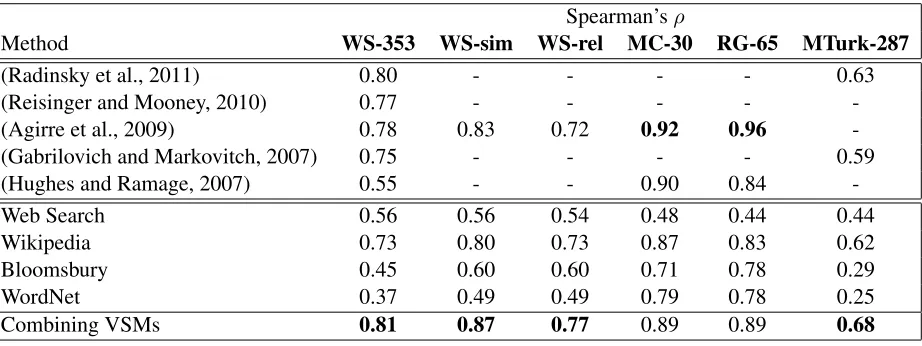
Table 1 summarizes the results of various methods, where the top part lists the performance of state-of-the-art systems and the bottom shows the results of individual vector space models, as well as combin-ing these models uscombin-ing the averaged cosine scores. We make several observations here. First, while none of the four VSMs we tested outperforms the best existing systems on the benchmark datasets, surprisingly, using the averaged cosine scores of these models, the performance is improved substan-tially. It achieves higher Spearman’s rank coeffi-cient on WS-353 and MTurk-287 than any other sys-tems2 and are close to the state-of-the-art on MC-30 and RG-65. Unlike some approach like (Hughes and Ramage, 2007), which performs well on some datasets but poorly on others, combing the VSMs from heterogeneous sources is more robust. Individ-ually, we notice that Wikipedia context VSM pro-vides consistently strong results, while thesaurus-based models work only reasonable on MC-30 and RG-65, potentially because other datasets contain more out-of-vocabulary words or proper nouns. Due to the inherent ambiguity of the task, there is a high variance among judgements from different annota-tors. Therefore, it is unrealistic to assume any of the methods can correlate perfectly to the mean human judgement scores. In fact, the inter-agreement study done on the WS-353 dataset indicates that the result of our approach of combining heterogeneous VSMs is close to the averaged human performance.
It is intriguing to see that by using the averaged cosine scores, the performance can be improved over the best individual model (i.e., Wikipedia). Ex-amining the scores of some word pairs carefully
sug-2
Spearman’sρ
Method WS-353 WS-sim WS-rel MC-30 RG-65 MTurk-287
(Radinsky et al., 2011) 0.80 - - - - 0.63
(Reisinger and Mooney, 2010) 0.77 - - - -
-(Agirre et al., 2009) 0.78 0.83 0.72 0.92 0.96
-(Gabrilovich and Markovitch, 2007) 0.75 - - - - 0.59
(Hughes and Ramage, 2007) 0.55 - - 0.90 0.84
-Web Search 0.56 0.56 0.54 0.48 0.44 0.44
Wikipedia 0.73 0.80 0.73 0.87 0.83 0.62
Bloomsbury 0.45 0.60 0.60 0.71 0.78 0.29
WordNet 0.37 0.49 0.49 0.79 0.78 0.25
[image:4.612.77.538.59.232.2]Combining VSMs 0.81 0.87 0.77 0.89 0.89 0.68
Table 1: The performance of the state-of-the-art methods and different vector space models on measuring semantic word relatedness using the cosine similarity.
gests the broader coverage of different words and senses could be the reason. For example, some of the words in the datasets have multiple senses, such as “jaguar vs. car” and “jaguar vs. cat”. Al-though in previous work, researchers try to capture word senses using different vectors (Reisinger and Mooney, 2010) from the same text corpus, this is in fact difficult in practice. The usage of words in a big text corpus, which contains diversified topics, may still be biased to one word sense. For example, in the Wikipeida term vector that represents “jaguar”, we found that most of the terms there are related to “cat”. Although some terms are associated with the “car” meaning, the signals are rather weak. Simi-larly, WordNet does not indicate “jaguar” could be related to “car” at all. In contrast, the “car” sense of “jaguar” dominates the vector created using the search engine. As a result, incorporating models from different sources could be more effective than relying on word sense discovering algorithms op-erating solely on one corpus. Another similar but different example is the pair of “bread” and “but-ter”, which are treated as synonyms by corpus-based VSMs, but is demoted after adding the thesaurus-based models.
5 Conclusion
In this paper we investigated the usefulness of het-erogeneous information sources in improving mea-sures of semantic word relatedness. Particularly, we created vector space models using 4 data sources
from 3 categories (corpus-based, Web-based and thesaurus-based) and found that simply averaging the cosine similarity derived from these models yields a very robust measure. Other than directly plying it to measuring semantic relatedness, our ap-proach is complementary to more sophisticated sim-ilarity measures such as developing kernel functions for different structured data (Croce et al., 2011), where the similarity between words serves as a basic component.
While this result is interesting and encouraging, it also raises several research questions, such as how to enhance the quality of each vector space model and whether the models can be combined more ef-fectively3. We also would like to study whether sim-ilar techniques can be useful when comparing longer text segments like phrases or sentences, with poten-tial applications in paraphrase detection and recog-nizing textual entailment.
Acknowledgments
We thank Joseph Reisinger for providing his pro-totype vectors for our initial study, Silviu-Petru Cucerzan for helping process the Wikipedia files and Geoffrey Zweig for preparing the Bloomsbury the-saurus data. We are also grateful to Chris Meek for valuable discussions and to anonymous review-ers for their comments.
3
References
E. Agirre, E. Alfonseca, K. Hall, J. Kravalova, M. Pas¸ca and A. Soroa. 2009. A study on similarity and re-latedness using distributional and wordnet-based ap-proaches. InNAACL ’09, pages 19–27.
A. Budanitsky and G. Hirst. 2006. Evaluating wordnet-based measures of lexical semantic relatedness. Com-putational Linguistics, 32:13–47, March.
D. Croce, A. Moschitti, and R. Basili. 2011. Structured lexical similarity via convolution kernels on depen-dency trees. In Proceedings of EMNLP 2011, pages 1034–1046, July.
L. Finkelstein, E. Gabrilovich, Y. Matias, E. Rivlin, Z. Solan, G. Wolfman, and E. Ruppin. 2001. Placing search in context: The concept revisited. In WWW, pages 406–414. ACM.
E. Gabrilovich and S. Markovitch. 2007. Computing mantic relatedness using wikipedia-based explicit se-mantic analysis. InIJCAI ’07, pages 1606–1611. Z. Harris. 1954. Distributional structure. Word,
10(23):146–162.
T. Hughes and D. Ramage. 2007. Lexical semantic re-latedness with random graph walks. InProceedings of EMNLP-CoNLL-2007, pages 581–589.
A. Kolcz and W. Yih. 2007. Raising the baseline for high-precision text classifiers. In KDD ’07, pages 400–409.
G. Miller and W. Charles. 1991. Contextual correlates of semantic similarity. Language and cognitive pro-cesses, 6(1):1–28.
K. Radinsky, E. Agichtein, E. Gabrilovich, and S. Markovitch. 2011. A word at a time: computing word relatedness using temporal semantic analysis. In
WWW ’11, pages 337–346.
J. Reisinger and R. Mooney. 2010. Multi-prototype vector-space models of word meaning. InNAACL ’10. H. Rubenstein and J. Goodenough. 1965. Contextual correlates of synonymy. Communications of the ACM, 8:627–633, October.