Training Paradigms for Correcting Errors in Grammar and Usage
Alla Rozovskaya and Dan Roth University of Illinois at Urbana-Champaign
Urbana, IL 61801
{rozovska,danr}@illinois.edu
Abstract
This paper proposes a novel approach to the problem of training classifiers to detect and correct grammar and usage errors in text by selectively introducing mistakes into the train-ing data. When traintrain-ing a classifier, we would like the distribution of examples seen in train-ing to be as similar as possible to the one seen in testing. In error correction problems, such as correcting mistakes made by second lan-guage learners, a system is generally trained on correct data, since annotating data for train-ing is expensive. Error generation methods avoid expensive data annotation and create training data that resemble non-native data with errors.
We apply error generation methods and train classifiers for detecting and correcting arti-cle errors in essays written by non-native En-glish speakers; we show that training on data that contain errors produces higher accuracy when compared to a system that is trained on clean native data. We propose several train-ing paradigms with error generation and show that each such paradigm is superior to training a classifier on native data. We also show that the most successful error generation methods are those that use knowledge about the arti-cle distribution and error patterns observed in non-native text.
1 Introduction
This paper considers the problem of training clas-sifiers to detect and correct errors in grammar and word usage in text. Both native and non-native speakers make a variety of errors that are not always
easy to detect. Consider, for example, the problem of context-sensitive spelling correction (e.g., (Gold-ing and Roth, 1996; Gold(Gold-ing and Roth, 1999; Carl-son et al., 2001)). Unlike spelling errors that result in non-words and are easy to detect, context-sensitive spelling correction task involves correcting spelling errors that result in legitimate words, such as confus-ingpeaceandpieceoryourandyou’re. The typical training paradigm for these context-sensitive ambi-guities is to use text assumed to be error free, replac-ing each target word occurrence (e.g. peace) with a
confusion setconsisting of, say{peace, piece}, thus generating both positive and negative examples, re-spectively, from the same context.
This paper proposes a novel error generation ap-proach to the problem of training classifiers for the purpose of detecting and correcting grammar and usage errors in text. Unlike previous work (e.g., (Sj¨obergh and Knutsson, 2005; Brockett et al., 2006; Foster and Andersen, 2009)), we selectively intro-duce mistakes in an appropriate proportion. In par-ticular, to create training data that closely resemble text with naturally occurring errors, we use error fre-quency information and error distribution statistics obtained from corrected non-native text. We apply the method to the problem of detecting and correct-ing article mistakes made by learners of English as a Second Language (ESL).
The problem of correcting article errors is gener-ally viewed as that of articleselection, cast as a clas-sification problem and is trained as described above: a machine learning algorithm is used to train a clas-sifier on native English data, where the possible se-lections are used to generate positive and negative
examples (e.g., (Izumi et al., 2003; Han et al., 2006; De Felice and Pulman, 2008; Gamon et al., 2008)). The classifier is then applied to non-native text to predict the correct article in context. But the article
correctionproblem differs from the problem of ar-ticle selection in that we know the original (source) article that the writer used. When proposing a cor-rection, we would like to use information about the original article. One reason for this is that about 90% of articles are used correctly by ESL learners; this is higher than the performance of state-of-the-art clas-sifiers for article selection. Consequently, not us-ing the writer’s article, when makus-ing a prediction, may result in making more mistakes than there are in the data. Another reason is that statistics on ar-ticle errors (e.g., (Han et al., 2006; Lee and Sen-eff, 2008)) and in the annotation performed for the present study reveal that non-native English speak-ers make article mistakes in a consistent manner.
The system can consider the article used by the writer at evaluation time, by proposing a correction only when the confidence of the classifier is high enough, but the article cannot be used in training if the classifier is trained on clean native data that do not have errors. Learning Theory says that the distribution of examples seen in testing should be as similar as possible to the one seen in training, so one would like to train on errors similar to those ob-served in testing. Ideally, we would like to train us-ing corrected non-native text. In that case, the orig-inal article of the writer can be used as a feature for the classifier and the correct article, as judged by a native English speaker, will be viewed as the la-bel. However, obtaining annotated data for training is expensive and, since the native training data do not contain errors, we cannot use the writer’s article as a feature for the classifier.
This paper compares the traditional training paradigm that uses native data to training paradigms that use data with artificial mistakes. We propose several methods of generating mistakes in native training data and demonstrate that they outperform the traditional training paradigm. We also show that the most successful error generation methods use knowledge about the article distribution and error patterns observed in the ESL data.
The rest of the paper is organized as follows. First, we discuss the baseline on the error
correc-tion task and show why the baselines used in selec-tion tasks are not relevant for the error correcselec-tion task. Next, we describe prior work in error genera-tion and show the key difference of our approach. Section 4 presents the ESL data that we use and statistics on article errors. Section 5 describes train-ing paradigms that employ error generation. In Sec-tions 6 and 7 we present the results and discuss the results. The key findings are summarized in Table 7 in Section 6. We conclude with a brief discussion of directions for future work.
2 Measuring Success in Error Correction Tasks
The distinction between the selection and the error correction tasks alluded to earlier is important not only for training but also in determining an appro-priate evaluation method.
The standard baseline used in selection tasks is the relative frequency of the most common class. For example, in word sense disambiguation, the baseline is the most frequent sense. In the task of article selection, the standard baseline used is to predict the article that occurs most frequently in the data (usually, it is the zero article, whose fre-quency is 60-70%). In this context, the performance of a state-of-the-art classifier (Knight and Chander, 1994; Minnen et al., 2000; Turner and Charniak, 2007; Gamon et al., 2008) whose accuracy is 85-87% is a significant improvement over the base-line. The majority has been used as the baseline also in the context-sensitive spelling task (e.g., (Golding and Roth, 1999)).
Using the definitions of precision and recall and the “real” baseline, we can also relate the resulting accuracy of the classifier to the precision and recall on an error correction task as follows: LetP andR
denote the precision and recall, respectively, of the system on an error correction task, andBasedenote the error rate in the data. Then the task baseline (i.e., accuracy of the data before running the system) is:
Baseline= 1−Base
It can be shown that the error rate after running the classifier is:
Error= Base∗(P +R−2RP) P
It follows that the accuracy of the system on the task is1−Error.
For example, we can obtain a rough estimate on the accuracy of the system in Han et al. (2006), us-ing precision and recall numbers by error type. Ex-cluding the error type of categoryother, we can esti-mate thatBase= 0.1, so the baseline is0.9, average precision and recall are0.85and0.25, respectively, and the resulting overall accuracy of the system is 92.2%.
3 Related Work
3.1 Generating Errors in Text
In text correction, adding mistakes in training has been explored before. Although the general ap-proach has been to produce errors similar to those observed in the data to be corrected, mistakes were added in an ad-hoc way, without respecting the er-ror frequencies and erer-ror patterns observed in non-native text. Izumi et al. (2003) train a maxi-mum entropy model on error-tagged data from the Japanese Learners of English corpus (JLE, (Izumi et al., 2004)) to detect 8 error types in the same cor-pus. They show improvement when the training set is enhanced with sentences from the same corpus to which artificial article mistakes have been added. Though it is not clear in what proportion mistakes were added, it is also possible that the improvement was due to a larger training set. Foster and Ander-sen (2009) attempt to replicate naturally occurring learner mistakes in the Cambridge Learner Corpus
(CLC)1, but show a drop in accuracy when the orig-inal error-tagged data in training are replaced with corrected CLC sentences containing artificial errors. Brockett et al. (2006) generate mass noun er-rors in native English data using relevant exam-ples found in the Chinese Learners English Cor-pus (CLEC, (Gui and Yang, 2003)). Training data consist of an equal number of correct and incor-rect sentences. Sj¨obergh and Knutsson (2005) in-troduce split compound and agreement errors into native Swedish text: agreement errors are added in every sentence and for compound errors, the train-ing set consists of an equal number of negative and positive examples. Their method gives higher recall at the expense of lower precision compared to rule-based grammar checkers.
To sum up, although the idea of using data with ar-tificial mistakes is not new, the advantage of training on such data has not been investigated. Moreover, training on error-tagged data is currently unrealistic in the majority of error correction scenarios, which suggests that using text with artificial mistakes is the only alternative to using clean data. However, it has not been shown whether training on data with artifi-cial errors is benefiartifi-cial when compared to utilizing clean data. More importantly, error statistics have not been considered for error correction tasks. Lee and Seneff (2008) examine statistics on article and preposition mistakes in the JLE corpus. While they do not suggest a specific approach, they hypothesize that it might be helpful to incorporate this knowl-edge into a correction system that targets these two language phenomena.
3.2 Approaches to Detecting Article Mistakes
Automated methods for detecting article mistakes generally use a machine learning algorithm. Ga-mon et al. (2008) use a decision tree model and a 5-gram language model trained on the English Giga-word corpus (LDC2005T12) to correct errors in En-glish article and preposition usage. Han et al. (2006) and De Felice and Pulman (2008) train a maximum entropy classifier. Yi et al. (2008) propose a web count-based system to correct determiner errors. In the above approaches, the classifiers are trained on native data. Therefore the classifiers cannot use the
original article that the writer used as a feature. Han et al. (2006) use thesourcearticle at evaluation time and propose a correction only when the score of the classifier is high enough, but thesourcearticle is not used in training.
4 Article Errors in ESL Data
Article errors are one of the most common mistakes that non-native speakers make, especially those whose native language does not have an article sys-tem. For example, Han et al. (2006) report that in the annotated TOEFL data by Russian, Chinese, and Japanese speakers 13% of all noun phrases have an incorrect article. It is interesting to note that article errors are present even with very advanced speakers. While the TOEFL data include essays by students of different proficiency levels, we use data from very advanced learners and find that error rates on articles are similar to those reported by Han et al. (2006).
We use data from speakers of three first language backgrounds: Chinese, Czech, and Russian. None of these languages has an article system. The Czech and the Russian data come from the ICLE corpus (Granger et al., 2002), which is a collection of es-says written by advanced learners of English. The Chinese data is a part of the CLEC corpus that con-tains essays by students of all levels of proficiency.
4.1 Data Annotation
A portion of data for each source language was cor-rected and error-tagged by native speakers. The an-notation was performed at the sentence level: a sen-tence was presented to the annotator in the context of the entire essay. Essay context can become nec-essary, when an article is acceptable in the context of a sentence, but is incorrect in the context of the essay. Our goal was to correct all article errors, in-cluding those that, while acceptable in the context of the sentence, were not correct in the context of the essay. The annotators were also encouraged to pro-pose more than one correction, as long as all of their suggestions were consistent with the essay context.
The annotators were asked to correct all mistakes in the sentence. The annotation schema included the following error types: mistakes in article and preposition usage, errors innoun number, spelling,
verb form, and word form2. All other corrections were marked as word replacement, word deletion, andword insertion. For details about annotation and data selection, please refer to the companion paper (Rozovskaya and Roth, 2010).
4.2 Statistics on Article Errors
Traditionally, three article classes are distinguished:
the,a(an)3and None(no article). The training and the test data are thus composed of two types of events:
1. All articles in the data
2. Spaces in front of a noun phrase if that noun phrase does not start with an article. To identify the beginning of a noun phrase, we ran a part-of-speech tagger and a phrase chunker4and ex-cluded all noun phrases not headed5 by a per-sonal or demonstrative pronoun.
Table 1 shows the size of the test data by source language, proportion of errors and distribution of ar-ticle classes before and after annotation and com-pares these distributions to the distribution of articles in English Wikipedia. The distribution before anno-tation shows statistics on article usage by the writers and the distribution after annotation shows statistics after the corrections made by the annotators were applied. As the table shows, the distribution of arti-cles is quite different for native data (Wikipedia) and non-native text. In particular, non-native data have a lower proportion ofthe.
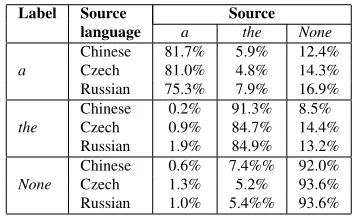
The annotation statistics also reveal that learn-ers do not confuse articles randomly. From Table 2, which shows the distribution of article errors by type, we observe that the majority of mistakes are omissions and extraneous articles. Table 3 shows statistics on corrections bysourceandlabel, where
source refers to the article used by the writer, and
label refers to the article chosen by the annotator. Each entry in the table indicates P rob(source =
2
Our classification, was inspired by the classification pre-sented in Tetreault and Chodorow (2008)
3
Henceforth, we will useato refer to bothaandan
4The tagger and the chunker are available athttp://
L2R.cs.uiuc.edu/˜cogcomp/software.php
Source Number of Proportion of Errors Article Classes language test examples errors total distribution a the None
Chinese 1713 9.2% 158 Before annotation 8.5 28.2 63.3 After annotation 9.9 24.9 65.2
Czech 1061 9.6% 102 Before annotation 9.1 22.9 68.0 After annotation 9.9 22.3 67.8
Russian 2146 10.4% 224 Before annotation 10.5 21.7 67.9 After annotation 12.5 20.1 67.4
[image:5.612.122.495.64.152.2]English Wikipedia 9.6 29.1 61.4
Table 1: Statistics on articles in the annotated data before and after annotation.
Source Proportion of Errors total Errors by Type
language errors in the data Extraneous Missing a Missing the Confusion Chinese 9.2% 158 57.0% 13.3% 22.8% 7.0% Czech 9.6% 102 45.1% 14.7% 33.3% 6.9% Russian 10.4% 224 41.5% 20.1% 25.5% 12.3%
Table 2: Distribution of article errors in the annotated data by error type. Extraneousrefers to usingaorthewhere None(no article) is correct.Confusionis usingainstead oftheor vice versa.
Label Source Source language a the None a
Chinese 81.7% 5.9% 12.4% Czech 81.0% 4.8% 14.3% Russian 75.3% 7.9% 16.9%
the
Chinese 0.2% 91.3% 8.5% Czech 0.9% 84.7% 14.4% Russian 1.9% 84.9% 13.2%
None
Chinese 0.6% 7.4%% 92.0% Czech 1.3% 5.2% 93.6% Russian 1.0% 5.4%% 93.6%
Table 3: Statistics on article corrections by the original article (source) and the annotator’s choice (label). Each entry in the table indicatesP rob(source=s|label=l)
for each article pair.
s|label = l)for each article pair. We can also ob-serve specific error patterns. For example, the is more likely thanato be used superfluously.
5 Introducing Article Errors into Training Data
This section describes experiments with error gener-ation methods. We conduct four sets of experiments. Each set differs in how article errors are generated in the training data. We now give a description of error generation paradigms in each experimental set.
5.1 Methods of error generation
We refer to the article that the writer used in the ESL data as source, and label refers to the article that the annotator chose. Similarly, when we introduce errors into the training data, we refer to the original
article as label and to the replacement as source. This is because the original article is the correct article choice, and the replacement that the classifier will see as a feature can be an error. We call this feature source feature. In other words, both for training (native data) and test (ESL data), source
denotes the form that the classifier sees as a feature (which could be an error) and label denotes the correct article. Below we describe how errors are generated in each set of experiments.
Method 1: General With probability x each ar-ticle in the training data is replaced with a different article uniformly at random, and with probability (1 − x) it remains un-changed. We build six classifiers, where x ∈ {5%,10%,12%,14%,16%,18%}. We call this methodgeneral since it uses no informa-tion about article distribuinforma-tion in the ESL data.
Method 2: ArticleDistrBeforeAnnot We use the distribution of articles in the ESL data before the annotation to change the distribution of ar-ticles in the training. Specifically, we change the articles so that their distribution approxi-mates the distribution of articles in the ESL data. For example, the relative frequency of
[image:5.612.97.277.288.397.2]distribution of labels is not affected. An ad-ditional constraint that we impose is the mini-mum error rater for each article class, so that
P rob(s|l)≥r∀l∈labels. In this fashion, for each source language we train four classifiers, where we use article distribution from Chinese, Czech, and Russian, and where we set the min-imum error raterto be∈ {2%,3%,4%,5%}.
Method 3: ArticleDistrAfterAnnot This method is similar to the one above but we use the dis-tribution of articles in the ESL data after the corrections have been made by the annotators.
Method 4: ErrorDistr This method uses informa-tion about error patterns in the annotated ESL data. For example, in the Czech annotated sub-corpus, labelthe corresponds to sourcethein 85% of the cases and corresponds to source
Nonein14% of the cases. In other words, in 14%of the cases where the articlethe should have been used, the writer used no article at all. Thus, with probability 14%we change thein the training data toNone.
6 Experimental Results
In this section, we compare the quality of the sys-tem trained on clean native English data to the qual-ity of the systems trained on data with errors. The errors were introduced into the training data using error generation methods presented in Section 5.
In each training paradigm, we follow a discrimi-native approach, using an online learning paradigm and making use of the Averaged Perceptron Al-gorithm (Freund and Schapire, 1999) implemented within the Sparse Network of Winnow framework (Carlson et al., 1999) – we use the regularized version in Learning Based Java6 (LBJ, (Rizzolo and Roth, 2007)). While classical Perceptron comes with generalization bound related to the mar-gin of the data, Averaged Perceptron also comes with a PAC-like generalization bound (Freund and Schapire, 1999). This linear learning algorithm is known, both theoretically and experimentally, to be among the best linear learning approaches and is competitive with SVM and Logistic Regression,
6
LBJ code is available athttp://L2R.cs.uiuc.edu/ ˜cogcomp/asoftware.php?skey=LBJ
while being more efficient in training. It also has been shown to produce state-of-the-art results on many natural language applications (Punyakanok et al., 2008).
Since the methods of error generation described in Section 5 rely on the distribution of articles and ar-ticle mistakes and these statistics are specific to the first language of the writer, we conduct evaluation separately for each source language. Thus, for each language group, we train five system types: one sys-tem is trained on clean English data without errors (the same classifier for the three language groups) and four systems are trained on data with errors, where errors are produced using the four methods described in Section 5. Training data are extracted from English Wikipedia.
All of the five systems employ the same set of fea-tures based on three tokens to the right and to the left of the target article. For each context word, we use its relative position, its part-of-speech tag and the word token itself. We also use the head of the noun phrase and the conjunctions of the pairs and triples of the six tokens and their part-of-speech tags7. In addition to these features, the classifiers trained on data with errors also use thesourcearticle as a fea-ture. The classifier that is trained on clean English data cannot use thesourcefeature, since in training thesourcealways corresponds to thelabel. By con-trast, when the training data contain mistakes, the
sourceis not always the same as thelabel, the situa-tion that we also have with the test (ESL) data.
We refer to the classifier trained on clean data as T rainClean. We refer to the classifiers trained on data with mistakes asT W E (TrainWithErrors). There are four types ofT W E systems for each lan-guage group, one for each of the methods of error generation described in Section 5. All results are the averaged results of training on three random sam-ples from Wikipedia with two million training ex-amples on each round. All five classifiers are trained on exactly the same set of Wikipedia examples, ex-cept that we add article mistakes to the data used by the T W E systems. The T rainClean system achieves an accuracy of 87.10% on data from En-glish Wikipedia. This performance is
state-of-the-7
art compared to other systems reported in the lit-erature (Knight and Chander, 1994; Minnen et al., 2000; Turner and Charniak, 2007; Han et al., 2006; De Felice and Pulman, 2008). The best results of 92.15% are reported by De Felice and Pulman (2008). But their system uses sophisticated syntac-tic features and they observe that the parser does not perform well on non-native data.
As mentioned in Section 4, the annotation of the ESL data consisted of correcting all errors in the sen-tence. We exclude from evaluation examples that have spelling errors in the 3-word window around the target article and errors on words that immedi-ately precede or immediimmedi-ately follow the article, as such examples would obscure the evaluation of the training paradigms.
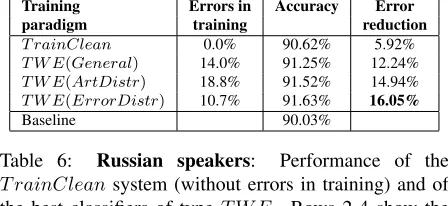
Tables 4, 5 and 6 show performance by language group. The tables show the accuracy and the er-ror reduction on the test set. The results of systems
T W E(methods 2 and 3) that use the distribution of articles before and after annotation are merged and appear as ArtDistr in the tables, since, as shown in Table 1, these distributions are very similar and thus produce similar results. Each table compares the performance of theT rainClean system to the performance of the four systems trained on data with errors.
For all language groups, all classifiers of type
T W E outperform the T rainClean system. The reduction in error rate is consistent when theT W E
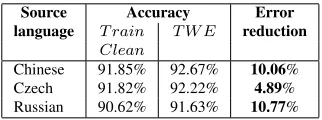
classifiers are compared to theT rainCleansystem. Table 7 shows results for all three languages, com-paring for each language group the T rainClean
classifier to the best performing system of type
T W E.
Training Errors in Accuracy Error paradigm training reduction T rainClean 0.0% 91.85% -2.26% T W E(General) 10.0% 92.57% 6.78% T W E(ArtDistr) 13.2% 92.67% 8.33% T W E(ErrorDistr) 9.2% 92.31% 3.51%
[image:7.612.313.537.249.352.2]Baseline 92.03%
Table 4: Chinese speakers: Performance of the
T rainCleansystem (without errors in training) and of the best classifiers of type T W E. Rows 2-4 show the performance of the systems trained with error generation methods described in 5.Error reductiondenotes the per-centage reduction in the number of errors when compared to the number of errors in the ESL data.
Training Errors in Accuracy Error paradigm training reduction T rainClean 0.0% 91.82% 10.31% T W E(General) 18.0% 92.22% 14.69% T W E(ArtDistr) 21.6% 92.00% 12.28% T W E(ErrorDistr) 10.2% 92.15% 13.93%
Baseline 90.88%
Table 5: Czech speakers: Performance of the
T rainCleansystem (without errors in training) and of the best classifiers of type T W E. Rows 2-4 show the performance of the systems trained with error generation methods described in 5.Error reductiondenotes the per-centage reduction in the number of errors when compared to the number of errors in the ESL data.
Training Errors in Accuracy Error paradigm training reduction T rainClean 0.0% 90.62% 5.92% T W E(General) 14.0% 91.25% 12.24% T W E(ArtDistr) 18.8% 91.52% 14.94% T W E(ErrorDistr) 10.7% 91.63% 16.05%
Baseline 90.03%
Table 6: Russian speakers: Performance of the
T rainCleansystem (without errors in training) and of the best classifiers of type T W E. Rows 2-4 show the performance of the systems trained with error generation methods described in 5.Error reductiondenotes the per-centage reduction in the number of errors when compared to the number of errors in the ESL data.
7 Discussion
As shown in Section 6, training a classifier on data that contain errors produces better results when compared to the T rainClean classifier trained on clean native data. The key results for all language groups are summarized in Table 7. It should be noted that the T rainCleansystem also makes use of the article chosen by the author through a confi-dence threshold8; it prefers to keep the article chosen by the user. The difference is that theT rainClean
system does not consider the author’s article in train-ing. The results of training with error generation are better, which shows that training on automati-cally corrupted data indeed helps. While the per-formance is different by language group, there is an observable reduction in error rate for each language group when T W E systems are used compared to
T rainCleanapproach. The reduction in error rate
8
[image:7.612.75.298.548.665.2]achieved by the best performingT W Esystem when compared to the error rate of theT rainClean sys-tem is 10.06% for Chinese, 4.89% for Czech and 10.77% for Russian, as shown in Table 7. We also note that the best performingT W Esystems for Chi-nese and Russian speakers are those that rely on the distribution of articles (Chinese) and the distribution of errors (Russian), but for Czech it is theGeneral T W Esystem that performs the best, maybe because we had less data for Czech speakers, so their statis-tics are less reliable.
There are several additional observations to be made. First, training paradigms that use error gen-eration methods work better than the training ap-proach of using clean data. Every system of type
T W E outperforms theT rainCleansystem, as ev-idenced by Tables 4, 5, and 6. Second, the propor-tion of errors in the training data should be similar to the error rate in the test data. The proportion of errors in training is shown in Tables 4, 5 and 6 in col-umn 2. Furthermore,T W EsystemsArtDistrand
ErrorDistrthat use specific knowledge about arti-cle and error distributions, respectively, work better for Russian and Chinese groups than the General
method that adds errors to the data uniformly at ran-dom. SinceArtDistrandErrorDistrdepend on the statistics of learner mistakes, the success of the systems that use these methods for error generation depends on the accuracy of these statistics, and we only have between 100 and 250 errors for each lan-guage group. It would be interesting to see whether better results can be achieved with these methods if more annotated data are available. Finally, for the same reason, there is no significant difference in the performance of methods ArtDistrBef oreAnnot
andArtDistrAf terAnnot: With small sizes of an-notated data there is no difference in article distribu-tions before and after annotation.
8 Conclusion and Future Work
We have shown that error correction training paradigms that introduce artificial errors are supe-rior to training classifiers on clean data. We pro-posed several methods of error generation that ac-count for error frequency information and error dis-tribution statistics from non-native text and demon-strated that the methods that work best are those that
Source Accuracy Error language T rain T W E reduction
Clean
[image:8.612.345.506.63.123.2]Chinese 91.85% 92.67% 10.06% Czech 91.82% 92.22% 4.89% Russian 90.62% 91.63% 10.77%
Table 7:Improvement due to training with errors. For each source language, the last column of the table shows the reduction in error rate achieved by the best perform-ingT W Esystem when compared to the error rate of the
T rainCleansystem. The error rate for each system is computed by subtracting the accuracy achieved by the system, as shown in columns 2 and 3.
result in a training corpus that statistically resembles the non-native text. Adding information about arti-cle distribution in non-native data and statistics on specific error types is even more helpful.
We have also argued that the baselines used ear-lier in the relevant literature – all based on the major-ity of the most commonly used class – suit selection tasks, but are inappropriate for error correction. In-stead, the error rate in the data should be taken into account when determining the baseline.
The focus of the present study was on training paradigms. While it is quite possible that the article correction system presented here can be improved – we would like to explore improving the system by using a more sophisticated feature set – we be-lieve that the performance gap due to the error driven training paradigms shown here will remain. The rea-son is that even with better features, some of the fea-tures that hold in the native data will not be active in in the ESL writing.
Finally, while this study focused on the problem of correcting article mistakes, we plan to apply the proposed training paradigms to similar text correc-tion problems.
Acknowledgments
References
C. Brockett, W. B. Dolan, and M. Gamon. 2006. Cor-recting ESL errors using phrasal SMT techniques. In Proceedings of the 21st COLING and the 44th ACL, Sydney.
A. Carlson, C. Cumby, J. Rosen, and D. Roth. The SNoW learning architecture.Technical report. A. J. Carlson and J. Rosen and D. Roth. 2001. Scaling
Up Context Sensitive Text Correction. IAAI, 45–50. R. De Felice and S. Pulman. 2008. A Classifier-Based
Approach to Preposition and Determiner Error Correc-tion in L2 English. InProceedings of COLING-08. J. Foster and Ø. Andersen. 2009. GenERRate:
Gener-ating Errors for Use in Grammatical Error Detection. InProceedings of the NAACL Workshop on Innovative Use of NLP for Building Educational Applications. Y. Freund and R. E. Schapire. 1999. Large margin
clas-sification using the perceptron algorithm. Machine Learning, 37(3):277-296.
M. Gamon, J. Gao, C. Brockett, A. Klementiev, W. Dolan, D. Belenko and L. Vanderwende. 2008. Using Contextual Speller Techniques and Language Model-ing for ESL Error Correction. Proceedings of IJCNLP. A. R. Golding and D. Roth. 1996. Applying Winnow to Context-Sensitive Spelling Correction. ICML, 182– 190.
A. R. Golding and D. Roth. 1999. A Winnow based ap-proach to Context-Sensitive Spelling Correction. Ma-chine Learning, 34(1-3):107–130.
S. Granger, E. Dagneaux and F. Meunier 2002. Interna-tional Corpus of Learner English.
S. Gui and H. Yang. 2003. Zhongguo Xuexizhe Yingyu Yuliaohu. (Chinese Learner English Corpus). Shang-hai Waiyu Jiaoyu Chubanshe. (In Chinese).
N. Han, M. Chodorow and C. Leacock. 2006. De-tecting Errors in English Article Usage by Non-native Speakers. Journal of Natural Language Engineering, 12(2):115–129.
E. Izumi, K. Uchimoto, T. Saiga and H. Isahara. 2003. Automatic Error Detection in the Japanese Leaners English Spoken Data. ACL.
E. Izumi, K. Uchimoto and H. Isahara. 2004. The NICT JLE Corpus: Exploiting the Language Learner’s Speech Database for Research and Education. Inter-national Journal of the Computer, the Internet and Management, 12(2):119–125.
K. Knight and I. Chander. 1994. Automatic Postediting of Documents. InProceedings of the American Asso-ciation of Artificial Intelligence, pp 779–784.
J. Lee and S. Seneff. 2008. An analysis of grammatical errors in non-native speech in English. InProceedings of the 2008 Spoken Language Technology Workshop, Goa.
G. Minnen, F. Bond and A. Copestake 2000. Memory-Based Learning for Article Generation. In Proceed-ings of the Fourth Conference on Computational Nat-ural Language Learning and of the Second Learning Language in Logic Workshop, pp 43–48.
V. Punyakanok, D. Roth, and W. Yih. The importance of syntactic parsing and inference in semantic role label-ing.Computational Linguistics, 34(2).
N. Rizzolo and D. Roth 2007. Modeling Discriminative Global Inference. InProceedings of the First Interna-tional Conference on Semantic Computing (ICSC), pp 597–604.
A. Rozovskaya and D. Roth 2010. Annotating ESL Er-rors: Challenges and Rewards. InProceedings of the NAACL Workshop on Innovative Use of NLP for Build-ing Educational Applications.
J. Sj¨obergh and O. Knutsson. 2005. Faking errors to avoid making errors. InProceedings of RANLP 2005, Borovets.
J. Tetreault and M. Chodorow. 2008. Native Judgments of Non-Native Usage: Experiments in Preposition Er-ror Detection. COLING Workshop on Human Judg-ments in Computational Linguistics, Manchester, UK. J. Turner and E. Charniak. 2007. Language Modeling
for Determiner Selection. InHuman Language Tech-nologies 2007: The Conference of the North American Chapter of the Association for Computational Linguis-tics; Companion Volume, Short Papers, pp 177–180. J. Wagner, J. Foster, and J. van Genabith. 2009.
Judg-ing grammaticality: Experiments in sentence classifi-cation. CALICO Journal. Special Issue on the 2008 Automatic Analysis of Learner Language CALICO Workshop.