Original Article
Ketamine impairs learning and memory ability in
early developing mice via the hippocampal
PKA/CREB signalling pathway
Fengxiang Wang1,2, Diyang Ling3, Shiyuan Xu1
1Department of Anesthesiology, Zhujiang Hospital of Southern Medical University, Guangzhou, Guangdong, China; 2Department of Anesthesiology, People’s Hospital of Liuzhou, Guangxi Zhuang Autonomous Region, Liuzhou, Guangxi, China; 3Department of Pain Medicine, People’s Hospital of Shenzhen, Shenzhen, Guangdong, China Received May 18, 2017; Accepted July 2, 2017; Epub August 15, 2017; Published August 30, 2017
Abstract: Objective: To investigate the effect of ketamine on the PKA/CREB signalling pathway in early developing mice and to explore the molecular mechanism of ketamine on the learning and memory ability impairment. Meth-ods: Sixty Kunming mice weighing 18-25 g were randomly divided into two experimental groups, with 30 mice in each group. These 30 mice were then randomly subdivided into three subgroups (ketamine group, vehicle group and control group). Mice in the ketamine group underwent intraperitoneal injection of ketamine (50 mg/kg), where-as mice in the vehicle group were given an intraperitoneal injection of the same volume of normal saline. And these two groups both received these injections once daily for six consecutive days. However, mice in the control group received no injections. On the seventh day of the experiment, the learning ability of mice was measured via a step-down test and Morris water maze test. Hippocampus proteins were then extracted from the mice, and the activation and expression of proteins involved in the PKA/CREB signalling pathway were detected using Western Blot technology. Results: Inthe ketamine group, the latency period was shortened, error times were increased, the escape latency was prolonged, the expression of PKAcα was decreased and phosphorylated-CREB was reduced, as compared with the corresponding measures in the control group. Conclusion: Ketamine can impair the learning and memory ability in early developing mice, and its mechanism may be related to the inhibition of the hippocampal PKA/CREB signalling pathway.
Keywords: Ketamine, signalling pathway, learning and memory, early development of mice
Introduction
Through the use of drugs or other methods, anaesthesia can cause a temporary loss of sensation for a patient’ s whole body or limited regions of the body, thereby making the patient feel no pain, and providing prerequisites for surgical therapies or other medical examina-tions and treatments [1]. As the derivative of phencyclidine, ketamine is a non-competitive N-methyl-D-aspartate (NMDA) receptor antago-nist that was developed by Dr. Craig in Wayne State University. Ketamine has been widely used as an intravenous anaesthetic drug in clinical situations for many years, due to its sedative and analgesic properties [2]. Many experimental animal studies, however, have found that repeated application of ketamine can cause short-term and long-term learning and memory dysfunction in early developing
mice [3, 4]. Clinical and experimental studies have reported that ketamine can also cause schizophrenia-like symptoms and cognitive impairment in people [5]; however, the molecu-lar biological mechanism of ketamine-induced learning and memory dysfunction remains unclear at present. Some studies have claimed that the learning and memory dysfunction caused by ketamine may be associated with the restraint of hippocampal long-term potenti-ation (LTP) formpotenti-ation, reduction of the expres-sion of the acetylcholine synthesising choline acetyltransferase enzyme and inhibition of the PKA/CREB signalling pathway [6].
expression. Meanwhile, cAMP response ele-ment-binding protein (CREB) is a transcription and transduction factor that is regulated by the cAMP available in cells, and its downstream efficacy includes influencing the survival and growth of neurons, the plasticity of synapses and the formation of long-term memory, which can thereby affect the learning and memory ability [7-10]. In this study, we aimed to investi-gate the change of PKA/CREB signalling path-way in the mice hippocampi under the repeated ketamine anaesthesia, and its effects on learn-ing and memory ability in early developlearn-ing mice, so as to explore the hidden connection.
Materials and methods
Laboratory animals, main reagents and equip-ments
Sixty healthy Kunming (KM) mice (weighing 18-25 g, regardless of gender, free diet and water intake) and a ketamine hydrochloride injection (NMPN: H32022820, approval num-ber: KH071004, 2 mL: 0.1 g) were purchased from the experimental animal centre of Southern Medical University. Other laboratory equipments and reagents included a YLS-3T jumping apparatus (Anhui Huaibei Zhenghua Biologic Apparatus Facilities Limited Company), a Morris water maze (MWM; Coulbourn Instruments Inc., USA), rabbit anti-CREB mAb and rabbit anti-p-CREB (pS133) mAb (Abcam, USA, approval number: ab32096), PKAcα anti -body (Beijing SinaSun Biological Technology Co., Ltd, approval number: MA119732), mouse anti-βActin mAb (Santa Cruz Biotechnology Inc., approval number: CW0096), peroxidase-conju-gated AffiniPuregoat anti-rabbit IgG (approval number: ZB2301) and goat anti-mouse IgG (Millipore Corp., approval number: AP136P), and a BCA Protein Assay Kit (Jiangsu Beyotime Institute of Biotechnology). All antibodies men-tioned above were diluted 1:1000.
Methods
Animal grouping: Sixty KM mice were equally divided into two groups at random. The step-down test and MWM test were respectively employed in the two groups. Each of these two groups was then randomly divided into three equally-sized sub-groups (ketamine group, vehicle group and control group), with ten mice
in each small group. Mice in the ketamine group were given an intraperitoneal injection of ket-amine (50 mg/kg), whereas mice in the vehicle group underwent an intraperitoneal injection of the same volume of normal saline, and both groups received an injection every morning for six consecutive days. Mice in the control group, however, received no injections.
Step-down test and MWM test: In the step-down experiment, we used opaque dark grey plastic to form five chambers, with each cham -ber being 120 mm by 120 mm by 180 mm, and being equipped with 36 V electric grid voltage and 0.25 mA electric current. On the seventh day after drug application, mice in the step-down group (n=30) were placed in the reaction chamber to adapt for 3 min. The electric grid at the bottom of chamber was then energised. The time that it took for mice to jump to the platform for the first time was within 5 min (la -tency period of learning) and the frequency of the electrical stimulation caused by the electric grid after jumping down from the platform (er-ror times of learning) were recorded. The next day, these mice were trained for 3 min in line with the above experimental operations after adaptation, and their latency period of learning and error times were also recorded. If the mice did not jump off the platform within 3 min, er-ror times were recorded as 0 and the latency period of learning was recorded as 180 s. The operations mentioned above were repeated at the same time for four consecutive days and the data were recorded accordingly.
fixed point and allowed to search for 90 s. If they found the platform successfully, they were required to stay on it for 20 s. But if they failed, they were also guided to the platform and then required to stay on it for 20 s. The average value of time that mice spent reaching the plat-form in four attempts was taken to be their escape latency for the day. And this test was conducted for four consecutive days.
WB technology detection: After finishing the experiments mentioned above, all 60 mice were anaesthetised with chloral hydrate, dur-ing which the low concentration oxygen (oxy-gen fluxes 2 L•min-1) was supplied. The skulls of these mice were exposed and brain samples were then taken. The hippocampal tissues of mice were isolated, RIPA lysis buffer and PMSF were added, and then each sample was ad-equately homogenised on ice using an ultra-sonic homogeniser. After being centrifuged at 12,000 rpm at 4°C for 15 min, a supernatant liquid was obtained and stored at -80°C. Pro-tein quantification was then conducted using bicinchoninic acid (BCA). Next, a polyacryl-amide gel was prepared, samples were added for electrophoresis, proteins were transferred, and the membranes were washed and blocked. The first antibody was added after rinsing with washing buffer for 3 times*10 min, and the corresponding secondary antibody was added after rewarming for 30 min and rinsing with washing buffer for 3 times*10 min the next day. Samples were then incubated on a slow speed shaker at room temperature for 2 h. Af-terwards, they were placed in a dark room to allow ECL exposure after rinsing with washing buffer for 3 min*10 min. The reaction was final -ly terminated by washing with deionised water after tablet compressing, and then the film was taken out for scanning. The results were anal-ysed using Image ProPlus, the image analysis system. The relative grey of each protein band was analysed, the optical density value of each
group was calculated, and the relative expres-sion level of each target protein was expressed as the ratio of target protein and reference grey. Moreover, the expression levels of PKAcα and P-CREB in the hippocampal tissues of mice in each group were detected.
Statistical analysis
SPSS 13.0 software was used to analyze the experimental data, and Graph PAD Prism 5.0 was applied to generate the summary graph. All measurement data were expressed as mean ± standard error (mean ± SEM). Comparison between the two main groups was carried out by using the t test, and the data were tested for homogeneity of variance. Comparison among all groups was performed by using the single factor analysis of variance and comparison of two groups was conducted using the SNK test. Data at different time points in the MWM exper-iment were compared by using a two-way repeated measure ANOVA design (time was the factor in groups, whereas comparison was the factor between groups). Differences were regarded to be statistically significant when the inspection level was α=0.05 and P<0.05.
Results
Results of step-down experiment
[image:3.612.92.523.98.164.2]Based on the average results of learning ability tests during three consecutive days one week after drug application and the memory ability test at the tenth day after drug application, we found that error times were increased in both the vehicle group (P=0.008) and the ketamine group (P=0.0005) in comparison with the con-trol group. In addition, the latency period was shortened in the ketamine group when com-pared with the control group (P=0.024; Table 1).
Table 1. The latency period and error times (mean ± SEM) for learning and memory ability in each of three treatment groups of mice subjected to a step-down test
Group Number Learning Memory
Latency period Error Latency period Error
Ketamine group 10 13.42±4.58* 2.83±1.51** 55.36±36.67* 1.60±0.88**
Vehicle group 10 19.76±10.16 2.03±1.82** 102.85±59.34 1.06±0.96**
Control group 10 27.28±19.66 0.83±0.92 145.16±37.03 0.59±0.56
Results of MWM experiment
In the water maze experiment that performed a week after drug application, there were no sta-tistically significant differences in the escape latency of mice among groups. From the sev-enth to tsev-enth day, the indexes were recorded
every day. And it was found that the escape latency of mice in the ketamine group was obvi-ously prolonged as compared with that of those in the control group (P=0.036; Figure 1). Additionally, the differences between the ket-amine group and the vehicle group were not statistically significant (P=0.803), whereas there was no significant difference between the vehicle group and the control group (P=1.056).
Results of WB technology detection
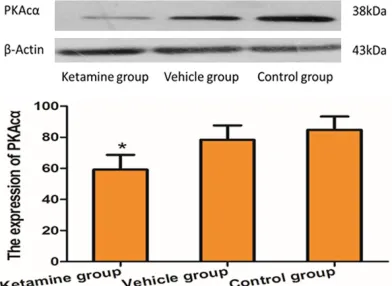
The expressions of both PKAcα proteins and P-CREB proteins in hippocampal tissues of mice were detected by using the WB technolo-gy. After ten days of drug application in mice, the expression of PKAcα proteins in hippocam -pal tissues of mice in the ketamine group was significantly decreased when compared with that of mice in the control group (P<0.05; Figure 2). Similarly, compared with the control group, the expression of P-CREB proteins in hippo-campal tissues of mice in the ketamine group was significantly decreased (P<0.05; Figure 3). Discussion
With the development of anaesthesiology, a variety of narcotic drugs have appeared in the clinical stage. Ketamine in particular has been widely used in various types of anaesthesia for surgical patients, especially in children, since it is a safe drug. Many researches have found, however, that ketamine can impair the learning and memory ability which are advanced func-tions of the brain. Learning refers to a neural process during which individuals and their movements can depend on experiences to change self-behaviours and adapt to the envi-ronment. Memory is a neural process during which individuals store and read out learned information, and it is also a fundamental and significant behavioural function in humans. In recent years, the reasons and mechanisms involved in ketamine-induced learning and memory impairement have therefore been clini-cal and basic research hotspots.
[image:4.612.90.288.71.165.2]In this study, we applied the step-down test and MWM experiment to detect the learning and memory ability of mice. When compared with the mice in the control group, mice that under-went repeated intraperitoneal injections of a basic anaesthetic dose of ketamine had the shortened latency period for learning and mem-ory, increased errors times and prolonged
Figure 1. A comparison of the escape latency of mice in different treatment groups at different periods of time post injection (7-10 days after), tested using the Morris water maze. *P<0.05, ketamine group com
[image:4.612.92.288.245.388.2]-pared with control group or with vehicle group.
Figure 2. The expression of PKAcα (mean ± SEM) in mice in each treatment group (n=10 for each group).
*P<0.05, compared with control group.
Figure 3. The expression of P-CREB (mean ± SEM) in mice in each treatment group (n=10 for each group).
[image:4.612.92.289.454.590.2]escape latency. These differences were statis-tically significant, suggesting that ketamine can lead to the obvious learning and memory ability impairment in mice. This result is consis-tent with the research of Yang et al., who found that after ketamine anaesthesia, the time nec-essary for learning and memory in mice was longer, and their error times during step-down and MWM experiments increased [11, 12]. Some foreign literature has reported that the process of learning and memory is associated with the connection of a loop between neurons, the transfer of neurotransmitters and the plas-ticity of synapses. Furthermore, it has been found that LTP can typically result in the change of synapse plasticity, and the PKA/CREB sig-nalling pathway can regulate extensive biologi-cal functions, including learning and memory ability [13]. A meta-analysis of related articles conducted by Setlow et al. indicated that cAMP can phosphorylate the target enzyme mainly by activating PKA, and PKA with catalytic activity can play a pivotal role in long-term synaptic plasticity and long-term memory [14]. PKAcα, one of the subunits of PKA, has been found to be abundantly expressed in neurons and essential for synapse plasticity. Activation of CREB phosphorylation is a convergence point for multiple signal transduction pathways, and the phosphorylated CREB (P-CREB) formed after activation can cause various long-term biological effects in cells, including learning and memory ability [15, 16]. The PKA/CREB signalling pathway therefore plays an impor-tant role in many aspects, such as neuronal development, synapse plasticity, learning and memory ability, injury and regeneration; in turn, the protein expressed by this signalling path-way can also reflect the conditions necessary for learning and memory ability [17].
In this study, it was found that the expressions of both PKAcα and P-CREB in the ketamine group were significantly decreased when com -pared with that in the vehicle and control groups. The results suggested that the learning and memory ability impairment of mice in the ketamine group might be related to the ket-amine-induced inhibition of the PKA/CREB sig-nalling pathway. Previous studies have indicat-ed that the mechanism may be relatindicat-ed to the nature of ketamine, as it is a NMDA receptor antagonist and, as such, can inhibit extracellu-lar calcium ion influx. Additionally, the PKA/
CREB signalling pathway is a calmodulin (Ca2+/ CaM)-dependent pathway, as Ca2+/CaM can inhibit CREB.
The results of our study were in line with those of Axel et al. and Lin et al. [18, 19]. The results of our Western Blot analysis showed that the expressions of P-CREB and PKAcα in the hip -pocampi of mice in the ketamine group were significantly decreased when compared with those of the vehicle and control groups. The research of Rajagopal et al. also have found that repeated injections of ketamine can likely affect the learning and memory ability in mice, and the reduction of P-CREB expression may be the mediating factor [20]. Furthermore, in our study, we also observed that in the step-down experiment, the error times of mice in the vehicle group were significantly increased. This probably because that the mice had not fully entered the anaesthetic state after acupunc-ture stimulation and were in a state of stress. Once the mice were released, they would be eager to break free, thereby ignoring the effects of electric shock. The study presented by Arendt et al. found that animals’ learning and memory abilities can be affected significantly when they are under strong acute stress or long-term chronic stress [21]; however, the spe-cific mechanism remains unclear at present.
In conclusion, this study found that ketamine may cause the learning and memory ability impairment by inhibiting the expressions of the proteins PKAcα and P-CREB.
Disclosure of conflict of interest
None.
Address correspondence to: Shiyuan Xu, Depart- ment of Anesthesiology, Zhujiang Hospital of Southern Medical University, No.253 Industrial Road, Guangzhou 510280, Guangdong, China. Tel: +86-020-61643298; Fax: +86-020-61643298; E-mail: [email protected]
References
[1] Liu RJ, Lee FS, Li XY, Bambico F, Duman RS and Aghajanian GK. Brain-derived neurotroph-ic factor Val66Met allele impairs basal and ketamine-stimulated synaptogenesis in pre-frontal cortex. Biol Psychiatry 2012; 71: 996-1005.
hip-pocampal neural cell and the ability of learning behavior in minor rats. Mol Biol Rep 2010; 37: 3137-3142.
[3] Zhang LM, Zhou WW, Ji YJ, Li Y, Zhao N, Chen HX, Xue R, Mei XG, Zhang YZ, Wang HL and Li YF. Anxiolytic effects of ketamine in animal models of posttraumatic stress disorder. Psy-chopharmacology (Berl) 2015; 232: 663-672. [4] Wang E, Feng Y, Zhang M, Zou L, Li Y, Buys ES,
Huang P, Brouckaert P and Chao W. Toll-like receptor 4 signaling confers cardiac protec- tion against ischemic injury via inducible nitric oxide synthase- and soluble guanylate cycla- se-dependent mechanisms. Anesthesiology 2011; 114: 603-613.
[5] Wang G, Bochorishvili G, Chen Y, Salvati KA, Zhang P, Dubel SJ, Perez-Reyes E, Snutch TP, Stornetta RL, Deisseroth K, Erisir A, Todorovic SM, Luo JH, Kapur J, Beenhakker MP and Zhu JJ. CaV3.2 calcium channels control NMDA re-ceptor-mediated transmission: a new mecha-nism for absence epilepsy. Genes Dev 2015; 29: 1535-1551.
[6] Pardue MT, Faulkner AE, Fernandes A, Yin H, Schaeffel F, Williams RW, Pozdeyev N and Iuvone PM. High susceptibility to experimental myopia in a mouse model with a retinal on pathway defect. Invest Ophthalmol Vis Sci 2008; 49: 706-712.
[7] Campos CA, Shiina H, Silvas M, Page S and Rit-ter RC. Vagal afferent NMDA receptors modu-late CCK-induced reduction of food intake through synapsin I phosphorylation in adult male rats. Endocrinology 2013; 154: 2613-2625.
[8] Zhu MJ, Du M, Nijland MJ, Nathanielsz PW, Hess BW, Moss GE and Ford SP. Down-regula-tion of growth signaling pathways linked to a reduced cotyledonary vascularity in placent-omes of over-nourished, obese pregnant ewes. Placenta 2009; 30: 405-410.
[9] Galeotti N, Stefano GB, Guarna M, Bianchi E and Ghelardini C. Signaling pathway of mor-phine induced acute thermal hyperalgesia in mice. Pain 2006; 123: 294-305.
[10] Peng S, Zhang Y, Wang H, Ren B and Zhang J. Anesthetic ketamine counteracts repetitive mechanical stress-induced learning and mem-ory impairment in developing mice. Mol Biol Rep 2011; 38: 4347-4351.
[11] Yang MY, Ding F, Jiang XG, Gu ZL and Bian SZ. Effects of ketamine on ethanol-induced learn-ing and memory impairment in mice. Journal of Nantong University 2013.
[12] Sharma AC and Kulkarni SK. Effects of MK-801 and ketamine on short-term memory defi-cits in passive avoidance step-down task para-digm in mice. Methods Find Exp Clin Pharmacol 1991; 13: 155-159.
[13] Song SP, Ma RR, Liu YJ, Jiang YN, Wang HH and Dai TJ. The effect of remifentanil combined with ketamine on the learning and memory function in mice. Acta Academiae Medicinae Xuzhou 2010.
[14] Wang H, Zhang Y, Zhang JN, Ren BX, Liu Y and Zeng YM. Effects on ketamine on learning and memory behavior and BDNF expression in im-mature mice. Journal of Clinical Anesthesiolo-gy 2008.
[15] Yang MY, Ding F, Jiang XG, Wu XX, Gu ZL, Guo CY and Bian SZ. [Effects of ketamine and alco-hol on learning and memory impairment in mice]. Fa Yi Xue Za Zhi 2012; 28: 115-119. [16] Xu XL, Wen J, Dai TJ and Ren XM. Effects of
re-peated ketamine on weight, autonomic ac- tivities, learning and memory in mice. Acta Ac-ademiae Medicinae Xuzhou 2008.
[17] Uchihashi Y, Kuribara H, Isa Y, Morita T and Sato T. The disruptive effects of ketamine on passive avoidance learning in mice: involve-ment of dopaminergic mechanism. Psycho-pharmacology (Berl) 1994; 116: 40-44. [18] Guskjolen A, Josselyn SA and Frankland PW.
Age-dependent changes in spatial memory re-tention and flexibility in mice. Neurobiol Learn Mem 2017; 143: 59-66.
[19] Lin L and Huang CP. Research on the ability of learning and memory behavior of mice after using ketamine anesthesia. Journal of Wen-zhou Medical College 2006.
[20] Rajagopal L, Burgdorf JS, Moskal JR and Melt-zer HY. GLYX-13 (rapastinel) ameliorates sub-chronic phencyclidine- and ketamine-induced declarative memory deficits in mice. Behav Brain Res 2016; 299: 105-110.