
R E S E A R C H
Open Access
Video coding using arbitrarily shaped block
partitions in globally optimal perspective
Manoranjan Paul
1*and Manzur Murshed
2Abstract
Algorithms using content-based patterns to segment moving regions at themacroblock(MB) level have exhibited good potential for improved coding efficiency when embedded into the H.264 standard as an extra mode. The
content-based pattern generation(CPG) algorithm provides local optimal result as only one pattern can be optimally generated from a given set of moving regions. But, it failed to provide optimal results for multiple patterns from entire sets. Obviously, a global optimal solution for clustering the set and then generation of multiple patterns enhances the performance farther. But a global optimal solution is not achievable due to the non-polynomial nature of the clustering problem. In this paper, we propose a near-optimal content-based pattern generation(OCPG) algorithm which outperforms the existing approach. Coupling OCPG, generating a set of patterns after clustering the MBs into several disjoint sets, with a direct pattern selection algorithm by allowing all the MBs in multiple pattern modes outperforms the existing pattern-based coding when embedded into the H.264.
Keywords:video coding, block partitioning, H.264, motion estimation, low bit-rate coding, occlusion
1. Introduction
VIDEO coding standards such as H.263 [1] and MPEG-2 [MPEG-2] introduced block-based motion estimation(ME) andmotion compensation(MC) to improve coding per-formance by capturing various motions in a small area (for example, a 8 × 8 block). However, they are ineffi-cient while coding at low bit rate due to their inability to exploitintra-block temporal redundancy(ITR). Figure 1 shows that objects can partly cover a block, leaving highly redundant information in successive frames as background is almost static in co-located blocks. Inabil-ity to exploit ITR results in the entire 16 × 16-pixel
macroblock(MB) being coded with ME&MC regardless of whether there are moving objects in the MB.
The latest video coding standard H.264 [3] has intro-duced tree-structured variable block size ME & MC from 16 × 16-pixel down to 4 × 4-pixel to approximate various motions more accurately within a MB. We empirically observed in [4] that while coding head-and-shoulder type video sequences at low bit rate, more than 70% of the MBs were never partitioned into
smaller blocks by the H.264 that would otherwise be at a high bit-rate. In [5], it has been further demonstrated that the partitioning actually depends upon the extent of motion and quantization parameter(QP): for low motion video, 67% (with low QP) to 85% (with high QP) of MBs are not further partitioned; for high motion video, the range is 26-64. It can be easily observed that the possibility of choosing smaller block sizes diminishes as the target bit-rate is lowered. Consequently, coding efficiency improvement due to the variable blocks can no longer be realized for a low bit rate as larger blocks have to be chosen in most cases to keep the bit-rate in check but at the expense of inferior shape and motion approximation.
Recently, many researchers [6-12] have successfully introduced other forms of block partitioning to approxi-mate the shape of amoving region more accurately to improve the compression efficiency. Chen et al. [6] extended the variable block size ME&MC method to include additional four partitions each with one L-shaped and one square segment to achieve improvement in picture quality. One of the limitations of segmenting MBs with rectangular/square shape building blocks as done in the method with variable block size and in [6] is that the partitioning boundaries cannot always * Correspondence: [email protected]
1
School of Computing and Mathematics, Charles Sturt University, Panorama Avenue, Bathurst, NSW 2795, Australia
Full list of author information is available at the end of the article
approximate arbitrary shapes of moving objects efficiently.
Hung et al. [7] and Divorra et al. [8,9] independently addressed this limitation with the variable block size ME&MC by introducing additional wedge-like partitions where a MB is segmented using a straight line modelled by two parameters: orientation angle θ and distancer from the centre of the MB. A very limited case with only four partitions (θ Î{0°, 45°, 90°, 135°} and r = 0) was reported by Fukuhara et al. [10] even before the introduction of variable block size ME&MC for low bit rate video coding. Chen et al. [11] and Kim et al. [12] improved compression efficiency further with implicit block segmentation (IBS) and thus avoided explicit encoding of the segmentation information. In both cases, the segmentation of the current MB can be gener-ated by the encoder and decoder using previously coded frames only.
But none of these techniques, including the H.264 standard, allows for encoding a block-partitioned seg-ment by skipping ME&MC. Consequently, they use unnecessary bits to encode almost zero motion vectors with perceptually insignificant residual errors for the background segment. These bits are quite valuable at low bit rate that could otherwise be spent wisely for encoding residual errors in perceptually significant seg-ments. Note that the H.264 standard acknowledges the penalty of extra bits used by the motion vectors by imposing rate-distortion optimisation in motion search to keep the length of the motion vector smaller and dis-allowing B-frames which require two motion vectors, in the Baselineprofile used widely in video conferencing and mobile applications.
Pattern-based video coding (PVC) initially proposed by Wong et al. [13] and later extended by Paul et al. [14,15] used 8 and 32 pre-defined regular-shaped bin-ary rectangular and non-rectangular pattern templates respectively to segment the moving region in a MB to exploit the ITR. Note that a pattern template is a size of 16 × 16 positions (i.e., similar to a MB size) with 64
‘1’s and 192‘0’s. The best-matched moving region of a MB with a pattern template (see in Figure 1) through
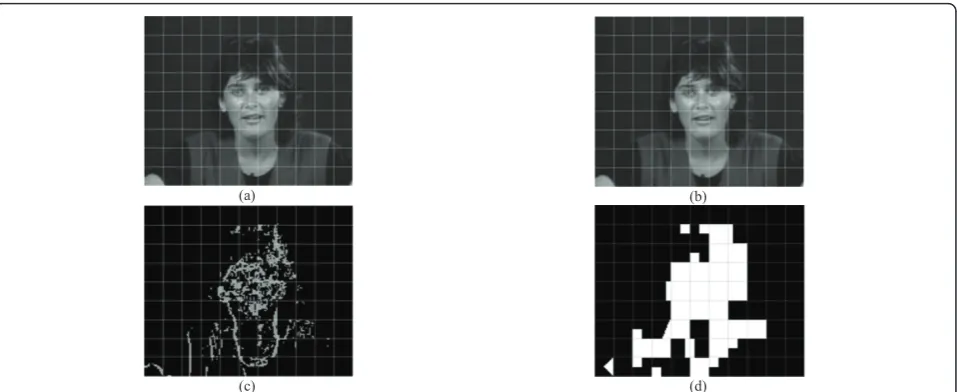
an efficient similarity measure estimates the motion, compensates the residual error using only pattern cov-ered-region (i.e., only 64 pixels among 256 pixels), and ignores the remaining region (which is copied from the reference block) of the MB from signalling any bits for motion vector and residual errors. Successful pat-tern matching can, therefore, theoretically attain maxi-mum compression ratio of 4:1 for a MB as the size of the pattern is 64-pixel. The actual compression how-ever will be lower due to the overheads of identifying this special type of MB as well as the best matched pattern for it and the matching error for approximat-ing the movapproximat-ing region usapproximat-ing the pattern. An example of pattern approximation using pre-defined thirty two patterns [14] for Miss America video sequence is shown in Figure 2.
As the objects in video sequences are widely varied, not necessarily the moving region is well-matched with any predefined regular-shape pattern template. Intui-tively, an efficient coding is possible if the moving region is encoded using the pattern templates gener-ated from the content of the video sequences. Very recently, Paul and Murshed [16] proposed a content-based pattern generation (CPG) algorithm to generate eight patterns from the given moving regions. The PVC using those generated patterns outperformed the H.264 (i.e., baseline profile) and the existing PVC by 1.0 and 0.5 dB respectively [16] for head-shoulder-type video sequences. They also mathematically proved that this pattern generation technique is optimal if only one pattern would be generated for a given division of moving regions. Thus, they got a local optimal solution as they could generate single pattern rather than mul-tiple patterns. But for efficient coding, mulmul-tiple pat-terns are necessary for different shape of moving regions.
It is obvious that a global optimal solution improves the pattern generation process for multiple patterns, and hence, eventually the coding efficiency. A global optimal solution can be achieved if we are able to divide the entire moving regions optimally. But, this problem is a
non polynomial(NP-complete) problem, as no clustering techniques provide optimal clusters. In this paper, we propose a heuristic to find the near-optimal clusters and apply local optimal CPG algorithm on each cluster to get the near global optimal solution.
Moreover, the existing PVC used a pre-defined threshold to reduce the number of MBs coded using patterns to control the computational complexity as it requires extra ME cost. It is experimentally observed that any fixed threshold for different video sequences may overlook some potential MBs from the pattern mode [15]. Obviously, eliminating this threshold by allowing all MBs to be motion estimated and Moving regions
64-pixel patterns
16u16 pixel MB Intra-block temporal static background
(a) Reference frame (b) Current frame
compensated using patterns and finally selected by the Lagrangian optimization function will provide better rate-distortion performance by increasing computa-tional time. To reduce the computacomputa-tional complexity we assume the already known motion vector of the H.264 in pattern mode, which may degrade the perfor-mance. But the net performance gain would outweigh this.
As the best pattern selection process solely relies on the similarity measures, it is not guaranteed that the best pattern will always result in maximum compression and better quality, which also depends on the residual errors after quantization and Lagrangian multiplier. This paper also exploits to introduce additional pattern modes that select the pattern in order of similarity rank-ing. Furthermore, a new Lagrangian multiplier is also determined as the pattern modes provide relatively less bits and slightly higher distortion as compared to the other modes of the H.264. The experimental results confirm that this new scheme successfully improves the rate-distortion performance as compared to the existing PVC as well as the H.264.
The rest of the paper is organized as follows: Section 2 provides the background of the content-based PVC techniques including collection of moving regions & generation of pattern templates, and encoding & decod-ing of PVC usdecod-ing content-based patterns. Section 3 illus-trates the proposed approach including optimal pattern generation technique and its parameter settings. Section 4 discusses the computational complexity of the pro-posed technique. Section 5 presents the experimental set up along with the comparative performance results. Section 6 concludes the paper.
2. Content-based PVC algorithm
The PVC with a set of content-based patterns termed as pattern codebook performs in two phases. In first phase, moving regions are collected from the given number of frames and pattern codebook is generated from those MRs using the CPG algorithm [15]. In the second phase, actual coding is taken place using the generated pattern codebook.
2.1. Collection of moving regions and generation of pattern codebook
The moving region in a current MB is defined based on the number of pixels whose intensities are different from the corresponding pixels of the reference MB. The moving region M of a MB Ω in the current frame is obtained using the co-located MBω in the reference frame [13] as follows:
M(x,y) =T((x,y)•−ω(x,y)•), 0≤x,y≤15 (1)
where Θis a 3 × 3 unit matrix for the morphological closing operation denoted by •[17], which is applied to reduce noise, and the thresholding functionT(v) = 1 ifv
> 2 (i.e., the said pixel intensity difference is bigger than two grey levels) and 0 otherwise. Let |M|1 be the total number of 1’s in the matrixM. If 8 ≤|M|1 < 2QP/3 + 64 where QP is the quantization parameter, the corre-sponding MB, i.e.,Ωwill participate in the pattern gen-eration process as it has a reasonable number of moving pixels to be covered by a 64-pixel‘1’s in a pattern so that high matching error is avoided.
The binary moving region map of Ω is used in the pattern generation process as the representative of Ω.
(a) (b)
(c) (d)
The MB with moving region is named as candidate region-active MB (CRMB). We have assumed that if the number of ‘1’s in a CRMB is too low or too high, the corresponding MB is not suitable to be encoded by the pattern mode, and thus, we do not include these CRMBs in the pattern generation process that is to be described next. In the proposed technique, if the num-ber of ‘1’s is less than 8 (same as in [13]), the MB has very low movement so that it can be encoded as skipped block. On the other hand, if the total number of ‘1’s is more than 64 + 2QP/3, the MB has very high motion so that it can be encoded using standard H.264 modes. Obviously, more MBs are encoded using the pattern mode at low bit rates as compared to high bit rates. Thus, we also relate the upper-bound threshold with QPto regulate the number of CRMBs with differ-ent bit rates.
Once all such CRMBs are collected for a certain num-ber of consecutive frames, decided by the rate-distortion optimizer [18] when the rate-distortion gain outweighs the overhead of encoding the shape of new patterns, these are divided into a sets to generate patterns. In order to generate patterns with minimal overlapping, a simpler greedy heuristic is employed where these CRMBs are divided intoaclusters such that the average distance among the gravitational centres of CRMBs within a cluster is small while the same among the cen-tres of CRMBs taken from different clusters is large. The CPG algorithm generates μ-pixel pattern for a clus-ter by theμ-most-frequent pixels among all the CRMBs in the cluster.
2.2. Encoding and decoding of PVC using content-based pattern codebook
The Lagrangian multiplier [19,20] is used to trade off between the quality of the compressed video and the bit rate generated for different modes. In this method, the Lagrangian multiplier,l is calculated with an empirical formula using the selected QP for every MB in the H.264 [18] as follows:
λ= 0.85×2(QP−12)/3. (2)
During the encoding process, all possible modes including the pattern mode are first motion estimated and compensated for each MB, and the resultant rates and the distortions are determined. The final modemis selected as follows:
mn= arg min(D(mi) +λB(mi)) (3)
WhereB(mi) is the total bits for modemi, including
mode type, motion vectors, extra pattern index code for pattern mode, and residual error after quantization, whileD(mi) is measured as thesum of square difference
between the original MB and the corresponding recon-structed MB for modemi.
3. Proposed algorithm
As mentioned earlier, the CPG algorithm can generate an optimal pattern from given moving regions but there is no guarantee to generate optimal multiple patterns from the entire given set of moving regions. For simpli-city, it uses a clustering technique which divides the moving regions into a clusters to generatea patterns. Thus, it is obvious that the performance of CPG also depends on the efficiency of clustering technique. As aforementioned, a clustering problem is a NP-complete problem and thus, a global optimization algorithm would be computationally unworkable. We propose a heuristic which can solve this problem near-optimally.
3.1. Optimal content-based pattern generation algorithm
Without losing any generality, we can assume that an optimal clustering technique with the CPG algorithm can provide optimal pattern codebook. We can define an optimal codebook, if each moving region is best-matched by the pattern which is generated from the cluster of that moving region. Suppose that an optimal clustering tech-nique divides the CRMBs into clustersC1,C2,...,Ca. If the
patternPiis generated from theCi, i.e.,
Pi=CPG(Ci) (4)
and the patternPjis selected as the best matched
pat-tern for the moving regionMÎ Cias
Pj= arg min Pn∈PC
(|M|1− |M∧Pn|1) (5)
then Pi and Pj will be same for an optimal pattern
codebook, and ^ represents the AND operation.
In the actual coding phase, a CRMB of a cluster can be approximated by the following two approaches: the pattern generated from its corresponding cluster or the best matched-pattern from the pattern codebook irre-spective of its clusters. The first approach is termed as
direct pattern selectionand later approach isexhaustive pattern selection.
always a possibility of ignoring a CRMB using the pat-tern mode, if only the extracted patpat-tern from a cluster is used to match against the CRMBs of the same cluster. Thus, this system requires reasonable number of pat-terns. On the other hand, we can called a CPG algo-rithm as the globally optimal one if it produces a pattern set in such a way that each CRMB is best-simi-larity-matched by the pattern which is generated from its own cluster, i.e., the value of τ is 100%. We can define τ as follows where |CRMBs| indicates the total
number of CRMBs:
τ =
|CRMBs|
k=1
x(k)
x(k) = 1 ifPi=Pj
0otherwise
/|CRMBs| (6)
wherePi andPjare selected from Equations 4 and 5,
respectively. When τ= 100%, we get the optimal solu-tion using clustering and the CPG algorithm. To do this we need to modify the CPG algorithm where a generic clustering technique using pattern similarity metric as a part of this algorithm. The dissimilarity of a CRMB against a pattern,Pnis defined as:
ψn
(M) =|M|1− |M∧Pn|1. (7)
where M and Pnare the CRMB and the nth pattern
respectively. The best-matched pattern is selected using Equation 5.
Unlike the CPG, optimal CPG (OCPG) (detailed in Figure 3) performs clustering and pattern formation until τ is 100% in each iteration. For a seed pattern codebook, it ensures that each CRMB will be best-matched by a pattern generated from its own cluster, i. e., the clustering process is optimum. However, it does not guarantee the global optimality of clustering because of trapping in local optima. To ensure the global optim-ality we need to determine average dissimilarity ψavg using pattern codebooks generated with iterations. The final pattern codebook is selected based on the mini-mumψavgfor a given number of iterations with random starts as ψavg indicates the optimal pattern codebook. We can define ψavg as follows where Cindicates the total set of CRMBs, Ci indicates the ith sub-set of
CRMBs clustered using ith pattern, |Ci| indicates the
total number of CRMBs inCi, andψi(Ci(j)) indicates the
dissimilarity betweenith pattern andjth CRMB in the
Cisub-set:
ψavg=
⎛
⎝α
i=1
|Ci|
j=1 ψi(C
i(j)) ⎞ ⎠/
α
i
|Ci|. (8)
For one random start, we will get a candidate global solution for a seed codebook. There would be multiple solutions for given moving regions. When the search
space is really large and there is no suitable algorithm to find the optimum solution, k-change neighbourhood may be considered as ak-optimal solution [21]. Lin and Kernighan [22] empirically found that a 3-optimal solu-tion for thetravelling salesman problemhas a probabil-ity of about 0.05 of being not optimal, and hence 100 random starts yields the optimum with a probability of 0.99. Lin and Kernighan also demonstrated that a 3-optimal solution is much better than a 2-3-optimal solu-tion; however, a 4-optimal solution is not sufficiently superior to a 3-optimal solution to justify the additional computational cost. In our approach we also use 100 random starts and replace 3-pixel in each pattern to get the optimal solution. We terminate each iteration of a random start when either the average dissimilarity is not reduced in successive iteration or τ = 100%. Thus, OCPG ensures convergence by providing near-optimal solutions.
The main advantage of this global OCPG approach over the local CPG approach is that it takes whole mov-ing region information to cluster the CRMB against the pattern (instead of a gravitational centre of a CRMB [15]). Moreover, multiple iterations ensure the quality of pattern codebook to represent the CRMBs and this approach does not require exhaustive pattern matching so that it reduces the computational time needed to select the best-match pattern from a codebook against each CRMB.
Figure 4 shows the way to generate a pattern using the proposed OCPG algorithm. Figure 4a shows 3D repre-sentation of the total moving regions for the corre-sponding pixel position which is calculated by the summation of all CRMBs’ ‘1’s in a cluster in the first iteration. This 3D representation indicates the most sig-nificant moving area (where the frequency is high) in a cluster. Figure 4d shows the same thing after the final iteration. Note that Figure 4d has more concentrated high frequency area compared to Figure 4a, and this suggests the necessity of global optimization for pattern generation. Figure 4b, e show the 2D cluster view. The final patterns are shown in Figure 4c, f where the latter is obviously the desirable pattern due to the compactness.
3.2. Impact of OCPG algorithm on correct classification rateτ, dissimilarityψ, and number of iterations
Figure 5 shows average number of iterations needed for each random start to provideτ = 100% using ten stan-dard QCIF video sequences. The average is 9.73 per ran-dom start, would be much lower if we use seed patterns for each start. But the seed pattern may bias towards the seed pattern shape.
definition, certain features are assumed for each 64-pixel pattern such that each is regular (i.e., bounded by straight lines),clustered (i.e., the pixels are connected), and boundary-adjoined. Since the moving region of a MB is normally a part of a rigid object, the clustered and boundary-adjoined features of a pattern can be easily justified, while the regularity feature is added to limit the pattern codebook size.
Figure 7 shows some example patterns from the seven test sequences. It is interesting to note the lack of similarity between the pattern sets for each of the sequences. The patterns cover different regions of a MB to ensure the maximum pattern coded MBs form maximum compression. It should also be noted that of the three fundamental pixel-based assumptions, which apply to any predefined codebook, only regularity has been relaxed, while the clustering and boundary-adjoined conditions are adhered to it in most cases. This relaxation is one of the main reasons for the
superior coding efficiency achieved by the arbitrary-shaped patterns.
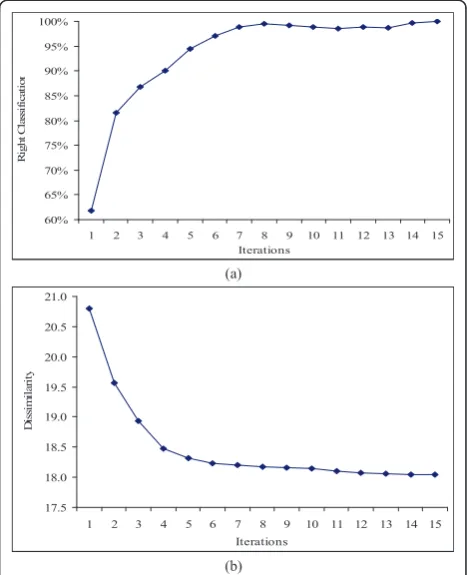
Figure 8 shows that how the proposed OCPG algo-rithm generates the optimal codebook. For each random start the OCPG algorithm reduces the dissimilarity,ψavg Algorithm PC = OCPG(D,P, K, C)
Precondition: Given a set of CRMBs, C, Given iterations K; Post condition: A pattern codebook PC {P1,...,PD}ofP-pixel content-based patterns;
1. k = 0; W= 0; \avg f; Replace = 0; 2. WHILE (k< K)
3. Randomly generate Dnumber of patterns, P1,...,PDof P-pixel 4. Divide C into Dclusters based on the equation (5) using PC or any
clustering algorithm.
5. t = 0; W 0;Calculate \avgP using current PC for all MR.
6. WHILE (W<100) 7. For i=1,...,D 8. For x = 0,…,15 9. For y = 0,…, 15 10. Pi(x,y) 0;
11.
¦
i
C
j ij i
i x y f x y M x y T
1 ,
) , ( )
, ( ) 16
( where
Mi,j is the MR of the jth CRMB in Ci; 12. {l0,...,l255}=ranked indices of Ti such that
) ( ) (j t i j1 i l T l
T for 0j<255; 13. For j=0,…,P-1
14. Pi(
¬
lj/16¼
,ljmod16) 1;15. Divide C into Dclusters based on the equation (5) using new PC and calculateW and\avgC for all M.
16. IF (\avgC >\avgP ) exit; ELSE \avgP = \Cavg; 17. t = t + 1;
18. IF \avg !\avgC
19. \avg \avgC ; PC {P1,...,PD}
20. k k1;
Figure 3 The OCPG algorithm for near optimal multiple
pattern sequence generation.
(a) (d)
(b) (e)
(c) (f)
Figure 4 Pattern generation using the proposed OCPG
algorithm.(a, d)3D representation of pixel frequency of one of the eight clusters of CRMBs obtained fromForemanvideo sequence, for the first and last iterations, respectively.(b, e)Their corresponding 2D top view projection; and(c, f)the generated pattern for this cluster by the OCPG algorithm after first iteration and final iteration for a random initial seed pattern. Please refer to the text for more explanation.
7 8 9 10 11 12
1 10 19 28 37 46 55 64 73 82 91 100
100 Random Starts
N
o of
It
er
at
io
ns
Figure 5Average number of iterations is needed to get
(see Figure 8b) by classifying the CRMBs (Line 15 of the proposed OCPG algorithm) using the best-matched pat-tern. Thus, it increases τ (see Figure 8a) and also ensures the convergence of the OCPG algorithm.
It is clear that the coding performance will decrease with the group of frames participated in the pattern for-mation process of the proposed OCPG algorithm as the generated PC is gradually approximating the shape of the CRMBs. This process imposes restriction on the group of frames size. Thus, we need to refresh the pat-tern codebook with a regular interval. As shown by experiments, thegroup of picture(GOP) size would be good candidate to test whether we need to refresh the codebook. The detailed procedure of pattern codebook refreshment and transmission will be described in Section 3.4.
3.3. Clustering techniques
The CPG algorithm usesK-means clustering technique [23] where it uses gravitational centre of the CRMBs to cluster them. The average value ofτis at best 70% using
the CPG algorithm. It is due to the gravitational centre which represents all the 256 pixels with a point. We also investigateFuzzy C-means[24,25] clustering techni-que, but the results is almost the same. Neural network is not a good candidate due to the computational com-plexity. It is interesting to note that the performance of the proposed OCPG algorithm does not depend on any specific clustering algorithm because whatever a
P1 P2 P3 P4 P5 P6 P7 P8
P9 P10 P11 P12 P13 P14 P15 P16
P17 P18 P19 P20 P21 P22 P23 P24
P25 P26 P27 P28 P29 P30 P31 P32
Figure 6The pattern codebook of 32 regular-shape, 64-pixel patterns, defined in 16 × 16 blocks, where thewhiteregion represents 1 (motion) andblackregion represents 0 (no motion).
Miss America Foreman
Carphone
Salesman
News
Suzie
Mother & Daughter
Figure 7The OCPG algorithm generates the pattern codebook of 8 arbitrary shaped, 64-pixel patterns, defined in 16 × 16 blocks, where thewhiteregion represents 1 (motion) andblack region represents 0 (no motion).
(a)
(b)
60% 65% 70% 75% 80% 85% 90% 95% 100%
1 2 3 4 5 6 7 8 9 10 11 12 13 14 15
Iterations
R
ig
ht C
la
ss
if
ic
atio
n
17.5 18.0 18.5 19.0 19.5 20.0 20.5 21.0
1 2 3 4 5 6 7 8 9 10 11 12 13 14 15 Iterations
D
is
sim
il
ar
it
y
Figure 8 Improvement of clustering process using the
clustering algorithm used is merely to generate only seed codebook and subsequently, the process converges quickly with our pattern similarity matching algorithm.
3.4. Pattern codebook refreshing and coding
For content-based pattern generation, we need to trans-mit the pattern codebook after a certain interval. To determine whether we need to transmit the newly gen-erated codebook or continue with the current one, we consider the bits and distortions generated with both the current and the previous pattern codebooks. The GOP [26] may be the best choice as after a GOP we need to send a freshIntrapicture in the bitstream. Note that this GOP may be different from the group of frames used for codebook generation. To trade off the bitstream size and quality we can use Lagrangian optimization function as it is used to control the rate-distortion performance. Here we consider average dis-tortion and bits per MB in both cases. We select the current codebook if it provides less Lagrangian cost as compared to the previous one.
From the experimental results we observe that around 2 to 4 times we need to refresh arbitrary patterns while we use first 100 frames of the seven standard QCIF video sequences (same as those used in Figure 7) as illu-strated in Figure 9. The figure also shows that the num-ber of transmission increases with the bit rate because almost fixed amount of bits for pattern transmission has significant contribution in rate-distortion optimization at the low bit rate but has insignificant contribution at relatively high bit rates. Note that five times in refresh-ment mean that we need to refresh the pattern code-book in all GOP in our experiments.
For pattern codebook transmission we have divided each pattern (i.e., 16 × 16 pixel binary MB) into four 8 × 8 blocks and then applied zero-run length coding.
The zero-run length will be 0-63 as the total number of elements in a block are 64. We have usedHuffman cod-ing to assign variable length codes for each combination. The length of codes varies from 2 to 14 bits for the length of 0-63. But we have treated the length of 64 (i. e., all are zeros) as a special case, and thus we assign it with two bits as well. As for the variable length codes, one can easily generate them from the frequencies of the zero-run lengths using Huffman coding, so we do not include the whole table in this paper. From the experimental results, for eight patterns with each of 64
‘1’s requires 518 bits on average. On the other hand, if we use fixed length coding for the positions of‘1’s in a pattern we need 4,096 bits to transmit eight patterns with 64‘1’s (i.e., 8 × 64 × 8 = 4096 bits).
3.5. Multiple pattern modes and allowance of all MBs as CRMBs
As we mentioned in “Introduction”, the best pattern selection process relying on the similarity measures does not guarantee that the best pattern would always result in coding efficiency because of residual errors after quantization and the choice of Lagrangian multiplier. To address this we use multiple pattern modes that select the pattern in the order of similarity. Since the similarity measure is a good estimator, we only consider higher ranked patterns. Eliminating the CRMB classifi-cation threshold for 8≤|M|1< 2QP/3 + 64, by allowing all MBs to be motion estimated and compensated using pattern modes and finally selected by the Lagrangian optimization function, provides better rate-distortion performance. Obviously this increases the computational complexity which is checked using already known motion vector determined by the 16 × 16 mode.
3.6. Encoding and decoding in the proposed technique
In the proposed technique, near-global-optimal arbitra-rily shaped PVC (ASPVC-Global) uses a pattern code-book that comprises eight patterns with 64 pixels as‘1’. Note that a pattern is a 16 × 16 binary MB with 64 positions are marked as‘1’and the rest of the positions are marked as ‘0’. The proposed OCPG technique is generic to form any pixel-size patterns (for example 64 as used in the experiment, 128, or 192) with any num-ber of patterns (for example 2, 4, 8 as used in the experiment, 16, 32) in a codebook. We have investigated into different combinations of pixels and patterns, but found that the eight 64-pixel patterns are the best pat-tern codebook in terms of rate-distortion and computa-tional performance using different video sequences. We have used fixed length codes (i.e., 3 bits) to identify each pattern in the proposed technique. Note that we have also encoded the pattern mode using finer quantization. In the implementation we have usedQPpattern=QP- 2,
1.00 1.50 2.00 2.50 3.00 3.50 4.00
51 44 40 38 36 34 32 30 28 26 24 22 20 Quantization Parameter (QP)
N
um
ber
o
f P
C
T
ran
sm
is
si
on
s
Figure 9The average number of pattern code transmissions with quantization parameters when we processed first 100 frames using seven standard QCIF video sequences. namely
Miss America,Suzie,Claire,Salesman,Car phone,Foreman, andNews
where QP is used for the other standard modes. The rationality of the finer quantization is that as the pattern mode requires fewer bits as compared to the other modes, we can easily spend more bits in coding residual errors by lowering quantization. The final mode decision is taken place by the Lagrangian optimizer.
Before encoding a GOP a new pattern codebook is generated using all frames of the GOP. Then encode that GOP using the new codebook and the previous codebook (if there is one, for the first GOP there is no previous codebook). We have selected the bits stream based on the minimum cost function (using Equation 3 with new Lagrangian Multiplier (see Section 5.1) using the average bits and distortion (sum of square differ-ence) per MB.
As mentioned earlier, we have used the motion vector of the 16 × 16 mode as the pattern mode motion vector to avoid computational time requirement of ME. Only the pattern-covered residual error (i.e., region marked as
‘1’ in the pattern template) is encoded and the rest of the regions are copied from the motion translated region of the reference frame. To encode a pattern-cov-ered region, we need four 4 × 4-pixel sub-blocks (as 64
‘1’s in a pattern) for DCT transformation. Using the existing shape of the pattern (for example, the first pat-tern in the Miss Americavideo sequence in Figure 7), we may need more than four 4 × 4-pixel blocks for DCT transformation. To avoid this, we need to rear-range the 64 positions before transformation so that we do not need more than four blocks. Inverse arrangement is performed in the decoder with the corresponding pat-tern index, and thus we do not lose any information.
In the decoder, we can determine the pattern mode and the particular pattern from the MB type and pattern index codes respectively. From the transmitted pattern codebook, we also know the shape of the pat-terns i.e., the positions of ‘1’s and ‘0’s. After inversely arranging the residual errors according to the pattern, we reconstruct the MB of the current frame by adding residual error with the motion translated MB of the reference frame.
4. Computational complexity of OCPG algorithm
In order to determine the computational complexity of the proposed ASPVC-Global algorithm, let us compare it with the H.264 standard. From now on, previous con-tent-based PVC is named as ASPVC-Local [16]. The H.264 encodes each MB with motion search for each mode. When the proposed ASPVC-Global scheme is embedded into the H.264 as an extra mode, additional one-fourth motion search is required per MB as the pat-tern size is a quarter of a macroblock. Each macroblock takes part in the proposed OCPG algorithm and the best pattern is selected at the end. For detailed analysis
of the proposed OCPG algorithm is described as follows.
We can divide the entire process into (i) Binary matrix calculation, (ii) clustering and correct classification rateτ calculation, (iii) pixel frequency calculation of each clus-ter, and (iv) sorting the pixels based on the frequency. Let N, a,M2,k, andIbe the total number of MBs, total number of cluster, block size, total number of random starts, and number of iterations for τ = 100%, respec-tively, and then:
[i] Each binary matrix calculation requires one sub-traction, one absolute and one comparison. Thus, totally 3NM2operations are required.
[ii] Each clustering requires one comparison and one addition. Thus totally 2aNM2 operations are required. Each correct classification rate calculation requires one comparison. Thus,aNoperations are required.
[iii] Each pixel frequency calculation requires one addition. ThusNM2operations are required.
[iv] Sorting the pixel frequency requires 2aM2lnM
operations.
Therefore, the proposed OCPG algorithm requires 3NM2 +kI(2aNM2 +aN+NM2 + 2aM2ln M) opera-tions. If we assume that N >>a and N >>M, the required operations would benM2(4 + 16K) whereKis the total number of iterations including the number of random starts and the associated inner-loop iterations. On the other hand, motion search using any mode requires 3(2d + 1)2 NM2 operations where d is the range of motion search. Thus, the proposed ASPVC-Global with 100 random starts and 9.73 (according to Figure 5) inner-loop iterations untilτ = 100% requires no more than 5.4 times operations compared to the full motion search by a mode where search length is 15.
For multiple pattern modes, the ASPVC-Global needs only bit and distortion calculation without ME. The ME, irrespective of a scene’s complexity, typically comprises more than 60% of the computational overhead required to encode an inter picture with a software codec using the DCT [27,28], when full search is used. Thus, maxi-mum of 10% operations are needed for one pattern mode as each pattern mode will process one-fourth of the MB. As a result, the ASPVC-Global algorithm using five random starts and up to four pattern modes may requires extra 0.58 of a mode ME&MC operations com-pared to the H.264 which would not be a problem in real time processing.
5. Experimental set up and simulation results 5.1. Integration with H.264 coder
To accommodate extra pattern modes in the H.264 video coding standard for testing, we need to modify its bitstream structure and Lagrangian multiplier. For inclu-sion of pattern mode we change the header information for MB type, pattern identification code, and shape of patterns. Inclusion of pattern mode also demands modi-fication of the Lagrangian multiplier as the pattern mode is biased to bits rather than distortion.
The H.264 recommendation document [3] provided binarization for MB and sub-MB in P and SP slices. Experimental results show that in most of the cases the 8 × 8 mode is less frequent compared to the larger modes. Thus, we use first part of the MB type header for the pattern mode using‘001’code and then assign variable length codes for pattern modes, 8 × 8, 8 × 4, 4 × 8, and 4 × 4. Using the frequency of MB type, we assigned the pattern modes, 8 × 8, 8 × 4, 4 × 8, and 4 × 4 as‘0’, ‘10’,‘111’, ‘1100’, and‘1101’, respectively. After the header of MB type we need to send the pattern type with the maximum length of codes as log2(number of pattern templates) when fixed length pattern codes will be used. For example, when we use eight patterns in a codebook, we use 3 bits for the pattern code. The pat-tern code will identify the particular patpat-tern. At the beginning of a GOP we transmit the codebook if neces-sary. We use one bit to indicate whether a new code-book is transmitting.
We also investigate into Lagrangian multiplier after embedding new pattern modes in the H.264 coder. It is already mentioned earlier that a new pattern mode yields less bits and sometimes higher distortion com-pared to the standard H.264 modes. To be fair with the other modes, the value of multiplier is reduced to l= 0.4 × 2(QP-12)/3. The experimental results of Lagrangian multiplier and rate-distortion performance have justified the new valuation. As the pattern modes require fewer bits compared to the 16 × 16 mode, the reducedl sig-nifies less importance in bits as compared to the
distortion in the minimization of Lagrangian cost func-tion. We have also observed that for a given l, the gen-erated QP is slightly large for relatively high motion compared to the smooth motion video sequences.
5.2. Experiments and results
In this paper, experimental results are presented using nine standard video sequences with wide range of motions (i.e., smooth to high motions) and resolutions (QCIF to 4CIF) [26]. Among them, three (Miss America,
Foreman, andTable Tennis) are QCIF (176 × 144), one (Football) is SIF (352 × 240), two (ParisandSilent) are CIF (352 × 288), and other two (Susie andPopple) are 4CIF (720 × 576). Full-search ME with 15 as the search range and fractional accuracy has been employed. We have selected a number of existing techniques to com-pare with the proposed one. They are the H.264 (as it is the state-of-the-art video coding standard), the ASPVC-Local [16] (as it is the latest block partitioning coding technique with arbitrarily shaped patterns), the IBS [12] (as it is the latest block partitioning video coding techni-que), and the PVC [15] (as it is the latest block parti-tioning technique using pre-defined patterns).
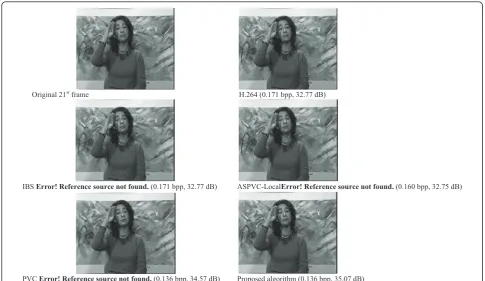
Figure 10 shows some decoded frames for visual view-ing comparison by the H.264, the IBS [12], the ASPVC-Local [16], PVC [15], and the proposed techniques. The 21st frame of Silentsequence is shown as an example. They are encoded using 0.171, 0.171, 0.160, 0.136, and 0.136 bits per pixel (bpp) and resulting in 32.77, 32.77, 32.75, 34.57, and 35.07 dB in Y-PSNR, respectively. Bet-ter visual quality can be observed in the decoded frame constructed by the proposed technique at the fingers areas. Apart from the best PSNR result by the proposed technique, subjective viewing has also confirmed the quality improvement. From the viewing tests with 10 people, the decoded video by the proposed scheme is with the best subjective quality. It is due to the fact that the proposed method performs well in the pattern-cov-ered moving areas, and the bit saving for partially skipped blocks (i.e., exploiting more of intra-block tem-poral redundancy) compared to the other methods. Thus, the quality of the moving areas (i.e., area compris-ing objects) is better in the proposed method.
Table 1 shows rate-distortion performance for a fixed bit rate using different algorithms for different video sequences. The table reveals that the proposed algo-rithm outperforms the relevant existing algoalgo-rithms such as H.264, the IBS [12], the ASPVC-Local [16], and the PVC [15] by 2.2, 2.0, 1.5, and 0.5 dB, respectively.
proposed technique outperforms the state-of-arts techni-ques. The proposed technique outperforms the most recent PVC technique [15] by at least 0.5 dB for almost all video sequences with wide range of bit rates. The proposed technique exhibits better performance due to the global optimization, allowing all MBs into multiple pattern generation and pattern modes, and spending more bits in pattern mode.
The performance of the proposed technique as well as other pattern-based video coding may not perform bet-ter significantly compared to the H.264 at high bit rates as the number of MBs encoded by the pattern-mode may diminish. It is due to the dominancy of the smaller modes of the variable block size over pattern mode. It may also fail if the video sequences have extremely high motion. It is due to the smaller amount of intra-block temporal redundancy available in MBs in such situa-tions. After all, the proposed technique is good at low bit rates by the nature of its theoretical ground. It has been demonstrated above that its objectives have been achieved.
6. Conclusions
In this paper, we have proposed an efficient video cod-ing technique uscod-ing arbitrarily shaped block partitions in global optimal perspective, for low bit rates. The pro-posed scheme uses a content-based pattern generation strategy in the globally optimal perspective, based upon multiple pattern modes. A Lagrangian multiplier has been derived to embed the pattern mode into the H.264. We have verified the effectiveness of the pro-posed technique by comparing other contemporary and relevant algorithms. The experimental results show that this new scheme improves the video quality by 0.5 and
Original 21st frame H.264 (0.171 bpp, 32.77 dB)
IBS Error! Reference source not found. (0.171 bpp, 32.77 dB) ASPVC-LocalError! Reference source not found. (0.160 bpp, 32.75 dB)
PVC Error! Reference source not found. (0.136 bpp, 34.57 dB) Proposed algorithm (0.136 bpp, 35.07 dB)
Figure 10The decoded frames of the 21st frame inSilentvideo sequence.
Table 1 Performance at a glance
Video sequence @ kbps H.264 IBS ASPVC-Local
PVC Proposed
Miss America QCIF @72 37.0 37.2 38.6 39.7 40.3
Table QCIF @200 32.2 32.2 32.2 32.7 33.0
Foreman QCIF @200 32.8 32.9 33.1 33.6 34.1
Mother&Daughter QCIF @110
34.4 34.4 35.2 36.8 37.2
News QCIF @110 29.0 29.0 30.4 33.0 33.6
Hall CIF @500 33.4 33.4 34.6 36.1 36.6
Football SIF @1100 28.6 28.6 28.6 28.9 29.1
Paris CIF @1100 34.5 34.5 34.7 35.8 36.5
Silent CIF @600 33.6 33.6 33.8 35.6 36.3
Table 4CIF @3500 29.6 29.7 29.8 30.2 30.7
Tempate 4CIF @3500 32.4 32.4 32.4 32.7 33.1
1.5 dB compared to the existing latest pattern-based video coding and the H.264 standard respectively.
Author’s information
Additional email addres for Professor Paul: mpaul@csu. edu.au
Abbreviations
ASPVC: arbitrarily shaped pattern-based video coding; BPP: bits per pixel; CPG: Content-based pattern generation; CRMB: candidate region-active macroblock; GOP: Group of picture; IBS: implicit block segmentation; ITR: intra-block temporal redundancy; MB: Macroblock; MC: motion
compensation; ME: motion estimation; NP: non-polynomial; OCPG: optimal content-based pattern generation; PVC: pattern-based video coding; QP: quantization parameter.
Author details
1School of Computing and Mathematics, Charles Sturt University, Panorama
Avenue, Bathurst, NSW 2795, Australia2Gippsland School of Information Technology, Monash University, Churchill, VIC 3842, Australia
Competing interests
A significant portion of the research work is done when I was a PhD student and research fellow in Monash University under the supervision of Manzur Murshed. I wrote this paper when I was not in Monash University. I have submitted this paper and modified the paper when I am a Lecturer in Charles Sturt University. Article processing fee is provided by Charles Sturt University.
Received: 5 January 2011 Accepted: 9 July 2011 Published: 9 July 2011
References
1. ITU-T Recommendation H.263. Video coding for low bit-rate communication, version 2 (1998)
2. ISO/IEC 13818, MPEG-2 International Standard (1995)
3. ITU-T Rec. H.264/ISO/IEC 14496-10 AVC. Joint Video Team (JVT) of ISO MPEG and ITU-T VCEG, JVT-G050 (2003)
4. M Paul, MM Murshed, Superior VLBR video coding using pattern templates for moving objects instead of variable-bloc size in H.264, inthe 7th IEEE Int
Conferen Signal Proce (ICSP-04), (Beijing, China, 2004), pp. 717–720
5. P Li, W Lin, XK Yang, Analysis of H.264/AVC and an associated rate control scheme. J Electron Imaging.17(4), 043023 (2008). doi:10.1117/1.3036181 6. S Chen, Q Sun, X Wu, L Yu, L-shaped segmentations in
motion-compensated prediction of H.264, inIEEE Conference on Circuits and Systems
(ISCAS-08)(2008)
7. EM Hung, L Ricardo, D Queiroz, D Mukherjee, On MB partition for motion compensation, inIEEE International Conference on Imaging Process (ICIP-06), pp. 1697–1700 (2006)
8. O Divorra-Escoda, P Yin, C Dai, X Li, Geometry-adaptive block partitioning for video coding, inIEEE International Conference on Acoustic Speech, and
Signal Processing (ICASSP-07), pp. I-657–I-660 (2007)
9. O Divorra-Escoda, P Yin, C Gomila, Hierarchical B-frame results on geometry-adaptive block partitioning, inVCEG-AH16 Proposal, ITU/SG16/Q6/ VCEG, (Antalya, Turkey, January 2008)
10. T Fukuhara, K Asai, T Murakami, Very low bit-rate video coding with block partitioning and adaptive selection of two time-differential frame memories. IEEE Trans Circ Syst Video Technol , 7: 212–220 (1997)
11. J Chen, S Lee, K-H Lee, W-J Han, Object boundary based motion partition for video coding, inPicture Coding Symposium(2007)
12. JH Kim, A Ortega, P Yin, P Pandit, C Gomila, Motion compensation based on implicit block segmentation, inIEEE International Conference on Image
Processing (ICIP-08)(2008)
13. K-W Wong, K-M Lam, W-C Siu, An efficient low bit-rate video-coding algorithm focusing on moving regions. IEEE Trans Circ Syst Video Technol. 11(10), 1128–1134 (2001). doi:10.1109/76.954499
14. M Paul, M Murshed, L Dooley, A real-time pattern selection algorithm for very low bit-rate video coding using relevance and similarity metrics. IEEE Trans Circ Syst Video Technol.15(6), 753–761 (2005)
15. M Paul, M Murshed, Video coding focusing on block partitioning and occlusions. IEEE Trans Image Process.19(3), 691–701 (2010) 16. M Paul, M Murshed, An optimal content-based pattern generation
algorithm. IEEE Signal Process Lett.14(12), 904–907 (2007)
17. P Maragos, Tutorial on advances in morphological image processing and analysis. Opt Eng.26(7), 623–632 (1987)
18. T Wiegand, H Schwarz, A Joch, F Kossentini, Rate-constrained coder control and comparison of video coding standards. IEEE Trans Circ Syst Video Technol.13(7), 688–702 (2003). doi:10.1109/TCSVT.2003.815168
19. GI Sullivan, T Wiegand, Rate-distortion optimization for video compression. IEEE Signal Process Mag.15, 74–90 (1998). doi:10.1109/79.733497 20. T Wiegand, B Girod, Lagrange multiplier selection in hybrid video coder
control, inIEEE International Conference on Image Processing (IEEE ICIP-01), pp. 542–545 (2001)
21. CH Papadimitriou, K Steiglitz, inCombinatorial Optimization: Algorithms and
Complexity, (Prentice-Hall, India, 1939)
22. S Lin, BW Kernighan, An effective heuristic procedure for the traveling-salesman problem. Oper Res.21, 498–516 (1973). doi:10.1287/opre.21.2.498 23. JB MacQueen, Some methods for classification and analysis of multivariate
observations, inProceeding of 5th Berkeley Symposium on Mathematical
Statistics and Probability, vol. 1. (University of California Press, 1967), pp.
281–297
24. JC Dunn, A fuzzy relative of the ISODATA process and its use in detecting compact well-separated clusters. J Cybern.3, 32–57 (1973). doi:10.1080/ 01969727308546046
25. JC Bezdek, Pattern Recognition with Fuzzy Objective Function Algorithms, (Plenum Press, New York, 1981)
26. IEG Richardson, H 264 and MPEG-4 Video Compression, (WIL, 2003) 27. T Shanableh, M Ghanbari, Heterogeneous video transcoding to lower
spatio-temporal resolutions and different encoding formats. IEEE Trans Multimedia.2(2), 101–110 (2000). doi:10.1109/6046.845014
28. M Paul, W Lin, CT Lau, B-S Lee, Direct inter-mode selection for H.264 video coding using phase correlation. IEEE Trans Image Processing.20(2), 461–473 (2011)
doi:10.1186/1687-6180-2011-16
Cite this article as:Paul and Murshed:Video coding using arbitrarily shaped block partitions in globally optimal perspective.EURASIP Journal on Advances in Signal Processing20112011:16.
Submit your manuscript to a
journal and benefi t from:
7Convenient online submission 7Rigorous peer review
7Immediate publication on acceptance 7Open access: articles freely available online 7High visibility within the fi eld
7Retaining the copyright to your article
![Figure 1 An example on how pattern based coding can exploitthe intra-block temporal correlation [15]in improving codingefficiency.](https://thumb-us.123doks.com/thumbv2/123dok_us/1146964.1143941/2.595.57.292.606.692/figure-example-pattern-exploitthe-temporal-correlation-improving-codingefficiency.webp)


![Figure 11 Rate-distortion performance on standard video sequences using the proposed. IBS [12], ASPVC-Local (i.e., ASPVC-L) [16], PVC[15], and the H.264 techniques.](https://thumb-us.123doks.com/thumbv2/123dok_us/1146964.1143941/12.595.58.540.86.640/figure-distortion-performance-standard-sequences-proposed-local-techniques.webp)