University of Twente
EEMCS / Electrical Engineering
Control Engineering
CTC++ enhancements towards fault
tolerance and RTAI
Thiemo van Engelen
M.Sc. Thesis
Supervisors
prof.dr.ir. J. van Amerongen dr.ir. J.F. Broenink M.Sc. D. Jovanovic
Abstract
This report describes two enhancements to the CT library that has been developed at the Control Engineering department of the University of Twente.
As control systems are inherently concurrent, the Control Engineering department does research on the design trajectory of concurrent controllers. In the past, transputers were used together with the CSP based programming language Occam. CSP is a process algebra for describing and analyzing concurrent systems. By nature, it encourages partitioning and allows one to reason about and to verify a design at an early stage of the design process. This provides a large advantage in the design trajectory of concurrent controllers.
As transputers became obsolete, research shifted to a new CSP based design methodology. The CT library, GML models and the gCSP program allow users to design and implement a CSP based design in an easy way. GML models are a graphical representation of a CSP design. These can be drawn using the gCSP tool, which can generate code from the models that uses the CT library.
For any embedded system, safety is an important issue. Safety can be provided by fault-tolerance. This means that the occurrence of a fault does not have to lead to a failure of the complete system. Fault-tolerance can be provided both in hardware and in software.
The main tool for fault-tolerance in software is an exception handling mechanism. This provides the possibility to have a piece of code guarded by an exception handler. If an exception is raised, the exception handler is executed. Because no language for which the CT library has been written provides an adequate exception handling mechanism for concurrent programs, the CT library has been extended with an exception handling mechanism. The mechanism closely resembles the try/throw/catch mechanism of C++ and Java.
The added exception handling mechanism and its usage is explained in a number of examples. Some of the examples use the JIWY setup. For these examples, extra hardware was needed to have interrupt-driven, digital inputs.
The implemented behavior of the parallel construct could lead to deadlock. This can be solved by using channel rejection, which is also explained in a number of examples. Because of the hazard of deadlock in the current parallel implementation, it is recommended that a different behavior is researched.
The programs compiled with the CT library need an operating system be able to run on a PC platform. Until now, the usable operating systems were DOS (Windows) and Linux. The second enhancement to the CT library that this report describes is the possibility run programs compiled with the CT library under RTAI, a real time Linux variant. The changes needed to the library are described. The implementation of these changes was straightforward.
Issues that have to be taken care of when writing programs that use the CTC++ library under RTAI are the inability to use dynamic libraries and the inability to include Linux kernel header files. These could be solved by making it possible for CTC++ programs to run under LXRT, which is recommended for further research. Furthermore, one has to take care that the CT processes at one time all stop or block on a channel, because otherwise, the Linux kernel will not run and Linux will no longer be responsive.
Samenvatting
Dit verslag beschrijft twee toevoegingen aan de CT bibliotheek, welke ontwikkeld is bij de Control Engineering vakgroep van de Universiteit Twente.
Omdat regelsystemen van nature parallel zijn, doet the Control Engineering vakgroep onderzoek naar een ontwerp traject voor parallelle regelaars. In het verleden werden transputers gebruikt, samen met de op CSP gebaseerde programmeer taal Occam. CSP is een proces algebra waarmee parallelle systemen beschreven en geanalyseerd kunnen worden. Van nature moedigt het partitioneren aan en het maakt het mogelijk in een vroeg stadium over een ontwerp te redeneren en het te controleren. Dit levert een groot voordeel op in het ontwerp traject van parallelle regelaars.
Omdat transputers niet meer verkocht werden, verschoof het onderzoek naar nieuwe CSP gebaseerde ontwerp methodieken. The CT bibliotheek, GML modellen en de gCSP tool bieden gebruikers de mogelijkheid om een CSP gebaseerd ontwerp te maken en te implementeren. GML modellen zijn een grafische notatie van een CSP ontwerp. Deze kunnen getekend worden met de gCSP tool. De gCSP tool kan code genereren die gebruikt maakt van de CT bibliotheek.
Voor elk embedded systeem is veiligheid erg belangrijk. Veiligheid kan bereikt worden door fouttolerantie. Dit houdt in dat het optreden van een fout niet leidt tot fout gedrag door het hele systeem. Fouttolerantie kan zowel door zowel hardware als software bereikt worden.
Het belangrijkste gereedschap voor fouttolerantie in software is een exception handling mechanisme. Dit biedt de mogelijkheid om een gedeelte van de code beschermd te hebben door een exception handler. Als een exceptie optreedt in de beschermde code wordt de exception handler uitgevoerd. Omdat de talen waarvoor de CT bibliotheek geschreven zelf onvoldoende mogelijkheid bieden voor exceptie afhandeling is er een exception handling mechanisme toegevoegd aan de CT bibliotheek. Dit mechanisme lijkt sterk op het try/throw/catch mechanisme van C++ en Java.
Het exception handling mechanisme dat is toegevoegd en het gebruik ervan wordt uitgelegd met behulp van een aantal voorbeelden. In een aantal van deze voorbeelden wordt de JIWY setup gebruikt. Voor deze voorbeelden was extra hardware nodig zodat er digitale ingangen met interrupt mogelijkheid beschikbaar waren.
Het exception handling mechanisme dat geïmplementeerd is kan in een parallel resulteren in deadlock. Dit kan voorkomen worden door het gebruik van channel rejection. Het gebruik hiervan wordt uitgelegd in een aantal voorbeelden. Omdat het gedrag van de Parallel construct kan leiden tot deadlock, is een aanbeveling om ander mogelijk gedrag van de Parallel construct te onderzoeken. Programma’s die gebruik maken van de CT bibliotheek hebben een besturingssysteem nodig om te kunnen draaien op een PC. Tot nu toe waren alleen DOS (Windows) en Linux te gebruiken als besturingssysteem. De tweede toevoeging aan de CT bibliotheek die beschreven wordt in dit verslag is de mogelijkheid om programma’s die gebruik maken van de CT bibliotheek te kunnen draaien onder RTAI, een real time Linux variant. De aanpassingen die nodig waren aan de bibliotheek worden beschreven. Het implementeren van deze aanpassing ging rechttoe rechtaan.
De problemen waar men mee te maken krijgt als men een programma gaat schrijven die RTAI gaat draaien zijn het niet kunnen gebruiken van dynamische bibliotheken en het niet kunnen includen van
Preface
Now that my report is finished, I would like to thank everybody who helped in this assignment. Some people deserve special mentioning:
First, I would like to thank Gerald Hilderink for the numerous discussions about CT. From this, the idea of this assignment has risen. More thanks for the guidance during the start of this assignment. Then I would like to thank Dusko Jovanovic. He invested a lot of time towards the end of the project, which made it possible for me to finish this assignment before September. Furthermore, his input to this project greatly increases the completeness of my work.
Next I would like to thank Jurrie Kraai for his feedback on my report.
It goes without saying that I want to thank my parents for their support during all my years of studying.
Finally a great deal of thanks goes to my girlfriend Marianne Kraai, not the least for being there for me these years.
Contents
1 Introduction ... 1
1.1 Introduction...1
1.2 Objectives ...2
1.2.1 RTAI CT extension... 2
1.2.2 Exception handling CT extension ... 2
1.3 The CT library and GML models ...2
1.3.1 Processes ... 2
1.3.2 Constructs ... 2
1.3.3 Parenthesizing in GML ... 4
1.3.4 Channels... 5
1.4 Outline report...5
2 CTC++ under RTAI ... 7
2.1 Outline ...7
2.2 Linux...7
2.3 RTAI ...7
2.4 Kernel modules and C(++) ...9
2.5 Changes to CTC++ ...9
2.5.1 Wrapper for RTAI CTC++ programs ... 9
2.5.2 Suspend & Resume ... 10
2.5.3 Real time safe functions ... 13
2.5.4 Interrupt mechanism ... 14
2.5.5 Timer (updating Linux time)... 16
2.5.6 Implementation of the changes ... 16
2.6 Porting example ...16
2.7 Summary...17
3 Exception handling in CT... 19
3.1 Outline ...19
3.2 Exceptions and exception handling ...19
3.2.1 Exceptions, raising and handling exceptions ... 19
3.2.2 Demands on an exception handling mechanism ... 20
3.2.3 Examples of exception handling mechanisms ... 21
3.3 Conceptual design of exception handling in CT...22
3.3.1 Main concept... 22
3.3.2 Raising exceptions and exception types... 23
3.3.3 The EXCeption construct... 23
3.3.4 The Sequential construct ... 24
3.3.6 The (Pri)Parallel construct ...25
3.4 Implementation in CT ...26
3.4.1 C++ try/throw/catch ...26
3.4.2 CTC++ TRY/THROW/CATCH/ENDTRY macros ...27
3.4.3 CTC TRY/THROW/CATCH/ENDTRY macros...27
3.4.4 CTC++ / RTAI exception handling mechanism ...29
3.4.5 Exception...30
3.4.6 ExceptionSet ...33
3.4.7 ExceptionConstruct ...34
3.4.8 ExceptionHandler...34
3.4.9 (Pri)Parallel construct...35
3.4.10 (Pri)Alternative construct...36
3.5 Evaluation ...38
3.6 Conclusions...39
4 Exception handling demonstrators ...41
4.1 Introduction and Outline ...41
4.2 Demonstrator setup ...41
4.2.1 Hardware ...41
4.2.2 Software ...42
4.3 Digital Inputs ...43
4.3.1 Hardware demands...43
4.3.2 Debouncing ...44
4.3.3 Print buildup...45
4.3.4 Software changes ...46
4.4 Examples...47
4.4.1 Raising exceptions in a process...47
4.4.2 Raising exceptions in an external channel ...48
4.4.3 Raising exceptions in an internal channel (to two sides of a channel) ...51
4.4.4 Raising exception in parallel compositions...54
5 Conclusions and recommendations ...65
5.1 Conclusions...65
5.2 Recommendations...65
Appendix A Compiling a program with CTC++ for RTAI...67
Appendix B Code for the four options of type determination...69
Appendix B.1 Option 1...69
Appendix B.2 Option 2...70
Appendix B.3 Option 3...72
Appendix C.1 Schematic...75
Appendix C.2 AHDL code of Altera chip...76
Appendix C.3 Usage...78
1 Introduction
1.1 Introduction
The focus of the Control Engineering department of the University of Twente lies in the field of robotic/mechatronic applications. The focus is both on controller design and on design methodology.
Real-time
A property of the studied control systems is that they all are hard real time systems. This means that actions have to be performed before a certain deadline, otherwise failure will occur. If a controller is required to be hard real time, it requires that all the services it uses are hard real time. This means that for a controlling hard real time program, not only the program needs to be programmed for this demand, but also the operating system (OS) it runs in and its communication with the outside world needs to be hard real time.
Concurrency
Because it was recognized that a control task is inherently concurrent, the focus has long been on concurrent controller design.
The CSP (Communicating Sequential Processes) language is a process algebra for describing and analyzing concurrent systems (Hoare, 1985). A CSP based design methodology encourages partitioning of the design and allows for good reasoning about the design at every level.
A CSP based design trajectory is described in (Hilderink, Gerald H. et al., 2003). It uses the CT library that has been developed at the Control Engineering department (Hilderink, G.H. et al., 1997). Using this library, CSP based designs can be implemented easily, because the CSP concepts can be directly translated into the programming language. Section 1.3 will give a short description of the CSP library.
Safety
Safety is an important issue in embedded systems. Think about large industrial applications or embedded systems in transportation usage. When they fail, they can cause a lot of damage or human injury. To ensure fail-safe operation in hardware, redundancy is an often-used method.
In software, an important tool to ensure a fail-safe device is to use proper design techniques. If the design can also be checked before it is implemented, a large number of errors can be removed on forehand. A CSP based design offers these advantages, because it can be checked by a model checker, for example FDR (FormalSystems, 2004).
When using C++, the code itself cannot be checked, unless perhaps only a safe subset of C++ is used and in accordance to strict rules. If however the program is based on CSP concepts, it can be proven that the design is correct. Because by nature the CSP design is already partitioned, only the implementations of the separate parts have to be checked for their correct behavior.
Fault tolerance
When a system is designed, a certain behavior of its environment and of the system itself is assumed. The actual behavior can however differ with the possible result that a part of the system fails. But for a system to be safe, not all parts of the system have to be error free. If the behavior of a system continues to be correct, even when a part of the systems fails, the system is said to be fault tolerant. It can tolerate failure of a certain part of the system, because it is known how to handle and cope with the failure. This way, the safety of the device can be increased. An example of fault tolerance is redundancy in hardware: failure of one piece of hardware is tolerated, because another piece takes over.
1.2 Objectives
1.2.1 RTAI CT extension
On a PC architecture, programs compiled with the CT library still run under a certain OS. Until now, this OS is either DOS or Linux. While Linux does provide a very useful development environment, real time behavior is not guaranteed. Under DOS, programs can execute in a real time environment, but there is no support for multithreading, severely limiting its use as a development environment. One objective of this assignment is to make it possible to run CT programs under RTAI, a real time Linux variant (RTAI, 2004). This way, a CT program can be run in a multithreaded, real time environment. Because it is multithreaded, the user can run the CT program and do other things beside it, for example monitor the system.
1.2.2 Exception handling CT extension
The second objective for this research is to add an exception handling mechanism to the CT library. Although an exception handling mechanism is often provided by the programming language, for CT based designs, the programming language mechanisms are not enough for proper exception handling. The reason being that they lack proper semantics when used in a concurrent environment.
By including an exception handling mechanism into the library, exception handling becomes an integral part of the software development process and can be properly incorporated into the design.
1.3 The CT library and GML models
To provide a graphical view on a CSP based design, a modeling language was developed called GML (Hilderink, Gerald H., 2002). A program called gCSP has been written to make the models on a computer and have code generated from the model (Jovanovic, Dusko S. et al., 2004). In this section, elements of the CT library will be explained, together with their GML models.
1.3.1 Processes
A process is an independent entity, whose purpose it is to perform a certain task within its private workspace. During its progress, it may interact with its environment by means of channel communication. Processes do not know each other’s name and cannot directly alter each other’s state. A process itself can be a collection of multiple other processes.
1.3.2 Constructs
Constructs are processes that regulate the execution of processes they contain. Because constructs are also processes, they can also be used in other constructs. Within the CT library, the following constructs are available:
• (Pri)Parallel
• (Pri)Alternative
• Sequential
The behavior of these constructs will now be discussed.
(Pri)Parallel
Figure 1. Two processes in a Parallel construct (left) and two processes in a PriParallel construct, giving priority to PROCESS1 (right)
(Pri)Alternative
The (Pri)Alternative construct does not contain processes, but contains Guards. A Guard however has a process associated with it.
The Alternative construct make a choice about which process to run, based on information provided by its Guards. They guard a channel they are associated with, and if a communication attempt has been observed on that channel, the Guard signals this to the Alternative construct. This can then decide to run the process associated to the Guard, which would perform communication over the channel. The
(Pri)Alternative terminates when a Guard has been chosen and the associated process has been executed.
The Alternative construct gives no priority to the guards. The PriAlternative prioritises the guards. When making a decision on which process to run, the one with the highest priority is chosen if multiple Guards signalled a communication attempt.
Figure 2 shows on the left-hand side guards in an Alternative construct. Both guards are input guards, so they signal the Alternative construct when another process tries to write to the channel. The right-hand side of Figure 2 shows two guards in a PriAlternative construct. If a write is attempted in both channels, the PriAlternative construct will execute PROCESS1.
Figure 2. Two processes in an Alternative construct (left) and two processes in a PriAlternative construct (right), favoring PROCESS1 over PROCESS2
Sequential
The processes that are contained by a Sequential construct are executed in order. Figure 3 shows a
Sequential construct containing two processes. The sequential relation prescribes that PROCESS1 should be run first. The Sequential construct terminates when all the process that it contains have terminated.
Figure 3. Two processes in a Sequential construct, executing PROCESS1 before PROCESS2
PROCESS1 terminates, the guard of the µ-process is evaluated. As long as the guard is true, PROCESS1 will be repeated.
Figure 4. A Sequential construct with a µ-process
1.3.3 Parenthesizing in GML
A GML model allows processes to be grouped. This is shown by means of an open dot with an index. This parenthesis symbol shows the boundary of a group. When a number of processes are grouped into one process, the index of the parenthesis symbol on a construct that does not belong to the group is increased by one. Processes that are connected via a construct without parenthesis symbols belong to one group.
Figure 5 shows a GML model with parenthesizing. Which processes can be grouped according to the indices is shown according to the thick box and the dashed box. One can see that the number of times a construct is crossed equals the index of the parenthesis symbol on that side of the construct.
Figure 5. GML model with parenthesizing
Between process 1 and 4 and process 2 and 5 are no parenthesis symbols, so 1 and 4 can be grouped and 2 and 5 can be grouped. This is shown using the thick rounded box. When these are grouped, the indices at process 1 and process 2 are decreased by one (See Figure 6).
Figure 6. GML model with the processes 1 and 4 and 2 and 5 grouped
Now there are no parenthesis symbols between 1_4, 3 and 2_5, so these can be grouped. This is shown using the dashed box. The index on process 2_5 is decreased by one (See Figure 7). Now there are no parenthesis symbols left in the model.
1.3.4 Channels
A channel is an object that performs communication between processes or between a process and the environment. Channels provide synchronization, scheduling and the actual data transfer. Each channel supports one-way point-to-point synchronous communication. The notion of a channel itself abstracts away from the actual physical implementation of the communication link.
Channels that are used for communication within the program are called internal channels, while channels that are used to communicate with the environment are called external channels. The part within an external channel that provides the actual communication with the environment is called the
linkdriver. The left-hand side of Figure 8 shows a GML model of two processes communicating over an internal channel and the right-hand side shows a GML model of process that has an external channel as input.
Internal channels in CT by default provide rendezvous communication, meaning that both a reader and a writer need to participate in the communication. When the first one wants to communicate, it is suspended until the other one also wants to communicate. At this moment, data transfer takes place and they both can resume execution.
Rendezvous channel communication can only take place between processes that run in parallel. The reason is that when they do not run in parallel, they can never participate in the communication at the same time. Therefore, if communication has to take place between sequential or alternative processes, a non-rendezvous channel has to be used.
Processes can communicate through channels by calling their read and write method. For communication, this is the only interface to the process. In (Hilderink, Gerald H. and Broenink, 2003) and (Brown and Welch, 2003), a way to change the state of the channel has been proposed. In this state, the channel throws an exception when an action is performed on the channel. In this report, placing the channel in this state is called channel rejecting, because after the change, the channel rejects all actions.
Figure 8. Two processes communicating over a channel (left) and a process that communicates through an external channel (right)
1.4 Outline report
2 CTC++ under RTAI
2.1 Outline
This chapter discusses the changes needed to CTC++ to make it run under RTAI.
First, section 2.2 will give a small introduction into Linux and mentions what kernel modules are. Section 2.3 gives an introduction into what RTAI is and how it fits into Linux. It explains which kernel modules of RTAI are important for CTC++ under RTAI. Problems that are encountered when writing kernel modules in C++ will be discussed in section 2.4.
In section 2.5 the changes to CTC++ that were needed to run it under RTAI are mentioned. It also gives points to consider when writing programs that use CTC++ for RTAI.
As a demonstrator a CTC++ for DOS program that controlled a mechatronic setup called JIWY was converted to a CTC++ for RTAI program. Section 2.5.5 mentions the changes to the program as an example of how to convert a program written for the DOS version of CTC++ to a version for RTAI.
2.2 Linux
Linux is an OS, based on UNIX, originally designed by Linus Torvalds (LinuxOnline, 1994). It has a modular structure in which a basic kernel is loaded at boot time and modules for certain hardware or software support is later on loaded into the kernel on demand. These modules are called kernel modules. When the processor is running code inside the kernel, the code can execute any command and directly call other functions that are inside the kernel.
Because of its good network support and its stability, it is used for servers around the world. This means that there is a large user base of Linux users and, consequently, a lot of expertise is available. This expertise is shared is on the Internet. There are many forums on which questions can be asked and problems be posted.
The Linux kernel and many Linux applications are distributed under the GNU/GPL license (Foundation, 1989). This means they can be copied freely. This makes it interesting for the industry because there are not any license costs involved.
Another advantage of the GNU/GPL license system is that the source should be freely available to the user. This means that when a bug is suspected in the kernel or in a program, the users can search for the error them selves and fix it.
The main disadvantage of Linux is the lack of proper documentation. Many things are at first written for personal use only, and documentation is then the last point of focus.
2.3 RTAI
The standard Linux kernel is does not allow hard real time behavior. This can be solved by a set of kernel modules and a patch of the Linux kernel. One of these solutions is called RTAI, which has been developed at the Department of Aerospace Engineering at the university of Milan (RTAI, 2004). The core of RTAI consists of three parts:
• A patch to the Linux kernel
• A real time interrupt handling module
• A scheduler module.
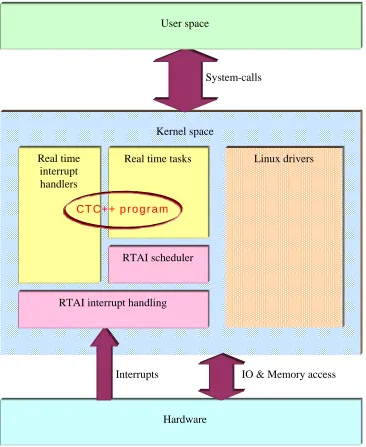
Figure 9 depicts the situation when the Linux kernel is patched and the RTAI interrupt handler module and the RTAI scheduler module are loaded. It also shows where the CTC++ programs will be placed.
Patch
Interrupt handling module
Using the patch alone doesn’t change the functioning of Linux. The changes to the kernel take effect when the main RTAI module (rtai.o) is loaded. From this point on, all interrupts are first handled by RTAI interrupt-handling code in this module and are then forwarded to the Linux kernel. Other kernel modules can install a real time interrupt handler by registering them to the RTAI interrupt-handling module. If the associated interrupt occurs, the registered interrupt handler is called by the RTAI code. If a real time interrupt handler has been registered, then the associated interrupt will no longer be automatically forwarded to Linux. This will only be done if the installed interrupt handler tells RTAI to do so. More on interrupts can be found in section 2.5.4.
Scheduler
Next to the RTAI interrupt handling module, RTAI also consists of a scheduler module. This module implements a priority-based scheduler. When this module is loaded, it continues to run the Linux kernel as the lowest priority task (from now on called the Linux task). If there are no tasks running besides the Linux task, the Linux task gets all the CPU time. When a kernel module starts a new RTAI
Figure 9. Structure of Linux and RTAI Hardware Interrupts
Kernel space
Real time interrupt handlers
RTAI scheduler Real time tasks
System-calls
CTC++ program
User space
Linux drivers
RTAI interrupt handling
task, the Linux task is scheduled out by the RTAI scheduler and the new task starts to execute. The Linux task does not get any CPU time, until the new task is either blocked or terminated. This means that when a RTAI task never ends and never blocks, the Linux task gets no more CPU time, which means the system is does no longer respond to input from the user which is handled by the Linux kernel (and thus the Linux task).
2.4 Kernel modules and C(++)
There are certain differences between writing kernel modules and normal programs, especially when using C++. These differences will be discussed in this section.
When writing kernel modules, not all normal C functions like printf or malloc are available. There are two reasons for this. The first is that these functions are in a shared library that is dynamically loaded when a program is run. The loading of the library is done before calling the main
function by a piece of code that is automatically linked to the program by the linker. When a kernel module is compiled, this part of code is not linked to the kernel module. Therefore, the library is not loaded when a module is loaded.
The second reason is that these functions assume that they are executed in user space. Most of them use a system-call to call functions inside the kernel. Because it is not allowed do make system-calls inside the kernel, this code should not be used by a kernel module.
Because of the two reasons that are mentioned, many normal C functions cannot be used in kernel modules. For some of them there are usable replacements, which will be mentioned in section 2.5.3. The problem with dynamic libraries applies to C and to C++ programs. For C++ programs the problem is more extensive because commands like new, delete, try, catch and throw
use functions in dynamic libraries and are thus normally not available in the kernel. For the C++ functions new and delete replacements are available in a RTAI kernel module called rtai_cpp.o. This module must be loaded before a C++ written kernel module can be loaded. Until now support for
try, catch and throw is not provided by this module. The main reason for this is that the implementation and thus which functions are needed are for try, catch and throw are different between compiler versions.
For kernel modules written in C++ another problem exists. The Linux kernel is mostly written in C, some assembly code, but no C++ code. The effect of this is that not all header files in the Linux kernel directory are compatible with C++ and cannot be included in C++ code. A problem can for example be that a variable is called new, which is a reserved keyword in C++. This means that when a kernel module written in C++ wants to use variables or call functions in the kernel, a prototype is not available. This gives problems when compiling the C++ code. This problem can only be solved by copying the prototypes from the Linux kernel header files to the C++ code or a new header file that can be used in a C++ program.
2.5 Changes to CTC++
2.5.1 Wrapper for RTAI CTC++ programs
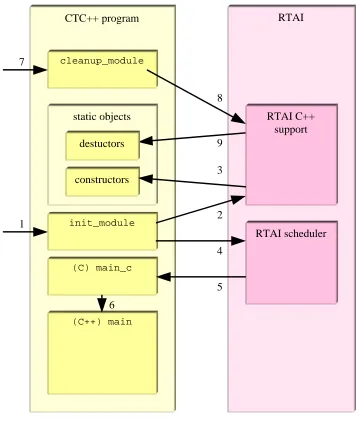
A normal program has a main function where execution will start. Linux kernel modules do not have a main function where execution is started. Kernel modules have an init_module function that is executed when the module is loaded, and a cleanup_module that is executed just before the module is unloaded. To make it easier to write CTC++ programs for RTAI, a wrapper was written, that contains these functions. When a program is compiled with the CTC++ for RTAI library this wrapper is automatically linked to the program. The following steps are performed when a program is loaded and, after running, unloaded from the kernel:
1. init_modules is called when a module is loaded into the kernel 2. The C++ support of RTAI is initialized
3. The constructors of all static object are invoked
4. The RTAI scheduler is told to start a new real time task
5. The RTAI scheduler starts the execution of the task at the function main_c
7. cleanup _module is called when a module is unloaded from the kernel 8. The RTAI C++ support is told to destruct the static variables
9. The destructors of all static objects are called
A RTAI CTC++ kernel module should not be removed from the kernel when the RTAI CTC++ task has not been terminated. This will result in memory leakage and possibly a kernel crash.
2.5.2 Suspend & Resume
CTC++ contains an Idletask, which is normal process. An Idletask is always created by the scheduler. The Idletask runs when all other processes are either blocked or terminated. If all other processes are terminated, the Idletask also terminates and thus the CTC++ program terminates. If all processes are blocked, the DOS/Linux implementation of the Idletask goes into a busy loop. In this loop, it checks if it should terminate or schedule to a process that is no longer blocked.
If the DOS/Linux implementation of the Idletask would be used in the RTAI CTC++ implementation, the RTAI task where CTC++ runs in keeps running when the Idletask is active. This means that the RTAI scheduler would not schedule to the Linux task. This in turns means that the Linux kernel is no
Figure 10. Sequence of the loading and unloading of a CTC++ for RTAI kernel module CTC++ program
static objects
init_module
constructors
RTAI
RTAI C++ support
RTAI scheduler
(C) main_c
(C++) main
destuctors
cleanup_module
1 7
2 3
4
5 6
8
longer responsive to input from the user. This is solved by letting the Idletask call a function, which is included in the RTAI CTC++ wrapper, which suspends the RTAI task CTC++ runs in.
If the RTAI task of the CTC++ program is suspended, it means all CTC++ processes are blocked on a channel. When a process becomes unblocked, the RTAI task of CTC++ should be resumed. The only processes that can become unblocked are processes that are blocked on an external channel or on a timed channel. For a timed channel, the unblocking is done inside the Timer interrupt handler. For external channels, the unblocking can be done inside an interrupt routine or inside a function that is called by the Linux kernel. The moment of resumption of the RTAI task is different between resuming in an interrupt handler and resuming in a function called from the Linux kernel.
If the unblocking is not done in an interrupt, like in a FifoChannel (see section 2.6), the RTAI task of CTC++ is immediately resumed. Because the task was suspended in the Idletask, it will also resume in the Idletask. Here the CTC++ scheduler schedules to the unblocked task.
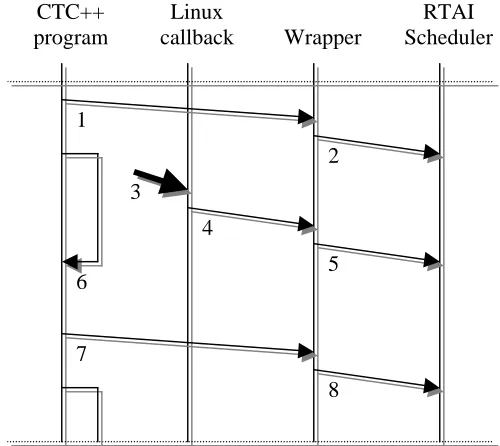
Figure 11 shows a sequence diagram when the unblocking is done outside an interrupt routine. In this case, the following steps are performed:
1. IdleTask signals the wrapper to suspend the RTAI task it runs in 2. The wrapper signals RTAI to suspend the RTAI task of CTC++
3. A (callback) function in the CTC++ program is called by a Linux user space process
4. The callback function calls the unlock method in linkdriver, which signals the wrapper that it should resume the CTC++ RTAI task immediately
5. The wrapper signals to RTAI that the CTC++ RTAI task can be resumed.
6. Execution continues in the IdleTask, which then immediately yields, scheduling to the highest priority thread
7. The CTC++ program runs until all processes are blocked again. The IdleTask signals the wrapper to suspend the RTAI task it runs in
8. The wrapper signals RTAI to suspend the RTAI task of CTC++ and execution of the Linux
kernel continues
If the unblocking is done in an interrupt routine, the RTAI task of CTC++ should not be resumed until all interrupt routines for the interrupt are executed. This is because RTAI resumes a task immediately when the resume function is called. It does not wait for the interrupt routine to finish. This means that when the RTAI CTC++ task would be resumed on the first unblock action, the RTAI CTC++ is immediately scheduled in without finishing the interrupt routine. If the interrupt routine would also Figure 11. Sequence diagram for unblocking outside an interrupt routine
CTC++ program
Linux
callback Wrapper
unblock a higher priority task, this task would remain blocked until the interrupt routine is finished, which happens when the Linux task is scheduled in again.
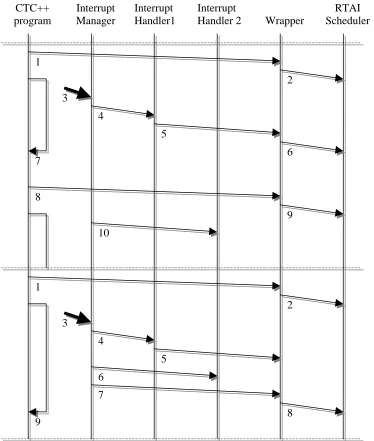
The erroneous behavior described above is pictured in the top part of Figure 12. The numbers correspond with the following actions:
1. IdleTask signals the wrapper to suspend the RTAI task it runs in 2. The wrapper signals RTAI to suspend the RTAI task of CTC++ 3. An interrupt occurs and the interrupt manager is started
4. The interrupt manager calls 1st interrupt handler
5. Interrupt Handler1 calls unlock in linkdriver which signals the wrapper that it should resume the CTC++ RTAI
6. The wrapper signals to RTAI that the CTC++ RTAI task can be resumed.
7. Execution continues in the IdleTask, which then immediately yields, scheduling to the highest priority thread.
8. The CTC++ program runs until all processes are blocked again. The IdleTask signals the wrapper to suspend the RTAI task it runs in
9. The wrapper signals RTAI to suspend the RTAI task of CTC++
10. Execution continues in the interrupt manager that now calls Interrupt Handler2
One can see in the figure that the time between Interrupt Handler1 and Interrupt Handler 2 is as large as the time it takes for the CTC++ program to be blocked again. This problem is solved by checking in the unblock routine if it is called from an interrupt routine. If this is the case, it only sets a bit. After all interrupt handlers are executed, this bit is checked and if it is set, the RTAI CTC++ task is resumed. This then continues its execution inside the Idletask. Here the CTC++ scheduler schedules to the highest priority task that was unblocked. This (correct) behavior is shown in the bottom part of Figure 12 where the following actions are performed:
1. IdleTask signals the wrapper to suspend the RTAI task it runs in 2. The wrapper signals RTAI to suspend the RTAI task of CTC++ 3. An interrupt occurs and the interrupt manager is started
4. The interrupt manager calls the 1st interrupt handler
5. Interrupt Handler 1 calls unlock in linkdriver, which signals the wrapper that it should resume the CTC++ RTAI task once all interrupt handlers are done
6. The interrupt manager calls the 2nd interrupt handler
7. The interrupt manager signals to the wrapper that all interrupt handlers are done and that now the CTC++ RTAI task can be resumed
8. The wrapper signals to RTAI that the CTC++ RTAI task can be resumed.
Figure 12. Sequence diagram for incorrect (top) and correct (bottom) behavior for unblocking from an interrupt routine
2.5.3 Real time safe functions
As mentioned in section 2.4, many functions are not available in Linux kernel space. There are functions inside the kernel that can be used as replacement in non real time kernel modules. Examples of this are printk, which is a replacement for printf and kmalloc, which is a replacement for
malloc. However, these should not be used in real time programs, because they are not written for real time behavior. For some of these functions, there are real time replacements provided by RTAI. These will be discussed in this section.
Two replacements have to do with memory management. The first is rt_malloc. This function is a real time variant of the function kmalloc, which is a kernel replacement for malloc. Normally
kmalloc has to do some memory management, which can slow down the request considerably. The RTAI memory management solves this by allocating a chunk of memory when the Linux kernel is running and dividing this up when rt_malloc calls are made. This way the memory allocation is really fast. When the total amount of allocated memory is above a certain threshold, the RTAI memory management module allocates a new chunk of memory. It does this in Linux kernel time, so it doesn’t interfere with the real time tasks. This means that if the Linux task gets no processor time, the RTAI memory management module can run out of memory. The size of the chunk that is allocated can be changed inside the RTAI source code. The second memory related replacement is rt_free, which is
CTC++ program Interrupt Manager Interrupt Handler1 Interrupt
Handler 2 Wrapper
the real time equivalent of the C function free. It must be used to free memory that was allocated using rt_malloc.
As said in section 2.4, the rtai_cpp.o module provides new and delete functions for C++ kernel modules. In these functions the rt_malloc and rt_free functions are used, so new and
delete are also real time.
Another real-time safe replacement provided by RTAI is rt_printk. It replaces printk, which is a kernel replacement for printf. A lot of functionality of printf is included rt_printk, with the exclusion of floating point printing. The text that is printed using rt_printk is first placed in a buffer and when the Linux kernel is scheduled in, it starts to print to the screen. The first consequence of this is that when the Linux kernel does not get any processor time, nothing will be printed to the screen. Secondly, the amount of text that can be printed while the CTC++ program is running is limited, because of the buffer that is used to store the text until the Linux kernel gets processor time. The size of this buffer can be adjusted in the RTAI source code.
2.5.4 Interrupt mechanism
Although CTC++ can be seen as an OS, because it has its own scheduler, for some architectures it still depends on an OS that is already running. One the functionality that is used from the OS is the interrupt mechanism.
If an interrupt handler is installed in a CTC++ DOS program, there is the possibility to chain the new interrupt handler. This means that an interrupt handler that is already installed by another program (or driver) will also be executed together with the CTC++ interrupt handler. The interrupt handling routine for CTC++ for RTAI also has a possibility to chain interrupts, but the meaning is different. In CTC++ for RTAI, it determines whether the received interrupt should also be forwarded to the Linux kernel. When an interrupt is forwarded, the Linux kernel executes its interrupt handler for that interrupt, when the Linux task is scheduled in.
Figure 13, Figure 14 and Figure 15 depict a timeline what the processor is executing when an interrupt occurs.
Figure 13 shows a timeline when an interrupt is only handled by Linux. When the interrupt occurs, the RTAI kernel disables the interrupt and resumes execution of real time tasks. When the real time tasks are suspended, the Linux task is scheduled in. This then starts to handle the interrupt after which the interrupt is re-enabled by the RTAI kernel. One can see that the minimum time between two interrupts is at least the time it takes for the RTAI task, which is here the CTC++ program, to get suspended or terminated. This should be no problem, because the interrupts are not used in the real time program. Figure 14 shows the situation when an interrupt is only handled by CTC++ program. When an interrupt occurs, the RTAI kernel again disables the interrupt and immediately starts the execution of the real time interrupt handler. When the handler is finished, the interrupt is re-enabled by the RTAI kernel. The minimum time between two interrupts is the smallest in this case, because the interrupt is immediately enabled after the CTC++ interrupt handler.
Figure 15 shows the situation when an interrupt is shared between a CTC++ handled IO card and a Linux handled IO card. In this case, the CTC++ program should chain the interrupt. If an interrupt occurs, the RTAI kernel disables the interrupt and starts to execute the real time interrupt handler. When this is finished, the running real time tasks are resumed. When these are all finished or suspended, the Linux kernel is scheduled in, which starts to handle the interrupt. When the Linux interrupt handlers are finished, the RTAI kernel re-enables the interrupt.
the maximum possible interrupt rate because interrupts are enabled as soon as all interrupt services are called.
RTAI "kernel"
disable
interrupt
enable interrupt
CTC++ interrupt handler
CTC++ Processes
Linux interrupt handler
Linux user space tasks
Figure 13. Timeline when an interrupt is only handled by Linux
RTAI "kernel"
disable interrupt
enable
interrupt
CTC++ interrupt handler
CTC++ Processes
Linux interrupt handler
Linux user space tasks
Figure 14. Timeline when an interrupt is only handled by CTC++
RTAI "kernel"
disable
interrupt
enable interrupt
CTC++ interrupt handler
CTC++ Processes
Linux interrupt handler
Linux user space tasks
Figure 15. Timeline when an interrupt is handled by both CTC++ and Linux Interrupt
Interrupt
Interrupt
Next interrupt possible
Next interrupt possible Next interrupt
2.5.5 Timer (updating Linux time)
As said in section 2.5.4 CTC++ runs on top of another OS for some architectures. Therefore, it needs to take care not to interfere with the OS that is already running. Because of this, an addition had to be made to the Timer64 object in the CTC++ for RTAI library.
When Linux boots it sets up the PC’s timer to generate timer interrupts at a rate of 100 Hz. Linux uses this, among other things, to allow round robin scheduling between tasks and to keep track of the system time. When the interrupt would no longer be received by Linux, the dynamic behavior of Linux changes drastically, because it can only schedule to another user space task in certain kernel functions, for example semaphore functions. Therefore, the RTAI for CTC++ library needs to forward the timer interrupts to the Linux kernel. The frequency of the forwarding should be close to 100 Hz. To achieve this, the CTC++ for RTAI library creates a task when a new Timer64 object is created. This task runs at a rate of 100 Hz the only thing it does is forward one timer interrupt to the Linux kernel every time it runs. When the Timer64 object is destructed, it restores the Linux interrupt handler and the 100 Hz timing, so that everything is back to normal.
2.5.6 Implementation of the changes
The changes to the CTC++ library that are mentioned in the previous sections have been implemented. During implementation, no problems were encountered. The changes can mostly be found by searching for #ifdef RTAI or #ifndef RTAI commands in the source code of the library.
2.6 Porting example
As a CT demonstrator setup for the Control Engineering department the JIWY is often used. More on JIWY will be discussed in chapter 4. This chapter will discuss the porting of the existing CTC++ for DOS program to a CTC++ for RTAI program.
The largest change had to be made to the drivers for the NI6024E interface card that is being used. The problem was the (PCI) initialization part of the driver. The card responds to memory access at certain addresses. These addresses can not be directly accessed under DOS nor Linux. To solve this, the DOS driver remaps the card in such a way that the card responds to an address range that the DOS driver can access. It does so in a very low level way, by directly accessing registers on the card.
This method is not allowed under Linux, as Linux maintains all the PCI addresses. To be able to access the card the Linux kernel provides functions to reserve a piece of memory that, when accessed, actually points to the address the interface card listens to. The include files that contain the prototypes for these functions are however Linux kernel include files and thus cannot be used in the C++ driver for the IO card. This was solved by putting the PCI initialization in a separate C file, which can include the Linux kernel include files.
As already mentioned in section 2.4, there are functions that are not available in the kernel or for which no prototype is available. Some of these functions are also used in the JIWY program. This was solved by making custom header files, which redefine the functions that are not available to empty statements or to equivalents that can be used.
Another thing changed to the program was the addition of the possibility to use a FifoChannel
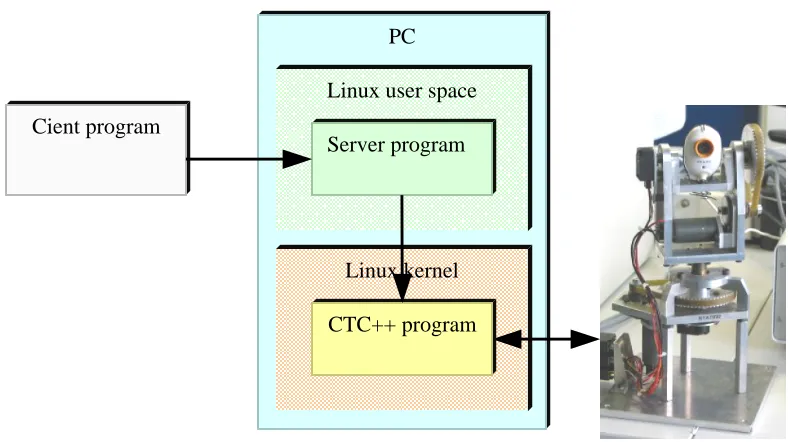
instead of an AnalogJoystick channel. The AnalogJoystick channel returns the position of an analog joystick connected to the controlling computer. This position is used as the reference for the controllers of JIWY (See Figure 16).
Figure 16. Diagram of JIWY controlled by a joystick
Figure 17. Diagram of JIWY controlled over a network connection
2.7 Summary
In this chapter, CTC++ for RTAI has been discussed. A small introduction into RTAI and kernel modules is given where the problems with writing kernel modules using C++ are discussed. These problems were also encountered when porting the JIWY program to CTC++ for RTAI.
There are two large problems when using CTC++ for RTAI programs:
• Not being able to use all standard functions, because they are in dynamic libraries.
• Not being able to include kernel header files in C++ files.
The necessary changes to the CTC++ library that were needed to make it work correctly under RTAI are discussed. Changes to the Idletask, to the unblocking of external channels, to the interrupt mechanism and to the Timer64 object were needed to make CTC++ cooperate in the right way with RTAI and Linux. The implementation of the changes was straightforward.
PC
Linux kernel
CTC++ program
PC
Linux kernel Linux user space Cient program
3 Exception handling in CT
3.1 Outline
This chapter will discuss the exception handling mechanism that has been added to the CTC++ library. Section 3.2 will give a short discussion on what exceptions are, what the demands on an exception handling mechanism are and how exceptions are handled in programming languages. Section 3.3 will give a description of the conceptual design of the exception handling mechanism. This will not only be on the CTC++ library, but more on CT in general. How this concept was implemented in the CTC++ library is discussed in section 3.4. In section 3.5, an evaluation will give be given of the implementation and in conclusions will be presented in section 3.6.
Examples of using the implemented exception handling mechanism are the subject of chapter 4.
3.2 Exceptions and exception handling
3.2.1 Exceptions, raising and handling exceptions
An exception is an indication (signal) of the inability to perform a certain operation form the operational domain of a system (Cristian, 1995).
The notion of an exception is often coupled to occurrence of an error in the system design or its environment. Common examples in computing practice are:
• “Division by zero” (inability to perform a mathematical operation)
• “Memory page fault” (inability to perform a memory operation)
• “File does not exist” (inability to perform a file operation)
Exceptions can be signaled by hardware (“Memory page fault”) and by software (“File does not exist”). Division by zero can be signaled by both hardware and software. A program can check if the denominator is zero and if this is the case raise an exception or it can attempt the division in the hardware without checking the denominator’s value. In that case, the hardware may raise an exception when this value is zero. In section 4.4.2 disabling a cable on a robotic set-up represents an exception to normal environmental conditions.
Another way to look at exceptions builds upon the concept of operational state space of a system, what will be here referred to as operating range (of the values of the system’s variables). Every system (process, program, etc.) has a certain valid operating range within which it operates correctly. For a processor a certain range in ambient temperature is a component of its operating range. For (mathematical) division of real numbers, the valid operating range for denominator values spans all real numbers except zero. The operating range consists of both the input to the process and the internal state of the process. In the case study of chapter 4, the position of a motor axes (internal state of the motor) outside an allowed position range may cause overflow of underflow of the position encoder supplying the controller with feedback information (input to the computational process).
An exception can be seen as an indication of a violation of the valid operating range of a process. By observing the occurrence of an exception caused with exceeding the operation range in some of its subsystems (processes, components, etc.) a system effectively extends the operation range of its functionality, provided that the subsystem is able to encounter and signal the exception. For example, if a processor cannot sense the ambient temperature, it cannot raise an exception when it is out of bounds. This can lead to an error within the system and, in this case, damage to the processor because of a high temperature. This indicates two necessities for using exceptions: an exception occurrence should be observable and there must be a possibility to signal the exception. Beside these two necessities, there must be a possibility to react to the signaled exception.
Raising (or throwing) an exception by a process represent signaling of the inability to perform the operation. Receiving (catching) an exception and a proper handling is, in principle, responsibility of the same or another process, called exception handler. Catching an exception may not follow the throwing immediately – the mechanism of propagating an exception may get activated.
When a process is accompanied (guarded) by a separate exception handler, the combination of the two forms a new process. The valid operating range of this new process is larger then the valid operating range of the original (unguarded) process. This does not say anything about the correct behavior of the new process. Whether the behavior is correct or not is up to the system designer.
The functionality of original, unguarded process is called the error-free operation (Burns and Wellings, 2001). The functionality of the exception handler is called exceptional operation.
3.2.2 Demands on an exception handling mechanism
An exception handling mechanism is the complete chain from raising an exception, propagating and handling the exception. In the literature (Buhr and Mok, 2000; Burns and Wellings, 2001), several general demands are imposed on exception handling mechanisms.
1. The mechanism should be simple to understand and use.
If this rule is violated, the exception handling mechanism will not be used or not be used to its full potential.
2. A clear separation between the exceptional operation and the error-free operation code. This is desirable because one can focus independently on the normal operation and the
exceptional operation. In a program, the code is more maintainable because it is clearer what a certain piece of code does;
3. Information about occurrence of an exception must contain all the necessary data for a proper handling.
There is little use in knowing that an exception was thrown, without knowledge on the context of the exceptional occurrence.
4. The overhead of the exception handling mechanism should stay to a minimum for the error-free operation. In other words, overhead should only occur when an exception is thrown. 5. The mechanism should allow uniform treatment of exceptions detection both by the
environment (processor) and by the program.
6. The mechanism should prevent an incomplete operation from continuing, because there is no use in continuing if the correctness of its output cannot be guaranteed.
There are more specific demands for an exception handling mechanism in a concurrent environment: 7. Throwing an exception in one process should start handling in that process and all others that
communicate with that one. 8. Hierarchy of exceptions.
In a concurrent environment, it is possible that two or more exceptions, coming from different sources, arrive at an exception handler at the same time. The exception handler should be able to prioritize the exceptions and handle them accordingly.
Demands on an exception handling mechanism, more specific for CT are:
9. It should comply with the CSP based, process oriented design methodology. 10. It should be expressible in machine-readable CSP (CSPm).
3.2.3 Examples of exception handling mechanisms
Handling exceptions has to do with multiple hardware and software levels, like the processor, OS, programming language and the structuring of programs. A form of exception handling in hardware is hardware redundancy. When a piece of hardware is broken (the exception) another piece of hardware takes over (the exception handling).
Some exception handling mechanisms that are used in software are discussed below.
Exception handling in C++/Java
In single threaded, sequential C++ and Java programs, exception handling is structured using
try/throw/catch statements. This also closely resembles the exception handling mechanism of Ada.
The try statement embodies a guarded error-free operation. Raising an exception is implemented by throwing an arbitrary object using the throw statement. Once an exception is raised, the exceptional operation, which is embodied by the catch statement, receives and handles the exception.
Positive things about this kind of exception handling are:
• It gives a clear separation of error-free code and exceptional operation code
• The exception can contain any information that is encapsulated by the thrown object
• When an exception is raised, it propagates to the closest appropriate exception handler, along the call chain
A serious downside is a lack in semantics when used in multithreaded applications. Namely, the models for synchronizing concurrent exceptional operations are not provided by the languages themselves.
Exception handling in C
In C programs, error conditions (exceptions) are handled using function return values with goto, non-local jumps using setjmp and longjmp and OS supported constructs. C does not define any exception-handling facilities within the language. Such an omission clearly limits the usefulness of the language in the structured programming of reliable system (Burns and Wellings, 2001).
Return values & goto
Return values of functions is the most widespread form of error handling in C. They can be combined with goto statements or if/else statements.
The largest drawback to this technique is that the return value has to be checked every time. If a function returns an error value, the invoker should check for the error code and further signal the error if it is not able to handle the error. In this chain of error return codes, every part must check the return value. In order to make the error propagate to a place it can be handled every part of the code has to check the return values. Certainly, the non-automatic propagation of the error is a large drawback. Another large drawback to this form of error handling is that the error handling code intertwines with the error-free operation code. This limits the readability and maintainability of the code. In addition, requirement three is not fulfilled since error codes can contain only a limited amount of information about the error causing the exception.
Non-local jumps
Non-local jumps use the functions setjmp and longjmp. With the setjmp function a point can be defined to which the program can later jump back to using the longjmp function.
This mechanism looks a bit like the try/throw/catch mechanism of C++. As will be shown in section 3.4.1, a “try/throw/catch”-like mechanism can be made using the functions setjmp
and longjmp. This means that it inherits some of the advantages of the try/throw/catch
The setjmp/longjmp technique itself does not provide a coherent way of using it as exception handling mechanism, failing at least the first demands of section 3.2.2. This can only be provided by programming structures that use this mechanism.
OS support for exception handling Signals
Besides the use of the mechanisms above, provided by the programming language, signals can be used in an environment that supports it. Signals can be seen as software interrupts. The functionality of code that is allowed in a signal handler is in general very limited so most of the time the signal handler can only set a variable. This variable is then checked in the error-free operation. This gives the same problem as function return values; the variable should be checked at certain places. If somewhere such a check is omitted, the exception handling stops functioning properly.
Exception handling in multithreaded environments
For multithreaded applications, the programming language constructs are used (so try/catch, function return calls and so on) together with inter process communication like signals, semaphores and message boxes and functions to suspend and resume tasks. Some of the requirements stated in section 3.2.2 can be met using these constructs, but they are not enforced. It largely depends on how the programmer uses the provided constructs.
3.3 Conceptual design of exception handling in CT
3.3.1 Main concept
As stated in section 3.2.3, the programming languages that implement CT libraries, C, C++ and Java, do not provide adequate exception handling mechanisms (for concurrent environments) on their own. Therefore, a concurrency-adequate exception handling mechanism on the level of the CTC++ library is designed.
The main concept of the exception handling design in CT was to make it resemble the C++ and Java
try/throw/catch mechanism. This is a concept that many programmers are familiar with and it complies with all of the general demands listed in section 3.2.2 except demand 5.
That the mechanism has to resemble the try/throw/catch mechanism does not mean that
try/throw/catch statements must be available in the language. Section 3.4.3 shows the feasibility of implementing the mechanism in CTC and same concept could probably be introduced into new derivatives of Occam (Welch and Wood, 1996).
The process termination model
Because the try/throw/catch mechanism of C++ was made for a sequential program, it only works in one thread of control. The reason for this is the stack unwinding that takes place when an exception is being raised. In a sequential program, the complete program runs on one stack and the stack unwinding can never go beyond the top of that stack. If the top of the stack is reached, the program unconditionally terminates.
This means that when this mechanism is used in a multithreaded environment, that CT is, exceptions must be caught somewhere in the same thread that raised the exception. Otherwise, if the exception were not caught, the stack unwinding would go beyond the top of the stack, which would result in unpredictable behavior, usually termination of the program.
The exception propagation model
From the moment an exception is raised, it propagates through processes and constructs until an exception handler is found. How an exception propagates depends on the constructs it propagates through. This behavior for the different constructs will be discussed further on in this chapter.
3.3.2 Raising exceptions and exception types
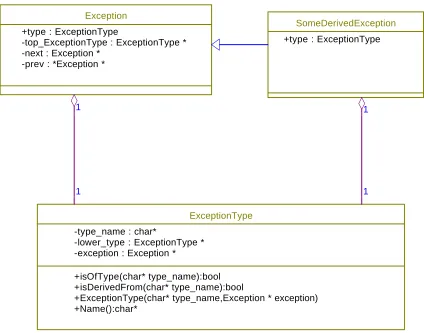
One of the demands mentioned in section 3.2.2 was that there should be enough information for the handler to properly determine how to handle the exception that was raised. In C++ and Java, an exception handler catches objects of specific classes like int, String or some user-defined class; thus any type of class can be thrown and caught. Within the proposed exception handling mechanism for CT only ExceptionSets are being caught and thrown. The ExceptionSet is a class that can contain multiple Exception instances in a linked list. The reason that Exceptions themselves are not caught, but ExceptionSets, is that the parallel construct collects exceptions thrown by child processes and throws them higher up. The parallel construct will be further discussed in section 3.3.6 and section 4.4.4.
An exception is always of a type that is derived from the Exception class. This Exception class contains methods to determine the exact type of the exception in the ExceptionSet. This way, the exception handler can distinguish different exception occurrences. The handler can thus handle all the exception types that it knows how to handle and if the ExceptionSet contains any more unhandled exceptions, it can throw the remaining ExceptionSet. There will be an example of this behavior in section 3.4.8
3.3.3 The EXCeption construct
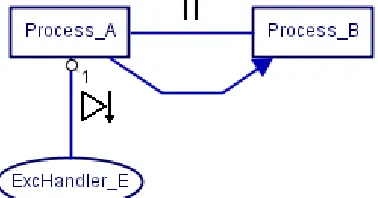
In the proposed exception-handling concept, a new construct is needed. The new construct is named the EXCeption construct. The GML symbol of that new construct is . This construct catches an
ExceptionSet that is thrown and directs it to the associated exception handler.
The EXCeption construct is associated with a process and an exception handler (See Figure 18). The process encapsulates the error-free operation. This process is run first. When it terminates normally, the EXCeption construct terminates normally as well. When the normal process terminates abnormally by throwing an ExceptionSet, the EXCeption construct executes the exception handler. If this exception handler terminates normally, the exception construct terminates normally. If however, the exception handler terminates abnormally by throwing an ExceptionSet the exception construct terminates abnormally.
The EXCeption constructs can be cascaded so that exceptions that are not handled by the first exception handler can be handled by other exception handlers:
A EXC B EXC C (A EXC B) EXC C A EXC (B EXC C)
= =
(1) (2) (3)
All three of the above options capture the concept of partial exception handling. That means that ExceptionHandler_B may handle some exceptions from the exception set and propagates the remaining exceptions by throwing them higher up. These can then be handled by ExceptionHandler_C.
However, due to the restriction that the EXCeption construct can only be associated with a process and an exception handler, option two is the model of implementation for partial exception handling. The parenthesizing on option two indicates the composition of Process_A and ExceptionHandler_B into an
EXCeption construct, which is again a process. Thus, it can be composed with ExceptionHandler_C in a higher EXCeption construct.
Option one cannot be implemented because an EXCeption construct can only be associated with one process and one Exception handler. Option three cannot be implemented because here the EXCeption
construct between ExceptionHandler_B and ExceptionHandler_C would be the exception handler for the upper EXCeption construct, which is not allowed because an EXCeption construct is a process and not an exception handler.
3.3.4 The Sequential construct
The Sequential construct arranges the execution of the child processes in sequence, as in the case of C++ of Java code. The behavior when an exception occurs resembles the behavior of C++ or Java code. The process that is being executed terminates abnormally by raising an exception and consequently, the sequential construct terminates abnormally without running any more processes. Since the genuine behavior of this construct in presence of exceptions complies with the desired (exceptional) flow of control, supporting exception handling on the level of the CT libraries requires no change to the sequential construct.
3.3.5 The (Pri)Alternative construct
The alternative construct makes a choice to run a certain process based on the guards that are guarding channels. A guard observes if the process on the other side of the channel wants to communicate. If a guard, for whatever reason, cannot make this observation, it can signal this to the alternative. Because the alternative cannot make a competent choice, it terminates abnormally by throwing an
ExceptionSet that contains all the exceptions given by the guards.
If one or more of the guards signal that the other side wants to communicate, the alternative chooses one of the guards and executes its associated process. If this process terminates abnormally, the alternative will also terminate abnormally.
Thus, the exception enabled alternative execution consists of three stages:
1. Initial checking of the guards. The guards can signal problems to the alternative. If a problem was found, the alternative terminates abnormally.
2. Waiting for one or more guards to become ready or signal a problem. If a problem was found, the alternative terminates abnormally.
3. Running the associated process. If the process terminates abnormally, the alternative will terminate abnormally.
Figure 19. Two processes in an Aternative construct
If, for example, in Figure 19 Chan1 is an external communication channel, but a cable break is detected, the guard can signal this to the alternative, which will then terminate abnormally. If the guard is able to observe a communication attempt from the other side, Process_A will start. If in the execution of Process_A an ExceptionSet is thrown, it will propagate through the alternative construct.
3.3.6 The (Pri)Parallel construct
The behavior of the parallel in an error-free operation is that it terminates, when all its child processes have terminated. This behavior stays the same under abnormal termination of any of its child processes. The parallel collects ExceptionSets that are thrown by child processes and places their exceptions in one ExceptionSet. If this ExceptionSet is empty when all child processes have terminated, so there were no exceptions raised by the child processes, the parallel terminates normally. If the ExceptionSet of the parallel is not empty when all child processes are terminated, the parallel terminates abnormally by raising this ExceptionSet.
If an exception is raised in A, A will terminate abnormally. If it was to communicate with B at some point and B is waiting for this to happen, B will not terminate. It will be blocked, waiting for the communication. Therefore, the parallel construct will not terminate and E will not execute. Therefore, if two processes communicate with each other and they are running in parallel and they can terminate abnormally, each one of them should have an exception handler, which would make sure the other process also terminates.
This problem in the proposed exception handling mechanism is addressed by the channel rejection technique. Now looking back at the example, when A en B could communicate with each other and for example A would be able to terminate abnormally, the structure should be changed to:
In this situation, exception handler E not only handles the exception that occurred in A, but also rejects the channel between A and B, annotated by the bold crosses. This way, the exception handler of A makes sure that B also terminates (although abnormally). If B terminates because of the channel rejection, exception handler F filters out the exception thrown because of the channel rejection. When exception handler F also rejects the channel between A and B, it doesn’t matter any more which of the two processes terminated because of an exception. Due to the channel rejection, the other process will eventually also terminate.
More examples on this will be given in section 4.4.4.
3.4 Implementation in CT
3.4.1 C++ try/throw/catch
As mentioned in section 3.3.1, the concept of exception handling in CT looks a lot like
try {
//Some guarded code …
throw(SomeType()); …
} catch (SomeType localInstance) { //Exception handler
…
if (!completely_handled) throw;
… }
3.4.2 CTC++ TRY/THROW/CATCH/ENDTRY macros
Instead of using try/throw/catch in CTC++ programs directly, macros should be used that