Volume 2008, Article ID 289184,11pages doi:10.1155/2008/289184
Research Article
Multirate Formulation for Mismatch Sensitivity
Analysis of Analog-to-Digital Converters That Utilize
Parallel
ΣΔ
-Modulators
Anton Blad, H˚akan Johansson, and Per L ¨owenborg
Division of Electronics Systems, Department of Electrical Engineering, Link¨oping University, Sweden
Correspondence should be addressed to Anton Blad,[email protected]
Received 1 June 2007; Accepted 21 October 2007
Recommended by Boris Murmann
A general formulation based on multirate filterbank theory for analog-to-digital converters using parallel sigmadelta modulators in conjunction with modulation sequences is presented. The time-interleaved modulators (TIMs), Hadamard modulators (HMs), and frequency-band decomposition modulators (FBDMs) can be viewed as special cases of the proposed description. The useful-ness of the formulation stems from its ability to analyze a system’s sensitivity to aliasing due to channel mismatch and modulation sequence level errors. Both Nyquist-rate and oversampled systems are considered, and it is shown how the matching requirements between channels can be reduced for oversampled systems. The new formulation is useful also for the derivation of new modula-tion schemes, and an example is given of how it can be used in this context.
Copyright © 2008 Anton Blad et al. This is an open access article distributed under the Creative Commons Attribution License, which permits unrestricted use, distribution, and reproduction in any medium, provided the original work is properly cited.
1. INTRODUCTION
Traditionally, analog-to-digital converters (ADCs) and digital-to-analog converters (DACs) based on ΣΔ -modula-tion have been used primarily for low bandwidth and high-resolution applications such as audio application. The re-quirements make the architecture perfectly suited for this purpose. However, in later years, advancements in VLSI tech-nology have allowed greatly increased clock frequencies, and ΣΔ-ADCs with bandwidths of tens of MHz have been re-ported [1, 2]. This makes it possible to use ΣΔ-ADCs in a wider context, for example, in wireless communications. One of the most attractive features ofΣΔ-ADCs is their re-laxed requirements on the analog circuitry, which is espe-cially important in wireless communications where integra-tion in analog-hostile deep submicron CMOS is favorable. However, the high-operating frequencies used for the realiza-tion of such wideband converters result in devices with high analog power consumption.
One way to reduce the operating frequency is to use sev-eral modulators in parallel, where a part of the input signal is converted in each channel. Several flavors of suchΣΔ-ADCs have been proposed, and these can essentially be divided into
decomposition of the integrator in one channel. Thus the ar-chitecture is not directly comparable to the systems described in this paper.
The parallel systems have been analyzed both in the time-domain and the frequency-time-domain [3, 4,6–8,12,15–17], and in [18] an attempt was made to formulate a general model covering the TIM, HM, and FBDM systems. The for-mulation in this paper is slightly different from the one in [18] due to differences in the usage of causal and noncausal delays. The overall ADC was formulated in terms of circu-lant and pseudocircucircu-lant matrices, and the formulation is derived from multirate filter bank theory. The formulation is refined in this paper, and extended with a more compre-hensive sensitivity analysis. Using the formulation, the be-havior of a practical ADC with channel gain and modulation sequence level mismatches present can be analyzed, and it is apparent why some schemes are sensitive to mismatches be-tween channels whereas others are not. Also, it is found that some schemes (in particular the HM systems) suffer from sensitivity in a limited set of channels such that “full calibra-tion” between the channels is not needed. Whereas the new formulation is in fact not constrained to parallelΣΔ-ADCs but applicable to general parallel systems that use modula-tion sequences, it is described in that context in this paper as this application is considered to be particularly interesting. Further, the usefulness of the new formulation is not only limited to the analysis of existing schemes, but also for the derivation of new ones, which is demonstrated in the paper.
The organization of the paper is as follows. InSection 2, the multirate formulation of a parallel system is derived, and the signal input-to-output relation of the system is analyzed. Conditions for the system to be free from nonlinear distor-tion (i.e., free from aliasing) are stated. InSection 3, the sen-sitivity to channel mismatches for a system is analyzed in the context of the multirate formulation. InSection 4, the for-mulation is used to analyze the behavior of some representa-tive systems, and also the derivation of a new scheme that is insensitive to some mismatches is presented. InSection 5, the quantization noise properties of a parallel system is analyzed. Finally,Section 6concludes the paper.
2. LINEAR SYSTEM MODEL
We consider the scheme depicted inFigure 1. In this scheme, the input signalx(n) is first divided intoNchannels. In each channelk,k = 0, 1,. . .,N−1, the signal is first modulated by theM-periodic sequenceak(n)=ak(n+M). The
result-ing sequence is then fed into aΣΔ-modulatorΣΔk, followed
by a digital filterGk(z). The output of the filter is modulated
by theM-periodic sequencebk(n)=bk(n+M) which
pro-duces the channel output sequenceyk(n). Finally, the overall
output sequence y(n) is obtained by summing all channel output sequences. TheΣΔ-modulator in each channel works in the same way as an ordinaryΣΔ-modulator. By increasing the channel oversampling, and reducing the passband width of the channel filter accordingly, most of the shaped noise is removed, and the resolution is increased. By using sev-eral channels in parallel, wider signal bands can be handled without increasing the input sampling rate to unreasonable
× × ×
. .
. ...
x(n)
a0(n)
a1(n)
aN−1(n)
ΣΔ0
ΣΔ1
ΣΔN−1
G0(z)
G1(z)
GN−1(z) × × ×
b0(n)
b1(n)
bN−1(n)
yN−1(n)
y1(n)
y0(n)
+ y(n)
Figure1: ADC system using parallelΣΔ-modulators and modula-tion sequences.
values. In other words, instead of using one singleΣΔ-ADC with a very high input sampling rate, a number ofΣΔ-ADCs in parallel provide essentially the same resolution but with a reasonable input sampling rate.
The overall outputy(n) is determined by the inputx(n), the signal transfer function of the system, and the quanti-zation noise generated in theΣΔ-modulators. Using a linear model for analysis, the signal input-to-output relation and noise input-to-output relation can be analyzed separately. The signal transfer function from x(n) to y(n) should be equal to (or at least approximate) a delay in the signal fre-quency band of interest. The main problem in practice is that the overall scheme is subject to channel gain, offset, and modulation sequence level mismatches [4, 15,16]. This is where the new general formulation becomes very useful as it gives a relation between the input and output from which one can easily deduce a particular scheme’s sensitivity to mis-match errors. The noise contribution, on the other hand, is essentially unaffected by channel mismatches. Therefore, the noise analysis can be handled in the traditional way, as in
Section 5.
2.1. Signal transfer function
From the signal input-to-output point of view, we have the system depicted in Figure 2(a) for channel k. Here, each
Hk(z) represents a cascade of the corresponding signal
trans-fer function of theΣΔ-modulator and the digital filterGk(z).
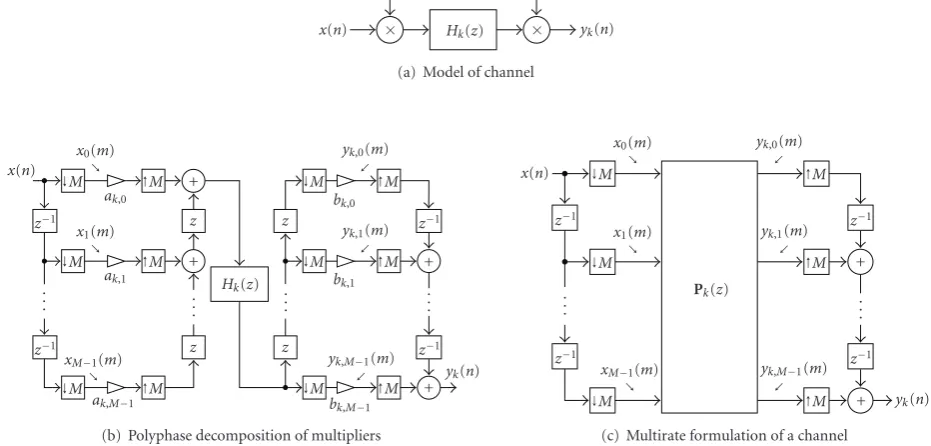
To derive a useful input-output relation in thez-domain, we make use of multirate filter bank theory [19]. Asak(n) and
bk(n) areM-periodic sequences, each multiplication can be
modelled asMbranches with constant multiplications and the samples interleaved between the branches. This is shown in the structure inFigure 2(b), where
ak,n=
⎧ ⎨ ⎩
ak(0) forn=0,
ak(M−1) forn=1, 2,. . .,M−1,
bk,n=bk(M−1−n) forn=0, 1,. . .,M−1.
(1)
Now, consider the system shown inFigure 3, representing the path fromxq(m) toyk,r(m) inFigure 2(b). Denoting
x(n) ×
ak(n)
Hk(z) ×
bk(n)
yk(n)
(a) Model of channel
z−1
. . . z−1
x(n)
↓M x0(m)
x1(m) ↓M
xM−1(m) ↓M
ak,0
ak,1
ak,M−1 ↑M ↑M
↑M +
z +
. . . z
Hk(z)
z
z
↓M
↓M
↓M bk,0
bk,1
bk,M−1
yk,0(m)
yk,1(m)
yk,M−1(m)
↑M
↑M
↑M
z−1
+ yk(n) . . . .
. .
+ z−1
(b) Polyphase decomposition of multipliers
z−1
. . . z−1
x(n)
↓M
↓M
↓M x0(m)
x1(m)
xM−1(m)
Pk(z)
yk,0(m)
yk,1(m)
yk,M−1(m)
↑M
↑M
↑M
z−1
+ yk(n)
. . . + z−1
(c) Multirate formulation of a channel Figure2: Equivalent signal transfer models of a channel of the parallel system inFigure 1.
the transfer function fromxq(m) toyk,r(m) is given by the
first polyphase component in the polyphase decomposition ofzqH
k(z)z−r, scaled byak,qbk,r. Forp=q−r=0, 1,. . .,M−
1, the polyphase decomposition ofzpH
k(z) can be written
zpHk(z)= M−1
i=0 zp−iHk,i
zM, (3)
and the first polyphase component isHk,p(z), that is, thepth
polyphase component ofHk(z) as specified by the Type 1
polyphase representation in [19]. Forp= −M+ 1,. . .,−1,
zpH k(z)=
M−1
i=0
zp−i+Mz−MH k,i
zM (4)
and the first polyphase component isz−1H
k,p+M(z).
Return-ing to the system inFigure 2(b), the transfer functionsPkr,q(z) fromxq(m) toyk,r(m) can now be written
Prk,q(z)=
⎧ ⎨ ⎩
bk,rHk,q−r(z)ak,q forq≥r,
bk,rz−1Hk,q−r+M(z)ak,q forq < r.
(5)
The relations can be written in matrix form asPk(z) in
Pk(z)=
⎡ ⎢ ⎢ ⎢ ⎢ ⎢ ⎢ ⎢ ⎢ ⎢ ⎣
A1 A5 A9 · · · A13
A2 A6 A10 · · · A14
A3 A7 A11 · · · A15
..
. ... ... . .. ...
A4 A8 A12 · · · A16
⎤ ⎥ ⎥ ⎥ ⎥ ⎥ ⎥ ⎥ ⎥ ⎥ ⎦
, (6)
where
A1=ak,0bk,0Hk,0(z), A2=ak,0bk,1z−1Hk,M−1(z), A3=ak,0bk,2z−1Hk,M−2(z), A4=ak,0bk,M−1z−1Hk,1(z), A5=ak,1bk,0Hk,1(z), A6=ak,1bk,1Hk,0(z), A7=ak,1bk,2z−1Hk,M−1(z), A8=ak,1bk,M−1z−1Hk,2(z), A9=ak,2bk,0Hk,2(z), A10=ak,2bk,1Hk,1(z), A11=ak,2bk,2Hk,0(z), A12=ak,2bk,M−1z−1Hk,3(z), A13=ak,M−1bk,0Hk,M−1(z), A14=ak,M−1bk,1Hk,M−2(z), A15=ak,M−1bk,2Hk,M−3(z), A16=ak,M−1bk,M−1Hk,0(z),
(7)
and it is thus obvious that one channel of the system can be represented by the structure inFigure 2(c). In the whole sys-tem (Figure 1) a number of such channels are summed at the output, and the parallel system ofNchannels can be repre-sented by the structure inFigure 4, where the matrixP(z) is given by
P(z)=
N−1
k=0
Pk(z). (8)
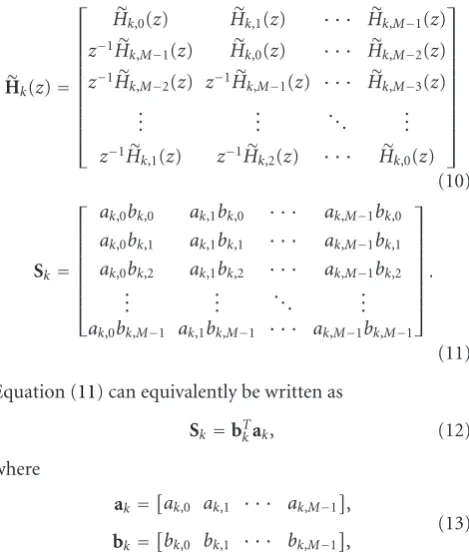
For convenience, we write (6) as
xq(m)
ak,q
↑M zq Hk(z) zM−1 z−r ↓M
bk,r
yk,r(m)
Figure3: Path fromxq(m) to yk,r(m) in channelkas depicted in Figure 2(b).
where “·” denotes elementwise multiplication and where
Hk(z) andSkare given by
Hk(z)=
⎡ ⎢ ⎢ ⎢ ⎢ ⎢ ⎢ ⎢ ⎢ ⎢ ⎢ ⎣
Hk,0(z) Hk,1(z) · · · Hk,M−1(z) z−1H
k,M−1(z) Hk,0(z) · · · Hk,M−2(z) z−1H
k,M−2(z) z−1Hk,M−1(z) · · · Hk,M−3(z)
..
. ... . .. ...
z−1H
k,1(z) z−1Hk,2(z) · · · Hk,0(z) ⎤ ⎥ ⎥ ⎥ ⎥ ⎥ ⎥ ⎥ ⎥ ⎥ ⎥ ⎦
(10)
Sk=
⎡ ⎢ ⎢ ⎢ ⎢ ⎢ ⎢ ⎢ ⎣
ak,0bk,0 ak,1bk,0 · · · ak,M−1bk,0 ak,0bk,1 ak,1bk,1 · · · ak,M−1bk,1 ak,0bk,2 ak,1bk,2 · · · ak,M−1bk,2
..
. ... . .. ...
ak,0bk,M−1 ak,1bk,M−1 · · · ak,M−1bk,M−1 ⎤ ⎥ ⎥ ⎥ ⎥ ⎥ ⎥ ⎥ ⎦ .
(11) Equation (11) can equivalently be written as
Sk=bTkak, (12)
where
ak=
ak,0 ak,1 · · · ak,M−1
,
bk=
bk,0 bk,1 · · · bk,M−1,
(13)
andTstands for transpose. Examples of theSk-matrices and
of theak- andbk-vectors are provided for the TIM system in
(26) and (25) in Example 1inSection 4. Examples are also provided for the HM and FBDM systems in Examples2and
3, respectively.
2.1.1. Alias-free system
With the system represented as above, it is known that it is alias-free, and thus time-invariant if and only if the matrix
P(z) is pseudocirculant [19]. Under this condition, the out-putz-transform becomes
Y(z)=HA(z)X(z), (14) where
HA(z)=z−M+1
N−1
k=0
M−1
i=0
s0,kiz−iHk,i
zM
=
N−1
k=0
M−1
i=0
s0,kiz−iHk,i
zM,
(15)
withs0,kidenoting the elements on the first row ofSk. This
case corresponds to a Nyquist sampled ADC of which two
z−1
. . . z−1
x(n)
↓M
↓M
↓M
P(z)
↑M
↑M
↑M
z−1
+ y(n) . . . + z−1
Figure4: Equivalent representation of the system inFigure 1based on the equivalences inFigure 2.P(z) is given by (8).
special cases are the TIM ADC [3,12] and HM ADC in [6]. These systems are also described in the context of the multi-rate formulation in Examples1and2inSection 4.
RegardingHk(z), it is seen in (10) that it is
pseudocir-culant for an arbitrary Hk(z). It would thus be sufficient
to make Sk circulant for each channelk in order to make
eachPk(z) pseudocirculant and end up with a
pseudocircu-lantP(z). Unfortunately, the set of circulant real-valuedSk
achievable by the construction in (12) is seriously limited, because the rank ofSkis one. However, for purposes of
er-ror cancellation between channels it is beneficial to group the channels in sets where the matrices within each set sum to a circular matrix. The channel set{0, 1,. . .,N−1}is thus par-titioned into the setsC0,. . .,CI−1, where each sum
k∈Ci
Sk (16)
is a circulant matrix. It is assumed that the modulators and filters are identical for channels belonging to the same par-tition,Hk(z)=Hl(z) wheneverk,l∈Ci, and thusHk(z)=
Hl(z). The matrix for partitioniis denotedH0,i(z).
Sensitiv-ity to channel mismatches are discussed further inSection 3.
2.1.2. L-decimated alias-free system
We say that a system is anL-decimated alias-free system if it is alias-free before decimation by a factor ofL. A channel of such a system is shown inFigure 5(a). Obviously, the deci-mation can be performed before the modulation, as shown in Figure 5(b), if the index of the modulation sequence is scaled by a factor ofL. Considering the equivalent system in
Figure 5(c), it is apparent that the downsampling byLcan be moved to after the scalings bybk,l if the delay elementsz−1
are replaced byL-fold delay elementsz−L. The system may then be described as inFigure 5(d), wherePk(z) is defined
by (5). However, the outputs are taken from everyLth row of
Pk(z), such that the first outputyk,L−1 modM(m) is taken from
rowL, the second outputyk,2L−1 modM(m) is taken from row
(2L−1 modM) + 1, and so on. It is thus apparent that only rows gcd(L,M)·i,i=0, 1, 2,. . ., are used.
x(n) ×
ak(n)
Hk(z) ×
bk(n)
↓L yk(l)
(a) Decimation at output
x(n) ×
ak(n)
Hk(z) ×
bk(L1)
↓L yk(l)
(b) Internal decimation
z−1
. . . z−1
x(n)
↓M x0(m)
x1(m) ↓M
xM−1(m) ↓M
ak,0
ak,1
ak,M−1 ↑M
↑M
↑M +
z +
. . . z
↓L Hk(z)
z
z
↓M
↓M
↓M bk,L−1 modM
bk,2L−1 modM
bk,ML−1 modM=bk,M−1 ↑M
↑M
↑M
z−1
+ yk(l)
. . . .
. .
+ z−1
(c) Polyphase decomposition of input and output
z−1
. . . z−1
x(n)
↓M
↓M
↓M x0(m)
x1(m)
xM−1(m)
Pk(z)
yk,L−1 modM(m)
yk,2L−1 modM(m)
yk,M−1(m)
↓L
↓L
↓L
↑M
↑M
↑M
z−1
+ yk(l)
. . . + z−1
(d) Multirate formulation of a channel.yk,L(m) denotes the output
pertaining to theLth row ofPk(z) Figure5: Channel model ofL-decimated system.
L-decimated system may be described in the same way as the critically sampled system, but that relaxations may be allowed on the requirements of the modulation sequences. As only a subset of the rows of P(z) are used, the matrix needs only to be pseudocirculant on these rows. As in the critically sampled (nonoversampled) case, the channel set
{0, 1,. . .,N−1}is partitioned into setsC0,. . .,CI−1where
the matrix k∈CiSk is circulant on the rows gcd(L,M)·i,
i=0, 1, 2,. . ., andHk(z)=Hl(z)=H0,i(z) whenk,l∈Ci.
The oversampled Hadamard-modulated system in [7] be-longs to this category of the formulation, and another exam-ple of a decimated system is given inExample 4inSection 4.
3. SENSITIVITY TO CHANNEL MISMATCHES
In this section, the channel model used for the sensitivity analysis is explained. In the system shown inFigure 6, several nonidealities resulting from imperfect analog circuits have been included. Difficulties in realizing the exact values of the analog modulation sequence are modelled by an additive er-ror termεk(n). The error is assumed to be static, that is, it
depends only on the value ofak(n), and is therefore a
peri-odic sequence with the same periperi-odicity asak(n). The
time-varying errorεk(n) may be a major concern when the
mod-ulation sequences contain nontrivial elements, that is, ele-ments that are not−1, 0, or 1. The trivial elements may be realized without a multiplier by exchanging, grounding, or passing through the inputs to the modulator, and are for this reason particularly attractive on the analog side.
A channel-specific gain γk is included in the
sensitiv-ity analysis, and analog imperfections in the modulator are modelled as the transfer function ΔHk(z). The modulator
nonidealities including channel gain and modulation se-quence errors are analyzed separately in the context of the multirate formulation. In practice, there is also a channel off
-set δk which is not suitable for analysis in this context, as
it is signal independent. Channel offsets are commented in
Section 3.3below.
3.1. Modulator nonidealities
Assume that the ideal system is alias-free, that is, the ma-trixP(z) = Pk(z) is pseudocirculant. Due to analog
cir-cuit errors the transfer function of channelkdeviates from the idealHk(z) toγk(Hk(z) +ΔHk(z)), andHk(z) is replaced
byHk(z)=γk(Hk(z) +ΔHk(z))zM−1. The transfer matrix for
channelkthus becomesPk(z) with elements
Pkj,i(z)=
⎧ ⎨ ⎩
bk,jHk,i−j(z)ak,i fori≥j,
bk,jz−1Hk,i−j+M(z)ak,i fori < j,
(17)
whereHk,p(z) are the polyphase components ofHk(z). It is
apparent that Pk(z) is pseudocirculant whenever Pk(z) is.
Thus a system where all theSkmatrices are circulant is
com-pletely insensitive to modulator mismatches.
In the general case, unfortunately, allSkare not circulant
and Pk(z) =
Sk·Hk(z) does not sum up to a
pseudo-circulant matrix as the matricesHk(z) are different between
the channels. Partitioning the channel set into the sets Ci,
as described inSection 2, and matching the modulators of channels belonging to the same partitionCi, that is, defining
γk=γlandΔHk(z)=ΔHl(z) whenk,l∈Ci, allowsP(z) to
be written
P(z)=
N−1
k=0
Sk·Hk(z)= I−1
i=0
H0,i(z)·
k∈Ci
and it is apparent that each term in the outer sum is pseu-docirculant, and thus that also P(z) is. Thus the system is alias-free and non-linear distortion is eliminated.
3.2. Modulation sequence errors
It is assumed that the ideal system is alias-free, that is,P(z)=
Pk(z) is pseudocirculant. Due to difficulties in realizing
the analog modulation sequence, the signal is modulated in channelkby the sequenceak=ak+εkrather than the ideal
sequenceak. We consider here different choices of the
mod-ulation sequences.
3.2.1. Bilevel sequence for an insensitive channel
Assume that an analog modulation sequence with two lev-els is used for an insensitive channel, that is,Sk = bTkak is
a circular matrix. Examples of this type of channel include the first two channels of an HM system. Assuming that the sequence errorsεk depend only onak, that is, εk,n1 = εk,n2
whena(k,n1) =a(k,n2), the modulation vector can be written
ak=αkak+[βkβk · · · βk] for some values of the scaling
fac-torαkand offset termβk. The channel matrixPk(z) for the
channel modulated with the sequenceakthen becomes
Pk(z)=bTk
αkak+
βk βk · · · βk
·Hk(z)
=αkSk·Hk(z) +βkBkHk(z),
(19)
whereBkis a diagonal matrix consisting of the elements of
bk. The first term is pseudocirculant, and thus the system is
insensitive to modulation sequence scaling factors in channel
k. The impact of the offset termβk, that is, the second term, is explained underSection 3.2.4below.
3.2.2. Bilevel sequence for sensitive channels
Consider one of the subsetsCiin the partition of the channel
set. The sum of theSk-matrices corresponding to the
chan-nels in the set,k∈CiSk, is a circulant matrix, whereas the
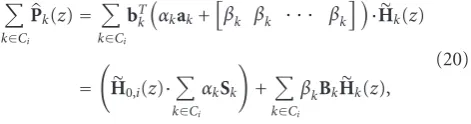
constituent matrices are not. Examples of this type of chan-nels are the TIM systems and the HM systems with more than two channels. As in the insensitive case, the modulation vec-tors are writtenak =αkak+ [βkβk · · · βk], and the sum of
the channel matrices for the channel subset becomes
k∈Ci
Pk(z)=
k∈Ci
bTkαkak+
βk βk · · · βk ·Hk(z)
=
H0,i(z)·
k∈Ci αkSk
+
k∈Ci
βkBkHk(z),
(20)
whereBkis a diagonal matrix consisting of the elements of
bk. The first sum is generally not a pseudocirculant matrix,
and the channels are thus sensitive to sequence gain errors. If the gains are matched, denoteα0,i=αk =αlwhenk,l∈Ci,
the channel matrix sum may be written
k∈Ci
Pk(z)=
α0,iH0,i(z)·
k∈Ci
Sk
+
k∈Ci
βkBkHk(z), (21)
x(n) εk(n)
×
+
× +
ak(n)
γk δk
Hk(z) ΔHk(z)
×
+ bk(n)
yk(n) Figure6: Channel model with nonideal analog circuits.
z−1
. . . x(n) βk
↓M
↓M
Hk(z)
↑M
↑M
z z−1
+
. . .
. . .
↓M
↓M
Bk
↑M
↑M
z +
yk(n)
. . .
Figure 7: Model of errors in a parallel system pertaining to se-quence offsets.
and it is seen that the first term is a pseudocirculant matrix, and the channel set is alias-free. Again, the impact of the off -set termβkis explained underSection 3.2.4below.
3.2.3. Multilevel sequences
If an insensitive channel is modulated with a multilevel se-quenceak=ak+εk, the channel matrix becomes
Pk(z)=bTk
ak+εk
·Hk(z)
=Sk·Hk(z) +bTkεk·Hk(z),
(22)
which is pseudocirculant only ifbTkεkis a circulant matrix.
Systems with multilevel analog modulation sequences are thus sensitive to level errors.
3.2.4. Modulation sequence offset errors
Consider here the modulation sequence offset errors intro-duced above under Sections3.2.1and3.2.2. The channel ma-trix for a channel with a modulation sequence containing an offset error can be written as (19). Thus the error pertaining to the sequence offset is additive, and can be modelled as in
Figure 7. The signal is thus first filtered throughHk(z) and
then aliased by the systemBk, asBk is not pseudocirculant
unless the elements in the digital modulation sequencebkare
identical. However, as the signal is first filtered, only signal components in the passband ofHk(z) will cause aliasing. If
0 0.2π 0.4π 0.6π 0.8π π ωT
−150
−100
−50 0
Am
pli
tude
(dB)
(a) Simulation using ideal system
0 0.2π 0.4π 0.6π 0.8π π
ωT
−150
−100
−50 0
Am
pli
tude
(dB)
(b) Simulation with 2% gain mismatch in one channel
0 0.2π 0.4π 0.6π 0.8π π
ωT
−150
−100
−50 0
Am
pli
tude
(dB)
(c) Simulation with 1% offset error in one modulation sequence
0 0.2π 0.4π 0.6π 0.8π π
ωT
−150
−100
−50 0
Am
pli
tude
(dB)
(d) Simulation with 1% offset error in one modulation sequence using highpass modulators instead of lowpass modulators
Figure8: Sensitivity of TIM ADC inExample 1.
3.3. Channel offset errors
Channel offsets must be removed for each channel in order not to overload theΣΔ-modulator. Offsets affect the system in a nonlinear way and may not be analyzed using the multi-rate formulation. However, the problem has been well inves-tigated and numerous solutions exist [12,16,20].
4. EXAMPLES
In this section, examples of how the formulation can be used to analyze a system’s sensitivity to channel mismatch errors are presented. Examples are provided for the TIM, HM, and FBDM ADCs. Also, an example is provided of how the for-mulation can be used to derive a new architecture that is in-sensitive to channel matching errors.
Example 1(TIM ADC). Consider a TIM ADC [3,4] with four channels. The samples are interleaved between the channels, each encompassing identical second-order lowpass modulators and decimation filters. Ideally, their z-domain transforms may be written
Hk(z)=H(z)=
⎧ ⎨ ⎩
z−1, −π
4 ≤ωT≤
π
4,
0, otherwise. (23)
All modulators are running at the input sampling rate, with their inputs grounded between consecutive samples. Thus the modulation sequences are
a0(n)=b0(n)=1, 0, 0, 0,. . .,
a1(n)=b1(n)=0, 1, 0, 0,. . .,
a2(n)=b2(n)=0, 0, 1, 0,. . .,
a3(n)=b3(n)=0, 0, 0, 1,. . .,
(24)
all periodic with periodM=4. The vectorsakandbkare as
defined by (13):
a0=b3=
1 0 0 0
a1=b0=
0 0 0 1
a2=b1=
0 0 1 0
a3=b2=
0 1 0 0
(25)
The matricesSk, defined by (12), then become
S0=bT0a0=
⎡ ⎢ ⎢ ⎢ ⎣
0 0 0 0 0 0 0 0 0 0 0 0 1 0 0 0
⎤ ⎥ ⎥ ⎥ ⎦,
S1=bT1a1=
⎡ ⎢ ⎢ ⎢ ⎣
0 0 0 0 0 0 0 0 0 0 0 1 0 0 0 0
⎤ ⎥ ⎥ ⎥ ⎦,
S2=bT2a2=
⎡ ⎢ ⎢ ⎢ ⎣
0 0 0 0 0 0 1 0 0 0 0 0 0 0 0 0
⎤ ⎥ ⎥ ⎥ ⎦,
S3=bT3a3=
⎡ ⎢ ⎢ ⎢ ⎣
0 1 0 0 0 0 0 0 0 0 0 0 0 0 0 0
⎤ ⎥ ⎥ ⎥ ⎦.
(26)
Because the sum of allSk-matrices is a circulant
ma-trix, the system is alias-free and the transfer function for the system is given by (15) as HA(z) = z−1s0,13 H3,1(z4) = z−1
polyphase decomposition ofH(z). The transfer function is thus a simple delay, and the system will digitize the complete spectrum.
As none of theSk-matrices are circulant, and a
circu-lant matrix can be formed only by summing all the matrices, the TIM ADC requires matching of all channels in order to eliminate aliasing. Thus we defineC0 = {0, 1, 2, 3}, accord-ing to the description inSection 2.1.1. The system has been simulated with modulator nonidealities and errors of bilevel sequences for sensitive channels, as described in Section 3.
Figure 8(a)shows the output spectrum for the ideal case with no mismatches between channels (γk =1 for allk). Apply-ing 2% gain mismatch for one of the channels (γ0 = 0.98,
γ1=γ2=γ3=1), the spectrum inFigure 8(b)results, where the aliasing components can be clearly seen. InFigure 8(c), the channel gains are set to one, and a 1% offset error has been added to the first modulation sequence (β0 = 0.01,
β1=β2 =β3 =0), which results in aliasing. InFigure 8(d), high-pass modulators have been used instead, and the distor-tions disappear, as predicted by the analysis inSection 3.2.4.
Example 2 (HM ADC). Consider a nonoversampling HM ADC [6] with eight channels. In this case, every channel fil-ter is an 8th-band filfil-ter (Hk(z)=H(z), k=0,. . ., 7) and the
modulation sequencesak(n) andbk(n) are
a0(n)=b0(n)=1, 1, 1, 1, 1, 1, 1, 1,. . .,
a1(n)=b1(n)=1,−1, 1,−1, 1,−1, 1,−1,. . .,
a2(n)=b2(n)=1, 1,−1,−1, 1, 1,−1,−1,. . .,
a3(n)=b3(n)=1,−1,−1, 1, 1,−1,−1, 1,. . .,
a4(n)=b4(n)=1, 1, 1, 1,−1,−1,−1,−1,. . .,
a5(n)=b5(n)=1,−1, 1,−1,−1, 1,−1, 1,. . .,
a6(n)=b6(n)=1, 1,−1,−1,−1,−1, 1, 1,. . .,
a7(n)=b7(n)=1,−1,−1, 1,−1, 1, 1,−1,. . ..
(27)
The vectorsakandbkbecome
a0=b0=
1 1 1 1 1 1 1 1
a1= −b1=
1 −1 1 −1 1 −1 1 −1
a2=b3=
1 −1 −1 1 1 −1 −1 1
a3= −b2=
1 1 −1 −1 1 1 −1 −1
a4=
1 −1 −1 −1 −1 1 1 1
b4=
−1 −1 −1 −1 1 1 1 1
a5=
1 1 −1 1 −1 −1 1 −1
b5=
1 −1 1 −1 −1 1 −1 1
a6=
1 1 1 −1 −1 −1 −1 1
b6=
1 1 −1 −1 −1 −1 1 1
a7=
1 −1 1 1 −1 1 −1 −1
b7=
−1 1 1 −1 1 −1 −1 1.
(28)
WithSk=bTkak, the following matrices can be computed:
S0=1,
S1=
⎡ ⎢ ⎢ ⎢ ⎢ ⎢ ⎢ ⎢ ⎢ ⎢ ⎢ ⎢ ⎢ ⎣
−1 1 −1 1 −1 1 −1 1
1 −1 1 −1 1 −1 1 −1
−1 1 −1 1 −1 1 −1 1
1 −1 1 −1 1 −1 1 −1
−1 1 −1 1 −1 1 −1 1
1 −1 1 −1 1 −1 1 −1
−1 1 −1 1 −1 1 −1 1
1 −1 1 −1 1 −1 1 −1
⎤ ⎥ ⎥ ⎥ ⎥ ⎥ ⎥ ⎥ ⎥ ⎥ ⎥ ⎥ ⎥ ⎦
,
S2+S3=
⎡ ⎢ ⎢ ⎢ ⎢ ⎢ ⎢ ⎢ ⎢ ⎢ ⎢ ⎢ ⎢ ⎣
0 2 0 −2 0 2 0 −2
−2 0 2 0 −2 0 2 0
0 −2 0 2 0 −2 0 2
2 0 −2 0 2 0 −2 0
0 2 0 −2 0 2 0 −2
−2 0 2 0 −2 0 2 0
0 −2 0 2 0 −2 0 2
2 0 −2 0 2 0 −2 0
⎤ ⎥ ⎥ ⎥ ⎥ ⎥ ⎥ ⎥ ⎥ ⎥ ⎥ ⎥ ⎥ ⎦
,
S4+S5+S6+S7=
⎡ ⎢ ⎢ ⎢ ⎢ ⎢ ⎢ ⎢ ⎢ ⎢ ⎢ ⎢ ⎢ ⎣
0 4 0 0 0 −4 0 0
0 0 4 0 0 0 −4 0
0 0 0 4 0 0 0 −4
−4 0 0 0 4 0 0 0
0 −4 0 0 0 4 0 0
0 0 −4 0 0 0 4 0
0 0 0 −4 0 0 0 4
4 0 0 0 −4 0 0 0
⎤ ⎥ ⎥ ⎥ ⎥ ⎥ ⎥ ⎥ ⎥ ⎥ ⎥ ⎥ ⎥ ⎦ .
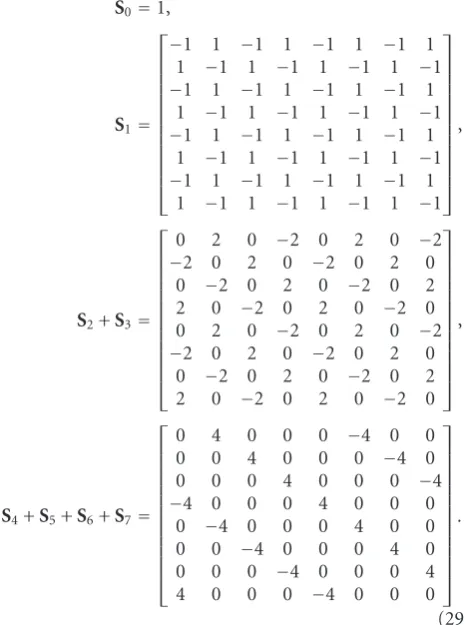
(29)
It is seen thatS0andS1are circulant matrices. Also,S2+S3
is circulant. Further, the remaining matrices sum to a circu-lant matrixS4+S5+S6+S7, whereas no smaller subset does.
Thus, in order to eliminate aliasing, the channels are parti-tioned into the setsC0 = {0},C1 = {1},C2 = {2, 3}, and
C3 = {4, 5, 6, 7}. The HM ADC thus contains both insensi-tive channels 0 and 1, and sensiinsensi-tive channels 2,. . ., 7.
Using the model of the ideal system, the spectrum of the output signal is as shown inFigure 9(a).Figure 9(b)shows the output spectrum for the system with 1% random gain mismatch (γk ∈[0.99, 1.01]), where the aliasing distortions are readily seen. Matching the gains of the C2-channels to each other (settingγ2=γ3) and the gains of theC3-channels to each other (settingγ4 =γ5 =γ6 =γ7), the spectrum in
Figure 9(c)results, and the distortions disappear. Although the HM ADC is less sensitive than the TIM ADC, the match-ing requirements for eight-channel systems and above are still severe. Another limitation is that the reduced sensitiv-ity seemingly requires a number of channels that are a power of two. For Hadamard matrices of other orders, extensive searches by the authors have not yielded solutions with sim-plified matching requirements.
0 0.2π 0.4π 0.6π 0.8π π ωT
−150
−100
−50 0
Am
pli
tude
(dB)
(a) Simulation using ideal model
0 0.2π 0.4π 0.6π 0.8π π
ωT
−150
−100
−50 0
Am
pli
tude
(dB)
(b) Simulation using 1% channel gain mismatch
0 0.2π 0.4π 0.6π 0.8π π
ωT
−150
−100
−50 0
Am
pli
tude
(dB)
(c) Simulation using gain matching of sensitive channels Figure9: Sensitivity of TIM ADC inExample 2.
0 0.2π 0.4π 0.6π 0.8π π
ωT
−200
−150
−100
−50 0 50
Am
pli
tude
(dB)
Figure10: Sensitivity of new scheme inExample 4. Simulation us-ing 10% channel gain mismatch.
channel, and two bandpass channels centered at 3π/8 and 5π/8.
As the signal is not modulated,
ak=bk=[1 1 1 1] (30)
(31) for allk, and
Sk=
⎡ ⎢ ⎢ ⎢ ⎣
1 1 1 1 1 1 1 1 1 1 1 1 1 1 1 1
⎤ ⎥ ⎥ ⎥
⎦ (32)
for allk. As eachSk-matrix is circulant, the system is
insen-sitive to channel mismatches. Further, modulation sequence errors are irrelevant in this case, as the signal is not modu-lated. The FBDM ADC is thus highly resistant to mismatches. Its obvious drawback, however, is the need to use bandpass modulators which are more expensive in hardware.
Example 4(generation of new scheme). This example dem-onstrates that the formulation can also be used to devise new schemes, although a general method is not presented. A three-channel parallel system using lowpass modulators is designed. The signal is assumed to be in the frequency band
−π/4< ωT < π/4, and the ADC is thus an oversampled sys-tem and is described according toSection 2.1.2withL =4 andM=8.
Using complex modulation sequences, three bands of widthπ/4 centered at−π/4, 0, andπ/4 can be translated to baseband and converted with a lowpass ADC. These modu-lation sequences area0(n)=1,a1(n)=exp(jπn/4),a2(n)=
exp(−jπn/4), andbk(n)=a∗k(n). Summing the resultantSk
-matrices yields
Sk
=1+
⎡ ⎢ ⎢ ⎢ ⎢ ⎢ ⎢ ⎢ ⎢ ⎢ ⎢ ⎢ ⎢ ⎣
√
2 2 √2 0 −√2 −2 −√2 0
0 √2 2 √2 0 −√2 −2 −√2
−√2 0 √2 2 √2 0 −√2 −2
−2 −√2 0 √2 2 √2 0 −√2
−√2 −2 −√2 0 √2 2 √2 0
0 −√2 −2 −√2 0 √2 2 √2
√
2 0 −√2 −2 −√2 0 √2 2
2 √2 0 −√2 −2 −√2 0 √2
⎤ ⎥ ⎥ ⎥ ⎥ ⎥ ⎥ ⎥ ⎥ ⎥ ⎥ ⎥ ⎥ ⎦ .
(33)
Unfortunately, using complex modulation sequences is not practical. However, as the modulators and filters are identi-cal for all channels (Hk(z)=H(z) for allk), any other choice
of modulation sequences resulting in the same matrix will perform the same function. Moreover, for a decimated sys-tem, relaxations may be allowed on the new modulation se-quences. In this case, with decimation by four, it is sufficient to find replacing modulation sequences ak and bk such that the sum of the resultingSk-matrices equalsSkon rows
4 and 8, as gcd(L,M)=4. One such choice of modulation se-quences is
a0=1 1 1 1 1 1 1 1,
a1=1 1 0 −1 −1 −1 0 1,
a2=1 0 0 0 −1 0 0 0,
b0=0 0 0 1 0 0 0 1,
(34)
b1=0 0 0 −√2 0 0 0 √2, (35)
b2=0 0 0 (√2−2) 0 0 0 (2−√2). (36)
modulators, whereas the nontrivial multiplications in bk
can be implemented with high precision digitally. Note that
bTk ak
=1 +
⎡ ⎢ ⎢ ⎢ ⎢ ⎢ ⎢ ⎢ ⎢ ⎢ ⎢ ⎢ ⎢ ⎣
0 0 0 0 0 0 0 0
0 0 0 0 0 0 0 0
0 0 0 0 0 0 0 0
−2 −√2 0 √2 2 √2 0 −√2
0 0 0 0 0 0 0 0
0 0 0 0 0 0 0 0
0 0 0 0 0 0 0 0
2 √2 0 −√2 −2 −√2 0 √2
⎤ ⎥ ⎥ ⎥ ⎥ ⎥ ⎥ ⎥ ⎥ ⎥ ⎥ ⎥ ⎥ ⎦
, (37)
which is equal toSkin (33) on rows 4 and 8. Note also that
theSk-matrices, given on rows 4 and 8 by
b0,3
b0,7
a0=
1 1 1 1 1 1 1 1 1 1 1 1 1 1 1 1
,
b1,3
b1,7
a1=
−√2 −√2 0 √2 √2 √2 0 −√2
√
2 √2 0 −√2 −√2 −√2 0 √2
,
b2,3
b2,7
a2=
(√2−2) 0 0 0 (2−√2) 0 0 0 (2−√2) 0 0 0 (√2−2) 0 0 0
, (38) are circulant on these rows, and thus the system is insensitive to channel mismatches. This is demonstrated in Figure 10, where the channel gain mismatch is 10% and no aliasing re-sults. However, as three levels are used in the analog modu-lation sequences a1 and a2, the system is sensitive to
mis-matches in the modulation sequences of these channels, as described inSection 3.
5. NOISE MODEL OF SYSTEM
The primary purpose of this paper is to investigate the signal transfer characteristics of the parallelΣΔ-system. However, the system’s noise properties are also affected by the choice of modulation sequences, and therefore a simple noise analysis is included.
A noise model of the parallelΣΔ-system can be depicted as inFigure 11. The quantization noise qk(n) of channelk
is filtered through the noise transfer function NTFk(z) and
filterGk(z). The filtered noise is then modulated by the
se-quencebk(n). The channels are summed to form the output
y(n).
In order to determine the statistical properties of the out-puty(n), channelkis modeled as inFigure 12. Denoting the spectral density of the quantization noise of channel k by
RQk(ejω), the spectral densities of the polyphase components yk,mof the channel output can be written
Ryk,m
ejω=bk2,m M−1
l=0 Gk,l
ejω2RQk
ejω, (39)
whereGk,l(z) are the polyphase components of the cascaded
system NTFk(z)Gk(z). It is seen that the noise power is scaled
q0(n)
q1(n)
qN−1(n)
NTF0(z)
NTF1(z)
NTFN−1(z)
. . .
G0(z)
G1(z)
GN−1(z)
. . .
× × ×
+ b0(n)
b1(n)
bN−1(n)
y(n)
Figure11: Noise model of parallel system.
qk(n)
NTFk(z) Gk(z)
↓M
↓M
↓M
↑M
↑M
↑M
z−1
z−1
yk,0(m)
yk,1(m)
yk,M−1(m)
bk,0
bk,1
bk,M−1
+
. . . .
. .
+
z z
yk(n)
Figure12: Noise model of channk.
by the factorbk2,m, and it is thus of interest to keep the
ampli-tudes of the modulation sequences low on the digital side. For example, inExample 4, alternative choices ofa1andb2
would have been
a1=[0 1 0 −1 0 −1 0 1],
b2=[0 0 0 −2 0 0 0 2].
(40)
However, in this case the noise power is larger. This shows that the smaller magnitudes of the digital modulation se-quences, as in (36), is preferable from a noise perspective.
6. CONCLUSION
ACKNOWLEDGEMENT
The work is financially supported by the Swedish Research Council.
REFERENCES
[1] L. J. Breems, R. Rutten, and G. Wetzker, “A cascaded continuous-time ΣΔmodulator with 67-dB dynamic range in 10-MHz bandwidth,”IEEE Journal of Solid-State Circuits, vol. 39, no. 12, pp. 2152–2160, 2004.
[2] N. Yaghini and D. Johns, “A 43mW CT complexΔΣADC with 23MHz of signal bandwidth and 68.8dB SNDR,” in Interna-tional Solid-State Circuits Conference, Digest of Technical Pa-pers, pp. 502–503, February 2005.
[3] A. Eshraghi and T. S. Fiez, “A time-interleaved parallelΔΣ A/D converter,”IEEE Transactions on Circuits and Systems II, vol. 50, no. 3, pp. 118–129, 2003.
[4] A. Eshraghi and T. S. Fiez, “A comparative analysis of parallel delta-sigma ADC architectures,”IEEE Transactions on Circuits and Systems I, vol. 51, no. 3, pp. 450–458, 2004.
[5] E. King, F. Aram, T. Fiez, and I. Galton, “Parallel delta-sigma A/D conversion,” inProceedings of the Custom Integrated Cir-cuits Conference, pp. 503–506, 1994.
[6] I. Galton and H. T. Jensen, “Delta-sigma modulator based A/D conversion without oversampling,”IEEE Transactions on Cir-cuits and Systems II, vol. 42, no. 12, pp. 773–784, 1995. [7] I. Galton and H. T. Jensen, “Oversampling parallel delta-sigma
modulator A/D conversion,”IEEE Transactions on Circuits and Systems II, vol. 43, no. 12, pp. 801–810, 1996.
[8] S. K. Kong and W. H. Ku, “Frequency domain analysis ofΠΔΣ ADC and its application to combining subband decomposi-tion andΠΔΣADC,” inProceedings of the Midwest Symposium on Circuits and Systems, vol. 1, pp. 226–229, August 1997. [9] R. F. Cormier, T. L. Sculley, and R. H. Bamberger,
“Combin-ing subband decomposition and sigma delta modulation for wideband A/D conversion,” inProceedings of the IEEE Interna-tional Symposium on Circuits and Systems, vol. 5, pp. 357–360, 1994.
[10] G. Ding, C. Dehollain, M. Declercq, and K. Azadet, “Frequency-interleaving technique for high-speed A/D con-version,” inProceedings of the IEEE International Symposium on Circuits and Systems, vol. 1, pp. I857–I860, May 2003. [11] R. Khoini-Poorfard and D. A. Johns, “Time-interleaved
over-sampling convertors,”Electronics Letters, vol. 29, no. 19, pp. 1673–1674, 1993.
[12] R. Khoini-Poorfard, L. B. Lim, and D. A. Johns, “Time-interleaved oversampling A/D converters: theory and prac-tice,” IEEE Transactions on Circuits and Systems II, vol. 44, no. 8, pp. 634–645, 1997.
[13] M. Kozak, M. Karaman, and I. Kale, “Efficient architectures for time-interleaved oversampling delta-sigma converters,”IEEE Transactions on Circuits and Systems II, vol. 47, no. 8, pp. 802– 810, 2000.
[14] F. Colodro, A. Torralba, and M. Laguna, “Time-interleaved multirate sigma-delta modulators,” inProceedings of the IEEE International Symposium on Circuits and Systems, vol. 6, pp. 5581–5584, Kobe, Japan, May 2005.
[15] R. Khoini-Poorfard and D. A. Johns, “Mismatch effects in time-interleaved oversampling converters,” inProceedings of the IEEE International Symposium on Circuits and Systems, vol. 5, pp. 429–432, 1994.
[16] R. D. Batten, A. Eshraghi, and T. S. Fiez, “Calibration of par-allelΔΣADCs,”IEEE Transactions on Circuits and Systems II, vol. 49, no. 6, pp. 390–399, 2002.
[17] V. T. Nguyen, P. Loumeau, and J.-F. Naviner, “Analysis of time-interleaved delta-sigma analog to digital converter,” in Pro-ceedings of the IEEE Vehicular Technology Conference, vol. 4, September 2002.
[18] A. Blad, H. Johansson, and P. L¨owenborg, “A general formula-tion of analog-to-digital converters using parallel sigma-delta modulators and modulation sequences,” inProceedings of the Asia-Pacific Conference on Circuits and Systems, pp. 4–7, Sin-gapore, December 2006.
[19] P. P. Vaidyanathan, Multirate Systems and Filter Banks, Prentice-Hall, Eaglewood Cliffs, NJ, USA, 1993.