Volume 2008, Article ID 693731,10pages doi:10.1155/2008/693731
Research Article
Optimizing Training Set Construction for Video
Semantic Classification
Jinhui Tang,1Xian-Sheng Hua,2Yan Song,1Tao Mei,2and Xiuqing Wu1
1Department of Electronic Engineering and Information Science, University of Science and Technology of China, Hefei 230027, China 2Microsoft Research Asia, Beijing 100080, China
Correspondence should be addressed to Jinhui Tang,[email protected]
Received 9 March 2007; Revised 14 September 2007; Accepted 12 November 2007
Recommended by Mark Kahrs
We exploit the criteria to optimize training set construction for the large-scale video semantic classification. Due to the large gap between low-level features and higher-level semantics, as well as the high diversity of video data, it is difficult to represent the prototypes of semantic concepts by a training set of limited size. In video semantic classification, most of the learning-based approaches require a large training set to achieve good generalization capacity, in which large amounts of labor-intensive manual labeling are ineluctable. However, it is observed that the generalization capacity of a classifier highly depends on the geometrical distribution of the training data rather than the size. We argue that a training set which includes most temporal and spatial distribution information of the whole data will achieve a good performance even if the size of training set is limited. In order to capture the geometrical distribution characteristics of a given video collection, we propose four metrics for constructing/selecting an optimal training set, includingsalience, temporal dispersiveness, spatial dispersiveness, and diversity. Furthermore, based on these metrics, we propose a set of optimization rules to capture the most distribution information of the whole data using a training set with a given size. Experimental results demonstrate these rules are effective for training set construction in video semantic classification, and significantly outperform random training set selection.
Copyright © 2008 Jinhui Tang et al. This is an open access article distributed under the Creative Commons Attribution License, which permits unrestricted use, distribution, and reproduction in any medium, provided the original work is properly cited.
1. INTRODUCTION
Video content analysis is an elementary step for mining the semantic information in video collections, in which seman-tic classification (or we may call it annotation) of video seg-ments is essential for further analysis, as well as important for enabling semantic-level video search. For human being, most semantic concepts are clear and easy to identify, while due to the large gap between semantics and low-level features, the corresponding features generally are not well-separated in feature space thus difficult to be identified by computer. This is an open difficulty in computer vision and visual con-tent analysis area.
Generally, learning-based video semantic classification methods use statistical learning algorithms to model the se-mantic concepts (generative learning) or the discriminations among different concepts (discriminative learning). In [1], hidden Markov model and dynamic programming are ap-plied to play/break segmentation in soccer videos. Fan et al. [2] classify semantic concepts for surgery education videos
tion on the issue of the training set construction. Generally, most of them adopt a random selection scheme to construct the training set. In this paper, we argue that a better train-ing set, though the size is very small, can be carefully con-structed/selected with a good performance being simultane-ously preserved.
It has been shown that the generalization capacity of a classifier usually depends on the geometrical distribution of the training data rather than the size [11]. Therefore, if the selected training data can capture this kind of characteristic of the entire video collection, the classification performance will still be good enough even in the case that the size of training set is much smaller than that of the whole dataset, thus much manual labor for training data labeling will be saved. In other words, according to the distribution analy-sis of the video dataset, a “skeleton” of the prototypes of the semantic concepts can be achieved in a training set with an extremely limited number of samples.
Given a large video collection, it is possible to construct a small-size but effective training set (to be labeled manu-ally) by exploiting the temporal and spatial distribution of the entire dataset. Typically, a semantic concept and its cor-responding feature variations within the same video are rel-atively smaller than those among different videos and the concept drifting is gradual in most cases [12]. The cluster-ing information can be extracted accordcluster-ing to this observa-tion. That is, based on visual similarity and temporal order, the video shots can be preclustered in an over-segmentation manner [4]. Each cluster can be represented by the cluster center (or the shot closest to the cluster center in terms of low-level features). This clustering process aims at making all the samples within each cluster most likely associate with the same semantic concept. As a result, the training set can be constructed by selecting samples from these cluster centers. Intuitively, we can take all the cluster centers as the train-ing set. However, as clustertrain-ing information is obtained in an over-segmentation manner, typically the number of cluster centers is very large. Therefore, much redundancy still exists among these clusters and actually only a small part of them is highly informative.
In this paper, we analyze the factors which can capture the distribution characteristics of a given video collection, and propose the following four metrics for the training set construction, includingsalience,temporal dispersiveness, spa-tial dispersiveness,anddiversity. First, as the candidates for constructing the training set are actually cluster centers, the samples in this candidate set should have different potential contributions to the training set as their corresponding clus-ter sizes are different. Accordingly, we introducesalience, as a potential contribution measure of each candidate sample. Second, the samples in the training set should distribute dis-persively in temporal order, as well as in the low-level feature
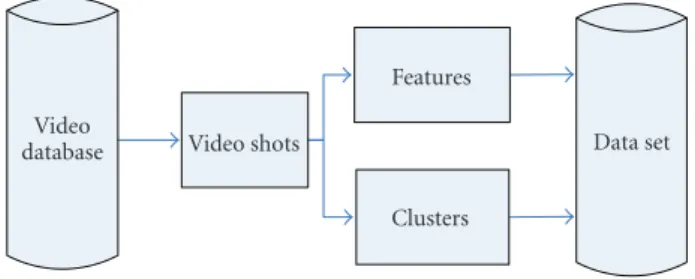
Figure1: Preprocessing of video database.
space, thus more “prototypes” of the semantic concept can be selected. Therefore, we introduce two measures, tempo-ral dispersivenessandspatial dispersiveness, to reflect how well the training set captures the distribution of the entire video dataset in temporal order and the feature space, respectively. Finally, in addition to temporal and spatial dispersiveness, the selected samples need to be diversely distributed in the feature space [13]. In this paper, the measurediversityis de-fined to capture this training set property.
According to the above analyses, a set of optimization rules based on these metrics are further proposed to reduce the redundancy in the set of cluster centers. A set of experi-ments are conducted on a real-video dataset to show the ef-fectiveness of these rules.
The rest of this paper is organized as follows. InSection 2, representativeness metrics for training set construction are presented. Section 3 discusses the optimization rules and methods according to the representativeness metrics. Exper-imental results are presented inSection 4, followed by con-cluding remarks and future work inSection 5.
2. REPRESENTATIVENESS METRICS
In this section, we first describe the preprocessing step of video database, including shot detection, feature extraction, and preclustering. Then the four metrics includingsalience,
temporal dispersiveness, spatial dispersiveness, and diversity
are discussed in detail based on the preprocessing results. Figure 1 illustrates the flowchart of preprocessing the video dataset. First, each video is segmented into shots ac-cording to timestamp (for DVs) or visual similarity (for ana-log videos). In the following process, each shot is represented by a certain number of frames uniformly excerpted from the shot. Shot is taken as the elementary unit for the semantic classification in this paper, which is the basic annotation unit most frequently applied in the literature.
Figure2: Exemplary thumbnails for the 4 different sematic classes. First row:landscape; second row:indoor; third row:cityscape; last row:
others.
is different from theirs. We aim to select a set of informa-tive samples for the users to annotate and then the set is used for training. Before the training set being constructed, the labels are unknown, and they use the labels of the entire dataset. Our objective is to reduce the manual work while Yuan’s work focuses on reducing the number of support vec-tors.
As aforementioned, the training set is constructed to roughly represent the prototypes of the semantic concepts to be modeled from the video collection. Here, we detail the aforementioned four metrics to measure the representative-ness of a training set. To clearly present our ideas, we define the following notations at first.
Notation 1. The center (or representative shot) set of the clusters is denoted by CntSet= {xj, 1 ≤ j ≤K(cl)}, where
xjis the shot closest to the center of thejth cluster andK(cl)
is the total number of the clusters in the whole video dataset.
Notation 2. The training set consisted of the selected shots from CntSet is denoted by TrnSet= {xi, 1≤i≤M}, where
Mis the size of training set that will be constructed. TrnSet is a subset of CntSet.
Notation 3. The distance between two sample feature vectors in the kernel mapped feature space is defined as dis(φi,φj):
disφi,φj
=φxi
−φxj=
φTiφi−2φiTφj+φTjφj
=Kxi,xi
−2Kxi,xj
+Kxj,xj
,
(1)
whereφiis the kernel mapping of the feature vectorxi(we use
xto denote both the shot and its feature vector in this paper), Kis the kernel function. In our experiments,Gaussian kernel
is adopted forK.
Based on these notations, we introduce four metrics to measure the effectiveness of a training set.
2.1. Salience metric
First, the effectiveness of samples (cluster centers) is different from each other, that is, the sample corresponding to a large cluster should be more “important” than the ones of small clusters. In other words, such samples most likely represent the salient prototypes of the semantic concepts. Therefore, we define SAL as the salience metric of TrnSet as follows.
Metric 1. Salience:
SAL= 1 K(cl)
xi∈TrnSet
Sal(xi), (2)
where Sal(xi) is the number of shots in the cluster
corre-sponding to theith sample in TrnSet.
2.2. Temporal dispersiveness metric
Second, the samples to be selected should distribute disper-sively through the temporal axis of the whole video dataset. Thus more prototypes of the semantic concept can be pre-served. This is from the observation that if the two salient samples lie close to each other in temporal order, it may be-long to the same concept with high probability. We define the temporal distance between the sets CntSet and TrnSet as
DisT=
1 K(cl)
xj∈CntSet
min
xi∈TrnSet
t
xi
−txj, (3)
where minxi∈TrnSett(xi)−t(xj)is the temporal distance
be-tweenxjand TrnSet, andt(x) is the normalized temporal
or-der of the samplex. Thetemporal dispersivenessis defined as follows.
Metric 2. Temporal dispersiveness:
T Disp= 1 DisT =
K(cl)
xj∈CntSetminxi∈TrnSett
xi
−txj.
500 450 400 350 300 250 200 150 100
The number of selected samples Random selection
Selection using salience 0.25 0.3 T h e er (a) 500 450 400 350 300 250 200 150 100
The number of selected samples Random selection
Selection using temporal spersiveness only Selection using temporal spersiveness with salience 0.1 0.15 0.2 T h e er ror (b) 500 450 400 350 300 250 200 150 100
The number of selected samples Random selection
Selection using spatial dispersiveness only Selection using spatial dispersiveness with salience 0.1 0.15 0.2 0.25 0.3 0.35 0.4 0.45 T h e er ror ra te of classificat ion (c) 500 450 400 350 300 250 200 150 100
The number of selected samples Random selection
Selection using diversity only Selection using diversity and salience 0.2 0.25 0.3 0.35 0.4 T h e er ror ra te of classificat ion (d) 500 450 400 350 300 250 200 150 100
The number of selected samples Random selection
Selection using temporal spersiveness only Selection using spatial spersiveness only Selection using diversity only
Selection using Rule all 0.1 0.15 0.2 0.25 0.3 0.35 0.4 0.45 T h e er ror ra te of classificat ion (e) 500 450 400 350 300 250 200 150 100
The number of selected samples Using temporal spersiveness and salience Using spatial spersiveness and salience Using diversity and salience Using Rule all
400 350 300 250 200 150 100
The number of selected samples Random
Salience Diversity
Spatial dispersiveness Temporal dispersiveness Salience + diversity
Salience + spatial disversiveness Salience + temporal disversiveness Rule-all
0.2 0.25 0.3 0.35 0.4 0.45 0.5
T
h
e
er
ror
ra
te
of
classificat
ion
Figure4: Comparisons of the experimental results after data sepa-ration.
In order to assure that the TrnSet can capture most tem-poral distribution information of the CntSet, it is necessary to minimize the DisT, which is equivalent to the
maximiza-tion ofT Disp. Thus, for each sample in CntSet, there should be a sample in TrnSet close to it in temporal order. Given the size of the TrnSet, maximizingT Disp can mostly disperse the samples in TrnSet in temporal order.
2.3. Spatial dispersiveness metric
Third, similar to the aforementioned temporal dispersive-ness, the samples to be selected should distribute dispersively through the whole kernel mapped feature space. This is from the observation that if the two salient samples lie close to each other in the feature space, it may belong to the same concept with high probability. We define the spatial distance DisS
be-tween the sets CntSet and TrnSet as
DisS=
1 K(cl)
xj∈CntSet
min
xi∈TrnSet
φ
xi
−φxj, (5)
where minxi∈TrnSetφ(xi)−φ(xj)is the spatial distance
be-tweenxjand TrnSet. Then we definespatial dispersivenessas
follows.
Metric 3. Spatial dispersiveness:
SDisp= 1 DisS =
K(cl)
xj∈CntSetminxi∈TrnSetφ
xi
−φxj,
(6)
whereφ(x) is the kernel mapping ofx. TrnSet can capture the most spatial distribution characteristics of CntSet through maximizingS Disp. It corresponds to minimizing DisS, that
is, the samples in CntSet have a minimal average distance to TrnSet in the kernel mapped space. Thus, for each sample xj in CntSet, there should be a sample in TrnSet close to it.
Given the size of TrnSet, maximization ofS Disp can mostly disperse the samples in TrnSet in the mapped feature space.
2.4. Diversity metric
Goh et al. [13] have pointed out that the selected samples need to be diversified in image retrieval application, and de-fined the measureangle diversityto choose the sample with the maximal angle (less than 90◦) to the current selected sam-ple set. That is, the selected samsam-ple should be “almost or-thogonal” to current selected sample set. However, their def-inition of the angle between the unlabeled instancexito the
current sample setSis the maximal angle from instancexito
any instancexjin setS. This definition just ensures that the
chosen instances can be almost orthogonal to one sample in current set, but not almost orthogonal to the set. We intro-duce feature vector selection (FVS) method to handle this problem. FVS method is proposed in [16] to find an approx-imate basis of the whole dataset to reduce feature dimension. Here we employ it to find the almost orthogonal sample set in CntSet. FVS is similar to the kernel principal component analysis (KPCA) while FVS selects the existed sample vectors as the basis, and the KPCA uses the firstkeigenvectors as the basis. The authors of [16] show that in some special cases the FVS-PCA is equivalent to KPCA.
As aforementioned, the samples in TrnSet are denoted as {xi, 1≤i≤M}, whereMis the size of TrnSet. Given a
well-selected TrnSet, each samplexjin CntSet could be
approxi-mated by the linear combination of samples in TrnSet in the kernel mapped space. The normalized Euclidean distanceδj
is defined to measure the fitness betweenφ(xj) andφ(xj) as
follows:
δj=
φ
xj
−φxj2
φ
xj2
, (7)
δj is a similarity measure between the original vectorφ(xj)
and the reconstructed vectorφ(xj)=
xi∈TrnSetαjiφ(xi). The
smaller δj is, the betterxj can be approximated by TrnSet.
Consequently, the metricdiversitycan be defined as follows.
Metric 4. Diversity:
Divers=1− 1 K(cl)
xj∈CntSet
δj
=1− 1 K(cl)
xj∈CntSet
φ
xj
−xi∈TrnSetαjiφ
xi2
φ
xj2
,
(8)
where ai j are weights of the combination. This metric
similar but have difference.
3. OPTIMIZATION RULES
As aforementioned, four metrics have been defined to mea-sure the representativeness of TrnSet. According to these metrics, the following rules are further proposed to construct an optimal training set with a given size.
Rule 1. Maximizingsalience:
TrnSet∗= argmax
TrnSet⊂CntSet
{SAL|#(TrnSet)=M}, (9)
where #(TrnSet) is the number of samples in TrnSet,Mis a given number.
The constructing procedure based on this rule can be de-scribed as shown inAlgorithm 1.
Rule 2. Maximizingtemporal dispersiveness:
TrnSet∗= arg max
TrnSet⊂CntSet
T Disp|#(TrnSet)=M. (10)
This rule is equal to minimize DisT, and the training set
con-struction procedure is illustrated inAlgorithm 2.
Rule 3. Maximizingspatial dispersiveness:
TrnSet∗= arg max
TrnSet⊂CntSet
SDisp|#(TrnSet)=M. (11)
This rule is equal to minimize DisS, and the procedure can
be accomplished similar toRule 2, just needs to change the temporal distancedtmnto the spatial distance dis(φm,φn)=
φ(xm)−φ(xn).
Rule 4. Maximization ofdiversity:
TrnSet∗= argmax
TrnSet⊂CntSet
Divers|#(TrnSet)=M. (12)
So the target is to find a set (TrnSet) of feature vectors (FVs) [16] with the fixed size which minimize
xj∈CntSet
φ
xj
−xi∈TrnSetαjiφ
xi2
φ
xj
2 . (13)
It has been proven in [16] that the minimization of
δj=
φ
xj
−φxj2
φ
xj2
(14)
KSS=
Kxp,xq
1≤p,q≤M (16)
is a square matrix of dot products of FVs, and
KS j=
Kxp,xj
1≤p≤M (17)
is the vector of dot products betweenxjand the FVs.
Define the fitness for the samplexjby
JSj =
φxj2
φ
xj2
=K
T S jKSS−1KS j
kj j
, (18)
which is a measure of the best fit case, wherexj ∈ CntSet,
xi∈TrnSet andkj j =K(xj,xj). Then the objective becomes
to select a set TrnSet for a given sizeMto maximize the fitness for the CntSet:
JS= 1 K(cl)
xj∈CntSet
JSj. (19)
Note that the maximum of (19) is one and for xi ∈
TrnSet, (15) is zero. Therefore, when #(TrnSet) increases, we only need to explore (K(l)−#(TrnSet)) remaining vectors to evaluate the maximization ofJS.
The process is iterative, which consists of a set of sequen-tial forward selection operations: at the first iteration, we look for the sample that gives the maximumJS. Except for the first iteration, the algorithm uses the lowest fitnessJSj for
the current basis TrnSet to select the new FV while evaluat-ing theJS.JSis monotonic since the new basis will recon-struct all the samples at least as well as the previous basis did. Algorithm 3shows the detailed procedure.
Among the four metrics,salienceis the property of each sample, while the other three metrics are related to the cor-relations between TrnSet and CntSet. Therefore,saliencecan be combined intoRule 2–4to improve the results.
Rule 1 + 2. Maximizing temporal dispersiveness with
salience.1We want the sample with high salience to have more
chance to be selected, so we can minimize
xj∈CntSet
min
xi∈TrnSet
t
xi
−txj
Salxi
·Sal(xj
(20)
subject to a fixed-size TrnSet. The training set construction procedure of this rule is presented inAlgorithm 4.
1The computation for optimizingRule 1+2is NP hard. For
1: Initialization: TrnSet := {}and #(TrnSet)=0;
2: Obtain Sal(xj) for every samplexjin CntSet according to the cluster size;
3: While #(TrnSet)< M
Find the maximal element maxSal in vector [Sal(xj)]1≤j≤K(cl);
Add the sample corresponding to maxSal to TrnSet; Remove this sample from CntSet;
#(TrnSet)=#(TrnSet) + 1; End While
4: Return TrnSet
Algorithm1: Optimization ofRule 1.
1: Initialization: TrnSet:=CntSet and #(TrnSet)=K(cl);
2: In current TrnSet, compute the temporal distance between every two samples
dtmn= |t(xm)−t(xn)|,m=n. dtmn=inf whenm=n. The temporal order is normalized; 3: While #(TrnSet)> M
Find the minimal element mindtin matrix [dtmn]1≤m,n≤K(cl); Remove the correspondingxnfrom TrnSet;
#(TrnSet)=#(TrnSet)−1;
Setdtnk=inf ;dtkn=inf ;k∈ {1, 2,. . .,K(cl)} End While
4: Return TrnSet
Algorithm2: Optimization ofRule 2.
Rule 1 + 3. Maximizingspatial dispersivenesswithsalience. Similar toRule 1+2, we minimize
xj∈CntSet
min
xi∈TrnSet
φ(xi)−φ(xj)
Sal(xi)·Sal(xj) (21)
subject to a fixed-size TrnSet. This procedure is similar to Rule 1+2.
Rule 1 + 4. Maximizingdiversityaccompanied withsalience. Consider the effect of salience, the objective becomes finding a feature vector set (FVs) under the constraint of fixed size to minimize
xj∈CntSet
φ(xj)−
xi∈TrnSetαjiφ(xi) 2
φxj
2·Salx
j
. (22)
Then we can select samples as the procedure inAlgorithm 5.
Actually, finally, we want to use all these four metrics to optimize TrnSet. A direct way is to maximize a linear combi-nation of the four metrics, that is, to maximize
R=α·SAL +β·T Disp
+γ·SDisp + (1−α−β−γ)·Divers (23)
subject to a fixed-size TrnSet. However, it is not easy to deter-mine the three weights (which is our future work).
Alterna-tively, in this paper, we optimize the four metrics in a hierar-chical way. That is, firstly we minimize
xj∈CntSet
min
xi∈TrnSet
disφi,φj·dtxi,xj
Salxi
·Salxj
(24)
to optimize theMetric 1–3simultaneously (see Algorithm6), and then useRule 1+4to remove 10% redundancy. We call this method Rule all.
4. EXPERIMENTAL RESULTS
To evaluate the performance of our proposed algorithms on real video dataset, we conduct several experiments on a home video dataset which contains about 55 home videos with a wide variety of contents, such as wedding, vacation, meeting, party, and sports.
In the experiments, we classify the shots in the video dataset into the following four semantic concepts: indoor,
landscape,cityscape,andothers. The four semantic concepts are mutually exclusive, that is, one sample just can belong to one concept. After preprocessing of the video dataset includ-ing shot detection, low-level feature extraction and preclus-tering, about 7000 shots are obtained. These shots are further clustered into about 1600 clusters in an over-segmentation manner. Each shot is labeled asindoor,cityscape,landscape,
For 1< j < K(l)
Using current TrnSet as the basis, compute theJSj;
End For
Find the smallestJSj;
Add the correspondingxjinto TrnSet; #(TrnSet)=#(TrnSet) + 1;
End While 5: Return TrnSet
Algorithm3: Optimization ofRule 4.
1: Initialization: TrnSet=CntSet and #(TrnSet)=K(cl);
2: In current TrnSet, compute the following distance between every two samples
dtmn=Sal(xm)·Sal(xn)·dt(xm,xn),m=n. dm,n=inf when m=n.The temporal order is normalized;
3: While #(TrnSet)> M
Find the minimal element min dtin matrix [dtmn]1≤m,n≤K(cl); Find the correspondingxmandxn;
If Sal(xm)≥Sal(xn) Removexnfrom TrnSet;
Setdnk=inf ;dkn=inf ;k∈ {1, 2,. . .,K(cl)} Else
Removexmfrom TrnSet;
Setdmk=inf ;dkm=inf ;k∈ {1, 2,. . .,K(cl)}
End If End While 4: Return TrnSet
Algorithm4: Optimization ofRule 1+2.
1: Initialization: TrnSet := {}and #(TrnSet)=0; 2: For 1< j < K(l)
Compute theJSjusing otherK(l)−1 samples as the basis;
End for
3: Find the largest Sal(xj)JSjand add the correspondingxjinto TrnSet as the first sample;
4: While #(TrnSet)< M
For 1< j < K(l)
Using current TerSet as the basis, compute theJSj;
End For
Find the smallest Sal(xj)JSj;
Add the correspondingxjinto TrnSet; #(TrnSet)=#(TrnSet) + 1;
End While 5: Return TrnSet
1: Initialization: TrnSet=CntSet and #(TrnSet)=K(cl);
2: In current TrnSet, compute the following distance between every two samples
dmn=Sal(xm)·Sal(xn)·dis(φm,φn)·dt(xm,xn),m=n,dmn=inf whenm=n; 3: While #(TrnSet)> M
Find the minimal element min din matrix [dmn]1≤m,n≤K(cl); Find the correspondingxmandxn;
If Sal(xm)≥Sal(xn) Removexnfrom TrnSet;
Setdnk=inf ;dkn=inf ;k∈ {1, 2,. . .,K(cl)} Else
Removexmfrom TrnSet;
Setdmk=inf ;dkm=inf ;k∈ {1, 2,. . .,K(cl)} End If
End While 5: Return TrnSet
Algorithm6: Optimization ofRule 1–3.
The low-level features we used here has 90 dimensions, consisting of a 36-D HSV color histogram, a 9D color mo-ment, and a 45D blockwise edge distribution histogram. Low-level features are normalized by Gaussian normaliza-tion [18]. Each shot is represented by a certain number (i.e., 10) of frames uniformly excerpted from the shot, and the shot closest to the cluster center is taken as the sample to form the dataset. So the dataset used in experiment has about 7000 samples, and each sample is represented as a 900D vec-tor. The CntSet has about 1600 samples, and each sample is also a 900D vector.
We conduct 5 experiments in transductive manner: when the training set TrnSet is constructed, we train the SVM model [19] to classify the samples in CntSet (here the pa-rameters C andg are both set to 1 empirically), and then extend the label of each cluster center to all other samples in the same cluster [14]. The error rates are calculated for all samples on all concepts.
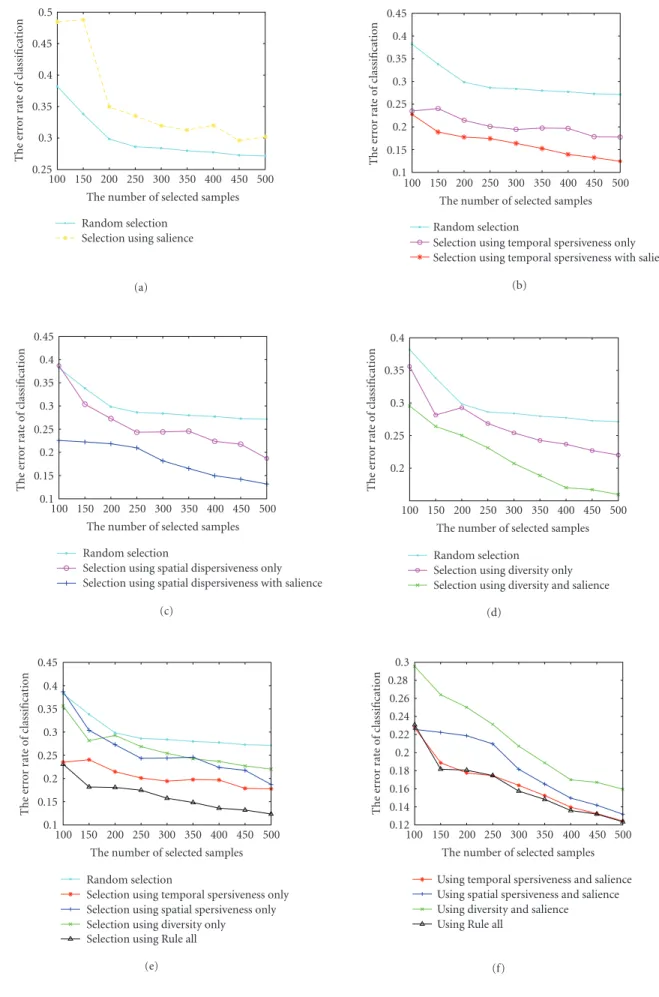
Experiment 1. Construct the training set usingRule 1. The classification error rate is illustrated inFigure 3(a), compared with random training set selection (averaged over ten runs). We can see that the result is worse than the random selection. That is because the distribution information of original data is significantly lost in the training set constructed by using Rule 1only.
Experiment 2. Construct the training set usingRule 1 and Rule 1+2. The results are shown in Figure 3(b). It can be seen thatRule 2significantly improves the classification per-formance and the embedding of salience further improves Rule 2.
Experiment 3. Construct the training set usingRule 3 and Rule 1+3. The results inFigure 3(c)show thatRule 3also improves the classification performance significantly. And it is effective to embedsalienceintoRule 3.
Experiment 4. Construct the training set usingRule 4 and Rule 1+4.Figure 3(d)shows the different performances of Rule 4,Rule 1+4, and random selection.
Experiment 5. Construct the training set using Rule all. We compared the performance of Rule all with Rules2,3, and 4, as well as Rules1+2,1+3, and1+4, respectively. The results are shown in Figures3(e)and3(f).
It can be seen that we achieve a good performance by a limited-size training set. For example, when the size of train-ing set is 150 (about 2.1% of the whole data), the classifica-tion error rate is about 18.2% under Rule all criterion, while random selection only achieves an error rate around 33.8% with the same number of training samples.
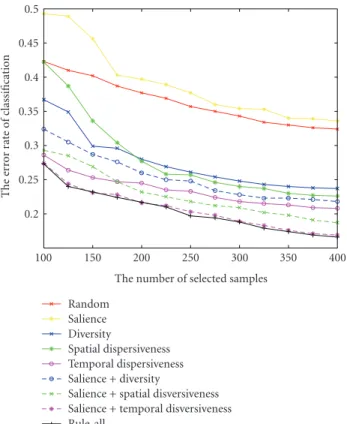
To show the generalization ability of the proposed meth-ods, we separate the entire dataset into two parts: the first part contains about 3500 shots, which are used for training set construction and training; the second part contains the remaining 3500 shots, which are used for testing. We con-struct the training set using all rules we proposed above, the comparisons of results are shown in Figure 4. We can see when the size of training set is 300 (about 8.4% of the data used for training set construction), the classification error rate on the test dataset is about 18.8% under Rule all cri-terion, while random selection only achieves an error rate around 34.3% with the same number of training samples.
All these experimental results demonstrate that these rules are effective for training set construction in video se-mantic classification and the hierarchical combination strat-egy could further improve the classification performance over each rule. However, this strategy could not improve the result ofRule 1+2significantly, which can be seen in Figures 3(f)and4. The reasons for this phenomena lies in twofold: (1) the hierarchical strategy of combining the four rules in this paper is not the optimal solution, which still needs to be exploited in the future; (2) in this particular video collection, Rule 1+2removes most of the redundancy in the clustering information.
5. CONCLUSIONS AND FUTURE WORK
enough since home videos tend to be temporally more simi-lar than edited footages. However, for other datasets without such strong temporal similarity, such as the broadcast news videos, optimizing the other metrics that we proposed is still effective for training set construction.
Future work will be on the optimal combination of all these rules, as well as applying these rules on multiple se-mantic concepts, more types of videos, and larger video databases.
ACKNOWLEDGMENT
This work was performed when the first author was visiting Microsoft Research Asia as a research intern.
REFERENCES
[1] L. Xie, P. Xu, S.-F. Chang, A. Divakaran, and H. Sun, “Struc-ture analysis of soccer video with domain knowledge and hid-den markov models,”Pattern Recognition Letters, vol. 25, no. 7, pp. 767–775, 2004.
[2] J. Fan, H. Luo, and X. Lin, “Semantic video classification by in-tegrating flexible mixture model with adaptive em algorithm,” inProceedings of the ACM SIGMM International Workshop on Multimedia Information Retrieval, pp. 9–16, Berkeley, Calif, USA, November 2003.
[3] D. Zhong and S.-F. Chang, “Structure analysis of sports video using domain models,” in Proceedings of IEEE International Conference in Multimedia & Expo, pp. 713–716, Tokyo, Japan, August 2001.
[4] Y. Song, X.-S. Hua, L.-R. Dai, and M. Wang, “Semi-automatic video annotation based on active learning with multiple com-plementary predictors,” inProceedings of ACM SIGMM Inter-national Workshop on Multimedia Information Retrieval, pp. 97–104, Singapore, November 2005.
[5] R. Yan and M. Naphade, “Semi-supervised cross feature learn-ing for semantic concept detection in videos,” inProceedings of the IEEE Computer Society Conference on Computer Vision and Pattern Recognition (CVPR ’05), vol. I, pp. 657–663, 2005. [6] J. Tang, X.-S. Hua, G.-J. Qi, M. Wang, T. Mei, and X. Wu,
“Structure-sensitive manifold ranking for video concept de-tection,” inProceedings of ACM Multimedia, 2007.
[7] J. Tang, X.-S. Hua, T. Mei, G.-J. Qi, and X. Wu, “Video anno-tation based on temporally consistent gaussian random field,”
Electronics Letters, vol. 43, no. 8, pp. 448–449, 2007.
[8] M. Wang, Y. Song, X. Yuan, H.-J. Zhang, X.-S. Hua, and S. Li, “Automatic video annotation by semi-supervised learning with kernel density estimation,” inProceedings of the 14th An-nual ACM International Conference on Multimedia (MM ’06), pp. 967–976, 2006.
[9] R. Yan, J. Yang, and A. Hauptmann, “Automatically labeling video data using multi-class active learning,” inProceedings of the IEEE International Conference on Computer Vision, vol. 1, pp. 516–523, Nice, France, October 2003.
[12] J. Wu, X.-S. Hua, H.-J. Zhang, and B. Zhang, “An online-optimized incremental learning framework for video seman-tic classification,” inProceedings of the 12th ACM International Conference on Multimedia (ACM ’04), pp. 320–323, New York, NY, USA, October 2004.
[13] K.-S. Goh, E. Chang, and W.-C. Lai, “Concept-dependent multimodal active learning for image retrieval,” inProceedings of the ACM International Conference on Multimedia, pp. 564– 571, New York, NY, USA, October 2004.
[14] G.-J. Qi, Y. Song, X.-S. Hua, L.-R. Dai, and H.-J. Zhang, “Video annotation by active learning and cluster tuning,” in Proceed-ings of International Workshop on Semantic Learning Applica-tions in Multimedia, vol. 2006, New York, NY, USA, June 2006. [15] J. Yuan, J. Li, and B. Zhang, “Learning concepts from large scale imbalanced data sets using support cluster machines,” in
Proceedings of the 14th Annual ACM International Conference on Multimedia (MM ’06), pp. 441–450, 2006.
[16] G. Baudat and F. Anouar, “Feature vector selection and pro-jection using kernels,”Neurocomputing, vol. 55, no. 1-2, pp. 21–38, 2003.
[17] “Trec video retrieval evaluation,”http://www-nlpir.nist.gov/ projects/trecvid/.
[18] Y. Rui, T. S. Huang, M. Ortega, and S. Mehrotra, “Relevance feedback: a power tool for interactive content-based image re-trieval,”IEEE Transactions on Circuits and Systems for Video Technology, vol. 8, no. 5, pp. 644–655, 1998.