Thesis by
Richard Dale Rocke
In Partial Fulf:lllinent of the Requirements for the Degree of
Doctor of Philosophy
California Institute of Technology Pasadena, California
1966
ACKNOWLEDGMENTS
The author desires to gratefully acknowledge the guidance and encouragement given by his former advisor, the late Professor
C. E. Crede, during the early phases of graduate work.
The many ideas and suggestions provided by Dr. Sheldon Rubin during the entire course of this investigation have been sincerely
appreciated.
The author is especially grateful to Professor D. E. Hudson, his present advisor, for the guidance, encouragement, and valuable suggestions provided during the course of this work and the prepara-tion of this manuscript.
The author is. further indebted to the Hughes Aircraft Company for the Doctoral Fellowship and other generous financial aids provided, to the California Institute of Technology, and to the National Aero-riautics and Space Administration for partial support of this wor~ under
Contract No. NAS 8-2451.
ABSTRACT
The use of transmission matrices and lumped parameter model's for describing continuous systems is the subject of this study. Non-uniform continuous systems which play important roles in practical vibration problems, e.g., torsional osdllations in bars, transverse bending vibrations of beams, etc., are of primary importance.
A new approach for deriving closed form transmission matrices is applied to several classes of non-uniform continuous segments of one dimensional and beam systems. A_ power series expansion method is presented for determining approximate transmission matrices of any order for segments of non-uniform systems whose solutions can not be found in closed form. This direct series method is shown to give results comparable to those of the improved lumped parameter models for one dimensional systems.
Four types of lumped parameter models are evaluated on the basis of the uniform continuous one dimensional system by comparing the behavior of the frequency root errors. The lumped parameter models which are based upon a close fit to the low frequency approxima-tion of the exact transmission matrix, at the segment level, are showi:.i· to be superior. On this basis an improved lumped parameter model is
recommended for approximating non-uniform· segments. This new . model is compared to a uniform segment approximation and error
CHAPTER
I
II
III
IV
TABLE OF CONTENTS
TITLE NOMENCLATURE
. INTRODUCTION
1. 1 Contents of Thesis TRANSMISSION MA TRICES
2. 1 Description
PAGE
1 2 4 4 2, 2 Direct Derivation of Transmission 9
Matrices
SYSTEMS GOVERNED BY THE ONE DIMENSIONAL WAVE EQUATION
3. 1 Comparison of Different Physical . Systems
3. 2 Transmission Matrices for Continuous Systems
12
12-15
3. 3 Investigation of Lumped Parameter 19 Models
3. 4 Linear Taper Model 42
3. 5 Optimum Segmenting with the 69 Linear Taper Model
BEAM ELEMENTS
4. 1 Lumped Parameter Models for Uniform Continuous Beams 4. 2 Transmission Matrices for
Non-Uniform Continuous Beams
82 82
CHAPTER
v
.
VI
TITLE.
POWER SERIES EXPANSION OF TRANSMISSION MA TRICES
5.1 Method Description 5. 2 Illustration
SUMMARY AND CONCLUSION APPENDIX A
APPENDIX B APPENDIX C APPENDIX D REFERENCES
PAGE
99
99
102 109 114119
[A]
A(x}
. A 0
B
b
c
c
D.(x} 1
[E)
E
NOMENCLATURE
=
matrix (n X n) which characterizes a system= cross sectional area expressed as a function of x
=
cross sectional area at the input end of a segment= cross sectional area at the output end of a segment
=
Nf3
= width of a rectangular cross section
= variable used to .control segment lengths
= constants in the transmission matrix for a beam i, k=l,2,3,4
= velocity of sound
=
ith differential operator with the independent variable x= transmission matrix (n X n} for a uniform continuous system
=
Young's modulusEI(x) - beam bending stiffness expressed as a .function of x
EI = beam bending stiffness at the input end of a segment 0
= non-dimensional frequency root error for the vth mode with N· segments
F = force
f = 1
;g
g 1
+
fG
=
shearing modulush = height of a rectangular cross section
I ±n J ±n K ±n k. 1
[ L]
L[M]
M N n p r r[ T]
u v y :1:n·Y(x)
O!
f) l
E
E ••
lJ
= modified Bessel function of the first kind, of order n
= Bessel function of the first kind, or order n
= modified Bessel function of the second kind, of order n
.th . '
= i spring constant
= transmission matrix (n X n) for lumped parameter models
=length of an element composed of N segments
= length of one segment (or increment)
= transmission matrix (n X n) derived by power series expan-sion method
= point mass (except where noted in Appendix D)
= number of segments
= constant for controlling cross sectional variation of beams
= constant for controlling cross sectional area variation
= radius of circular cross sections
= radius of gyration
= transmission matrix (n X n) for non-uniform continuous systems
= rectilinear displacement
= rectilinear velocity
= Bessel functions of the second kind, of order n
= admittance type element in the [A ] . matrix expressed as function of x
= ff)
= w
J
p/E= matrix norm
i) = subdividing parameter for lumped parameter models ~ = slope parameter
p = mass density
<J' = stress {force/area)
1
µ
=
2If
J!fl
[~~:]
4
.v =mode number
l\J
-
state vector {column vector)A general theory for vibration problems involving continuous systems has existed for many years. However, the number of
prob-lems which are exactly solvable analytically is very small, e.g.,
uniform and some simple non-uniform systems. Therefore, other techniques, which give approximate solutions to continuous systems, have been extensively investigated. These methods provide solutions to many practical vibration problems which do not fit into the category of being exactly solvable.
One method, which has been especially emphasized since the
advent of large computers, is the lumped parameter approximation
whereby the continuum is replaced by a finite N degree ·Of freedom system composed of lumped elements, i.e., massless springs, point masses, etc. This technique was first applied by Lagrange [ 1
J
andRayleigh[ Z] in studying the vibrating string. Duncan[ 3
J,
using a lumped parameter model attributed to Lagrange, was one of the firstto study the behavior of errors resulting from lumped parameter
ap-proximations .. Livesley[ 4
J,
Gladwell[ 5J,
and others[b,?,B]have evaluated lumped parameter approximations of uniform continuous beams using many different models.Transmission matrices, which have been applied to mecha ni-cal vibration problems only in recent ye·ars, provide another approach
for describing continuous systems in either an exact or approximate
description of four terminal electrical networks in which case the method is commonly designated "four pole parametersn. Molloy[ 9 ] was one of the first to systematically apply four pole parameters to acoustical, mechanical, and electromechanical vibration problems. Pestel and Leckie[ lO] have catalogued transmission matrices for uniform elastomechanical elements up to twelfth ord.er. R bu in . [ 11] has extended the application of transmission matrices through a
completely general treatment.
1. 1 Contents of Thesis
The objective of the present study is to investigate more thoroughly several aspects of the application of lumped parameter and transmission matrix approaches to vibration problems, in par-ticular, those problems which involve non-uniform continuous systems.
In Chapter II transmission matrices and their derivation are briefly discussed.
fhghts [ l Z]. Models based on the one dimensional wave equation
similar to those to be treated in Chapter III were used to describe
structural components and fluid lines in the analysis of this missile
vibration problem.·
Chapter III also contains a presentation of transmission
matrices for three classes of non-uniform continuous cross sections
and the transmission matrix technique is used to evaluate the error
behavior of four types of lumped parameter models used to
approxi-mate the uniform continuous system. A new lumped parameter model
is proposed for non-uniform systems and for one particular case,
the linear taper model, the lumped parameters are defined. In
addi-tion, the effect of varying segment lengths is ptudied.
Chapter IV includes a surnmary of various lumped parameter
models which have been used to approximate uniform beams.
Trans-mission matrices for three groups of non-uniform continuous beams
are derived.
A power series expansion method for obtaining transmission
matrices which are low frequency approximations for non-uniform
continuous syst.ems of any order is presented in Chapter V.
Finally a summary of the work presented herein, and
2. 1 Description
CHAPTER II
TRANSMISSION MA TRICES
The transmission matrix describes the manner in which
sinusoidal forces and motions are transmitted through a linear elastic
· element during steady state conditions. All consideration .of the
dif-ferential equations describing the element is contained within the
derivation of the 'transmission matrix and the approach is equally
applicable to lumped parameter or continuous systems.
A general transmission element is shown in Fig. 2. 1. 1. The
state vector. denoted by l);' is a column vector consisting of forces
and velocities or displacements. The transmission matrix relates
the state vector at the input to that at the output of the element. The
form of the transmission matrix which will be used herein is:
{1.j;
}input - [ T] {l.j; }output (2.1.1)where [ T
J
is commc:mly designated the "forward transmission ·matrix". The sign convention to be used, see arrows in Fig. 2. 1. 1,
has positive directions for forces applied
EY
the output the same asthose for forces applied to the input.
·When a line of elements or segments are in an end-to-end or
chain like arrangement,· which is the situation for which this approach
is best suited, the transmission matrices for the individual segment
r-z
lJJ ti;:' ..:! lJJ ....JtJ
lJJr-
I
2
0
::>
I
(/)a...
r-(/)::>
I
~0
(/) ~I
z
~
<C
"-v--'
~
a::
i-<( LL
0
.
z
(\JQ
0
·
·-
-
I- LI..<{
r-z
w
(/)w
a::
i-l\
a..
{l\J } = [ T ]
{~ }1 1 z
{l\J
}=(T ]
{l\J}
z z . 3
and for the total chain of segments:
.
{l\J }
= [ T ] [ T ] . . . • . . [TN ]{lj!N}1 1 z -1 (2.1.2)
This simple result is obtained because the state vector at the input of any given segment is equal to the state vector deliyered by the output of the preceding segment. This result will be used in the following chapters to obtain the overall transmission matrix for a system com-posed of N segments.
Another way to write the state vector and transmission matrix is in partitioned forrr;i. where the state vector becomes:
(2. 1. 3)
and the transmission matrix is:
A1B [T]=
---i---[
. I ]
. C: D
For one dimensional systems, e.g. , the longitudinally vibrating rod,
F is the force, V is the velocity, and the submatrices in
p p
Eq. ( 2. 1. 4) reduce to scalar quantities. For the simple transverse
bending beam, ,however, the transmission matrix is fourth-order,
shear force
bending moment
rectilinear velocity
rotational velocity
and the submatrices in Eq. ( 2. 1. 4} are 2 X 2 matrices. Pestel and
Leckie[ lQ] have catalogued transmission matrices for various
uni-form elastomechanical elements which have transmission matrices
up to twelfth-order (12 X 12}.
The elements of the transmission matrix are not independent
and as a consequence of reciprocity it has been shown [ 11] that the
square submatrices of Eq. (2. 1. 4} must satisfy:
(2. 1. 5)
.where:
I
[I]
=the identity matrix, and[A]T =the matrix transpose of [A]
Equation (2. 1. 5) provides an excellent means of checking the validity
of derivations of transmission matrices.
lumped parameter models in Chapter III, are important character-istics of unda_mped linear elastic systems which can be obtained
through the use of transmission matrices. The transmission matrix, by definition, is independent of boundary conditions and is a function of frequency, w. Upon substituting the appropriate boundary con-ditions for a system into the input and output state vectors of Eq. (2. 1. 1), a frequency determinant can be obtained. A simply sup;.. ported beam, for example, with the boundary conditions included in the state vectors is described by:
which gives:
v.
1
0 0
.
</>. 1
=
T ..lJ
.
O'=VT +c/>TO Zl 0 M
.
O=VT +c/>T. 0 31 0 34
v
0
(2. 1. 6)
(2. 1. 7)
For a nontrivial solution of Eqs. (2. 1. 6} and (2. 1. 7} the determinant of the T.. coefficients must be zero, that is,
lJ
T
T
Zl M
=
0T
T
31 34
which define the natural frequencies. To obtain normal mode fre-quencies of one dimensional _systems which are described by second-order {2 X 2) transmission matrices the above process reduces to finding zeros of single T.. elements, e.g., the natural frequencies
iJ
of a free-free rod are given by the zeros of the T
lZ term.
Having determined the naturci..l frequencies, the corresponding normal mode shapes can also be obtained. This is accomplished. by relating the nonzero components of the input state vector to one reference component. Then the state vectors are determined at other points through the system, in terms of the one reference com-ponent, by applying the. transmission matrix which relates the input to the point in question. The determination of normal mode frequen-cies and mode shapes in this manner has been demonstrated by Molloy[ 9 ], Pestel and Leckie [ 1 OJ, Rubin [ l 3.], and others in tp.eir application of transmission ·matrices to mechanical vibration prob-lems.
2. 2 Direct Derivation of Transmission Matrices
Methods used in finding transmission matrices, in the past, have. v·aried according to the preferences of the users. These meth-ods have proven satisfactory for simple lumped parameter or lower-order uniform continuous systems, but become cumbersome when used for non-uniform and higher-order systems because. of the
. d 1 b . . 1 t' R 1 h R b' ( l 4
J
require a ge raic manipu a ions. ecerit y, owever, u inalgebra and results directly in differential equations for the elements
of the transmission matrix. This approach will be summarized in this section and· its application demonstrated in Appendices A, B,
and D.
'
.
.
[10]
In general, the state vector is usually known · to satisfy
a differential equation of the _form:
~
{tJ;(:x;)}=
[A(x)]{ljJ(x)} (2. 2.1)The [A(x)
J
matrix is entirely determined by the differentialequa-tions which govern a· dx increment of the system (see Appendix A or D). By definition of the forward transmission matrix:
{ljJ(O)} = [T(x)J {ljJ(x)} (2. 2. 2)
Differentiating Eq. (2. 2. 2) _with respect to x gives:
I I
0 = [ T (x)] {ljJ(x)} + [ T(x) ]{ljJ(x)} . (2. 2. 3)
I
However, {ljJ(x)} can be replaced using Eq. (2. 2.1); hence, reduc-ing Eq. ( 2. 2. 3). to:
I
0
=
[T (x)]{ljJ(x)}+ [T(x)][A(x)]{ljJ(x)}which upon elimination of {ljJ(x)} gives:
~
[T(x)]=
-[T(x).][A(x)] (2. 2. 4)becomes:
(T(O)] =I the -identity matrix. (2.2.5)
Substituting this result into Eq. (2. 2. 4) gives:
I
(T (O)]
=
-(A(O)] (2. 2. 6)Differentiating Eq. (2. 2. 4) with respect to x and using Eqs. (2. 2. 5)
It
and (2. 2. 6) results in [ T (0)]. This process can be continued to
obtain as many initial conditions as required to evaluate constants
which arise in solving Eq. ( 2. 2. 4); hence, the formulation of the
CHAPTER III
SYSTEMS GOVERNED BY THE ONE DIMENSIONAL WAVE EQUATION
3. 1 Comparison of the Different Physical Systems
The one-dimensional wave equation mathematically describes a group of uniform continuous systems. The following three vi
bra-tion problems have this identical mathematical formulation with
suitable interpretation of properties. 1. longitudinal vibration of rods,·
2. torsional vibration of bars, and
3. acoustical vibrations in tubes.
·Another system belonging to this category is the electrical transmission line, which has been treated rather extensively by Pipes . [15,16,17]. . . The transmission line will not be specifically in
-eluded herein, but some of the resulting transmission matrices and
lumped parameter models could be directly applied to this problem. When considering the cross sectional properties of the above ·
systems to be non-uniformly distributed, the governing differential
equations in each case are all similar; and each system under
steady-state sinusodial conditions is described by a similar second-order ( 2 X 2) transmission matrix of the following form.
\l [
ljJ=
T 11 T lZ ] { } ljJinput T 21 T 22 output
In each case the transmission matrix is determined by the same
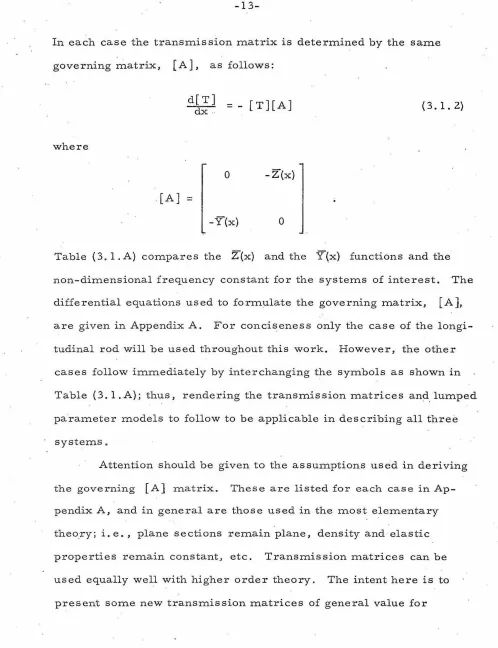
governing matrix, [A], as follows:
where
d[T]
~
.
[A]
== -
[T][A]0 -Z(x)
-Y(x) 0
( 3. 1. 2)
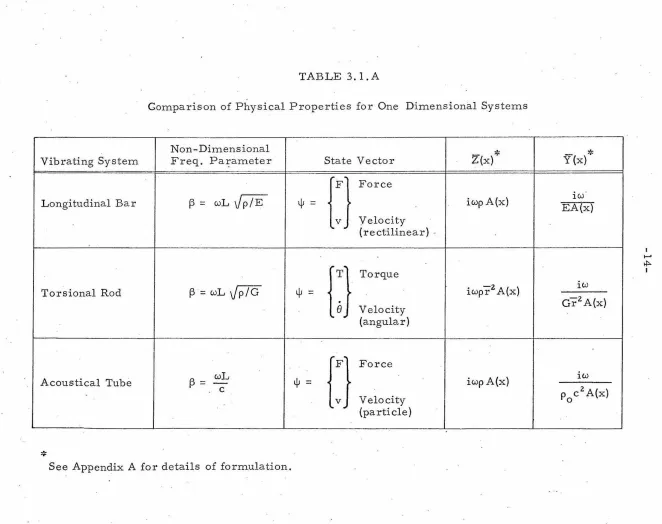
Table (3. 1. A) compares the Z{x) and the Y (x) functions and the
non-dimensional frequency constant for the systems of interest. ·The differential equations used to formulate the governing matrix, [A],
are given in Appendix A. For conciseness only the case of the
longi-tudinal rod will be used throughout this work. However, the other cases follow immediately by interchanging the symbols as shown in Table (3. 1. A); thus, rendering the transmission matrices and_ lumped parameter models to follow to be applicable in describing all three
systems.
Attention should be given to the assumptions used in deriving
the governing [A] matri~. These are listed for each case in
Ap-pendix A, and in general are those used in the most. elementary
theoxy; i.e., plane sections remain plane, density and elastic
properties remain constant,, etc. Transmission matrices can be used equally well with higher order theory. The intent here is to
Comparison of Physical Properties for One Dimensional Systems
Vibrating System
Longitudinal Bar
Torsional Rod
Acoustical Tube
....
...
Non-Dimensional Freq. Pa:i;ameter
f3
= wLJPfE
f3
= wL Jp/Gf3
= wLc
See Appendix A for details of formulation.
State Vector
ljJ
=
{Fv} ForceVelocity (rectilinear)
-ljJ
=
Torque
Velocity (angular)
ljJ = {vF} Force
Velocity
(particle)
...
Z(x) ...
iwp A(x)
iwpr2 A(x)
iwp A(x)
....
Y(x).,.
iw EA(x)
iw
Gr
2 A(x)iw
...
describing non-uniform systems and in particular to use them to
improve lumped parameter modeling of continuous systems. These
principles can be sufficiently demonstrated using the elementary theory.
3. 2 Transmission Matrices for Continuous Systems
The parameter des cri birig the spatial dependence in the
governing matrix, [A
J,
is the area, A(x). To obtain a transmis-sion matrix useful for describing many non-uniform systems requires
selection of a general function to represent the variable area. This
function must be general to represent many useful cases but of a
form which will lead to closed form solutions. One such function is:
z
-1A(x) =A
0 (l+ax) p (3.2.1)
where
a = some suitable constant and
p = an integer or non-integer.
Another useful function for exponentially tapered sections is:
where
z (x/x ) A(x) =A e 0
0
x = some suitable constant. 0
(3. 2. 2)
Equation (3. 2. 1) with a convenient coordinate transformation
leads to differential equations for the transmission matrix elements·
d2 T.. dT ..
x2 lJ + ax ~d 1 · + bx2 T .. = 0
dxz . x lJ
It is well known that this equation with variable coefficients has
solu-tions in terms of Bessel funcsolu-tions. The exponential t_aper leads to
second-order differential equations with constant coefficients of the form:
d2T.. dT ..
-1
""'J
+
a --.-:.Ld 1+
b T. . = 0dxz x . lJ
which can be easily solved.
Using the two area functions given in Eq. (3. 2. 1) and (3. 2. 2) and following the basic approach outlined in Section 2. 2, general
transmission matrices can be derived· for a broad group of non-uniform continuous elements. The derivation of the general matrix
elements for three specific cases (p = an integer, p
I
an integer, and the exponential taper) is given .in Appendix B. The resultingtrans-mission matrices for these three cases are given below:
Case I A(x) =A (l+ax{ p-l p = 0 or an integer 0
l -p
T (£) =( fg}
.!._
{Y · (fj3)J (gl3)-J (fj3)Y (gl3)}11
x
-p i -p -p l -pT (1)
12 . l {Y (fj3)J (gf3)-J (fj3)Y (gf3)}
X P P P P .
T (l) = -
~rA
f.
E]
(fg). 1-p.!._
{Y (fj3)J (gj3)-J. (f(3)Y (g.f3)}21 I-'
·
x
p-1 p-1 p-1 p-10 ' I
p .
T (£) =(;}
.!._
{Y . (ff3)J (gj3)-J .(fj3)Y (gf3)}~
I-=>
0......
:::>
0
,--A-. LL >'-v-1
-
~-
<(..
Ll.J
..
Q,,<l.
o
I-:::>
a..
z
,--A-. LL > '-w-J ' ) (_J
r-z
w
~w
....J
LLJ
(.)-...
(/)<( --:
....J
C\Jw
r0
(..9
~
u..
X
=
2/ ir£f3 independent of 11p" in this case.Case II A(x) -- A (l+ax)zp-l -1- 0 · t
0 p T or an in eger
1-p
T (1) = (gf)
l_
{Jp(ff3)J (gj3)+J (£f3)J (gf3)}11
x
i-p -p p-1T (J..) =
.1..[E~o]
(Kf)P..!_
{J (ff3)J (gf3)-J (£f3)J (gf3)}lZ lW Jt.. X p . -p . -p p
T (.e)
z l
~
[AoJ..El
(.&)
l -p Xl {J (£f3)J (gf3)-J J . (gf3)}
tJ
J
1 l ""'P . p-1 p-1 l -pT (£) = (Kf )P
l_
{j
(£ f3)J (g f3) +J (£ f3)J {g13)}
.
zz
x
i -p p p-1 -p2
X = ir£f3 sin (pir)
In Cases I and II the following definitions are appropriate (see Fig.
3. 2.1):
s
= a slope parameter =A
=
area at the input end of the element 0A .R.
=
area at the output end of the element£
=
l/s
a=
s/J..
g=
£+
1 and f3=
w1J;/E'
For systems with circular cross sections:
S·
= ( r n - r ) / rJt.. 0 0 where r
0 and r 1 are the radii. at the input and output ends,
Case III
T
11
(£)
T
12. {l)
T
2.1
(£)
T (£) zz
where
= e
z (x/x )
0
A(x) =A e 0
-i. Ix
( co s( 'Y .£ )
+
I 0'YX
0
sin( 'Yi.).
£/x
(A
0E) (
~~
)sin(~
1
)
0
e
=
lW
-.R./x
13z
0(
e i
-
-
iw pA0'Y
i.
/x
= e 0 ( cos('Y.R.)
..: l/x
z
0) sin('Yi.)
- - 1- sin("Yi.))
-'YXO
and the other terms are identical to those used in Cases II and III.
This element exhibits a cut-off frequency,
13z
=
1/x z.
l 0 When
{3:
<
l /x~, oscillations do not occur in the element; and when13:
>
l /x0 2
, mechanical oscillations do exist. Thus, this element be-hci.ves as a high pass rµechanical filter.
3. 3 Investigation of Lumped Parameter Models
The determination of eigenvalues and eigenfunctions for co
n:-tinuous systems is generally_ a difficult problem. The approach of
using transmission matrices to piecewise describe a continuous system has been previously discussed in Section 2. 1, and a general
-
0-.Q
--
c
-
·
CJ)
....J
w
0
0
systems has been given in Section 3. 2. Another more commonly used
approach· is to replace the continuum by a discrete N degree of
free-dom system composed of lumped parameters. It has been shown [ 2]
that the behavior of the discrete N degree system approaches that of
the continuous system in the limit as N - oo , and it is on this basis
that this method is justified. However, the degree to which the finite
system approximates the· continuous is often uncertain even though this
technique is widely used. The main goal in this and the following
. .
sections is to formulate some generalizations as to which lumped
parameter models should be used, how they should be employed, and
what accuracies can be expected upon using the models.
Three models that have been used previously are given in
Fig. (3. 3.1). In the first model, which was first used by Rayieigh[2
J,
the total mass. of each of the N increments into which the rod has
been segmented is further divided into two equal masses concentrated
at each end of a spring which represents the stiffness of the increment.
The second model, which has been attributed in the literature [ 18] to
Lagrange, has been investigated to some extent by Duncan [ 3] and is
some times referred to as Duncan's model. This model has the mass
of the increment concentrated at the center and equal springs on each
side. The third model, which is used to a large e::l<i;ent in practice, has
the mass concentrated at one end of a spring.
To critically examine the usefulness of these models requires
a mathematical approach. which allows the formulation of the problem
-22-system representation as a function of the number of increments. A
method commonly used by some is the finite difference approach. The
approach used herein is that of .the transmission matrix, which was
chosen for the following reasons:
1. This method allows complete freedom to choose
incremental models in any form.
2. This metho.d provides a means of determining how well the models represent the continuum at
the incremental level. Also, the accuracy of
representing a total element by N increments
of a given model can be evaluated.
3. The method allows for an analytic treatment of
uniform systems and is easily extended to include
non-uniform systems.
3. 3. 1 Model Comparison on the Incremental Level
The first comparison for the models shown in Fig, (3. 3. 1) is
to determine how well the tran.smis sion matrix for each agrees with that of the contimious uniform system for one increment of length .R..
This should give some insight into what model will best describe an
overall continuous uniform element 'composed of N increments.
Using the state vector form involving force and displacement, the
transmission matrix for the continuous uniform rod is (see
cos (13)
(E]
=
fl.
A--:E
0
sin(f3) 13
A E 0
1 13sin(13)
cos ( 13)
. (3. 3.1)
This represents the exact description cf a ·uniform continuous incre
-mental element of length. 1 (considering the elementary theory being
used). The transmission matrices for the three lumped parameter
models are:
1 - Mw 2
- Mw2
+
Mzw4~ ~
[ L ] = 1
1
1 - Mw 2
k ~
(3. 3. 2)
1 Mw
2
- Mw2
-
2k[ L ]
2 = (3. 3. 3)
l Mw2
1 - Mw
2
k -
- -
~4k2
1 -Mw2
[ L
J
= (3. 3. 4)3
1
1 - Mw 2
k k
where [Li] isthematrixforthe ith
mod
e
~(se
e
Fi
g
.
3. 3.1).Using the relationships k = AE/ i., 13
=
wi.{PiE.
z = (AE/P.) and 0terms of the constant z and the frequency parameter
13,
0[L
J
= l. [ L ] =
2
( L ] =
3
1-
13
2I
z
1z 0
1-132; 2
1
(1-(32/4) z
0
1
1
z 0
1 -f/-/2
-z
13
20
1- 132/ 2
-z 13z
0
1-
13
2(3.3.5)
(3. 3. 6)
(3. 3. 7)
To facilitate a comparison between the elements of the lumped
para-meter matrices and those of the matrix for the continuous element,
series expansions for the trigonometric functions are used. The E;.
lJ
elements from Eq. (3. 3. 1) then become:
2 4 . 6
E · =-z {13 - 13 /6+0(13 )
-12 0
-
-
}6
O( (3 ) - - - - }
A comparison of matrix terms indicates that the L ..
(a) match the E.. terms to almost the same degree as those of model
lJ
(b). With models {a) and {b) the L and L elements are
identical-11 22
ly equal to the first two terms. in the series for E and E In
11 22
model (a) t;he L term is almost the same as the two first terms in
12
E
12 and L 2 l is equal only to the order unity term of E 21 , the· term
is not present in L
21 In model (b) ·nearly the reverse of·
model (a) is true. The L term of model {b) is nearly equal to the
21 .
first two terms of E but the L term includes only the first
21 12 .
term of the series for E , L in model (b) does not have any 0(134 ) 12 12
term. Model (c) displays each Of the deficiencies shown by models {a)
and (b) when it is compared to E ... . Also L of the matrix for
lJ . 11
model {c) has only the first term of the series for E and no 0(132)
11
term . . From this comparison at the incremental level it appears
natural that model {c) would be inferior to models {a) and (b) when N increments are used to approximate a continuous element. This con-clusion does hold true in most cases and some illustrative results are
shown in Figs. (3. 3. 3) and (3. 3.4).
The comparison between the L .. and E ..
lJ lJ elements indicates
why the finite lumped parameter system is only a low frequency ap
-proximation to the continuous system. The L.. expressions,
lJ
particularly for models (a) and (b), are similar to the first two terms of the series representations of the E ..
lJ elements. If which is
proportional to the product of frequency and length of the increment, is small, then these first two terms are good approximations to the
This same argument remains true when describing the total element
because the transmission matrix for the total element is just the
product of N incremental matr:lces. Although it is arbitrary how
small
f3
.
must be to achieve good approximations from a few terms of the trigonometric. series, it follows directly that the approximationsbecome poorer as the value of
f3
increases; assuming. the number of increments and the length remain constant. Thus, lumped parameterapproximations are best for small values of
f3
or low frequencies.3.3. 2 Model Comparison on the Basis of Total Element Representation
The conclusion obtained above in the incremental comparison
was that models (a) and (b) should be superior to model (c) in
describ-ing an element composed of N such increments. The three models
will now be compared on the basis of representing an entire uniform
element. Figure (3. 3. 2) depicts an element subdivided into N equal
length increments, each of which will be described by the appropriate
transmission matrix as given in Eqs. (3. 3. 2), (3. 3 .. 3), or (3. 3. 4),
However, to determine which model best approximates the dynamic
behavior of the total element requires the adoption of some qualitative
basis of comparison. Two criteria which are motivated by the method
used herein and the classical method of superposition of normal modes
are:
1. Compare the overall transmission matrix,
which represents the N cascaded incremental
.
.
l
1.
---·
.
·-~
·-T
l-
----*
.
.
I
...J
r-z
w
~w
a::
u
z
z
0
1-z
-0
w
Q
>
-0CD
::>
CJ) C\JI-
~ z ~w
· ~ ~w
LL.The model whose matrix best approximates the
matrix of the continuum is the better model.
·2, The model that produces eigenvalues (natural frequ'encies) closest to those·of the continuous
element with specific boundary conditions of
free or fixed ends is the better model.
In the following it will be shown that the second choice is the more
acceptable criterion. ,
The first step in evaluating the overall element representation
by any of the models with either of the above criterion is to obtain the
transmission matrix for the total element. For the uniform system
this matri:X is given by the product of
N
equal incremental trans-mission matrices.[ L]
=or
[ L]
=
[ L]
l
[
L]
2 . . . . . . . . • . [ L]NL 11
L 12
L L
21 2 2 N
A squa,re matrix can be raised to the Nth power by employing the
Cayley, Hamilton theorem [ 19 ]which states that any square matrix [ M] satisfies its own characteristic equation. A direct result of this
is that [M]N for any (n Xn) matrix can be expressed as a
·In this case the matrix [M] is the transmission matrix [L]
a:r:i.d the order is two (n =
2).
Therefore(3. 3. 8)
(3.3.9)
AN= C
+
C Az 0 l z (3. 3. 10)
where ·A and . A are the characteristic values of [ L]. Solving
l
z
Eqs. (3. 3;9) and (3. 3.10) for the constants
c
·
and · C gives:0 1
AAN-AAN
c
-
z l l z.
A -A
0 (3 .. 3.11)
z
land
AN-AN
c
= lz
l A -}\.·
l z
(3~ 3.12)
The characteristic values of the incremental transmission matrix are
defined by:
(L -A) L 11 lZ
Det. = 0 .or
L (L
-
}-.)z l zz
A z - A(L
+
L )+
(L L - L L ) = 0 11 z z 11 zz lZ ZlIt is well known that the second-order transmission matrix has the
L L - L L = Det. [L .. [ = 1
11 ZZ l Z Zl lJ
Therefore,
(L
+
L ) 11 zzFrom Eqs. (3. 3. 5), (3. 3. 6) and (3. 3. 7):
(L
+
L )I
2 = 1-132I
2• 11 zz
for all three models; hence,
'A = D ± iD
l
,z
lz
where
for .0~13~2
Writing t-.· in polar form gives
,...., -i8 "' l =
~
and"'
z
,...., i8
= t-.e
~
=
D2+
D2=
1 and lz
-1
I
8 =tan (D D )
z l
(3.3.13)
By combining Eqs. (3. 3.11), (3. 3.12), and (3. 3.13) constants C and 0
c
l can be determined, whereby [ L] is known. Denoting the ele -ments from the transmission matrix to the Nth power as L ..
L sin(N 8)-sin{N-l) 8
L
=
1111 sine (3. 3. 14)
L sin(N8)
L = 12
12 sine (3. 3. 15)
L sin(N8) L
=
2 121 sine (3.3.16)
L sin(N8)-sin(N-1)8
L = 22
22 sine (3.3.17)
At the outset of the investigation the first criterion based. on
the matrix comparison appeared to offer attractive possibilities.
First, the transmission matrix. was available because it was the basic technique being used. Secondly, _the matrix is independent of any boundary conditions on the element. However, this criterion is still not completely defined because there are several ways of comparing
mat:i;-ices. One possibility, which seems meaningful here, is to com
-pare matrix norms. The definition of matrix norm used is,
Matrix Norm = E (L)
= \
IE
..
-L ..I
L
lJ lJi' j
which is a measure of ·the total absolute difference between the ele
-ments of the two matrices being compared. The norm does have the advantage of independence of bounda.ry conditions, but it also has the disadvantage of not being independent of cross sectional properties of
'i
the increment. Note that in Eqs. (3. 3.15) and (3. 3.16) L and L
are directly proportional to L and L respectively. These
lZ Zl
terms, however, are directly and inversely proportional to {AE/ 1), respectively. Therefore, the magnitude of (AE/1) will govern to some degree the importance of the L
lZ and L 2.1 terms in the norm.
Because of this difficulty the norm criterion was discarded;
more-over, no other suitable matrix comparison was found and the second
criterion of the non-dimensional frequency root co"mparison, which is independent of {AE/ 1), was us~d.
To complete the three model comparison, the behavior of the non-dimensional frequency root errors was determined for each model. This was done for four sets of boundary conditions; fixed-fixed, free-free, fixed-fr.e~, and free-fixed.
The frequency roots for the free-free and fixed-fixed boundary conditions are determined by the zeros of the L and
. 12.
L terms, respectively. · By inspection of Eq. (3. 3. 15) and {3. 3. 16)
2. 1 . '
it is apparent that L , L , or sin(N8) must then be zero as sin()
· lZ Z 1
is a bounded function. Re -examining the L
12. and L 2.1 terms for all
models shows that the L term in models (b) and (c) is the same
lZ
and, similarly, the· L. term is the same in models (a) and (c).
2.1
Equating these expressions to zero gives only the rigid body.mode,
•'
f3
=
0, for L=
0 and in the other case L is a constant.lZ ' Zl In the
L and L terms of models {a) and (b), respectively, there is an
lZ 2.1
additional l -
f3z
I
4 factor. This factor contributes the non-rigid mode for model (a) and the free-free case wheri N = 1, and thesinN8/sin 8 cannot be equal fo zero. Consequently, the major term of interest for these two boundary conditions is sin{N8). The zeros of this function give the non-dimensional frequency roots for the lumped system. From the discussion above and the fact that sin(N8) is identical for all three models it becomes obvious that all three models must give the same frequency roots for the specific cases of free-free and fixed..:fixed boundary conditions. Equating sin{N8) to zero then gives:
sin(N8)
=
0 ore
=
V1TN
where v = 1,2,3, . . . N
where
tan e sine
=
C"O"Se
L +L
a = - u zz - 1 -13z
I
2l 2
-L
=
Ni (length of total element), andB
=
wL.JPjE'
=
Nf3Solving for the frequency roots of the total element gives:
where
v = {l, 2, 3 . . . N) mode number and
N
=
number of incrementsThe frequency roots for the other two boundary conditions, fixed-free and fixed-free-fixed, are the same for models (a) and (b), but they are different than the ones for model (c). For models (a) and (b)
Bz
(L ) = {L ) = {L ) = {L ) ·= 1 - -. - ; conseq~ently~ the
n a 11 b . zz a zz b
z
Nz·frequency roots for these two models are given by:
(l-B2/ZN2)sin(N8) - sin(N-1)8
=
0or
B z vN -ZNz[l-- cos (Zv-l)rr] ZN . (3. 3.19)
For model (c) similar expressions can be obtained and are given by:
z _ z[ (Zv-l)rr]
BvN - 2N 1 - cos (ZN±
l)
(3. 3. 20)where
{ZN+l) "'fixed-free boundaries, and (ZN-1) "'free-fixed boundaries.
The behavior of the error in the frequency roots is obtained
by .subtracting Eqs. (3. 3.18), (3. 3.19), and (3. 3. 20) from the exact roots which are denoted as . B ve . For all · three models with bound-ary conditions being free-free ·or fixed-fixed:
th
evN= (erro.r in the v mode) = Bve- BvN
Expanding sin( v-rr/ ZN) and retaining only the lower order terms for large N gives:
e ~
vN (3. 3. Zl}
The errors which occur when using models (a) or (b) with boundary conditions of fixed'-free or free-fixed ends are~
· -[(Zv-l}l ·
e vN - Z
j
7T(Zv-1)-rr - ZN sin
4N
or for large N:
e ~
vN
(Zv-1}3'IT3 19ZN2
For model (c) the results are:
·e = [(Zv-1)
l
vN Z
J
Expanding the sin term.gives:
or
(Zv-l)'IT 'IT - ZN sin .
Z(
ZN±l)(Zv-l)'IT
evN = ± 4N(l±l/ZN) +higher order terms.
Thus, for large N ther error behaves as:
e ~:I:
vN
(Zv-l}'IT
4N
(3. 3. ZZ)
(3. 3. Z3)
used above. For reasonably large N the frequency root error is
proportional to 1 /N2 , except for the cases of fixed-free and
free-fixed rods when approximated by model (c). In these cases, the error
is proportional to 1 /N. Duncan [ 3 \ias examined several of the cases
described above. Usi:ig Rayleigh 1
s principle, Duncan establ.ished a
general inverse square law for model (b) which states that the error
in the frequency of any normal mode of oscillation varies inversely
as the square of the number of segments. The results presented
here for model (b) agree with those of Duncan. Duncan also
inves-tigated briefly the case where the mass is moved away from the
center of the increment and concluded that this always results in
frequency root errors which behave as l/N for large N. Model (c)
is an example of this case and the results presented here verify
Duncan's conclusion in part; however, they show that this conclusion
does not hold true in every case, and in particular not for the
free-free and fixed-fixed cases. Figure (3. 3. 3) and (3. 3. 4) show the non
-dimensional frequency root errors for all three models with the four
boundary conditions. Figure (3. 3 .. 4) gives the errors for only the
fixed-free boundarT condition. However, for models (a) and (b).
these errors are identical to those for the free-fixed case. For
model (c) the errors are of the same magnitude but negative because
this model always gives frequency roots which are too large for the
free-fixed condition-.
Another interesting technique of modeling was also
investi-gated for the two cases of fixed-fixed a,nd free-free boundary
-
~ ·0
a::
a:::
w
t-0 0
0::
>-(.)z
w
:::>
0w
a:::
LL-z
;::::.
Q)
1.0
0.1
.0
1
.00
1
0
Fig. 3. 3. 3
2
4
6
8
N
(
N
U
M
BER
10
OF
THIRD MODE
I
MODE
M
ODE
12
14
16
18
SEG
M
ENTS)_.
Non-Dimensional Frequency Root Errors for
Free-Free and Fixed-Fixed Elements when
-
0:::~
a:::
lJ.J>-u
"""?Cu
:'.). CJ
w
a:
LL-1.0
0.
1
.0
1
.001
0
\
\
\
Fig; 3. 3. 4
\
\
\
\
\
2
\
\
\
MODE\
'
"
'
'
...
......
~'
'
'
' ..:[_HIRD MODE
'
FIRST MOOE ..._ ..._
'
'
......
' - SECOND WOOE
'
\
\
\
\
'
'
'
'
MODELS
a
a
bMODEL
c
'
'
'
...
'- ..._ FIRST MODE
'
...
,
...
... .
...
4
6
8
10
12
14
16
.
18
N (NUMBER
OF SEGMENTS)
represent the total mass and N
+
1 or N - 1 equal springs whichrepresent the total stiffness. If the boundary conditions are
fixed-fixed, then N
+
1 springs are used; in the other case only N - 1springs are used. The motivation for this type of modeling comes
from the following reasoning. When using models (a) or (b) the
results for these two boundary conditions are the same. Moreover,
if model (a) is used for the free:..free case and model (b) is used for
the fixed-fixed case, then the total mass and total stiffness of the
element are always active in the models. In contrast to this, model
(c) does not reflect the total mass of the element in the fixed-fixed
case because the last mass is always inactivated by the boundary
condition. Likewise, in the free-free case the total stiffness is not
reflected by use of model (c). To determine if these deficiencies
cause model (c) to be less effective than possible, the modeling
technique described above was investigated.
To avoid confusion with models (a), (b), and (c), the model
-ing technique described above will be designated as model (d). Model
(d) can be analyzed by the previou_s methods and the frequency roots
can be found in the same manner. The [L] matrix for the
free-free case is:
1
-N(N+l)
.
[
L]
=and for the case of fixed-fixed ends:
Bz
(E
.
LA)
(N+ 1) .1
>::::
N
B2 l - N(N+l)
[ L]
=
where
*
N = N +I
~2
(~E)
1
*
N
(3. 3. 25)
Using Eqs. (3~ 3, 15) and (3. 3.16) to determine
L
and Lin-12 21
dicates that the frequency roots for both cases are determined by the
*
zeros of sin(N 8); therefore, the frequency roots are given by:
B vN= 2
V
N(N+l) sin 2(N+l) V1T (3. 3. 26)The frequency root error is:
evN=(v1T)[l - N+l N
1
+ VN(N+l) 24 V31T3- - - - + h i g her order terms.
(N+I)3
Expanding this expression for large N and retaining the lowest
order term gives:
for large N (3.3.27)
The result, therefore, is that the errors_ in the frequency roots de-,. crease as 1 /N for large N. This is the same behavior as displayed
in Fig. ( 3. 3. 4) for model (c). Figure ( 3. 3. 5) shows, in particular,
how many increments are required by both models (d) and model (a)
"
18 (2) SECOND MODE _Jw 16 (3) THIRD MODE 0
0
~
0:: 14
0
LL
.
---7--....
I
--
..;~- ..
.
--- - - - . . (3)
I
--
.
e - - ...
-(/) 12
t-z
w ~ 10
w
-
--0::
0
~ 8
LL
0 a = 30% ERROR
6
0:: b" 20% ERROR
w CD
~ 4 c .. 10% ERROR
:::>
z
--
d .. 5% ERRORu 2
z
e " 3.5% ERROR0 ....
0
0 2 3 4 5 6 7 8 9 10
No (NUMBER OF INCREMENTS FOR MODEL a OR b)
achieve a frequency root error of 5 per cent or less in the first
normal mode three increments of model (a) or (b) and eleven
incre-ments of model (d} are required.
In summary, it has been shown that models (a) and (b} give
consistent results when used to approximate the uniform system.
The errors in the non-dimensional frequency roots for these two
models decrease as l/Nz for large N. Models (c) and (d) are less
consistent in that for some boundary conditions their frequency root
errors decrease as l /N for large N; henc~, model (d} has not, in
general, shown any improvement over model (c). When considering
the higher modes two additional trends are apparent (see Figs. 3. 3. 4
and 3. 3. 5). First, the overall error level increases as expected
with higher modes for all models; and, second, the advantage of
models (a) and (b) with respect to model (c) decreases in higher
modes. The fact that the differ.ences between these models decreases for higher modes is n6t surprising, since the higher modes are less
sensitive to boundary conditions which is the main difference between
model (a) or (b) and model (c). Model (b) is slig.htly more efficient than model (a) because it achieves the same accuracy in frequency
roots with one less mass, which in turn means that the number of
differential equations is, in general, one less when using model (b).
3. 4 Linear Taper Model
Exact solutions for .non-uniform one dimensional systems
\ .
described by exact transmission matrices (see Section 3. 2). Systems which are not susceptible to exact solution can be treated in several alternative ways. A commonly recommended approach [ 1 O] is to use a piecewise uniform segment representation as shown in Fig. (3. 4. I)
A second approach, which should obviously be better, is to approxi-mate each segment by some best fit non-uniform segment for which the exact transmission matrix is known. Approximate transmission matrices can also be obtained more directly as discussed in Chapter V. A third approach is to subdivid,e the continuous system into N segments and then represent each of these segments by lumped
para-meters. In this section the lumped parameter approach will be of primary concern.
The standard way of representing the N non-uniform seg-ments by lumped parameters is to base the parameters on some mean or average uniform section for that particular segment, which is a further approximation to the £i rst case mentioned above, (see
Fig. (3. 4. 1). Duncan [ 3] derived a general error law for a particular model, which is similar to the model in Fig. (3. 4. 3)except .f. always
1
equals .R.. '
2 that is used with equal segment lengths to approximate linear non-uniform systems. The goal here is to investigate the lumped parameter representation of a non-uniform segment in a more general manner in an attempt to improve upon Duncan's model and to determine if other models are more appropriate. The work
From the investigation of the uniform system, model (b) and ·model (a) of Fig.(3. 3. l)were found to be about equivalent with model
(b) being slightly more efficient; therefore, a model similar to model (b) will be employed in this sectio.n. When considering how to improve the standard lumped parameter approximation based upon uniform equivalent segments' a natural extension would be to use variable segments of prescribed variation for which simple and accurate
lumped parameters are known. For example, in one dimensional non-uniform systems where cross sections are circular the variable. radius
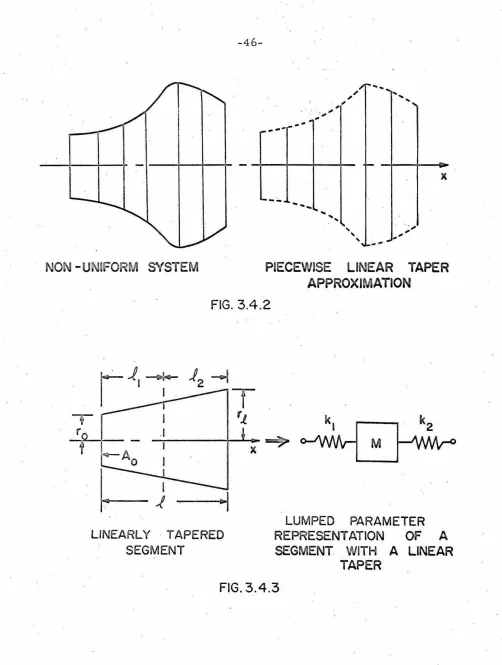
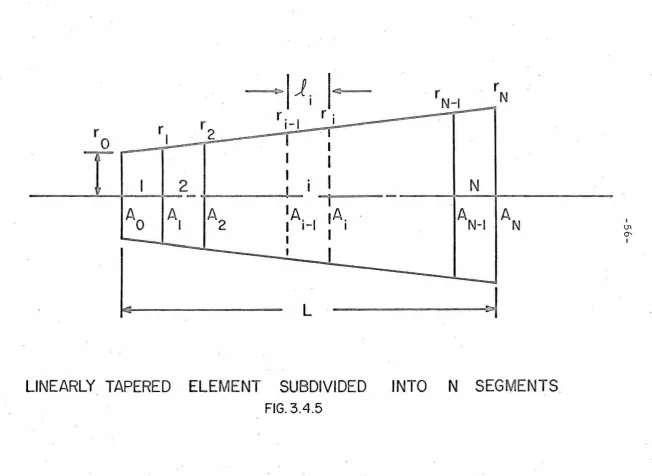
could be best fitted on a piecewise basis with segments that have a linearly varying radius. Once a general segment with a linearly varying radius is well approximated in terms of lumped parameters, this model could_ be applied just as the uniform segments are used and improved results would be anticipated. Figure (3. 4. 2) indicates how the piecewise linear approximation can be employed geometrically for the case of non-uniform, circular cross sectional systems. For con-venience the following development treats specifically circular cross sectional systems, but it will be emphasized later that the results apply to much more general systems.
Figure (3. 4. 3) shows ho:w a linearly tapered increment will be represented by a spring..:mass-spring model. This lumped parameter. model is essentially the same as model (b), but for the non-uniform segment the springs. are not equal; k and k represent the stiffness
l 2
of the portions of length P. and P.
NON
-
UNIFORM
SYSTEM
...
...
..
x
--~
...
....
...
...
' '
'
--
,.,
,
.
,
PIECEWISE
LINEAR TAPER
APPROXIMATION
FIG.
3.4.2
LINEARLY
·
TAPE RED
SEG
MENT
M
LUMPED
PARAMETER
REPRESENTATION
OF
A
SEGMENT
WI
TH A LINEAR
TAPER
1
-
Mwz. -Mwz.--ic--z.
[L]
= (3.4.1)1
+
1 Mwz. 1 Mwz.k
k
k k-
~l z. l z. l
It will be shown that the L term and the first part of L ,
lZ. . Z.l
(l/k
+
l/k ), are fixed for any given increment.· The L and Ll z. . 11 z. z.
terms· are functions of 1. and /.. , however, and they can be adjusted
l z.
by the choice of these lengths. To define a criterion for choosing 1.
l
and i.
2 the lumped parameter matrix will be compared and adjusted
to approximate the exact transmission matrix for a continuous linearly
tapered segment.
Several types of tapered sys'(:ems commonly encountered in practical vibration problems can be included in the two following groups:
Group I: Cross sectional area which varies quadratically with the spatial variable.
A common example is the solid circular er.ass section with a linearly varying radius. Another is the solid rectangular cross section where height and width both vary linearly.
cross sections 'where radius varies
linearly, and solid or thin wall
rectangular cross sections where
one lateral dimension remains
constant and the other varies
linearly.
Recalling that the area function was given in Section 3. 2 as:
s;
)
Zp-1 A(x) = A0 { 1
+
A.it can be observed that Group l is characterized by p
=
1. 5 andGroup II by p
=
1. 0 where the definition ofs
was given as:where:
Ai. = area at the output end of a segment
A =area at the endput end of a segment. 0
As mentioned above the following development is specifically for
circular cross sectional systems, but with the above definition of
s
there is no loss of generality and the results apply equally well to all
other systems belonging to Groups I or II.. The name erlinear taper
model" comes only from the geometrical fact that the radius does
vary linearly for circular cross sectional systems of the two groups
Group I is defined by p = 3/2; therefore, the exact
transmis-sion matrix can be obtained from Case II in Section 3, 2. Using the
following relationships:
J/
(y) = -·r;y
siny.1.2
VTiY
- cosy]
and the T.. expressions from Case II, the transmission matrix terms
lJ
for the cont.inuous, linearly tapered element for Group I can be writ-ten in terms of trigonometric functions as:
T
11
(1) = -
f (
- -sin f3+
cos f3)g f (3 (3.4.2)
T (1) = - {
f)
z0 ( (3) {sin f3
+
sin f3
+
Q:fil
cos f3)12 (fg) (32 fg (3. 4. 3)
T
21
(£)
={~)~o(~)
(3.4.4)T (1) = -( g} ( cos f3 - - -sin f3 )
22 f
gf3
(3. 4. 5)The transmission matrix which describes Group II, p = 1, is
obtained from Case I in Section 3. 2. The terms for this matrix
remain in Bessel function form.
T (£) = f3{Y (gf3)J (ff3)-Y (ff3)J (gf3)}
T (£) = z
(_g_
2 ) {3
2 {Y (f f3}J (g [3)- Y (g f3}J (ff3)}
12 0 Tr 1 l 1 1 (3.4.7)
1 . ( f )
T (£)
= - -
-,-
{Y (f[3}J (gf3)-Y (g[3}J (f[3)}· Zl Z t:.Tr 0 O O 0
0 .
(3.4.8)
T (,e) :::
(
1-2 ) f3{Y (ff3}J (gB)-Y (gf3)J (ff3)}
2Z Tr 0 1 1 0 (3.4.9)
Equations (3. 4. 2) through (3. 4. 9) must be expanded in series form to be compared to the matrix elements in expression (3.4.1). For the first group the trigonometric series can be used which
im-mediately gives;
T (1)
=
l..;(3z [ (£+3)]+
0((34)11 . 6(1 +~) (3.4. 10)
A E
T . (£) - - ~ {1+£+£2 /3}[32 + 0((34)
12 x. (3.4.11)
T
(£)Zl (3.4.12)
T (1) = 1 -132 [ 2£
+
3]+
O( (34 ). Z2
- r
(3.4.13)To expand the second group for lower order terms in
f3
is somewhat more difficult because of the behavior of Y ( 13). For small0 2
arguments Y ((3) "' - £n(l3); therefore, Y ({3) _,. oo as
f3-+
0 and0 Tr 0
Y (13) . can not be expanded directly in a power series of the form: 0
a + a x + a x2 + . . . • . . . + a xn
o 1 z n
The approach used to obtain a converging power series, valid for small 13, is to expand the T .. functions directly in a Maclaurin 's
lJ
that possesses finite derivatives. Applying the Maclaurin series:
I
f32
11T .. {f3)
=
T .. (o) + f3T .. (o) + -21. T .. {o) + . • .+
lJ
lJ
lJ
lJ
and using l 'Hospital's rule to evaluate indeterminate forms gives:
Tu (1)
=
1+
f3~
[ f.z2_gz+
fz .ln{g/f)]+
O{f34)T"
(1)=
E; 0 [ (~'
l
£'?'
]
+
0(~·)
Tz1{1) =
A:E
f R.n(g/f) [1 -( f3;) fz+f z ] + 0(13'1)T
22 (1)
=
1 -~~
[ £'~
g'
+
g
2
.!n(g/f)]
+
0((34)(3.4.14)
(3. 4.15)
(3.4.16)
(3.4.17)
To check the validity of the series expansions in Eq. (3. 4. 1 O) through (3. 4. 17) the condition that
g
-+ 0, which is the uniform rod in the limit, can be imposed. Completing this for both groups above gives expressions which agree with the lower order terms in the series for the · E.. elements which were given in Section 3. 2. 1.lJ
.
As mentioned earlier the' L term and the first part of the 12
L term, (1 /le
+
1 /k ), from expression (3. 4. 1) are fixed for any21 1
z
given increment. This can be illustrated by using the appropriate .:r:elationships for M and w which shows that the lower order ·terms
inEqs. (3. 4.11) and (3.4.15) are always identical to ·
L .
Likewise, 12by using the appropriate k and k expressions from Appendix C,
1
z
.
it can be shown that the order unity term in Eqs ~ (3. 4. 12) and
(3. 4. 16) is always equal to (1 /k
+
1 /k ) . The two remaining termswhich can be used to define the subdivision of a segment are L and
11
L The choice of 1. and 1. is based upon minimizing the
dif-zz l z
ference between the lower order terms in T and T and those in·
. 11
z
z
respectively. · Proceeding in this expressions for L and L
11 22.
manner gives:
11
=
1. 1Ii.
and 1. l+
1. z=
1.For Group I:
Therefore,
L =
1-11
L = 1
-zz.
A E kl ::: (1+£11)
-T-:-1
A E
k
2=
(1+g) ( 1
+£
11)-l--z
A E
Mwz. =
--f-:-
{l
+
g
+£
2/3}(3zMwz.
1 - ( 1-:Q) (1+;+gz/3)(32
l C
= (1 +£) (l +£11)2
Mw2
1 - 11 {1+;+gz /3}132
l <
= ( 1+g11)Consequently, for E and E (where E •• = T .. - L .. ):
11
zz.
lJ lJ lJThen setting L and L
11 zz
£+3
1
z6(1+~)
(3E •.
=
0 to equate the coefficient of the O( (32) term inlJ .
to that in T and T · respectively, ·gives. the follow- .
11
zz
For Group II:
k
l
EA
·O k2 =
-1.--2
2£+3 11r ~ 3(g+2)
A E
Mw2
=
+
(1+£/2}132(3.4.18)
Setting E and E equal t.o zero as before gives an expression,
. 11 . 2 2
which is the same in both cases, for 11 II"
. (3. 4. 19} where:
b
=
2( 1 +£)2c
=
g(2+g)a
=
2£(2+£)A check on both 11