DOI: 10.18488/journal.1/2016.6.1/1.1.35.48 ISSN(e): 2224-4441/ISSN(p): 2226-5139
© 2016 AESS Publications. All Rights Reserved. 35
THE EFFECTIVENESS OF E-LEARNING COORDINATORS' PERFORMANCE:
FACULTY MEMBERS' PERSPECTIVE
Arwa Rafeeq Arna'out
11Assistant Professor, The Preparatory Year, Najran University, KSA
ABSTRACT
This research aims at exploring the effectiveness of E-learning coordinators performance in Najran University. To illicit faculty members’ opinion and feedback on this issue, a questionnaire was developed and distributed among 390 male and female faculty members from Scientific and Humanistic colleges in Najran University. It consists of 28 items distributed on four domains: Promoting E-learning culture, planning and training, consulting support, and coordination and follow up. Validity and reliability of the questionnaire were ensured. Statistical treatments were conducted. The results showed an average level of the effectiveness of E-learning coordinators performance. The results also showed that there were statistically significant differences regarding gender and academic qualification and no statistically significant differences regarding faculty type. Some recommendations are proposed based on the results.
© 2016 AESS Publications. All Rights Reserved.
Keywords:
E-learning coordinator, Effectiveness, Performance, Faculty member, Learning management systems, Najran university.Contribution/ Originality
This study is one of very few studies which have investigated the effectiveness of E-learning coordinators performance in Najran University from faculty members' perspective. In light of the results, suggestions were introduced to the Deanship of E-learning and Distance Education for further improvement.
1. INTRODUCTION
The emergence of information and instructional technologies and their influence on teaching and learning has brought about significant changes in academic environment in the Kingdom of Saudi Arabia (Al-Asmari and Rabb Khan, 2014). This is to note that a good number of Saudi universities and colleges have started moving towards the application of E-learning and most of
International Journal of Asian Social Science
ISSN(e): 2224-4441/ISSN(p): 2226-5139© 2016 AESS Publications. All Rights Reserved. 36 them are mainly using learning management systems to support their students. Much more efforts need to be made available for the examples capturing the complete live lecture experience and making it available to students through the Internet. Policies also need to be changed to allow students to take virtual online degrees no matter where the university around the world may be. (Mirza, 2007)
The National Center for E-learning and Distance Learning (NCeL) was established under the umbrella of the Ministry of Higher Education in 2007 with the vision of establishing a holistic educational system based on the best applications and techniques of E-learning. The Center collaborates with partner universities like Najran University and support them receiving training, digital content, technical and advisory services. Consequently, in 2010, the list of distance education in higher education institutions in the Kingdom of Saudi Arabia was officially published and ratified. (National Center for e-Learning and Distance Learning, 2014). The implementation of educational technology in Saudi Arabia witnessed barriers and challenges such as lack of knowledge, lack of clear Web Based Instruction, lack of technical, administrative, and governmental support (Albalawi Mohammed, 2007).
Other challenge is the need to develop suitable E-learning systems to facilitate distance learning and culturally acceptable mixed gender collaboration. Najran University is a leading and emerging university in Saudi Arabia, which was established in 2006. It is one the universities in Saudi Arabia that started the transformation from traditional education to E-learning platforms. It currently includes fourteen Colleges: Applied Medical Sciences, Pharmacy, Nursing, Medicine, Dentistry, Engineering, Computer Science and Information Systems, Education, Science and Arts, Administrative Sciences, Languages and Translation, Science and Arts (Sharourah Branch), Sharia and Fundamentals of Religion, and Community College. (Najran University, 2014)
As other universities in KSA, Najran University established a Deanship of E-learning and Distance Education in line with the interest of the kingdom to encourage the adoption of E-learning in the educational community. According to its organizational structure, it consists of six administrative units. (Najran University, 2014). With a vision of “leadership in achieving a comprehensive electronic environment to participate in the construction of science and knowledge-based society,” the Deanship of E-learning and Distance Education set strategic objectives. These objectives are:
1. Building a standard management system to facilitate the application of E-learning and distance education.
2. Preparing and developing human resources to be able to apply and develop E-learning systems and distance Education.
3. Ensuring a modern and integrated technology to meet the developments of E-learning methods.
4. Providing distinguished E-learning and distance educational programs. (Najran University, No Date)
© 2016 AESS Publications. All Rights Reserved. 37 University provided a set of tools (Learning Management Systems) such as Blackboard which is the main E-learning system used in the university that offers the service of registering courses electronically and supporting students through E-learning. Therefore, all freshmen at the university are trained using Blackboard. The university sees that utilizing Blackboard provides a unique opportunity to grasp the depth of subjects and understanding of key concepts without sacrificing valuable lectures time.
The Deanship of E-learning and Distance Education provided other LMSs such Questionmark (Assessment Management System), Elluminate (Web Conferencing Program), and Tegrity (Lectures Recording System). The Deanship of E-learning and Distance Education also launched Blackboard Mobile Application for Smartphone's devices (iPhone – iPad – Android – iPod – BlackBerry) which allows the user –whether a faculty member or student – to access easily the electronic content materials in an attractive way anywhere anytime. This application contributes raising the level of activation of the electronic courses because of its easy access to the faculty members and the students. Then it proceeded to step several steps in this direction. One of these steps is activating E-learning coordinators.
Success of E-learning in higher education institutions depends on the human element rather than technological sophistication (Sirkemaa, 2001). Therefore, the Deanship of E-learning and Distance Education in Najran University - with collaboration of the fourteen faculties - nominated supportive and qualified human resources from the learning community in the university to help achieving its vision, mission and objectives. The process of nomination of E-learning coordinators in Najran University started with naming candidates from faculties. The Deanship of E-learning and Distance Education was seeking for highly effective, innovative, and motivated faculty members with a passion for E-learning.
The Deanship was also seeking for human recourses who have good information and communications technology competencies, good communication skills and problem solving, ability to design and manage electronic courses, ability to train and give consultation in Learning Management Systems (mainly Blackboard) and a strong work ethics including the ability to work with students and faculty members. The chosen E-learning coordinators (the researcher was one of them) were exposed to a series of intensive training courses in Learning Management Systems: Blackboard, Questionmark, Ulluminate and Tegrity. On the other hand, they were notified about the requirements and duties of this job which are:
1) Promoting E-learning culture in their faculties.
2) Planning quarterly action plans for implementation and preparing a special database which consists of information about faculty members and students for training needs. In addition, training faculty members and students on Learning Management Systems.
3) Consulting support by offering consultation and advice for both faculty members and students and helping them overcoming obstacles, which limit the interaction within E-learning environment. 4) Coordinating between the Deanship of E-learning and Distance Education and the faculty in relation to E-learning matters and following up the implementation of the quarterly action plan.
© 2016 AESS Publications. All Rights Reserved. 38 and students feel satisfied about fulfilling the objectives of their duties. During the interaction between the coordinators and faculty members, faculty members can evaluate the effectiveness of their performance. After all, they are in direct contact with. Therefore, the key question arises: What is the level of the effectiveness of E-learning coordinators' performance from faculty members' perspective?
2. LITERATURE REVIEW
Many researches have been conducted about E-learning in Kingdom of Saudi Arabia from different aspects. Alshwaier et al. (2012) addressed cloud computing in KSA. They studied how cloud computing can benefit E-learning education in KSA and discuss future challenges to cloud education. They mentioned that there is almost no professional support base for E-learning at the moment and educational theory and design is not a topic taught in the universities in KSA.
© 2016 AESS Publications. All Rights Reserved. 39 He concluded that E-learning possessed many challenges but it is important for discussion to quote Shakespeare: "to E or not to E, that is the question." Using a qualitative approach, he found out that all participants considered themselves as decision makers on E-learning in their organization, management, and information technology. Clear vision and strategic planning with prospective of eLearners in mind are essential to make E-learning programs cost effective. Albalawi Mohammed (2007) investigated the facilitating and impeding factors that affect faculty decisions in Saudi Arabia either to participate or not in Web-based instruction (WBI). Incentives and barriers to WBI, Faculty attitudes, and participants' demographic information were explored. He found that faculty had positive attitudes towards Web Based Instruction. On the other hand, Bin Fryan and Stergioulas (2011) investigated the critical success factors for the adoption of E-learning in KSA educational institutions. Findings showed that 25% of the total 52 Critical Success Factors were highlighted only through interviews and survey questionnaires and were not found in the existing literature. Abouchedid and Eid George (2004) studied E-learning challenges in the Arab World. The study has shown that the vast majority of faculty members were favorable to E-learning. However, these attitudes are thwarted by the actual academic and administrative conditions of the university. Almalki Aidd (2011) conducted a study to explore the experiences and views of the instructors and students at Umm Al-Qura University in Makkah regarding instructor websites used as a supplement to attendances at lectures and tutorials. His study employs a mixed methods approach, interviewing instructors who used websites on the university portal, and surveying their students through questionnaires. The findings of the study indicate that the instructor websites provide better learning experiences and improve class communication and interaction. The study concludes that blended learning in Saudi universities has the potential to improve the universities' performances in terms of quality and efficiency.
Al-Ismaiel Omar (2013) investigated student collaboration in Saudi higher education through the use of online collaborative tools, which were selected to compliment the face-to-face experiences traditionally offered and how these online tools may support student learning through group tasks orchestrated and completed within an online learning environment. Results show that student collaboration through online tools did not support the students to advance their understanding while completing the collaborative tasks and cultural and contextual factors were found to affect online collaborative learning. Alebaikan and Troudi (2010) attempted to investigate the nature of obstacles and challenges encountered at Saudi universities while implementing a
blended learning approach. One major challenge to be considered in the implementation of blended
learning in Saudi universities is the adaptation of this element in the traditional university culture.
Finding the right design of blended learning is another challenge that is discussed in detail.
Furthermore, the time issue is considered a crucial challenge facing blended learning faculty.
3. RESEARCH PROBLEM
© 2016 AESS Publications. All Rights Reserved. 40 nominated to play a key role in achieving specific objectives. The researcher as an E-learning coordinator at the Preparatory Year in Najran University – noticed that faculty and other associated staff have started taking interest in E-Learning provided by the Deanship of E-learning and Distance Education on activating E-learning LMS. On the other hand, a disparity in the effectiveness of their performance was noticed through interaction with faculty members and students. This research aims to assess the effectiveness of E-learning coordinators' performance from faculty members' perspective. To achieve the stated objective, the following research questions were developed:
1. What is the level of E-learning coordinators' performance effectiveness according to faculty members' perspective?
2. Are there any statistically significant differences at (α ≤ 0.05) in the study sample responses regarding gender variable?
3. Are there any statistically significant differences at (α ≤ 0.05) in the study sample responses regarding faculty type (humanistic and scientific)?
4. Are there any statistically significant differences at (α ≤ 0.05) in the study sample responses regarding academic qualification (PhD, Master, and Bachelor)?
4. METHEDOLOGY
In the absence of any published local literature about (investigating the performance of E-learning coordinators) that would enable comparisons to be made, the study adopts the descriptive survey method because of what is involved in monitoring of reality. The validity was enhanced through content and face validity according to the arbitrators response. The collected data (from the instrument) were analyzed using the Statistical Package for Social Sciences (SPSS). Descriptive
and inferential statistics, namely reliability analysis (Cronbach's Alpha), means, and Standard
Deviations, independent sample t-test, paired sample t-test, and one-way ANOVA with LSD test
were utilized to analyze the collected data, and answer the formulated research questions.
4.1.Population and Sample
The research population consists of all faculty members at Najran University during the first semester of the academic year 2014-2015, (1352) faculty members from scientific and humanistic faculties. Table 1shows the distribution of the population according to the study variables.
Table-1. Population Distribution according to Study Variables
Qualification Ph. D Master Bachelor
Total
Gender Male Female Male Female Male Female
Faculty Type Scien tific Hu m an is tic Scien tific Hu m an is tic Scien tific Hu m an is tic Scien tific Hu m an is tic Scien tific Hu m an is tic Scien tific Hu m an is tic
Population 102 283 31 131 120 133 37 92 128 97 31 167
Total 385 162 253 129 225 198 1352
© 2016 AESS Publications. All Rights Reserved. 41 A random sample consisted of (390) male and female faculty member selected from scientific and humanity's faculties. Table 2 shows the distribution of the sample study according to the academic qualification, gender and faculty type.
Table-2. Study Sample Distribution According to Academic Qualification, Gender and Faculty Type
Academic Qualification
Ph. D Master Bachelor
Total
Gender Male Female Male Female Male Female
Faculty Type Scien tific Hu m an is tic Scien tific Hu m an is tic Scien tific Hu m an is tic Scien tific Hu m an is tic Scien tific Hu m an is tic Scien tific Hu m an is tic
Sample 30 81 9 38 35 38 11 26 37 28 9 48 390
Total 111 47 73 37 65 57 390
4.2. Instrument
A quantitive questionnaire – five- points Likert Scale - was developed to achieve the objectives of the study. It consists of (24) items after omitting (6) items modified by (4) specialists in Najran University who have experience in E-learning and who expressed their opinion about the instrument's content validity. The questionnaire items describe E-learning coordinators' performance distributed in four domains: Promoting E-learning culture, planning and training, consulting support, and coordination and follow up. Table 2 illustrates the distribution of the domains according to the question types.
Table-3. The Distribution of the Domains According to the Question Types
E-learning Coordinators' Performance Domain Item Number
Promoting E-learning Culture 1-7
Planning and Training 8-14
Consulting Support 15-21
Coordination and Follow up 22-28
Furthermore, for analyzing and explaining the results, the questionnaire has been classified according to the means into three levels as showed in table 4.
Table-4. Explanation of the Level of the Effectiveness of E-learning Coordinators' Performance
Mean Level of Effectiveness
1 – 2.33 Low
2.34 – 3.67 Average
3.68 – 5 High
© 2016 AESS Publications. All Rights Reserved. 42
Table-5. Cronbach's Alpha Reliability Coefficient of the
Effectiveness of E-learning Coordinators' Performance
Domains
Domain N of Items Cronbach's Alpha
1 7 0.902
2 7 0.936
3 7 0.782
4 7 0.782
Total 28 0.908
5. RESULTS
5.1. Results Related To the First Question
What is the level of E-learning coordinators' performance effectiveness according to faculty members' perspective?" To answer the first question, means and standard deviations of sample responses for each domain were computed. Table 6 demonstrates the results.
Table-6. Means, Standard deviations, Level and Ranks of E-learning Coordinators' Performance Domains
According to table 6 the means of the four domains of E-learning coordinators performance were between (3.23 – 3.46) with an average level. Coordination and follow up domain ranked as (M = 3.4692). On the other hand, Planning and training domain ranked as the last (M = 3.2315).
Table-7. T-test Results Regarding Gender Variable
E-learning Coordinator Performance Domains
Gender Number Mean Std.
Deviation t df
Sig. (2-tailed)
Promoting E-learning Culture
Male 249 3.37 .754 2.86 388 .004*
Female 141 3.15 .717 2.90 302.818 .004
Planning and training Male 249 3.32 .919 2.75 388 .006*
Female 141 3.06 .893 2.77 297.696 .006
Consulting and
Supporting
Male 249 3.42 .751 -.702- 388 .483
Female 141 3.48 .828 -.683- 267.990 .495
Coordination and follow up
Male 249 3.53 .736 2.25 388 .025*
Female 141 3.35 .785 2.21 275.370 .027
Total Male 249 3.41 .595 2.43 388 .015
Female 141 3.26 .589 2.44 293.307 .015
© 2016 AESS Publications. All Rights Reserved. 43 5.2. Results Related To the Second Question
"Are there any statistically significant differences at (α ≤ 0.05) in the study sample responses regarding gender variable?" To answer the question, means, standard deviations, and T-test formula were computed. Table 7 demonstrates the results.
Table 7 demonstrates that there are statistically significant differences between mean scores of the responses regarding gender variables in three other domains (spreading and promoting E-learning culture, planning and training and coordination and follow up) in favour of male. T Values in all domains are significant at (p ≤ 0.05) and these differences are in favour of male according to the mean values.
5.3. Results Related To the Third Question
"Are there any statistically significant differences at (α ≤ 0.05) in the study sample responses regarding faculty type (humanistic, scientific)?" Means, Standard Deviations and T-test formula are computed. Table 8 demonstrates the results.
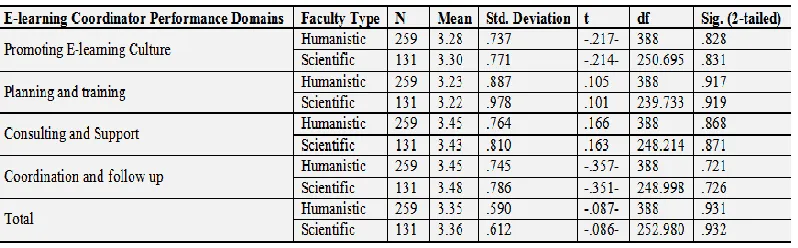
Table-8. T-test Results Regarding Faculty Type Variable
Table 8 demonstrates that there are no statistically significant differences in the effectiveness of E-learning coordinators performance domains regarding faculty type (Humanistic or Scientific).
5.4. Results Related To the Fourth Question
"Are there any statistically significant differences at (α ≤ 0.05) in the study sample responses regarding the academic qualification variable)?" Means, Standard Deviations, and T-test formula are computed as well as ANOVA and LSD test to determine the source of significant differences. Table 9 demonstrates the results.
© 2016 AESS Publications. All Rights Reserved. 44 Table-9. ANOVA Results Regarding Academic Qualification Variable
On the other hand, there are statistically significant differences at (p ≤ 0.05) between the mean scores of the sample responses depending on the academic qualification variables (PhD, Master, Bachelor) in the second and fourth domain. In order to determine the differences direction, LSD test was used to explore the differences among means: which means are significantly different from each other. Table 10 illustrates this.
Table-10. LSD Multiple Comparisons Test Results
* The mean difference is significant at the 0.05 level.
© 2016 AESS Publications. All Rights Reserved. 45 and PhD in favour of PhD with statistically significant (1210.) and mean differences are (120.061).
6. DISCUSSION AND SUGGESTIONS
6.1. Discussion
The results obtained through this study show that the effectiveness of E-learning coordinators performance level from faculty members' perspective is average in E-learning coordinators performance domains in the following order: coordination and follow up domain, consulting support domain, promoting E-learning culture domain and finally planning and training domain. This indicates that faculty members’ notice efforts exert from E-learning coordinators but it is not up to the distinctive, satisfactory level.
The average level of the effectiveness of E-learning coordinators' performance may be interpreted due to the fact that E-learning coordinators are actually faculty members who have academic loads and administrative tasks as well and that may restrict them to perform and fulfill their tasks effectively. These tasks, as faculty members include teaching, examination procedures, researches and studies, supervision of students’ research, scientific reports, scientific activities, quality unit tasks, and academic advising. There are also other tasks required, such as participating in university committees, community services and community development.
Therefore, the need for the E-learning coordinators is crucial, but, at the same time, they should be able to respond effectively to the needs of the position. Moreover, it is difficult for E-learning coordinators to fulfill the requirements of the responsibility assigned to them, use the latest available technology, stay informed about the latest developments, transfer this to train faculty members and students, overcome difficulties of students and faculty members, lack of E-learning skills, give counseling and support, etc. There are actually numerous and complex work requirements related to faculty members, students, the e-content, the technology, the services, etc. This needs a complete full-time employee or perhaps establish a special unit to fulfill these requirements.
This may also be interpreted due the fact that E-learning coordinators are doing administrative and training work which equals at least four administrative units in the Deanship. The reason for this is that the units and divisions of the Deanship are still in transition stage and there aren't enough human resources to carry out these tasks.
© 2016 AESS Publications. All Rights Reserved. 46 Therefore, E-learning coordinators deal with a number of interrelated elements and any disorder in one of those elements can affect their performance in promoting E-learning culture, planning, training, consulting, coordination, and follow up. These results are consisted with Mirza (2007) who mentioned that Saudi universities have already started moving towards the application of E-learning but also consisted with results mentioned in Albalawi Mohammed (2007) and Alkhalaf et al. (2010) who found that there are barriers and challenges that face the implementation of educational technology.
The results showed that there are statistically significant differences in the effectiveness level regarding gender variables in promoting E-learning culture, planning and training, coordination and follow up domains in favour of male. This can be interpreted due to the lack of female element in E-learning Deanship who train female faculty members.
No statistically significant differences in the effectiveness of E-learning coordinators performance domains regarding faculty type (Humanistic or Scientific). This can be interpreted as the circumstances are the same at the university as a whole regardless of faculty type. It also indicates that there is a consensus between faculty members from humanistic and scientific faculties about E-learning.
The results show statistical significant regarding academic qualification in planning and training between Bachelors and Master in favour of Master, between Bachelor and PhD in favour of PhD, and between PhD and Master in favour of PhD.
This can be interpreted as PhD and Master have more experience and they have more comprehensive overview on E-learning. The Bachelors exert their efforts to prove themselves in teaching and focus their attention on results. PhDs, on the other hand, have gone through stages of challenges than the Master and Bachelor degree holders refine their ability to evaluate. These give them an overall look and scientific way to deal with these matters.
The results also show statistical significant attributed to academic qualification in coordination and follow up between Bachelor and PhD in favour of Bachelor. This can be interpreted that the Bachelors try to get more details in his/her work focus on professionalism and gaining experience as "teaching assistant" on the other hand, the administrative and teaching load is not required for the Master and PhD.
The results show statistical significant between Master and PhD in favour of Master. This can be interpreted that Masters are less experience than PhDs and they make effort to get the experience needed in his work. Masters try to have opportunities in completing their higher education to expand their experience, seeking for new future prospects.
6.2. Suggestions
In light of the results of the study, the researcher suggests the following:
© 2016 AESS Publications. All Rights Reserved. 47 2. Najran University Deanship of E-learning and Distance Education should hire female staff to
facilitate the process of dealing with female faculty members on E-learning matters. 3. Current E–learning coordinators should be supported and motivated through rewards.
4. A comprehensive system should be built to evaluate, monitor and improve the performance of learning coordinators. Moreover, communication between learning Deanship and E-learning coordinators in faculties should be strengthen.
REFERENCES
Abouchedid, K. and M. Eid George, 2004. E-learning challenges in the Arab world: Revelations from a case
study profile. Quality Assurance in Education, 12(1): 15-27.
Al-Asmari, A.M. and S.M. Rabb Khan, 2014. E-learning in Saudi Arabia: Past, present and future. Near and
Middle Eastern Journal of Research in Education, 2(1): 1-11.
Al-Ismaiel Omar, A., 2013. Collaborative blended learning with higher education students in an Arabic
context. Doctoral Dissertation, University of Wollongong.
Al-Khalifa, H.S., 2010. A first step in evaluating the usability of jusur learning management system. Paper
Presented at the Third Annual Forum on e-Learning Excellence in the Middle East 2010: Bringing
Global Quality to a Local Context. February 1st - 3rd, Dubai, U.A.E.
Al Shehri, A.M., 2010. E-learning in Saudi Arabia: To E or not to E, that is the question. Journal of Family
and Community Medicine, 17(3): 147-150.
Albalawi Mohammed, S., 2007. Critical factors related to the implementation of web-based instruction by
higher-education faculty at three universities in the Kingdom of Saudi Arabia. A Doctoral
Dissertation, University of West Florida.
Alebaikan, R. and S. Troudi, 2010. Blended learning in Saudi universities: Challenges and perspectives.
ALT-J, Research in Learning Technology, 18(1): 49-59.
Alkhalaf, S., A. Nguyen and S. Drew, 2010. Assessing E-learning systems in the Kingdom of Saudi Arabia’s
higher education sector: An exploratory analysis. International Conference on Intelligent Network
and Computing (ICINC).
Almalki Aidd, M., 2011. Blended learning in higher education in Saudi Arabia: A study of Umm Al-Qura
university. Unpublished Thesis, College of Design and Social Context, RMIT University.
Alshwaier, A., A. Youssef and A. Emam, 2012. A new trend for E-learning in KSA using educational clouds.
Advanced Computing: An International Journal (ACIJ), 3(1): 81-97.
Bin Fryan, L. and L. Stergioulas, 2011. Critical success factors for the adoption of e learning in the Kingdom
of Saudi Arabia educational institutions. The European Conference on e-Learning.
Chanchary, F. and S. Islam, 2011. Is Saudi Arabia ready for E-learning? A case study. The International Arab
Conference on Information Technology (ACIT), Riyadh, Saudi Arabia. pp: 169-175.
Hussein, H.B., 2011. Attitudes of Saudi universities faculty members towards using learning management
system (JUSUR). The Turkish Online Journal of Educational Technology, 10(2): 43-53.
Kanovsky, I. and R. Or-Bach, 2001. A gradual process for integrating E-learning in a higher education
institute. Teaching and Learning Models, 0(2): 107-111.
Mirza, A., 2007. Is E-learning finally gaining legitimacy in Saudi Arabia?. Saudi Computer Journal, 6(2):
© 2016 AESS Publications. All Rights Reserved. 48
Najran University, 2014. Organizational structure. Available from
http://portal.nu.edu.sa/web/elearning-deanship/organizational-structure [Accessed March 26, 2015].
Najran University, 2014. University establishment. Available from http://portal.nu.edu.sa/en/933 [Accessed
March 25, 2015].
Najran University, No Date. Vision, mission, objectives. Available from
http://portal.nu.edu.sa/en/web/elearning-deanship/73 [Accessed March 25, 2015].
National Center for e-Learning and Distance Learning, 2014. From national center for e-learning and distance
learning. Available from http://www.elc.edu.sa/?q=en/aboutus [Accessed March 25, 2015].
Sirkemaa, S., 2001. Information technology in developing a meta-learning environment. European Journal of
Open, Distance and e-Learning. Available from
http://www.eurodl.org/materials/contrib/2006/Seppo_Sirkemaa.htm [Accessed March 25, 2015].