International Journal of Asian Social Science, 2014, 4(2): 217-225
† Corresponding author
STUDENTS, ASSESSMENT THROUGH OPEN-BOOK CONCEPT FOR FINAL
EXAM
Muhammad Fairuz Abdul Jalal
†Centre for Advanced Mechatronics and Robotic, Universiti Tenaga Nasional, Selangor
Siti Sarah Ain Fadhil
Centre for Advanced Computational Engineering, Universiti Tenaga Nasional, Selangor
Hasril Hasini
Centre for Advanced Computational Engineering, Universiti Tenaga Nasional, Selangor
ABSTRACT
Starting from Semester 2 2011/2012, open-book final examination has been applied to a third year
mechanical engineering subjects; Machine Design (MEMB 333). The student, who are enrolled in
this subject, are exposed to critical thinking in designing and evaluating the components. In this
paper, the performance of 84 students from 3 sections in answering static and fatigue failure
theories by having open-book final and close-book mid semester examination will be presented.
The study will focus on the influence of distraction under open-book condition and the evaluation
on their overall performance. It is understood that students perform poorly, tended to replicate the
solution from textbook.
© 2014 AESS Publications. All Rights Reserved.
Keywords:
Open-book examination, Machine design, Student performance.1.
INTRODUCTION
The Machine Design course (MEMB 333) is enrolled by third year mechanical engineering
students in fifth semester at Universiti Tenaga Nasional, Malaysia. This course is focused on the
fundamentals of overall machine design, component selection, analysis and evaluation according to
predetermined factor of safety. By the end of the course, the students should able to understand
static and fatigue failure theory and able to select and evaluate the usage of important machine
components for instance gears, shafts, keys, couplings, fasteners, springs, bearings, brakes, clutches
etc. Thus, the class tends to be taught in a very content-intensive manner – full of definitions,
International Journal of Asian Social Science
ISSN(e): 2224-4441/ISSN(p): 2226-5139
Special Issue:
International Conference on Teaching and
Learning in Education, 2013
interrelated relations for calculating component behaviours and component failure in accordance to
standards.
The students, who are enrolled in this subject, are often exposed to the uncertainty due to the
iterative nature of design, full of assumption and decision, required experience for design
conceptualization and need sufficient understanding in the prerequisite subjects; Mechanics of
Material (MEMB 243), Manufacturing Processes (MEFB 213) and Theory of Machines (MEMB 263). The students’ performance is captured via Quiz/Assignments, Case Study Presentation, Group Project, Midterm test and Final Exam. The open-book concept is applied only to the final
examination start from Semester 2 2011/2012 (Abdul Jalal et al., 2012).
The effectiveness of open-book or close-book assessment to measure student performance is
open for debate. In general, open-book examination reduces student anxiety (Theophilides and
Dionysiou, 1996), push student to read more and focus on understanding concepts and principles.
However, Francis (1982), Ioannidou (1997) and Theophilides and Dionysiou (1996) mentioned that
the marks attained by students who performed open-book examination were lower than those
obtained by traditional manner possibly due to the higher level of difficulty and complexity of the
questions, thus required higher order of critical thinking.
In addition, Vanderburgh (2005) indicated that the open-book exam for undergraduate
physiology appeared to be beneficial for and received the strong endorsement by students as it
promoted a higher level of critical thinking and improved their writing skills albeit exerting extra
load and time consuming for preparing the questions and grading the assignment.
According to Theophilides and Koutselini (2000), the students prepared themselves for the
open-book examination by referring to various sources and digested the gathered information.
Thus, they had better understanding in the subject matter and were able to answer the question
creatively. On the contrary, students, who prepared for a closed book examination, tended to do last
minute revision and focused only on the given assignment or tutorial question and memorized
them.
Open-book examination is not always good as it gives false alarm and hope to the student as
they assume all of the questions can be solved by referring to the textbook during the examination
period. The survey conducted by Soh-Loi and TEO (1999) at the Nanyang Technological
University in Singapore showed that almost two-thirds of the students preferred open-book
examinations compared to closed book examinations with intention to have less time for
preparation, require less memorization on the subject matter and left more room for logical
thinking. Furthermore, research conducted by Therriault et al. (2011) showed that students had
© 2014 AESS Publications. All Rights Reserved.
evaluated. The mid semester and final examinations were conducted in week 7 and 15 accordingly
and took place in exam hall environment. The study focused on the influence of distraction under
open-book condition by having question similar to the example in textbook and the student
achievement in solving questions by having open-book and close-book alternatives.
2.
RESULT AND DISCUSSION
The lecture on static and fatigue failure theories was covered in the first 6 weeks. Supposedly,
the students had been well prepared to the subject for the mid semester and final examination. The
evaluation on open-book assessment concept of 84 students from 3 sections was performed on two
questions in the final examination in Semester 2 2012/2013. For evaluation purposes, the marks of
84 students from 3 sections were evaluated using the reference scale as shown in Table 1.
Table-1. The student performance scale
Student marks SM (%) Student performance
SM > 75 Good
50 ≤ SM < 75 Sufficient
25 ≤ SM < 50 Poor
SM < 25 Very Poor
2.1. Open Book with Distraction
Therriault et al. (2011) reported that in open-book assessment concept, the students were
exposed to distraction by the textbook during the examination. The students tended to rely on the
textbook and had been distracted by the examples in textbook which were similar to the given
exam questions. The influence of distraction in open-book alternative was tested via the question
below. The question for open-book final examination was formulated in such a way that it was
similar to the example in the course textbook by (Norton, 1996).
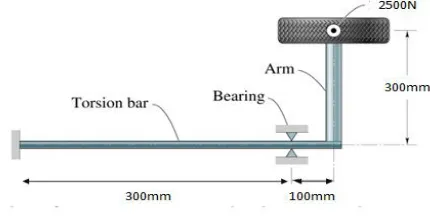
Figure 1 shows a suspension system of a car. The spring motion is provided by a torsion bar
fastened to the arm on which the wheel is mounted. The torsion bar is made of SAE/AISI 1050
quench and temper @ 400°F carbon steel. The torque in the torsion bar is created by the 2500N
force acting on the wheel from the ground through a 300mm long lever arm. Due to space
limitations, the bearing holding the torsion bar is situated 100mm from the wheel shaft. Given that
and the static safety factor in the torsion bar at the bearing is 2.5, find the diameter of the torsion
bar according to Distortion Energy Theory (Caceres-Valencia, 2008).
In this question, students were required to determine the diameter of the torsion bar with a
given factor of safety. However, the example in the textbook guided the students to find the factor
of safety with a given diameter of the torsion bar. The equation for factor of safety (FS) and von-Misses stress (σvm) is described in equation 1 and 2 accordingly whereas Sy is yield strength of the
ductile material. The diameter of the torsion bar parameter is implicitly lies in von-Misses stress (σvm) equation.
vm y S FS
(1)
2
2
3 2 xy y x y xvm
(2)
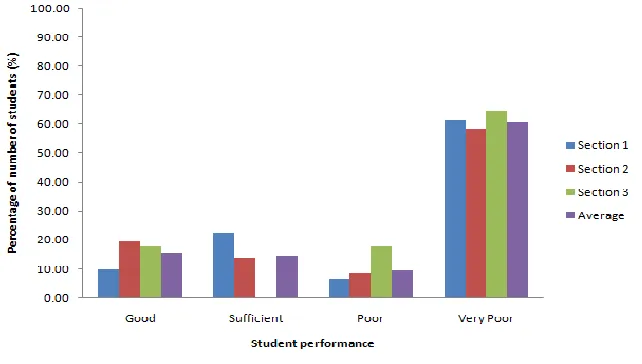
The students’ performance for 84 students from 3 sections in answering question 1 is shown in Figure 2. On average, only 15.5% and 14.3% of students were able to respond to the question in
good and sufficient manner accordingly. The rest inclined to reproduce the exact solution approach
as in textbook and 9.5% were able to solve it halfway. The students blindly assumed the diameter of the torsion bar and wrongly solved for factor of safety. The students’ behaviour during the examination has also been studied via observation. In general, the students with lower mark were
not well prepared in strategizing the answering technique. They were prone to distraction by similar
solution in the text, required more time for reading and possibly took the simplest route by
replicating the exact solution from the text without any critical interpretation. The same conclusion
had been drawn by Carrier (2003) and Gray (1994) and Therriault et al. (2011).
© 2014 AESS Publications. All Rights Reserved.
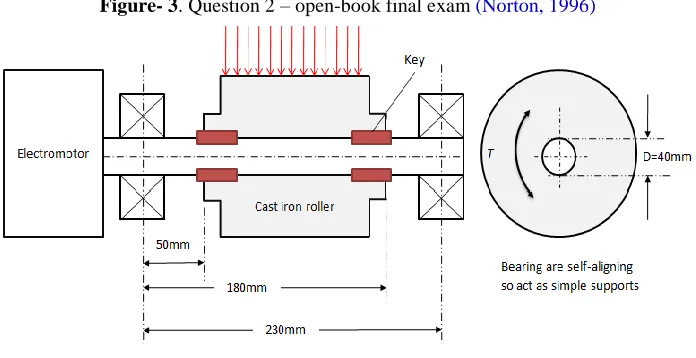
Figure 2 shows an electromotor connected to a cast iron roller via a shaft. The shaft is
subjected to a time-varying torque varies from a maximum torque of 2000 Nm and a minimum
torque of 0.0 Nm. Determine the size of key necessary to give factor of safety of at least 2 against
shear and bearing failure for infinite life design. Given that the shaft is made of SAE/AISI 1060 hot
rolled carbon steel and the key is made of SAE/AISI 1050 cold rolled carbon steel. Assume shaft
diameter is 40mm, the finishing of the key is machined, reliability is 99.99% and the key is in 1000
°F working environment (Norton, 1996).
Figure- 3. Question 2 – open-book final exam (Norton, 1996)
Question 3 in close-book mid semester examination:
Question 2 was Figure 4 show a shaft in an electromotor which is supported by two bearings
(at A and B). A constant magnitude transverse load P=1000 lbf is applied as the shaft rotates
subject to a time varying torque, Tmin=100 lbf.in and Tmax=2100 lbf.in. Knowing that, the shaft
made of AISI 1040 quench and tempered at 800 °F carbon steel, find the diameter of shaft required
to obtain a safety factor of 2 in fatigue loading condition for infinite life regime. Draw the moment
diagram of the shaft. Assume no stress concentration is present, the finishing of the shaft is
machined, reliability is 99.99% and the shaft is in 1000 °F working condition. Also assume all
stress concentration factors equal to unity.
Se Sut
SeSut S
F
m vm a
vm, ,
.
(3)
The students’ performances for 84 students from 3 sections in answering question 2 in open-book final exam and question 3 in close-open-book mid semester test are shown in Figure 5 and 6
respectively. The results of the open-book assesment (Figure 5) were depressing, as only 6.0% and
28.6% of the students actually attempted and were able to answer the question with good or
sufficient level accordingly, while the rest unable to solve the questions. On the contrary, the students’ performance in close-book mid semester is illustrated in Figure 6; 26.2% of the students were able to answer the question properly and 20.2% in sufficient manner. The students were more
confident and performed better in close-book compared to open-book conditions.
Figure-5. Percentage of number of student vs. student performance in answering question 2
© 2014 AESS Publications. All Rights Reserved.
design question were still deficient among the students. Supposedly, the students were able to
answer question 2 as the method is quite similar for question 1 albeit extra working steps are
needed to find mean and alternate value of the von-Misses stress as well as strength of the material
in infinite life regime. The students with lower marks were unable to systematically answer the
question and applied wrong equations or tried to imitate the example in textbook even though not
relevant to the question at all.
The research findings obtained from the observations and students’ grade showed a cautionary note with the advantages of open-book assessment method listed by Theophilides and Dionysiou
(1996). Based on student performance in Figure 5 and 6, it can be concluded that the students
behaved differently to the close- and open-book exam. They performed better in traditional
assessment compared to open-book alternative. Possibly, the students were not well prepared for
open-book concept, did less preparation and had false confidence as they assumed the all answers,
techniques and methods are provided in text. The similar students’ perception had been recorded
via interview by Eilertsen and Valdermo (2000) and survey by Soh-Loi and TEO (1999).
In the reality, the students are lacked of awareness regarding the reality of open-book
alternative. In open-book assessment, critical thinking is vital instrument to strategize their solution
approach to solve the question in a permitted duration. The questions are not constructed in a
straight forward manner. In this matter, students must plan beforehand, think analytically and
strategize the working plan thus resulting proper time management. All these must be practiced by
the students start from the beginning of the course.
Therriault et al. (2011) stated that there was strong correlation between times spent on hunting
through the textbook during open-book examination to the student achievement. It was noticeable
that the students with lower marks were stressed-out and seemed to “study during the assessment”
instead of answering the questions. Our finding indicated that student performance negatively
associated with their reliance upon the textbook.
As mentioned, the main objective of open-book assessment is to culture critical thinking and to
educate the students in effective use of resources for professional engineering practice. Therefore, the real engineering problems need to be introduced to the student in “class” and “exam hall” at different difficulty and complexity level in order to align the course for higher level of critical and
creative thinking strategy. The student must be able to develop his/her own reasonable assumption
and apply the acquired knowledge to the new ill defined problem rather than recalling and
memorizing the information or rigidly reproduce the standard solution approach. The lecturers
must indeed have deep understanding in subject matter in order to develop comprehensive and
compatible open ended assignments and assessments but yet having certain boundary to avoid any
trap of unnecessary design iteration.
The conducive environment for teaching and learning activity in the lecture and tutorial
session is considered uttermost important to initiate active participation in lecture, encourage
independent learning and indirectly culture deep thinking. The students can only do well in the
open - book assessment if they are well prepared and have a deep understanding on the current and
prerequisite subjects. Therefore, intensive and rigorous assessment, which address higher level of
Bloom's Taxonomy in assignments, quizzes and test should be implemented at the beginning of the
having “everything” in textbook, be mindful and efficient in using resources with minimal distraction.
3.
CONCLUSION
The effectiveness of open-book and close-book examination is open for debate as both
alternatives offer various advantages and disadvantages in stimulating deeper understanding in
subject matter. Our study showed that the students with lower marks were prone to distraction by
similar solution in the text, consumed more time for reading and tried to replicate the exact solution
from the text without any critical interpretation. In addition, the overall students’ performances
were negatively associated with textbook dependency during the open-book examination. The
similar findings were also reported by Carrier (2003) and Gray (1994) and Therriault et al. (2011).
In our case, the students performed better in traditional assessment compared to open-book
alternative. Possibly, the students, who were preparing for open-book final examination, had false
confidence as they assumed all the required references were accessible during the examination and did less preparation for the examination. The similar students’ perception had been recorded by
Eilertsen and Valdermo (2000) and Soh-Loi and TEO (1999).
4.
ACKNOWLEDGEMENT
The authors would like to sincerely thank the Universiti Tenaga Nasional for providing
Internal Grant to support this research work as well as the students, who have been enrolled in
Machine Design (MEMB333) in Semester 2 2012/2013 for their active engagement and feedbacks.
REFERENCES
Abdul Jalal, M.F., F. Tarlochan and B.M. Mohamad Bali, 2012. Course outline - machine design MEMB 333,
Universiti Tenaga Nasional.
Caceres-Valencia, P.G., 2008. Lecture note - machine component design 1 (INME 4011). University of Puerto
Rico.
Carrier, L.M., 2003. College students’ choices of study strategies. Perceptual and Motor Skills, 96(1): 54-56.
Eilertsen, T.V. and O. Valdermo, 2000. Open-book assessment: A contribution to improved learning? Studies
in Educational Evaluation, 26(2): 91-103.
Francis, J., 1982. A case for open-book examinations. Educational Review, 34(1): 13-26.
Gray, T.G., 1994. Open book examinations. Biochemical Education,, 22(3): 13-125.
Heijne-Penninga, M., J. Kuks, W.H. Hofman and J. Cohen-Schotanus, 2008. Influence of open-and
© 2014 AESS Publications. All Rights Reserved.
Theophilides, C. and M. Koutselini, 2000. Study behavior in the closed-book and the open-book examination:
A comparative analysis. Educational Research and Evaluation, 6(4): 379-393.
Therriault, D.J., C.S. Lee, E.P. Douglas, M. Koro-Ljungberg and N. McNeill, 2011. Open-book
problem-solving in engineering: An exploratory study. ASEE Annual Conference and Exposition 2011,
Conference Proceedings. pp: 13
Vanderburgh, P.M., 2005. Open-book tests and student-authored exam questions as useful tools to increase
critical thinking. Advances in Physiology Education, 29(3): 183-184.