Article
Comparative Analysis of Child Restraint Systems
Safety Parameters in Relation to the New Regulation
No. 129 Of the Economic Commission for Europe Of
the United Nations (UN / ECE)
Artur Muszyński1 Jakub Łuszczek1 Rafał Szymaniuk1 1 Idap Technology LTD.
* Correspondence: [email protected]
Abstract: The study presents a comparison of the common Child Restraint Systems (CRS) which reduces the value of dynamic loads affecting the child's body during car accidents. The analyzed systems were: child seats, Combi Booster Seats, and straps adjusting vehicle seat belts to children's sizes. The effectiveness of the analyzed devices was assessed on the basis of experimental tests carried out in the accredited laboratory approving the Child Restraint Systems. The tests were carried out accordingly to the new Regulation No. 129 UN / ECE. Whether the tested devices meet the guidelines of the new Regulations No. 129 despite approval in accordance with Regulation No. 44. Based on the research result, better safety parameters of some new solutions dedicated to children’s safety could be observed. The final results show that there is still space for improving the safety of young vehicle passengers.
Keywords: child seats; car accidents; car crash analyses; children safety
1. Introduction
Based on the World Health Organization, available research results every year, children die or are seriously injured during car crashes on the roads in the whole world [1,2,10]. To reduce the enormous number of children’s deaths and injuries in car crashes, researchers from R&D departments in commercial companies and scientists from scientific facilities are developing different technologies to increase children's safety in the vehicles [3–7]. A significant number of children are saved by airbags, seat belts in child seats, car seat belts connected with CRS [6] and all cars and additional devices for passive protection. All mentioned elements can absorb part of energy during an impact [8,9]. Despite all available solutions for children's safety during car crashes the Economic Commission for Europe of the United Nations (UN / ECE) still try to improve the approval requirements for increasing children's safety during car crashes. All of the available devices for children’s safety in the market have to assure the dynamic load's reduction during a car collision. According to the dynamic load's reduction requirement, there are several main parameters that are measured during every test. To obtain approval – the value of each parameter must be below a strict limit. In the new Regulation No. 129 of the Economic Commission for Europe of the United Nations (UN / ECE) the following parameters are registered: acceleration of the test trolley, force in the dummy's neck, moment in the dummy’s neck, thoracic acceleration in three directions, displacement in the chest of the dummy, left and right abdominal pressure [11]. All mentioned sensors are necessary to detect as many as possible variables to avoid children’s bodies injured during a car collision. According to the comparison of the previous and new UN regulation, the Child Restraint Systems should have different parameters to fulfil the main requirements in each regulation.
During the analysis of this study, it was taken into account how newly included parameters affect potential body damage during a car crash influence the examination results.
The main purpose of research conducted by the authors of this paper was to analyze the common devices of Child Restraint Systems including child seats, booster seats, and straps adjusting vehicle seat belts to children's sizes. All test results had been compared and shown in specially prepared charts to determine how the common solutions for children’s safety meet the new requirements.
2. Experimental
The frontal collision simulation tests for Child Restraint Systems were carried out in an accredited test unit authorized to carry out tests according to the guidelines of UN/ECE Regulation No. 129. The tests were focused on determining the impact of the dynamic loads acting on the child's body transported in five child restraint systems. It was also determined how measured parameters meet the new guidelines of the No. 129 Regulations.
The tested devices were mounted on the specially prepared test seat for the approval process prepared according to Annex 6 ECE 129. The requirement for a seat cushion and supporting of the test bench from a square foam block was subjected. For frontal impact, the trolley shall be so propelled that, during the test, its total velocity change ΔV is 52 + 0 – 2 km/h and its acceleration curve is within the hatched area of the graph in Annex 7, Appendix 1 and stay above the segment defined by the coordinates (5 g, 10 ms) and (9 g, 20 ms). The start of the impact (T0) is defined, according to ISO 17 373 for a level of acceleration of 0,5 g. For the most research credibility, the tests were carried out on the same day under the same temperature conditions. All five devices for tests were delivered 48 hours before the planned tests and were stored at the Institute in a specially prepared air-conditioned room. During the tests, the image from the collision was recorded using two high-speed cameras and the acceleration and forces measured on the dummy in selected parts of the its body. For the tests, the anthropomorphic dummy Q6 series was used (corresponding to children under the age of six).
The sensors were registered by the following parameters: 1) the test trolley acceleration,
2) dummy’s head acceleration, where the maximum value may not exceed 80g for the Q6 head
cumulative 3 ms value,
3) dummy’s chest acceleration, where the maximum value may not exceed 55g for the Q6 chest
cumulative 3 ms value,
4) the forces and bending moment in the upper part of the cervical spine,
5) deflection of the dummy torso,
Figure 1. Description of the acceleration curve of the test trolley.
3. Results
For all tested devices the data was shown in line charts. For additional visualization, all characteristic values had been compared into bar charts.
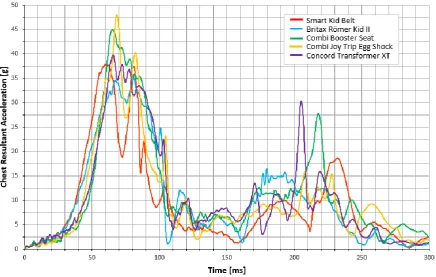
Figure 2. Chest Resultant Acceleration for all CRS tested.
For the Smart Kid Belt and for the Britax Römer Kid II , an earlier delay increasing as a function of time can be observed. The nature of this phenomenon is associated with a shorter time of the clearance elimination between the child's dummy and the seat belts, i.e. the dummy begins to slow down together with the test trolley. It could also be observed that the maximum recorded delays for the Britax Römer Kid II are smaller than in the Smart Kid Belt. It could be connected with the construction features of each restraint system.
0 5 10 15 20 25 30
0 20 40 60 80 100 120 140
Acc
ele
ra
tio
n
[
g]
Figure 3. Chest Resultant Acceleration for all CRS tested regarding the maximum limit.
The maximum recorded chest delay values for devices tested are:
1) for the Smart Kid Belt: 37,85 g in 59,2 ms,
2) for the Britax Römer Kid II : 35,14 g in 80,3 ms, 3) for the Combi Booster Seat: 45,02 g in 64,2 ms, 4) for the Combi Joy Trip Egg Shock: 48,21 in 67,7 ms,
5) for the Concord Transformer X: 39,75 g in 64,9 ms.
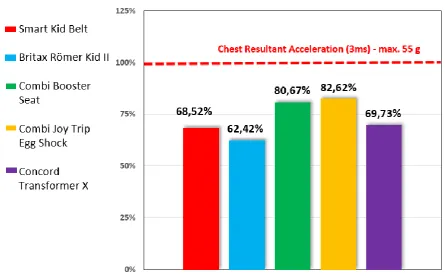
One of the approval criteria according to the regulation No. 129 UN / ECE is the reduction of torso acceleration with a value greater than or equal to 55 g for cumulative 3 ms values. During the analysis of the data from the acceleration measurement in five different constructions it can be observed that the characteristic values were not exceeded in any of the Child Restraint Systems. For individual restraint devices, the maximum recorded values of chest acceleration for cumulative 3 ms values were:
1) for the Smart Kid Belt: 37,69 g for the time interval between 58,5 and 80 ms, where it is 68,52 % of the limit,
2) for the Britax Römer Kid II : 34,33 g for the time interval between 65,8 and 81 ms, where it is 62,42 % of the limit,
3) for the Combi Booster Seat: 44,37 g for the time interval between 63 and 66 ms, where it is 80,67 % of the limit,
4) for the Combi Joy Trip Egg Shock: 45,44 g for the time interval between 66,2 and 69,2 ms, where it is 82,62 % of the limit,
5) for the Concord Transformer X: 38,35 g for the time interval between 63,1 and 66,1 ms,
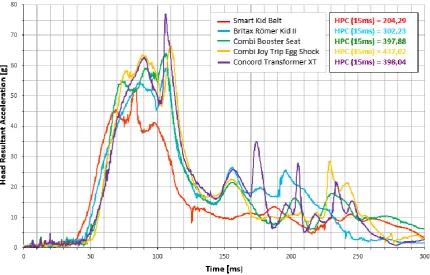
Figure 4. Head Resultant Acceleration for all tested devices.
Figure 5. Head Resultant Acceleration for all tested devices regarding the maximum limit.
The maximum recorded acceleration values of individual devices are:
1) for the Smart Kid Belt: 52,97 g at 83,7 ms
2) for the Britax Römer Kid II is: 59,25g at 106,2 ms. 3) for the Combi Booster Seat: 64,26 g at 106,3 ms, 4) for the Combi Joy Trip Egg Shock: 66,55 g at 109,4 ms,
5) for the Concord Transformer X: 77,01 g at 106 ms.
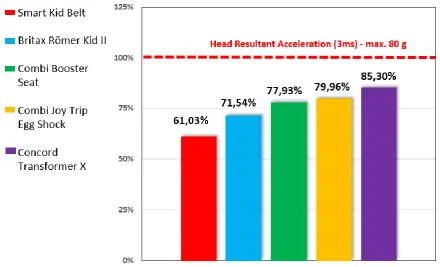
One of the approval criteria according to No. 129 UN / ECE regulation is the reduction of the accelerations in the head with a value greater than or equal to 80 g for cumulative 3 ms values. Analyzing data from the accelerations in the head of the test dummy in five different constructions, it can be observed that all the values were not exceeded in any of the restraint systems tested. The maximum recorded values of head acceleration cumulative 3ms values for each device are as follows:
1) for the Smart Kid Belt: 48,83 g for the time interval between 81,5 and 84,5 ms, where it is
61,03% of the limit,
2) for the Britax Römer Kid II: 57,23 g for the time interval between 104,6 and 107,9 ms, where
it is 71,54 % of the limit,
3) for the Combi Booster Seat: 62,34g for the time interval between 104 and 107,2 ms, where it
is 77,93 % of the limit,
4) for the Combi Joy Trip Egg Shock: 63,97 g for the time interval between 108,2 and 111,3 ms,
where it is 79,96 % of the limit,
5) for the Concord Transformer X: 68,24 g for the time interval between 105,2 and 108,3 ms,
where it is 85,3 % of the limit.
(1)
Where:
1) a - is the resultant acceleration is measured in units of gravity, g (1 g = 9,81 m/s2 );
2) t1 and t2 - are time instants, expressed in seconds, defining the time interval between the
beginning and the end of the recording for which the value of HPC is maximum.
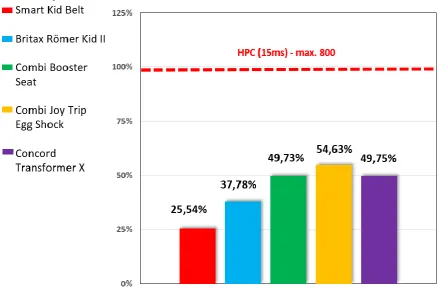
According to the No. 129 UN / ECE regulation when Child Restraint Systems are tested in a complete vehicle or a vehicle body shell, the head performance criterion (HPC) and the Head Acceleration 3 ms shall be used as assessment criteria. Where there is no head contact, these criteria shall be passed without measurement, and recorded only as "No Head Contact". For HPC research purposes, a value was calculated for a 15ms time interval for all tested Child Restraint Systems. The HPC is a biomechanical parameter described as the highest load value in a time interval which is not more than 15 ms. It should be emphasized that the values included in many scientific studies are related to critical HPC parameter values. According to No. 129 UN / ECE regulation, the critical value of HPC15 is 800 for the Q6 dummy. Few scientific studies show a tendency to include additional parameters that are not related to the critical parameters but may have a significant impact on the injuries generation during an accident. According to [11], the value of the Head Injury Criteria parameter for a ten-year-old child when this child could be injured is 400. This is the main reason that it is necessary to take into account the situation where the injury limit values may occur at much lower HPC parameter values.
Figure 6. Head Perfomance Critrion for all tested devices regarding to the maximum limit.
The determined value of the biomechanical HPC parameter for individual devices are:
• for the Britax Römer Kid II: HPC is 302,23 for the time interval between 81 and 96 ms, where it is 37,78 % of the limit,
• for the Combi Booster Seat: HPC is 397,88 for the time interval between 92,7 and 107,7 ms, where it is 49,73 % of the limit,
• for the Combi Joy Trip Egg Shock: HPC is 437,02 for the time interval between 83,5 and 98,5 ms, where it is 54,63 % of the limit,
• for the Concord Transformer X: HPC is 398,04 for the time interval between 80,1 and 95,1 ms, where it is 49,75 % of the limit.
Figure 7. Upper neck force for all tested devices.
In connection to the No. 129 UN / ECE regulation, there are no legal guidelines regarding the limits of forces and moments values in the dummy’s neck. Currently, these parameters are for monitoring purposes only. The registered forces and moments in the dummy’s neck segment are very important parameters due to the direct impact on the biomechanical features of the child's body. The head of a 9-month-old baby represents 25% of its total body weight. For comparison - the head of an adult male is only 6% of his weight. Head injuries in children are often very serious because their skulls are significantly different in structure from adults. The newborn cervical vertebrae are made up of separate bone parts connected by cartilage. The children’s ossification process continues until puberty. At the same time, gradually, muscle and cervical tendons develop. In addition, human cervical vertebrae change their shapes over the years in the process of growth. This phenomenon is the main reason for totally different biomechanical characterization of children’s bodies in comparison to adults. The most significant difference is a disproportionately large and heavy head, which affects the reduction body strength of a child during a car collision.
The maximum registered value of neck tension force and neck bending moment for an individual devices are:
• for the Combi Booster Seat: 2097,25 N during 103,7 ms and 60,19 Nm during 103 ms. • for the Combi Joy Trip Egg Shock: 2182,21N during 108,4 ms and 56,57 Nm during 108,1 ms. • for the Concord Transformer X: 2099,58 N during 106,9 ms and 53,41 Nm during 106,3 ms.
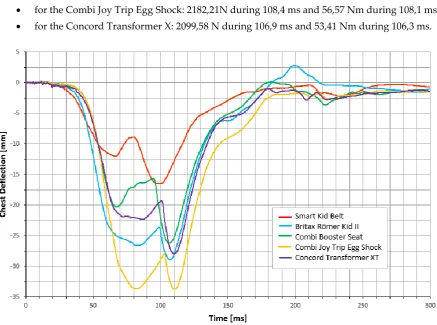
Figure 8. Chest deflection for all tested devices.
The torso deflection value according to the regulations are currently for monitoring purposes only. Analyzing the test results, it can be stated that the maximum recorded torso deflection value for individual devices are:
• for the Smart Kid Belt: -16,49 mm after 99,8 ms. • for the Britax Römer Kid II: -28,93 mm after 107 ms, • for the Combi Booster Seat: -26,2 mm after 106,2 ms,
Figure 9. Right abdominal pressure for all tested devices regarding the maximum limit.
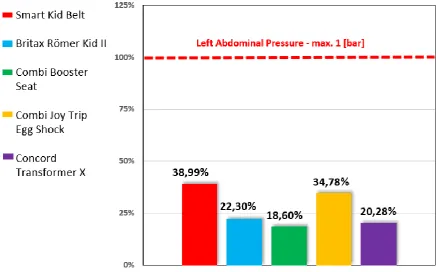
Figure 10. Left abdominal pressure for all tested devices regarding the maximum limit.
Analyzing the test results, it can be stated that the maximum recorded values of pressure in the left abdominal segment are:
• for the Smart Kid Belt: 0,39 bar after 81,7 ms which is 38,99 % of the limit, • for the Britax Römer Kid II: 0,22 bar after 84,3 ms, which is 22,3 % of the limit, • for the Combi Booster Seat: 0,19 bar after 85 ms, which is 18,6 % of the limit,
• for the Combi Joy Trip Egg Shock: 0,35 bar after 85,5 ms, which is 34,78 % of the limit, • for the Concord Transformer X: 0,2 bar after 99 ms, which is 20,28 % of the limit.
The recorded values of right abdominal pressure for individual restraint systems are:
• for the Smart Kid Belt: 0,58 bar after 79,7 ms which is 57,69 % of the limit. • for the Britax Römer Kid II: 0,49 bar after 89,6 ms, which is 49,4 % of the limit, • for the Combi Booster Seat: 0,33 bar after 102,6 ms, which is 33,17 % of the limit, • for the Combi Joy Trip Egg Shock: 1,1 bar after 85,2 ms, which is 109,55 % of the limit, • for the Concord Transformer X: 0,46 bar after 88,1 ms, which is 45,96 % of the limit.
4. Discussion
The Child Restraint Systems legal regulation currently impose on the devices manufacturers, very high requirements for meeting certain safety criteria. A significant growth of the professional measurement devices has enabled the investigation of a new type of children dummies with an increased number of sensors located in different parts of their body.
Analyzing the test results, it can be seen that the safety criteria pointed in No. 129 UN / ECE regulation have been met for almost all tested restraint devices (except for abdominal pressure in one of the tested solutions). However, the analysis of recorded data and individual values of physical quantities showed significant differences between each solution. The number of dynamic loads is influenced by a number of each device design solution. Different parameter values for each device might be connected with the different initial position of the dummy, the stiffness characteristics of the element on which the child is placed, and the solution of seat belt guidance configuration characteristics. The research results clearly show that the issue of safety of children's transportation in vehicles requires further research and development in the aspect of determining the correlation between design features of the restraint system and the registered physical parameters.
Advances in computer technology have provided the opportunity to develop effective and reliable numerical computational tools that can be used for the Child Restraint Systems design. The next stage of research could be connected with the finite element methods for creation of a child’s numerical model. That kind of numerical model could contain all the basic phenomena relevant to the simulation of the collision process, including mapping the child's behavior during an accident. The numerical model created in this way would significantly facilitate the analysis of many different aspects of the child restraint systems to increase safety criteria values in that kind of device.
Funding: This study and the studies presented in it have not received any external financing.
Acknowledgments: The study is of a scientific nature and its purpose is not to commercially use the content presented in it.
References
1. Jones, L.E.; Ziebarth, N.R. U.S. Child Safety Seat Laws: Are they Effective, and Who Complies? J. Policy
Anal. Manag. 2017, 36, 584–607.
2. Wacowska – Ślęzak, J.; Dąbrowska - Loranc, M. Children safety in road transport European project
EUCHIRES. J. KONES 2008, 15, 51–60.
3. Mazurkiewicz, Ł.; Muszyński, A.; Wicher, J.; Trzaska, P. Analysis of the forces developing in the straps of
the belts that restrain a child in a safety seat. Arch. Motoryz. 2015, 67.
4. Ptak, M. Method to assess and enhance vulnerable road user safety during impact loading. Appl. Sci. 2019,
9.
5. Finn, J.W.; Wagner, J.R.; Walters, E.J.; Alexander, K.E. An integrated child safety seat cooling system-model
and test. IEEE Trans. Veh. Technol. 2012, 61, 1999–2007.
6. Byard, R.W.; Noblett, H. Child booster seats and lethal seat belt injury. J. Paediatr. Child Health 2004, 40, 639–
641.
7. Cao, L.; Chen, H.; Ren, X.; Ouyang, Z. Study on an integrated child safety seat. Appl. Mech. Mater. 2010, 34–
35, 517–522.
8. Cummings, P. Association of seat belt use with death: A comparison of estimates based on data from police
and estimates based on data from trained crash investigators. Inj. Prev. 2002, 8, 338–341.
9. Viklund, Å .; Björnstig, J.; Larsson, M.; Björnstig, U. Car Crash Fatalities Associated With Fire in Sweden.
Traffic Inj. Prev. 2013, 14, 823–827.
10. World report on child injury prevention. Department of Violence and Injury Prevention and Disability,
World Health Organization, 20 Avenue Appia, 1211 Geneva 27, Switzerland
11. UN/ECE status document TRANS/WP.29/343, available at: