Article
1
The Effect of Recreation in a Snow-Covered Forest
2
Environment on the Psychological Relaxation of
3
Young Females
4
Ernest Bielinis 1*, Adrian Łukowski 2, 3, Aneta Omelan 4, Sergii Boiko 5 and Norimasa Takayama 6
5
1 Department of Forestry and Forest Ecology, Faculty of Environmental Management and Agriculture,
6
University of Warmia and Mazury, Pl. Łódzki 2, 10-727 Olsztyn, Poland; [email protected]
7
2 Faculty of Forestry, Poznań University of Life Sciences, Wojska Polskiego 71c, 60-625 Poznań, Poland;
8
9
3 Institute of Dendrology Polish Academy of Sciences, Parkowa 5,62-035 Kórnik, Poland
10
4 Department of Tourism, Recreation and Ecology, Faculty of Environmental Sciences, University of Warmia
11
and Mazury, ul. Oczapowskiego 5, 10-719 Olsztyn, Poland; [email protected]
12
5 Forest Culture Center in Gołuchów, ul. Działyńskich 2, 63-322 Gołuchów; [email protected]
13
6 Environmental Planning Laboratory, Department of Forest Management, Forestry and Forest Products
14
Research Institute in Japan, 1 Matsunosato, Tsukuba, Ibaraki 305- 8687, Japan; [email protected]
15
* Correspondence: [email protected]; Tel.: +48-603-809-211
16
17
Abstract: Forest recreation can be successfully conducted for the purpose of psychological
18
relaxation, as has been proven in previous scientific studies. During the winter in many countries,
19
when snow cover occurs frequently, forest recreation (walking, relaxation, photography, etc.) is
20
common. Nevertheless, whether forest therapy conducted in a forest environment with a snow
21
cover will also have a positive effect on psychological indicators remains unknown. Furthermore,
22
male subjects frequently participate in forest therapy experiments, whereas females are rarely
23
involved. Thus, in this study, the effectuality of forest recreation during winter and with snow
24
cover was tested on 32 young females. For these reasons, the experiment involved 15-minute
25
periods of relaxation in a forest environment or in an urban environment, in addition to a pre-test
26
under indoor conditions. Four psychological questionnaires (POMS, PANAS, ROS, SVS) were
27
administered to participants before and after interventions. Results showed that participants’ levels
28
of negative mood, as measured by different aspects of the POMS questionnaire (tension-anxiety,
29
anger-hostility, depression-dejection, confusion, fatigue), decreased after exposure to the forest
30
environment. In contrast, both tension-anxiety and anger-hostility increased in the urban
31
environment. The indicator of negative affect from the PANAS questionnaire also increased after
32
exposure to the urban environment, whereas the indicator of positive affect based on PANAS was
33
higher in the forest environment than in the urban environment. Restorativeness and subjective
34
vitality exhibited higher values after exposure to the forest environment in comparison to those
35
from the control and pre-test. The changes in these indicators demonstrates that forest recreation in
36
the snow during winter can significantly increase psychological relaxation in young females, as
37
well as showing that recreation can be successfully conducted under these winter conditions.
38
Keywords: deciduous forest; female; forest bathing; forest therapy; Positive and Negative Affect
39
Schedule; Profile of Mood States; Restorative Outcome Scale; restoration; Shinrin-Yoku; snow
40
covered forest; Subjective Vitality Scale; winter.
41
42
1. Introduction
43
Forest recreation is an activity in which one engages for pleasure, and it is done without the
44
confines of buildings, in a natural forest environment [1]. One specific form of this activity is forest
45
recreation for the purpose of health improvement, mainly called forest therapy (or forest bathing, or
46
Shinrin-yoku). The importance of forest recreation for health improvement has increased in recent
47
years, as manifested by, inter alia, an increase in the number of scientific publications regarding this
48
issue (based on Google Scholar search data). This popularity is not without base; many of these
49
scientific papers report various positive influences of forest recreation interventions on humans with
50
stress symptoms, both psychological and physiological [2-10]. Many positive outcomes have been
51
reported in both males and females, including lowered negative and heightened positive mood
52
states [11], lowered pulse rate and blood pressure [12], reduced rates of hormones involved in stress
53
[13], increased immunological activity, and increased levels of cells responsible for cancer resistance
54
[14]. This beneficial impact on health has been observed in Scandinavian and Asian countries, and
55
various strategies, including forest therapy roads [15] and the forest garden Nacadia® [16], have
56
been introduced to facilitate using the forest and nature for health recreation purposes. Knowledge
57
concerning the management of forest environments to best achieve the purpose of forest recreation,
58
and knowledge regarding how and when to organise forest recreation, is crucial for interested
59
subjects (e.g. forest owners, foresters, and therapists).
60
Previous research has confirmed that forest recreation may also be successfully conducted
61
during the winter and still exhibit beneficial effects on mental health. In a previous study of ours,
62
psychological relaxation was observed in male and female participants; however, the study was
63
conducted during a period without snow cover, and any additional effects of snow cover have not
64
been examined before [17]. Participants in preference tests positively evaluated winter landscapes of
65
forests with snow, but the potential of this environment to induce psychological relaxation has not
66
been determined [18]. Thus, the effectuality of forest recreation on psychological relaxation was
67
tested in the current study. Snow in a forest may influence visual properties of the landscape: the
68
ground is covered, plants growing on the forest floor are not visible, the branches of standing trees
69
are covered, and the dominant colour of scenery is changed from green and brown to white.
70
Furthermore, a layer of snow can affect the process of visual stimulation. In other studies, different
71
indices of greens induced different effects on relaxation, with lower amounts of observed greens
72
resulting in lower levels of relaxation in participants [19]. Thus, hypothetically, a forest covered by
73
snow might not have the same restorative effect because greens are hidden. A lack of relaxing effect
74
of the forest environment on respondents may therefore be expected if the forest is snow-covered.
75
Nevertheless, standing trees continue to fill the forest environment, regardless of snow, and this
76
could still stimulate relaxation. One of the aims of this study was therefore to test the influence of a
77
forest with snow cover on psychological relaxation. Effects were tested with the participation of
78
young females – a group which has not frequently been represented in research regarding forest
79
recreation. This study thus provided a good opportunity to examine the influence of the forest
80
environment on psychological relaxation in this under-represented group.
81
Overall, the purpose of this work was to test the hypothesis that short periods of forest
82
recreation could induce the psychological relaxation of participants in a forest environment with
83
snow cover. If this hypothesis is confirmed, this would suggest that forest recreation could also be
84
successfully conducted under snowy winter conditions. To examine the hypothesis, an experiment
85
was designed with an urban environment as a control and a snow-covered forest environment as an
86
experimental group.
87
2. Materials and Methods
88
2.1. Participants
89
A group of 34 female students from the University of Warmia and Mazury in Olsztyn
90
participated in this study. Females were selected over males because it is common in Poland that in
91
the winter, females spend their free time, as well as much of their time spent with children, on walks.
92
For this reason, we suggested that this form of activity related to staying in forest areas should be
93
examined by this experimental study involving females. Students were recruited from one study
94
course at the University (a non-forestry course) and participation in the study was voluntary.
95
researcher (A.O.) performed this exclusion, asking participants this question in a discreet, kind, and
97
private way. A female researcher (A.O.) asked in a discreet, kind, and private way if they wished to
98
take part in the study. These two women did not want to participate in the research voluntarily.
99
Qualified participants (32 females; mean age = 20.97 years, S.D. = 0.63) were randomly assigned to
100
one of two groups (16 persons in each): experimental group (group 1) and control group (group 2).
101
Before the experiment, participants from each group were informed that they would be asked to
102
contribute to a research study of ‘forest recreation’ and informed consent was obtained. The purpose
103
of the study was explained thoroughly after the experiment, because the authors of the research
104
wished to omit the effect of suggestion on participants. All procedures performed in this study were
105
in accordance with the ethical standards of the Polish Committee of Ethics in Science and with the
106
1964 Helsinki Declaration and its later amendments.
107
2.2. Study sites
108
Before the experiment, all participants completed research questionnaires under indoor
109
conditions, in one of the classrooms at the University in Olsztyn city (north-eastern Poland). This
110
place was also a gathering point. Afterwards, the experiment was conducted in a forest environment
111
at the forest point (group 1) and in an urban environment at the urban point (group 2). The
112
participants reached each of these two areas by walking. The locations of the indoor, forest, and
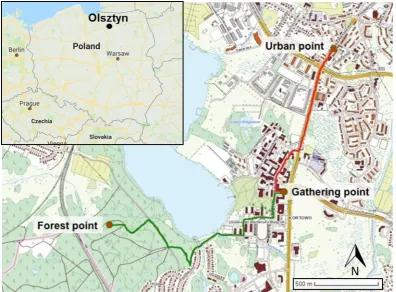
113
urban environments are shown in Figure 1. The distance from the gathering point to either the urban
114
point or the forest point was approximately 1 km, which required 20 minutes of walking for
115
participants in each group. The roads to both points were constantly flat, without any hills or other
116
hindrances.
117
118
Figure 1. Map of experimental locations.
119
The indoor environment was quite warm (21.5°C), exhibited no noise from outside, and was
120
also without any potted plants. The forest environment was located a 20-min walk from the
121
gathering point. A deciduous, broadleaved urban forest was selected, consisting of European beech
122
(Fagus sylvatica L.), Pedunculate oak (Quercus robur L.), Common aspen (Populus tremula L.), and
123
this area, although in some places there was Norway spruce (Picea abies [L.] H. Karst) in the shrub
125
layer. The ground was mainly covered by snow during the experiment, and small amounts of snow
126
were also visible on trunks. The urban environment (urban point) was also a 20-min walk from the
127
gathering point, near the centre of Olsztyn. A particular place was selected without visible tree
128
trunks and crowns, and without any greens. In the city environment, the snow dissolved and was
129
not visible during the experiment. The forest environment and urban environment used in the
130
experiment are shown in Figure 2.
131
Figure 2. Photos showing the urban (A) and forest (B) views used for the viewing session. Photos of
132
the research group during viewing sessions in the urban environment (C) and forest environment
133
(D).
134
During the field experiment, the level of noise was measured with the application ‘Sound level
135
analyser (SLA)’ using an iPhone 6. This method of noise measure has been scientifically tested and
136
shown to give excellent results [20]. The mean sound level (±S.D.) in the urban environment was
137
66.61 ± 5.38 dB, whereas the mean sound level in the forest environment was 37.18 ± 5.23 dB.
138
Meteorological data was not recorded in the forest and urban environments; however,
139
information regarding temperature, humidity, and wind speed was available from the nearest area
140
recorded by a meteorological station. On the day of experiment, meteorological conditions were
141
noted from the meteorological station in Olsztyn-Mazury (location: 53°28′50.0“N, 20°56′10.9“E). The
142
temperature was -0.5°C, humidity was 100%, cloudiness was 100%, atmospheric pressure was 995
143
hPa, and the speed of the west wind was 9 km/h. No snow precipitation was observed, but snow
144
cover occurred on the ground and dissolved during the day in the city.
145
2.3. Psychological measurements
146
In the current study, four psychological questionnaires were used to measure the reactions of
147
participants to the investigated environments. The Profile of Mood States (POMS) is a valid and
148
states, such as vigour [21]. This tool has been used previously to measure participants’ responses to
150
forest environments (e.g. Lee et al. [22]). POMS measures six different mood states: tension-anxiety,
151
depression-dejection, anger-hostility, vigour, fatigue, and confusion. Occasionally, a short version of
152
this questionnaire is used. In this research, the regular Polish version with 65 items was applied [23].
153
The Positive and Negative Affect Schedule (PANAS) is another reliable and valid instrument for
154
measuring negative (10 items) and positive (10 items) affects [24]. Its original version is in English
155
[25], but the Polish edition was applied in the current study [26]. PANAS has also previously been
156
used for forest environment assessment (e.g. Takayama et al. [27]). The Restorative Outcome Scale
157
(ROS), which measures the restorative phenomenon, is a valid and reliable scale [28, 29] that has
158
been used to measure restorativeness induced by the forest environment [27]. A Polish adaptation
159
with six items was successfully developed and used in this study [17]. The Subjective Vitality Scale
160
(SVS), which measures a participant’s level of vitality, is another scale that has been shown to be
161
reliable and valid [30]. The Polish adaptation, consisting of four items [17], was used in the current
162
work.
163
In all four questionnaires that were used, the time frame ‘during present moment’ was applied,
164
which allowed the measurement of participant reactions to different environments over a relatively
165
short time. All scales used in this study involved the Likert scale, with the response to each item
166
noted by participants as one of a continuous series of numbers. To assess items in the POMS scale, a
167
0 to 4 Likert scale was used. For PANAS, a 1 to 5 scale was used, and for ROS and SVS, a 1 to 7 scale
168
was used.
169
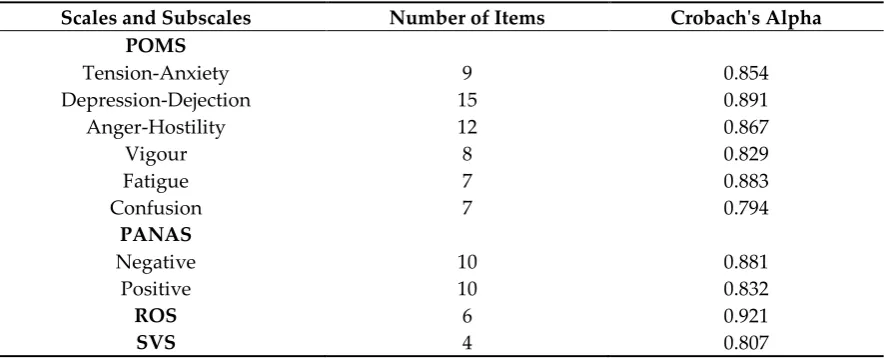
The raw data from each questionnaire were applied in all further calculations. The internal
170
consistencies and numbers of items for each scale and subscale are included in Table 1. Most of the
171
scales used exhibited good internal consistency, with the exception of the POMS subscale
172
‘confusion’, where internal consistency was lower (but still acceptable).
173
Table 1. Verification of internal consistency and number of items for each (sub)scale.
174
Scales and Subscales Number of Items Crobach's Alpha POMS
Tension-Anxiety 9 0.854
Depression-Dejection 15 0.891
Anger-Hostility 12 0.867
Vigour 8 0.829
Fatigue 7 0.883
Confusion 7 0.794
PANAS
Negative 10 0.881
Positive 10 0.832
ROS 6 0.921
SVS 4 0.807
POMS: Profile of Mood States; PANAS: Positive and Negative Affect Schedule; ROS: Restorative
175
Outcome Scale; SVS: Subjective Vitality Scale; n = 32.
176
2.4. Procedure
177
Meeting with participants was planned for 6th March 2018, at 9:00. At this time, while at the
178
gathering point, participants were randomly divided into one of two groups (experimental and
179
control). Each group then completed the questionnaires at the gathering point, a classroom at the
180
University. Afterwards, participants were asked to walk to the urban point or to the forest point,
181
with researchers to guide this walk (two researchers per group). At the destination point,
182
participants were asked to stand in a line, 1 meter apart from one another. Each participant was
183
placed with a proper view throughout the urban or forest environment. The viewing property for
184
each participant was the same. While standing as described, participants were asked to relax and
185
because during the winter in Poland, it is too cold to relax in a seated position. After 15 minutes of
187
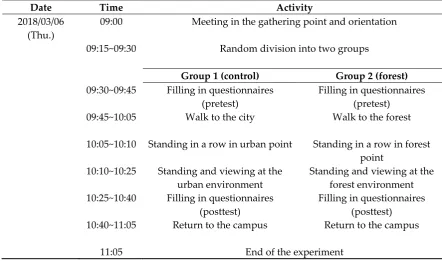
relaxation, participants were asked to fill out the questionnaires once again. The procedure followed
188
for the experiment is also described in Table 2.
189
Table 2. Procedure followed during the experiment.
190
Date Time Activity
2018/03/06 (Thu.)
09:00 Meeting in the gathering point and orientation
09:15~09:30 Random division into two groups
Group 1 (control) Group 2 (forest)
09:30~09:45 Filling in questionnaires (pretest)
Filling in questionnaires (pretest)
09:45~10:05 Walk to the city Walk to the forest
10:05~10:10 Standing in a row in urban point Standing in a row in forest point
10:10~10:25 Standing and viewing at the urban environment
Standing and viewing at the forest environment 10:25~10:40 Filling in questionnaires
(posttest)
Filling in questionnaires (posttest) 10:40~11:05 Return to the campus Return to the campus
11:05 End of the experiment
2.5. Data analysis
191
Means and S.D. values were calculated in Excel (Microsoft, USA). A parametric, mixed-design
192
ANOVA was conducted to analyse the interactions and main effects of the POMS, PANAS, ROS,
193
and SVS scores as pre–post indicators of the psychological restorative effect of exposure to the urban
194
versus forest environment. After ANOVA, post-hoc comparisons using the LSD test were conducted,
195
a method that has also been used in previous studies [31, 32]. For each analysis, effect size η2 was
196
calculated, with effects set as: small = 0.10; medium = 0.30; and large = 0.50. All statistical analyses
197
were conducted using SPSS Statistics Version 24 (IBM, USA).
198
3. Results
199
3.1. POMS
200
Two types of psychological restorative effects were considered: the effect of different conditions
201
(urban vs. forest environment) and effect of exposure to a different environment (pre vs. post). These
202
two factors were analysed using a mixed model ANOVA to compare the changes in the POMS
203
scores and to analyse the interactions between factors (Table 3). For four of the six POMS indicators
204
(tension-anxiety, depression-dejection, anger-hostility, confusion), interactions between conditions
205
and time were found. Regarding main effects, conditions had a significant effect on anger-hostility
206
and time had a highly significant effect on fatigue.
207
The results of the LSD comparisons showed that tension-anxiety and anger-hostility were
208
significantly increased after participants in the urban group were exposed to the urban environment
209
(urban: pre vs. post; Table 4). In contrast, tension-anxiety, depression-dejection, anger-hostility,
210
fatigue, and confusion significantly decreased in the forest group after exposure to the forest
211
environment (forest: pre vs. post). All POMS indicators were similar in both the urban and forest
212
(except vigour) showed significantly lower values in the forest group than in the urban group (post:
214
Table 3. Results for mixed-model ANOVAs investigating POMS scores.
216
POMS
Main Effect Interaction
Conditions: Urban vs. Forest Time: Pre vs. Post Conditions × Time
F p η2 F p η2 F p η2
Tension-Anxiety 3.680 0.065 - 0.109 0.025 0.875 - 0.001 18.056 0.000 *** 0.376
Depression-Dejection 0.881 0.355 - 0.029 0.386 0.539 - 0.013 7.315 0.011 * 0.196
Anger-Hostility 4.500 0.042 * 0.130 1.185 0.285 - 0.038 16.198 0.000 *** 0.351
Vigour 0.023 0.879 - 0.001 1.572 0.220 - 0.050 1.775 0.193 - 0.056
Fatigue 2.587 0.118 - 0.079 9.827 0.004 ** 0.247 3.263 0.081 - 0.098
Confusion 0.718 0.404 - 0.023 0.273 0.605 - 0.009 9.172 0.005 ** 0.234
***: p<0.001, **: p < 0.01, *p < 0.05, -: not significant, mixed-design (split-plot) ANOVA; POMS: Profile of Mood States; n = 32.
217
Table 4. Results of multiple comparisons of POMS scores for urban versus forest environments, as well as before and after environmental exposure.
218
Urban Forest
Pre Post Pre Post
Average S.D. Average S.D. p Average S.D. Average S.D. p
Tension-Anxiety 0.85 0.36 1.33 0.73 0.007 ** 0.99 0.81 0.47 0.46 0.004 **
Depression-Dejection 0.71 0.56 0.95 0.55 0.151 - 0.85 0.72 0.48 0.54 0.025 *
Anger-Hostility 0.85 0.48 1.38 0.76 0.001 ** 0.88 0.67 0.57 0.39 0.047 *
Vigour 1.93 0.78 1.91 0.71 0.956 - 1.75 0.72 2.15 0.73 0.077 -
Fatigue 1.81 0.88 1.59 0.84 0.355 - 1.65 1.13 0.82 0.91 0.002 **
Confusion 1.17 0.63 1.47 0.87 0.087 - 1.33 0.65 0.91 0.77 0.018 *
Pre Post
Urban Forest Urban Forest
Average S.D. Average S.D. p Average S.D. Average S.D. p
Tension-Anxiety 0.85 0.36 0.99 0.81 0.522 - 1.33 0.73 0.47 0.46 0.000 ***
Depression-Dejection 0.71 0.56 0.85 0.72 0.505 - 0.95 0.55 0.48 0.54 0.029 *
Anger-Hostility 0.85 0.48 0.88 0.67 0.902 - 1.38 0.76 0.57 0.39 0.000 ***
Vigour 1.93 0.78 1.75 0.72 0.500 - 1.91 0.71 2.15 0.73 0.360 -
Fatigue 1.81 0.88 1.65 1.13 0.633 - 1.59 0.84 0.82 0.91 0.026 *
Confusion 1.17 0.63 1.33 0.65 0.541 - 1.47 0.87 0.91 0.77 0.039 *
3.2. PANAS
220
A mixed-model ANOVA of the PANAS data was conducted, with conditions differences and
221
time differences used as two factors (Table 5). The results showed that an interaction occurred in the
222
case of ‘PANAS negative affect’. Regarding main effects, no statistically significant differences were
223
found for conditions or time. The results of the multiple comparisons tests (Table 6) showed that in
224
the case of the urban group, there was a marginal (p = 0.044) difference in negative affect between
225
pre- and post-test (negative affect was slightly higher after exposure to the urban environment).
226
When comparing the urban and forest groups after the intervention (urban: pre vs. post), a marginal
227
effect on ‘PANAS positive’ was observed (p = 0.033), with positive affect slightly increased in the
228
forest environment; however, this is likely an effect of non-conservative comparison.
229
Table 5. Results for mixed-model ANOVAs investigating PANAS scores.
230
PANAS
Main Effect Interaction
Conditions: Urban vs. Forest Time: Pre vs. Post Conditions × Time
F p η2 F p η2 F p η2
Negative 0.461 0.503 - 0.015 0.541 0.468 - 0.018 4.999 0.033 * 0.143
Positive 1.624 0.212 - 0.051 0.696 0.411 - 0.023 3.371 0.076 - 0.101
***: p<0.001, **: p < 0.01, *p < 0.05, -: not significant, mixed-model ANOVA; n = 32, PANAS: Positive
231
and Negative Affect Schedule States.
232
Table 6. Results of multiple comparisons of PANAS scores for urban versus forest environments, as
233
well as before and after environmental exposure.
234
Urban Forest
Pre Post Pre Post
Average S.D. Average S.D. p Average S.D. Average S.D. p
PANAS Negative 1.43 0.42 1.79 0.64 0.044 * 1.59 0.72 1.41 0.51 0.297 -
PANAS Positive 2.73 0.69 2.56 0.74 0.484 - 2.65 0.63 3.08 0.62 0.069 -
Pre Post
Urban Forest Urban Forest
Average S.D. Average S.D. p Average S.D. Average S.D. p
PANAS Negative 1.43 0.42 1.59 0.72 0.453 - 1.79 0.64 1.41 0.51 0.069 -
PANAS Positive 2.73 0.69 2.65 0.63 0.753 - 2.56 0.74 3.08 0.62 0.033 *
***: p<0.001, **: p < 0.01, *p < 0.05, -: not significant, ANOVA-LSD test; n = 32, PANAS: Positive and
235
Negative Affect Schedule.
236
3.3. ROS
237
In the case of the ROS, a mixed-model ANOVA was used to investigate restorativeness of the
238
two environments, with conditions and time as factors. This analysis was similar to those conducted
239
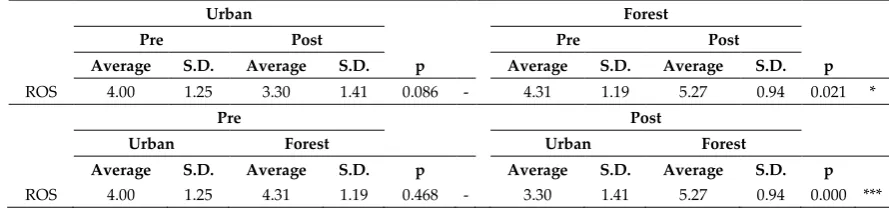
for data from the POMS and PANAS questionnaires (Table 7). An interaction was observed between
240
conditions and time. Regarding main effects, a significant of environment was observed. The results
241
of multiple comparisons LSD tests (Table 8) showed that in the forest group, there was a significant
242
increase in ROS scores after exposure to the forest environment (forest: pre vs. post). Furthermore, in
243
the forest group, values of ROS were higher after exposure to the forest environment than they were
244
in the urban group after exposure to the urban environment (post: urban vs. forest).
245
Table 7. Results for mixed-model ANOVAs investigating ROS scores.
246
ROS
Main Effect Interaction
Conditions: Urban vs. Forest Time: Pre vs. Post Conditions × Time
F p η2 F p η2 F p η2
***: p<0.001. **: p < 0.01. *p < 0.05. -: not significant; mixed-model ANOVA; n = 32;
247
ROS: Restorative Outcome Scale
248
Table 8. Results of multiple comparisons of ROS scores for urban versus forest environments, as well
249
as before and after environmental exposure.
250
Urban Forest
Pre Post Pre Post
Average S.D. Average S.D. p Average S.D. Average S.D. p
ROS 4.00 1.25 3.30 1.41 0.086 - 4.31 1.19 5.27 0.94 0.021 *
Pre Post
Urban Forest Urban Forest
Average S.D. Average S.D. p Average S.D. Average S.D. p
ROS 4.00 1.25 4.31 1.19 0.468 - 3.30 1.41 5.27 0.94 0.000 ***
***: p<0.001, **: p < 0.01, *p < 0.05, -: not significant, ANOVA-LSD test; n = 32, ROS: Restorative
251
Outcome Scale.
252
3.4. SVS
253
A mixed-model ANOVA was conducted to compare changes in SVS scores and to analyse the
254
interaction between factors and main effects, as was done for POMS, PANAS, and ROS data (Table
255
9). As with ROS data, an interaction was observed between conditions and time for SVS score data.
256
When main effects of the conditions and time differences were analysed, a statistically significant
257
effect of conditions was confirmed, and the time effect was not significant. The results of LSD
258
comparisons (Table 10) showed that in the forest group, SVS scores significantly increased after
259
exposure to the forest environment. Furthermore, after exposure to the forest environment, SVS
260
scores were higher than after exposure to the urban environment.
261
Table 9. Results for mixed-model ANOVAs investigating SVS scores.
262
SVS
Main Effect Interaction
Conditions: Urban vs. Forest Time: Pre vs. Post Conditions × Time
F p η2 F p η2 F p η2
5.524 0.026 * 0.155 1.103 0.302 - 0.035 4.527 0.042 * 0.131
***: p<0.001. **: p < 0.01. *p < 0.05. -: not significant; mixed-model ANOVA; n = 32; SVS: Subjective
263
Vitality Scale.
264
Table 10. Results of multiple comparisons of SVS scores for urban versus forest environments, as
265
well as before and after environmental exposure.
266
Urban Forest
Pre Post Pre Post
Average S.D. Average S.D. p Average S.D. Average S.D. p
SVS 3.86 1.52 3.55 1.29 0.452 - 4.08 1.23 5.00 1.12 0.032 *
Pre Post
Urban Forest Urban Forest
Average S.D. Average S.D. p Average S.D. Average S.D. p
SVS 3.86 1.52 4.08 1.23 0.635 - 3.55 1.29 5.00 1.12 0.002 **
***: p < 0.001, **: p < 0.01, *p < 0.05, -: not significant, ANOVA-LSD test; n = 32, SVS: Subjective Vitality
267
Scale.
268
4. Discussion
269
Consistent with previous studies [2, 5, 10, 11, 14, 17, 33, 34], this study confirmed that short
271
periods of forest recreation in a snow-covered forest (in this case: 15 minutes of relaxation in this
272
environment) have a significant effect on mood states of participants. The negative indices of mood
273
states, including tension-anxiety, anger-hostility, depression-dejection, confusion, and fatigue,
274
decreased after exposure to the forest environment. This confirms our hypothesis, that this type of
275
intervention results in a positive outcome. The positive index of mood states (vigour) did not
276
increase after exposure, but neither did it decrease significantly. This is not consistent with a
277
previous study [14] or another study conducted only with females [4]. Lower levels of indicators of
278
negative mood have many positive outcomes, confirming that brief forest recreation during the
279
winter, when snow has occurred, can be successfully conducted for the purpose of stress reduction
280
in females. Females may, however, react differently to the forest environment than do men [17],
281
which indicates the need for further testing of these effects on both sexes.
282
The effect of lowering negative mood states is useful information for therapists who work with
283
individuals living with high levels of stress, such as a highly stressful work environment. The
284
positive effect of nature therapy on this topic is already known [6-9], but a novel element of this
285
study was the addition of snow cover. As snow occurs in the winter in many countries, the way in
286
which this element affects individuals requires examination. A positive effect of forest recreation
287
was still observed with snow cover in this study, and there are several hypotheses as to why this
288
effect was observed. It is possible that snow in the forest environment does not obstruct the view
289
that is generally visible in this environment. Some authors suggest that some fractal dimensions are
290
responsible for the existence of the effect of visual stimulation on mood states. For example, some
291
kinds of natural fractals might, hypothetically, induce this positive effect [35, 36] and in a
292
snow-covered forest, these fractal dimensions are still perceivable to respondents. This stimulation
293
during forest recreation is crucial, and this reaction of humans is possibly some special effect
294
connected to the biophilia hypothesis [37], which states that people evolved in a natural
295
environment, and hence feel healthy in a natural environment like a forest [38].
296
4.2. Positive and Negative Affect
297
Previous studies have indicated that subjects exhibit a significant decrease in negative affect
298
after forest recreation and a significant increase in positive affect [17, 27]. In the current study, an
299
effect on positive affect was observed, as this indicator increased in the forest environment. Negative
300
affect did not decrease in the forest environment after the experiment, however, although it did
301
increase after exposure to the urban environment. These two indicators, positive and negative affect,
302
are important in psychological research, as their usage gives researchers and therapists information
303
concerning the mental state of participants and patients [24].
304
The interpretation of results regarding negative affect is similar to that of the negative mood
305
states of POMS – any negative symptoms are not necessary, so any decrease in this effect is welcome.
306
In this case, a lowering effect on this indicator was unfortunately not observed. In the urban
307
environment, an increase in negative affect was observed, possibly due to the higher level of noise in
308
that environment [39]. Further research should compare environments with more similar levels of
309
noise. In the case of positive affect, a difference was observed when comparing forest and urban
310
environments. In the forest environment, this indicator had higher values, suggesting that in the
311
forest environment, successful recreation could be conducted with positive effects. Because positive
312
affect increased in the forest environment, this tendency might be explained by the biophilia
313
hypothesis [37, 38].
314
4.3. Restorative outcome
315
Our findings are consistent with those of previous studies [17, 27], showing that restorativeness
316
significantly increased after exposure to the forest environment. The phenomenon of restoration in
317
the natural environment has been previously described. This effect is frequently explained by
318
Attention Restoration Theory [40], which states that the mental refreshment of humans, as measured
319
restoration might be a natural tool of the human nervous system, meant to naturally maintain
321
alertness in non-safe environments, such as the forest, as opposed to safe places, such as houses and
322
caves. Increasing thinking capacity in a natural environment could be a natural adaptation to
323
hunting or foraging. Perhaps restoration is a mechanism in humans predisposed to save calories
324
[41], although this hypothesis requires further investigation.
325
4.4. Subjective vitality
326
Consistent with previous studies [17, 27], this study’s findings suggest that short, 15-min
327
periods of relaxation in a snow-covered forest during winter can have psychological benefits for
328
subjective vitality levels. Vitality is a concept that can be measured objectively using physiological
329
reactions or subjectively using psychological reactions [30]. In the case of the current work,
330
subjective methods were used. The importance of factors that increase vitality is great, as a high level
331
of vitality is connected with better accomplishments of subjects [42], and anything that increases
332
human performance is important for society. Based on the current study, snow cover should not be a
333
barrier to increasing vitality during recreational stays or walks in the forest. Thus, successful forest
334
recreation in snow-covered forests may be a good activity for people interested in increasing their
335
personal effectiveness by stimulating an increase in their own vitality.
336
5. Conclusions
337
This study examined the effect of a snow-covered forest environment during winter on young
338
females’ psychological relaxation, with the urban environment as a control. The results showed that
339
participants’ levels of negative mood indicators (tension-anxiety, anger-hostility,
340
depression-dejection, confusion, fatigue) decreased after exposure to a forest environment with
341
snow cover. Furthermore, some of these indicators increased in the urban environment
342
(tension-anxiety, anger-hostility). An indicator of negative affect increased after exposure to the
343
urban environment, whereas an indicator of positive affect was higher in the forest environment
344
than in the urban environment. Restorativeness and subjective vitality exhibited higher values after
345
exposure to the forest environment in comparison to both the control and pre-test. This indicates
346
that forest recreation, during winter and with snow cover, continues to have a significant influence
347
on the psychological relaxation of young females. These findings are import for forest therapy
348
practitioners, as well as for individuals who want to obtain the positive effects of forest recreation.
349
Such recreation could be successfully conducted during winter in a forest with snow cover, and
350
there should still be a positive effect on psychological parameters.
351
This study has several limitations. First, in this study, the psychological effect of relaxation
352
while simply standing in the forest environment was measured. These effects should be measured
353
during other activities in a forest with snow cover. In fact, some reports indicate that being involved
354
in certain activities may harm the positive effects of nature relaxation [43]; it is therefore worth
355
examining why some activities induce relaxation and some do not. Second, only young females were
356
involved in this study. Future studies should investigate how recreation in a snow-covered forest
357
influences younger and older females, as well as how this activity influences males of different ages.
358
Third, only psychological measurements were used in this case; the physiological effects of this
359
activity were not considered. Fourth, different respondents went to each research site. The
360
respondents at each research point can therefore not be compared directly, meaning that the
361
differences among individuals in the two respondent groups could have caused the significant
362
differences observed between the urban and forest environments. In future studies, this occurrence
363
could be eliminated by exposing respondents from the two groups to both environments in reverse
364
order. Fifth, as respondents walked to each point on foot, they would have viewed surrounding
365
scenery before getting to either experimental point. It is therefore possible that the time period
366
during which respondents were exposed to the stimulus was not exactly 15 minutes in length. It is
367
worth mentioning, however, that the walks to the two analysed environments were conducted
368
through either the urban environment or the forest (Figure 1), so only one environment was able to
369
occurred, as the positive effect of forest recreation on health can persist for a longer period of time in
371
subjects, and the tests had to be carried out as soon as possible (due to periodic snowfall only).
372
Conducting a crossover study could therefore be burdened with a carryover effect and the use of this
373
research system was abandoned. Thus, a parallel study was carried out in which the carryover effect
374
was avoided. In addition, such a study can be carried out in a relatively short time. This study did
375
not compare the effects of forest recreation to the effects of conventional recreation (active control),
376
which would not take place under forest conditions. This is a limitation of the current research and
377
should be investigated in future work. Seventh, In this study, it was assumed that snow was present
378
in the forest landscape if 90% of the ground's surface was covered by it. It is not known, however,
379
what amount of snow affects the psychological reactions of subjects. This requires future research.
380
Eight, in the described research, it was tested whether the forest environment with the existing snow
381
cover affects the psychological relaxation of the subjects. Indeed, it has been shown that in a forest
382
environment with a snow cover causes a psychological relaxation effect. The aim of the study was
383
not to compare the forest with the snow cover with the forest environment without snow cover,
384
however in future studies, this type of comparison could be done (including the same participants)
385
to find out whether the snow cover in the forest environment affects another way on the subjects
386
than the forest environment without snow cover. Ninth, it will also be important, however, to
387
examine how different seasons, during which forest stands in the temperate climate zone change,
388
can affect the intensity of the psychological relaxation of subjects. Research regarding this should be
389
carried out in the future. Tenthly, this paper focuses on examining the impact of a forest
390
environment on the psychological relaxation of young adult students. In the future, it is worth
391
investigating how forest recreation, also conducted in winter, can affect people of different ages and
392
from other demographic groups (e.g. older people, working, etc.). Eleventh, this study did not
393
include men, so future studies concerning recreation in a forest environment with snow cover
394
present should include this group. Twelfth, it is also possible that spending too much time in the
395
forest may have a negative effect, depending on the temperature. For this reason, encouraging
396
people to move around to stay warm may be less stressful. The effect of ambient temperature should
397
be examined in future research. All these limitations could likely be overcome in further
398
experiments in the area of forest recreation research. Future studies should also test the effect of
399
forest recreation on males and on different age groups (e.g. on elderly participants).
400
Author Contributions: E.B. conceived and designed the experiment, conducted data analysis, and prepared the
401
first version of the manuscript. A.Ł. consulted on the design of the experiment, and reviewed and edited the
402
manuscript. A.O. and S.B. were responsible for the implementation of field research and minor editorial
403
comments on the text. L.B. contributed to publication by editing the content and English of the manuscript. N.T.
404
contributed to publication by reviewing and editing the manuscript.
405
Funding: The publication process was supported by funds of the Poznań University of Life Sciences. The
406
publication id co-finansed within the framework of Ministry of Science and Higher Education programme as
407
"Regional Initiative Excellence" in years 2019-2022, project number 005/RID/2018/19.
408
Acknowledgments: The authors of this article thank Dominik Dobrzyński for technical assistance during the
409
research.
410
Conflicts of Interest: The authors declare no conflicts of interest.
411
References
412
1. Douglas, R.W. Forest Recreation, 3rd ed.; Pergamon Press: New York, USA, 1982; p. 336, 9781483148267.
413
2. Lee, J.; Tsunetsugu, Y.; Takayama, N.; Park, B.J.; Li, Q.; Song, C.; Komatsu, M.; Ikei, H.; Tyrväinen L.;
414
Kagawa T.; Miyazaki, Y. Influence of forest therapy on cardiovascular relaxation in young adults.
415
Evid.-Based Compl. Alt. 2014, 834360, 1-7.
416
3. Sung, J.; Woo, J.M.; Kim, W.; Lim, S.K.; Chung, E.J. The effect of cognitive behavior therapy-based “forest
417
therapy” program on blood pressure, salivary cortisol level, and quality of life in elderly hypertensive
418
4. Ochiai, H.; Ikei, H.; Song, C.; Kobayashi, M.; Miura, T.; Kagawa, T.; Li, Q.; Kumeda, S.; Imai, M.; Miyazaki,
420
Y. Physiological and psychological effects of a forest therapy program on middle-aged females. Int. J.
421
Environ. Res. Public Health 2015, 12, 15222-15232.
422
5. Ochiai, H.; Ikei, H.; Song, C.; Kobayashi, M.; Takamatsu, A.; Miura, T.; Kagawa, T.; Li, Q.; Kumeda, S.;
423
Imai, M.; Miyazaki, Y. Physiological and psychological effects of forest therapy on middle-aged males
424
with high-normal blood pressure. Int. J. Environ. Res. Public Health, 2015, 12, 2532-2542.
425
6. Morita, E.; Fukuda, S.; Nagano, J.; Hamajima, N.; Yamamoto, H.; Iwai, Y.; Nakashima, T.; Ohira H.;
426
Shirakawa, T. Psychological effects of forest environments on healthy adults: Shinrin-yoku (forest-air
427
bathing, walking) as a possible method of stress reduction. Public Health 2007, 121, 54-63.
428
7. Jung, W.H.; Woo, J.M.; Ryu, J.S. Effect of a forest therapy program and the forest environment on female
429
workers’ stress. Urban For. Urban Gree. 2015, 14, 274-281.
430
8. Poulsen, D.V.; Stigsdotter, U.K.; Djernis, D.; Sidenius, U. ‘Everything just seems much more right in
431
nature’: How veterans with post-traumatic stress disorder experience nature-based activities in a forest
432
therapy garden. Health Psychol. Open 2016, 3, 1-14.
433
9. Tyrväinen, L.; Ojala, A.; Korpela, K.; Lanki, T.; Tsunetsugu, Y.; Kagawa, T. (2014). The influence of urban
434
green environments on stress relief measures: A field experiment. J. Environ. Psychol. 2014, 38, 1-9.
435
10. Tsunetsugu, Y.; Park, B.J.; Lee, J.; Kagawa, T.; Miyazaki, Y. Psychological relaxation effect of forest
436
therapy: results of field experiments in 19 forests in Japan involving 228 participants. Jap. J. Hyg. 2011, 66,
437
670-676.
438
11. Song, C.; Joung, D.; Ikei, H.; Igarashi, M.; Aga, M.; Park, B. J.; Miwa, M.; Takagaki, M.; Miyazaki, Y.
439
Physiological and psychological effects of walking on young males in urban parks in winter. J. Physiol.
440
Anthrop. 2013, 32, 1-18.
441
12. Song, C.; Ikei, H.; Miyazaki, Y. Physiological effects of nature therapy: A review of the research in Japan.
442
Int. J. Environ. Res. Public Health 2016, 13, 1-17.
443
13. Kamioka, H., Tsutani, K., Mutoh, Y., Honda, T., Shiozawa, N., Okada, S., Park, S.J.; Kitayuguchi, J.;
444
Kamada, M.; Okuizumi, H.; Handa, S. A systematic review of randomized controlled trials on curative
445
and health enhancement effects of forest therapy. Psych. Res. Behav. Manag. 2012, 5, 85-95.
446
14. Li, Q.; Kawada, T. Effect of forest therapy on the human psycho-neuro-endocrino-immune network. Jap. J.
447
Hyg. 2011, 66, 645-650.
448
15. Hanai, T. Tourism meets psychology. J. Glob. Tour. Res. 2016, 1, 89-92.
449
16. Sidenius, U.; Stigsdotter, U.K.; Dahl Refshauge, A. A year in the therapy forest garden
450
Nacadia® -participants’ use and preferred locations in the garden during a nature-based treatment
451
program. Alam Cipta 2015, 8, 44-53.
452
17. Bielinis, E.; Takayama, N.; Boiko, S.; Omelan, A.; Bielinis, L. The effect of winter forest bathing on
453
psychological relaxation of young Polish adults. Urban For. Urban Gree. 2018, 29, 276-283.
454
18. Tyrväinen, L.; Silvennoinen, H.; Hallikainen, V. Effect of the season and forest management on the visual
455
quality of the nature-based tourism environment: a case from Finnish Lapland. Scand. J. Forest Res. 2017,
456
32, 349-359.
457
19. Choi, J.Y.; Park, S.A.; Jung, S.J.; Lee, J.Y.; Son, K.C.; An, Y.J.; Lee, S.W. Physiological and psychological
458
responses of humans to the index of greenness of an interior space. Complement. Ther. Med. 2016, 28, 37-43.
459
20. Murphy, E.; King, E.A. Testing the accuracy of smartphones and sound level meter applications for
460
measurement environmental noise. Appl. Acoust. 2016, 106: 16-22.
461
21. McNair, D.M.; Maurice, L. An analysis of mood in neurotics. J. Abnorm. Soc. Psychol. 1964, 69, 620–627.
462
22. Lee, J.; Park, B.J.; Tsunetsugu, Y.; Ohira, T.; Kagawa, T.; Miyazaki, Y. Effect of forest bathing on
463
physiological and psychological responses in young Japanese male subjects. Public Health 2011, 125, 93–
464
100.
465
23. Dudek, B.; Koniarek, J. The adaptation of Profile of Mood States (POMS) by D.M. McNair, M. Lorr and L.F.
466
Droppelman. Przegląd Psychologiczny 1987, 30, 753–762. [in Polish]
467
24. Crawford, J.R.; Henry, J.D. The Positive and Negative Affect Schedule (PANAS): Construct validity,
468
measurement properties and normative data in a large non-clinical sample. Br. J. Clin. Psychol. 2004, 43,
469
245–265.
470
25. Watson, D.; Clark, L.A.; Tellegen, A. Development and validation of brief measures of positive and
471
26. Brzozowski, P. Polish Adaptation of the Positive and Negative Affect Scale (PANAS) by David Watson
473
and Lee Anna Clark. PTPPTP: Warsaw, Poland, 2010, pp. 34-113. [in Polish]
474
27. Takayama, N.; Korpela, K.; Lee, J.; Morikawa, T.; Tsunetsugu, Y.; Park, B.J.; Li, Q.; Tyrväinen, L.; Miyazaki,
475
Y.; Kagawa, T. Emotional, restorative and vitalizing effects of forest and urban environments at four sites
476
in Japan. Int. J. Environ. Res. Public Health 2014, 11, 7207–7230.
477
28. Korpela, K.M.; Ylén, M.; Tyrväinen, L.; Silvennoinen, H. Determinants of restorative experiences in
478
everyday favorite places. Health Place 2008, 14, 636–652.
479
29. Korpela, K.M.; Ylén, M.; Tyrväinen, L.; Silvennoinen, H. Favorite green, waterside and urban
480
environments: restorative experiences and perceived health in Finland. Health Promot. Int. 2010, 25, 200–
481
209.
482
30. Ryan, R.M.; Frederick, C. On energy, personality, and health: subjective vitality as a dynamic reflection of
483
well‐being. J. Pers. 1997, 65, 529–565.
484
31. Pedersen, E.; Weisner, S.E.; Johansson, M. Wetland areas' direct contributions to residents' well-being
485
entitle them to high cultural ecosystem values. Sci. Total Environ. 2019, 646, 1315-1326.
486
32. Dobbie, M.F. Public aesthetic preferences to inform sustainable wetland management in Victoria,
487
Australia. Landscape Urban Plan. 2013, 120, 178-189.
488
33. Ikei, H.; Song, C.; Kagawa, T.; Miyazaki, Y. Physiological and psychological effects of viewing forest
489
landscapes in a seated position in one-day forest therapy experimental model. Jap. J. Hyg. 2014, 69, 104-110.
490
34. Joung, D.; Kim, G.; Choi, Y.; Lim, H.; Park, S.; Woo, J.M.; Park, B.J. The prefrontal cortex activity and
491
psychological effects of viewing forest landscapes in autumn season. Int. J. Environ. Res. Public Health 2015,
492
12, 7235-7243.
493
35. Kaiserman, J. G. Urban Nature for Well-being: Design Recommendations for Psychological Benefits in
494
Urban Public Spaces. Doctoral dissertation, University of Washington, 2017, pp. 1-91.
495
36. van Almkerk, M.; Huisman, G. Virtual Nature Environments Based on Fractal Geometry for Optimizing
496
Restorative Effects. Environment, 2018, 12, 1-11.
497
37. Wilson, E.O. Biophilia: The Human Bond with Other Species, Harvard University Press, Cambridge, UK,
498
1984; pp. 160.
499
38. Kobayashi, H.; Song, C.; Ikei, H.; Kagawa, T.; Miyazaki, Y. Analysis of individual variations in autonomic
500
responses to urban and forest environments. Evid.-Based Compl. Alt. 2015, Vol. 2015, 1-7.
501
39. Benfield, J. A.; Bell, P. A.; Troup, L. J.; Soderstrom, N. C. Aesthetic and affective effects of vocal and traffic
502
noise on natural landscape assessment. J. Environ. Psychol. 2010, 30, 103-111.
503
40. Kaplan, S. The restorative benefits of nature: Toward an integrative framework. J. Environ. Psychol. 1995,
504
15, 169-182.
505
41. Cheval, B.; Tipura, E.; Burra, N.; Frossard, J.; Chanal, J.; Orsholits, D.; Radel, R.; Boisgontier, M.P.
506
Avoiding sedentary behaviors requires more cortical resources than avoiding physical activity: An EEG
507
study. Neuropsychologia 2018, 119: 68-80.
508
42. Hone, L. C.; Jarden, A.; Schofield, G.M.; Duncan, S. Measuring flourishing: The impact of operational
509
definitions on the prevalence of high levels of wellbeing. Int. J. Wellbeing 2014, 4, 62-90.
510
43. Jiang, B.; Schmillen, R.; Sullivan, W. C. (). How to Waste a Break: Using Portable Electronic Devices