FROM A STUDENT TEACHER TO A BEGINNING TEACHER:
A STUDY ON THE PROCESS OF LEARNING TO TEACH
Thesis submitted in fulfilment of the requirements
for the degree of Doctor of Philosophy of
the University of London
Department of Educational Psychology
and Special Educational Needs
Institute of Education University of London
Mr CHAN Pui-kai
1993
Abstract
The first year of formal teaching is generally found to be particularly traumatic for some beginning teachers. The situation in Hong Kong is felt by most professionals to be even more acute. Though some research has been done on the needs of beginning teachers, hardly any research in Hong
Kong
or elsewhere has addressed the process of learning to teach. This thesis aims at investigating (i) the alleged 'reality shock' during the early stages of teaching, (ii) sequential developments in the process of learning to teach, and (iii) the formulation and testing of a model to predict and explain progressive changes in the beginning teachers' perceptions of their competence in teaching. A special interest of this study is the opportunity to gather a useful data bank on Hong Kong teachers and to relate the findings towards improving the services in Hong Kong.Building on previous studies both in Hong Kong and in the
international setting, a psychological model is proposed to cover the first year of teaching. Five states, Perplexity, Control
Anxiety, Experimentation, Reflection and Integration, serve as useful indices of change in beginning teachers' perception of competence in teaching. The model is evaluated by data from three sources, questionnaires, interviews and follow-up interviews with non-respondents to questionnaire study. The questionnaires are constructed to reflect changes in perceived competence in teach-ing predicted by the model and pretested on 124 teachers in pilot study. 365 teachers responded in the main study.
The occurrence of 'reality shock' is detected and analysed as a general lowering in beginning teachers' perceived competence in teaching early in their first year.
A factor analysis on questionnaire data shows that the five states are collapsible into two higher order dimensions, namely Survival and Growth states. Their interplay vividly demonstrates the pattern of changes as the process of learning to teach devel-ops and the pattern revealed supports the prediction from the
model. By using these higher order states, the 'reality shock' can be more clearly portrayed by the rise or fall of the mean Growth state rather than changes in the Survival state. The
relationship between psychological states and reported experience is also investigated.
Revisions to the model are proposed in the light of the findings; and suggestions for further research and for ways of supporting teachers in their induction year are put forward.
TABLE OF CONTENTS
Page 1 2 3 9 11
13 Title Page
Abstract
Table of Contents List of Tables List of Figures CHAPTER
ONE From Learning to Teach to Teaching to Learn: An Introduction to the Research
TWO A Review of Situations and Studies of Beginning Teachers and Pre-service Teacher Education in Hong Kong
Introduction 17
A. An Analysis of Pre-service Teacher Education
in Hong Kong 18
B. A Review of Studies on Pre-service Teacher
Education, and Beginning Teachers in Hong Kong 24 C. Statement of Problems of the Present Research 32
THREE General Review on Studies of Beginning Teachers and Teacher Development
Introduction 34
Part I: Beginning Teachers' Problems
A. Possible Causes and Perceived Problems 35 B. Development of Beginning Teachers 44 Part II: Dealing with Beginning Teachers' Problems
Introduction 53
A. Pre-service Teacher Education: A
re-examination 54
Chapter
Page
THREE
B. Induction for Beginning Teachers
62
FOUR
Developing a Theoretical Model on the Process
of Learning to Teach
Introduction
69
A.
Models for Teacher Development
70
B.
Recent Studies on Learning
73
C.
Towards a Model of Professional Learning
and Development
77
D.
Postulated Changes in the beginning Teachers
in their First Year of Teaching according
to the Model
88
FIVE
The Empirical Study
Part I: The Research Questions
93
Part II: Design of Study
A.
Establishing the Time Points for Data
Collection
94
B.
Selecting the Sample of Beginning Teachers
96
Part III: Instrumentation
100
A.
Questionnaire Design - I: Beginning Teacher
Development Questionnaire (BTDQ)
101
B.
Questionnaire Design - II: Beginning Teachers'
Views Questionnaire (BTVQ)
106
Part IV: Field Procedures
108
Part V: Data Recording and Analysis
A.
Questionnaire I: BTDQ
110
B.
Questionnaire II: BTVQ
113
Part VI: Methodological Assumptions
114
Part VII: Limitations
115
Chapter
SIX
Page
Perceived Competence as measured by the
BTDQ
Part I: Changes in Psychological States of
Individuals and in Groups
Introduction
A.
The Whole Group
B.
The Primary Subgroup
C.
The Secondary Subgroup
D.
The Modal States and the Totals: A
Correlational Study
E.
General Conclusions
Part II: Distribution Patterns of Mean Scores
of Perceived Competence in Teaching
Introduction
130
A.
The Whole Group
131
B.
The Primary Subgroup
139
C.
The Secondary Subgroup
146
D.
Comparing Patterns of Change in Primary and
Secondary Subgroups
E.
General Conclusions
Part III: The Longitudinal Study
Introduction
156
A.
The Whole Longitudinal Group
157
B.
The Primary Longitudinal Subgroup
161
C.
The Secondary Longitudinal Subgroup
165
D.
General Conclusions: the Longitudinal Study 168
Part IV: Patterns of Change in Cross-sectional
and the Longitudinal Study
A. General Patterns of Change in PCT:
A Concluding Remark
170
Chapter
Page
Six
B. Summary Statements on Patterns of PCT
from BTDQ studies
174
SEVEN
Teachers' Reports of Experience in the
First Year
Part I: Responses to the BTVQ
A.
The Most Important Events or Difficulties
encountered
176
B.
Personal Impressions of Teaching
190
C.
A Retrospective View of the Most Important
Events or Difficulties encountered
198
D.
A Summary of Findings on the Most Important
Events/Difficulties encountered by the Whole
group from the Cross-sectional and the
Retrospective Reports
204
Part II: Analysis of Interviews with Respondents
and Non-respondents to Questionnaires
Introduction
206
A.
The Most Important Events/Difficulties
encountered
207
B.
Personal Impressions of Teaching
210
Concluding Statements from BTVQ and Interviews
213
EIGHT
The Model on the Process of Learning
to Teach: Evaluation, Conclusions and
Recommendations
Part I: Answering the Research Questions
A.
'Reality Shock'
215
B.
General Pattern of Change in the Process
of Learning to Teach
217
C.
Supporting Evidences for the Findings
219
Chapter Page
EIGHT Part II: Evaluating the Research Model:
The Model on the Process of Learning to Teach
A. 'Reality Shock': An Evaluation and
Redefinition 222
B. Patterns of Change in the PCT:
An Evaluation 224
C. The Primary and the Secondary Subgroups 227
0. Revision of the Model 228
Part III: Implications and Recommendations
A. For Further Research 229
B. For Support for Professional Development 231
REFERENCES 240
APPENDIX 1. Distribution of Items of Questionnaire One
for Pilot Study 253
2. Questionnaire One Items in Five States
(Original set) 254
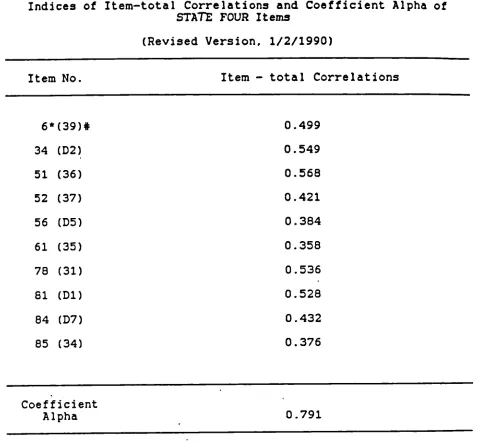
3. Distribution of Samples for Pilot Study 262 4. Item-total Correlations and Coefficient
Alpha of Items in Each of the Five States 263 5. Distribution of Items of Questionnaire One
for the Main Study 268
6. Questionnaire Two (BTVQ) for pilot Study
and Main Study 269
7. Summary and Initial findings of
Questionnaire Two in Pilot Study 270 8. Questionnaire One and Response Data Sheet
for Pilot Study 284
9. Questionnaire One (BTDQ) and Response data
Sheet at TP1, TP2 and TP3 289
10. Questionnaire One (BTDQ) for TP4 Study 293
Chapter Page APPENDIX 11. Questionnaire Two (BTVQ) for TP4 Study 296
12. Questionnaire One Items sorted according
to the Five States (from BTDQ) 297 13e Separate Factor Analysis for the five states,
the mean Growth and Survival, and Total 302 14. Factor Analysis for five states at each
time points 310
15. Correlation between Total and Dominant
States at four time points 314 16. ANOVA Tables for BTDQ Cross-sectional Study 315 17. ANOVA Tables for BTDQ longitudinal Study 335
LIST OF TABLES Table 2.1 2.2 3.1 3.2 5.1 5.2 6.1 6.2 6.3 6.4 6.5 6.6 6.7 Page Distribution of Hong Kong Primary School Teachers
in Academic, Professional Qualifications and School
types 23
Distribution of Hong Kong Secondary School Teachers in Academic, Professional Qualifications and School
types 23
The 24 Most Frequently Perceived Problems of
Begin-ning Primary Teachers 42
The 24 Most Frequently Perceived Problems of
Begin-ning Secondary Teachers 43
Distribution of Graduates from Four Colleges of Education in Hong Kong forming the Population of
the Study 97
Field Procedures of Main Study 109
Distribution of All Beginning Teachers by
Percentage in their Dominant States at four Time
Points 119
Distribution of Primary Beginning Teachers by Percentage in their Dominant States at four Time
Points 122
Distribution of Secondary Beginning Teachers by Percentage in their Dominant States at four Time
Points 125
Means and Standard Deviations of Five States, 'Survival' and 'Growth' states and Totals
(Whole group) 133
Means and Standard Deviations of Five States, 'Survival' and 'Growth' states and Totals
(Primary Subgroup) 143
Means and Standard Deviations of Five States, 'Survival' and 'Growth' states and Totals
(Secondary Subgroup) 149
Means and Standard Deviations of Five States, 'Survival' and 'Growth' states and Totals
(Whole Longitudinal group) 159
Table Page 6.8 Means and Standard Deviations of Five States,
'Survival' and 'Growth' states and Totals
(Primary Longitudinal Subgroup) 163
6.9 Means and Standard Deviations of Five States, 'Survival.' and 'Growth' states and Totals
(Secondary Longitudinal Subgroup) 166 6.10 Summary Table to show the distribution of Tukey
test results of adjacent pairs of time points in all five states, mean Survival and Growth states and mean totals for the Whole group, the Primary and the Secondary Subgroups in Cross-sectional
Study 172
6.11 Summary Table to show the distribution of Tukey test results of adjacent pairs of time points in all five states, mean Survival and Growth states and mean totals for the Whole group, the Primary
and the Secondary Subgroups in Longitudinal Study 173 7.1 Summary Table of the Most Important Events /
Difficulties encountered by the Whole group of
beginning Teachers 178
7.2 Summary Table of the Most Important Events /
Difficulties encountered by Primary Subgroup 184 7.3 Summary Table of the Most Important Events /
Difficulties encountered by Secondary Subgroup 186 7.4 Summary Table to show Percentage Distribution
of Different Types of Responses of General Impression on teaching: Primary and Secondary
Subgroups 197
7.5 Frequency Distribution of months in which
Beginning Teachers reported to have encountered
the Most Difficult Time 199
7.6 Comparison of Rankings of the Most Important Events/Difficulties encountered by Beginning
Teachers (A Retrospective Study) 201
7.7 Summary Table of the Most Important Events / Difficulties encountered by Beginning Teachers as reported in the Interviews
(The Respondent Group) 209
7.8 Summary Table of the Most Important Events / Difficulties encountered by Beginning Teachers as reported in the Interviews
(The Non-respondent Group) 209
Figure Page
6.11 Perceived Competence in Teaching: Mean Scores for Mean 'Survival' and Mean 'Growth State for
Secondary Teachers 150
6.12 Perceived Competence in Teaching: Mean Total scores
for Secondary Teachers 151
6.13 A combined Figure showing Mean Score Distributions of all five States, mean Survival and Growth and mean Totals attained by Longitudinal group at
Four Time Points 160
6.14 A combined Figure showing Mean Score Distributions of all five States, mean Survival and Growth and mean Totals attained by Primary Longitudinal
Subgroup at Four Time Points 164
6.15 A combined Figure showing Mean Score Distributions of all five States 1 mean Survival and Growth and mean Totals attained by Secondary Longitudinal
Subgroup at Four Time Points 167
8.1 An Example of General PCT Pattern and its possible conditions of interplay of Dimensions of Growth
and Survival 226
8.2 A School-based Induction Model for First Year
Beginning Teachers 234
CHAPTER ONE
FROM LEARNING TO TEACH TO TEACHING TO LEARN:
AN INTRODUCTION TO THE RESEARCH
'An understanding of how people learn would make a more
fundamental change to the educational system as a whole
than any decision on what should be contained in the
national curriculum, for understanding how people learn
forces a reassessment of the purpose of learning, the
curriculum and the way it is communicated.'
(Cullingford,1990, p. 2)
It has been some years since I graduated from a two-year
full-time course from the Grantham College of Education in Hong
Kong. But, I can still vividly remember the 'scene' on the very
last day of the college term. I gazed at the logo of the College
high over the front door and promised myself that I would come
back to help the future 'trainees' (the term naturally flowed out
from the mouths of lecturers at that time) and it would NOT be
the same college again. I said that because I was disappointed
with many things inside there and felt quite ungrateful to many
of those who 'lectured' in there since I was a bit shocked by the
gap between theory and practice after the seven-week teaching
practice experience just about a month and a half before the end
of the college course in mid-July; and, moreover, I was
frustrat-ed for it was too late to know that.
Some years after my graduation from Grantham, I returned to a college to 'lecture'. Though it was not Grantham, I was very excited to work there, giving my best (I thought)
Till now, I have been working in the same College for some years, still 'lecturing'; but, I am not so sure whether the
'best' that I have been contributing is really the 'best' because there are still many graduating students from my college (and also from the other three as found in the research) possibly speaking more or less the same words to the 'logos'.
The discontent with the college programmes preparing student teachers in the process of learning to teach was part of my
personal experience when I left Grantham. The feelings had deep-ened in the first year of teaching but I blamed the 'laziness' or
'poor academic standards' of those who had trained me. I credited my success in survival, development and attainment of 'maturity'
in teaching to my never-say-die spirit and the will-power to survive in order to return to the College to start a new page in teacher education there with 'an unconditional faith in an uncon-ditional meaning' (Frankl, 1988, p . 156). Actually, learning teaching in the 'wilderness' of the staff room and detaching
myself from 'the madding crowd' which was so close together was a constant torture for me in the first one or two years because I was reluctant to talk, trying to solve any problems encountered all by myself lest I be regarded as incompetent.
Some years ago, I decided to find a better way to learn through teaching and formed a strong conviction that actual
experience was the best teacher; but after a few more years, I
began to doubt whether experience really was transferable as I
would feel anxious and puzzled for a short time when I had to
change teaching subjects or schools and no obvious improvement in
teaching was felt by simply teaching for some years. So, I
start-ed to engage myself in more disciplinstart-ed research work hoping to
improve the 'effectiveness' of the process of learning to teach.
I started this research some time ago with the same
simple-minded conviction to find a way to help (but whom?). Today, I sit
calmly in my study and write this introduction to my thesis and
reflect on my process of learning to teach in the whole context
of my research experience of devising and testing a model on the
process of learning to teach in the first year teachers: I know
as clear as crystal that nothing magical has happened in the past
years of my work as a teacher educator in a similar college to
that in which I had myself received a pre-service course on the
process of learning to teach and, to my profound disappointment,
it seems that I have simply been regarded by the graduates of the
1990s as one of those lecturers that I had critised many years
ago. Is that because nothing has changed in the courses or is it
because there exists an inconspicuous cause that it has been
overlooked for decades ? At this stage, it is still too early to
say to what extent I have found an answer but I am certain that I
have come closer to a few of those answers by the end of this
research. I think I have learned through teaching and it is also
natural for some people to demean the role of pre-service teacher
education and prefer a more practical mode of on-the-job training
in teaching like those in many other professions. Through the
research I have been convinced that the problems do not exist in the theoretical courses or in experience per se but exist else-where.
This thesis reports why and how I devised certain research instruments to use with beginning teachers and how I analysed the data to come to my findings.
Through the self-devised set of two questionnaires and inter-views, the perceived competence in teaching of the first year beginning teachers waS surveyed with a view to probe for possi-ble patterns of changes across four time points in the first year of teaching; possible causes were then offered with some conclu-sions and recommendations presented in the end.
The eitationromCullingford in the beginning of this chap-ter is a summary of what I believe and what I would have had my
'lecturers' do for us many years ago. I tried to gain a better understanding of learning to teach and have presented it in the following chapters.
CHAPTER TWO
A REVIEW OF SITUATIONS AND STUDIES OF BEGINNING TEACHERS
AND PRE-SERVICE TEACHER EDUCATION IN HONG KONG
Introduction
Teachers in primary and secondary schools in Hong Kong are
trained through two parallel channels: through the government-run
colleges of education and the faculty of education of the
Univer-sity of Hong Kong and the Chinese UniverUniver-sity of Hong Kong. The
present state of the teacher education programmes offered in
these institutions will be described in Section A of this
chap-ter.
Previous studies of pre-service teacher education and on the
studies of beginning teachers in Hong Kong are concisely reviewed
in Section B with a brief history of the development of
educa-tional research on these topics since 1945 in Hong Kong.
In Section C, based on the background to the research problems
elaborated in the previous sections, the set of research problems
to be possibly tackled are derived and listed out.
A, An Anal y sis of Pre-servjce Teacher Education in Hon g Kong
1. The trainin g of teachers with non- g raduate status
Teachers of the primary schools have been traditionally re-cruited from graduates of Form Five or Form Upper Six students who are not offered places in the universities or polytechnics Back in the 1920s, only some of these school-leavers were provid-ed opportunities to be trainprovid-ed as teachers of general subjects at the primary level and Chinese subjects at the junior secondary level through a training school organized by some Chinese educa-tionalists in Hong Kong. A formal teacher training institute, the Northcote Training College, was first started by the Government
in 1939 to train non-graduate teachers for the primary and the junior secondary levels. Later when the need for more teachers arose, more colleges were established: Grantham in 1951, Sir Robert Black in 1960 and the Hong Kong Technical Teachers' Col-lege in 1974.
At present, secondary 5 and secondary 7 school-leavers meeting the minimum requirements of the colleges, are offered full-time three-year and two-year initial teacher education courses respec-tively at the four government-run colleges of education in which all staff are civil servants. They are prepared to become Certif-icated Masters/Mistresses each receiving the same Teacher's
Certificate qualifying them to teach general subjects at primary level and two elective subjects up to secondary 3 level, that is, the total spectrum of free compulsory education for all children and youths of seven to fifteen.
All courses (except one three-year course at Grantham) are
offered in the English medium except for the elective subjects of
Chinese and the Chinese History. It is worth noting that while
the majority of the secondary schools are Anglo-Chinese, using
English as the formal medium of instruction, the great majority
of the primary and the kindergarten schools use Cantonese as the
medium of instruction (which is a dialect spoken in South China
and is slightly different from the written literary style of
Chinese commonly used by all Chinese).
For all three-year and two-year teacher education courses,
there are four areas to cover: Area A, Professional Studies, Area
B, Elective Studies, Area C, Practical Teaching and Area D,
General Studies. The Professional Studies, a compulsory
pro-gramme, include education, education technology, general
method-ologies (primary and secondary) and primary studies (covering the
general subjects taught in primary classes). As for Area B,
students of the three colleges, Northcote, Grantham and Sir
Robert Black have to study two electives chosen from the list of
thirteen secondary school subjects: Chinese, Chinese History,
English, Economic and Public Affairs, History, Geography, General
Science, Mathematics, Social Studies, Art and Design, Home
Eco-nomics, Music and Physical Education (the last four are called
cultural subjects). Students of the Hong Kong Technical Teachers'
College have to choose one subject from Commerce, and Design and
Technology and another from Chinese, English, Science and
Mathe-matics for elective studies. In Area C, all first year students
of the first three colleges have to go on a seven-week practical
teaching session from March to May; the second-year students of
the three-year course have to do another five-week practical
teaching block in the primary from November to December; and all final year students have to practice teaching in the junior
secondary classes from secondary 1 to secondary 3 for seven weeks from March to May. Students of the Hong Kong Technical Teachers' College have to practice in the same period of time as those of the other colleges but all in the secondary classes. All students are required to take the compulsory courses of Language Skills (English) and Language Skills (Chinese) throughout their years of training in Area D, General Studies; but they can choose one from dozens of Complementary Programmes in each of the first two years so that they may extend their abilities in organizing interest groups or courses for extra-curricular activities in schools
(Ref. Colleges of Education, Education Department, Hong Kong, 1991, pp . 5-24).
All courses in teacher education are unit-based with one unit being equivalent to about 15 contact hours. To take the example of the two-year course in Northcote, the standard number of units to be covered in all four areas should be 39, 40 (46 if a cultur-al subject is elected), 30 and 26, making a totcultur-al of 135 (141) units by the end of the course. For the three-year course in Northcote, unit totals for the Areas A, B, C, and D are 51, 60, 45 and 39 amounting to a total of 195 by the end of the three years of study (Ref. Handbook for Full-time Two-year Course
(English) 1988-1990; and Handbook for Full-time Three-year Course (English) 1987-1990). The proportions of units in all areas of teacher education courses in other colleges are slightly differ-ent but all curricula among the colleges are essdiffer-entially based on
the same core curricula agreed upon by the joint college boards
of different electives under the central joint college board of
principals.
2. The trainin g of teachers with g raduate status
During the pre-1965 period, teachers with graduate status were
only able to receive training, if they wished, from the school of
education of the University of Hong Kong since secondary subject
teachers were required to possess a university degree in the
sub-ject and teach up to the form upper six level. So, in the 1950s
for instance, only about twenty to thirty graduates were trained
in a year. By 1965, with the establishment of the School of
Education in the Chinese University of Hong Kong, the output rate
of trained graduate teachers had doubled. In 1967, out of the
7500 or so graduate teachers in schools only 2391 were trained
(Cheng, 1987, p. 219), i.e. about 30% trained. Though the
devel-opment of initial teacher education courses in the universities
has been considerably expanded to produce about 1000 teachers per
year through the full-time one-year and part-time two-year
post-graduate training programmes, the speed of school building
pro-gramme exceeded the growth rate of trained graduate teachers at
times. In September, 1989, only about 68% of teachers with
recog-nized university degrees were formally trained, and it is widely
believed that the situation will not be considerably improved in
the 1990s.
Through the one-year full-time or two-year part-time study in
the day/evening course, a graduate of a recognized university
would be awarded a postgraduate diploma in education from the Chinese University of Hong Kong (which is equivalent to a PGCE in the United Kingdom). Similarly, one would be awarded the post-graduate certificate in education after finishing a one-year
full-time or two-year part-time evening course from the Universi-ty of Hong Kong.
The curriculum of the 'PGCE' course at the Chinese University of Hong Kong includes I. Curriculum and Teaching Methods, II. Psychology and Counselling, III. Society, Institution and Organi-zation and IV. Culture and Thought, and an independent project on any of the four categories mentioned. An eight-week practice
teaching is also required for the full-time students (Ref. Chi-nese University Calendar, ChiChi-nese University of Hong Kong, 1989-90, pp. 222-223). The curriculum of the PGCE courses at the Uni-versity of Hong Kong is similar to that of the Chinese UniUni-versity
in essence though they have been different in emphasis.
At present, since the salary of all teachers in the public sector, i.e. the government and aided, is paid by the Hong Kong Government, graduate teachers are encouraged to get their formal initial training within ten years or they will not be given any increments in salary afterwards nor promoted to higher posts of teaching and/or school administration.
To illustrate the recent distributions of Hong Kong primary and secondary teachers in their academic, professional qualifica-tions and school types, two tables of the 1989-1990 school term is presented for reference (Table 2.1 & 2.2, p.23).
259
84?
213
9854
8606
72.01 67.78
4091
5429
93.44 8 .07
1351
Trained 106? 7280
Graduate
Untrained 68 3176
Trained 699 4517
Non-graduate
Untrained 5 3614
i!IbU AQ9_QIJ Oft1 long Pri.ariJchooJeachers in
(Adapted fro. Table Iii of Annual Suuaary 1989-90, EducatIon Depart.ent, Hong Long (1990, p. 63))
School Types 2
Govern.ent$ Aided$* Private$$* Total trained trained
Acade.ic Professional (G) (A) (P) (G+A) (G+A4P)
Qualification
Trained 13 492 2? 532
Graduate 61.81 54.45
Untrained 4 308 133 445
Trained 1271 14590 247 16108
Non-graduate 94.04 88.13
Untrained 0 10064 11634 2169
* : All teachers are civil servants governed by civil service regulations.
H Teachers are e.ployed by different school boards but all are paid by the central govern.ent, Eaployient and salary scales are controlled by private school boards,
I : So.e are receiving training at in-service initial teacher education institutions.
TABLE 2
(Adapted hoi Table ha of Annual Sunary, Education Departuent (1989-90), Hong Long (1990, p.63))
School Types 2
Govern,ent* Aided** Private*** Total trained trained
Acadeiic Professional (G) (A) (P) (G+A) (G+A+P)
Qualification
* : All teachers are civil servants governed by civil service regulations.
** : Teachers are e.ployed by different ichool boards but all are paid by the central govern.ent, E.ploy.ent and salary scales are controlled by private school boards.
4 : Sose are receiving training at in-service initial teacher education institutions,
B. A review of studies of p re-service teacher education, and be g innin g teachers in Hon g Kong
Fewer than eight studies of teachers and teacher education in Hong Kong were reported in the years between 1945 to 1964. After 1965, considerably more studies were carried out as more trained graduate teachers and trainers became more inclined to conduct educational research when the school of education was set up by the Chinese University of Hong Kong in 1965. There were 25 stud-ies on teachers and/or teacher education from 1965 to 1974 and 61 related studies from 1975 to 1982 (Ref. Chung et al., 1991, p. xviii). In the early 1980s, the School of Education, University of Hong Kong initiated the Advanced Diploma in Education and the Master of Education courses by course work for practicing teach-ers to further their studies in education through the part-time day-release mode (two three-hour sessions per week during the university terms). Studies on a wide range of educational issues have thus blossomed since then. But relatively fewer studies were on teacher preparation and there were hardly any studies on
beginning teachers in the 1980s.
1. Studies on pre-service teacher education
In the 1960s, two studies were on the teacher training pro-grammes in general: one on Elementary Training Programme (Cheng, 1961) and one on Problems related to teacher preparation from 1943 to 1963 in Hong Kong (Chan, 1968). One pioneering study by Leong (1964) was an experimental study on the attitudes and abilities of the pre-service teacher trainees of a training college and those of a 'diploma in education' (an equivalent to
PGCE) class at the University of Hong Kong. Later Leong reported
another studies on the motives for the choice of the teaching
profession of both the college trainees and the postgraduate
students working for the 'diploma in education' (Leong, 1969).
The major message from both studies was that the non-graduate
trainees were generally less motivated and of lower academic
abilities than those of the 'diploma in education' classes though
both groups were reported to be 'influenced more by practical
considerations in terms of monetary reward and security of
occu-pation and less by idealistic factors such as opportunity of
keeping up with favourite studies and possibility of doing good'
(Leong, 1964, p.122).
In the 1970s, besides a general paper on teacher education in
Hong Kong (Hinton, 1975), the other studies were concentrated on
two aspects: on curriculum studies of certain subjects in the
colleges of education (N.B. all teachers' training colleges were
renamed as colleges of education from 1967); and on teacher
trainees' attitudes and role conceptions and their changes in the
course of study. Studies on the subject curricula were mainly
associateship reports at the Institute of Education, University
of London, such as Chan (1972), Chau Lam (1975) and Luk (1976).
All three reports mentioned were comparative studies of teacher
training on certain subjects in Hong Kong and in certain teacher
training institutions in U. K. Examples of the second emphasis
were Lai's paper on the attitudes, education assessment and
teaching performance of college education students (Lai, 1973)
and Luk's H. Phil. thesis on the conceptions of teachers' role as
held by pre-service and inservice teacher trainees (Luk, 1978).
Luk's study was a large scale one involving about 500 pre-service and 600 inservice teacher trainees of all three colleges of
education. Through the use of a Teacher Role Questionnaire, Oliver's Survey of Opinions Questionnaire and the Minnesota Teacher Attitude Inventory, Luk concluded that a) there were significant changes in the teacher trainees' conceptions of the teacher's role by the end of the course; b) the teacher trainees had a shift to a more authoritarian orientation on the concep-tions of traditional roles of teachers and c) though there was a positive shift for the inservice trainees on the conceptions of emergent roles of the teacher by the end of the course, there was a negative shift for those pre-service teacher trainees. Luk
stated that
'... it is apparent that the pre-service students probably due to their lack of practical teaching experience at the beginning of the course, were inclined to be idealistic about the emergent roles of the teacher.
After having gone through periods of teaching practice they had come to terms with reality...
the effect of teaching practice on the role conceptions of inexperienced teachers would contribute a worthwhile topic for further investigation' (Luk, 1978, p.168).
Though Luk had pointed out the impact of teaching practice on the attitudinal changes of the pre-service teacher trainees, he did not explicitly state the implications of this phenomenon for the teacher education curriculum as a whole, nor the effect of this negative change on the trainees' further development in their teaching career, especially in their first year of teach-ing.
In the 1980s, three research studies of the impact of teaching practice in the primary and the junior secondary classes on the
teacher trainees of a college of education at various levels of their training were conducted. The findings were strikingly
similar to the other national studies reported: there were gener-al negative shifts, after a teaching practice of five to seven weeks, in their attitudes from a more individualized, liberal and open perception of education to a more standardized, authoritar-ian and restrictive perception of education, which were obviously not those explicitly advocated by the college lecturers before the teaching practice. These reports agreed that it was alarming to see that the effect of just a few weeks' practical experience could change the general attitudes of the trainees and it would only be natural for all parties concerned in teacher education to face up to this 'reality' and to re-evaluate the practicability of the teacher education curriculum as a whole (ref. Chan, 1983; Teacher Education Study Unit, N.C.E. 1984, 1986).
Still, in the three studies, though more explicit and specific recommendations were suggested, there was still much room for more in-depth studies on the causes for these phenomena, which were collectively termed as 'reality shock' in some studies of teacher trainees and beginning teachers (ref. Veenman, 1984). So, in the mid-1980s, a few educational researchers in Hong Kong began to show their interest in the studies of beginning teachers as a result of the stimulation of Veenman's review of previous research and the unsatisfactory effect of teacher education pro-grammes judged from the feedback from many former trainees of the colleges and the universities.
2. Review of the_p ioneerin g studies of be g innin g teachers in Hon g Kong
In 1987, Cooke and Pang (1987) reported a pilot study of the experiences and needs of a group of trained and untrained science beginning teachers in Hong Kong who were graduates from the
University of Hong Kong. Following up the 1987 study, Cooke led a more comprehensive study on a larger scale with 129 trained (who have received the certificates of education, an equivalent of PGCE), partially trained (who had received a one-week intensive pre-service orientation programme) and untrained beginning teach-ers though they had not explicitly indiccilc/ the exact number ; each group in their reports (Cooke et al., 1990; Cooke & Pang, 1991).
Cooke and his colleagues reported that, in their 'first sys-tematic investigation of beginning teachers and of induction provision in Hong Kong' (Cooke et. al., 1990, p. 67), three
studies were completed: a) a comprehensive survey (1986-87), the Teacher Induction Study, conducted with questionnaires adapted from studies of Taylor & Dale (1971), Tisher et al. (1978, 1979) and DES (1982) and a diary adapted from Bradley & Eggleston
(1976); b) an interview study of 18 beginning teachers in three different subjects andAdifferent training backgrounds (1987-78)*; and c) a survey conducted among principals (headteachers) to
obtain their perceptions of the problems and needs of beginning teachers. The major objectives of these studies were the search for information about experiences, needs, and differences in
*: This interview study was dsr.ribe4 in Cooke et al. (1990) but not in the report of the same study in Cooke & Pang (1991, p.94).
first year beginning teachers between those with trained,
par-tially trained and untrained backgrounds thus building the
foun-dation of a regional study of beginning teachers similar to many
national studies reviewed in Veenman (1984). Since the target
groups of study were graduate teachers from only one of the two
schools of education in Hong Kong, more extensive studies on
graduate teachers, trained non-graduate beginning teachers from
the colleges of education and untrained non-graduate beginning
teachers are expected to be conducted and compared and contrasted
with findings of Cooke et al. (1990, 1991).
The major findings of these pioneering studies have revealed
that a) all beginning teachers experienced a 'shock', in other
words a
sudden realization of the difference
be-tween their expectations and reality in schools. This is of
varying intensity. These findings are in line with most studies
reviewed in Veenman (1984, p . 143) but the trained group in
general adapted better to the new changes than the other two
groups; b) induction measures were recommended to 'maximize the
a reducêd
likelihood of enhancing factors , such as
A
workload, classes
of pupils with good abilities and good behaviour in classrooms,
and more helpful colleagues and supportive administrators, and to
'minimize the occurrence of deterring factors', such as heavy
workload, poor and disruptive pupils in classroom, and lack of
support from school administration. Finally they suggested a list
of recommendations for the improvement of initial teacher
educa-tion (Cooke & Pang, 1991, pp. 105-109).
Referring to the three major sets of findings mentioned above,
it is clear that Cooke's team have identified the various prob-lenis, needs and changes over time of the groups of Hong Kong beginning teachers; but it appears that they have not been ex-plicit enough to show how the beginning teachers had coped under the impact of 'reality shock' (or whether there were some who did not encounter any). To compare and contrast the group of trained beginners with those untrained counterparts (one-week partially trained ones can hardly be regarded as trained to any extent in the practical sense!), did not solve the riddle of the extent of a 'reality shock' for beginning teachers, who were basically trained as reported in Veenman's monumental review of the inter-national studies of beginning teachers. If the basic causes of the traumatic effect on many beginning teachers during the adap-tational period are not studied in detail, it is highly doubtful whether the designers of induction programmes could accurately cater for the specific 'needs' of these teachers, both in physi-cal and psychologiphysi-cal terms. Through the interplay of 'enhancing' and 'deterring' factors identified, three types of beginners were identified: positive survivors, marginal survivors and leavers (Cooke & Pang, 1991, p. 105); but as there were no distinctions made between trained and untrained teachers in the reports, it is worth exploring further how the trained beginners changed at
different points in time within the first year of their teaching. It is natural for the untrained to have second thoughts about teaching after their first attempt at getting a job, but it means an entirely different thing for the disheartened trained teachers to leave teaching for good after the first year. It seems that
Cooke's team ha not taken notice of previous studies of the impact of teaching practice on the teacher trainees by Luk
(1978), and more specifically by Chan (1983) and the Teacher
Education Study Unit (1984, 1986) revealing that there existed an obvious sudden impact when putting theory into practice through just a few weeks of practical teaching in school. Entry into the teaching profession would probably intensify this sense of
'shock'. Studies of the development of the trained beginning teachers, especially in their first year, are thus more urgently needed than studies of some other groups.
C. Statement of p roblems to be p ossibl y tackled
With reference to the background to the present research presented in the previous sections, the initial problems that would lead to the formulation of more specific research questions for possible future research are listed as follows:
1) When would the beginning teachers in their first year of teaching encounter, if any, difficult times during which they feel puzzled, frustrated, angry and helpless ?
2) What were the problems/difficulties they encountered during different times of the first year ?
3) How did they deal with the problems/difficulties encoun-tered ? Which of theni were they unable to solve in the course of
the year ?
4) From what source(s) would the beginning teachers seek assistance to deal with the problems/difficulties encountered:
(a) the knowledge and skills learnt in the teacher education programmes,
(b) their friends and/or former collegemates, (c) colleagues and/or school administrators, (d) other personnel outside the schools, and (e) their own previous experiences ?
5) What were the beginning teachers' perceptions of teaching and learning by the end of the first year of full-time teaching in the primary or secondary schools ?
6) What were the differences in experiences and teaching strategies between the beginning teachers who had encountered some difficult times in their first year of teaching and those who did not seem to have experienced any ?
In the next chapter, a more comprehensive review of the relevant literature on all aspects presented in the above-men-tioned lists of problems follows, and a more specific set of questions for research is then reformulated.
CHAPTER THREE
GENERAL REVIEW ON STUDIES OF BEGINNING TEACHERS AND TEACHER DEVELOPMENT
introduction
There are two parts in this chapter : Part I, Studies explor-ing Beginnexplor-ing Teachers' Problems, and Part II, Studies Dealexplor-ing with Beginning Teachers' Problems. There are two sections in Part I: Section A deals with the possible causes of beginning teach-ers' problems, and in Section B the scope and nature of the problems reported in previous studies are reviewed critically. The four sections of Part II are concerned with the possible alternatives reported in dealing with beginning teachers' prob-lems. Through a review of pre-service teacher education and the induction of beginning teachers described in Sections A and B, two different kinds of literature on the problems of beginning teaching, and of methods to help beginning teachers to solve their problems both before and during their full-time teaching career, are reviewed and commented on.
Part I: Be g innin g Teachers' Problems
A. Possible Causes and Perceived Problems
Problems encountered by beginning teachers, especially in their first year of teaching are generally regarded as generated during the dramatic and traumatic transition from teacher
train-ing to a full-time teachtrain-ing post, and this phenomenon has been called the 'reality shock' (Wiseman & Start, 1965; Gibson, 1976).
The reality shock indicates 'the collapse of the missionary ideals formed during teacher training by the harsh and rude
reality of everyday classroom life'(Veenman, 1984). Similar views are also echoed in the studies of Pataniczek and Issacson (1981) and Adams (1982).
But, as Veenman stated, 'reality shock' should not be regarded as shorted-lived. In fact,
'it deals with the assimilation of a complex reality which forces itself incessantly upon the beginning teacher, day in and day out. This must be mastered continually especially in the first period of actual teaching.' (Veenman, 1984, p. 144)
1. Possible causes
Ryan (1979) speculated that beginning teachers as a group experience reality shock due to the following reasons:
a) They might essentially be undertrained;
b) there are no clear selection criteria in teacher training; c) the beginning teachers do have a general training but they are not trained for specific jobs in specific schools.
The first year of teaching is also the period of initiation
into adult work in which new teachers have to be away from home, adapting to the new living and working environment (Levinson et al., 1978).
Yet putting a heavy emphasis on the inadequacies of initial teacher training seems to exclude some possible or even major causes for the problems encountered by beginning teachers in their teaching. It is possible that by focussing solely on pre-service teacher education and not including the work-place envi-ronments of beginning teachers, an insufficiently comprehensive and probably one-sided view is created.
Muller-Fohrbrodt et al. (in Veenman,1984, p.147) grouped the causes for the reality shock in the following two ways: personal and structural causes. Personal causes are related to making a wrong choice of teaching as a profession, and to inappropriate
attitudes and unsuitable personality characteristics. Structural causes include inadequate professional training, a problematic school situation such as an authoritarian climate, a fixed organ-izational structure, inadequate staffing and resources, insuffi-cient guidance and support, isolation and loneliness, pressure from parents or multiplicity of tasks.
It is difficult to pinpoint which causes are specifically encountered under what situations and it is not possible to relate beginning teachers' characteristics to any of the struc-tural causes.
Several questions are posed by these proposed causes of the reality shock:
a) Are all causes proposed generally found in all school
settings at all times ?
b) Will all beginning teachers generally encounter problems due to the proposed causes ? and
c) On what assumptions are the proposed causes based and why ? With these questions about causes in mind, what seems to be missing from the analysis so far is the beginning teachers' own perspectives and it may be helpful to look at their problems through their own eyes.
2. Perceived problems
A comprehensive review of the perceived problems of beginning teachers was conducted by Veenman (1984). It was based on 83
international studies (USA 67%, Europe 27%, Australia 4%, Canada, 2%). The research methods used were mainly questionnaires (82%) and interviews (13%). The perceived problems of the beginning teachers were not grouped under clearly stated categories though the most frequently perceived problems were tabulated according to the following crite p-io : all studies, elementary level, second-ary level and elementsecond-ary and secondsecond-ary. The perceived problems of beginning primary and secondary teachers from Veenman (1984) are given in Tables 3.1 and 3.2 (P. 42 & 43) which have been con-structed to relate also to the work of Vonk (1983) and Jordell (1987).
Vonk (1983) initiated a survey of the perceived problems of beginning teachers based on a structured diary for the beginning teacher, a questionnaire for his/her students, and an interview
for the beginning teacher after each session. From his findings,
he described beginning teacher development as having two stages in the first year: the threshold period and the period of "grow-ing up". For the first 5 to 6 months, the major problems of the threshold period are basically arising from the micro-level such as problems with content of learning materials, with organization of teaching and learning activities, with pupil control, disci-pline and the establishment of rules, with pupils' motivation and participation, and with feelings with respect to personal prefer-ences and to relations with individual pupils.
Considerably fewer problems were reported at the macro-level. These were problems in relation to school organization, contacts with colleagues, contacts with the school management and contacts with parents. TABLES 3.1 & 3.2 (ref. p.42 & 43), Column (3), , the ratio of micro-level problems to macro-level problems is 2 : 1 by the end of the first year. Veenman's sum-mary can be regarded as a support for Vonk's study.
Jordell (1987) also reported a study of the socialization of beginning teachers. Two sets of influences on beginning teachers were suggested: personal influences and structural influences. Personal influences are from other persons with whom the teacher
interacts, e.g. students, colleagues, administrators and parents. Structural influences are from structures within which teacher works,e.g. classroom level, school/institution level and societal
level. From his study, he concluded that at the classroom level, the impact of structural influences was much more important than the personal influences but no explicit data were presented. In Column (4), TABLES 3.1 and 3.2, Jordell's concept is used to
identify the problems delimited by Veenman. From the results,
if K?s Mat
Athe ratio of the problems in the structural influences to the problems of the personal influences is 2 : 1 by the end of the first year, a support for Jordell's study.
By comparing and contrasting TABLES 3.1 and 3.2, similarities and differences between the top thirteen perceived problems of beginning teachers in the primary and the secondary settings,noybe summarized as follows:
1) Out of the top thirteen perceived problems, nine are in common at both levels;
2) The top three are the same set of problems with 'Classroom Discipline' ranking as the first on both lists;
3) In the primary table, Vonk's ratio of micro-level to
macro-level is 9:4 and Jordell's ratio of structural influences to personal influences is 9:4, but those of the secondary level are 11:2 and 9:4 respectively. This may imply that the secondary beginning teachers are more concerned with matters related to their work within classrooms and with pupils than those of their primary counterparts;
4) The four problems within the top thirteen found only in the primary group are 'Relation with parents (3.5)', 'Organization of classwork (5), 'Planning of lessons and schooldays (11)' and
'Inadequate school equipment (11)'. Out of these,two are macro-level. The four problems restricted to the secondary group within the first thirteen problems are 'Effective use of different
teaching methods (9.5)', 'Determining learning level of students (9.5)', 'Dealing with slow learners (9.5)', and 'Knowledge of subject matter (12.5)' which are all micro-level and closely
related to student learning matters.
It is thus worth investigating the perceived problems of
beginning teachers separately at the primary and secondary levels
in further research such as that to be reported in this thesis.
All the previous studies reviewed seem promisingly
comprehen-sive and informative but they leave a number of questions
unan-swered. MacDonald & Elias (1983) pointed out that there are two
major / important omissions:
a) 'the absence of studies which relate differences in
the characteristics of beginning teachers to their
receptivity to certain form of training and to the
kinds of problems they have' and
b) 'the failure to relate the characteristics of the
setting in which the teacher begins to teach or
learns to teach to the kinds of problems they have
or do not have.'
(MacDonald & Elias,1983,p.4 )
Veenman also pointed out that most previous studies in the
perceived problems of beginning teachers can give
'little or no information about the features of educational
situations that teachers experience as problematic,
about the psychological dimensions of meaning underlying
these situations, and about the significant personal
characteristics of beginning teachers which interact with
these situations.' (Veenman, 1984, p.168)
It is therefore necessary to probe into the person-specific
and situation-specific nature of these problems.
There is a very large empty space within which the development
of the cognitive and affective states in the transition from
teacher trainees to beginning teachers is still unexplored and so
is a worthwhile area for research.
The next section examines work which has attempted to describe
development and suggests frameworks within which transitional
experience may be explored.
P S P S S S S S S P Table 3.1
The 24 Most Fre q uentl y Perceived Problems of Be g innin g Primar y Teachers
(1) (2) (3) (4)
Rank Problems Level Influence
1 Class discipline I S
2 Dealing with individual differences I P
3.5 Motivating students I S
3.5 Relation with parents A P
5 Organization of class work I S
6.5 Assessing students' work I S
6.5 Insufficient materials and supplies I S 8 Dealing with problems of individual
11 11 11 11 11 14.5 14.5 16.5 16.5
students I
Heavy teaching load resulting in
insufficient preparation time I
Relation with colleagues A
Planning of lessons and schooldays I Awareness of school policies and rules A Inadequate school equipment A Effective use of different teaching methods I Knowledge of subject matter I
Burden of clerical work A
Relation with principal/administrators A
20 Determining learning level of students I S
20 Dealing with slow learners I P
20 Dealing with students of different
cultures and deprived backgrounds I S 20 Effective use of textbooks and curriculum
guides I S
20 Large class size A S
23 Inadequate guides and supports A S
24 Lack of spare time I P
(1) & (2): Adapted from Table II, Veenman (1984, p.154-155). (3): Ref. Vonk's study (1983): I=Micro-level & A=Macro-level. (4): Ref. Jordell's study (1987): P = personal influences;
S = structural influences.
TABLE 3.2
The 23 Most Fre q uentl y Perceived problems of Be g innin g Secondar y Teachers
(1) (2) (3) (4)
Rank Problems Level Influence
1 Classroom discipline I S
2 Motivating students I S
3 Dealing with individual differences I P
5 Assessing students' work I S
5 Dealing with problems of individual I P students
5 Relation with colleagues A P
7 Heavy teaching load resulting in
insufficient preparation time I S 9.5 Insufficient materials and supplies I S 9.5 Effective use of different teaching methods I S 9.5 Determining learning level of students I S
9.5 Dealing with slow learners I P
12.5 Awareness of school policies and rules A S
12.5 Knowledge of subject matter I S
15 Relation with parents A P
15 Relation with principal/administrators A P 15 Planning of lessons and schooldays I S
19 Organization of class work I S
19 Inadequate school equipment A S
19 Dealing with students of different
cultures and deprived backgrounds I S 19 Effective use of textbooks and curriculum
guides I S
19 Lack of spare time I P
22.5 Burden of clerical work A S
22.5 Inadequate guidance and support A S
(1) & (2): Adapted from Table II, Veenman (1984, p.154-155).
(3) Ref. Vonk's study (1983): I=Micro-level; AMacro-level. (4) Ref. Jordell's study (1987): P = personal influences;
S = structural influences.
B. Develo pment of Be g innin g Teachers
1. Study of Change in Human Development: an initial search for a research framework on the study of beginning teachers
Gergen (1977) distinguished three major approaches in the study of the change in human development: the ordered-change orientation, the stability-orientation and the aleatory-change orientation. The ordered-change orientation assumes that develop-ments are to be constituted by stages --- patterned or orderly changes across time. Kohlberg (1973), based on this orientation, dealt with the biological-maturational, the sociocutural and the cognitive-structural stages of conceptions. The stability-orien-tation focuses on stability rather than change and aims at iden-tifying consistent aspects rather than those which are transito-ry. Several different kinds of stability are suggested. The
aleatory-change orientation also focuses on change but is based on the assumption that the courses of life of individuals are neither universal nor invariant. It emphasizes how specific
environmental influences vary across time and culture. Impacts of significant life events in specific time and space contexts
affect the directions of change in the course of life.
Many developmental psychologists have adopted an orderchange orientation to look at childhood and a stability-orientation to look at adulthood.
Perceptions of a variety of events in teaching may vary in intensity according to the individual. However, as the background of teacher education and school organizational structures and school curricula are strikingly similar (or even uniform in
government schools), it is highly likely that more general trends of change might be detected in the groups of beginning teachers who have been trained through the pre-service initial teacher education courses in government teacher education colleges in Hong Kong.
As the third orientation is concerned with a changing individ-ual in a changing time and space context, it is more appealing than the other two as the basis on which to form a conceptual orientation for the study of beginning teachers' changes in the process of learning to teach in the first year.
While the aleatory approach to developmental change is the most appropriate there are studies which suggest that socialisa-tion must also be taken into account.
2. From Developmental Frameworks to Socialisation Frameworks
Referring to the conceptual framework used, Veenman (1984) summarized recent research on teacher development in three main areas: Developmental Stages of Concerns, the Cognitive Develop-mental Framework and the Teacher Socialization Framework.
Re-search on teachers' concerns over time within a conceptual frame-work of phases of change (e.g. Fuller 1969; Adams & Martray,
1981) were grouped under the area of Developmental Stages
of Concerns. The second area was based on theories and concepts of cognitive development assuming that the development of begin-ning teachers results from changes in their cognitive structures (e.g. Glassberg, 1979; Sprinthall & Thies-Sprinthall, 1983). The Teacher Socialization Framework focused on the changes of the