Available online: https://edupediapublications.org/journals/index.php/IJR/ P a g e | 2808
Application of Smart Material in Structural Engineering for Eco Friendly
Buildings
M Raja1, Bhukya Shanker2
1 B. Tech Scholar, Department of Civil Engineering, Siddhartha Institute of Engineering and Technology,
Vinobha Nagar, Ibrahimpatnam, Hyderabad, Telangana 501506.
2 Asst. Prof., Department of Civil Engineering, Siddhartha Institute of Engineering and Technology,
Vinobha Nagar, Ibrahimpatnam, Hyderabad, Telangana 501506.
Abstract
With the development of materials and technology, many new materials find their applications in civil engineering to deal with the deteriorating infrastructure. Smart material is a promising example that deserves a wide focus, from research to application. With two crystal structures called Austenite and Martensite under different temperatures, smart material exhibits two special properties different from ordinary steels. One is shape memory, and the other is super-elasticity. Both of these two properties can suit varied applications in civil engineering, such as prestress bars, self-rehabilitation, and two-way actuators, etc. One of the main objectives of the research is to investigate the application of smart materials in civil engineering by focusing on the literature review, basic information collection, and basic mechanic properties of smart materials. In axial tension tests, the force- extension curve and stress-strain curve of shape memory and super elasticity materials were measured separately. These curves verify the research of forerunners. Four beam experiments were conducted to evaluate the performance of flexure beams with super elasticity material as reinforcement bars. Load-displacement relationship at the midspan, strains on the surface of the concrete beam, and cracking width for different loads were measured.
Keywords: Austenite, Martensite, prestress, super elasticity.
I. Introduction
Reinforced concrete structures must be designed to satisfy the requirements of both the strength and serviceability limit state[1-2]. The design for serviceability, however, is not straightforward, since the prediction of behaviour under sustained service loads is complicated by time-dependent deformations in the composite beams due to creep and shrinkage of concrete [3-4]. It exhibit strains with age of concrete and causes considerable impact on its performance results in deflection as well as affecting stress distribution. It also causes dimensional change in the material under the influence of sustained loading.
Therefore it is very important to develop a smart system for reinforced concrete structures, which can minimize internal and external disturbances for structural safety and extension of its service life. Although SMAs have been known for decades, they have not been used much in the civil structures until rather recently. Many research activities are at laboratory stage towards use of SMA in civil structures, but few have been implemented for field applications and found effective.
Available online: https://edupediapublications.org/journals/index.php/IJR/ P a g e | 2809 regains its original geometry during heating or, at
higher ambient temperatures, during unloading. These extraordinary properties are due to the temperature and stress dependent phase transformation from a low-symmetry to a highly symmetric crystallographic structure.
II. History of Smart Materials
The first recorded observation of smart material transformation was made in 1932 on Goldcadmium. In addition, in 1938 the phase transformation was observed in brass (Copperzinc). It was not until 1962, however, that Beehler and co-workers found the transformation and attendant shape memory effect in Nickel-Titanium at the Naval Ordinance Laboratory. They named this family of alloy Nitinol after their lab. A few years after the discovery of Nitinol, a number of other alloy systems with the shape memory effect were found Though product development using smart materials began to accelerate after the discovery of Nitinol, many of the smart materials contained expensive and exotic elements. Only the copper-based alloys came close to challenging the Nitinol family as a commercially attractive system. During the 1980s and early 1990s, a number of companies began to provide Ni-Ti materials and components, and an increasing number of products, especially medical products were developed to market.
III. CRYSTAL STRUCTURES AND
ITS BEHAVIOR
Like all other metals and alloys, SMAs have more than one crystal structure which is known as polymorphism. The prevailing crystal structure or phase in polycrystalline metals [5] depends on both temperature and external stress. It exists in two different temperature dependent crystal structures, known as martensite at lower temperature and austenite at higher temperature or parent phase. In austenite phase [6], i.e. at higher
temperature, SMAs is stronger and stable and in martensite phase i.e. at lower temperature it is weaker [7]. These two phases differ in their crystal structures. The austenite has a body-cantered cubic crystal structure, while the martensite has a parallelogram asymmetric structure having up to 24 variations. When, SMA in martensite phase is subjected to external stress, it deformed through a detwining mechanism and transforms different crystal structure variations to a particular one variation which can accommodate maximum elongation. Due to parallelogram structure, the martensite phase is weak and can be easily deformed. In austenite phase, the high temperature causes the atoms to arrange themselves into the most compact and regular pattern possible, resulting in a rigid cubic arrangement and have relatively stronger resistance to external stress. The special property that allows shape memory alloys to revert to their original shape on increase in temperature is that their crystal transformation is fully reversible. The transition temperature of SMAs varies from, about –50 deg C to 166 deg C depending upon their compositions.
IV. MATERIAL PHENOMENA
SMAs have two unique properties, 1. Shape Memory Effects (SME) 2. Super elasticity.
Available online: https://edupediapublications.org/journals/index.php/IJR/ P a g e | 2810 Super elasticity refers to the phenomenon that
SMA can undergo a large amount of inelastic deformations and recovers their shape after unloading. On increasing the external stress without thermal actuation the phase transformation of SMA may occur from austenite to martensite which causes super elasticity or pseudo elasticity. A mechanical stress occurs in the material if this deformation recovery is restrained. This recovery stress can be used for introducing forces in concrete structures to improve its resistance towards growth of creep, shrinkage and thermal strains. Due to presence of super elasticity property the SMAs can be used in civil applications as a passive structural control, isolation device and energy dissipation devices.
A. Shape memory effect (SME)
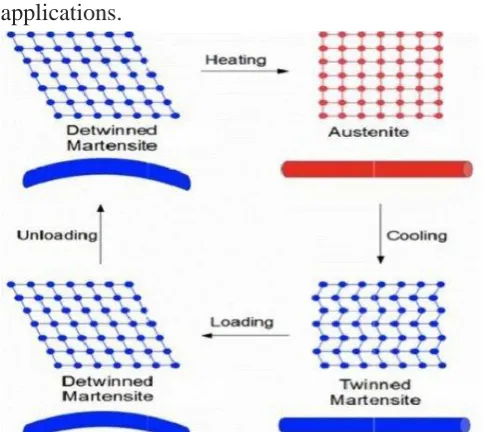
Shape memory is one of those special properties. When the smart material in twinned Martensite phase [8] undergoes external stress, it transforms to de-twinned Martensite phase as Procedure 1 indicates .There is no temperature change during this transformation. When the de-twinned Martensite material undergoes an increase in temperature, the de-twinned Martensite transforms to Austenite as seen in Procedure 2. As Procedure 3 indicates, Austenite will go back to twinned Martensite when the temperature goes down. There are four characteristic temperature points between Procedures 2 and 3, in the ascending temperature sort:
Mf, Martensitic finish temperature; Ms, Martensitic start temperature; As, Austenite start temperature; and Af, Austenite finish temperature During Procedures 1, 2 and 3, smart material will experience external stress change, temperature increase, and temperature decrease. Finally, it will go back to its original twinned status. Constraints of Procedure 3, the recovery procedure from Austenite to twinned Martensite, will generate a
considerable force. This particular property can be used in many ways in civil engineering structural applications.
Fig 1: Transformations between different phases
Fig 2: Demonstration of shape-memory effect B. Super elasticity
Available online: https://edupediapublications.org/journals/index.php/IJR/ P a g e | 2811 Fig 3: Stress-induced transformations of Austenite
materials
Figure b shows the stress-strain relationship of the typical phase changes of super elasticity smart materials under stress. The upper plateau represents the change from Austenite to Martensite under stress while the lower plateau represents the reverse process with stress release. This property can be used to rehabilitate the cracking of concrete when super elasticity smart material is used as the reinforcement bar. Super elasticity material also has some other important features like hysteretic damping, highly reliable energy dissipation capacity through repeatable phase transformation, excellent fatigue properties, and good resistance to corrosion.
V. SMA IN CIVIL STRUCTURES
The properties for which SMAs can be integrated in civil structures are:
1. The large force generated upon returning to its original shape is a very useful property.
2. Repeated absorption of large amounts of strain energy under loading without permanent deformation.
3. SMA has excellent damping characteristics at temperature below the transition temperature range.
4. Excellent property of corrosion resistance (comparable to series 300 stainless steels) and nonmagnetic in nature.
5. SMA has low density and high fatigue resistance under large strain cycles.
6. It has the ability to be heated electrically for recovery of shape.
A. Application of tensioning properties of SMA utilizing shape memory effect
1) SMA as a tendon in concrete structure
In concrete members shape memory alloy bars or cables can act as tendons. Studies of Deng.Z., , and Krstulovic-Opara, N., presented the use of SMA as a tendon in concrete members. SMA tendons have several advantages over conventional steel tendons. There are no frictional losses due to development of uniform tension force along the total length of the tendon during initiation of shape memory effects. It is very suitable for curved concrete
member or where tendon profile is much curved. Using SMA prestressing tendon, there is no need of anchors. This can be used for tensioning extremely thin concrete members.
Fig 4: SMA used as a tendon
2) SMA as an external tensioning material in concrete structure
Available online: https://edupediapublications.org/journals/index.php/IJR/ P a g e | 2812 presented an example of realization of an external
post tensioning. Corrosion resistant Fe-Mn-Si-Cr rods were used to enhance the shear resistance of a cracked region of a reinforced concrete bridge girder. Resistance heating was applied at a current of 1000Ampere.
B. Retrofitting of structure using super elastic properties of SMA
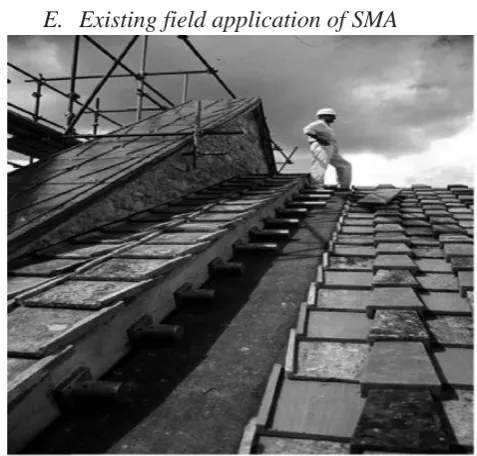
The super elastic behavior of SMA has attracted the attention of civil engineers. Its major field of application is retrofitting structures in an earthquake design. Graesser E.J successfully used Ni-Ti SMA for damping of seismic loads. The work of Wittig, P.R., used Cu-Zn-Al for torsion, bending and tension dampers. Cardone. D., compare in their work the super elastic bracing of RC-frames with classic steel bracings. A real scale application of a super elastic SMA device is the earthquake resistant retrofit of the Basilica San Francesco at Assisi, Italy Castellano, M.G., and Brite E.,. The historic gable was connected with the main structure by device using SMA rods. The Ni-Ti SMA rods were subjected to tension, although they were designed to take tension and compression forces.
Another project was executed to retrofit the earthquake resistant bell tower of the Church of San Giorgio, Italy .Steel tendons were added to increase its tilt resistance with intermediary super elastic SMA devices to act as load limiters to prevent the masonry from compression failure, Indirli, M., and ISTECH . DesRoches, R., proposed increasing the position stability of Simply Supported bridges in earthquake prone regions through connection between the bearings of the bridge and the bridge deck slab using super elastic bars.
The result shows that the SMA restrainer reduces effectively the relative hinge displacement at the abutment whereas with conventional steel
restrainer cable the elastic deformation range in compression was large. In-addition, the SMA restrainer extremely limits the response of bridge deck to near field ground motion. Sakai et al. carried out research work on self- restoration of a concrete beam using superelastic SMA wires. The results revealed that the mortar beam with SMA wires recovers almost completely after incurring an extremely large crack. University of Houston developed a more efficient way to use superelastic SMA wires to achieve a larger restoration forces in the form of standard cable. A concrete beam (24 in. x 4 in. x 6 in.) was reinforced with fourteen 1/8 in. diameter superelastic stranded cables with 2% pre-strain. Each cable had seven strands and each strand had seven superelastic wires. Special clamps were used to hold the superelastic strands without slippage. There was appearance of large cracks in the test beam under 11000 lbs load. On removal of load the crack on the beam was closed under the elastic restoration force of superelastic SMA. This research also demonstrates that the effective way to use SMAs for civil application is in form of stranded cable.
C. Concept of smart bridges
Available online: https://edupediapublications.org/journals/index.php/IJR/ P a g e | 2813 This height adjustment will correct the
unevenness problem as well as the internal forces induced from differential settlements, time-dependent deformations (creep and shrinkage of concrete, relaxation of prestressing steel), and temperature changes as discussed earlier. When needed, the prestress forces can also be adjusted to deal with cracking issues in both positive and negative moment zones.
With the combined application of the smart bearings and smart strands, the bridge can adjust its internal force distribution and mobilize each element to adapt itself to different environmental loads like those induced by differential settlement, time-dependent effects, temperature effects, and over-weight trucks.
Fig 5: Sketch of a smart bridge
D. Type of SMA, suitable for use in civil structures
However, not all the SMAs have the potential for being used in civil structures due to requirement of special mechanical properties, the specific temperature conditions in civil structures and last but not the least the cost involvement. Fe-Mn-Si-X alloys are low cost SMA with high super elastic properties and good shape memory effects. Comparing the market price of Ni and Ti on the one side and Fe, Mn, Si, Cr on the other side and consider their ratio, it will be a factor of about 8 to 12. So, in terms of cost an iron based SMA could only be a small fraction of that NiTi SMA. The study of Tamarat.K, shows that Fe-based SMA like Fe-Mn-Si-X, Fe-Ni-C and Fe-Ni-Co-Ti also referred to as shape memory steel or
Ferrous SMA have the potential for use in civil structures. The shape memory effects in FeMn-Si
containing sufficient amount of Mn were detected in 1982 by Sato et al.. In last decades Fe-Mn-Si based alloys with several additional alloying elements were developed and tested. With lots of research work, the poor shape memory effects and inferior corrosion behavior was improved. It was found that 60% to 65% ratio of iron in Fe-Mn-Si-X alloys combine low cost with high strength and high Young’s modulus. Corrosion behavior similar to that of stainless steel was achieved by Li. H.J., with addition of 10% chromium and nickel. From the literature of Farjami, S., , Lin. C., and Baruj, A., it was found that addition of Al, C, Co, Cu, N, Nb, NbC, V, VN, and ZrC improves shape memory effect. There is a wide scope of research towards uses of low-cost SMAs for initiating large-scale applications like civil structures. Low-cost SMA has been successfully implemented in bridge rehabilitation by Soroushian et al. . Graesser. E. J., used Ni-Ti for the damping of seismic load successfully. Wittig, R.P., used Cu-Zn-Al for torsion, bending and tension dampers incorporated in bracings. Because of better workability and lower cost of ferrous SMAs, these are more attractive than Ni-Ti SMA’s for use in civil structures.
Available online: https://edupediapublications.org/journals/index.php/IJR/ P a g e | 2814 Fig 6: Retrofitting of the Basilica of San
Francesco at Assisi, Italy
Fig 7: Retrofitting of the bell tower of the Church of San Giorgio at Trignano, Italy
Fig 8: Exterior of the Sherith Israel Synagogue retrofitted with SMA devices
Conclusion
This paper presents a review of the basic properties of Shape Memory Alloys and their applications in passive, active and semi-active control of civil structures. A number of experimental and analytical research works on SMA devices like dampers and base isolators are presented. They are proved to be effective in improving the response of civil structures to any extreme earthquake loading. In particular, the recentring capability of SMAs can be very efficient in reducing the cost of repairing and
retrofitting of various structures. Other prospective use of SMAs is in prestressing, which can help the structure to actively accommodate additional loading or remedy prestress losses over time. The self-repairing capabilities of super elastic SMAs may be utilized to regain the preload drop in bolted joints or other type of fasteners, and thus necessary clamping forces can be provided to keep the joint members together. Although there has been substantial research work on civil structures utilizing SMAs, the short and long-term deflection behaviour of concrete flexural members with SMAs are yet to be investigated through experimental program. The analysis for deflection behaviour of SMA & steel RC beams under various service loads had been carried out and their differences are presented. The analytical results show that, the mid-span deflection in SMA RC beams were less compared to steel RC beams of identical cross-section, length and grade. High rigidity and super elastic properties of SMA increase this load carrying capacity and reduces instantaneous and long-term deflections of SMA, RC beams. SMA act as a stiffener in the RC flexural members. Increase in percentage area of reinforcement, cross-sectional area and span of SMA RC beams results in increase of resistance to the deflection under service load. These analytical results are further required to be validated through experiments.
References
Available online: https://edupediapublications.org/journals/index.php/IJR/ P a g e | 2815 on fiber optic sensors embedded in concrete.
Measurement 2010;43:157–63.
2. F. Qin, Q. Kong, M. Li, Y. L. Mo, G. Song, F. Fan, "Bond slip detection of steel plate and
concrete beams using smart
aggregates", Smart Mater. Struct., vol. 24, no. 11, pp. 115039, Oct. 2015.
3. A. Katz, N. Berman, "Modeling the effect of high temperature on the bond of FRP reinforcing bars to concrete", Cement and Concrete Composites, vol. 22, pp. 433-443, 2010.
4. Q. Yu, Z.P. Bažant, R. Wendner, Improved algorithm for efficient and realistic creep analysis of large creep-sensitive concrete structures. ACI Struct. J. 109(5), 665–676 (2012)
5. Rao A: ‘Creep and elastic deformation in austenitic steels’, PhD thesis, The Open University, Milton Keynes, 2010.
6. M Kabla, H Seiner, M Musilova, M Landa, D Shilo - Acta Materialia, 2014 – Elsevier
7. F Maresca, VG Kouznetsova, MGD Geers – ‘multi phase steel’,Scripta Materialia, 2016 – Elsevie