Image Resolution Improvement by Using Discrete Wavelet Transforms
and Stationary Wavelet Transform
Raghu Amgothu
Assistant Professor, Department Of ECE, Government Polytechnic, Warangal, Telangana 506007, India.
Abstract: In this correspondence, the creators
propose an image resolution upgrade procedure in
view of the introduction of the high-recurrence
suband images got by discrete wavelet transform and
the info image. The edges are upgraded by presenting
a moderate stage by utilizing stationary wavelet
transform . discrete wavelet transforms is connected
keeping in mind the end goal to deteriorate an info
image into various subbands. At that point, the
high-recurrence subbands, and in addition the information
image, is inserted. The assessed high-recurrence
subbands are being changed by utilizing
high-recurrence subband acquired through stationary
wavelet transform. At that point, all these subbands
are joined to produce another high-resolution image
by utilizing backward discrete wavelet transforms.
The quantitative and visual outcomes are
demonstrating the prevalence of the proposed method
over the customary and condition of-workmanship
image resolution upgrade systems.
Index Terms: discrete wavelet transforms, image
super resolution, stationary wavelet transform.
1.INTRODUCTION
SATELLITE images are used in numerous
applications, for example, geoscientific studies,
cosmology, and topographical data frameworks.
Resolution of an image is dependably a vital issue in
all image and video preparing applications, for
example, video resolution upgrade, including
extraction and satellite image resolution
improvement. In image preparing to expand the
number of pixels in the advanced image is called as
the interjection. Insertion has been broadly utilized
for resolution upgrade. The addition has been
generally utilized as a part of all image preparing
applications, for example, numerous depiction
coding, facial recreation, and image resolution
improvement. There are four prominent insertion
methods named as the closest neighbor, bilinear,
bicubic and Lanczos. Closest Neighbor result in
noteworthy Jaggy Edge twisting. The Bilinear
Interpolation result in smoother edges however to
some degree obscured appearance by and large.
Bicubic Interpolation looks best with smooth edges
and considerably less obscuring than the bilinear
outcome. The Lanczos interjection which is the only
windowed type of a sinc channel is superior to
anything other customary addition strategies like the
closest neighbor, bilinear, and bicubic insertion, on
account of expanded capacity to identify edges and
direct highlights. Resolution upgrade strategies which
not utilize wavelets get influenced by the downside of
losing high-recurrence segments, which create
obscured yield. In any case, Wavelet Transform holds
these high recurrence parts. Wavelet transform gives
time and recurrence portrayal at the same time. The
high recurrence subbands got by applying
STATIONARY WAVELET TRANSFORM on the
insertion to get high recurrence subbands with a
specific end goal to get right evaluated coefficients.
In this work, we are utilizing STATIONARY
WAVELET TRANSFORM and DISCRETE
WAVELET TRANSFORMS to upgrade image
resolution and the halfway subbands of the image
created by STATIONARY WAVELET
TRANSFORM and DISCRETE WAVELET
TRANSFORMS are added by utilizing Lanczos
insertion. At long last, we join all subbands by
utilizing IDISCRETE WAVELET TRANSFORMS.
We can apply this image resolution upgrade
procedure in multitemporal image change
recognition, which is only a utilization of this image
resolution improvement strategy. The initial phase in
multitemporal image change location is finding the
distinction image of satellite image taken at two
diverse time stamps of same geological territory at
that point upgrading same by above resolution
improvement strategy, which create improved
contrast image. At long last we get change discovery
come about by applying k-mean calculation on
upgraded distinction image as it were.
2. PROPOSED IMAGE RESOLUTION
IMPROVEMENT
In image resolution improvement by utilizing
addition the fundamental misfortune is on its
high-recurrence segments (i.e., edges), which is because of
the smoothing caused by interjection. So as to build
the nature of the super-settled image, protecting the
edges is fundamental. In this work, DISCRETE
WAVELET TRANSFORMS has been utilized
keeping in mind the end goal to protect the
high-recurrence segments of the image. The repetition and
move invariance of the DISCRETE WAVELET
TRANSFORMS imply that DISCRETE WAVELET
TRANSFORMS coefficients are characteristically
interpolable. In this correspondence, one level
DISCRETE WAVELET TRANSFORMS is utilized
to decay an information image into various subband
images. Three high-recurrence subbands contain the
high-recurrence segments of the information image.
In the proposed strategy, bicubic introduction with
growth factor of 2 is connected to high-recurrence
subband images. Downsampling in each of the
DISCRETE WAVELET TRANSFORMS subbands
causes data misfortune in the separate subbands. That
is the reason STATIONARY WAVELET
TRANSFORM is utilized to limit this misfortune.
The interjected high-recurrence subbands and the
STATIONARY WAVELET TRANSFORM
high-recurrence subbands have a similar size which
implies they can be added to each other. The new
rectified high-recurrence subbands can be interjected
encourage for higher growth. Additionally, it is
realized that in the wavelet space, the low-resolution
image is gotten by lowpass sifting of the
high-resolution image . At the end of the day, the
low-recurrence subband is the low resolution of the first
image. In this manner, rather than utilizing
low-recurrence subband, which contains less data than the
first high-resolution image, we are utilizing the info
image for the interjection of low-recurrence subband
image. Utilizing input image rather than
low-recurrence subband builds the nature of the
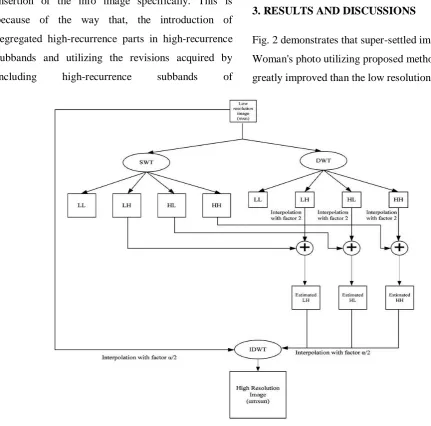
super-settled image. Fig. 1 shows the square outline of the
proposed image resolution upgrade system. By
introducing input image by, and high-recurrence
introduction arranges separately, and afterward by
applying IDISCRETE WAVELET TRANSFORMS,
as outlined in Fig. 1, the yield image will contain
more honed edges than the introduced image got by
insertion of the info image specifically. This is
because of the way that, the introduction of
segregated high-recurrence parts in high-recurrence
subbands and utilizing the revisions acquired by
including high-recurrence subbands of
STATIONARY WAVELET TRANSFORM of the
info image, will save more high-recurrence segments
after the insertion than interjecting input image
straightforwardly.
3. RESULTS AND DISCUSSIONS
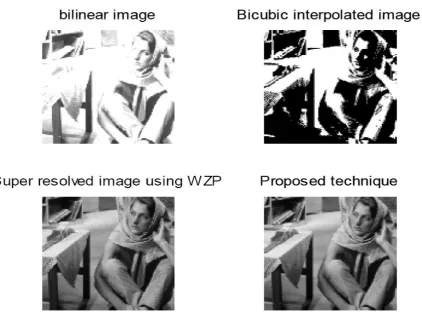
Fig. 2 demonstrates that super-settled image of
Woman's photo utilizing proposed method in (d) are
greatly improved than the low resolution
Fig. 3.0. Block diagram of the proposed super resolution algorithm.
The image in (a), super-settled image by utilizing the
addition (b), and WZP (c). Note that the info
low-resolution images have been gotten by
down-inspecting the first high-resolution images. Keeping
in mind the end goal to demonstrate the viability of
the proposed strategy over the ordinary and condition
of-craftsmanship image resolution upgrade systems;
four surely understood test images with various
highlights are utilized for correlation. Table I looks at
the PSNR execution of the proposed system utilizing
bicubic insertion with customary and condition
bicubic, HMM SR, WZP, NEDI, HMM, WZP-CS,
WZP-CS-ER, DISCRETE WAVELET
TRANSFORMS SR, CWT SR, and
Regularity-safeguarding image introduction. Furthermore,
keeping in mind the end goal to have more far
reaching examination, the execution of the
super-settled image by utilizing STATIONARY
WAVELET TRANSFORM just is additionally
incorporated into the table. The outcomes in Table I
show that the proposed system over-plays out the
previously mentioned traditional and condition
of-craftsmanship image resolution upgrade procedures.
Table I likewise demonstrates that the proposed
method over-plays out the previously mentioned
ordinary and condition of-craftsmanship image
resolution improvement strategies.
4. CONCLUSION
This work proposed an image resolution
improvement method in view of the insertion of the
high recurrence subbands got by DISCRETE
WAVELET TRANSFORMS, amending the high
recurrence subband estimation by utilizing
Fig. 2. (an) Original low-resolution Woman's image. (b) Bicubic inserted image. (c) Super-settled image