© 2014, IJCSMC All Rights Reserved 532 Available Online atwww.ijcsmc.com
International Journal of Computer Science and Mobile Computing
A Monthly Journal of Computer Science and Information Technology
ISSN 2320–088X
IJCSMC, Vol. 3, Issue. 11, November 2014, pg.532 – 547
RESEARCH ARTICLE
Coverage Improvement by Using
RNCHE Algorithm Based on LEACH
Protocol for Wireless Sensor Network
Ali Hassan Muosa1, Rana Hameed Hussain2
1,2 Dep. of Computer Science, Faculty Science Computers and Mathematic, Thi-Qar University, Iraq
1
[email protected]; 2 [email protected]
Abstract
Maximization of Wireless Sensor Network (WSN) lifetime cannot be achieved
without carefully scheduling the energy utilization. Energy saving represents one of the
important factors that should be taken into account during the design of any routing protocol.
It also explained that some applications require getting a high degree of network coverage to
get a full knowledge about the events occurs in the different parts of the network.
This work present proposed a new algorithm which develops Low Energy Adaptive
Clustering Hierarchy (LEACH) algorithm to improve the network coverage. That called
Reduced Number of Cluster Heads Enhancement (RNCHE) and it aims at reducing the
energy consumption by avoiding communication with the sink node from two adjacent cluster
heads in the network and providing them in the parts that left without any cluster head after
the phase that LEACH algorithm selects some nodes to be responsible for data gathering and
transferring.
© 2014, IJCSMC All Rights Reserved 533 1. Introduction
LEACH is a self-organizing and adaptive clustering protocol and
also a simple routing protocol in WSNs [1]. It uses randomization to
distribute the energy load evenly among the sensors in the network [2, 3].
Recent advances in wireless communications and electronics have
enabled the development of low-cost, low-power and multifunctional
sensor nodes that are small in size and have sensing, data processing and
communicating components [4]. These devices leverage the idea of
sensor networks [5]. WSN consists of a large number, may be hundreds
or thousands, of small devices, which are called nodes or motes, with
sensing, computation and wireless communication capabilities distributed
to monitor physical or environmental conditions such as temperature,
sound, motion, etc. [6]. Nodes in WSN communicate over short distances
through wireless channels for information sharing and cooperative
processing to accomplish common tasks and they have many advantages
over other traditional ad hoc networks such as easy deployment and low
cost [7].
In this paper provide improved schemes based on LEACH. It
presents algorithm; to deals with the formation of adjacent clusters which
may be very close to each other so the network will consume energy to
transfer redundant data. Adjacent cluster merging algorithm is energy
saving and in order to verify the performance of this algorithm, the
energy consumed by the cluster heads that will be merged is computed
for both LEACH and RNCHE.
2. The Coverage in WSNs Problem Description
The random selection of cluster heads depended by LEACH
© 2014, IJCSMC All Rights Reserved 534 heads at the same round [8]. So the two formed cluster will be overlapped
and the distances between their members may be very small.
This case leads to consume energy to gather and transmit a
redundant data especially when the two selected cluster heads are very
close to each other [9]. RNCHE aims at avoiding data redundancy and
reducing the energy that is consumed by the two adjacent cluster heads
because it minimizes the number of data transmissions towards the sink
using clusters merging.
Reducing the number of transmission times towards the sink has a
great effect on the energy saving in the network since energy needed to
communicate with the sink node is larger than that needed to gather
information within the cluster range because of the large distances
between the network nodes and the sink node.
3. The RNCHE Algorithm Description
The algorithm suggests that any two adjacent cluster heads; the
distance between them is less than or equal a predetermined threshold,
should be merged to form one cluster.
Clusters heads can dedicate the existence of other cluster heads in
their communication range depending on their receiving to the
“advertisement message”, each cluster head can estimate the distance
between it and the “advertisement message” sender according to the
strength of the signal received then they compare the estimated distance
with the pre-determined threshold. If the distance between the two
adjacent cluster heads is less than or equal to the threshold value, the
following RNCHE is applied.
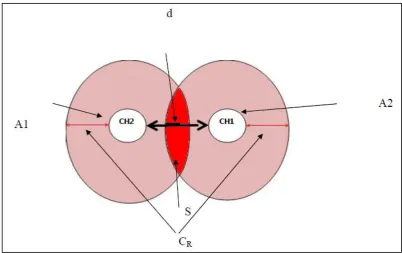
The algorithm Suppose that CH1 and CH2 are two adjacent cluster
© 2014, IJCSMC All Rights Reserved 535 to T, T is a distance threshold that its value is determined previously
depending on the sensing and communication ranges of the sensors, A1 is
the area of CH1 cluster, i.e. the area determined by of the Cluster Radius
(CR) of CH1. A2 is the area of CH2 cluster and S is the overlapping area
between CH1 and CH2 clusters. In Figure (1) these two overlapped
clusters are shown.
Suppose that CH1 has a higher energy level than CH2, CH1 and
CH2 will be merged and CH1 will be the head of the cluster formed from
their merging. Because it is not preferred to make CH1 exhausted with
the transmission from data gathered from the new cluster resulting from
clusters merging, CH2 partitions A2 into a grid of MxN square cells and
it selects the only members that can preserve the coverage for its cluster
region. CH1 will do the same with (S) to achieve more energy saving.
In case of receiving more than one “advertisement message”, the
node selects the nearest CH whose energy level is more than the residual
energy it has.
© 2014, IJCSMC All Rights Reserved 536 The area of the overlapping is mainly depended on the distance
between the two clusters heads, the steps of RNCHE are as follows:
1. According to advertisement message, the energy values of both CH1 and CH2
are known by each other's.
2. Suppose CH1 energy level > CH2 energy level.
3. CH2 divides A2 into MxN square cells with W length, where W varied
according to the sensing range of the sensors.
4. If there are more than one member of CH2 in one cell, only one is selected.
5. CH2 sends a message to CH1 containing the ID’s of the selected members in
(4).
6. CH1 partitions S into a grid into KxL square cells with the sameW used by
CH2 in step (3).
7. For each cell in S, CH1 do the following:
If this cell contains CH1 member together with CH2 selected member,
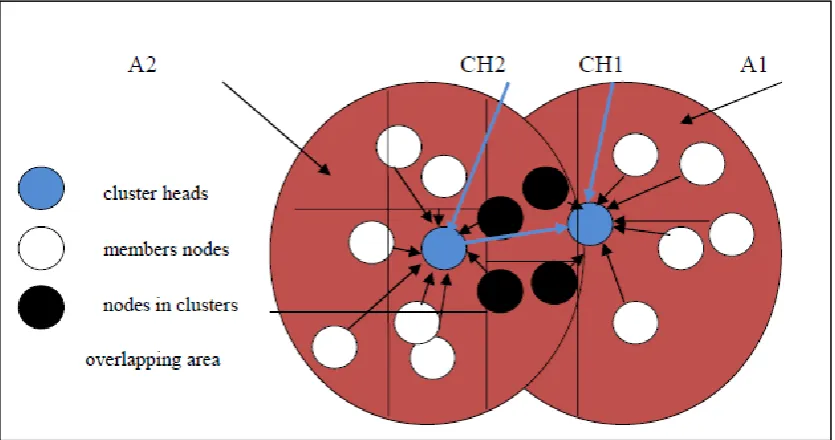
then CH1 ignore it's member. Else it select this member (Figure 2.a.
steps 3-7).
8. CH1 sends a message to CH2 which includes the time slot that CH2 should
start with in order to schedule it’s selected members to avoid collision during
data transmission.
9. CH1 schedules all its members that have been chosen in (7).
10.CH2 schedules all its selected members with a scheduling message which
contain the ID of CH1. The selected members of CH2 cluster terminate the
connection with CH2 and send their data to CH1 (Figure 2.b).
11. Members of CH1 send their data CH1 as normal.
12.CH1 aggregates the whole received data and sends the aggregated data to the
sink.
© 2014, IJCSMC All Rights Reserved 537
Figure 2.a: The partitioning of CH2 cluster region and the overlapping area.
Figure 2.b: New cluster construction.
© 2014, IJCSMC All Rights Reserved 538
4.
Performance Measurement
LEACH protocol and the proposed algorithm are simulated using
the proper environments, then the results are recorded and compared
depending on certain comparison factors.
Since the important goal of the adjacent cluster merging algorithm
is energy saving and in order to verify the performance of this algorithm,
the energy consumed by the cluster heads that will be merged is
computed for both LEACH and RNCHE. The following procedure is
applied to compare the results:
The energy value of each cluster head is recorded before and after
the round at which it acts as cluster head. The difference between
these two levels is computed to find out the energy consumed when
the nodes served as CH.
The difference values -calculated in the previous step- of the CHs
that will be merged when applying the cluster merging algorithm
are accumulated together to computed the total energy consumed
by the two adjacent cluster heads, the summation values of
LEACH protocol will be compare with the corresponding values of
cluster merging algorithm.
The second proposed algorithm is not only concerned with energy
levels, this algorithm aims also to increase the number of nodes that
sending their data to the sink in the parts where no coverage is provided
by LEACH, so two factors are depended to show the algorithm
efficiency; they are the number of active nodes (nodes that send data to
© 2014, IJCSMC All Rights Reserved 539 After a certain number of execution rounds, the number of the
active nodes are computed and compared for each round for both LEACH
and the proposed algorithm, The energy levels of nodes after the last
round is also compared in order to see that the normal nodes energies are
kept without a great change by the additional data gathering tasks caused
by the responses to the queries sent by the advanced nodes to provide the
necessary coverage. The reason behind the energy keeping of the normal
nodes is that the cluster heads responsibilities are taken by advanced
nodes.
This work provides many of the conditions that should be taken
into account to ensure a fair comparison. These conditions are:
The similarity between the simulation topologies: The locations
of the normal nodes deployed in the two environments used to
simulate LEACH protocol and the new algorithm are exactly the
same and the existence of the advanced nodes in the second
algorithm environment would never affect the locations of the
normal nodes, the sizes of the networks and the sink nodes
locations were also the same. This accurate similarity is essential
because the changing of nodes locations leads to changing the
adjacency of the nodes and the distances between them, this will
affect the energy consumed by the CHs because of the variation of
the number of their neighbors and the distances between them
which make the comparison operation untrusted.
The similarity between the cluster heads nodes at each round:
The nodes that will act cluster heads at each round of the execution
of the algorithm that are wanted to be compared should be the
same. To explain the meaning clearer consider the following
© 2014, IJCSMC All Rights Reserved 540 round (0) of LEACH protocol, the same nodes should be forced to
be cluster heads at the same round during the execution of the
proposed algorithms.
5.
The Reduced Number of Cluster Heads Enhancement
Algorithm Results:
Reduced Number of Cluster Heads Enhancement algorithm is
tested three times for each one of the three environments (50, 75 and 100
nodes environments), LEACH is executed first, CHs are selected
randomly depending on LEACH algorithm and the nodes that acted as
CHs during each round of the simulation is recorded in order to use them
as cluster heads at the same rounds during the simulation of the proposed
RNCHE algorithm. Energy values are calculated according to the radio
energy model, are used to calculate the energy consumed by the two
adjacent cluster heads during the round they act as cluster heads in
LEACH and after the clusters merging using RNCHE algorithm.
Some of the runs contain more than one merging case and this
mainly depends on the locations of the cluster heads that selected
randomly by LEACH, in these cases the results of only two merging
cases are presented.
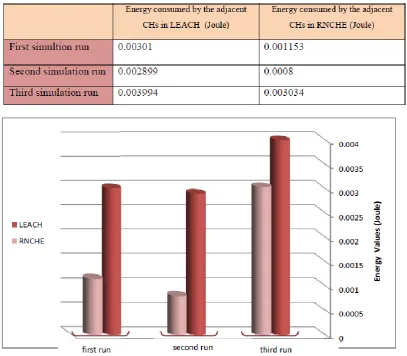
Tables (1, 2 and 3) show the summation of the energy consumed
by the adjacent cluster heads before and after their merging using 50, 75
and 100-nodes networks respectively.
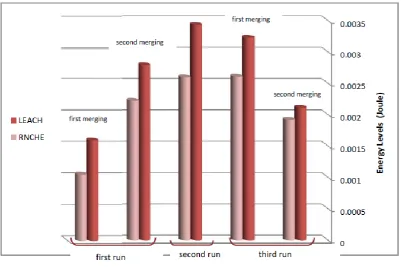
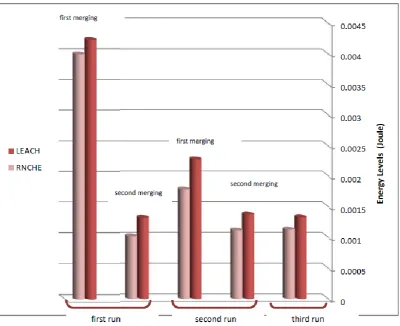
Figures (3, 4 and 5) contain two columns, the first one represents
the summation of the energy consumed by the two CHs in LEACH while
the second represents that summation after applying the merging
© 2014, IJCSMC All Rights Reserved 541 Figure (3) shows the results of the first, second and third
simulation runs using the 50-nodes network. In the same manner, Figure
(4) explained the results of 75-nodes network while the results of first,
second and the third simulation runs of the 100-nodes network are shown
in Figure (5).
As it has mentioned earlier, some simulation runs have more than
one merging case.
Table 1: The energy values of the adjacent cluster heads in 50-nodes
network.
© 2014, IJCSMC All Rights Reserved 542 Table 2: The energy values of the adjacent cluster heads 75-nodes
network.
© 2014, IJCSMC All Rights Reserved 543 Table 3: The energy values of the adjacent cluster heads 100-nodes
network.
© 2014, IJCSMC All Rights Reserved 544 It is clear from the above charts that there is a significant difference
in the total consumed energy by the two algorithms, this makes RNCHE
helps in energy saving. It can easily concluded from the values of the
consumed energy shown in Tables (1, 2 and 3) that there is a difference
between the energy consumed by the adjacent cluster heads before and
after their merging. Although these differences are in the third or fourth
decimal points but this values are significant compared to the initial value
of the sensor's energy (0.5) which is expected to work during long periods
of time, besides that these differences represent the saved energy at single
round and it will be increased by the reputation of the merging cases
during the whole the network lifetime.
It can be noticed also that the amount of energy saved is varied
from one merging case to another and this mainly depended on the
numbers of the nodes that both of the cluster heads could give up when
they applied the clusters area partitioning.
In the first and second merging cases in Table (1), the amount of
the energy needed to transfer data from the cluster heads after the
applying of RNCHE is very small compared with that was spending by
them before merging. This occur because the number of the member
nodes in cluster with low energy level is small or lying in adjacent
locations.
By the increasing of nodes density, the number of merging cases is
increased and this will have a good effect on the total consumed energy at
each simulation run even when the amount of the saved energy in each
single merging case is not very large. In Table (2), the total saved energy
(the summation of the differences between consumed energy before and
after merging ) in the two merging cases at the first simulation run is
© 2014, IJCSMC All Rights Reserved 545 the cluster heads in the second merging case before their merging which
is equal (0.001593). the is also true in the (100-nodes) network where the
amount of the total saved energy in the first simulation run is (0.000433)
which represents (1/3) of the energy consumed by the two adjacent
clusters before merging.
It is important to take into account that:
In simulation runs that contain more than one merging case the
results of only merging cases are presented, the additional merging
cases will help in keep more amount of the network energy.
Data aggregation strategy has a great effect on the results. In this
work it is assumed that the (1/3) of the received data is redundant,
the results can be improved when the user applies another
parameter or aggregation function. If the used aggregation function
is MAX, for example, the energy required by the cluster head of
the cluster formed from clusters merging (the cluster head with
high energy level) to transmit the (MAX) value will be the same
before and after its merging with another cluster head since it
represents a single value. This will make RNCHE algorithm reduce
the energy needed by the merged cluster heads to half of the energy
before merging.
6.
Conclusions
Sensors spent more of their energies in messages transferring and
according to the radio dissipation energy model, the amount of the
consumed energy is highly affected by the distance between the source
and the destination of the communication.
Reduction of the number of the nodes that send data for large
© 2014, IJCSMC All Rights Reserved 546 clustering protocols and it is one of the main factors of the efficiency of
these protocols. In clustering, only one node at each cluster sends the data
of its neighbors to base station, this will prevent data transferring from all
the nodes. The idea is applied in RNCHE, in the algorithm the merging
cases reduce the number of the communications with the sink while the
normal nodes in the newly covered parts will be used only for intra –
cluster communication.
7.
Future Works
RNCHE algorithm can be extended to include the combination of
more than two adjacent clusters using any other suitable merging
conditions. And also can be combined with a powerful data aggregation
algorithm to achieve more energy saving. Fuzzy logic mechanism can be
considered as a mean of providing new conditions in the adjacent clusters
merging.
References
[1] Heinzelman W., Chandrakasan A. and Balakrishnan H., “
Energy-Efficient Communication Protocol for Wireless Mirosensor
Networks”, Proceeding of the 33rd Hawii International Conference
on System Science, 2000.
[2] Hussain S. A and K. E Sreenivasa Murthy, “Efficient and Reliable
Routing protocol for Wireless Sensor Networks (WSNs)”,
International Journal of Computer Science and Communication
(IJCSC), Vol. 2, No. 2, Pages. 509-512, July-December 2011.
[3] Dargie W. and Poellabauer C., “Fundamentals of Wireless Sensor
© 2014, IJCSMC All Rights Reserved 547 Communications and Mobile Computing, A john Wiley and Sons,
Ltd., Publication, 2010.
[4] Deep T., “Analysis of Low Energy Adaptive Clustering
Hierarchy (LEACH) protocol”, National Institue of Technology,
Department of Computer Science and Engineering, 2011.
[5] 1. Lan F. Akyildiz, Weilian Su, Yogesh Sankarasubramaniam and
Erdal Cayirci, “A Survey on Sensor Networks”, IEEE
communications Magazine, August 2002.
[6] Fan G. and Jin S., “Coverage Problem in Wireless Sensor
Network: A Survey”, Journal of Networks, Vol.5, No. 9, September
2010.
[7] M. Bani Yassein, A. Al-zou'bi Y. Khamayseh and W. Mardini,
“Improvement on LEACH Protocol of Wireless Sensor Network
(VLEACH)” , International Journal of Digital Content Technology
and its Applications ,Volume 3, Number 2, June 2009.
[8] Ebadi S., Ghasembaglou M., Navin A. and Mirnia M., “ Energy
`Balancing in Wireless Sensor Networks with Selecting Two
Cluster-Heads in Hierarchical Clustering”, International
Conference on Computational Intelligence and Communication
Systems, 2010.
[9] Naeimi S., Ghafghazi H., Chow C., and Ishii H., “A survey on The
Taxonomy of Cluster-based Routing Protocol for Homogeneous