© 2014, IJCSMC All Rights Reserved 469
Available Online atwww.ijcsmc.com
International Journal of Computer Science and Mobile Computing
A Monthly Journal of Computer Science and Information Technology
ISSN 2320–088X
IJCSMC, Vol. 3, Issue. 11, November 2014, pg.469 – 476
RESEARCH ARTICLE
Study of Image Fusion- Techniques,
Method and Applications
1
R.Johnson Suthakar,
2J.Monica Esther
M.E,
3D.Annapoorani,
4F.Richard Singh Samuel
PG Student, Assistant Professor, PG Student, PG Student,
1,2,3,4Department of Information Technology,
Francis Xavier Engineering College, Tirunelveli, TamilNadu, India
Abstract - This paper describes a survey of image fusion. Image fusion is process of combining multiple input images into a single output image which contain better description of the scene than the one provided by any of the individual input images. The fused image provides detail information about the scene which is more useful for human vision perception and machine perception or further image-processing tasks such as segmentation, feature extraction and object recognition. This survey paper mainly looks into the methods, technique and applications which helpful for researcher to refer image fusion concept.
Keywords: Image fusion, fused image, human and machine vision
I. INTRODUCTION OF IMAGE FUSION
Generally two types of vision are classified. They are human vision and computer vision. Human vision is sophisticated system that senses and acts on visual stimuli. It has evolved for millions of years, primarily for defence or survival. Basic computer vision system requires a camera, a camera interface and a computer.
A feature closely related to image quality is focus. Sharp images provide better information than blurry images. However, in some situations it is not possible to obtain totally focused images in just one single camera shot, since some regions appear to be blurred due to variations in the depth of the scene and of the camera lenses focus. This means that if the camera is focused at one specific object, another region of the scene can be out of focus. An interesting solution is to take more pictures of the desired landscape in the same position, but with focus centered in different elements of the scenery. Then, using the image fusion concept, all source images are combined, creating a single image that contains all the best focused regions. Image fusion is becoming very popular in digital image processing.
The main aim of any image fusion algorithm is to coalesce all the important visual information from multiple input images such that the resultant image contains more accurate and complete information than the individual source images, without introducing any artifacts.
© 2014, IJCSMC All Rights Reserved 470
II. THE EVOLUTION OF IMAGE FUSION RESEARCH
The good image fusion method has the following properties. First, it can preserve most of the useful information of different images. Second, it does not produce artifacts which can distract or mislead a human observer or any subsequent image processing steps. Third it must be reliable and robust. Finally it should not discard any salient information contained in any of the input images.
Figure 1: Image Fusion Process
The first evolution of image fusion research is simple image fusion, which perform the basic pixel by pixel related operations like addition, subtraction, average and division. Normally fusion techniques which rely on simple pixel operations on the input image values. Now the following operations are described.
Addition
Addition is the simplest fusion operation. It works by estimating the average intensity value of the input images on a pixel-by-pixel basis. The technique assumes a semantic alignment and requires very accurate spatial and radiometric alignment. The technique has the advantage of suppressing any noise which is present in the input images.
Average
The pixel average technique has the disadvantage that it tends to suppress salient image futures producing a low contrast image with a “washed-out” appearance.
Subtraction
Subtraction is the complement to addition and is used as a simple fusion operator in change detection algorithms.
Multiplication
Multiplication is not widely used as image fusion operators. However, one important image fusion application where multiplication is used in Brovey pan sharpening.
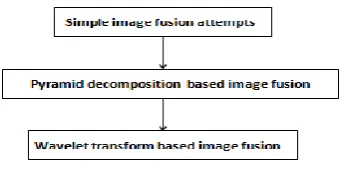
Figure 2: evolution of image fusion
The second evolution of image fusion research is pyramid decomposition based image fusion. The primitive fusion schemes perform the fusion right on the source images, which often have serious side effects such as reducing contrast. With the introduction of pyramid transform in mid80’s, some sophisticated approaches began to emerge. People found that it would be better to perform the fusion in the transform domain.
More recently, with the development of wavelet theory, people began to apply wavelet decomposition to take the place of pyramid decomposition for image fusion. Actually wavelet transform can be taken as one special type of pyramid decompositions.
III. IMAGE FUSION TECHNIQUES
In general, fusion techniques can be classified into different levels. They are signal level, pixel/data level, feature level and decision level.
Signal level fusion In signal based fusion, signals from different sensors are combined to create a new signal with a better signal to noise ratio than the originals signals.
© 2014, IJCSMC All Rights Reserved 471
Feature level fusion extracts various features, e.g. edges, corners, lines, texture parameters etc., from different data sources and then combines them into one or more feature maps that may be used instead of the original data for further processing. It used as input to preprocessing for image segmentation or change detection.
Decision level fusion combines the result from multiple algorithms to yield a final fused decision. When the results from different algorithms are expressed as confidences rather than decisions, it is called soft fusion. Otherwise it is called hard fusion. Methods of decision fusion include voting methods, statistical methods and fuzzy logic based methods.
IV. IMAGE FUSION METHOD
Now a day’s many fusion methods are available in research, but every new method based on the common characteristics on basics method. This paper contains some basic image fusion methods. They are IHS, PCA, BT, MRA and EMD. Here above methods described in theoretically.
A. Intensity-Hue-Saturation (IHS) Image Fusion Method
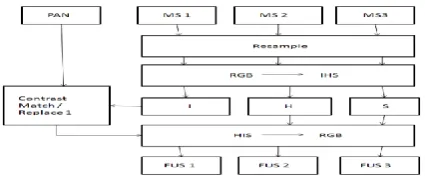
IHS is a common way of fusing high spatial resolution, single band, pan and low spatial resolution, multispectral remote sensing image. The R, G and B bands of the multispectral image are transformed into HIS components, replacing the intensity component by the pan image, and performing the inverse transformation to obtain a high spatial resolution multispectral image (see fig 3). HIS can enhance spatial details of the multispectral image and improve the textural characteristics of the fused, but the fusion image exist serious spectral distortion. The HIS transform is used for geologic mapping because the IHS transform could allow diverse forms of spectral and spatial landscape information to be combined into a single data set for analysis.
Figure 3: Block scheme of the IHS fusion method
Although the HIS method has been widely used, the method cannot decompose an image into different frequencies in frequency space such as higher or lower frequency. Hence the IHS method cannot be used to enhance certain image characteristics. The color distortion of HIS technique is often significant. To reduce the color distortion the PAN image is matched to the intensity component are stretching before the reverse transform. Image fusion based on the non sub sampled Contourlet transform (NSCT) and HIS achieved increased in retaining the spectral information and spatial details and better integration effect. With HIS transform, the segment based fusion was developed specifically or a spectral characteristics preserving image merge coupled with a spatial domain filtering.
B. The Brovey Transform image fusion
The BT is based on the chromaticity transform. It is a simple method for combining data from multiple sensors with the limitation that only three bands are involved. It purpose is to normalize the three multispectral bands used for RGB display and to multiply the result by any other desired data to add the intensity or brightness component to the image.
This technique requires an experienced analyst for the specific adaptation of parameters. This produces development of a user friendly automated tool. The Brovey Transform was developed to avoid the disadvantages of the multiplicative method. It is a combination of arithmetic operations and normalizes the spectral bands before they are multiplied with the panchromatic image.
C. Principal Component Analysis
© 2014, IJCSMC All Rights Reserved 472 It translates correlated data set to uncorrelated dataset. PCA data are often more interpretable than the source data. By using this method, the redundancy of the image data can be decreased.
The PCA involves a mathematical procedure that transforms a number of correlated variables into a number of uncorrelated variables called principal components. It computes a compact and optimal description of the data set. The first principal component is taken to be along the direction with the maximum variance.
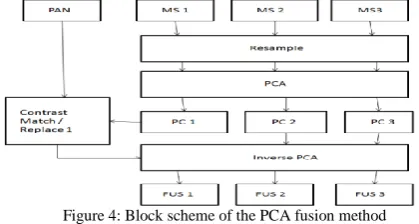
Figure 4: Block scheme of the PCA fusion method
The second principal component is constrained to lie in the subspace perpendicular of the first. Within this subspace, this component points the direction of maximum variance. The third principal component is taken in the maximum variance direction in the subspace perpendicular to the first and two. The PCA is also called as Karhunen-Loeve transform or the Hotelling transform. The PCA does not have a fixed set of basis vectors like FFT, DCT and wavelet etc.
In the fusion process, PCA method generates uncorrelated images (PC1, PC2,…. PCn , where n is the number of input multispectral bands). The first principal component (pc1) is replaced with panchromatic band, which has higher spatial resolution than the multispectral images. Afterwards, the inverse PCA transformation is applied to obtain the image in the RGB color model as shown in Figure 4.
V. MULTI RESOLUTION ANALYSIS BASED METHOD
Multiresolution analysis is one of the most promising methods in image processing. The MRA concepts was intimated by Meyer and Mallat, which provides a natural framework for the understanding for wavelet and pyramid transform bases. The first component to multiresolution analysis is vector spaces. The researcher classified the multiresolution in two ways, they are low resolution and high resolution. The vector space contain another vector space its higher resolution. Each vector space contains all vector spaces that are of low resolution.
A. Pyramid Transformation
The basic idea is to construct the pyramid transform of the fused image from the pyramid transforms of the source images and then fused image is obtained by taking inverse pyramid transform. Here are some advantages of pyramid transform:
1.It can provide information on the sharp contrast changes and human visual system is especially sensitive to these sharp contrast changes.
2.It can provide both spatial and frequency domain localization
Several types of pyramid decomposition are used or developed for image fusion such as
o Laplacian Pyramid
o Ratio of low pass pyramid
o Gradient Pyramid
Laplacian Pyramid
© 2014, IJCSMC All Rights Reserved 473 Figure 5: Block scheme of the Laplacian Pyramid fusion method
Laplacian Pyramid used several modes of combination such as selection or averaging. In the first one the combination process selects the component pattern from the source and copies it to the composite pyramid, while discarding the less pattern. In the second one, the process averages the sources patterns.
B. Wavelet Transform
The wavelet transform has become a very useful tool for image fusion. The wavelet based approach is appropriate for performing fusion takes for the following reasons
1. It is a multiscale (multiresolution) approach well suited to manage the different image resolutions.
2. The discrete wavelet transform allows the image decomposition in different kinds of coefficients preserving the image decomposition
3. Such coefficients coming from different images can be appropriately combined to obtain new coefficients so that the information in the original images is collected appropriately.
4. Once the coefficients are merged, the final fused image is achieved through the inverse discrete wavelets transform (IDWT), where the information in the merged coefficients is also preserved.
The key step in image fusion based on wavelets is that of coefficients combination in order to obtain the best quality in the fused image. This can be achieved by set of strategies.
Figure 6(a): Single resolution level Figure 6(b): Multi resolution level
Fig. 6 illustrates two diagrams for generic MSD approaches. In Fig. 6(a) the source images must have identical spatial resolutions. Hence, if their resolutions are different, an image resampling (RS) followed by an image registration (IR) strategies are previously required. The DWT is applied to both images and a decomposition of each original image is achieved.
Only coefficients of the same level and representation are to be fused, so that the fused multiscale coefficients can be obtained. Once the fused multiscale is obtained, through the IDWT, the final fused image is achieved. In Fig. 6(b) there are two sources images with different resolution levels, the DWT is only applied to the image with the higher spatial resolution and then obtain a multiscale image representation for such image. Here only a unique type of coefficients belonging to the multiscale representation of the higher-resolution image and the original pixels of the smaller image are to be fused. A fused multiscale representation is obtained and as before, through the IDWT the final fused image is achieved.
Figure 7: (a) image 1 (focus on left) (b) image 2 (focus on right) Figure 7: (c) fused image by DWT
© 2014, IJCSMC All Rights Reserved 474
Image resampling RS is the used to create a new version of the original image with a different width and height in pixels. Simply speaking, RS can change the size of the image. Increasing the size is called upsampling, and decreasing the size is called downsamplig.
Histogram matching Consider two images X and Y. If Y is histogram-matched to X, the pixel values of Y is changed by a nonlinear transform such that the histogram of the new Y is the as that of X.
VI. EMPIRICAL MODE DECOMPOSITION
Empirical mode decomposition is a data driven time frequency technique which adaptively decompose a signal by means of a finite set of AM/FM modulated components. These components called “intrinsic mode functions” (IMFS) represent the oscillation modes embedded in the data. By definition an IMF is a function for
which the number of zero crossing differs by at most one and the mean of the two envelopes associated with the local maxima and local minima is approximately zero.
Figure 8 a and b: Partially defocused images. Top: Foreground focus. Bottom: Background focus. Figure 8 c: All-in-focus image obtained by bivariate EMD
In theory it is natural to consider EMD for fusion due to its ability to separate spatial frequencies in an adaptive way. It is fully data driven, it is unlikely that matching IMFs will be produced for heterogeneous sources. To use EMD for data fusion the following problems have to be addressed
The number of IMFs from each source must be equal
The IMFs properties from each source should also be matched to enable a meaningful comparison.
VII. APPLICATION OF IMAGE FUSION
Image Fusion has become a commonly used technology to increase the visual interpretation of the images in various applications like enhanced vision system, medical diagnosis, robotics, military and surveillance to name a few. It has been widely used in many fields such as object identification, classification and change detection.
Object identification
In order to maximize the amount of information extracted from satellite image data useful products can be found in fused images.
Classification
Classification is one of the key tasks of remote sensing applications. The classification accuracy of remote sensing images is improved when multiple source image data are introduced to the processing.
Change detection
Change detection is the process of identifying differences in the state of an object by observing it at different times. Change detection is an important process in monitoring and managing natural resources and urban development because it provides quantitative analysis of the spatial distribution of the population of interest. Image fusion for change detection takes advantage of the different configurations of the platforms carrying the sensors.
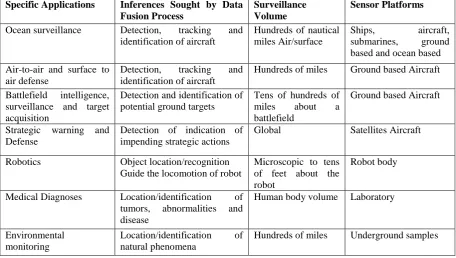
A. Applications of image fusion in various departments
© 2014, IJCSMC All Rights Reserved 475
Specific Applications Inferences Sought by Data Fusion Process
Surveillance Volume
Sensor Platforms
Ocean surveillance Detection, tracking and identification of aircraft
Hundreds of nautical miles Air/surface
Ships, aircraft, submarines, ground based and ocean based
Air-to-air and surface to air defense
Detection, tracking and identification of aircraft
Hundreds of miles Ground based Aircraft
Battlefield intelligence, surveillance and target acquisition
Detection and identification of potential ground targets
Tens of hundreds of miles about a battlefield
Ground based Aircraft
Strategic warning and Defense
Detection of indication of impending strategic actions
Global Satellites Aircraft
Robotics Object location/recognition Guide the locomotion of robot
Microscopic to tens of feet about the robot
Robot body
Medical Diagnoses Location/identification of tumors, abnormalities and disease
Human body volume Laboratory
Environmental monitoring
Location/identification of natural phenomena
Hundreds of miles Underground samples
Table 1:- Fusion application in Various System
VIII. CONCLUSION
Due to the advances in satellite technology, a great amount of image data has been available and has been widely used in different applications. Thus, image data fusion has become a valuable tool used to integrate the best characteristics of each sensor data involved in the processing.
Indeed, the above techniques, method and applications are used for researchers, to refer the image fusion.. The fusion quality often depends upon the user’s experience, the fusion method, and upon the data set being fused. The objective of a fusion process is to generate a hybrid image with the highest possible spatial information content while still preserving good spectral information quality. Unfortunately, this task is not easy. In the next few years, Experts expect that especially high-level fusion techniques combining different data sources and different sensors, e.g. in a sensor network, will be widely used for quantitative modeling and inversion of the biophysical parameters and ecological modeling, in addition to map updating.
REFERENCES
[1]. A. Goshtasby and S. Nikolov, “Image fusion: Advances in the state of the art,” Inf. Fusion, vol. 8, no. 2, pp. 114–118, Apr. 2007.
[2]. Leila Fonseca1, Laercio Namikawa, Emiliano Castejon, Lino Carvalho, Carolina Pinho and Aylton Pagamisse “Image Fusion for Remote Sensing Applications”, Image Fusion and Its Application, pp 153-173. [3]. M.Pradeep “Implementation of Image Fusion algorithm using MATLAB (LAPLACIAN PYRAMID)”. [4]. Sascha Klonus , Manfred Ehlers “Performance of evaluation methods in image fusion”, 12th International Conference on Information Fusion Seattle, WA, USA, July 6-9, 2009.
[5]. Gonzalo Pajares , Jesus Manuel de la Cruz ” A wavelet-based image fusion tutorial” Pattern Recognition 37
(2004) 1855 – 1872.
[6]. H.B. Mitchell “Image Fusion Theories, Techniques and Applications”.
[7]. Yufeng Zheng “Image Fusion and Its Applications”.
[8]. David L. Hall, Ph.D “Handbook of Multisensor Data Fusion”.
[9]. http://www.ece.lehigh.edu/SPCRL/IF/image_fusion.htm#Image_fusion. Investigation of Image fusion, LEHIGH University.
[10]. Jiang Dong , Dafang Zhuang, Yaohuan Huang and Jingying Fu “Advances in Multi-Sensor Data Fusion: Algorithms and Applications” Sensors 2009, 9, 7771-7784.
© 2014, IJCSMC All Rights Reserved 476 [12]. Richa Singh, Mayank Vatsa, Afzel Noore “Multimodal Medical Image Fusion using Redundant Discrete Wavelet Transform”.
[13]. Nemir Al-Azzawi and Wan Ahmed K. Wan Abdullah “Medical Image Fusion Schemes Using Contourlet Transform and PCA Bases”.
[14]. Slavica Savic, "Multifocus Image Fusion Based on Empirical Mode Decomposition", Twentieth International Electro technical and Computer Science Conference, ERK 2011.
[15]. David Looney and Danilo P. Mandic “Multiscale Image Fusion Using Complex Extensions of EMD”.
[16]. Jixian Zhang “Multi-source remote sensing data fusion: status and trends”, International Journal of Image and Data Fusion, Vol. 1, No. 1, March 2010, 5–24.