© 2014, IJCSMC All Rights Reserved
122
Available Online atwww.ijcsmc.comInternational Journal of Computer Science and Mobile Computing
A Monthly Journal of Computer Science and Information Technology
ISSN 2320–088X
IJCSMC, Vol. 3, Issue. 11, November 2014, pg.122 – 126
REVIEW ARTICLE
Review on Routing Stability in
Wireless Sensor Network
ARUNKUMAR.C
1, Dr. CHITRA.C
2¹PG Student, ²Professor
1,2Department of Electronics and Communication Engineering,
PSNA College of Engineering and Technology, Dindigul, TamilNadu, India
1
[email protected], 2 [email protected]
_____________________________________________________________________________________________ Abstract- Adaptive Load-Balancing Algorithm-Rainbow version (ALBA-R for short), is a simple and efficient geographic forwarding for WSNs. ALBA-R integrates contention-based MAC principles, geographic routing concepts, and an algorithm to deal with the dead end problem. The protocol proves to be robust and applicable to realistic scenarios in the sense specified before. In addition, ALBA-R directly addresses the important issue of balancing the packet load among possible relays featuring explicitly congestion metrics in the relay selection process, ALBA-R performs excellently in terms of packet delivery ratio, end-to-end packet latency, energy consumption, and overhead, The Rainbow mechanism of ALBA-R deals effectively with dead ends, always providing routes around connectivity holes The Rainbow distributed scheme is remarkably resilient to localization errors and independent of whether or not the network topology is modeled by a unit disk graph.
Keywords: Dead-end problems, localization error, efficient relay selection, ALBA, ALBA-R
_____________________________________________________________________________________________
I. INTRODUCTION
Dead ends are unable to forward the packets they generate or receive. These packets will never reach their destination and will eventually be discarded. Many geographic routing schemes fail to fully address important design challenges including,
i) Routing around connectivity holes,
ii) Resilience to localization errors, and
iii) Efficient relay selection.
© 2014, IJCSMC All Rights Reserved
123
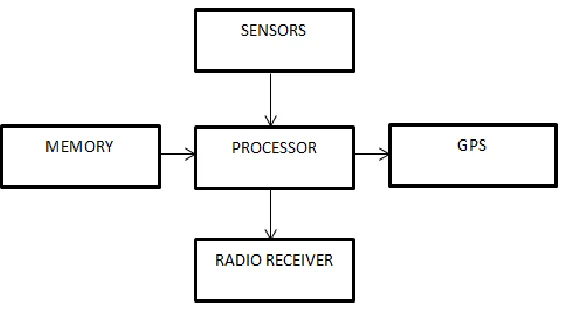
Fig 1.1 components of wireless sensor network
In the not-too-distant future, tiny, dirt-cheap sensors may be literally sprayed onto roads, walls, or machines, creating a digital skin that senses a variety of physical phenomena of interest: monitor pedestrian or vehicular traffic in human-aware environments and intelligent transportation grids, report wildlife habitat conditions for environmental conservation, detect forest fires to aid rapid emergency response, and track job flows and supply chains in smart actories. Unlike current information services such as those on the Internet where information can easily get stale or be useless because it is too generic, sensor networks promise to couple end users directly to sensor measurements and provide information that is precisely localized in time and/or space, according to the user’s needs or demands. With such technological advances come new challenges for information processing sensor networks.
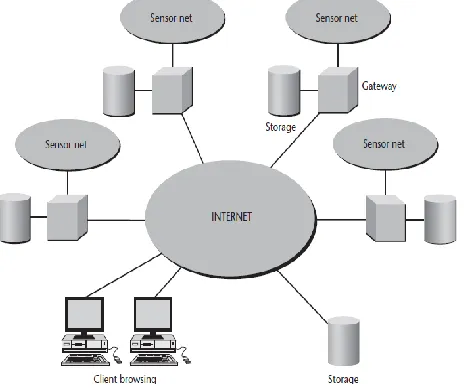
Unlike a centralized system, a sensor network is subject to a unique set of resource constraints such as finite on-board battery power and limited network communication bandwidth. In a typical sensor network, each sensor node operates untethered and has a microprocessor and a small amount of memory for signal processing and task scheduling. Each node is also equipped with one or more sensing devices such as acoustic microphone arrays, video or still cameras, infrared (IR), seismic, or magnetic sensors. Each sensor node communicates wirelessly with a few other local nodes within its radio communication range. Sensor networks extend the existing Internet deep into the physical environment. The resulting new network is orders of magnitude more expansive and dynamic than the current TCP/IP network and is creating entirely new types of traffic that are quite different from what one finds on the Internet now. Information collected by and transmitted on a sensor network describes conditions of physical environments—for example, temperature, humidity, or vibration— and requires advanced query interfaces and search engines to effectively support user-level functions. Sensor networks may internetwork with an IP core network via number of gateways, as in A gateway routes user queries or commands to appropriate nodes in a sensor network. It also routes sensor data, at times aggregated and summarized, to users who have requested it or are expected to utilize the information.
A. Design challenge of Wireless sensor network
1. Limited hardware: Each node has limited processing, storage, and communication capabilities, and limited energy supply and bandwidth.
2. Limited support for networking: The network is peer-to-peer, with a mesh topology and dynamic, mobile, and unreliable connectivity. There are no universal routing protocols or central registry services. Each node acts both as a router and as an application host.
© 2014, IJCSMC All Rights Reserved
124
Fig 1.2 overall view of wireless sensor
B. Advantages of Sensor Networks
Networked sensing offers unique advantages over traditional centralized approaches. Dense networks of distributed communicating sensors can improve signal-to-noise ratio (SNR) by reducing average distances from sensor to source of signal, or target. Increased energy efficiency in communications is enabled by the multi hop topology of the network Moreover, additional relevant information from other sensors can be aggregated during this multi hop transmission through in network processing but perhaps the greatest advantages of networked sensing are in improved robustness and scalability. A decentralized sensing system is inherently more robust against individual sensor node or link failures, because of redundancy in the network. Decentralized algorithms are also far more scalable in practical deployment and may be the only way to achieve the large scales needed for some applications
1. System performance goal: The abstract characterization of system properties. Examples include scalability, robustness, and network longevity, each of which may be measured by a set of evaluation metrics.
2. Data storage: Sensor information is stored, indexed, and accessed by applications. Storage may be local to the node where the data is generated, load-balanced across a network, or anchored at a few points (warehouses).
II. RELATED WORK
H. Frey, S. R¨ uhrup, and I. Stojmenovic, et al. [1] offer an inclusive review on Routing in wireless sensor Networks Routing protocols for wireless sensor networks have to ensure reliable multi-hop communication under these conditions. We describe design challenges for routing protocols in sensor networks and illustrate the key techniques to achieve desired characteristics, such as energy efficiency and delivery guarantees. It subscribe about of state-of-the-art routing techniques with a focus on geographic routing, a paradigm that enables a reactive message-efficient routing without prior route discovery or knowledge of the network topology.
Anandhi.R1, Dr.R.Manicka chezian2 et al. [2] offer an inclusive review on Geographic routing [1] is about forwarding a packet in the direction of its intended destination.The forwarding mechanism usually follows the well-known greedy paradigm: When a sensor node has a packet to transmit, a relay node is chosen that takes the packet closer to the sink. This greedy principle is applied until the final destination is reached Geographic routing has many characteristics that meet the unique requirements of WSNs
© 2014, IJCSMC All Rights Reserved
125
K. Seada, A. Helmy, and R. Govindan et al. [4] offer an inclusive review on face routing protocol and its improvisation over geographical routing, it only uses location information about nodes to do routing and it provably guarantees message delivery in static connected plane graphs, Face routing is applied on a plane sub graph of the network graph. A specifics routing protocol provides a set of rules for each node to decide where to send a packet using only the local Information about its neighbors and the information in the packet header
K. Seada, A. Helmy, and R. Govindan et al. [5] offer an inclusive review on effect of effect of localization errors on geographic face routing in sensor networks, a detailed analysis of the effects of location errors on the perfection and routine of geographic routing in static sensor networks, we compare localization error on GPSR and GHT and completely describes about combination of both geographical routing with face routing
H. Takagi and L. Klein rock et al. [6] offer an inclusive review on the communication range that achieves the most efficient use of energy in wireless ad hoc network is studied under homogeneous node distribution. By assuming the knowledge of node location, then the average packet progress for a transmission range universal for all nodes is derived, which is accordingly used to determine the optimal transmission range that gives the maximum efficiency of energy consumption
S. Basagni, I. Chlamtac, V. R. Syrotiuk, and B. A. Woodward et al. [7] offer an inclusive review on geographical routing protocols vs. DREAM, which shows improvement in delivery ratio than GEIDR protocol, it also provides routing around even though obstacle is present.
R. Fonseca, S. Ratnasamy, J. Zhao, C. T. Ee, D. Culler, S. Shenker, And I. Stoica et al. [8] offer an inclusive review on Geographic Routing (GR) algorithms require nodes to periodically transmit HELLO messages to allow neighbors to know their positions (beaconing mechanism). Beacon-less routing algorithms have recently been proposed to reduce the control overheads due to these messages.
A. Caruso, S. Chessa, S. De, and A. Urpi et al. [9] offer an inclusive review on GPS geo graphical routing protocol which has low overhead when compare with GEIFR protocol and IFIRS protocol, and its describe how geographical information are obtained
Y. Zhao, Q. Zhang, Y. Chen, and W. Zhu, et al. [10] offer an inclusive review on geographical routing that has been shown to attain good scalability without saturating; however, this usually requires the disposal of position information and can suffer from poor routing performance and severe dead end problems, particularly in sparse networks. Definitely, in this scheme a simulated coordinate-based routing protocol and does not require any position information. This achieves excellent routing performance comparable with that obtained by the shortest path routing schemes. In addition, we design efficient algorithms for setting up the system and adapt to the node mobility quickly and can effectively route out of dead ends
Varun G Menon, Joe Prathap P et al. [12] offer an inclusive review on Enactment Investigation of Geographic Routing Protocols in Highly Mobile Ad Hoc Network
III. PROPOSED METHOD
© 2014, IJCSMC All Rights Reserved
126
with connectivity holes, The Rainbow mechanism allows ALBA-R to efficiently route packets out of and around dead ends. Rainbow is resilient to localization errors and to channel propagation impairments. It does not need the network topology to be planar, unlike previous routing protocols. It is therefore more general than face routing based solutions.
IV. CONCLUSION
ALBA-R combines geographic routing, handling of dead ends, MAC, awake-asleep planning associate degreed consecutive information packet transmission for achieving an energy-efficient information gathering mechanism. to cut back end-to-end latency and rescale to high traffic ALBA-R achieves exceptional delivery quantitative relation and latency, and might greatly limit energy consumption, outperforming all previous geographical furthermore as face routing protocols, my protocol is totally distributed has low overhead, and makes it attainable to route packets around property holes while not resorting to the creation and maintenance of flat topology graphs. Rainbow is shown to ensure packet delivery below discretional localization errors, at the only real value of a restricted increase in route length.
REFERENCES
[1] 1.H. Frey, S. R¨ uhrup, and I. Stojmenovic, ―Routing in wireless sensor Networks,‖ in Guide to Wireless Sensor Networks, ser. Computer Communications and Networks, S. Misra, I. Woungang, and S. C.Misra, Eds. London, U.K.: Springer-Verlag, May 2009, Ch. 4, pp.81–112.
[2] International Journal of Innovative Research in Computer and Communication Engineering (An ISO 3297: 2007 Certified Organization) Vol. 2, Issue 7, July 2014Copyright to IJIRCCE www.ijircce.com 5101 A Review on Geographic Routing in Wireless Sensor Network Anandhi.R, Dr.R.Manicka chezian.
[3] IEEE TRANSACTIONS ON MOBILE COMPUTING, VOL. 4, NO.2, MARCH/APRIL 2005A Location-Based Routing Method for Mobile Ad Hoc Networks Ljubica Blaze Vic, Member, IEEE, Jean-Yves Le Boudec, Fellow, IEEE, and Silvia Giordano, Member, IEEE
[4] Face Routing in Wireless Ad-hoc Networks Xiao yang Guan Doctor of Philosophy Graduate Department of Computer Science University of Toronto 2009
[5] K. Seada, A. Helmy, and R. Govindan, ―On the effect of localization errors on geographic face routing in sensor networks,‖ in Proc. of IEEE/ACM IPSN, Berkeley, CA, Apr. 2004, pp. 71–80.
[6] H. Takagi and L. Klein rock, ―Optimal transmission ranges for randomly Distributed packet radio terminals,‖ IEEE Trans. Commun., vol. 32, no. 3, pp. 246–257, Mar. 1984.
[7] S. Basagni, I. Chlamtac, V. R. Syrotiuk, and B. A. Woodward, ―A distance routing effect algorithm for mobility (DREAM),‖ in Proceedings of MobiCom 1998, Dallas, TX, October 1998, pp. 76–84.
[8] Q. Cao and T. Abdelzaher, ―A scalable logical coordinate’s framework for routing in wireless sensor networks,‖ in Proc. of the IEEE Real-Time Systems Symposium, Lisbon, Portugal, Dec. 2004, pp. 349– 358.
[9] R. Fonseca, S. Ratnasamy, J. Zhao, C. T. Ee, D. Culler, S. Shenker, And I. Stoica, ―Beacon Vector Routing: scalable point-to-point routing in wireless sensor nets,‖ in Proc. of NSDI, Boston, MA, May 2004. [10]Caruso, S. Chessa, S. De, and A. Urpi, ―GPS free coordinate assignment and routing in wireless sensor
networks,‖ in Proceedings Of IEEE Info com 2005, Miami, FL, Mar. 2005, pp. 150–160
[11]Y. Zhao, Q. Zhang, Y. Chen, and W. Zhu, ―Hop ID based routing in mobile ad hoc networks,‖ in Proc. of IEEE ICNP, Boston, MA, Nov. 2005, pp. 179–190