1556-6811/08/$08.00
⫹
0
doi:10.1128/CVI.00169-08
Copyright © 2008, American Society for Microbiology. All Rights Reserved.
Oral Immunization with Recombinant
Lactobacillus plantarum
Induces
a Protective Immune Response in Mice with Lyme Disease
䌤
Beatriz del Rio,
1Raymond J. Dattwyler,
1,2Miguel Aroso,
1Vera Neves,
1Luciana Meirelles,
1Jos F. M. L. Seegers,
3and Maria Gomes-Solecki
1,2*
Department of Microbiology and Immunology, New York Medical College, Valhalla, New York
1; Biopeptides Corp., Valhalla,
New York
2; and Falco Biotherapeutics BV, Zernikedreef 9, 2331 CK Leiden, The Netherlands
3Received 13 May 2008/Returned for modification 23 June 2008/Accepted 4 July 2008
Mucosal immunization is advantageous over other routes of antigen delivery because it can induce both
mucosal and systemic immune responses. Our goal was to develop a mucosal delivery vehicle based on bacteria
generally regarded as safe, such as
Lactobacillus
spp. In this study, we used the Lyme disease mouse model as
a proof of concept. We demonstrate that an oral vaccine based on live recombinant
Lactobacillus plantarum
protects mice from tick-transmitted
Borrelia burgdorferi
infection. Our method of expressing vaccine antigens
in
L. plantarum
induces both systemic and mucosal immunity after oral administration. This platform
tech-nology can be applied to design oral vaccine delivery vehicles against several microbial pathogens.
Lactic acid bacteria are naturally associated with mucosal
surfaces, particularly the gastrointestinal tract, and are also
indigenous to food-related habitats, including plants, wine,
milk, and meat. These gram-positive bacteria include both
important pathogens, e.g., several
Streptococcus
species, and
extremely valuable nonpathogenic species that have been used
since ancient times for food and feed fermentation (11, 37, 58).
The host is highly adapted to the presence of commensal
intestinal bacteria (36). There is evidence that some strains of
lactic acid bacteria have a favorable influence on physiologic
and pathological processes of the host due to their specific
health-promoting probiotic characteristics that relate to
mod-ulation of the immune system (15, 36, 41). Some strains of
lactic acid bacteria polarize the naı¨ve immune system by
skew-ing it toward Th1 responses (41, 56).
There have been a number of reports of oral vaccine
candi-dates established from genetically modified pathogenic
bacte-ria, such as
Salmonella
and
Listeria
species (1, 2, 30, 45, 52), or
commensal bacteria, such as
Lactococcus lactis
and
Lactoba-cillus
species (27, 31, 32, 60). The latter are food-grade bacteria
that have GRAS status (
g
enerally
r
egarded
a
s
s
afe). While
both pathogenic and commensal bacteria have advantages and
disadvantages as mucosal delivery vehicles, lactic acid bacteria
are preferable in terms of safety and a lower risk of side effects
(27, 47). Presentation of antigens on the surface of lactobacilli
is attractive for vaccine design, especially because the
pepti-doglycan layer of some strains appears to exhibit natural
im-muno-adjuvanticity (33, 35, 44, 46). Thus, these species are
excellent candidates for the development of safe mucosal
de-livery vehicles of prophylactic and therapeutic molecules. Of
the
Lactobacillus
strains previously used for vaccine delivery,
we chose
L. plantarum
because there is evidence that this strain
is a better agent for vaccination with tetanus toxin fragment C
(TTFC) than
L. casei
or
L. lactis
(22, 53).
Lyme disease is the most prevalent vector-borne infectious
disease in the United States. A vaccine administered via needle
inoculation and based on outer surface protein A (OspA) has
proved effective in preventing
Borrelia burgdorferi
infection in
animals and humans (7, 10, 16–18, 55). Although a
controver-sial autoantigenic epitope identified in OspA (8, 24) hampered
its acceptance for human use, a second-generation
OspA-based subcutaneous vaccine has been developed (59). This
vaccine works in an unconventional manner. As
B. burgdorferi
expresses OspA mostly at lower temperatures while
undergo-ing the tick stage of its enzootic cycle (49, 50), OspA-specific
antibodies in the serum from vaccinated mice block or
neu-tralize
B. burgdorferi
in the tick midgut, thereby preventing its
transmission to the mouse upon tick feeding (10).
We used the Lyme disease mouse model to develop a live
oral vaccine based on recombinant
Lactobacillus plantarum
. In
order to determine vaccine efficacy we challenged vaccinated
mice with infected field ticks, which are the natural vectors of
infection.
MATERIALS AND METHODS
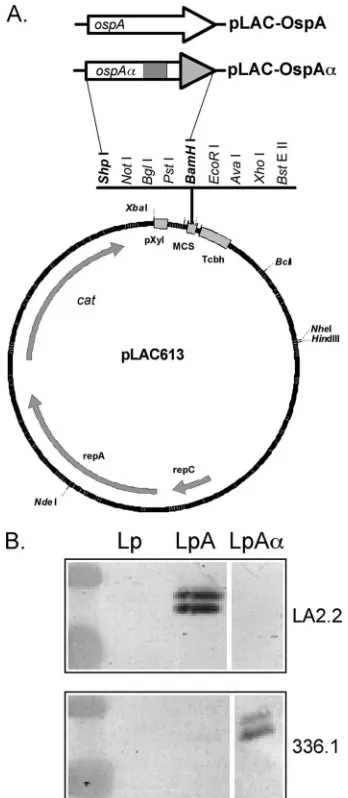
Construction and characterization of vaccine candidates.The antigen was cloned in an expression vector, pLAC613. This vector has the replication region
of pSH71 (repAandrepC) and the chloramphenicol acetyltransferase gene (cat)
from pC194 for selection purposes. A detailed description of the plasmid
fea-tures can be found in reference 47. Based on the coding sequence ofBorrelia
burgdorferiOspA, primers were designed with SphI and BamHI restriction sites that allowed for direct cloning of the gene under the inducible Pxyl promoter.
The vector was transformed intoLactobacillus plantarumstrain 256, and protein
expression was checked by immunoblotting as follows: recombinantL. plantarum
was mechanically broken with a French press (SLM-Aminco Instruments), and supernatants were run on a sodium dodecyl sulfate-polyacrylamide gel electro-phoresis gel and electrotransferred to a polyvinylidene difluoride membrane (Millipore, Billerica, MA) for analysis with OspA-specific monoclonal antibodies LA2.2 and 336.1.
Preparation of vaccine antigen.L. plantarumexpressing the target antigen was cultured in Lactobacillus medium (1% proteose peptone [wt/vol], 1% beef ex-tract [wt/vol], 0.5% yeast exex-tract [wt/vol], 0.5% lactose [wt/vol], 9 mM ammonium citrate, 61 mM sodium acetate anhydrous, 0.4 mM magnesium sulfate, 0.3 mM manganese sulfate, 11.2 mM dipotassium phosphate, 0.5% Tween 20 [vol/vol]),
supplemented with 10g/ml of chloramphenicol (Cm) and 0.5% lactose and
grown at 30°C to an optical density at 600 nm (OD600) of 1.0. That is the
* Corresponding author. Mailing address: Department of Molecular
Sciences, UTHSC, 858 Madison Ave., Memphis, TN 38163. Phone:
(901) 448-2536. Fax: (901) 448-3330. E-mail: [email protected].
䌤
Published ahead of print on 16 July 2008.
1429
on August 17, 2020 by guest
http://cvi.asm.org/
time, and on days 52 to 55 they received the second boost. On day 64, mice were bled for the third time. Serum was tested by indirect enzyme-linked immunosor-bent assay (ELISA) for the presence of immunoglobulin G (IgG) to OspA. Stool samples for determination of anti-OspA IgA were collected on the same days as
the serum. Challenge was performed on day 67, viaB. burgdorferi-infectedIxodes
scapularisnymph inoculation. One month later (day 97), mice were euthanized and blood, heart, and bladder tissues were obtained to assess protection or spirochete dissemination.
Enumeration of viable lactobacilli in the gut.Approximately 100 mg of the luminal contents was placed in tubes containing 1 ml of 1% bovine serum albumin (BSA) in phosphate-buffered saline with protein inhibitor mixture (Roche, NJ) for homogenization by vortexing. Numbers of viable lactobacilli in
stool were determined by plating serial dilutions of the suspension on MRS/Cm⫹
agar (Oxoid, Cambridge, United Kingdom) followed by incubation for 3 days at 37°C. The number of colonies was counted as CFU per gram of luminal contents.
Presence of theospAgene in theLactobacilluscolonies was confirmed by PCR.
Challenge withB. burgdorferi-infected field ticks.Ixodes scapularisticks that were collected in areas where Lyme disease is endemic (from New York state; ticks were kindly provided by D. Brisson and R. S. Ostfeld) and maintained in
our laboratory (21) were checked forB. burgdorferiinfection by PCR. Tick
challenge of mice was performed as follows: we placed 8 to 10B. burgdorferi
-infected nymphal field ticks on the back of the mouse heads and restrained the mice for 2 h to allow enough time for ticks to attach. Three days later, ticks that were engorged after taking a blood meal were collected after naturally falling off and counted, and a daily record was kept for each mouse.
Mucosal and systemic immune responses. (i) Extraction of mucosal IgA an-tibodies.OspA-specific IgA antibodies were extracted from stool pellets. Briefly, 100 mg of stool was dissolved in 1 ml of phosphate-buffered saline–1% BSA (Sigma) supplemented with protease inhibitor cocktail (Complete; Roche, Ger-many). The suspension was mixed vigorously and incubated for 16 h at 4°C and
then centrifuged at 16,000⫻gto remove insoluble material.
(ii) Antibody assays.Purified recombinant lipidated OspA was used to coat Nunc MaxiSorp flat-bottom ELISA plates (eBioscience, San Diego, CA), and an indirect ELISA was performed using either extracted stool samples (undiluted) or serum (1:400) from immunized mice to identify OspA-specific IgA or IgG antibodies, respectively. We used as secondary antibodies anti-mouse IgA con-jugated to horseradish peroxidase or anti-mouse IgG concon-jugated to alkaline phosphatase (1:1,600; Jackson ImmunoResearch, West Grove, PA). To further characterize the IgG response, subclass isotyping was done in serum from im-munized mice by capture ELISA, using the mouse IgG1, IgG2a, and IgG2b ELISA quantitation kit (Bethyl Laboratories Inc., Montgomery, TX) according
to the manufacturer’s instructions. We checked for anti-B. burgdorferiantibodies
in serum from immunized mice (1:100) by immunoblotting (Virablot; Plannegg, Germany). We considered a pattern of 5 out of 10 bands positive as preliminary evidence of infection. Immunized mice showing a single OspA band were con-sidered potentially protected.
Determination of vaccine efficacy: assessment ofB. burgdorferidissemination.
Mice orally immunized with recombinantL. plantarumwere challenged withB.
burgdorferi-infected field ticks. One month after challenge, mice were sacrificed and spirochete dissemination was detected by immunoblotting of serum against
whole-cell sonicate ofB. burgdorferi(Virablot) and by culture ofB. burgdorferi
from heart and bladder tissues in BSK-H medium with an antibiotic mixture for
Borrelia(Sigma) at 34°C for up to 6 weeks. Cultures were checked for the presence of spirochetes by dark-field microscopy, and results were confirmed by
PCR amplification of theB. burgdorferi ospCgene from DNA extracted from the
same tissues.
1A). In order to do this substitution we had to consider the
maintenance of charge parity. Changing T170 to K would
re-quire changing V179 to E on the next

-strand. To address
both issues we replaced residues 161 to 190 in OspA from
B.
burgdorferi
with the analogous region from a nonarthritogenic
European species (
Borrelia afzelii
) that had these
compensa-tion changes. To further stabilize the C terminus of the mutant
OspA molecule, which is extremely important in inducing a
protective immune response, we replaced it with the analogous
C-terminal sequence from the same species used to do the
previous substitution. This construct, comprised of OspA
B31
1–164PGau
165–189B31
190–218Pko
219–273was then used to
generate
L. plantarum
expressing the mutant OspA (LpA
␣
).
Cloned genes were confirmed by sequencing. To evaluate
pro-tein expression, recombinant
L. plantarum
clones were
evalu-ated by immunoblotting, using anti-OspA monoclonal
antibod-ies. As expected, monoclonal antibody LA2.2 recognized the
C-terminal sequence of
B. burgdorferi
OspA in LpA and
mono-clonal antibody 336.1 recognized the C-terminal sequence of
B.
afzelii
OspA in LpA
␣
, in contrast to the control (Fig. 1B).
Enumeration of viable lactobacilli in the gut after
immuni-zation.
Throughout the immunization regimen, stool samples
were collected on days 0, 2, 4, 7, 9, 11, 14, 28, 30, 32, 34, 49, 51,
53, and 55 to determine the viability of
L. plantarum
and its
ability to colonize the digestive tract. Suspensions of stools
collected from mice immunized with LpA or LpA
␣
contained
on average 10
6cells/g of luminal contents, in contrast to the
control. The number of
L. plantarum
able to grow on MRS/
Cm
⫹agar increased within 24 h after the first inoculation and
decreased 48 h after the last inoculation (Fig. 2). PCRs done to
confirm the presence of
ospA
in recombinant
L. plantarum
colonies were positive only for LpA or LpA
␣
.
Mucosal and systemic immune responses after oral
immu-nization.
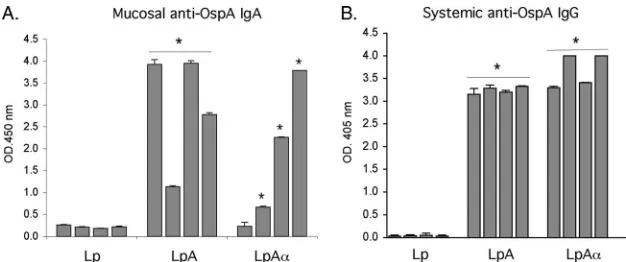
To assess the mucosal and systemic immune response
induced by the oral vaccine, we tested stool and serum levels of
total OspA-specific IgA and IgG antibodies, respectively, by
indirect ELISA (Fig. 3). Mice vaccinated orally with
L.
plan-tarum
expressing both wild-type and mutant OspA had
detect-able anti-OspA IgA and IgG antibodies 4 weeks
postimmuni-zation (day 28). As a result of boosting, this response increased
considerably from day 28 until day 64. Results for
determina-tion of OspA-specific IgA antibody in gut luminal material and
IgG antibody in serum on day 64, 3 days before tick challenge,
are shown in Fig. 3A and B, respectively. All vaccinated mice
showed a significant difference (
P
⬍
0.0001) in OspA-specific
IgA and IgG antibody titers in comparison to the control,
on August 17, 2020 by guest
http://cvi.asm.org/
except for one mouse immunized with mutant LpA
␣
that did
not have significant levels of IgA.
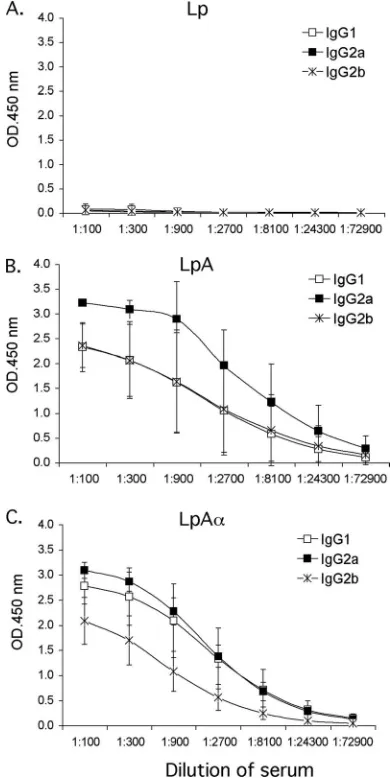
We determined the OspA-specific antibody isotype
distribu-tion with a capture ELISA by testing threefold serial diludistribu-tions
of serum collected on day 64. Oral immunization with
L.
plan-tarum
expressing wild-type OspA (LpA) resulted in equivalent
levels of the three IgG subclasses with a bias toward IgG2a
production, and oral immunization with the mutant OspA
(LpA
␣
) resulted in an IgG subclass distribution biased toward
IgG2a and IgG1 (Fig. 4).
Evaluation of vaccine efficacy.
Next, we wanted to determine
if the systemic anti-OspA immune response elicited by this oral
vaccine could protect mice from
B. burgdorferi
infection in vivo.
In vaccinated mice, protection or infection was determined by
the absence or presence of
B. burgdorferi
dissemination,
re-spectively, after challenge by infestation with
I. scapularis
nymphs carrying
B. burgdorferi
(in vivo correlate of natural
infection). The infection rate of the laboratory-maintained
field ticks used for challenge was determined at 80% by PCR.
A total of 36 mice were immunized orally with
L. plantarum
expressing either the wild-type antigen (LpA;
n
⫽
12) or the
mutant antigen (LpA
␣
;
n
⫽
12) and the parental strain (Lp
antigen;
n
⫽
12). Results from one of three independent
ex-periments are shown in Fig. 5. Data from three exex-periments
are summarized in Table 1. In the groups orally immunized
with either the wild-type or the mutant vaccine (LpA or
LpA
␣
), we observed that all mice were free of spirochetes as
determined by immunoblotting (Fig. 5A) and by dark-field
microscopy analysis of
B. burgdorferi
cultures from tissues (Fig.
5B). Culture results were confirmed by PCR (Fig. 5C). None of
the mice in the control group developed antibodies to OspA,
and all had an immunoblot profile indicative of
B. burgdorferi
dissemination that was confirmed both by culture and PCR.
Taken together, these results demonstrate that oral
immu-nization with
L. plantarum
expressing either wild-type or
mu-tant OspA resulted in an OspA-specific seroconversion that
protected vaccinated mice from
B. burgdorferi
infection.
Dif-ferences between the control and the wild-type or mutant
vac-cines were statistically significant by McNemar’s exact test for
correlated proportions (
P
⬍
0.05) (Table 1). The percentage of
infected mice observed in the group of control mice also
showed that the number of infected ticks used to challenge
mice was appropriate and effective in transmitting
B.
burgdor-feri
and therefore validated the results observed in the
vacci-nated groups.
FIG. 1. Graphical representation and characterization of the
vac-cine constructs, showing cloning design of the vacvac-cine candidates (A).
The vector pLAC613 comprises the replication region of pSH71 (
repA
and
repC
) and the
cat
gene from pC194 for selection purposes. OspA
(pLAC-OspA) and OspA
␣
(pLAC-OspA
␣
) were cloned in the SphI
and BamHI sites, using primers with the appropriate restriction sites.
Expression of recombinant proteins by
L. plantarum
was confirmed by
immunoblot assay (B). Whole-cell extracts of control, OspA-, and
OspA
␣
-expressing
L. plantarum
(Lp, LpA, and LpA
␣
antigens) were
run on a 15% sodium dodecyl sulfate-polyacrylamide gel, transferred
to polyvinylidene difluoride membrane, and tested by immunoblotting
with OspA-specific monoclonal antibodies LA2.2 and 336.1.
FIG. 2. Recombinant
L. plantarum
does not colonize the gut. Four
mice per group were immunized by intragastric inoculation of
recom-binant OspA- and OspA
␣
-expressing
L. plantarum
(LpA or LpA
␣
) or
with
L. plantarum
carrying the empty vector pLAC613 (Lp antigen).
Stool samples were collected 24 h before and during and after vaccine
inoculations and plated on MRS/Cm
⫹agar to screen for recombinant
L. plantarum
. The results are expressed as the mean log
10-transformed
CFU/g of luminal content, and the error bars are standard errors of the
means.
on August 17, 2020 by guest
http://cvi.asm.org/
DISCUSSION
The main goal of this study was to develop a platform
de-livery system using safe lactic acid bacteria to design oral
vac-cines against a number of maladies that affect humans. In this
report we describe the development of an effective,
recombi-nant
Lactobacillus-
based, live oral vaccine against a
vector-borne infectious disease.
Mucosal immunization has several advantages over other
routes of antigen delivery, including convenience,
cost-effec-tiveness, and more importantly, induction of both local and
systemic immune responses (38, 51, 52). Mucosal vaccines
us-ing commensal bacteria rely on its endogenous regulation
be-ing transferred to the vaccine antigen (40). Vaccines based on
attenuated bacterial pathogens, especially live
Salmonella
-based oral vaccines, have demonstrated the ability to induce
protective mucosal and systemic immune responses (6, 14, 52,
61, 63). However, public fear of using an attenuated pathogen
as a vaccine carrier has deterred its acceptance. Recent studies
have shown that oral administration of a number of lactobacilli
expressing recombinant immunogens induces local mucosal
(42) and systemic antibody responses (62). Other studies have
explored this further and showed that immune responses
in-duced via lactobacilli delivered through oral vaccination confer
some protection against challenge with the respective
patho-gen (27, 31, 32, 60). Because of its GRAS status, a live
vaccine based on
Lactobacillus
will be more readily
accept-able to the public than an oral vaccine based on a
well-recognized pathogen.
We chose
L. plantarum
because it is a better agent for oral
vaccination than
L. casei
or
L. lactis
(22, 53) due to its higher
intrinsic antigenicity. Data that support these findings were
recently reported from a study which analyzed the differences
between these species on immunization and found that
L.
plantarum
was 10-fold more immunogenic (9). Furthermore,
L. plantarum
can activate human myeloid dendritic cells
through upregulation of costimulatory molecules (CD40) on
the cell surface (3, 4, 28, 57).
L. plantarum
survives gastrointestinal passage, and its transit
time was monitored in mice that received the vaccine
through-out the immunization regimen. Transit dynamics of
L.
planta-rum
revealed that the number of live bacteria in mouse luminal
contents increases 2 h after the first inoculation, reaches its
highest level 2 h later, and returns to preinoculation levels
within 24 h (39, 43). In addition, evidence has accumulated that
suggests that more doses are required to obtain efficient
prim-ing and boostprim-ing of antibody responses via the intragastric
route than via the intranasal route of administration (58).
Thus, we designed an immunization regimen that included
inoculating the mice twice a day for a longer priming period to
allow enough time for the immunogen to be presented to the
intestinal immune system. This strain of
Lactobacillus
planta-rum
did not colonize the gut for extended periods of time.
Stimulation of the intestinal immune system with the vaccine
antigen merely during our predetermined immunization
time-table seems to be a crucial factor in the induction of a
protec-tive systemic immune response rather than induction of oral
tolerance. Thus, we believe that both the immunization
sched-ule and dose administered contribute to the outstanding
effi-cacy of this vaccine.
In mouse models, IgG2a and IgG2b are induced primarily by
Th1 cytokines, while IgG1 is induced by Th2 cytokines. Studies
done with parenteral and mucosal administration of TTFC
vaccines have shown that the route of vaccination determines
the immune response phenotype. TTFC vaccine antigen
in-jected with alum induces an immune response dominated by an
IgG1/Th2 response, whereas mucosal delivery of
TTFC-ex-pressing
L. plantarum
induces both the IgG1 and IgG2a
sub-classes of antibody to TTFC (22, 23, 58). Similarly, OspA
antigen administered subcutaneously, such as the previous
hu-man Lyme disease vaccine, induces equivalent levels of the
three IgG subclasses with a bias toward IgG1 (59). In this
study, we found that oral immunization with
L. plantarum
expressing wild-type OspA (LpA) induced primarily IgG2a, a
Th1-driven immune response, and immunization with the
mu-tant induced IgG2a/IgG1, a mixed Th1/Th2-driven immune
response. Thus, we too determined that
Lactobacillus
vaccines
promote a mixed Th-cell response. The ability of
Lactobacillus
spp. to shift cellular immune responses toward Th1 may be
FIG. 3. Oral immunization with OspA-expressing
L. plantarum
induces a mucosal and systemic anti-OspA immune response. Four mice per
group were immunized by intragastric inoculation with recombinant OspA- or OspA
␣
-expressing
L. plantarum
(LpA or LpA
␣
) or
L. plantarum
carrying the empty vector pLAC613 (Lp antigen). On day 64, stool and serum samples were collected and OspA-specific IgA (A) and IgG
(B) antibodies were determined by ELISA, respectively. The results are expressed as the OD at 450 nm (IgA) or 405 nm (IgG) of the mean end
point titer. The average of triplicate samples per mouse was determined, and the error bars indicates standard deviations. Cutoff values are the
averages of the negative control plus 3 standard deviations. Differences between vaccinated and control responses were statistically significant (
P
⬍
0.0001) as determined with Student’s
t
test. Results are representative of one of three independent experiments.
on August 17, 2020 by guest
http://cvi.asm.org/
advantageous for vaccination strategies, as was recently shown
in a model of pneumococcal infection (26).
Lactobacillus
spe-cies have several components that elicit innate immune
re-sponses through molecular pattern recognition receptors of
mammalian cells, such as peptidoglycan, lipoteichoic acids, and
bacterial oligodeoxynucleotides (29, 54). Furthermore, there is
evidence that some
Lactobacillus
strains per se can have an
adjuvant effect (27). Our data support the finding that the
bacterial vehicle itself can influence the immune response due
to its immunomodulatory properties. All together these data
suggest that IgG class switching is determined by the OspA
antigen, by the delivery system, and by the route of vaccination.
Because of our extensive experience developing
immuno-prophylactic agents for
B. burgdorferi
, we used the Lyme
dis-ease mouse model as a proof of concept. OspA was the
im-munogen of choice because it is a proven vaccine candidate
against
B. burgdorferi
via the parenteral route (16, 18) in
ad-dition to inducing a protective immune response when
admin-istered orally as purified antigen (34) or as recombinant
Esch-erichia coli
(17, 21). Although there have been many studies to
find additional vaccine candidates for Lyme disease (5, 12, 13,
19, 20, 25, 48), OspA is still the most effective immunogen
against this pathogen. Following the discovery of a
controver-sial autoantigenic epitope in OspA (24), we substituted this
epitope in its sequence before cloning it into
L. plantarum
. In
this study, we demonstrated that orally delivered, live
L.
plan-tarum
expressing either wild-type OspA or its mutant are
equally effective in blocking transmission of
B. burgdorferi
in
the tick, thereby preventing infection. Neutralization of
B.
burgdorferi
within the tick is dependent on OspA-specific IgG
present in the serum of orally vaccinated mice, and intestinal
OspA-specific IgA responses to recombinant
L. plantarum
could be a controlling factor in the uptake of bacteria and the
ability of luminal bacteria to interact with the systemic immune
system.
We report the development of an oral, live vaccine delivery
vehicle based on a bacterium generally regarded as safe by the
FDA. Our method of expressing vaccine antigens in
L.
plan-tarum
induces both systemic and mucosal immunity after oral
administration. Standard parenteral vaccines do not induce
mucosal immunity, and the failure to do so has led to vaccine
failures even in the face of strong systemic immunity. Our
platform technology, in addition to the effective oral vaccine
that has been described here for Lyme disease, can be
ex-panded upon and applied to design oral vaccines against
sev-eral microbial pathogens and possibly some allergens. Some
examples of potential mucosal vaccines include targets to
Yersinia pestis
,
Bacillus anthracis
, and
Francisella tularensis
. These
protection strategies for airborne, category A bioterrorism
FIG. 4. OspA-expressing
L. plantarum
induces a systemic IgG
re-sponse with a subclass distribution skewed toward IgG2a, and OspA
␣
-expressing
L. plantarum
induces IgG2a and IgG1. We determined the
OspA-specific antibody isotype distribution by testing threefold serial
dilutions of sera collected on day 64 from mice immunized with
OspA-or OspA
␣
-expressing
L. plantarum
(LpA or LpA
␣
) or
L. plantarum
carrying the empty vector, pLAC613 (Lp antigen), by ELISA.
Horse-radish peroxidase-labeled secondary antibody was used. The results
are expressed as the OD at 450 nm of the mean end point titer. The
average of triplicate samples from four mice is represented (each data
point), and standard errors of the means were determined. Results are
representative of one of three independent experiments.
FIG. 5.
B. burgdorferi
does not infect mice immunized orally with
L.
plantarum
expressing OspA. Immunized mice were sacrificed 1 month
after tick challenge, and blood and tissues were collected to assess
spirochete dissemination. Serum was tested against whole-cell extract
of
B. burgdorferi
by immunoblotting using the Virablot test (A). Heart
and bladder cultures were checked for the presence of spirochetes by
dark-field microscopy (B), and results were confirmed by PCR of the
same tissues (C). Results are representative of one of three
indepen-dent experiments.
on August 17, 2020 by guest
http://cvi.asm.org/
agents would greatly benefit from a mucosal and systemic
dou-ble-edged immune response. Other examples include
respira-tory syncytial virus, enteropathogenic
Escherichia coli
, and
malaria vaccines.
ACKNOWLEDGMENTS
This study was supported by grant numbers R44 AI058364, R43
AI074092, and R43 AI072810 to M.G.S. and by grant number R01
AI055652 to R.J.D. from the National Institute of Allergy and
Infec-tious Diseases. This study was also supported by a postdoctoral
fel-lowship from Fundacion Alfonso Martin Escudero, Spain, to B.D.
The content of this article is solely the responsibility of the authors
and does not necessarily represent the official views of the National
Institute of Allergy and Infectious Diseases or the National Institutes
of Health.
We thank Jesus Lajara, Dolma Magar, and Daniel DiLeo for
excel-lent technical support. We are grateful to D. Brisson (University of
Pennsylvania) and R. S. Ostfeld (Institute of Ecosystem Studies) for
providing naturally infected field ticks.
REFERENCES
1.Anderson, R., G. Dougan, and M. Roberts.1996. Delivery of the pertactin/ P69 polypeptide of Bordetella pertussis using an attenuated Salmonella typhimurium vaccine strain: expression levels and immune response. Vaccine
14:1384–1390.
2.Ascon, M. A., D. M. Hone, N. Walters, and D. W. Pascual.1998. Oral
immunization with aSalmonella typhimuriumvaccine vector expressing
re-combinant enterotoxigenicEscherichia coliK99 fimbriae elicits elevated
an-tibody titers for protective immunity. Infect. Immun.66:5470–5476.
3.Braat, H., E. C. de Jong, J. M. van den Brande, M. L. Kapsenberg, M. P. Peppelenbosch, E. A. van Tol, and S. J. van Deventer.2004. Dichotomy between Lactobacillus rhamnosus and Klebsiella pneumoniae on dendritic
cell phenotype and function. J. Mol. Med.82:197–205.
4.Braat, H., J. van den Brande, E. van Tol, D. Hommes, M. Peppelenbosch, and S. van Deventer.2004. Lactobacillus rhamnosus induces peripheral
hyporesponsiveness in stimulated CD4⫹T cells via modulation of dendritic
cell function. Am. J. Clin. Nutr.80:1618–1625.
5.Brown, E. L., J. H. Kim, E. S. Reisenbichler, and M. Hook.2005.
Multicom-ponent Lyme vaccine: three is not a crowd. Vaccine23:3687–3696.
6.Cazorla, S. I., P. D. Becker, F. M. Frank, T. Ebensen, M. J. Sartori, R. S. Corral, E. L. Malchiodi, and C. A. Guzman.2008. Oral vaccination with
Salmonella entericaas a cruzipain-DNA delivery system confers protective
immunity againstTrypanosoma cruzi. Infect. Immun.76:324–333.
7.Chang, Y. F., M. J. Appel, R. H. Jacobson, S. J. Shin, P. Harpending, R. Straubinger, L. A. Patrican, H. Mohammed, and B. A. Summers.1995. Recombinant OspA protects dogs against infection and disease caused by
Borrelia burgdorferi. Infect. Immun.63:3543–3549.
8.Chen, J., J. A. Field, L. Glickstein, P. J. Molloy, B. T. Huber, and A. C. Steere.1999. Association of antibiotic treatment-resistant Lyme arthritis with T cell responses to dominant epitopes of outer surface protein A of
Borrelia burgdorferi. Arthritis Rheum.42:1813–1822.
9.Cortes-Perez, N. G., F. Lefevre, G. Corthier, K. Adel-Patient, P. Langella, and L. G. Bermudez-Humaran.2007. Influence of the route of immunization and the nature of the bacterial vector on immunogenicity of mucosal
vac-cines based on lactic acid bacteria. Vaccine25:6581–6588.
10.de Silva, A. M., S. R. Telford III, L. R. Brunet, S. W. Barthold, and E. Fikrig.
1996. Borrelia burgdorferi OspA is an arthropod-specific
transmission-block-ing Lyme disease vaccine. J. Exp. Med.183:271–275.
11.de Vos, W. M.2005. Lactic acid bacteria: genetics, metabolism and
applica-tion. FEMS Microbiol. Rev.29:391.
12.Earnhart, C. G., E. L. Buckles, and R. T. Marconi.2007. Development of an OspC-based tetravalent, recombinant, chimeric vaccinogen that elicits bac-tericidal antibody against diverse Lyme disease spirochete strains. Vaccine
25:466–480.
13.Earnhart, C. G., and R. T. Marconi.2007. An octavalent lyme disease vaccine induces antibodies that recognize all incorporated OspC
type-spe-cific sequences. Hum. Vaccin.3:281–289.
14.Echchannaoui, H., M. Bianchi, D. Baud, M. Bobst, J. C. Stehle, and D. Nardelli-Haefliger.2008. Intravaginal immunization of mice with recombi-nantSalmonella entericaserovar Typhimurium expressing human papilloma-virus type 16 antigens as a potential route of vaccination against cervical
cancer. Infect. Immun.76:1940–1951.
15.Erickson, K. L., and N. E. Hubbard.2000. Probiotic immunomodulation in
health and disease. J. Nutr.130:403S–409S.
16.Fikrig, E., S. W. Barthold, F. S. Kantor, and R. A. Flavell.1992. Long-term protection of mice from Lyme disease by vaccination with OspA. Infect.
Immun.60:773–777.
17.Fikrig, E., S. W. Barthold, F. S. Kantor, and R. A. Flavell.1991. Protection
of mice from Lyme borreliosis by oral vaccination withEscherichia coli
expressing OspA. J. Infect. Dis.164:1224–1227.
18.Fikrig, E., S. R. Telford III, S. W. Barthold, F. S. Kantor, A. Spielman, and R. A. Flavell.1992. Elimination of Borrelia burgdorferi from vector ticks
feeding on OspA-immunized mice. Proc. Natl. Acad. Sci. USA89:5418–
5421.
19.Gilmore, R. D., Jr., R. M. Bacon, A. M. Carpio, J. Piesman, M. C. Dolan, and M. L. Mbow.2003. Inability of outer-surface protein C (OspC)-primed mice to elicit a protective anamnestic immune response to a tick-transmitted
challenge of Borrelia burgdorferi. J. Med. Microbiol.52:551–556.
20.Gilmore, R. D., Jr., K. J. Kappel, M. C. Dolan, T. R. Burkot, and B. J. Johnson.1996. Outer surface protein C (OspC), but not P39, is a protective
immunogen against a tick-transmitted Borrelia burgdorferichallenge:
evi-dence for a conformational protective epitope in OspC. Infect. Immun.
64:2234–2239.
21.Gomes-Solecki, M. J., D. R. Brisson, and R. J. Dattwyler.2006. Oral vaccine that breaks the transmission cycle of the Lyme disease spirochete can be
delivered via bait. Vaccine24:4440–4449.
22.Grangette, C., H. Muller-Alouf, M. Geoffroy, D. Goudercourt, M. Turneer, and A. Mercenier.2002. Protection against tetanus toxin after intragastric administration of two recombinant lactic acid bacteria: impact of strain
viability and in vivo persistence. Vaccine20:3304–3309.
23.Grangette, C., H. Muller-Alouf, D. Goudercourt, M. C. Geoffroy, M. Turneer, and A. Mercenier.2001. Mucosal immune responses and protection against
tetanus toxin after intranasal immunization with recombinant Lactobacillus
plantarum. Infect. Immun.69:1547–1553.
24.Gross, D. M., T. Forsthuber, M. Tary-Lehmann, C. Etling, K. Ito, Z. A. Nagy, J. A. Field, A. C. Steere, and B. T. Huber.1998. Identification of LFA-1 as
a candidate autoantigen in treatment-resistant Lyme arthritis. Science281:
703–706.
25.Hagman, K. E., X. Yang, S. K. Wikel, G. B. Schoeler, M. J. Caimano, J. D. Radolf, and M. V. Norgard.2000. Decorin-binding protein A (DbpA) of
Borrelia burgdorferiis not protective when immunized mice are challenged
via tick infestation and correlates with the lack of DbpA expression byB.
burgdorferiin ticks. Infect. Immun.68:4759–4764.
26.Hanniffy, S. B., A. T. Carter, E. Hitchin, and J. M. Wells.2007. Mucosal
delivery of a pneumococcal vaccine usingLactococcus lactisaffords
protec-tion against respiratory infecprotec-tion. J. Infect. Dis.195:185–193.
27.Kajikawa, A., E. Satoh, R. J. Leer, S. Yamamoto, and S. Igimi.2007. Intragastric immunization with recombinant Lactobacillus casei express-ing flagellar antigen confers antibody-independent protective immunity
against Salmonella enterica serovar Enteritidis. Vaccine25:3599–3605.
28.Karlsson, H., P. Larsson, A. E. Wold, and A. Rudin.2004. Pattern of cyto-kine responses to gram-positive and gram-negative commensal bacteria is profoundly changed when monocytes differentiate into dendritic cells. Infect.
Immun.72:2671–2678.
on August 17, 2020 by guest
http://cvi.asm.org/
29.Kim, Y. G., T. Ohta, T. Takahashi, A. Kushiro, K. Nomoto, T. Yokokura, N. Okada, and H. Danbara.2006. Probiotic Lactobacillus casei activates innate
immunity via NF-B and p38 MAP kinase signaling pathways. Microbes
Infect.8:994–1005.
30.Kohler, J. J., L. Pathangey, A. Hasona, A. Progulske-Fox, and T. A. Brown.
2000. Long-term immunological memory induced by recombinant oral
Sal-monellavaccine vectors. Infect. Immun.68:4370–4373.
31.Lee, J. S., H. Poo, D. P. Han, S. P. Hong, K. Kim, M. W. Cho, E. Kim, M. H. Sung, and C. J. Kim.2006. Mucosal immunization with surface-displayed
severe acute respiratory syndrome coronavirus spike protein on
Lactobacil-lus caseiinduces neutralizing antibodies in mice. J. Virol.80:4079–4087. 32.Li, Y. G., F. L. Tian, F. S. Gao, X. S. Tang, and C. Xia.2007. Immune
responses generated by Lactobacillus as a carrier in DNA immunization
against foot-and-mouth disease virus. Vaccine25:902–911.
33.Link-Amster, H., F. Rochat, K. Y. Saudan, O. Mignot, and J. M. Aeschli-mann. 1994. Modulation of a specific humoral immune response and changes in intestinal flora mediated through fermented milk intake. FEMS
Immunol. Med. Microbiol.10:55–63.
34.Luke, C. J., R. C. Huebner, V. Kasmiersky, and A. G. Barbour.1997. Oral delivery of purified lipoprotein OspA protects mice from systemic infection
with Borrelia burgdorferi. Vaccine15:739–746.
35.Maassen, C. B., J. D. Laman, M. J. den Bak-Glashouwer, F. J. Tielen, J. C. van Holten-Neelen, L. Hoogteijling, C. Antonissen, R. J. Leer, P. H. Pouwels, W. J. Boersma, and D. M. Shaw.1999. Instruments for oral disease-inter-vention strategies: recombinant Lactobacillus casei expressing tetanus toxin fragment C for vaccination or myelin proteins for oral tolerance induction in
multiple sclerosis. Vaccine17:2117–2128.
36.Macpherson, A. J., and N. L. Harris.2004. Interactions between commensal
intestinal bacteria and the immune system. Nat. Rev. Immunol.4:478–485.
37.Makarova, K. S., and E. V. Koonin.2007. Evolutionary genomics of lactic
acid bacteria. J. Bacteriol.189:1199–1208.
38.Mannam, P., K. F. Jones, and B. L. Geller.2004. Mucosal vaccine made from
live, recombinantLactococcus lactisprotects mice against pharyngeal
infec-tion withStreptococcus pyogenes. Infect. Immun.72:3444–3450.
39.Marco, M. L., R. S. Bongers, W. M. de Vos, and M. Kleerebezem.2007.
Spatial and temporal expression ofLactobacillus plantarumgenes in the
gastrointestinal tracts of mice. Appl. Environ. Microbiol.73:124–132.
40.Mestecky, J., M. W. Russell, and C. O. Elson.2007. Perspectives on mucosal
vaccines: is mucosal tolerance a barrier? J. Immunol.179:5633–5638.
41.Mohamadzadeh, M., S. Olson, W. V. Kalina, G. Ruthel, G. L. Demmin, K. L. Warfield, S. Bavari, and T. R. Klaenhammer.2005. Lactobacilli activate human dendritic cells that skew T cells toward T helper 1 polarization. Proc.
Natl. Acad. Sci. USA102:2880–2885.
42.Moorthy, G., and R. Ramasamy.2007. Mucosal immunisation of mice with
malaria protein on lactic acid bacterial cell walls. Vaccine25:3636–3645.
43.Oozeer, R., N. Goupil-Feuillerat, C. A. Alpert, M. van de Guchte, J. Anba, J. Mengaud, and G. Corthier.2002.Lactobacillus caseiis able to survive and initiate protein synthesis during its transit in the digestive tract of human
flora-associated mice. Appl. Environ. Microbiol.68:3570–3574.
44.Perdigon, G., S. Alvarez, and A. Pesce de Ruiz Holgado.1991. Immunoad-juvant activity of oral Lactobacillus casei: influence of dose on the secretory immune response and protective capacity in intestinal infections. J. Dairy
Res.58:485–496.
45.Peters, C., X. Peng, D. Douven, Z. K. Pan, and Y. Paterson.2003. The
induction of HIV Gag-specific CD8⫹T cells in the spleen and gut-associated
lymphoid tissue by parenteral or mucosal immunization with recombinant
Listeria monocytogenes HIV Gag. J. Immunol.170:5176–5187.
46.Pouwels, P. H., R. J. Leer, and W. J. Boersma.1996. The potential of Lactobacillus as a carrier for oral immunization: development and prelimi-nary characterization of vector systems for targeted delivery of antigens.
J. Biotechnol.44:183–192.
47.Pouwels, P. H., A. Vriesema, B. Martinez, F. J. Tielen, J. F. Seegers, R. J. Leer, J. Jore, and E. Smit.2001. Lactobacilli as vehicles for targeting anti-gens to mucosal tissues by surface exposition of foreign antianti-gens. Methods
Enzymol.336:369–389.
48.Probert, W. S., and R. B. LeFebvre.1994. Protection of C3H/HeN mice from
challenge withBorrelia burgdorferithrough active immunization with OspA,
OspB, or OspC, but not with OspD or the 83-kilodalton antigen. Infect.
Immun.62:1920–1926.
49.Schwan, T. G., and J. Piesman.2000. Temporal changes in outer surface
proteins A and C of the Lyme disease-associated spirochete, Borrelia
burgdorferi, during the chain of infection in ticks and mice. J. Clin. Microbiol.
38:382–388.
50.Schwan, T. G., J. Piesman, W. T. Golde, M. C. Dolan, and P. A. Rosa.1995. Induction of an outer surface protein on Borrelia burgdorferi during tick
feeding. Proc. Natl. Acad. Sci. USA92:2909–2913.
51.Seegers, J. F.2002. Lactobacilli as live vaccine delivery vectors: progress and
prospects. Trends Biotechnol.20:508–515.
52.Shata, M. T., M. S. Reitz, Jr., A. L. DeVico, G. K. Lewis, and D. M. Hone.
2001. Mucosal and systemic HIV-1 Env-specific CD8⫹T-cells develop after
intragastric vaccination with a Salmonella Env DNA vaccine vector. Vaccine
20:623–629.
53.Shaw, D. M., B. Gaerthe, R. J. Leer, J. G. Van Der Stap, C. Smittenaar, M. Heijne Den Bak-Glashouwer, J. E. Thole, F. J. Tielen, P. H. Pouwels, and C. E. Havenith.2000. Engineering the microflora to vaccinate the mucosa: serum immunoglobulin G responses and activated draining cervical lymph nodes following mucosal application of tetanus toxin fragment C-expressing
lactobacilli. Immunology100:510–518.
54.Shimosato, T., H. Kitazawa, S. Katoh, M. Tohno, I. D. Iliev, C. Nagasawa, T. Kimura, Y. Kawai, and T. Saito.2005. Augmentation of TH-1 type response
by immunoactive AT oligonucleotide from lactic acid bacteria via Toll-like
receptor 9 signaling. Biochem. Biophys. Res. Commun.326:782–787.
55.Steere, A. C., V. K. Sikand, F. Meurice, D. L. Parenti, E. Fikrig, R. T. Schoen, J. Nowakowski, C. H. Schmid, S. Laukamp, C. Buscarino, D. S. Krause, et al.1998. Vaccination against Lyme disease with recombinant Borrelia burgdorferi outer-surface lipoprotein A with adjuvant. N. Engl. J. Med.
339:209–215.
56.Sudo, N., S. Sawamura, K. Tanaka, Y. Aiba, C. Kubo, and Y. Koga.1997. The requirement of intestinal bacterial flora for the development of an IgE production system fully susceptible to oral tolerance induction. J. Immunol.
159:1739–1745.
57.Veckman, V., M. Miettinen, J. Pirhonen, J. Siren, S. Matikainen, and I. Julkunen.2004. Streptococcus pyogenes and Lactobacillus rhamnosus dif-ferentially induce maturation and production of Th1-type cytokines and chemokines in human monocyte-derived dendritic cells. J. Leukoc Biol.
75:764–771.
58.Wells, J. M., and A. Mercenier.2008. Mucosal delivery of therapeutic and
prophylactic molecules using lactic acid bacteria. Nat. Rev. Microbiol.6:349–
362.
59.Willett, T. A., A. L. Meyer, E. L. Brown, and B. T. Huber.2004. An effective second-generation outer surface protein A-derived Lyme vaccine that elim-inates a potentially autoreactive T cell epitope. Proc. Natl. Acad. Sci. USA
101:1303–1308.
60.Wu, C. M., and T. C. Chung.2007. Mice protected by oral immunization with Lactobacillus reuteri secreting fusion protein of Escherichia coli enterotoxin
subunit protein. FEMS Immunol. Med. Microbiol.50:354–365.
61.Xie, C., J. S. He, M. Zhang, S. L. Xue, Q. Wu, X. D. Ding, W. Song, Y. Yuan, D. L. Li, X. X. Zheng, Y. Y. Lu, and Z. Shang.2007. Oral respiratory syncytial virus (RSV) DNA vaccine expressing RSV F protein delivered by attenuated
Salmonella typhimurium. Hum. Gene Ther.18:746–752.
62.Xu, Y., and Y. Li.2007. Induction of immune responses in mice after
intra-gastric administration ofLactobacillus caseiproducing porcine parvovirus
VP2 protein. Appl. Environ. Microbiol.73:7041–7047.
63.Yang, X., B. J. Hinnebusch, T. Trunkle, C. M. Bosio, Z. Suo, M. Tighe, A. Harmsen, T. Becker, K. Crist, N. Walters, R. Avci, and D. W. Pascual.2007. Oral vaccination with salmonella simultaneously expressing Yersinia pestis F1 and V antigens protects against bubonic and pneumonic plague. J.
Im-munol.178:1059–1067.