Available online: https://edupediapublications.org/journals/index.php/IJR/ P a g e | 1102
Geometrically Nonlinear Static And Dynamic Analysis Of
Functionally Graded Plates
A. Sai Kumar
Asst. Prof. Mech Dept Abhinav Hi-Tech College of Engineering Himayatnagar, RR Dist. [email protected]
ABSTRACT:
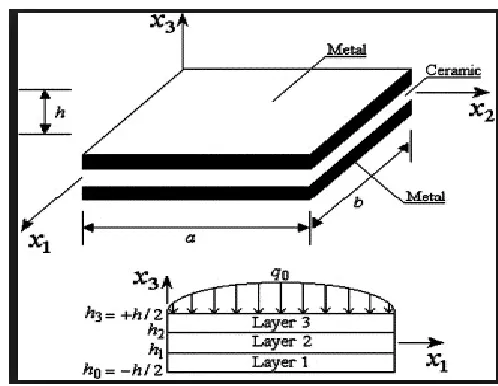
Functionally graded materials have gotten a great deal of enthusiasm for late days by their expanded and potential applications in aviation and different enterprises. They have high particular mechanical properties and high temperature abilities which makes them exceptional over all the leaving propelled materials. The present work examined static and dynamic investigation of practically evaluated plate. The material properties differ persistently from metal (base surface) to clay (top surface). The viable material properties of practically reviewed materials for the plate structures are thought to be temperature autonomous and evaluated in the plate thickness heading as per a power law conveyance of the volume parts of the constituents. In show an eight gestured isoperimetric quadrilateral shell component is utilized to discretize the present model for both static and also unique investigation. The present model is created utilizing ANSYS parametric outline dialect code in the ANSYS stage.
1.0 INTRODUCTION:
Laminated composites have gotten a considerable measure of enthusiasm for late days by enhanced and potential applications in car and airplane business because of their quality to weight, solidness to weight proportion, low weariness life and durability and other higher material properties. These are produced using at least two constituent materials which have distinctive concoction or
physical properties and delivered a material having diverse conduct from the person. These are utilized as a part of structures, stockpiling tanks, spans and so forth. Each layer is overlaid keeping in mind the end goal to get unrivaled material properties. The individual layer has high quality filaments like graphite, glass or silicon carbide and network materials like epoxies, polyimides. By fluctuating the thickness of lamina wanted properties (quality,
wear protection, firmness) can be
accomplished. In spite of the fact that these materials have prevalent properties, their real downside is the shortcoming of covered materials. This is known as delamination marvel which prompts the disappointment of the composite structure. Lingering stresses are available because of contrast in warm extension of the grid and fiber. It is notable that at high temperature the glue being artificially shaky and neglects to hold the cover. Sometimes due to fiber breakdown it also prematurely fails.
Functionally Graded Material is mix of an
earthenware and a metal. A material in which
its structure and piece both differs
continuously finished volume keeping in mind
the end goal to get certain particular properties
of the material henceforth can play out specific
capacities. The properties of material rely upon
the spatial position in the structure of material.
Available online: https://edupediapublications.org/journals/index.php/IJR/ P a g e | 1103 at the overlaid composite interfaces because of
sudden difference in material properties
diminished by ceaseless reviewing of material
properties. By and large micro structural
heterogeneity or non-consistency is presented
in practically reviewed material. The primary
intention is to build break sturdiness,
increment in quality since earthenware
production just are fragile in nature. Reviewed
screw plates with piezoelectric layers under
electrical and mechanical loadings.
Geometrically nonlinear conduct of the plate
has been considered. The examination is
completed utilizing nonlinear limited
component technique. Broad numerical
outcomes are displayed in graphical structures
to give a knowledge into the impacts of
material piece and the sort of stacking on the
nonlinear static conduct of FGM plate for
instance.
Homogenization of Functionally Graded screw Materials:
When all is said in done, there are two
conceivable ways to deal with homogenization
of FGM. The decision of the approach ought to
be founded on the slope of degree in respect to
the measure of a regular agent volume
component. For the situation where the
varieties of the material properties related with
degree are generally moderate changing
elements of spatial directions, standard
homogenization strategies can be connected.
As needs be, the material is accepted locally
homogeneous at the RVE scale consistent
constituent stage volume divisions and
homogeneous boundary conditions yet it is all
around heterogeneous on the plainly visible
basic scale
Figure A particulateFGMwith the volume
fractions of constituent phases
HEAT TRANSFER IN FUNCTIONALITY GRADED MATERIAL
Available online: https://edupediapublications.org/journals/index.php/IJR/ P a g e | 1104 transient thermal moment in a FGM strip with
the properties shifting in the thickness bearing whose surfaces are abruptly cooled to various temperatures The shut frame asymptotic arrangement was gotten by subdividing the strip into various homogeneous layers. Sutradhar and Paulino built up a three-dimensional limit component approach for the examination of transient warmth conduction in FGM and exhibited that their answer was in phenomenal concurrence with agent limited component and logical arrangements The quadratic, exponential, and trigonometric classes of material degree can be utilized as a part of conjunction with this arrangement. In a current paper, a three-dimensional Galerkin
boundary element formulation was
successfully implemented in a FGM heat conduction problem and applied to the analysis of a compressor blade.
LITATRAURE REVIEW
[1] K.K. SHUKLA(2006) An explicit solution for the nonlinear static and dynamic reactions of the practically evaluated materials rectangular plate is gotten. The volume part of the material constituents is expected to take
after a straightforward power law
dissemination. The definition depends on the primary request shear disfigurement hypothesis and von-Karman nonlinear kinematics. The arrangement philosophy uses the quadratic extrapolation procedure for linearization, limited twofold arrangement for spatial discretization of the factors and Unbolt time walking plan for worldly discretization Analysis comes about show that the volume part example significantly affects the reaction of the plate and with an expansion in the estimation of the volume division type up to two, the transverse redirection increments fundamentally in both the static and dynamic stacking cases, demonstrating that the plate solidness diminishes with an increment in n. The impact of volume part example is
comparative for thin and respectably thick plates
[2] Bashir Behjat1, and Mohammad – Reza (2012) In this paper, static bowing investigation of practically evaluated plates with piezoelectric layers has been done considering geometrical nonlinearity in various arrangements of mechanical and electrical loadings. Just the geometrical nonlinearity has been considered. The overseeing conditions are acquired utilizing potential vitality and Hamilton's standard. The limited component show is determined in light of constitutive condition of piezoelectric material representing coupling amongst versatility and electric impact by utilizing higher request components. The present limited component utilized removal and electric potential as nodal degrees of opportunity. Results are exhibited for two constituent FGM plate under various mechanical limit conditions. Numerical outcomes for FGM plate are given in dimensionless graphical structures.
[3] Lat. Am. j.(2014)On the premise of the standard of least potential vitality and the Rayleigh Ritz strategy, the conditions of movement are inferred in conjunction with the reviewed limited component approach. Arrangement of the came about arrangement of conditions in time area is completed by
means of New stamp's opportunity
reconciliation strategy. Computations are connected for completely cinched boundary condition. In the present paper, two distinct arrangements of appropriations for material properties are considered. For the static examination, material properties are considered to change through the thickness bearing as indicated by an exponential law. The outcomes are gotten for different material reviewing record and diverse skew edges,
subsequently demonstrating the
Available online: https://edupediapublications.org/journals/index.php/IJR/ P a g e | 1105 fluctuate through the thickness bearing as
indicated by an exponential material degree and for the dynamic investigations, the successful material properties dissemination of the FGM plate was resolved utilizing Mori– Tanaka homogenization technique..
3.0
METHODOLOGY:
The problems of optimization of FGM are normal for this class of multiphase materials that have been created to improve the properties and reaction of structures. Plan parameters utilized as a part of the advancement of FGM are normally identified with a fitting evaluating of the material. The target capacities change reliant on the undertaking and issue considered, however as a rule, they may incorporate weight, greatest anxieties or enhanced break protection, and necessities to warm exchange and protection. While the investigations of advancement are vital for the improvement of future materials, innovative impediments may undermine the materialness of a portion of the conclusions from these examinations. Considered the optimization of thermal stresses in an infinite plate with a FGM coating subjected to a steady heat flux, while cooled on the opposite surface. The outline factors considered in this paper were the thickness and the volume part sythesis of homogeneous FGM interlayers. The enhancement of the properties of a transversely isotropic FGM layer that is inhomogeneous in the thickness bearing was viewed as Transient and relentless state warm worries in a fired metal FGM were additionally streamlined where the degree was spoken to by a two-parameter bend with the coefficients filling in as outline factors. Cho and Shin utilized a back engendering simulated neural system to accomplish an ideal material arrangement in a three-layered plate comprising of fired and metal layers and a FGM layer sandwiched between them
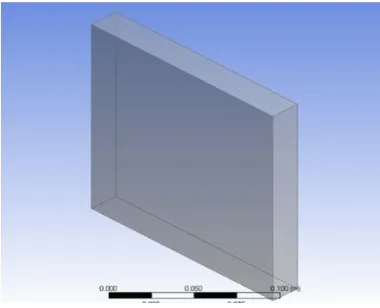
Geometric modeling:
Modeling the geometry (or shape) of an object is the primary purpose of most design systems. The goal is simple: provide a system capable of maintaining a model’s geometry and provide the tools to define that geometry by accurately capturing the designer’s geometric intent. Existing CAD systems provide this functionality in many formats, but the basic idea is typically to define the boundary of an object, whether it is a single part and a component of an assembly.
Figure geometric modeling view.
FG model (ANSYS):
Available online: https://edupediapublications.org/journals/index.php/IJR/ P a g e | 1106 Figure Meshing model
Properties of the FGM plate constituents:
Materials Young's Modulus E
(GPa)
Poisson's Ratio
Density(Kg/m3)
Aluminum (Al) 70 0.3 2707
Steel (SUS304) 201.04 0.28 8166
4.0RESULTS:
FGM plates with various length to thickness proportion, aspect ratio (a/b) are broke down in this investigation. The stacking conditions are thought to be static. The component decided for this investigation is SHELL281, which is a layered variant of the 8-hub auxiliary shell display. This is reasonable for breaking down thin to respectably thick shell structures. This shell component has six degrees of flexibility at every hub in particular three interpretations and three pivot in the nodal x, y and z headings individually. The investigation is performed in industrially accessible programming (ANSYS 15.0). The stacking conditions are thought to be static. The FGM plate is demonstrated in ANSYS 15.0 as shown in the below fig.
STATIC ANALYSIS:
For Functionally graded aluminum alloys:
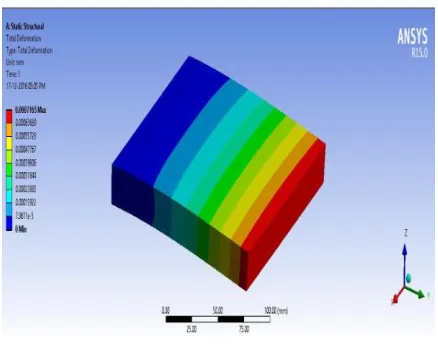
Figure Total deformation
Figure Equivalent stress
Available online: https://edupediapublications.org/journals/index.php/IJR/ P a g e | 1107 Figure Heat flux
Figure Temperature distribution
STATIC ANALYSIS FOR
FUNCTIONALLY GRADED STEEL ALLOYS
Figure Total deformation
Figure Equivalent stress
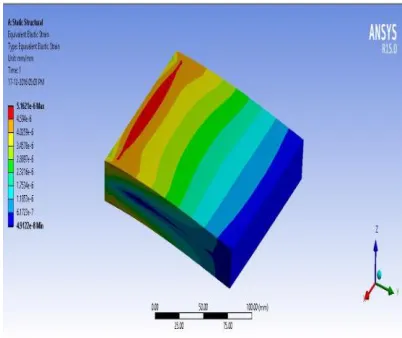
FigureEquivalent elastic strain
Figure Heat flux
FigureTemperature
Available online: https://edupediapublications.org/journals/index.php/IJR/ P a g e | 1108 FG model (ANSYS)
Rectangular simply supported Aluminum/Steel FG flat panel has been developed in ANSYS15.0 platform. Time dependent step load has been taken for transient dynamic thermal analysis. Step type loading has been taken in to consideration. Below are the boundary conditions.
The analysis is carried out for different materials
from time zero second to 60seconds. Dynamic
behavior of FG flat panel can be seen in below
figures.
FG aluminum material:
Temperature distribution FG aluminum flat panel with time = 1
When time = 20 seconds
Available online: https://edupediapublications.org/journals/index.php/IJR/ P a g e | 1109 When t = 60 seconds
FG steel material:
Below are the results for FG steel material with same boundary conditions.
Temperature distribution FG steel flat panel with time = 1
When t = 20 seconds
When t = 40 seconds
Available online: https://edupediapublications.org/journals/index.php/IJR/ P a g e | 1110 Temperature distribution:
Temperature distribution for aluminum:
Temperature distribution for steel
Validation:
Functionally graded materials FGMs are composite materials shaped of at least two constituent stages with a persistently factor sythesis. FGMs have various focal points that make them alluring in potential applications, including a potential diminished of in-plane and transverse through-the-thickness focuses on, an enhanced remaining anxiety conveyance, improved warm properties, higher break sturdiness, and decreased stress force factors. Procedures of the universal symposiums on FGM additionally shed light on the latest research in these materials At exhibit, FGMs are usually associated with particulate composites where the volume fraction of particles varies in one or several directions The nonlinear static and dynamic reactions of the practically evaluated materials plate with non-traditional boundary conditions are gotten, expressly. The impact of volume part
example on the static and dynamic transverse removal reactions is gotten, which might be valuable for deciding the volume portion of the materials for a coveted reaction. Investigation comes about show that the volume part type significantly affects the reaction of the plate and with an expansion in the estimation of the volume portion type up to two, the transverse avoidance increments essentially in both the static and dynamic stacking cases, demonstrating that the plate firmness lessens with better outcomes for produced steel material.
CONCLUSIONS:
In this study, static and dynamic responses of
FGM plates are analyzed. Boundary conditions
Available online: https://edupediapublications.org/journals/index.php/IJR/ P a g e | 1111 plates are in the project we determine the
maximum and minimum mechanical properties of two different FGM’s.Ansys models were created to approximate the actual behavior of the material and to help predict future behavior of more complex structures. The maximum elastic strain in FG aluminum and FG steel material, FG aluminum deformation is lesser than FG steel material and forbetter temperature distribution FG steel material is recommended.
Future Scope of work:
Different geometric structures can be modeled such as cylindrical, spherical,
conical, hyperboloid etc.
Temperature dependent material property can be considered.
Different type of analysis like buckling, post buckling, free vibration, forcedvibration etc. can also be performed using the presented model
REFERENCES:
[1] K.K. SHUKLA (2006) nonlinear-static-and dynamic examination of practically evaluated plates Int. J. of Applied Mechanics and Engineering,vol.11, No.3 pp. 679-698.
[2] Bashir Behjat1, and Mohammad - Reza Nonlinear examination of practically reviewed covers considering piezoelectric impact "Diary of Mechanical Science and Technology pp:2581~2588.