Vaccines Containing Recombinant
Leptospira interrogans
Outer
Membrane Proteins and Flagellin Adjuvant
D. Monaris,a,bM. E. Sbrogio-Almeida,cC. C. Dib,dT. A. Canhamero,eG. O. Souza,bS. A. Vasconcellos,bL. C. S. Ferreira,f P. A. E. Abreua
Laboratório de Bacteriologia, Instituto Butantan, São Paulo, SP, Brazila; Faculdade de Medicina Veterinária e Zootecnia, Universidade de São Paulo, São Paulo, SP, Brazilb;
Centro de Biotecnologia, Instituto Butantan, São Paulo, SP, Brazilc; Laboratório de Tuberculose, Instituto Biológico, São Paulo, SP Brazild; Laboratório de Imunogenética,
Instituto Butantan, São Paulo, SP, Brazile; Laboratório de Desenvolvimento de Vacinas, Instituto de Ciências Biomédicas, Universidade de São Paulo, São Paulo, SP, Brazilf
Leptospirosis is a global zoonotic disease caused by different
Leptospira
species, such as
Leptospira interrogans
, that colonize the
renal tubules of wild and domestic animals. Thus far, attempts to develop effective leptospirosis vaccines, both for humans and
animals, have failed to induce immune responses capable of conferring protection and simultaneously preventing renal
coloni-zation. In this study, we evaluated the protective immunity induced by subunit vaccines containing seven different recombinant
Leptospira interrogans
outer membrane proteins, including the carboxy-terminal portion of the immunoglobulinlike protein A
(LigA
C) and six novel antigens, combined with aluminum hydroxide (alum) or
Salmonella
flagellin (FliC) as adjuvants.
Ham-sters vaccinated with the different formulations elicited high antigen-specific antibody titers. Immunization with LigA
C, either
with alum or flagellin, conferred protective immunity but did not prevent renal colonization. Similarly, animals immunized
with LigA
Cor LigA
Ccoadministered with six leptospiral proteins with alum adjuvant conferred protection but did not reduce
renal colonization. In contrast, immunizing animals with the pool of seven antigens in combination with flagellin conferred
pro-tection and significantly reduced renal colonization by the pathogen. The present study emphasizes the relevance of antigen
composition and added adjuvant in the efficacy of antileptospirosis subunit vaccines and shows the complex relationship
be-tween immune responses and renal colonization by the pathogen.
L
eptospirosis is an important global public health problem,
par-ticularly in tropical and subtropical countries (1). It is a
zoo-notic disease caused by pathogenic leptospires that are maintained
by persistent renal colonization of domestic and wild animal
spe-cies. The infection may result from either direct contact with
in-fected animals or indirect exposure to water or soil contaminated
with the urine of infected animals (2). Annually, 500,000 cases of
severe leptospirosis in humans have been reported worldwide,
with a mortality rate of more than 10% (3,
4). Despite the gravity
of the disease, the incidence of the illness is likely underestimated
due to the nonspecific clinical manifestations and lack of an
effi-cient method of diagnosis (4,
5). In the veterinary field,
leptospi-rosis causes significant economic losses due to the effects on the
reproductive potential of animals, including infertility, stillbirths,
abortions, weak newborns, and reduced milk production in cattle
and other ruminants (6,
7).
Commercially available leptospirosis vaccines have been
widely used in livestock and are licensed for human use in a few
countries (8). These vaccines consist of killed whole cells
(bacte-rins) and suffer from several limitations, such as reduced
protec-tive efficacy that fails to prevent renal colonization and urinary
shedding of the pathogen by vaccinated animals. The vaccines also
fail to induce long-term immunity and confer protection only
against the serovars present in the preparation. In addition, the
presently available vaccines carry a number of contaminants that
originate from the production process and are associated with
rather serious side effects (8–10).
Subunit vaccines may be an alternative for leptospirosis
pre-vention. Several leptospiral outer membrane proteins have been
evaluated as potential vaccine antigens, including lipoproteins
(LipL41 and LipL32), porin OmpL1, immunoglobulinlike
pro-teins (LigA and LigB), and OmpA-like propro-teins (9–20). Previous
evidence indicated that hamsters vaccinated with a combination
of OmpL1 and LipL41 embedded in bacterial membranes
devel-oped protective immunity and resistance to renal colonization
(11). Immunization with a DNA vaccine encoding the conserved
amino-terminal regions of LigA and LigB provided partial
protec-tion, and most of the surviving animals showed sterilizing
immu-nity (19). LigA belongs to the family of bacterial proteins
charac-terized by the presence of immunoglobulinlike repeat domains.
Three genes (
ligA
,
ligB
, and
ligC
) have been described in
Leptospira
spp. and are only present in pathogenic species. The
ligB
gene is
found in several
Leptospira
species, whereas
ligA
is restricted to
L.
interrogans
and
Leptospira kirschneri
, and
ligC
is a pseudogene (15,
Received13 May 2015Returned for modification3 June 2015
Accepted17 June 2015
Accepted manuscript posted online24 June 2015
CitationMonaris D, Sbrogio-Almeida ME, Dib CC, Canhamero TA, Souza GO,
Vasconcellos SA, Ferreira LCS, Abreu PAE. 2015. Protective immunity and reduced renal colonization induced by vaccines containing recombinantLeptospira interrogansouter membrane proteins and flagellin adjuvant. Clin Vaccine Immunol 22:965–973.doi:10.1128/CVI.00285-15.
Editor:D. W. Pascual
Address correspondence to P. A. E. Abreu, [email protected]. Supplemental material for this article may be found athttp://dx.doi.org/10.1128 /CVI.00285-15.
Copyright © 2015, American Society for Microbiology. All Rights Reserved.
doi:10.1128/CVI.00285-15
on August 17, 2020 by guest
http://cvi.asm.org/
21–23). LigA and LigB are expressed during infection and
partic-ipate in the processes of adhesion of leptospires to host cells (15,
21,
22).
In a previous study, 238 putative surface-exposed or secreted
leptospiral proteins were expressed in
Escherichia coli
and tested as
potential antigens in vaccine formulations with aluminum
hy-droxide adjuvant (24). The purified recombinant proteins were
immunogenic, but none could prevent renal colonization after
challenge with
Leptospira borgpetersenii
(24). These results
indi-cated that the induction of protective immunity and the
simulta-neous prevention of renal colonization remain unmet challenges
for those dealing with the development of leptospirosis vaccines.
For that purpose, the testing of new adjuvants may represent a key
step toward the discovery of an effective leptospirosis vaccine.
Flagellin, the subunit protein of the flagellar filament,
ex-pressed by
Salmonella
as well as other bacterial species, represents
an agonist of innate immunity and has been successfully used as a
vaccine adjuvant (25–30). The inflammatory responses induced
by flagellin, as well as other pathogen-associated molecular
pat-terns (PAMPs), activate antigen-presenting cells and result in the
release of cytokines and chemical mediators with direct effects on
the adaptive immune response (31–33). This knowledge has been
used in the development of new vaccine formulations by
promot-ing the link between innate and adaptive immune responses
through the incorporation of PAMPs with the target antigens
(25–30).
In this study, we evaluated the induction of protective
im-munity in hamsters after immunization with leptospiral
sub-unit vaccines containing seven different
L. interrogans
outer
membrane proteins, including the carboxy portion of LigA, in
combination with two different adjuvants, the
Salmonella enterica
serovar Typhimurium flagellin (FliC) and aluminum
hydrox-ide (alum). Our results demonstrated that only animals
immu-nized with the pool of antigens combined with flagellin
mounted a protective immune response and controlled renal
colonization by the pathogen.
MATERIALS AND METHODS
Leptospiral strain and growth conditions.TheL. interrogansserovar Co-penhageni strain Fiocruz L1-130 (ATCC BAA-1198) was cultivated at 29°C under aerobic conditions in liquid EMJH medium (Difco) with 10% rabbit serum, enriched withL-asparagine (0.015% [wt/vol]), sodium py-ruvate (0.001% [wt/vol]), calcium chloride (0.001% [wt/vol]), magne-sium chloride (0.001% [wt/vol]), peptone (0.03% [wt/vol]), and meat extract (0.02% [wt/vol]). Virulence was maintained by iterative passages in hamsters (34).
In silicoanalysis.The proteins encoded by the LIC10009, LIC10301, LIC10507, LIC10704, LIC11030, and LIC11087 genes were identified in theL. interrogans serovar Copenhageni lipoprotein database (http:// mic.sgmjournals.org/content/journal/micro/10.1099/mic.0.28317 -0#tab5) (35) on the basis of outer membrane localization as previously described (36). The standard protein-protein BLAST analysis (BLASTp) (http://blast.ncbi.nlm.nih.gov/Blast.cgi) was used to identify similarities between selected proteins in sequence databases. We considered only se-quences that aligned to the query with an E value of zero or less.
Purification of recombinant proteins and Salmonella flagellin.
Open reading frames LIC10009 (encoding a protein designated Lp25, for leptospiral protein 25), LIC10301 (Lp11), LIC10507 (Lp21), LIC10704 (Lp22), LIC11030 (Lp35), and LIC11087 (leptospiral adhesion protein 30 [Lsa30]) were cloned without signal peptide tags into the pAE vector as previously described (36). The coding sequence of the carboxy-terminal portion of LigA (LigAC), corresponding to nucleotides 1891 to 3675
(LIC10465), was amplified by PCR from genomic DNA ofL. interrogans serovar Copenhageni strain Fiocruz L1-130 using the following primers: F, GGATCCCTTACCGTTTCCAACACAAACG, and R, CCATGGTTAC TCGAGTGGCTCCGTTTTAATAG. After digestion with BamHI and NcoI restriction enzymes, the fragment was cloned into the pAE vector. The expression and purification of recombinant proteins with an amino-terminal 6⫻His tag were performed as previously described (36,37). Competent cells of theE. coliC43 strain were transformed with pAE constructs and cultivated until the optical density at 600 nm reached 0.6. The expression of recombinant proteins was induced with 1 mM isopro-pyl-1-thio--D-galactopyranoside (IPTG) at 37°C for 3 h. The cells were harvested by centrifugation, resuspended in 20 mM Tris-HCl and 500 mM NaCl at pH 8.0, and lysed by using a French pressure cell (Spectronic Instruments, Inc., Rochester, NY). The soluble and insoluble fractions were separated by centrifugation at 26,000⫻gfor 15 min. The His-tagged recombinant proteins Lp21 and Lp22, from the supernatant (soluble frac-tion), and Lp25, Lp11, Lp35, Lsa30, and LigAC, from the inclusion bodies,
(insoluble fraction) were purified by metal affinity chromatography. The soluble fractions were diluted (10-fold) in binding buffer (20 mM Tris-HCl and 500 mM NaCl at pH 8.0) containing 5 mM imidazole. Inclusion bodies were washed with binding buffer containing 2 mM -mercapto-ethanol, 1 M urea, and 1% Triton X-100 and were then solubilized with binding buffer containing 8 M urea and 5 mM-mercaptoethanol for 16 h at 25°C. For refolding of proteins solubilized in the presence of urea, the suspensions were diluted (100-fold) with binding buffer containing 5 mM imidazole. Protein solutions obtained from the diluted soluble fraction and refolding fraction were loaded onto nickel-charged chelating Sephar-ose columns (GE Healthcare, United Kingdom). After adsorption of pro-teins, columns were washed sequentially with binding buffer mixtures containing 5, 20, 40, 60, and 100 mM imidazole. His-tagged proteins were eluted from the column with 1 M imidazole. Purified proteins were dia-lyzed extensively against phosphate-buffered saline (PBS), and samples were analyzed by sodium dodecyl sulfate-polyacrylamide gel electropho-resis (SDS-PAGE). The flagellin (FliC) was purified fromSalmonella en-tericaserovar Typhimurium SL3261 as previously described (30). Briefly, the cells were harvested by centrifugation, suspended in PBS, and sheared in a bench mixer at maximal speed (a 1-min treatment repeated three times), followed by another centrifugation step to remove the bacterial cells. Broken flagella fragments were precipitated with acetone, suspended in PBS, and submitted to heat treatment (65°C for 30 min) to dissociate the flagellin monomers. The protein concentrations were determined us-ing the Bradford assay (Pierce, Rockford, IL), and the purity of the protein preparations was monitored by SDS-PAGE. Removal of contaminating lipopolysaccharide was accomplished with Detoxi-Gel columns (Pierce, Rockford, IL) according to the manufacturer’s instructions. Endotoxin levels, determined with the chromogenic Limulus amebocyte lysate assay (Lonza), were always below 2.0 endotoxin units/g protein.
CD spectroscopy. Purified recombinant proteins were dialyzed against sodium phosphate buffer (pH 7.4). Circular dichroism (CD) troscopy measurements were performed at 20°C using a Jasco J-810 spec-tropolarimeter (Japan Spectroscopic, Tokyo, Japan) equipped with a Pel-tier unit for temperature control. Far-UV CD spectra were measured at 0.5-nm intervals using a 1-mm-path-length cell. The spectra are presented as the averages of five scans recorded from 190 to 260 nm.
Hamster immunization and challenge.Groups of 10 male Syrian golden hamsters, 4 weeks of age, were immunized subcutaneously with six purified recombinant proteins or a pool of these proteins (20g of each protein) with or without 50g of LigAC, as well as in combination with 5 g of FliC or 500g of aluminum ion in the form of aluminum hydroxide (Alhydrogel). Control groups were immunized with PBS in addition to 5
g of FliC or 500g of aluminum ion. The animals were boosted 15 days later with the same antigen preparation. One day before the second im-munization and 1 day before the challenge, the hamsters were bled from the retro-orbital plexus, and the sera were analyzed by enzyme-linked immunosorbent assay (ELISA). On the 31st day, the hamsters were
on August 17, 2020 by guest
http://cvi.asm.org/
lenged by intraperitoneal inoculation of 2⫻103leptospires,
correspond-ing to 100-fold the 50% lethal dose (LD50) calculated by the method of Reed and Muench (38). Animals surviving after 21 days were considered protected. Protection was calculated as the percentage of animals that were protected out of the total number of animals challenged. Blood was collected from survivors, and the collected sera were analyzed by the mi-croagglutination test (MAT) usingL. interrogansserovar Copenhageni antigen, as previously described (11). The surviving hamsters were eutha-nized, and the animals’ kidneys were collected at necropsy. One kidney sample from each animal was prepared for bacteriological culture by gen-tly homogenizing the tissue, and two serial 10-fold dilutions of the tissue homogenate were used to inoculate a semisolid medium. Cultures were periodically examined for the presence of bacteria using dark-field mi-croscopy for up to 1 month before being designated negative. Another kidney sample was processed for histopathology with formalin fixation, paraffin embedding, sectioning, and staining using the Warthin-Starry method. The establishment of renal infection was measured using bacte-riological culture and direct examination of leptospires in silver-stained tissue sections by microscopic analysis and MAT test. Figure S1 in the supplemental material presents representative examples of positive and negative cultures and microscopic examinations. An animal was consid-ered positive for renal colonization when we were able to detect lepto-spires using at least one of the methods. The percentage of renal coloni-zation was calculated as the number of positive animals divided by the total number of survivors. During all experiments, animals were supplied with food and waterad libitum, and experimental protocols were previ-ously approved by the Ethical Committee for Animal Research of the Faculdade de Medicina Veterinária e Zootecnia, Universidade de São Paulo, São Paulo, Brazil, under the license number 156108.
ELISA.Serum antibody responses after immunization with recombi-nant proteins and controls were quantified by ELISA. Microtiter plates (Nunc MaxiSorp; Thermo Fisher Scientific, Inc., Rochester, USA) were coated with recombinant proteins (100l at 10g/ml) overnight at 4°C. The wells were washed three times with PBS– 0.05% Tween 20 (PBST) (pH 7.4), blocked with 10% nonfat dry milk in PBS for 2 h at 37°C, and incubated with serial dilutions of hamster sera in PBS for 1 h at 37°C. The plates were washed three times with PBST and incubated with rabbit anti-hamster IgG (1:5,000) and with horseradish peroxidase (HRP)-con-jugated anti-rabbit IgG (1:5,000) (Sigma) in PBS–1% nonfat dry milk at 37°C for 1 h. The HRP substrate,o-phenylenediamine (0.04%) in citrate phosphate buffer (pH 5), plus 0.01% H2O2, was added, and the plates
were incubated for an additional 15 min at room temperature in the dark. The reaction was interrupted by the addition of 50l of 8 M H2SO4. All
samples were assayed in triplicate, and endpoint titers were defined as the inverse of the highest dilution that resulted in a reading 2 standard devi-ations above the background.
Western blot analysis.Cultures of leptospires were harvested by cen-trifugation, and the pellets were washed twice with PBS. After centrifuga-tion, the cells were suspended in PBS, homogenized, and along with pu-rified recombinant proteins, subjected to SDS-PAGE under reducing conditions; all proteins were then transferred to a nitrocellulose mem-brane. Nonspecific binding sites were blocked by using 10% (wt/vol) non-fat dried milk in PBST (pH 7.4) overnight at 4°C. Subsequently, the mem-brane was rinsed one time in PBST and incubated for 60 min at 25°C with hamster recombinant protein antibody (diluted 1:500), mouse anti-His tag antibody (diluted 1:3,000), or sera from hamsters immunized with heat-killed leptospires (diluted 1:50 for Lp11, Lp21, Lp22, and LigACand
1:100 for Lp25, Lsa30, and Lp35) in 5% (wt/vol) nonfat dried milk–PBST. After five washes with PBST, the membrane was incubated with secondary peroxidase-conjugated anti-mouse or anti-hamster IgG at a 1:5,000 dilu-tion for 60 min at 25°C. After incubadilu-tion, the membrane was washed with PBST four times. The positive signal was detected by enhanced chemilu-minescence (West Pico; Pierce, Thermo Fisher Scientific, Inc.).
Statistics.Differences in rates of survival and the presence of renal colonization were analyzed by Fisher’s exact test.
RESULTS
Selection and characteristics of the antigens.
As surface proteins
are potential targets of host immunity, our rationale for antigen
selection was based on the localization of proteins at the outer
membrane. Bioinformatics analyses using the
L. interrogans
sero-var Copenhageni strain Fiocruz L1-130 genome sequence were
performed previously as described in a work published by our
group (36). We selected six probable outer membrane proteins
that could be expressed in
E. coli
and produced them for the
im-munization experiments. These proteins were assigned
designa-tions using Lp, for leptospiral protein, with the exception of the
previously characterized protein named Lsa30 (leptospiral
adhe-sion protein 30), which is able to bind to laminin and plasma
fibronectin (39), and the protein encoded by the LIC10507 gene,
herein named Lp21, which is involved in the upregulation of
in-tercellular adhesion molecule 1 (ICAM-1) and E-selectin on
en-dothelial cells (40). We also evaluated the amino acid sequence
identities of the proteins in comparison to the amino acid
se-quences of proteins from other leptospire species. The names,
GenBank accession numbers, and sequence identities of the
pro-teins are presented in Table S1 in the supplemental material.
Se-quences identical or similar to the those of the six proteins were
identified in NCBI databases by BLASTp analyses. All proteins
were conserved in pathogenic strains of
Leptospira
spp., with
iden-tity values ranging from 30% to 100%. No sequences similar to
those of these proteins were identified in saprophytic
Leptospira
species. The proteins did not exhibit an assigned function or
spe-cific structural domains. Outer membrane localization was
exper-imentally confirmed for the proteins Lp21 (40), Lsa30 (39), and
Lp35 (41) in previous studies. In addition to these six proteins, the
LigA carboxy-terminal fragment, corresponding to repeat
do-mains 7 to 13 (LigA
C), was included in the study based on
previ-ously reported protective effects, although LigA
Chas not been
shown to confer sterilizing immunity (17,
18).
Purification, characterization, and antigenicity of
recombi-nant proteins.
The recombinant proteins were purified by
immo-bilized metal ion affinity chromatography, and the homogenous
protein bands were visualized by SDS-PAGE (see Fig. S2 in the
supplemental material). The structural integrity of the purified
proteins was assessed by circular dichroism (CD) spectroscopy. As
illustrated in Fig. S3, the CD spectra reveal that the secondary
structures of the recombinant proteins were maintained after the
purification process. The presence of significant near-UV signals
is a good indication that the proteins were folded into well-defined
structures.
The antigenicity of the recombinant proteins was evaluated
using the sera of hamsters immunized with heat-killed leptospires
(
L. interrogans
serovar Copenhageni strain Fiocruz L1-130). The
reactivity of the antileptospiral antisera to each recombinant
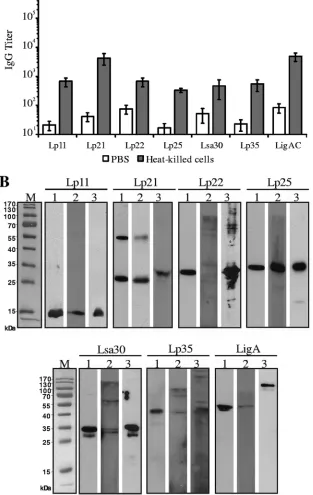
pro-tein was determined by ELISA and Western blot analysis (Fig. 1).
Hamsters immunized with heat-killed leptospires developed
se-rum IgG responses to all recombinant proteins tested. In contrast,
the sham (PBS)-treated animal group developed low-level,
non-specific reactions to the tested proteins (Fig. 1A). Immunoblots
were performed using the immobilized purified recombinant
pro-teins and anti-His tag antiserum or sera from hamsters
immu-nized with heat-killed leptospires.
Figure 1B
shows the results of
reaction with the anti-His tag antibodies (Fig. 1B, lanes 1). The
same figure also shows the results obtained with sera from
on August 17, 2020 by guest
http://cvi.asm.org/
sters immunized with heat-killed leptospires (Fig. 1B, lanes 2).
The Lsa30, Lp35, and LigA
Cproteins were detected less efficiently
than the Lp11, Lp21, and Lp25 proteins, while Lp22 was not
de-tected. The
⬃
55-kDa fragment observed in the membrane probed
with anti-Lp21 antiserum probably corresponds to dimers of the
protein. These results suggest that the reaction of Lp22 in ELISA
may represent cross-reactivity with
E. coli
antigens.
To assess whether the tested proteins are expressed in
culti-FIG 1Antigenic properties of the recombinantL. interrogansantigens. (A) Antigen-specific antibody responses in sera from hamsters immunized with heat-killed leptospires and subsequently reacted with purified recombinant antigens in ELISAs. Hamsters were inoculated subcutaneously with two doses of 105heat-killedL.interrogansserovar Copenhageni strain Fiocruz L1-130. A negative-control group was injected with PBS. On the 30th day after the first immunization, hamsters were bled, and the sera were analyzed by ELISA. Microtitration plates were coated with each recombinant protein and incubated with serial dilutions of serum from the immunized hamsters to measure specific reactions. Results are expressed as the means⫾standard errors (SE). (B) Reactivities of sera with recombinant antigens detected in immunoblots. The samples used in the Western blot analyses were as follows: lanes M, prestained molecular mass markers; lanes 1, purified recombinant proteins probed with anti-His tag monoclonal antibodies; lanes 2, sera from hamsters immunized with heat-killed leptospires; lanes 3, whole-cell lysate ofL. interrogansserovar Copenhageni probed with polyclonal antiserum raised with each of the recombinant proteins tested. The native LigA protein is⬃130 kDa, and the recombinant form, LigAC, is⬃60 kDa.
on August 17, 2020 by guest
http://cvi.asm.org/
vated leptospires, we performed immunoblots using whole-cell
lysates of
L. interrogans
serovar Copenhageni strain L1-130
incu-bated with antisera from hamsters immunized with each of the
different recombinant antigens. The results in
Figure 1B, lanes 3,
show that the tested proteins are expressed in leptospires. These
results are in agreement with previously published studies that
demonstrate the expression of Lp22 (40), Lsa30 (39), and Lp35
(41) proteins in bacterial culture. Overall, these data demonstrate
that the recombinant proteins preserve the antigenicity of the
na-tive leptospiral proteins.
Antibody responses, protective immunity, and renal
coloni-zation in hamsters immunized with subunit vaccines
contain-ing different recombinant leptospiral antigens.
To evaluate the
ability of recombinant proteins to promote protective immunity,
hamsters were immunized with isolated antigens adsorbed to
alum in two independent experiments. All experimental groups
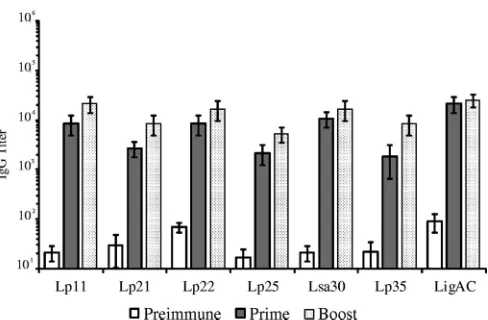
exhibited high serum IgG titers to the tested recombinant protein
after the first and second immunizations (Fig. 2). However, no
significant differences among the survival rates of immunized
an-imals and sham-treated anan-imals were recorded (see Table S2 in the
supplemental material). Animals immunized with LigA
Cand
alum survived the challenge and did not exhibit any symptoms of
the disease (see Table S2). Nonetheless, as expected, hamsters
im-munized with LigA
Ccould not prevent renal colonization by the
pathogen.
Next, we investigated the immune responses and protective
immunity elicited in hamsters immunized with the mixture of the
recombinant proteins tested. Animals were immunized with the
six purified recombinant proteins, with or without LigA
C,
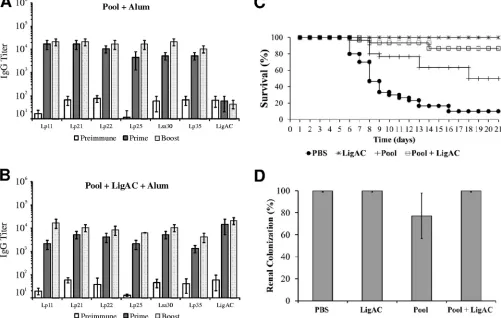
ad-sorbed to alum in three independent experiments. The vaccine
formulations containing the recombinant Lps induced high
anti-body titers to all tested proteins, and no differences were observed
with coadministration of LigA
C(Fig. 3A
and
B). Hamsters
immu-nized with LigA
Calone or LigA
Ccoadministered with the six Lps
and alum adjuvant exhibited statistically significant
immunopro-tection (100% and 87%, respectively) compared to the level of
protection in the animals inoculated with PBS and alum. Animals
immunized with the pool of Lps without LigA
Cwere partially
protected (50%) against the lethal challenge, whereas most of the
animals inoculated with PBS and alum exhibited symptoms of
leptospirosis and died (Fig. 3C; see also Table S3 in the
supple-mental material). In these experiments, animals immunized with
LigA
Cor LigA
Ccoadministered with the pool of Lps were positive
(100%) for the presence of leptospira in the kidneys (Fig. 3D; see
also Table S4). These data indicate that the combination of Lps did
not enhance the protective immunity induced by LigA
C, nor did
the combination confer sterilizing immunity when combined
with alum as an adjuvant.
In the next step, we evaluated the role of adjuvant in the
protective immunity conferred by the leptospirosis vaccine
formulation containing the pool of Lps and LigA
C. For this
purpose, we tested purified
Salmonella
FliC flagellin, previously
shown to be a promising vaccine adjuvant for acellular vaccines
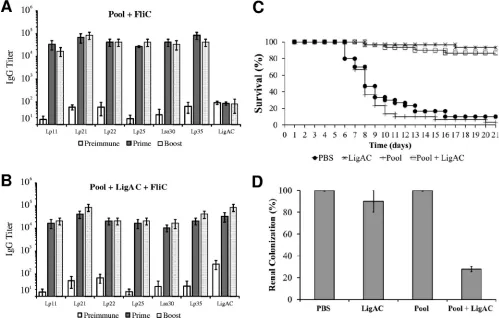
(25–30). Hamsters immunized with LigA
Calone or LigA
Ccom-bined with the six Lps and coadministered with flagellin
devel-oped high serum IgG titers to the tested antigens. The
incorpora-tion of LigA
Cdid not affect the antibody responses to the Lps (Fig.
4A
and
B). Nonetheless, animals immunized with LigA
Cplus FliC
or LigA
Cplus the Lp mixture and FliC were protected against the
lethal leptospiral challenge (93% for LigA
Cplus FliC and 86% for
LigA
C, Lp pool, and FliC). In contrast, animals immunized with
the Lp pool and FliC did not survive the challenge, despite the high
serum antibody titers. Most of the animals inoculated with PBS
and FliC showed symptoms of leptospirosis and died (Fig. 4C;
see also Table S5 in the supplemental material). In three
exper-iments, animals immunized with LigA
Cand FliC were positive
for the presence of
Leptospira
in the kidneys. Nonetheless,
ani-mals immunized with LigA
Ccoadministered with the Lp pool and
FliC exhibited significant reductions in renal colonization (72%
protection against renal colonization) (Fig. 4D; see also Table S6).
These data indicate that incorporation of the
Salmonella
FliC
flagellin as an adjuvant improves the protection against lethality
and renal colonization in challenged hamsters.
DISCUSSION
In this study, we evaluated the induction of protective
immu-nity in hamsters after immunization with seven different
L.
interrogans
outer membrane proteins, including LigA
C, in
combi-nation with flagellin of
Salmonella
Typhimurium and alum. Due
to its ability to confer protective immunity, LigA
Chas been
con-sidered to be one of the most promising antigen candidates for a
subunit vaccine (15–18). Nonetheless, sterilizing immunity
re-mains an unmet challenge because immunization with LigA
C, as
well as other antigens, has not yet succeeded in inhibiting renal
colonization by leptospires. Our results demonstrated that
ham-sters immunized with the pool of Lp antigens and LigA
Ccom-bined with flagellin not only survived the lethal challenge with
L.
interrogans
but also exhibited a significant reduction in renal
col-onization. Altogether, the results of the present study indicate that
the combination of LigA
C, additional Lp antigens, and FliC deserves
consideration as an approach for the development of leptospirosis
vaccines capable of inducing immunological mechanisms involved in
both protection against mortality and prevention of kidney
coloni-zation.
We selected six outer membrane proteins that are conserved in
pathogenic strains of
Leptospira
spp. as potential vaccine antigens.
Most recombinant proteins were expressed in an insoluble form
FIG 2Antibody responses induced in hamsters after immunization with therecombinant proteins. Hamsters were immunized subcutaneously with two doses of each purified recombinant protein adsorbed to alum at an interval of 15 days. One day before the second immunization (prime) and 1 day before the challenge (boost), the animals were bled, and the sera were analyzed by ELISA. Microtiter plates were coated with recombinant proteins and incubated with serial dilutions of the serum samples. Results are expressed as the means⫾SE.
on August 17, 2020 by guest
http://cvi.asm.org/
and had to be denatured and resolubilized before being tested as
vaccine antigens. The optimal conditions for solubilization and
refolding were specific for each protein and had to be determined
experimentally. The circular dichroism data analyses revealed that
the established purification and refolding protocols were suitable
for the generation of the recombinant antigens with good yields,
purity, and preservation of structural conformation. The
struc-tural integrity of the antigens may be critical for inducing
protec-tion against leptospirosis, because previous studies have reported
that immunization of hamsters with denatured LigA
Cdid not
pro-tect against lethal challenge (18,
42).
The efficacy of the recombinant proteins as potential
vac-cine antigens was tested in hamsters, which develop acute lethal
leptospirosis. All experiments were performed with 10 animals
per group to allow an appropriate statistical analysis. In
addi-tion, the dose of 2
⫻
10
3leptospires, corresponding to 100
times the LD
50, was determined to be an optimal challenge
inoculum for
L. interrogans
serovar Copenhageni strain L1-130.
Intraperitoneal inoculation with this dose caused 90 to 100%
mortality in the control groups of hamsters, with typical
man-ifestations of leptospiral infection. This inoculation protocol
was maintained during the study both to measure the
protec-tive immunity conferred by the tested vaccine formulations
and to evaluate the renal colonization in hamsters surviving the
lethal challenge.
Hamsters immunized with heat-killed leptospires or with each
purified recombinant protein produced serum IgG responses to the
recombinant proteins, suggesting that these proteins are antigenic
and expressed by living leptospires. However, none of the six
recom-binant proteins was individually capable of inducing a protective
im-mune response in hamsters. As previously reported, there seems to be
no correlation between high levels of antibodies to leptospiral
anti-gens and protection (18,
24). In contrast, animals immunized with
LigA
Csurvived the challenge, confirming previously reported results
(15–18). Hamsters immunized with LigA
Cor LigA
Cadministered
with the pool of proteins, both in the presence of alum, were
pro-tected against the lethal challenge. Interestingly, in the presence of
alum, animals immunized with the pool of Lps exhibited partial
pro-FIG 3Antibody response and protective immunity induced in hamsters after immunization with recombinant proteins plus alum as an adjuvant. Hamsters were subcutaneously immunized twice with the pool of recombinant protein, at an interval of 15 days. One day before the second immunization (prime) and 1 day before the challenge (boost), the hamsters were bled, and the sera were analyzed by ELISA. Microtitration plates were coated with recombinant proteins and incubated with serial dilutions of serum samples collected from the immunized hamsters to measure the antigen-specific IgG responses. On the 31st day, animals were challenged by intraperitoneal inoculation ofL. interrogansserovar Copenhageni strain Fiocruz L1-130. (A) Antibody responses after immunization with the pool of recombinant proteins without LigACbut with alum. (B) Antibody responses after immunization withthe pool of recombinant proteins and LigACplus alum. (C) Survival of hamsters after the lethal challenge. The percentage of hamsters that survived was calculated
as the number of survivors divided by the total number of animals challenged in three experiments (detailed results are in Table S3 in the supplemental material). (D) Renal colonization in animals surviving the challenge. The percentage of animals with renal colonization was calculated as the number of hamsters positive for kidney infection divided by the number of surviving hamsters in three experiments (detailed results are in Table S4). Results are expressed as the means⫾SE.
on August 17, 2020 by guest
http://cvi.asm.org/
tection (50%) against the challenge with
L. interrogans
. Synergistic
effects generated from combinations of different leptospiral
anti-gens have been reported previously for other antianti-gens, such as the
combination of OmpL1 and LipL41, which conferred enhanced
protection in hamsters (11), and three probable outer membrane
proteins of
L. interrogans
serovar Pomona (rLp1454, rLp1118, and
recombinant MceII), which exhibited greater protective efficacy
when administered together (43).
As previously reported, animals immunized with LigA
Cwere positive for the isolation of leptospires (15–18), and none
of these vaccine compositions in the presence of alum was able
to confer sterilizing immunity despite the higher titers of
anti-bodies generated in the hamsters. To date, no study has
evalu-ated the adjuvant effects of flagellin in combination with
pro-tective leptospiral antigens. Inoculating hamsters with LigA
Cor LigA
Cplus the pool of purified Lps and flagellin conferred
immunoprotection after challenge and induced robust
anti-body responses to the recombinant proteins. In contrast,
ani-mals inoculated with the Lp pool and FliC without LigA
Cdid
not survive after the challenge, despite the high titers of
anti-bodies generated. More remarkably, only animals inoculated
with LigA
Cplus the pool of Lps and FliC exhibited a significant
reduction of renal colonization by leptospires. These data
sug-gest that the combination of antigens and the incorporation of
Salmonella
flagellin as adjuvant represent the only vaccine
formu-lation that could confer protective immunity capable of impacting
leptospiral renal colonization in hamsters, a feature not previously
reported for leptospirosis vaccines.
To summarize, the results presented here suggest that a
multi-valent vaccine against leptospirosis, consisting of seven
recombi-nant outer membrane proteins plus
Salmonella
flagellin as an
ad-juvant, represents a promising step toward the development of
leptospirosis vaccines capable of triggering immune responses
in-volved with more efficient control of leptospiral infection.
Al-though the present evidence did not disclose the specific features
of the immune responses leading to the more efficient control of
the pathogen, the study provides valuable information for future
studies in the field.
FIG 4Antibody response and efficacy of protective immunity induced in hamsters after immunization with the pool of recombinant proteins plus flagellin as an adjuvant. Hamsters were subcutaneously immunized twice with the pool of recombinant proteins at an interval of 15 days. One day before the second immunization (prime) and 1 day before the challenge (boost), the hamsters were bled, and the sera were analyzed by ELISA. Microtitration plates were coated with recombinant proteins and incubated with serial dilutions of serum samples collected from the immunized hamsters to measure the antigen-specific IgG responses. On the 31st day, animals were challenged by intraperitoneal inoculation ofL. interrogansserovar Copenhageni strain Fiocruz L1-130. (A) Antibody responses after immunization with the pool of recombinant proteins without LigACbut with FliC. (B) Antibody responses
after immunization with the pool of recombinant proteins and LigACplus FliC. (C) Survival of the hamsters after the lethal challenge. The percentage of
hamsters that survived was calculated as the number of survivors divided by the total number of animals challenged in three experiments (detailed results are in Table S5 in the supplemental material). (D) Renal colonization in animals surviving the challenge. The percentage of animals with renal colonization was calculated as the number of hamsters positive for kidney infection divided by the number of surviving hamsters in three experiments (detailed results in are Table S6). Results are expressed as the means⫾SE.
on August 17, 2020 by guest
http://cvi.asm.org/
ACKNOWLEDGMENTS
This research was supported by Conselho Nacional de Desenvolvimento Científico e Tecnológico—Brasil (CNPq, grant 564618/08) and Fundação de Amparo à pesquisa no Estado de São Paulo (FAPESP, grants 06/ 54701-6, 10/20525-2, and 10/51365-0).
REFERENCES
1.Bharti AR, Nally JE, Ricaldi JN, Matthias MA, Diaz MM, Lovett MA, Levett PN, Gilman RH, Willig MR, Gotuzzo E, Vinetz JM. 2003. Leptospirosis: a zoonotic disease of global importance. Lancet Infect Dis 3:757–771.http://dx.doi.org/10.1016/S1473-3099(03)00830-2. 2.Adler B, De la Peña-Moctezuma A.2010. Leptospira and leptospirosis.
Vet Microbiol 140:287–296. http://dx.doi.org/10.1016/j.vetmic.2009.03 .012.
3.Vijayachari P, Sugunan AP, Shriram AN.2008. Leptospirosis: an emerg-ing global public health problem. J Biosci33:557–569.http://dx.doi.org /10.1007/s12038-008-0074-z.
4.World Health Organization. 2011. Leptospirosis: an emerging public health problem. Wkly Epidemiol Rec86:45–50.
5.Guerra MA.2013. Leptospirosis: public health perspectives. Biologicals 41:295–297.http://dx.doi.org/10.1016/j.biologicals.2013.06.010. 6.Ellis WA.1994. Leptospirosis as a cause of reproductive failure. Vet Clin
North Am Food Anim Pract10:463– 478.
7.Grooms DL.2006. Reproductive losses caused by bovine viral diarrhea virus and leptospirosis. Theriogenology66:624 – 628.http://dx.doi.org/10 .1016/j.theriogenology.2006.04.016.
8.Faine SB, Adler B, Bolin C, Perolat P.1999. Leptospira and leptospirosis. MediSci, Melbourne, Australia.
9.Dellagostin AO, Grassmann AA, Hartwig DD, Félix SR, Dilva EF, McBride AJA.2011. Recombinant vaccines against leptospirosis. Hum Vaccin7:1215–1224.http://dx.doi.org/10.4161/hv.7.11.17944.
10. Ko AI, Goarant C, Picardeau M.2009. Leptospira: the dawn of the molecular genetics era for an emerging zoonotic pathogen. Nat Rev Mi-crobiol7:736 –747.http://dx.doi.org/10.1038/nrmicro2208.
11. Haake DA, Mazel MK, McCoy AM, Milward F, Chao G, Matsunaga J, Wagar EA.1999. Leptospiral outer membrane proteins OmpL1 and LipL41 exhibit synergistic immunoprotection. Infect Immun67:6572– 6582.
12. Branger C, Sonrier C, Chatrenet B, Klonjkowski B, Ruvoen-Clouet N, Aubert A, André-Fontaine G, Eliot M.2001. Identification of the hemo-lysis-associated protein 1 as a cross-protective immunogen ofLeptospira interrogansby adenovirus-mediated vaccination. Infect Immun69:6831– 6838.http://dx.doi.org/10.1128/IAI.69.11.6831-6838.2001.
13. Branger C, Chatrenet B, Gauvrit A, Aviat F, Aubert A, Bach JM, André-Fontaine G.2005. Protection againstLeptospira interroganssensu lato challenge by DNA immunization with the gene encoding hemolysin-associated protein 1. Infect Immun73:4062– 4069.http://dx.doi.org/10 .1128/IAI.73.7.4062-4069.2005.
14. Seixas FK, da Silva EF, Hartwig DD, Cerqueira GM, Amaral M, Fa-gundes MQ, Sossa RG, Dellagostin OA.2007. Recombinant Mycobacte-rium bovisBCG expressing the LipL32 antigen ofLeptospira interrogans protects hamsters from challenge. Vaccine26:88 –95.http://dx.doi.org/10 .1016/j.vaccine.2007.10.052.
15. Koizumi N, Watanabe H.2004. Leptospiral immunoglobulin-like pro-teins elicit protective immunity. Vaccine22:1545–1552.http://dx.doi.org /10.1016/j.vaccine.2003.10.007.
16. Palaniappan RU, McDonough SP, Divers TJ, Chen CS, Pan MJ, Ma-tsumoto M, Chang YF.2006. Immunoprotection of recombinant lepto-spiral immunoglobulin-like protein A against Leptospira interrogans se-rovar Pomona infection. Infect Immun74:1745–1750.http://dx.doi.org /10.1128/IAI.74.3.1745-1750.2006.
17. Silva EF, Medeiros MA, McBride AJ, Matsunaga J, Esteves GS, Ramos JG, Santos CS, Croda J, Homma A, Dellagostin OA, Haake DA, Reis MG, Ko AI.2007. The terminal portion of leptospiral immunoglobulin-like protein LigA confers protective immunity against lethal infection in the hamster model of leptospirosis. Vaccine25:6277– 6286.http://dx.doi .org/10.1016/j.vaccine.2007.05.053.
18. Coutinho ML, Choy HA, Kelley MM, Matsunaga J, Babbitt JT, Lewis MS, Aleixo JA, Haake DA.2011. A LigA three-domain region protects hamsters from lethal infection byLeptospira interrogans. PLoS Negl Trop Dis5:e1422.http://dx.doi.org/10.1371/journal.pntd.0001422.
19. Forster KM, Hartwig DD, Seixas FK, Bacelo KL, Amaral M, Hartleben
CP, Dellagostin OA.2013. A conserved region of leptospiral immuno-globulin-like A and B proteins as a DNA vaccine elicits a prophylactic immune response against leptospirosis. Clin Vaccine Immunol20:725– 731.http://dx.doi.org/10.1128/CVI.00601-12.
20. Yan W, Faisal SM, McDonough SP, Chang CF, Pan MJ, Akey B, Chang YF.2010. Identification and characterization of OmpA-like proteins as novel vaccine candidates for leptospirosis. Vaccine28:2277–2283.http: //dx.doi.org/10.1016/j.vaccine.2009.12.071.
21. Matsunaga J, Barocchi MA, Croda J, Young TA, Sanchez Y, Siqueira I, Bolin CA, Reis MG, Riley LW, Haake DA, Ko AI.2003. Pathogenic Leptospira species express surface-exposed proteins belonging to the bac-terial immunoglobulin superfamily. Mol Microbiol49:929 –945.http://dx .doi.org/10.1046/j.1365-2958.2003.03619.x.
22. Palaniappan RU, Chang YF, Jusuf SS, Artiushin S, Timoney JF, Mc-Donough SP, Barr SC, Divers TJ, Simpson KW, McMc-Donough PL, Mohammed HO.2002. Cloning and molecular characterization of an immunogenic LigA protein ofLeptospira interrogans. Infect Immun70: 5924 –5930.http://dx.doi.org/10.1128/IAI.70.11.5924-5930.2002. 23. Cerqueira GM, McBride AJ, Picardeau M, Ribeiro SG, Moreira AN,
Morel V, Reis MG, Ko AI, Dellagostin OA.2009. Distribution of the leptospiral immunoglobulin-like (lig) genes in pathogenic Leptospira spe-cies and application of ligB to typing leptospiral isolates. J Med Microbiol 58(Pt 9):1173–1181.http://dx.doi.org/10.1099/jmm.0.009175-0. 24. Murray GL, Lo M, Bulach DM, Srikram A, Seemann T, Quinsey NS,
Sermswan RW, Allen A, Adler B.2013. Evaluation of 238 antigens of Leptospira borgpeterseniiserovar Hardjo for protection against kidney colonisation. Vaccine 31:495– 499. http://dx.doi.org/10.1016/j.vaccine .2012.11.028.
25. Newton SM, Jacob CO, Stocker BA.1989. Immune response to cholera toxin epitope inserted inSalmonellaflagellin. Science244:70 –72.http://dx .doi.org/10.1126/science.2468182.
26. Newton SM, Kotb M, Poirier TP, Stocker BA, Beachey EH. 1991. Expression and immunogenicity of a streptococcal M protein epitope in-serted inSalmonellaflagellin. Infect Immun59:2158 –2165.
27. Sbrogio-Almeida ME, Mosca T, Massis LM, Abrahamsohn IA, Ferreira LC.2004. Host and bacterial factors affecting induction of immune re-sponses to flagellin expressed by attenuatedSalmonellavaccine strains. Infect Immun 72:2546 –2555. http://dx.doi.org/10.1128/IAI.72.5.2546 -2555.2004.
28. Lee SE, Kim SY, Jeong BC, Kim YR, Bae SJ, Ahn OS, Lee JJ, Song HC, Kim JM, Choy HE, Chung SS, Kweon MN, Rhee JH.2006. A bacterial flagellin, Vibrio vulnificus FlaB, has a strong mucosal adjuvant activity to induce protective immunity. Infect Immun74:694 –702.http://dx.doi.org /10.1128/IAI.74.1.694-702.2006.
29. Huleatt JW, Nakaar V, Desai P, Huang Y, Hewitt D, Jacobs A, Tang J, McDonald W, Song L, Evans RK, Umlauf S, Tussey L, Powell TJ.2008. Potent immunogenicity and efficacy of a universal influenza vaccine can-didate comprising a recombinant fusion protein linking influenza M2e to the TLR5 ligand flagellin. Vaccine26:201–214.http://dx.doi.org/10.1016 /j.vaccine.2007.10.062.
30. Braga CJ, Massis LM, Alencar BC, Rodrigues MM, Sbrogio-Almeida ME, Ferreira LC.2008. Cytotoxic T cell adjuvant effects of three Salmo-nella entericaflagellins. Braz J Microbiol39:44 – 49.http://dx.doi.org/10 .1590/S1517-83822008000100011.
31. Takeda K, Kaisho T, Akira S.2003. Toll-like receptors. Annu Rev Immunol 21:335–376. http://dx.doi.org/10.1146/annurev.immunol .21.120601.141126.
32. Akira S, Takeda K, Kaisho T.2001. Toll-like receptors: critical proteins linking innate and acquired immunity. Nat Immunol2:675– 680.http: //dx.doi.org/10.1038/90609.
33. Akira S, Takeda K.2004. Toll-like receptor signalling. Nat Rev Immunol 4:499 –511.http://dx.doi.org/10.1038/nri1391.
34. Barbosa AS, Abreu PA, Neves FO, Atzingen MV, Watanabe MM, Vieira ML, Morais ZM, Vasconcellos SA, Nascimento AL. 2006. A newly identified leptospiral adhesin mediates attachment to laminin. Infect Im-mun74:6356 – 6364.http://dx.doi.org/10.1128/IAI.00460-06.
35. Setubal JC, Reis M, Matsunaga J, Haake DA.2006. Lipoprotein com-putational prediction in spirochaetal genomes. Microbiology152(Pt 1): 113–121.http://dx.doi.org/10.1099/mic.0.28317-0.
36. Barbosa AS, Monaris D, Silva LB, Morais ZM, Vasconcellos SA, Cian-ciarullo AM, Isaac L, Abreu PA.2010. Functional characterization of LcpA, a surface-exposed protein ofLeptospiraspp. that binds the human
on August 17, 2020 by guest
http://cvi.asm.org/
complement regulator C4BP. Infect Immun78:3207–3216.http://dx.doi .org/10.1128/IAI.00279-10.
37. Castiblanco-Valencia MM, Fraga TR, Silva LB, Monaris D, Abreu PA, Strobel S, Józsi M, Isaac L, Barbosa AS.2012. Leptospiral immunoglob-ulin-like proteins interact with human complement regulators factor H, FHL-1, FHR-1, and C4BP. J Infect Dis205:995–1004.http://dx.doi.org/10 .1093/infdis/jir875.
38. Reed LJ, Muench H.1938. A simple method of estimating fifty percent endpoints. Am J Hyg27:493– 497.
39. Souza NM, Vieira ML, Alves IJ, de Morais ZM, Vasconcellos SA, Nascimento AL.2012. Lsa30, a novel adhesin ofLeptospira interrogans binds human plasminogen and the complement regulator C4bp. Microb Pathog53:125–134.http://dx.doi.org/10.1016/j.micpath.2012.06.001. 40. Gómez RM, Vieira ML, Schattner M, Malaver E, Watanabe MM,
Barbosa AS, Abreu PA, de Morais ZM, Cifuente JO, Atzingen MV, Oliveira TR, Vasconcellos SA, Nascimento AL.2008. Putative outer membrane proteins ofLeptospira interrogansstimulate human
umbili-cal vein endothelial cells (HUVECS) and express during infection. Mi-crob Pathog45:315–322.http://dx.doi.org/10.1016/j.micpath.2008.08 .004.
41. Mendes RS, Von Atzingen M, de Morais ZM, Gonçales AP, Serrano SM, Asega AF, Romero EC, Vasconcellos SA, Nascimento AL.2011. The novel leptospiral surface adhesin Lsa20 binds laminin and human plas-minogen and is probably expressed during infection. Infect Immun79: 4657– 4667.http://dx.doi.org/10.1128/IAI.05583-11.
42. Lucas DS, Cullen PA, Lo M, Srikram A, Sermswan R, Adler B.2011. Recombinant LipL32 and LigA fromLeptospiraare unable to stimulate protective immunity against leptospirosis in the hamster model. Vaccine 29:3413–3418.http://dx.doi.org/10.1016/j.vaccine.2011.02.084. 43. Chang YF, Chen CS, Palaniappan RU, He H, McDonough SP, Barr SC,
Yan W, Faisal SM, Pan MJ, Chang CF.2007. Immunogenicity of the recombinant leptospiral putative outer membrane proteins as vaccine candidates. Vaccine 25:8190 – 8197. http://dx.doi.org/10.1016/j.vaccine .2007.09.020.