Design and Implementation of Energy Efficient & Secure
Routing Protocol in Manet’s
Mr. Parveen
Department of Computer Science E-Mail: [email protected]
ABSTRACT:
The structure of the Internetthat is used today is based mainly on wired
communications. The emerging technologies
like fiber optics–based high speed wired
networks would flourish in the near future.
With this existing network of networks,
semi-infrastructure and infrastructure-less
wireless networks will also be used in
abundance. Figure 4 shows a conceptual
view of the future global Internet structure.
MANETs would definitely play an important
role in the future Internet structure,
especially for the mobile Internet. Hence, in
some cases, it might be necessary that the
routing protocols of MANET work in perfect
harmony with their wired counterparts.
Considering different approaches of routing,
a hybrid approach might be more
appropriate for such scenarios.
Keywords: Routing Protocols, Mobile
Ad-hoc Network, DSDV, Associatively Based
Routing.
INTRODUCTION:
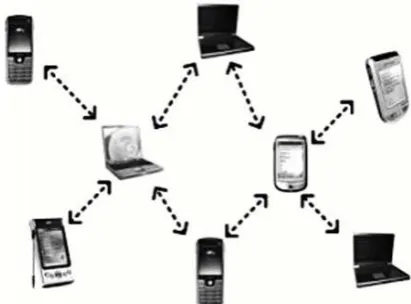
A mobile ad hoc network (MANET)
is built on the fly where a number of mobile
nodes work in cooperation without the
engagement of any centralized access point or
any fixed infrastructure. MANETs are
self-organizing, self-configuring, and dynamic
topology networks, which form a particular
class of multi-hop networks. Minimal
configuration, absence of infrastructure, and
quick deployment make them convenient for
combat, medical, and other emergency
situations. A sample model of mobile ad hoc
network is presented here in Fig. 1,
Properties of Routing Protocols:
A routing protocol for MANET should be
distributed in manner in order to increase its
reliability. Where all nodes are mobile, it is
unacceptable to have a routing protocol that
requires a centralized entity. Each node
should be intelligent enough to make routing
decisions using other collaborating nodes. A
distributed but virtually centralized protocol
might be a good idea.
The routing protocol should assume routes as unidirectional links.
The routing protocol should be
power-efficient.
The routing protocol should consider
its security.
Hybrid protocols, which combine the
benefits of different routing protocols,
can be preferred in most of the cases.
Categorizing of Routing Protocols:
The routing protocols for MANET could be
broadly classified into two major categories:
Proactive Routing Protocols and Reactive
Routing Protocols
1. Proactive Routing Protocols
Proactive protocols continuously learn the
topology of the network by exchanging
topological information among the network
nodes. Thus, when there is a need for a route
to a destination, such route information is
available immediately. The main concern
regarding using a proactive routing protocol
is: if the Routing in Mobile Ad Hoc
Networks network topology changes too
frequently, the cost of maintaining the
network might be very high.
2. Reactive Routing Protocols
The reactive routing protocols, on the other
hand, are based on some sort of query-reply
dialog. Reactive protocols proceed for
establishing route(s) to the destination only
when the need arises or on demand basis.
Reactive protocols are also known as
on-demand routing protocols.
3. Hybrid Routing Protocols
Often reactive or proactive feature of a
particular routing protocol might not be
enough; instead a mixture might yield better
solution. Hence, in the recent days, several
hybrid protocols are also proposed. The
hybrid protocols include some of the
characteristics of proactive protocols and
some of the characteristics of reactive
protocols.
REVIEW OF LITERATURE:
Manyrouting protocols have been designed and
reported in the literature so far we have listed
few of them according to the various category
1. Proactive Routing Protocols:
(B)Dynamic Destination-Sequenced
Distance-Vector Routing
Protocol(DSDV)
DSDV is developed on the basis of
Bellman–Ford routing algorithm with some
modifications. In this routing protocol, each
mobile node in the network keeps a routing
table. Each of the routing contains the list of
all available destinations and the number of
hops to each. Each table entry is tagged
with a sequence number, which is
originated by the destination node.
(C)Wireless Routing Protocol:
Wireless Routing Protocol (WRP) belongs
to the general class of path-finding
algorithms, defined as the set of distributed
shortest-path algorithms that calculate the
paths using information regarding the length
and second-to-last hop of the shortest path
to each destination.
(D)Cluster Gateway Switch Routing
Protocol:
Cluster Gateway Switch Routing Protocol
(CGSR) considers a clustered mobile
wireless network instead of a ‘‘flat’’
network. For structuring the network into
separate but interrelated groups, cluster
heads are elected using a cluster head
selection algorithm. By forming several
clusters, this protocol achieves a distributed
processing mechanism in the network.
However, one drawback of this protocol is
that, frequent change or selection of cluster
heads might be resource hungry and it
might affect the routing performance.
(E)Global State Routing:
In Global State Routing (GSR) protocol,
nodes exchange vectors of link states among
their neighbors during routing information
exchange.
(F)Fisheye State Routing:
Fisheye State Routing (FSR) is built on top
of GSR. The novelty of FSR is that it uses a
special structure of the network called the
‘‘fisheye.’’ This protocol reduces the
amount of traffic for transmitting the update
messages. The basic idea is that each update
message does not contain information about
all nodes. Instead, it contains update
information about the nearer nodes more
frequently than that of the farther nodes.
Hence, each node can have accurate and
exact information about its own neighboring
nodes.
(G)Hierarchical State Routing:
Hierarchical State Routing (HSR) combines
dynamic, distributed multilevel hierarchical
clustering technique with an efficient
location management scheme. This protocol
partitions the network into several clusters
level in the hierarchy becomes member of
the next higher level.
(H)Zone-Based Hierarchical Link State
Routing Protocol:
In Zone-Based Hierarchical Link State
Routing (ZHLS) protocol, the network is
divided into non-overlapping zones as in
cellular networks. Each node knows the
node connectivity within its own zone and
the zone connectivity information of the
entire network.
(I) Landmark Ad Hoc Routing:
Landmark Ad hoc Routing (LANMAR)
combines the features of Fisheye State
Routing (FSR) and Landmark Routing. It
uses the concept of landmark from
Landmark Routing, which was originally
developed for fixed wide area networks.
(J) Optimized Link State Routing:
Optimized Link State Routing (OLSR)
protocol inherits the stability of link state
algorithm. Usually, in a pure link state
protocol, all the links with neighbor nodes
are declared and are flooded in the entire
network. But, OLSR is an optimized
version of a pure link state protocol
designed for MANET.
2. Reactive Routing Protocols:
(A)Associativity-Based Routing:
Associatively-Based Routing (ABR)
protocol defines a new type of routing
metric for mobile ad hoc networks. This
routing metric is termed as degree of
association stability. Each node periodically
generates beacon to announce its existence.
Upon receiving the beacon message, a
neighbor node updates its own associability
table. For each beacon received, the
associativity tick of the receiving node with
the beaconing node is increased. A high
value of associativity tick for any particular
beaconing node means that the node is
relatively static. Associativity tick is reset
when any neighboring node moves out of
the neighborhood of any other node. ABR
protocol has three phases for the routing
operations:
Route discovery Route reconstruction Route deletion
(B)Signal Stability–Based Adaptive
Routing Protocol:
Signal Stability–Based Adaptive Routing
(SSA) protocol focuses on obtaining the most
stable routes through an ad hoc network. The
protocol performs on-demand route discovery
based on signal strength and location
stability. Based on the signal strength, SSA
detects weak and strong channels in the
network.
(C)Temporarily Ordered Routing
Temporally Ordered Routing Algorithm
(TORA) is a reactive routing protocol with
some proactive enhancements where a link
between nodes is established creating a
Directed Acyclic Graph (DAG) of the route
from the source node to the destination.
This protocol uses a ‘‘link reversal’’ model
in route discovery. A route discovery query
is broadcasted and propagated throughout
the network until it reaches the destination
or a node that has information about how to
reach the destination. TORA defines a
parameter, termed height. Height is a
measure of the distance of the responding
node’s distance up to the required
destination node.
(D)Cluster-Based Routing Protocol:
Cluster-Based Routing Protocol (CBRP) is
an on-demand routing protocol, where the
nodes are divided into clusters. For cluster
formation, the following algorithm is
employed. When a node comes up in the
network, it has the undecided state. The first
task of this node is to start a timer and to
broadcast a HELLO message. When a
cluster-head receives this HELLO message,
it replies immediately with a triggered
HELLO message. After that, when the node
receives this answer, it changes its state into
the member state. But when the node gets
no message from any cluster-head, it makes
itself as a cluster-head, but only when it has
bidirectional link to one or more neighbor
nodes. Otherwise, when it has no link to any
other node, it stays in the undecided state
and repeats the procedure with sending a
HELLO message again
(E)Dynamic Source Routing:
Dynamic Source Routing (DSR) allows
nodes in the MANET to dynamically
discover a source route across multiple
network hops to any destination. In this
protocol, the mobile nodes are required to
maintain route caches or the known routes.
The route cache is updated when any new
route is known for a particular entry in the
route cache. Routing in DSR is done using
two phases: route discovery and route
maintenance. When a source node wants to
send a packet to a destination, it first
consults its route cache to determine
whether it already knows about any route to
the destination or not. If already there is an
entry for that destination, the source uses
that to send the packet. If not, it initiates a 0
route request broadcast. This request
includes the destination address, source
address, and a unique identification number.
Each intermediate node checks whether it
knows about the destination or not. If the
intermediate node does not know about the
eventually this reaches the destination. A
node processes the route request packet only
if it has not previously processed the packet
and its address is not present in the route
record of the packet. A route reply is
generated by the destination or by any of the
intermediate nodes when it knows about
how to reach the destination.
(F)Ad Hoc On-Demand Distance Vector
Routing:
Ad Hoc On-Demand Distance Vector
Routing (AODV) is basically an
improvement of DSDV. But, AODV is a
reactive routing protocol instead of
proactive. It minimizes the number of
broadcasts by creating routes based on
demand, which is not the case for DSDV.
When any source node wants to send a
packet to a destination, it broadcasts a route
request (RREQ) packet. The neighboring
nodes in turn broadcast the packet to their
neighbors and the process continues until
the packet reaches the destination. During
the process of forwarding the route request,
intermediate nodes record the address of the
neighbor from which the first copy of the
broadcast packet is received. This record is
stored in their route tables, which helps for
establishing a reverse path. If additional
copies of the same RREQ are later received,
these packets are discarded. The reply is
sent using the reverse path. For route
maintenance, when a source node moves, it
can re-initiate a route discovery process. If
any intermediate node moves within a
particular route, the neighbor of the drifted
node can detect the link failure and sends a
link failure notification to its upstream
neighbor. This process continues until the
failure
(a) (b)
Fig.2 AODV protocol (a) Source node
broadcasting the route request packet. (b)
Route reply is sent by the destination using
the reverse path notification reaches the
source node. Based on the received
information, the source might decide to
re-initiate the route discovery phase.
(a) Dual-Hybrid Adaptive Routing:
Dual-Hybrid Adaptive Routing (DHAR)
uses the Distributed Dynamic Cluster
Algorithm (DDCA) presented in. The idea
of DDCA is to dynamically partition the
network into some non-overlapping clusters
of nodes consisting of one parent and zero
or more children. Routing is done in DHAR
utilizing a dynamic two-level hierarchical
strategy, consisting of optimal and
least-overhead table-driven algorithms operating
at each level.
(b). Adaptive Distance Vector Routing:
Adaptive Distance Vector (ADV) routing
protocol is a distance-vector routing
algorithm that exhibits some on-demand
features by varying the frequency and the
size of routing updates in response to the
network load and mobility patterns. This
protocol has the benefits of both proactive
and reactive routing protocols.
(c) Zone Routing Protocol:
Zone Routing Protocol (ZRP) is suitable for
wide variety of MANETs, especially for the
networks with large span and diverse
mobility patterns. In this protocol, each
node proactively maintains routes within a
local region, which is termed as routing
zone. Route creation is done using a
query-reply mechanism.
(d)Sharp Hybrid Adaptive Routing
Protocol:
Sharp Hybrid Adaptive Routing Protocol
(SHARP) combines the features of both
proactive and reactive routing mechanisms.
SHARP adapts between reactive and
proactive routing by dynamically varying
the amount of routing information shared
proactively. This protocol defines the
proactive zones around some nodes. The
number of nodes in a particular proactive
zone is determined by the node-specific
zone radius. All nodes within the zone
radius of a particular node become the
member of that particular proactive zone for
that node.
(e) Neighbor-Aware Multicast Routing
Protocol:
Neighbor-Aware Multicast Routing
Protocol (NAMP) is a tree-based hybrid
routing protocol, which utilizes
neighborhood information. The routes in the
network are built and maintained using the
traditional request and reply messages or
on-demand basis. This hybrid protocol uses
neighbor information of two-hops away for
transmitting the packets to the receiver. If
the receiver is not within this range, it
searches the receiver using dominant
pruning flooding method and forms a
multicast tree using the replies along the
Conclusion:
Thus we generally take somecommon criteria as the basis of comparison.
Commonly used criteria are the end-to-end
delay, control overhead, processing overhead
of nodes, memory requirement, and
delivery ratio. Of these criteria,
packet-delivery ratio mainly tells about the reliability
of the protocol. So, reliability of a routing
protocol depends on how efficiently it can
transmit data from source to the destination.
The less the packet loss ratio is, the better the
performance of that routing protocol. Often
security becomes the key aspect of MANET.
In such cases, the protocol that might ensure
better security is considered as more efficient
for that application. Having the knowledge of
the MANET routing protocols and their
comparison criteria, let us now investigate the
key influencing factors for routing
performance in different settings of
MANETs.
References:
[1]. Kahn RE (1977) The organization of
computer resources into a packet radio
network.IEEE Transactions on
Communications, Volume COM-25, Issue
1:169–178
[2]. Jubin J, Tornow JD (1987) the
DARPA Packet Radio Network Protocols.
Proceedings of the IEEE, Volume 75, Issue
1:21–32
[3]. Freebersyser J, Leiner B (2001) A
DOD Perspective on Mobile Ad Hoc
Networks. In: Perkins CE (Ed) Ad Hoc
Networking, Addison-Wesley: 29–51
[4]. Yang H, Luo H, Ye F, Lu S, Zhang, L
(2004) Security in Mobile Ad Hoc
Networks: Challenges and Solutions. IEEE
Wireless Communications, Volume 11,
Issue 1:38–47
[5]. Deng H, Li W, Agrawal DP (2002)
Routing Security in Wireless Ad Hoc
Networks. IEEE Communications
Magazine, Volume 40, Issue 10:70–75
[6]. Maih ¨ ofer C (2004) A Survey of
Geocast Routing Protocols. IEEE
Communications Surveys & Tutorials,
Volume 6, Issue 2:Q2:32–42
[7]. Perkins CE, Bhagwat P (1994) Highly
Dynamic Destination-Sequenced
Distance-Vector Routing (DSDV) for Mobile
Computers. Proceedings of ACM
SIGCOMM 1994:234–244
[8]. Cheng C, Riley R, Kumar SPR,
Garcia-Luna-Aceves JJ (1989) A Loop-Free
Extended Bellman-Ford Routing Protocol
Without Bouncing Effect. ACM SIGCOMM
Computer Communications Review,
Volume 19, Issue 4:224–236
(1996) an Efficient Routing Protocol for
Wireless Networks. Mobile Networks and
Applications, Volume 1, Issue 2:183–197
[10]. Humblet PA (1991) another Adaptive
Distributed Shortest-Path Algorithm. IEEE
Transactions on Communications, Volume