395 | P a g e
RC4 STREAM CIPHER DESIGN FOR DATA
SECURITY
Vaishali Singh
1, Shriddha Shrivastawa
2 1Student ,
2Assistant professor
Department of Electronics &Telecommunication Engineering
Lakshmi Narain College of Technology, Bhopal, (India)
ABSTRACT
In this paper, an efficient algorithm of the RC4 stream-cipher is proposed to enhance the security when the
network communication is established between software and hardware to transmit the information or data. One
of the significant piece of this project is to generate simulation and synthesis report for RC4 encryption
algorithm. The synthesis and simulation report is accomplished for Virtex-5 FPGA. Since, 0 to 256 bits can be
used in Key Scheduling Algorithm (KSA) as the key size, so the key size of 256 bits is chosen for this project. The
simulation result is verified using draft-josefsson-rc4-test-vectors-02 (This document consists of test vectors for
stream cipher RC4).
Keywords:
RC4, Stream Cipher, DES, KSA, PRGA, FPGA.
I. INTRODUCTION
Cryptography is a Greek word for “hidden writing” The art and science of transforming (encrypting)
information (plaintext) into a transitional form (cipher text) that stores information in storage or transit. The
main feature of cryptography is to solve the problems, which are associated with verification, integrity and
privacy. The Growing Use Of Networks Has Made Us Concern For The Security.The need of mechanism which
guarantees the protection & privacy sends over the electronic media developed the term cryptography. A
protocol is the sequence of actions, which is designed with two or more sides, through which a goal can be
fulfilled. Cryptography also, is associated with the meaning of protocol. Thus, a cryptographic protocol is a
protocol that deals with the use of cryptography. This protocol uses cryptographic algorithm and intends to halt
attempts of thefts and invasions. By the use of Theory of Statistics and Theory of Numbers now a day‟s
cryptography has been highly developed and strongly validated in science. Many kinds of cryptographic
algorithms have been invented in order to solve the problems of cryptography. The complexity of these
problems provides several categories of cryptographic algorithms. A much known cryptographic algorithm is the
RC4 stream cipher. Normally, security occurs as a result of having a huge number of different transformations..
Cryptography, which is a part of cryptology, is further classified as secret codes versus ciphers. Unlike
Steganography, which seeks to hide the existence of a message, cryptography seeks to deliver a message
unintelligible even if the message is completely exposed. In 1987, Ron Rivest of RSA security designed rc4,
396 | P a g e
secret; still it was anonymously posted to the cipher punk‟s mailing list in September 1994, so a description of itleaked out in 1994. The aim of working of cryptography is to transmit the plaintext into a cipher text. Where the
original data or message is called plaintext and encrypted data is called cipher text.
Plaintext + security key = cipher text.
Cryptology – Inherently a social science refers to the art of bridging this bizarre gap between an entirely social
notion called „security‟, and the logical foundations of computer science, mathematics and allied domains.
After some research on the web to find an interesting cryptographic primitive to implement, it has been decided
to implement RC4. There are several reasons for choosing this stream cipher. First of all, this cipher is
conventional stream cipher. Moreover it is used by really important and famous protocols and standards such as
WEP, WPA, TSL, SSL, etc. Another reason for this choice is that it is well known for its simplicity and
efficiency.
The main objectives of this project are as follows:-
• To generate 8-bit security key stream to encrypt and decrypt the data. • To Implement RC4 algorithm in Verilog language.
• To generate simulation and synthesis result for RC4 Stream Cipher Algorithm.
II. THEORY
This stream cipher was invented in 1987 by one of the originator of the RSA public key cryptography algorithm
and establisher of RSA security i.e. Ron Rivest. Even though the RC4 CIPHER is officially named "Rivest
cipher 4", it is also termed as "Ron's Code - 4". "RC - 2”, “RC - 5” & RC - 6 are other encryption algorithm that
also exists. The trade secret behind (supporting) RC4 was disclosed in September 1994 when the description of
the cipher was sent to the Cypherpunks mailing list (lots of human interested in privacy and cryptography who
used this mailing list to communicate). After that, the description was posted on many website and the
genuineness of the information was confirmed as the resulting outputs of the described cipher were analogous
the outputs of licensed RC4. RC4 had a really large success thanks to its simplicity and efficiency. It was used
in many (countless) popular standards and protocols such as WEP, WPA, and SSL OR TLS.
2.1 STREAM CIPHERS
The domain of symmetric key cryptology contains two major cryptographic primitives – Block ciphers and
Stream ciphers. In block cipher primitive encryption is carried out block-by-block by applying a key dependent
transformation on a block of message bits at a time. Whereas, a key stream is a pseudorandom sequence of bits
produced by a stream cipher, and encryption is done by masking or hide the plaintext (considered as a sequence
of bits) by the stream cipher key stream; using a simple XOR operation in general. The cipher text thus obtained
is also a sequence of bits of the same length as that of the plaintext. To increase the efficiency in software
applications, modern day stream ciphers are adopting a word-oriented approach, where word-wise (size of the
word depends on machine architecture) operations are used instead of bitwise operations. However, the
397 | P a g e
2.1.1 ONE-TIME PAD AND PERFECT SECRECYOne-time pad (OTP), also called the Vernam cipher is the motivation behind stream ciphers. OTP is a truly
random bit-string of the same length as that of the plaintext – unique for each plaintext – which is bitwise
XOR-ED with the plaintext to produce the cipher text. It is one of the strong technique of encryption that cannot be
easily cracked. Shannon showed that OTP is perfectly secure, i.e. even for an adversary with unbounded
computational power, it is impossible to derive any new information about the plaintext from the cipher text
beyond what is possible via random guess. Intuitively, for a perfectly secret encryption, the cipher text reveals
no information about the plaintext over prior knowledge. It is absolutely required that the masking (bitwise
XOR) is done using a unique sequence of bits for each plaintext; owing to the name one-time-pad to achieve
ideal information theoretic „perfect secrecy‟ in OTP. As in OTP it is required to manage unique keys as large as
the plaintexts therefore in reality the OTP scheme is not practical.
2.1.2. BLUETOOTH STREAM CIPHER
Bluetooth is one of the chiefly used modern technology for wireless communication, prevalent in an array of
practical devices. In 1998, the Bluetooth special interest group (SIG) developed the technology. The technology
has been embraced by all companies in the communication business ever since. The E0 stream cipher is used as
a pseudorandom key stream generator for confidentiality in Bluetooth transmission. The cipher follows the
standard design model of a combiner generator bythe use oflinear feedback shift registers, where the key length
is typically of 128 bits.
It comes up with the new shortrange radio link solution and provides strong protection in this range.
The consumption of extra power is also limit by this technology.
2.1.3. GSM STREAM CIPHERS
A5/1 and a5/2 stream ciphers, designed around late 1980‟s which were used to provide privacy in the GSM
cellular network. A5/2 is a debilitated version of A5/1, created for certain export regions. Both the ciphers A5/1
and A5/2, initially kept secret, became public in 1994 through leaks and reverse engineering. After several
minor and major attackson A5/1 and A5/2 published during 1994–2006, the GSM association instructed that the
GSM phones will not support A5/2 anymore, and usage of a5/1 was directed by the 3GPP association. Later in
the 3G cellular systems, the key stream generation algorithm for privacy was modified to A5/3, which uses the
block cipher KASUMI.
2.1.4. G STREAM CIPHERS
3GPP LTE advanced is the leading contender in the race towards 4G mobile technologies. For LTE advanced
technology, the chosen security algorithms for encryption and authentication employ two different stream
ciphers – snow 3G and ZUC. While in the earlier 3G platform snow 3G had already been deployed, along with
KASUMI, the other cipher ZUC is a brand new design. Both the ciphers are based on similar design principles
using word-oriented Linear Feedback Shift Registers; these are used in the LTE advanced technology within a
398 | P a g e
III. METHOD
The main features of cryptography is to solve problems like verification, privacy & secrecy.Many kinds of
algorithm are invented to solve the problem of cryptography. Here we used RC4 stream cipher due to its
attracting features and extensive usage.
Cryptography is further categorized in two categories, as follows
Asymmetric
Symmetric
oBlock Cipher
oStream Cipher
In an asymmetric cryptography, for the encryption of the information, it uses public key whereas at the
decryption of the information, it uses private keys.
In a symmetric cryptography, for both the encryption and decryption process, a single key is used and that key
should be known to both the parties.
Block cipher is a technique of symmetric cryptography which involves encryption of one block of text at a time.
Where as in stream cipher, at a time, single bit encrypts.
Synchronous and Self-Synchronizing Stream Ciphers are the models which have been described so far, suits the
class of synchronous stream ciphers. These stream ciphers, although most prominently studied and used in
practice, have a practical drawback. Once the synchronization between the sender and the receiver is
compromised, decryption of the cipher text does not yield the corresponding plaintext at the receiver end. In
such a case, the ciphers at the sender and the receiver ends need to re-synchronize for subsequent operation.
This requirement for re-synchronization poses practical problems while operating a synchronous stream cipher
over a noisy channel, where (burst) noise may frequently destroy parts of the communicated cipher texts.There
is another class of stream ciphers known as Self synchronizing stream ciphers, where the rth key stream bit
(word) depends on the key as well as on some predetermined number (t) of previous cipher text bits (words). So,
the decryption works correctly if the previous (t) cipher text bits (words) are received properly, irrespective of
earlier deletions.The selection of stream cipher depends on required level of security, speed of encryption and
cost of system.
3.1 RC4 STREAM CIPHER
RC4 uses a variable length key from 1 byte to 256 bytes in order to initiate a 256-byte array. 256-bytes arrays
include two types, S-Box and K-Box. The S-array is filled linearly such as S0=0, S1=1, S2=2………..S255 =
255. The K-array includes the key, repeating as necessary times, so that the array should get filled. The RC4 key
is usually limited to 40 bits, for the reason of export restrictions but it is sometimes used as a 128 bits key. RC4
keys have the ability of using keys between 1 byte and 256 bytes. The RC4 algorithm works in two phases, the
first phase is the key setup and the second phase is the pseudorandom key stream generation phase. The first and
most difficult phase is Key setup in this algorithm. The encryption key is used to achieve an encrypting variable
by utilizing twocategory of arrays, first S-array & second is K-array and N-number of mixing operations, during
399 | P a g e
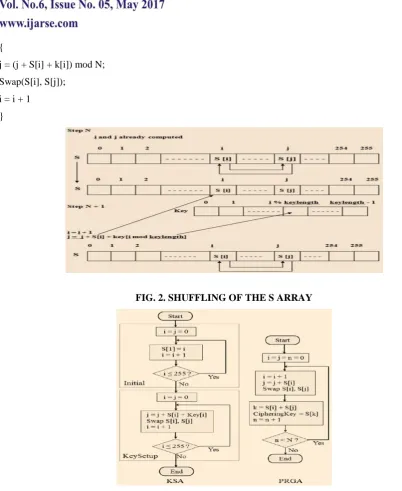
RC4 algorithm. Figure 3 shows the flow diagram of the RC4 two phases. RC4 uses two counters, counter i andthe counter j, these are initialized to zero value. In the key setup phase the S-box is being modified according to
pseudo-code:
3.2 KEY SETUP PHASE
For i= 0 to 255
j = (j + Si + Ki) mod 256
Swap Si and Sj
Once the encrypting variables are made from the key setup phase, then it enters into the pseudorandom key
stream generation phase. The following pseudo code provides the pseudorandom key stream
formation/generation phase as follows:
3.3 KEY STREAM GENERATION PHASE:
i = (i+ 1) mod 256
j = (j + Si) mod 256
Swap Si, and Sj
t = (Si + Sj) mod 256
K = Si
Where this generated pseudo random code is XORed with the plain text/cipher text to generate cipher text/plain
text. XOR is the logical operation of comparing two binary bits. When the bits are different, the result is 1.
When the bits are same, the result is 0. Once the receiver gets the encrypted message, he decrypts the encrypted
message by XORing with the same encrypting variable.
3.4 KEY SCHEDULING ALGORITHM
The permutation array is generated with the help of the key-scheduling algorithm. The first step of this
algorithm is to compute the S table with the identity permutation.The values which are in the array are equal to
their index.Once the Sarray is initialized, the next step is to shuffle the array using the key to make it a permuted
array
FIG.1. INITIALIZATION OF S TABLE
3.5 KSA ALGORITHM
For i = 0 to N – l
S[i] = i;
j = 0;
400 | P a g e
{j = (j + S[i] + k[i]) mod N;
Swap(S[i], S[j]);
i = i + 1
}
FIG. 2. SHUFFLING OF THE S ARRAY
FIG 3. FLOW CHART OF RC4 ALGORITHM
3.6 PSEUDO-RANDOM GENERATION ALGORITHM
The algorithm consists of generating a key stream of the size of the message to encrypt. Firstly initialize the two
indexes to 0 and then start the generation of the key stream one byte at a time until reached the size of the
message to encrypt.
401 | P a g e
i = j = 0;Generation loop
{
i = (i + 1) mod N;
j = (j + S[i]) mod N;
Swap (S[i], S[j]);
Output = S[( S[i] + S[j] ) mod N];
}
IV. RESULT
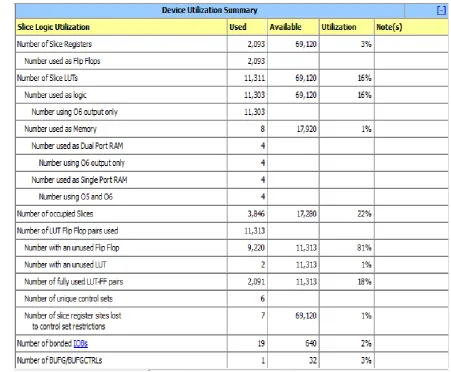
To ensure Equations Security Key Generation
1. Synthesis Result.256 bit
2. Simulation Result. 256 bit.
402 | P a g e
FIG.6. RTL VIEW OF “RC4” IMPLEMENTATION403 | P a g e
FIG.8. SIMULATION RESULT OF 256 BIT KEY GENERATIONSWHEN OUTPUT READY IS ONEThe FPGA devices/element, enhances the security, reliability and performance. The encryption & decryption is
performed stream wise and the data will remain secured in all respect. FPGAs are having the flexibility and high
speed capability. They can be re-programmed to execute the more estimation intensive operations of a range of
ciphers depending on security and application requirements. They also offer a better and cost effective solution
than any ASIC or VLSI design of longer design cycle. Hardware implementation can be better than software in
terms of high speed and level of security
V. CONCLUSION
This design provides high data throughput using variable key length from 0 bit to 256 bits. It provides high
flexibility as it can be used in many applications. This system achieves a data throughput up to 100 Mbytes/sec
in a clock frequency of 135.247 MHz often used in application where plaintext is present in quantities of
unknown length. The developed algorithm consumes less bandwidth as we used the 8bit stream of data. This
algorithm uses 1500 GHz and above frequency to work on which increases the level of security up to the great
extent. Use of FPGA platform for the implementation of this project, the other platforms with various control
404 | P a g e
REFERENCES
[1] Hardware Implementation of RC4 Stream Cipher for Wi-Fi Security by Vandana Malode , Nagnath Hulle,
Of transaction 8654-34253-434-429 2014 IEEE
[2] P. kitsos, G. Kostopoulos, N. Sklavos and O.Koufopavlou.VLSI design laboratory IEEE Std 802.11. IEEE
Standard: Hardware implementation of the RC4 stream cipher.
[3] Claude E. Shannon. Communication theory of secrecy systems. Bell Systems Technical Journal, 28(4):656–
715, 1949.
[4] Yi Lu, Willi Meier, and Serge Vaudenay. The conditional correlation attack: Apractical attack on
Bluetooth encryption. In Victor Shoup, editor, CRYPTO, volumeYi Lu and Serge Vaudenay. Cryptanalysis
of an E0-like combiner with memory. J.
[5] Yi Lu and Serge Vaudenay. Cryptanalysis of an E0-like combiner with memory. J.Cryptology, 21(3):430–
457, 2008.
[6] Rourab Paul, AmlanChakrabarti and Ranjan Ghosh, “Hardware implementation of four byte per clock RC4
algorithm,” in Journal of latex class files Vol. 6 No. 1, Jan. 2007.
[7] Jaya Dofe and Manish Patil, “Hardware implementation of modified RC4 stream cipher using FPGA,”
IOSRJEN, vol. 02, Issue 06, pp. 1447–1450, Jun. 2012.
[8] Poonam Jindal and Bramhajit Singh, “A survey on RC4 stream cipher,” IJCNIS, vol. 7, pp. 37–45, Jun.
2015.
[9] RajendarRacherla and S. NagakishorBhavanam, “Design and simulation of enhancing RC4 stream cipher
for Wi-Fi security using Verilog HDL,” IJERA, vol. 1, Issue 3, pp. 653–659.
[10] Sultan Weatherspoon, “Overview of IEEE 802.11b security,” Network Communication Group, Intel
Technology Journal Q2, 2000.
[11]P. Hamalainen, M. Hannikainen, T. Hamalainen and J. Saarinen, “Hardware Implementation of the
Improved WEP and RC4 Encryption Algorithms for Wireless Terminals”, The European Signal Processing
Conference (EUSIPCO'2000), September 5-8, 2000, Tampere, Finland, pp. 2289-2292.
[12]P. D. Kundarewich, S. J.E. Wilton, A. J. Hu, “A CPLD- Based RC-4 Cracking System”, The 1999
Canadian Conference on Electrical and Computer Engineering, May 1999.
[13]K.H Tsoi, K.H Lee and P.H.W Leong, “A Massively Parallel RC4 Key Search Engine”, Proc. of the 10th
Annual IEEE Symposium on Field-Programmable Custom Computing Machines (FCCM'02), September 22
- 24, 2002 Napa, California, pp. 13-21.
[14]B. Schneier, D. Whiting, “Fast Software Encryption: Designing Encryption Algorithms for Optimal
Software Speed on the Intel Pentium Processor”, Fast Software Encryption workshop (FSE97), LNCS, Vol.
1267, pp. 242-259, Springer-Verlag, Haifa, Israel, January 20-22, 1997.
[15]“Recommendation for Block Cipher Modes of Operation. Methods and Techniques”. National Institute of
Standards and Technology, Technology Administration, U.S. Department of Commerce.
http://csrc.nist.gov/publications/nistpubs/800-8a/sp800-38a.pdf
[16]Confirmed Test Vector for RC4, http://www.qrst.de/html/dsds/rc4.html