Star-planet interactions and dynamical evolution of
exoplanetary systems
Cilia Damiania
Laboratoire d’Astrophysique de Marseille, Aix-Marseille Universit´e UMR7326, 38, rue Fr´ed´eric Joliot-Curie 13388 Marseille cedex 13 France
Abstract. The dynamical evolution of planetary systems, after the evaporation of the accretion disk, is the result of the competition between tidal dissipation and the net an-gular momentum loss of the system. The description of the diversity of orbital configu-rations, and correlations between parameters of the observed system (e.g. in the case of hot jupiters), is still limited by our understanding of the transport of angular momentum within the stars, and its effective loss by magnetic braking. After discussing the challenges of modelling tidal evolution for exoplanets, I will review recent results showing the im-portance of tidal interactions to test models of planetary formation. This kind of studies rely on the determination of stellar radii, masses and ages. Major advances will thus be obtained with the results of the PLATO 2.0 mission, selected as the next M-class mission of ESA’s Cosmic Vision plan, that will allow the complete characterisation of host stars using asteroseismology.
1 Introduction
Unlike our own solar system, many extrasolar systems have planets orbiting very close to their stars, with orbital periods not greater than about ten days. For those planets, the typical distance to the star is less than 0.1 AU and interactions with the host through radiation, magnetism or tides may be significant. The space telescopes CoRoT [1] andKepler[5] have revolutionised the field of star-planet interactions because their high-precision, high-duty cycle light curves can be exploited to obtain detailed information about the hosts as well as the planets. In late-type stars, the period of rotation can be measured using the light curve modulations produced by photospheric activity. When starspots are occulted during a transit, some information about the inclinaison of the stellar axis of rotation of the line of sight can be estimated. Not only this provide useful constraints for the orbital state of the system, but the possible relationships between the star’s activity, rotation and the close-in companion can be studied. It is well known that the observed rotational period of stars show a clear, although not simple dependence with stellar mass and age [16]. It is now generally admitted that the convective zone of late-type stars host a hydromagnetic dynamo at the origin of their magnetic activity, which is in turn responsible for the angular momentum loss (AML). This is generally explained by magnetic braking, where a wind of charged particles can efficiently extract angular momentum from the star with a very low mass loss rate. Close-in planets may interact with the magnetic field of their host, and this will be treated elsewhere in these proceedings (see K. Poppenhaeger’s contribution). It is no yet clear if this kind of interaction changes the spin-down rate of the star. In any case magnetic braking in return has an effect on the dynamical evolution of the system because the tidal torque is also a function of the difference between the orbital period and the stellar rotational period.
In Sect. 2, I will first recall the current challenges in our understanding of tidal evolution, and cite recent works aiming at constraining tidal dissipation in exoplanetary systems. Then in Sect. 3, I will
a e-mail:[email protected] DOI: 10.1051/
C
Owned by the authors, published by EDP Sciences, 2015 /201
epjconf 51010 04 0
7KLVLVDQ2SHQ$FFHVVDUWLFOHGLVWULEXWHGXQGHUWKHWHUPVRIWKH&UHDWLYH&RPPRQV$WWULEXWLRQ/LFHQVHZKLFKSHUPLWV XQUHVWULFWHGXVHGLVWULEXWLRQDQGUHSURGXFWLRQLQDQ\PHGLXPSURYLGHGWKHRULJLQDOZRUNLVSURSHUO\FLWHG
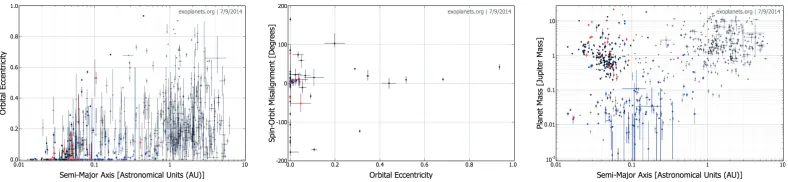
Fig. 1: Orbital parameters of known exoplanets as found at exoplanets.org in July 2014. Crosses are systems detected with the radial velocities method, circles are systems detected with the method of the transits. Among those, the blue dots are the system discovered byKepler and the red dots are those discovered by CoRoT. Left: Orbital eccentricity as a function of the semi-major axis. Middle: Obliquity as a function of the eccentricity. Right: Planet mass as a function of the semi-major axis.
present recent results that show that understanding tidal interactions, and their interplay with magnetic braking, is necessary to explain the distribution of the observed orbital parameters and to test migration scenarios. Finally, Sect.4 will give some general conclusion and perspectives.
2 Tidal theory
Tides are responsible for the secular evolution of the orbital elements because there exist some dissipa-tion mechanism that converts the kinetic energy of the tidal torque into heat. To this day, we still lack a detailed knowledge of tidal dissipation, thus it is still customary to characterise it by a dimensionless quality factor Q. In analogy with the forced, damped harmonic oscillator, it is defined by the ratio of the maximum energy associated with the tidal distortion to the energy dissipated during on complete cycle. It is convenient to introduce the reduced quality factorQ≡(3/2)(Q/k2), wherek2is the Love number of the body and it measures its density stratification, so thatQ=Qfor a homogeneous body without rigidity (for whichk2 = 3/2). Using this parameterisation, the global effects of tidal evolu-tion on the orbital elements can be estimated using simple time-scale estimate. A stronger dissipaevolu-tion, corresponding to a lower value ofQproduces a faster evolution.
For giant planets orbiting late-type stars, one can use Q = 106andQp = 105that corresponds to what has been measured for binary stars and Jupiter respectively [28] and obtain rough numerical estimates of characteristic time-scales of tidal evolution. For example, following [2], for e=0.4,Porb= 3 days andP =12.5 days, typical of close-in giant planets, this yields a circularisation timeτe ≈ 4 Myr, an alignment timeτi ≈6 Gyr and an inspiral timeτa ≈2 Gyr. In general, if the dissipation in the planets is more efficient than in the star, we expectτe < τaandτa τi[24]. Thus one would expect to see relatively few massive planets on close orbits, most of them being circularised. Provided that they were formed with an non-null obliquity, it should not be significantly damped by the tides. However a careful analysis of the observed orbital parameters, especially for giant close-in planets, also called hot Jupiters (Fig. 1) reveal that this trend is not clearly observed.
The disagreement could come from to two main issues. Either the classical description of tidal interactions is not suited to the case of exoplanetary systems, or there is something else acting on the secular evolution of the system. In particular, the presence of other planets in the system could excite the eccentricity and the obliquity through gravitational interactions such as the Kozai mechanism or resonant interactions.Keplerobservations seem to indicate that hot Jupiters are seldom accompanied by additional planets very close to their host star (within orbital periods 10 days) [34]. Besides, companions capable of maintaining a significant eccentricities and overcome the effect of tides would be massive or close enough to be observed at the current level of detection [24]. In most cases, the effect of unseen companions can be safely neglected.
theories need to be refined. Indeed, tidal quality factors depend sensitively on the detailed interior structure of either the star or the planet, as well as tidal forcing and amplitude. They are unlikely to be expressed as simple constant values and may differ from one object to the other, but also in time. The detailed interior structure of exoplanets cannot be constrained with current observations, which remains a fundamental limitation. But there has been in recent years much progress in the theoretical understanding of the mechanisms that are responsible for the dissipation (see [27] and S.Mathis’s contribution). The actual computation of the tidal dissipation is however still non-trivial and depends on the treatment of non-linearity or singularities. Indeed, several authors still predict vastly different results [29].
2.1 Observational constraints on Q’
On the other hand, some studies have tried to constrain the value of the tidal quality factors based on observations. A few of them use the enveloppes of the distribution of orbital parameters of the known hot Jupiters to constrain tidal theory at the level of the population [23, 8]. While those methods are robust relatively to the estimation of the ages and initial conditions, they can not be precise since they assimilate systems with different planetary and stellar properties. Thus, they provide constrains onQ that span several orders of magnitudes. Many more studies use the temporal evolution of individual systems. They rely on the integration of the time-derivative of the orbital elements in order to match their observed values[7, 17, 24, 14, 15, 6, 19, 30]. The obvious limitation is the poorly constrained age of the system, but there are also more fundamental unknowns that limit the accuracy of the estimation of the dissipation.
Firstly, those methods are sensitive to the choice of the value of the initial parameters for the stellar rotation and the orbit. Some authors chose to set them to the values of a reference popula-tion, e.g. known planets for which tidal evolution is deemed inefficient [17] or theoretical outcome of primordial migration [19]. Others choose to draw them form an assumed initial statistical popula-tion. The forward-integration of the temporal evolution to match the observed value can then produce confidence-intervals on the estimated values of Q’ [14, 15, 30].
Secondly, the numerical values obtained for Q’ depends on the assumed formulation for tidal friction. In the frame of the equilibrium tide, the tidal lag can be associated with either a constant Q’, i.e a constantphaselag, or a constanttimelag, or an intermediate approach (see [20] for details). The constant time lag is better suited to study the highly eccentric and non-aligned case. But the approach of the equilibrium tide introduces the lag in an artificial way and it can be abandoned altogether by considering that the fluid body cannot respond instantaneously to the perturbing potential, such as in the frame of thecreeptide [13]. This framework has also been developed for the case of a solid object, using a Maxwell viscoelastic rheology. Finally, thedynamicaltide, which corresponds to the response of the oscillation modes that are excited by the time-dependent tidal potential, produces yet another source of dissipation that may be significant [27, 28].
Thirdly, the transport of angular momentum inside stars is also not well understood, and it has been proposed that only the outer convective enveloppe participates in angular momentum exchange with the orbit [12]. If the core and enveloppe of late-type stars can indeed decouple, it affects the estimation of Q’ . Moreover as the extent of the convective zone evolves with time, Q’ is necessarily not constant. Besides, the effect of magnetic braking is also competing with tidal dissipation and different braking law produce different values of Q’ [8].
Even though the estimation of tidal dissipation efficiency is still a challenge, it has appeared in recent years that it plays a fundamental role in shaping the current observed distribution of orbital parameters of exoplanets, and especially hot Jupiters, as will be discussed in the next section.
3 Interplay between tides and magnetic braking
within a protoplanetary disk and require a solid core to first be assembled to allow efficient subsequent capture and growth within the relatively short disk lifetime. This implies that giant planets must form beyond the snow line, which is typically located at a few astronomical units from the star. Hot Jupiters have a semi-major axis0.1 AU, so they must have undergone some kind of migration.
To explain the small semi-major axis but also the others orbital properties of close-in planets, two main classes of scenarios have been proposed. On one hand, migration could occur within the protoplanetary disk and involves torques between the planet and the surrounding gas [21]. On the other hand, migration could be the result of dynamical interactions between two or more bodies orbiting the star after the evaporation of the disk [32]. Both types of theories could explain the proximity of the planets to their star but they involve different halting mechanisms and predict different distributions of the orbital parameters (see also K. Anderson’s contribution). However, further secular changes in the orbits of exoplanets can still be induced by tidal interaction between the planet and the star, even when the primordial migration mechanism is no longer effective.
3.1 Evolution of eccentricity
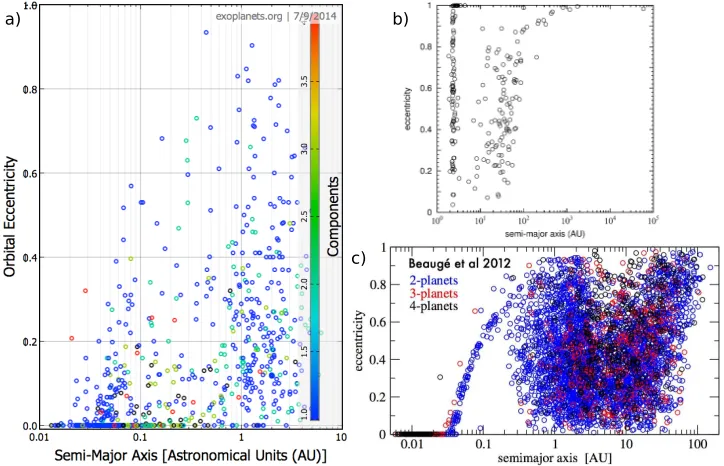
While the quiet migration within a disc is expected to produce mainly circular orbits, some hot Jupiters display a significant eccentricity (Fig. 2.a). On the contrary, high final eccentricities are expected from dynamical interactions between planets, in a process that is often called ”planet-planet scattering” (Fig. 2.b). However this process alone cannot reproduce the observations. First, the minimum semi-major reached is at least one order of magnitude greater than what is observed. Second, the shape of the distribution of the eccentricity as a function of the semi-major axis, and in particular the upper enveloppe of the population is not reproduced. This enveloppe is a familiar signature of tidal interaction that can be observed in binary stars. Indeed, including some form of tidal dissipation leads to a better reproduction of the shape (Fig. 2.c). By adjusting the cut-offperiod corresponding to systems mostly circularised, it is possible to obtain the tidal quality factor of the dissipation inside the planets. In this case, the authors findQp∼106−107in agreement with other estimates (see Sect. 2.1). Those models predict a vast population of massive planets at orbital distances larger than 1 AU that it is still difficult to observe with current instruments. But we can see that the spread in the measured values of the eccentricity for semi-major axis 0.03a0.2 AU is clearly not reproduced by the simulations. This spread could reflect a wider range ofQpvalue in those planets, although this would imply a diversity in the interiors of giant planets that is difficult to reconcile with formation theories [25]. Another interpretation associates the dispersion in eccentricity with the dispersion of stellar spin frequencies of young stars and their different spin-down rate [11]. Interestingly, this effect is indeed not included in the simulations shown in Fig. 2.c. for which the initial rotational period of the star is set to 28 days and magnetic braking is neglected.
3.2 Evolution of the obliquity
The obliquity, i.e. the angle between the normal to the orbital and the stellar spin, can be measured in transiting systems through its sky-projection using the Rossiter-McLaughlin effect. Although many systems are well-aligned, a significant fraction of hot Jupiters are severely misaligned, including nearly polar and even retrograde orbit (Fig. 1, middle). As for the eccentric orbits, these misaligned configura-tions are generally not expect as an outcome of migration within a disk, but arise naturally in scenarios that include multiple-body interactions [26, 3]. But the correlation between the obliquity and the host properties suggest that star-planet interaction may shaped the distribution of the obliquity (however this may be the only cause, see K.Anderson’s contribution).
a) b)
c)
Fig. 2: a): Eccentricity as a function of the semi-major axis of known exoplanets as of July 2014. The color of the symbol gives the number of planets detected on the system. b) Same distribution resulting of planet-planet scattering simulations without tidal circularisation [26]. c) Idem but including tidal circularisation [3].
sample of hot stars could thus be used to test theories of migration. However, this conclusion has been cautioned against, as it neglects the effect of magnetic braking in the tidal evolution [10]. This author concludes that the observed temperature cut-offbetween aligned and misaligned systems is indeed due to magnetic braking and not to different tidal dissipation efficiency between cool and hot stars. The model used is however very crude and a realistic treatment is necessary to confirm this hypothesis.
3.3 Evolution of the orbital period and stellar spin
4 Conclusion
Hot Jupiters may be a relatively rare, but understanding their orbital properties provide important clues to the planet-formation process. Tidal interactions cause the evolution of their orbital parameters on secular time-scales and shape their observed distribution. But to confront the predictions of different migration models to the observed population of close-in planets we need to understand not only the tide and but also its interplay with the angular momentum loss of the star through magnetic braking. This requires improvements in our theoretical understanding of the tidal dissipation mechanism, transport of angular momentum processes and stellar magnetic fields. But at the same time, those theories need better observational constraints. Thanks to the advent of space photometry and CoRoT andKepler, we now have precise measurement of masses and radii for a great number of systems. However, dynamical studies require also a good knowledge of the age of the system, which is still poorly constrained. The PLATO mission, using asteroseismology, will provide masses, radii and ages for hundreds of planet-hosting stars with relative accuracies of a few percents. Combined with the accurate measurement of orbital parameters, this will allow us to better understand how much of the diversity of orbital configuration observed in exoplanetary systems result from their formation or from their evolution.
References
1. Auvergne, M. et al. A&A506, (2009) 411
2. Barker, A. J. & Ogilvie, G. I. MNRAS395, (2009) 2268 3. Beaug´e, C. & Nesvorn´y, D. ApJ751, (2012) 119 4. Bolmont, E. et al. A&A544, (2012) A124 5. Borucki, W. J. et al. Science327, (2010) 977 6. Brown, D. J. A. et al. MNRAS415, (2011) 605
7. Carone, L. & P¨atzold, M. Planet. Space Sci.55, (2007) 643 8. Damiani, C. & Lanza, A.-F. A&A574, (2015) A39
9. Darwin, G. H. Philos. Trans. R. Soc. LondonA171, (1880) 713 10. Dawson, R. I. ApJL790, (2014) L31
11. Dobbs-Dixon, I., Lin, D. N. C. & Mardling, R. ApJ610, (2004) 464 12. Donati, J.-F. et al. MNRAS385, (2008) 1179
13. Ferraz-Mello, S. Celest. Mech. Dyn. Astron.116, (2013) 109 14. Hansen, B. ApJ723, (2010) 285
15. Hansen, B. ApJ757, (2012) 6
16. Irwin, J. & Bouvier, J. IAU Symposium258, (2009) 363 17. Jackson, B., Greenberg, R. & Barnes, R. ApJ678, (2008) 1396 18. Knutson, H. A. et al. ApJ785, (2014) 126
19. Lanza, A. F., Damiani, C. & Gandolfi, D. A&A529, (2011) A50 20. Leconte, J. et al. A&A516, (2010) A64
21. Lin, D. N. C., Bodenheimer, P. & Richardson, D. C. Nature380, (1996) 606 22. Mayor, M. & Queloz, D. Nature378, (1995) 355
23. Matsumura, S., Takeda, G. & Rasio, F. A. ApJ686, (2008) 29 24. Matsumura, S., Peale, S. J. & Rasio, F. A. ApJ725, (2010) 1995 25. Mordasini, C., Alibert, Y. & Benz, W. A&A501, (2009) 1139 26. Nagasawa, M., Ida, S. & Bessho, T. ApJ678, (2008) 498 27. Ogilvie, G. I. & Lin, D. N. C. ApJ610, (2004) 477 28. Ogilvie, G. I. & Lin, D. N. C. ApJ661, (2007) 1180 29. Ogilvie, G. I. MNRAS429, (2013) 613
30. Penev, K. et al. ApJ751, (2012) 96 31. Pont, F. MNRAS396, (2009) 1789
32. Rasio, F. A. & Ford, E. B. Science274, (1996) 954 33. Skumanich, A. ApJ171, (1972) 565
35. Winn, J. N. et al. ApJL723, (2010) L223