A NEW TECHNIQUE FOR
THE
PRODUCTION OF A-B TRANSLOCATIONS AND THEIR USE IN GENETIC ANALYSISFAROUK AHMED RAKHA2 AND D. S. ROBERTSON Department of Genetics, Iowa State University, Ames, Iowa 50010
Received August 28, 1969
RANSLOCATIONS between A (chromosomes of the basic set) and B (super- numerary chromosomes) chromosomes in maize were first produced by ROMAN (1947) by irradiation.
ROMAN
(1947) established that the nondisjunc- tion of the B centromere in the division of the generative nucleus of the micro- spore results in a pollen grain with two sperm nuclei that differ in their constitu- tion with respect to the translocated A segment (one will be deficient-hypoploid, and the other will have a n extra segment-hyperploid).
Depending upon how these sperm nuclei unite with the egg and the polar fusion nucleus of the embryo sac, two classes of seeds will result: 1) seeds with a n embryo hypoploid for the segment translocated to the B centromere and an endosperm hyperploid for this segment, and 2 ) seeds that are hyperploid in the embryo and hypoploid i n the endosperm for this segment. Subsequent investigations have demonstrated the usefulness of these aberrations in genetic studies (ROMAN and ULLSTRUP 1951;BIANCHI
1961;BIANCHI
et al. 1961;BELLINI, BIANCHI
and OTTAVIANO 1961; PETERSON and WERNSMAN 1964; ROBERTSON 1964a.)Until recently (BECKETT 1967, 1968) no new A-B translocations beyond those originally produced by ROMAN and ULLSTRUP 195 1 ) have been reported. This paper describes a technique for producing new A-B translocations of a prede- termined constitution by crossing over between existing A-B translocations and reciprocal A translocations and considers their usefulness in genetic studies.
MATERIALS A N D METHODS
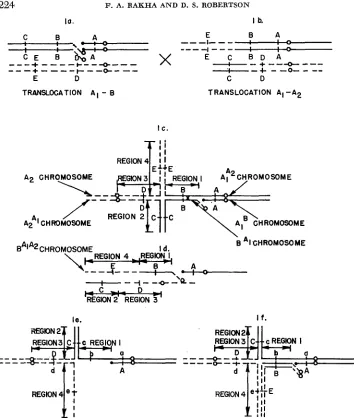
Crosses were made between female parents carrying an A-B translocation (designated A,-B, Figure l a ) and male parents having a reciprocal A translocation (designated Al-A2, Figure Ib). The A chromosome (A,) common to both translocations has a distal break point i n the A,-A, translocation and a promxima1 break point in the same arm in the A,-B translocation. If pairing of the translocated chromosomes in the F, is followed by a crossover i n the segment between the proximal and distal break paints (Figure IC) and if adjacent I disjunction occurs, a new A-B translocation will be produced. The A,B and A,% members of the exchange are unchanged, but the BA chromosome now consists of a B centromere, a proximal segment of the B chromosome, a portion of the A, chromosome, and a portion of the A, chromosome (BA,*, Figure Id).
Pollen from F, plants was used on normal female parents carrying a recessive endosperm gene in the region corresponding to the translocated segment of the A, chromosome (Figure 1, Journal Paper No. 56346 of the Iowa Agriculture and Home Economics Experiment Station, Ames. Project No. 1381. Much of the work reported in this paper was performed by the senior author for the partial fulfillment of the requirements for the degree of Doctor of Philosophy in the Genetics Department of Iowa State University.
Present address: Department of Genetics, Faculty of Agriculture, University of Alexandria, Alexandria, Egypt, U.A.R.
E D TRANSLOCATION A I
-
BI c.
REGION
‘Pi
/
A t 1 CHROMOSOME
I I
C D
TRANSLOCATION AI - A 2
\
B ‘1 CHROMOSOME B ~ I ~ ~ C H R O M O S O M E I d.
A
c
&- D;
I
~ E G I O N 2’ REGION 3
I f.
A
FIGURE 1.-Diagram of an A,-B translocation female parent ( l a ) and the reciprocal A,-A, translocation parent ( l b ) which will produce an F, (IC) in which crossing over (in region 1) followed by adjacent I segregation will result in the production of a new A-B translocation with the configuration shown in Id. Nondisjunction of the B centromere in the division of the genera- tive nucleus of a pollen grain carrying the new translocation will result in one sperm deficient (hypoploid) for B A A chromosome and one sperm hyperploid for the chromosome. Figure l e shows the hypoploid condition that results when the deficient sperm functions and Figure If the hyperploid condition that results when the hyperploid sperm functions in fertilizing a normal plant carrying recessive alleles (a, b, c, d and e ) in all regions.
PRODUCTION O F NEW A-B TRANSLOCATIONS 225 embryo. In this instance, if the female parent carried a recessive seedling or plant trait it would be uncovered. Thus the new translocation can be used to locate endosperm, seedling and mature plant traits in new chromosomal segments that were not involved in the original A-B translo- cations. In the isolation of these new translocations only recessive endosperm markers were used since seeds that showed the trait would have a hyperploid embryo which would permit the pro- pagation of the new translocation.
Once a new translocation was produced it was then used to locate genes with respect to the break points of the translocations involved. Any gene located in the region distal to the break point of the original B translocation but proximal to the break point of the reciprocal A trans- location (Figure 1, region l ) , will be uncovered by the new translocation. Any gene i n the portion of the A, chromosome transferred to the A, centromere (Figure 1, region 2) will not be uncovered by the new translocation. The original A-B translocation uncovered genes in this region but the new translocation will not. Any gene in the A, segment that is transferred to the B centromere by crossing over (Figure 1, region 4) will be uncovered by the new translocation. Any gene proximal to the break point of the reciprocal A translocation in the chromosome not involved in the original A-B translocation (Figure 1, region 3) will not be uncovered by the new translocation. Since all these break points have been mapped cytologically, it is possible to use the new A-B translocations to place genes to known physical segments of chromosome.
Seeds with the recessive phenotype on the testcross ears, indicated the presence of a new A-B translocation. These seeds were planted and the resulting plants self-pollinated. The segregation of the dominant phenotype on the self-pollinated ear indicated that the original seed showing the recessive phenotype was due to the functioning of the new A-B translocation and that it was not the result of contamination. A plant from a contaminated seed would be homozygous for the recessive trait. The new A-B translocation was used to locate known genes; one of two procedures was followed: 1) at the same time plants produced from the selected seeds were self-pollinated, they were crossed as male parents to the genes to be tested, or 2 ) the plants from the selected seeds were self-pollinated and outcrossed to a standard line. The outcross seeds were then used as a source of the new A-B translocation for crosses with the tester stocks.
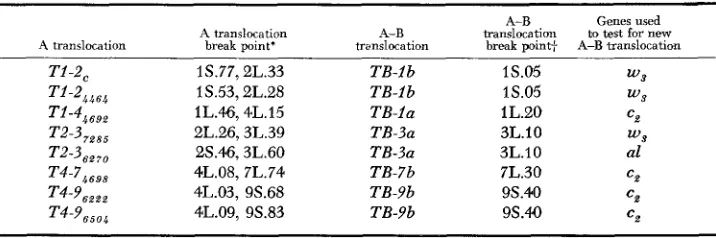
Table 1 lists the reciprocal A translocations used in this study, the B translocations with which they were crossed and the genes used to test for the presence of the new translocations. The reciprocal A translocations were selected so that the break points in the arm involved in the B translocations were well out on the arm, to maximize the distance between the B and A translocation break points and to ensure the greatest possible distance for crossing over.
TABLE 1
Stocks involued in eight F , combinations showing reciprocal A translocations with their break points, A-B translocations with their break points, and the genes used to test
for the production of new A-B translocations
A translocation A translocation break point'
T i -ZC 1S.77,2L.33
Ti-24464 1S.53,2L.28
T 1 - 4 4 6 9 2 lL.46,4L.15
T2-37*,5 2L.26,3L.39
T2-3,, 28.46,3L.60
T 4 - 7 4 6 9 8 4L.08, 7L.74
T4-9m t 2 4L.03, 9S.68
T 4 - 9 6 5 0 4 4L.09, 9S.83
A-B translocation
TB-lb TB-lb TB-la TB-3a TB-3a TB-7b TB-9b TB-9b
A-B translocation
break point+
1S.05 1S.05 1L.20 3L.10 3L.10 7L.30 9S.M 9s.40
Genes used
to test for new A-E translocation
* Break points by LONGLEY (1961 ).
226 F. A. R A K H A A N D D. S. ROBERTSON
TABLE 2
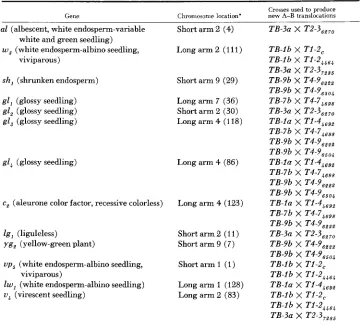
List of genes tesied with the new A-B translocations ana' their location on ihe chromosome m a p
Gene
~~
Crosses used to produce Chmmosome location' new A-B translocations
al (albescent, white endosperm-variable w , (white endosperm-albino seedling,
white and green seedling) viviparous)
sh, (shrunken endosperm)
gl, (glossy seedling)
gl, (glossy seedling)
gl, (glossy seedling)
gl, (glossy seedling)
c, (aleurone color factor, recessive colorless)
lg, (liguleless)
y g , (yellow-green plant)
up5 (white endosperm-albino seedling,
l w , (white endosperm-albino seedling)
U , (virescent seedling)
viviparous)
Short arm 2 (4) L o n g a r m 2 (111)
Short arm 9 (29) Long arm 7 (36) Short arm 2 (30) L o n g a r m 4 (118)
Long arm 4 (86)
Long arm 4 (123)
Shortarm2 (11) Shortarm9 ( 7 ) Shortarm1 (1) Long arm 1 (128) Long arm 2 (83)
TB-3a X T2-3,,,,
TB-lb X TI-2,
TB-3a X T2-3,,,, TB-lb X T1-2,,+,,
TB-9b X T4-9,,,, TB-9b X T4-9,,,4 TB-7b X T4-746g8 TB-3a X T2-3,,,, TB-la X T1-4,6g2
TB-9b X T4-9,,,2
TB-la x T1-44692 TB-7b X T4-746g8 TB-9b X T4-9,22n
TB-la X T1-4,,,, TB-7b X T4-746g8 TBBb X T4-9,,,, TB-3a X T2-3,,,,
TB-9b X T4-9,501 TB-lb X TI-2, TB-lb X TI-Z,,,, TB-la X T1-446g2 TB-lb X TI-2,
TB-3a X T2-3,,,, TB-7b X T4-746g8
TB-9b X T4-9,5,4
TB-9b X T4-9,5,4
TB-9b X T4-9,,,,
TB-lb X TI-Z,,,,
* Number in parentheses refers to the map position on the respective chromosomes as given by NEUFFER, JONES and ZUBEX (1968).
Table 2 lists the genes followed in tests of the new translocations and their locations on the linkage map.
PRODUCTION O F NEW A-B TRANSLOCATIONS 227
NOMENCLATURE
In choosing a symbol for the new translocations, information was utilized from both of the parents. For example, from the cross between TB-9b and T4-9,,,, a new translocated chromo- some was produced that included part the long arm of chromosome 4 (the new piece transferred to the B A chromosome) and the proximal portion of the old A-B translocation, which involved the short arm of chromosome 9. The symbol TB 4L, 9S,,,, is used to designate this new trans- location. The “4L” next to the letters TB indicates that the new segment involved in this translocation came from the long arm of chromosome 4. The “9s” indicates that the original A-B translocation involved the short arm of chromosome 9. The subscript (6222) identifies the reciprocal A translocation that gave rise to the new translocation. Thus the symbol specifies the chromosomal arms involved in the new translocation and the reciprocal A translocation and A-B translocation that gave rise to it. Similarly, the translocation produced from the cross between TB-Ib and TI-2, will be TB 2L, IS,.
RESULTS A N D DISCUSSION
The first four translocations involved the transfer of the long arm of chro- mosome 4 to the BA chromosome. The F,’s between the A-B translocation and the reciprocal A translocations were testcrossed on c2 tester plants (genotype A,A,A,A,C,C,c,c,RR). Crossing over in the F,, followed by adjacent I segrega- tion and nondisjunction of the
B
centromere in the division of the generative nucleus, would result in seeds with colorless aleurone when the deficient sperm united with the polar fusion nucleus (see Figure l e ) . Such seeds are expected to have embryos that would be hyperploid for the new “hybrid” translocation(see Figure 1 f)
.
TRANSLOCATION TB 4L, 9s,3,,,
This translocation was produced from the cross between T4-9,,,, and TB-9b.
The F, testcrossed on the c, stock yielded ears that had various numbers of yellow seeds (without anthocyanin color)
,
ranging from 2-9 seeds per ear. Some of the testcross seeds had purple scutellum. For scutellar color, C, as well as other aleu- ron and scutellar genes are needed (SPRAGUE 1932a). The presence of yellow seeds with colored scutellum indicated that the seeds with deficient endosperm must have embryos with C, presumably carried by the new BA chromosome in the hyperploid condition.Plants from the yellow seeds were used in crosses with stocks homozygous for
sh, (chromosome 9)
,
gl,, gl, (chromosome4)
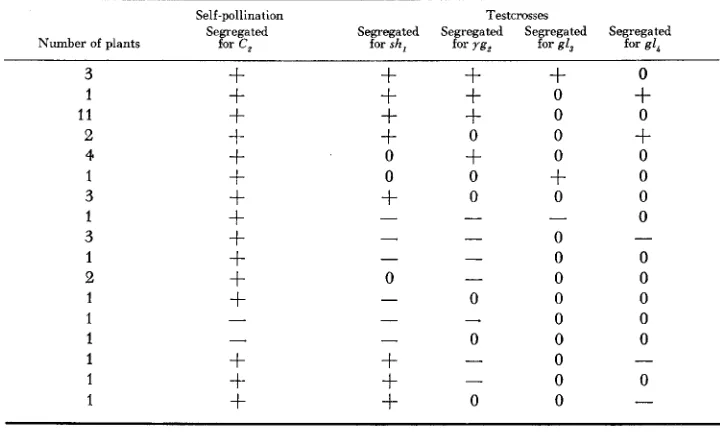
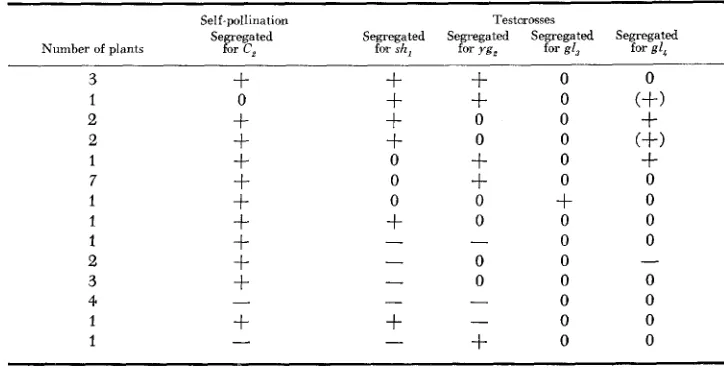
and heterozygous for yg, (chromo- some 9) to locate these genes with respect to the translocation break points. At the same time, the plants from the yellow seeds were self-pollinated to confirm the presence of the new translocation in the hyperploid condition (i.e., the segre- gation of seeds with colored aleurone). The results of these crosses are given in Table 3.228 F. A. RAKHA A N D D. S. ROBERTSON
TABLE 3
Results obtained from self-pollinating and testcrossing TB 4L, 9S,,,, with sh,, yg,, gI3 and g1,*
Self-pollination Testcrosses
Segregated Segregated Segregated Segregated Segregated Number of plants for C, for sh, for yg, for g13 for g16
3
+
+
+
+
01
+
+
+
0+
11
+
+
+
0 02
+
+
0 0+
4
+
0+
0 01
+
0 0+
00 0 0
0
3
+
0
1
+
- 0 0
3
+
0 0
1
+
0
- 0 0 0
2
+
-
-
0 01
+
1
1
-
- 0 0 00
0 0
1
+
+
1
+
+
1
+
+
0 0- -
+
-
-
-
--
-
-
-
-
-
-
*
+
= segregation, - = no segregation, 0 = no test.region 1 )
.
MCCLINTOCK (19M) located ygu in or near the first chromomere ofchromosome 9, which would suggest a position well out on the short arm, distal to the reported break point of the translocation (9S.68). MCCLINTOCK’S placement of ygt was based on observable deficiencies and is undoubtedly more accurate than that determined by a translocation break point. Nonhomologous pairing in a translocation heterozygote frequently hampers the accurate placement of the break points. The evidence suggests that in this case the break point of the trans- location is probably considerably distal to the reported position in chromosome 9. The positive tests with gI, and gZL, although limited, indicate that these genes are in the distal .97 of the long arm of chromosome 4 (Figure 1, region 4). Since gl, is closest to the centromere, the results indicate that this gene is distal to 4L.03. Eight plants listed in Table 3 were observed to segregate purple seeds upon self-pollination but they did not possess the A-B translocation as indicated by the outcrosses. These plants could be the result of heterofertilization ( SPRAGUE 1929, 193213) in which a deficient sperm from a pollen grain carrying the new translo- cation united with the polar fusion nucleus and a sperm from a pollen grain with- out the new translocation fertilized the egg nucleus. They also could result from the loss of chromosome 4 from the sperm fertilizing the polar fusion nucleus but
PRODUCTION O F NEW A-B TRANSLOCATIONS 229
Cc embryos which did not carry the new translocation were observed in all the crosses involving the c, locus.
The two seeds that segregated neither for C, upon self-pollinating nor for any of the test genes upon outcrossing were due to contamination. The last three sets of crosses recorded in Table 3 give unexpected results. The source of these anomalies is not known and additional testing of them will be necessary.
TRANSLOCATION T B 4L, 9s6504
For the production of this translocation,
T
4-96,,, and TB-9b were used. The number of yellow seeds ranged from 5 to 12 per ear in the testcross of theFl
with the c, tester. The results of crosses with the same testers as were used with the previous translocation are given in Table 4. The data do not differ from those ob- tained for the former translocation. Since the chromosome 9 break point in trans- location T4-9,,,, is 9S.83, the results indicate that ygz is proximal to this point. Again the crosses to gl, and gl; are limited, but both were uncovered and are therefore located in the distal 91% of the long arm of chromosome 4. Thus g14is distal to 4L.09.
The last two sets of crosses of Table 4 give anomalous results. Further tests of these will be required.
TRANSLOCATION T B 4L,
IL,,,,
Translocations TI -4,,,, and T B - l a were used to produce this translocation. Again a c, tester was used to select for the new translocation. The number of yel-
TABLE 4
Results obtained from self-pollinating and testcrossing TB 4L, 9S,,,, with sh,, yg,, g13 and g14*
Self-pollination Testmosses
Segregated Segregated Segregated Segregated Segregated Number of plants $or C, forsh, for y g S for g l , for g14
3 1 2 2 1 7 1 1 1 2 3 4 1 1
+
0+
+
+
+
+
+
+
+
+
+
--
+
+
+
+
0 0 0+
+
+
0 0+
+
0 0 0 0-
-+
0 0 0 0 0 0+
0 0 0 0 0 0 0 0 (+I+
(+I
+
0 0 0 0 0 0 0 0-
230 F. A. R A K H A A N D D. S. ROBERTSON
TABLE 5
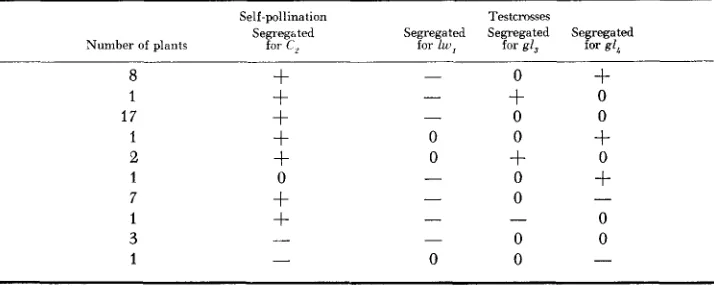
Results obtained from self-pollinating and testcrossing TB 4L, IL,,,, with lw,, gl,, and gl,*
Self-pollination Testcmsses
Segreg-ted Segregated Segregated Segregated Number of plants for C2 for lw, for g l , for g l ,
8 1 17
1 2 1
7 1 3 1
+
+
+
+
+
0
+
+
0
0
-
0
0
0
0
+
0
0
0 0
+
-
+
0 0+
0
+
-
0
0
-
*
+
= segregation, - = no segregation, 0 = no test.low seeds ranged from 1-5 per year. Many of these yellow seeds had a purple scutellum, which indicates the presence of a hyperploid embryo carrying C, and a hypoploid endosperm deficient for C,. The plants from the yellow seeds were self-pollinated and used as a pollen source for crossing with plants carrying lw,,
which is known to be in the long arm of chromosome 1, and also with plants car- rying gl, and gl,. Table
5
shows the results of these crosses.The gene lw, maps well out in the long arm of chromosome 1 (NEUFFER, JONES and ZUBER 1968). Since it is not uncovered by TB 4L, jL46gay it must be distal to the break point of T1-4,,g2 in the long arm of chromosome 1 (L.46) (Figure 1, re- gion 2). Both gl, and gl, are uncovered by the new translocation, placing gl, distal to the break point of the reciprocal translocation (4L.15).
TRANSLOCATION TB 4L, 7L469,
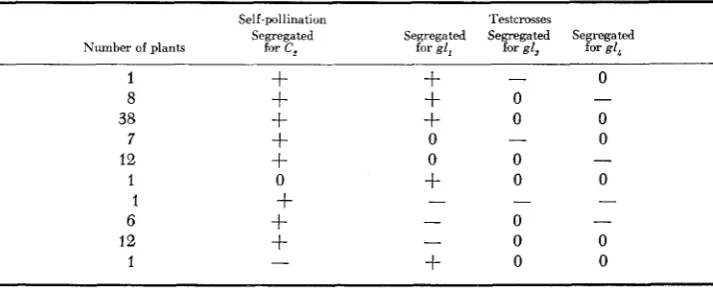
The cross between T 4-74,,, and TB-7b was the source of this new translocation. Yellow seeds in the cross of the F, to cBc. plants, ranging in number from 5-12 per ear, indicated the production of a new translocation. The plants from the yellow seeds were self-pollinated and used as pollen parents in crosses to plants homozygous for gl, (long arm, chromosome 7) and gl, and g l , (long arm. chro- mosome 4). The results of these crosses are given in Table 6.
The occurrence of purple seeds on the self-pollinated ears of plants from the yellow seeds confirms the production of a new translocation. The segregation of
gl, seedlings when this new translocation was crossed to plants carrying this gene indicates that gl, is located between .30 and .74 of the long arm of chromo- some 7 (Figure 1, region 1 ).
The absence of gl, or gl, seedlings when this translocation was crossed to plants of these genotypes was unexpected since the break point for the reciprocal A
PRODUCTION O F N E W A-B TRANSLOCATIONS
TABLE 6
Results obtained from self-pollinating and testcrossing TB +L, 7L4698 with gl,, g13 and gl,*
23 1
Self-pollination Testcrosses
Segregated Segregated Segregated Segregated Number of plants for C, for g l , for g13 for gl,
1 8
38 7
12 1 1
6
12 1
+
+
+
+
+
0
+
+
+
-
+
+
+
0 0+
-
0
0
0 0
0 0 0 -
- 0
0 0
0 -
-
-
0
0
*
+
= segregation, - = no segregation, 0 = no test.the previous three translocations, which have break points at 4L.03, 4L.09 and 4L.15. The negative results cast some doubt on the reported cytological position of the break point in chromosome 4 of T4-7,,,,. The genetic results would place the break point in the long arm of chromosome 4 between gZ3 and cp.
The last plant tested in Table 6 gave unexpected results. Further testing of this plant is indicated.
TRANSLOCATION TB 2L, Is,
This translocation and the three following translocations have been briefly de- scribed by
ROBERTSON
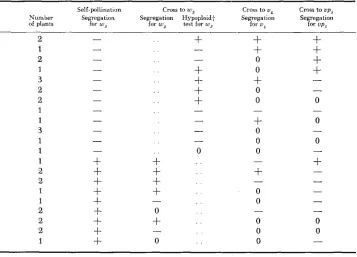
(1964b).The TB 2L, I S , translocation was synthesized by crossing TI-2c and TB-Ib. The w p gene on the long arm of chromosome 2 was used to test for the formation of the new
BA
chromosome. I n crosses tow,?,
white-dormant seeds were found with the number per ear ranging 1 to 14. On the same ears there were also found yellow viviparous seeds ranging from 1 to 6 per ear. The number of yellow viviparous kernels probably does not represent the total number of deficient(hypoploid) embryos since w 3 is not always viviparous.
The plants from the white seeds were self-pollinated and used as male parents in crosses to standard lines. All the self-pollinated ears segregated for yellow seeds, as expected if a new translocation had been produced.
Plants from seeds of the outcrosses to standard lines were self-pollinated and used as pollen parents in crosses to stocks carrying ws, U & (located in the long arm
of chromosome 2) and up5. The up, gene is located in the short arm of chromo- some 1 and is uncovered by TB-Ib.. Table 7 shows the results of self-pollinating
the plants from the cross of standard x T B 2Ly Is' as well as the crosses with the
w3
232 F. A. R A K H A A N D D. S. ROBERTSON
TABLE 7
Results obtained from self-pollinaiing and testcrossing plants from the cross of standard x TB 2L, 1S,/w3 with w3 v4 and vps*
Self-pollination Cross to w 3 Cross to uc Cross to ups
Number Segregation Segregation Ilypoploidf Segregation Segregation of plants lor w s for w 3 test f o r w 3 for uc for up5
+
. .
+
. .
+
0+
. .
+
0 0+
0
+
-
-
1 1 2 1 4 5 2 3 25
+
+
2
+
+
. .+
1
+
+
1
+
. . 0+
+
. . - 0
2
+
. . 0
+
1
+
. . 0
1
+
1
+
1
+
+
. . 0+
3
+
+
. . 0 0-
- - - . . - - . . - - 0 - . .-
0. . - 0 0
- - . . - - - - - . . - - - . . - - - . .
-
- . . - - - - -*
+
= segregation or positive hypoploid test, - = no segregation or negative hypoploid test,+
A positive hypoploid test is indicated by the segregation of white seeds that produce green0 = n o test.
seedlings and/or the segregation of yellow seeds with albino or viviparous seedlings.
Since the original hyperploid plant used in the outcross to standard was hetero- zygous for ws, most, if not all, the plants with the new translocation also should not carry w 3 because it is in the nontranslocated chromosome. Most, if not all, the plants heterozygous for w s should not have the new translocation. The data in Table 7 support these expectations. Since w s and up, are lethal traits, segregating families were used in the testcross. Thus a negative hypoploid test in crosses to these families does not necessarily indicate a negative test for the presence of the translocation but rather may be the result of having crossed to a plant that did not carry the tester gene. Crosses to homozygous U,, plants, though limited, indi-
cate that this gene is not uncovered by the translocation and thus is proximal to the break point of TI-2c in chromosome 2 (2L.33). ROBERTSON (1961 ) placed vp5 on chromosome 1, 1.8 crossover units proximal to the break point of T I - 2 ~
(1S.77). The data from Table 7 agree with this position.
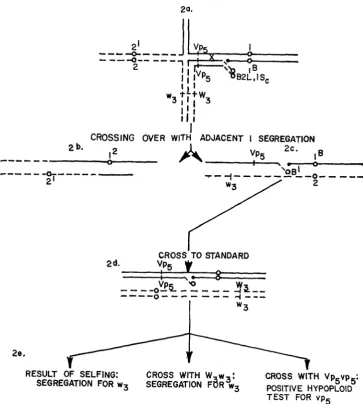
In Table 7 some of the tested plants segregated for w s in both the self- and outcross and at the same time gave a hypoploid test for up5 indicating the presence of an A-B translocation involving the short arm of chromosome 1. Such results cross was made, a crossover in TB 2b,
IS,
W S
PRODUCTION O F NEW A-B TRANSLOCATIONS 233
region 1 (Figure 1 ) of the new “hybrid”
A-B
translocation had occurred followed by adjacent I segregation. These events will produce a gamete with the reconsti- tuted original A-B translocation (TB-lb) and carryingw g
(Figure 2). The OC- currence of at least five such crossovers in the data recorded in Table 6 suggests a rather high reversion rate in this translocation, although the sample is too lim-RESULT OF SELFING: CROSS WITH W w3: CROSS WiTH Vp5vp5;
POSITIVE HYPOPLOID TEST FOR vp5
SEGREGATION FOR w3 SEGREGATION F ~ R w3
234 F. A. R A K H A A N D D. S. ROBERTSON
ited to get an accurate estimate of the true rate. Some of these five palnts could be the result of crossing over in region
4
(Figure 1) between ws, and the break point. If this occurred, w s would be transfered into the new A-B translocation.TRANSLOCATION T612L, 1 s 4 4 6 . 4
The cross of T1-24464 and TB-Ib was used to produce this new A-B transloca- tion. The same testing procedure was used with this translocation as with the preceding one. Table 8 gives the results of self-pollinating and testcrossing plants
with plants carrying ws, u4 and up,.
from the cross standard x
Table 9 gives additional data from crosses involving this translocation. The male parents used in the testcrosses reported in this table were derived from seed pro-
duced on self-pollinated ears out of the cross standard x
pollinated ears not segregating for w 3 were selected since they are more likely to carry the translocation.
T B 2L, l S . 5 4 6 4
ws
TB
2L, I S 4 4 6 4.
only
self-Ws
TABLE 8
Results obtained from self-pollinating and testcrossing plants from the cross of
standard x TB 2L, lSqq64/w3 with w3, vq and vp5*
Number of plants
2
1
2
1 3 2 2 1
1 3 1
1 1 2
2
1 1 2
2
2
1
Self-pollination Crass to wt Cross to U & Cross to ups
Segregation Segregation Hypoploid+ Segregation Segregation Eor uiS fur w g test fur u ; , ~ for U & for up5
. .
+
+
+
+
+
0
+
0
+
-
- -
- -
-
+
-
-
. .
+
+
. .
+
0-
. .+
0 0- -
-
+
+
+
+
+
+
+
+
+
+
+
+
+
0
-
+
0
-
0 0
-
*
+
= segregation or positive hypoploid test, - = no segregation or negative hypoploid test,f A positive hypoploid test is indicated by the segregation of white seeds that produce green 0 =I no test.
PRODUCTION O F NEW A-B TRANSLOCATIONS
TABLE 9
Results obtained from self-pollinating and testcrossing plants carrying TB 2L, IS,,,, with w3, vq and vp5 (see text for orgin of TB) *
235
Self-pollination Cross to w 3 Cross to U & cms to up5
Hypoploidi- Hypoplo?d+
Segregation segregation segregation Hypoploid+ test for up5
Number of plants for w Q test for w 3 for u4
+
+
+
+
0
+
+
0 0
+
+
0
0
*
+
= segregation or positive hypoploid test, - = no segregation or negative hypoploid test,t
A positive hypoploid test is indicated by the segregation of white seeds that produce green 0 = no test.seedlings and/or the segregation of yellow seeds with albino or viviparous seedlings.
The data from Tables 8 and 9 indicate that this translocation uncovers U , while
the previous one did not. This means that U& is located in the region between the
break points for these two translocations, 2L.28 and 2L.33, respectively. This translocation also uncovers u p j , which would place this gene proximal to 1S.53.
Three classes of exceptional plants are observed in Table 8: 1) One plant is observed that segregated for z~q, upon selfing and outcrossing but does not segre-
gate for u4 when crossed to this stock. This plant gave a positive hypoploid test with up5. These results are expected if the plant carried the original A-B translo- cation produced by crossing over as suggested for translocation TB 2L, IS,.
2)
One plant is found that does not segregate for w s upon selfing or outcrossing nor for U& or up5 when tested against those stocks. However, it is semisterile indicating
a translocation is present. The reciprocal crossover product to that used to explain the class 1 exception (Figure 2b) would give the observed results. 3 ) Two excep- tional plants are present that segregate for w 3 upon selfing and U, when crossed to
stocks carrying this gene. Such plants would be expected if a crossover had OC- curred that transferred
w s
into the new A-B translocation. Since these plants have the new A-B translocation, they would be expected to be semisterile. One was semisterile as expected but the other was normal. A bookkeeping error is the most likely explanation for the results obtained with the normal plants.TRANSLOCATION TB 2L, 3L7885
This translocation was derived from a cross between T2-3,,,, and TB-3a. Test- crossing F, plants on those carrying wb resulted in some white endosperm seeds that gave rise to green plants. These plants were self-pollinated and crossed to a
standard line. Plants from the cross standard
x
TB 2L, 3L7m5 were self-pollinated236 F. A. RAKHA A N D D. S. ROBERTSON
TABLE 10
Results obtained from self-pollinating and testcrossing plants from the cross of standard x TB 2L, 3L7&w3 with wg and v4*
Cross to w 3
Self-pollination Cross to U &
Segregation Hypoploid:
Number of plants Segregation for w 3 for w 3 test for w 3 Segregation for U &
. .
+
+
3
16 - . .
+
0+
1
. . - 0
23
+
+
. . 0. . 0
-
-
. .
-
__
-
. .
-
. .
-
1
+
2
+
8
+
1
+
-*
+
= segregation or positive hypoploid test, - = no segregation or negative hypoploid test, + A positive hypoploid test is indicated by the segregation of white seeds that produce green 0 = n o test.seedlings and/or the segregation of yellow seeds with albino or viviparous seedlings.
and crossed to w g and u4. The data are given in Table 10. Additional crosses in- volving this translocation were made with plants derived from seeds of self-
pollinated ears from the cross standard
x
- T B 2L7 3L7285.
Self-pollinated ears notw 9
segregating for w 3 were selected. The data from these crosses are given in Table 11.
This translocation uncovers U,,. This is in agreement with the results from the
previous translocation TB 2L, I S 4 4 6 4 which also uncovered u4. The break point in
TABLE 11
Results obtained from self-pollinating and testcrossing plants carrying TB 2L, 3L728s with wg and v4 (see text for origin of TB) *
Self-pollination Cross t o w Q Cross to U &
Number of plants Segregation for w 3 Hypoploid+ test for w 3 Segregation for u4
+
+
0
+
-
- 0
+
+
+
+
0 0
*
+
= segregation or positive hypoploid test, - = no segregation or negative hypoploid test, + A positive hypoploid test is indicated by the segregation of white seeds that produce green 0 = no test.PRODUCTION O F NEW A-B TRANSLOCATIONS 23 7 chromosome 2 is 2L.28 in TB
ZL,
1 8 4 4 6 4 and 2L.26 inTB
ZL,
3L,,,,. The plantsin Table 11 that did not segregate for
w s
and /or U, when tested against thesegenes were homozygous for the normal chromosomes derived from the standard line to which the translocation stock had originally been crossed.
TRANSLOCATION TB 2L, 3 L 6 3 7 ,
The cross between plants carrying T2-3,,,, and TB-3a was the source of this translocation. The F, progeny of this cross were used as pollen parents in crosses with plants carrying al. The occurrence of white endosperm seed in this cross indicated that a new hybrid translocation had been produced. This was confirmed by planting the white seeds, which gave green plants that segregated for yellow seeds when self-pollinated. At the same time these plants were self-pollinated they were crossed to a standard line. The results of self-pollinating and outcross-
ing plants from this cross (standard
x
TB
2S,3L~270 ) to al, lgl and gl, are given in Table 12. Crosses with the new translocation to Igl and gl, uncover these genes indicating that they must be in the distal 54% of the short arm of chromosome 2. Two classes of exceptional plants are found in Table 12. Four plants occur that segregated for a1 when self-pollinated and lgl and gl, when crossed with stocks carrying these genes. A crossover transferring a1 into the new A-B translocation would explain these results. As expected, since these plants carry the transloca- tion, they were all observed to be semisterile. The other exceptional class con- sists of five plants that did not segregate for a1 when self-pollinated and upon out- crossing to stocks carrying al, lgl and&
failed to segregate for one or more of these traits. These plants could be the result of transferring the normal allele of a1a2
TABLE 12
Results obtained from self-pollinuting and testcrossing plants from the cross of
standard x TB 2S, 3L,,,,/al with al, lg, and gl,*
Cross to a1 Cross to Ig, gl,
Self-pollination
Segregation for a1 Segregation
Hypoploid+ Segregation of a1 Lest for a1 for lg, and gl,
Number of plants
- 2
9
1 1
2 -
2
-
-
-
-
8
+
7
+
4
+
14
+
. .
+
+
0 0
+
+
0-
0
+
+
00
-
-
-
0
+
~~ ~
*
+
= segregation or positive hypoploid test, - = no segregation or negative hypoploid test,+
A positive hypoploid test is indicated by the segregation of white seeds that produce green 0 = no test.238 F. A. RAKHA A N D D. S. ROBERTSON
from the translocated chromosome into the normal chromosome 2 resulting i n normal plants without al. All these plants had normal pollen and seed set, as ex- pected.
CONCLUSIONS
The foregoing experiments have established that it is possible to produce new A-B translocations by crossing over between a reciprocal A (A1-AZ) and an A-B translocation (A,-B)
.
These new translocations have attached to the B centromere a proximal portion of the B chromosome, a segment of the A, chromosome and all of the A, chromosome that was translocated in the original A,-A, translocation. The other components of the translocation consist of the AIB chromosome from the original A-B translocation and A,”I member of the reciprocal A translocation. These new “hybrid” translocations can be used to locate genes on segments of the genome that were not involved in the original A-B translocations produced by ROMAN (ROMAN and ULLSTRUP 1951 ).
Also when several “hybrid” transloca- tions involving the same chromosomes are tested against genes carried on the BAIA2 chromosomes of the different aberrations, it is sometimes possible to locate the genes with respect to the break points and thereby place them on the cytological map. Thus, u4, which maps near the centromere in the long arm of chromosome2, was uncovered by T B 2L, IS,,,, and T B 2L, 3L,,,, and hence must be distal to the breakpoints of these translocations in chromosome 2 (2L.28 and 2L.26, re- spectively). I t was not uncovered by T B 2L, I S , with a break point at 2L.33 and consequently u4 must be proximal to this break point. Assuming the correct break point determination, this places U , between 2L.28 and 2L.33. Also, genes in region
1 (Figure 1) can be placed with a fair degree of accuracy if this region is not too long. For example in translocation T B 4L, 7L,,,, gl, is located cytologically be- tween 7L.30 and 7L.74.
The precision of this cytological mapping depends upon the accuracy of the break point determination, In these experiments no attempt was made to confirm the break points reported by LONGLEY (1961). On occasion genetic results were not in agreement with reported break point positions (e.g., the uncovering of yg,
by T B 4L, 9S,,,, and the failure of T B 4L, 7L,,,, to uncover g l , or g2,). The genetic results can serve as a check on the cytological information. When discrepancies are found, such as those indicated above, reexamination of the cytological mate- rial is indicated.
The crossing of four translocations to standard lines before further testing pro- vided the opportunity for crossing over to occur. Evidence for two classes of cross- overs was obtained: 1) Those that reconstituted the original parental transloca- tions (see Figure 2) were observed with T B 2L, I S , and T B 2L, IS,,,, and 2)
PRODUCTION O F NEW A-B TRANSLOCATIONS 239 ROBERTSON (1967) found in hyperploid TB-9b plants. About 96% of the time the two BA chromosomes of these plants paired and as a consequence very few cross- over progeny were observed. The more complex rearrangement of the “hybrid” A-B translocation might in some way be responsible for the more frequent pair- ing of the chromosome with the homologous regions of the A, and A, chro- mosomes. Further tests will be necessary to determine how crossing over in these “hybrid” A-B translocations compares with that of the original A-B transloca- tions.
Because of the danger of losing these new translocations through crossing over it will be essential that they be continually checked against the appropriate tester genes whenever they are propagated. To eliminate such loss, homozygous lines should be established as quickly as possible.
to work reported in Maize Genetics Cooperation News Letter.
The authors wish to express their appreciation t o Dr. JACK B. BECKETT for permission to refer
SUMMARY
A technique utilizing crossing over between an A-B translocation (Al-B) and a reciprocal A translocation (A,-A,) to produce new “hybrid” A-B transloca- tions is described. The BA element of these translocations consists of a portion of the original BA’ chromosome plus the A, segment of the reciprocal A translocation (BAlA2). The remaining elements of the translocation consist of the AIB and A,”l chromosomes. Eight new “hybrid” translocations are described. Three incorporate the long arm of chromosome 2, one the short arm of chromosome 2 and four the long arm of chromosome
4
as the A, segment of the BA,+ chromosome. These new translocations were used successively to locate genes in chromosome regions cor- responding to the translocated A, segments. Their usefulness in the cytological mapping of genes was also demonstrated.LITERATURE CITED
BECKETT, J. B., 1967 Two new B-type translocations. Maize Genet. Coop. News Letter 41: 139. -, 1968 A-B-type translocation involving the short arm of chromosome 3 and a translocation complex involving chromosomes 5, 6 and a supernumerary. Maize Genet. Coop. News Letter 42: 132.
BELLINI, G., A. BIANCHI and E. OTTAVIANO, 1961 The use of interchanges involving B type chromosomes in studying artificial mutagenesis in maize. Z. Vererbl. 92 : 85-99.
BIANCHI, A., 1961 Duplication of specific chromosome segments to increase kernel weight in maize. Genetics 96: 851-852.
BIANCHI, A., G. BELLINI, M. CANTIN and E. OTTAVIANO, 1961 Nondisjunction i n presence of interchanges involving B-type chromosomes in maize, and some phenotypical consequences of meaning in maize breeding. Z. Vererbl. 92 : 213-232.
Breakage points for four corn translocation series and other corn chro- mosome aberrations maintained at the California Institute of Technology. U. S. Dept. Agric. Res. Serv. Publ. ARS 34-16.
The relations of homozygous deficiencies to mutation and allelic series in maize. Genetics 29: 478-502.
LONGLEY, A. E., 1961
240 F. A. RAKHA A N D D. S. ROBERTSON
NEUFFER, M. G., L. JONES and M. S . ZUBER, 1968 The Mutants of Maize. Crop Sci. Soc. Am. Madison, Wisconsin.
PETERSON, P. A. and E. A. WERNSMAN, 1964 A monosomic type approach in maize breeding. Crop Sci. 4: 533-535.
ROBERTSON, D. S., 1961 Linkage studies of mutants in maize with pigment deficiencies in endosperm and seedling. Genetics 46: 649-662. - , 1964a Transfer of intact seg- ments of maize chromosomes: A possible Method. J. Heredity 5 5 : 107-114. 1964b The production of new A-B translocations by crossing over with reciprocal A translocations. Maize Genet. Coop. News Letter 38: 82-84. - , 1967 Crossing over and chromo- soma1 segregation involving the Bg elements of the A-B translocation B-9b in maize. Genetics 55 : 433-449.
ROMAN, H., 1947 Mitotic nondisjunction in the case of interchanges involving the B-type chromosomes in maize. Genetics 32: 391-409.
ROMAN, H. and A. J. ULLSTRUP, 1951 The use of A-B translocations to locate genes in maize. Agron. J. 43: 45Ck-454.
SPRAGUE, G. F., 1929 Hetero-fertilization in maize. Science 69: 526-527. - , 1932a The inheritance of scutellum colors in maize. U.S. Dept. Agric. Tech. Bull. 292. 1932b The nature and extent of heterofertilization in maize. Genetics 17: 358-368.
-,