Program Description
Abstract
Problem addressed Primary care settings require a feasible program for integrating lifestyle interventions, which can reverse metabolic abnormalities, for patients in practice.
Objective of program To integrate a lifestyle intervention program into existing primary care clinics with an interprofessional approach that includes dietitians and kinesiologists.
Program description Canadian Health Advanced by Nutrition and Graded Exercise (CHANGE) provides a personalized approach to nutrition and exercise modification focusing on patients with metabolic syndrome. With CHANGE, exercise intervention is individualized (ie, tailored to individual preferences) and graded (ie, intensity is built up slowly over time); supervision and implementation of the program is conducted in a collaborative fashion between the family physician and the kinesiologist. Patients undergo an initial fitness assessment that determines their baseline aerobic, strength, and flexibility scores, and the same assessment is performed at 3 months and at 12 months.
Conclusion The CHANGE program demonstrates how
interprofessional primary care teams can support patients with metabolic syndrome in achieving their health goals. By including dietitians and kinesiologists in primary care settings to work alongside family doctors, many barriers to lifestyle interventions can be overcome. The team’s collaborative understanding of the patient combined with the patient’s own sense of urgency for change creates the opportunity for the formation of new healthy lifestyle habits. Although results are preliminary, CHANGE appears to be a feasible, implementable, and effective program.
The CHANGE program
Exercise intervention in primary care
Doug Klein
MD MSc CCFPKhursheed Jeejeebhoy
MD PhDAngelo Tremblay
PhDMatthew Kallio
Caroline Rheaume
MD PhDCCFPSerena Humphries
PhDDawna Royall
MSc RDPaula Brauer
PhD RDDaren Heyland
MD MSc FRCPCRupinder Dhaliwal
RDDavid M. Mutch
PhDEditor’s kEy points
• The Canadian Health Advanced by Nutrition and Graded Exercise (CHANGE) intervention is an evidence-based diet and exercise program designed for primary care. Focusing on patients with metabolic syndrome, CHANGE is built on the principles of effective lifestyle interventions, including individualized goal setting, supervised and graded exercise, and a collaborative, team-based approach to care. The results achieved are owing to an interdisciplinary effort with multiple components including diet counseling, exercise, and closer follow-up visits with family doctors.
• With CHANGE, exercise principles are applied to achieve optimal health and fitness benefits, which include specificity, overload, and recovery. Patients receive guidance and education from the health care team.
• Establishing CHANGE in family medicine clinics ensures the main support and motivator (ie, the family doctor) for lifestyle changes remains connected to the patient. The family doctor can continue to monitor the patient, recognize issues early, and recruit further support from the team if necessary. The program has been designed to be generalizable to other primary care settings.
Résumé
Le problème à l’étude Les établissements de soins primaires devraient offrir à leur clientèle un programme réalisable permettant d’intégrer des interventions axées sur le mode de vie, susceptibles de corriger certains troubles métaboliques.
Objectif du programme Instaurer dans des cliniques de soins primaires existantes un programme d’intervention axé sur les habitudes de vie, qui fait appel à une équipe multidisciplinaire comprenant des diététistes et des kinésiologues.
Description du programme Le programme CHANGE (Canadian Health Advanced by Nutrition and Graded Exercise) utilise une méthode personnalisée axée sur le patient présentant un syndrome métabolique pour modifier ses habitudes en matière de nutrition et d’exercice. Dans ce programme, l’exercice est adapté aux préférences du sujet et il est progressif (autrement dit, son intensité augmente lentement avec le temps); l’instauration du programme d’exercice et sa supervision sont effectuées en collaboration par le médecin de famille et un kinésiologue. Une évaluation initiale de la condition physique du patient permet de connaître les niveaux de base de sa capacité aérobique, de sa force physique et de sa flexibilité; cette évaluation est répétée après 3 et 12 mois.
Conclusion Le programme CHANGE nous montre qu’une équipe interdisciplinaire de soignants de première ligne peut aider un patient présentant un syndrome métabolique à atteindre ses objectifs de santé. Le fait que des diététistes et des kinésiologues travaillent de concert avec le médecin de famille permet d’éliminer certains facteurs qui nuisaient au succès des interventions sur le mode de vie. L’évaluation du patient par les différents membres de l’équipe, combinée au fait que le patient lui-même comprend l’urgence de la situation, lui procure une excellente occasion d’adopter de saines habitudes de vie. Même si ces résultats sont préliminaires, on peut penser que ce programme est faisable et qu’il est efficace.
Le programme CHANGE
La prescription d’exercice au niveau des soins de première ligne
Doug Klein
MD MSc CCFPKhursheed Jeejeebhoy
MD PhDAngelo Tremblay
PhDMatthew Kallio
Caroline Rheaume
MD PhDCCFPSerena Humphries
PhDDawna Royall
MSc RDPaula Brauer
PhD RDDaren Heyland
MD MSc FRCPCRupinder Dhaliwal
RDDavid M. Mutch
PhDpoints dE rEpèrE du rédactEur
• Le programme CHANGE (Canadian Health Advanced by Nutrition and Graded Exercise) est un mode d’intervention basé sur des données probantes qui associe régime alimentaire et exercice pour des patients des soins primaires. Axé surtout sur des patients présentant un syndrome métabolique, il cherche à modifier certaines habitudes de vie de façon efficace, en proposant à chaque participant de se fixer les objectifs qui lui conviennent, en lui faisant faire des exercices progressifs sous supervision tout en lui assurant des soins de santé au sein d’une équipe de soignants. Les résultats sont obtenus grâce à une collaboration interdisciplinaire regroupant plusieurs éléments, y compris des conseils sur la nutrition, l’exercice, et un suivi plus étroit avec les médecins de famille.
• Dans le programme CHANGE, on applique des principes de base de l’exercice, tels que la spécificité, la surcharge et la récupération, de manière à maximiser les avantages pour la condition physique et la santé. Les patients reçoivent aussi des conseils et de l’information de la part de membres de l’équipe de soins.
• En instaurant le programme CHANGE dans une clinique de médecine familiale, on s’assure que la personne qui peut le mieux aider et motiver le patient à changer son mode de vie, c’est-à-dire son médecin de famille, sera toujours en contact avec lui. Ce médecin pourra suivre ses progrès, détecter d’éventuels problèmes et recourir à l’équipe de soins si nécessaire. Le programme a été conçu de façon à servir dans d’autres établissements de soins primaires.
Cet article a fait l’objet d’une révision par des pairs.
Program Description |
The CHANGE program
H
ypertension, cardiovascular disease, stroke,diabetes, and their complications account for nearly 17% of all health care costs and 43% of all deaths.1 Metabolic syndrome (MetS) refers to a group
of factors (abnormal cholesterol levels, elevated blood glucose levels, high blood pressure, and obesity) that increase the risk of these diseases. A patient is diag-nosed with MetS if he or she has at least 3 of the fol-lowing 5 conditions or is taking medications to control them: elevated blood pressure (> 130/85 mm Hg), high blood glucose levels (> 5.6 mmol/L), high triglycer-ide levels (> 1.7 mmol/L), low high-density lipoprotein cholesterol levels (< 1.0 mmol/L in men; < 1.3 mmol/L in women), and a large waist circumference (> 102 cm in men; > 88 cm in women).2 In Canada, 20% of the adult
population has MetS,3 with the prevalence of MetS in
Canadian adults aged 60 to 79 reaching 39%.3
Cen-tral obesity and other metabolic risk factors that lead to MetS are prevalent among older adults.4 Metabolic
syndrome doubles the risk of cardiovascular disease.2
People with MetS have been shown to have double the annual health care costs and tend to use services more frequently than those without MetS.5,6 The high
preva-lence of MetS, along with the aging of the population,7
forecasts an enormous financial burden for health sys-tems, patients, and families.8,9
Progression of MetS to diabetes and cardiovascular disease can be considerably reduced by dietary modi-fication and exercise.10-12 The combined diet and
exer-cise approach, better known as lifestyle intervention, has been demonstrated in clinical trials to reverse metabolic abnormalities, reduce reliance on pharmacotherapy, and prevent progression to diabetes and cardiovascular dis-ease.12-15 A 2012 meta-analysis reported that lifestyle
interventions of diet and exercise are effective in resolv-ing MetS and reducresolv-ing the severity of its related abnor-malities.16 Several other clinical trials have supported
lifestyle interventions in reversing MetS and its compli-cations, including in older adults.17,18
Despite the evidence showing that lifestyle interven-tions could substantially reduce the costs and complica-tions of these medical condicomplica-tions,19-22 delivery of these
preventive care services in primary care remains low.23
In a recent national survey in primary care, less than half of family doctors reported discussing obesity and physical activity with their patients during their periodic health examinations, with counseling on lifestyle modi-fications limited by time and remuneration structure.23
In addition, reasons for the poor implementation of life-style interventions in primary care include lack of time, lack of resources, and limited training.24-27 Thus, while
lifestyle interventions have been shown to be efficacious in the research setting, the resources and the personnel to implement these preventive care services in primary care are lacking, resulting in the focus of treatment being
pharmaceutical rather than behavioural. Current gaps in the literature exist regarding the effective implementa-tion of lifestyle intervenimplementa-tions in primary care. Research addressing the feasibility, effectiveness, and efficiency in the primary care context is required to promote wide-spread adoption.
Canadian Health Advanced by Nutrition and Graded Exercise (CHANGE) is an interprofessional approach to integrating lifestyle interventions into existing primary care clinics. By including dietitians and kinesiologists in primary care settings to work alongside family doctors, many barriers to lifestyle interventions can be overcome. Previous studies have reported on the effectiveness of indi-vidualized, supervised exercise28 and strength29 and
resist-ance training30 to improve health, with a paucity of
evi-dence on how to effectively implement such interventions in the primary care setting. The purpose of this article is to describe the CHANGE program, along with the evidence supporting its components, and to present preliminary findings from the evaluation of the program. Final results will be reported in the future. The description of the dietary intervention has been described elsewhere.31
Program description
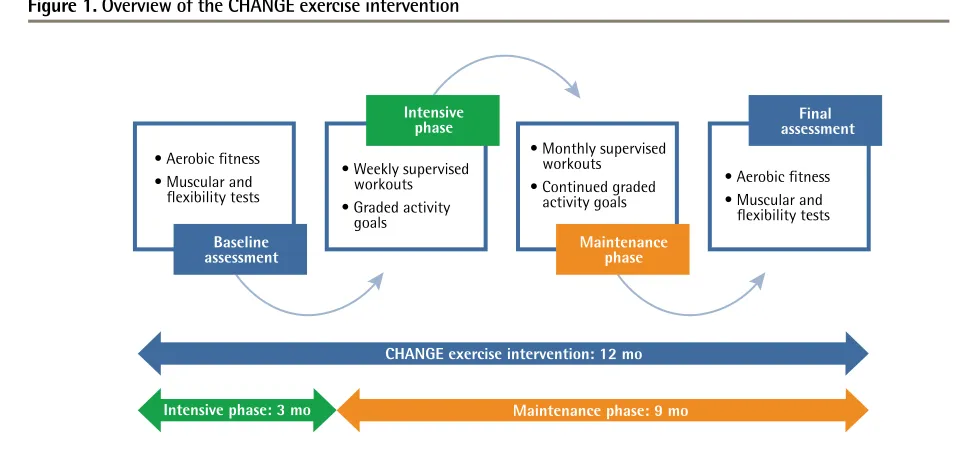
The CHANGE program is a personalized approach to nutrition and exercise modification supported by an interprofessional team focusing on patients with MetS. The program’s principles related to exercise are as fol-lows: exercise intervention will be individualized (ie, tailored to individual preferences) and graded (ie, inten-sity is built up slowly over time); and supervision and implementation of the program will be conducted in a collaborative fashion between the family physician and kinesiologist. Patients undergo an initial fitness assess-ment that determines their baseline aerobic, strength, and flexibility scores (Figure 1). The same assessment is performed at 3 months and at 12 months. Patients’ aerobic fitness is assessed by a methodology described by Ebbeling et al to estimate maximal oxygen consump-tion.32 The technical details of this test are described by
the Canadian Society for Exercise Physiology.33 Beyond
the preoccupation to have a marker of maximal aerobic power, the kinesiologist also obtains a standardized measure of the change in heart rate at a given workload before and after the program. The outcome variables used to evaluate effectiveness include heart rate, blood pressure, and perception of effort (Borg scale) at a refer-ence treadmill speed, as well as maximal oxygen con-sumption. Muscular endurance and vigour is assessed by the number of partial curl-ups and the adapted push-up test performed in 1 minute.34 The flexibility test is the
distance (cm) covered by a standardized trunk flexion.33
Figure 1.
Overview of the CHANGE exercise intervention
CHANGE—Canadian Health Advanced by Nutrition and Graded Exercise.
• Aerobic fitness
• Muscular and
flexibility tests
• Weekly supervised
workouts • Graded activity goals
• Monthly supervised
workouts
• Continued graded
activity goals
• Aerobic fitness
• Muscular and
flexibility tests
Baseline
assessment Maintenancephase
Intensive
phase assessmentFinal
CHANGE exercise intervention: 12 mo
Intensive phase: 3 mo Maintenance phase: 9 mo
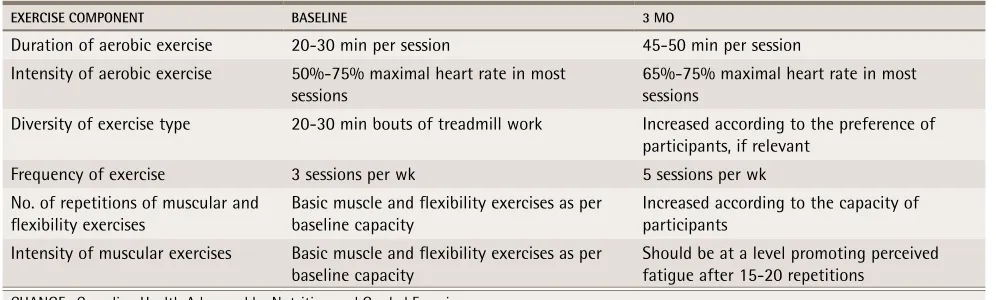
them. It is critical to emphasize that the fitness pro-gram is individualized. Factors to consider about the patient’s life include the following: Has the patient exer-cised before? What activities does the patient enjoy? Does the patient work part-time or full-time? Is the patient a single parent, divorced, or widowed? What is the patient’s health status? Where is the patient in terms of the stages of change (eg, precontempla-tion, contemplaprecontempla-tion, preparaprecontempla-tion, acprecontempla-tion, mainten-ance, or relapse)? The factors to consider are endless but the underlying principles are the same. Providers must understand what is important to each individual patient in order to assist him or her to develop a sense of urgency to make a lifestyle change. The kinesiolo-gist sees patients weekly for the first 12 weeks and then every month continuing for a duration of 1 year. It is expected that within several weeks there will be a pro-gression in exercise modalities, in accordance with the exercise tolerance of each individual patient. Table 1 presents an example of the typical progress a patient could achieve within the first 3 months of the program in terms of duration of exercise, intensity of exercise, diversity of exercise type, frequency of exercise, and number of repetitions.
Throughout the intervention, the family doctor receives summaries of patients’ goals and achievements from the kinesiologist in order to reinforce the messa-ging and to help support patients in achieving their goals.
Evaluation
The CHANGE program has been successful in recruit-ing patients in Edmonton, Alta, Toronto, Ont, and
Quebec city, Que. To date 307 patients with MetS have been recruited to the program by their family doctors. Table 2 shows the baseline demographic characteris-tics of the patients at the 3 CHANGE demonstration sites. Participation in the exercise components of the interven-tion is 96%. Preliminary results, based on data from the first 3 months of the intervention, have demonstrated that among those patients participating in the interdisci-plinary, multi-component CHANGE program nearly 20% of them have reversed MetS after 3 months in the pro-gram. The presence of MetS is defined as a patient hav-ing at least 3 of the 5 criteria conditions for MetS. Rever-sal of MetS, therefore, is defined as going from having 3 or more of the criteria conditions to having less than 3 of the criteria conditions (ie, having normal values for the criteria conditions and not taking medications for those conditions). Preliminary data also show that participating patients have demonstrated considerable changes to fit-ness, strength, and flexibility scores (Table 3). Complete results of the 12-month intervention will report on the effectiveness and cost-effectiveness of the intervention. Successful implementation and preliminary positive find-ings suggest that this type of intervention is feasible.
Discussion
Program Description |
The CHANGE program
to them. The team can then nudge and guide patients, but patients are empowered to make their own choices and choose what they want to do. Second, patients must have a sense of urgency about and believe that there is an importance to implementing the lifestyle chan-ges. The strong collaborative approach by a primary care–based interprofessional team provides patients with guidance and education about physical activities to improve their health; however, only a patient can determine whether or not it is important to incorporate
these health-improving activities in his or her life. Tell-ing someone to change his or her behaviour is often met with resistance, but asking a patient to communi-cate how he or she will implement the lifestyle change empowers the patient to make the decisions and cre-ate his or her personal urgency.35,36 When this occurs
patients become interested in learning more about exer-cise and physical activity.
The individualized, graded exercise program can then be gradually built from the patient’s starting point, with
table 1. Typical progression of CHANGE exercise protocol:
Progression from baseline to 3 months.
ExERCiSE CoMPoNENT BASELiNE 3 Mo
Duration of aerobic exercise 20-30 min per session 45-50 min per session
Intensity of aerobic exercise 50%-75% maximal heart rate in most sessions
65%-75% maximal heart rate in most sessions
Diversity of exercise type 20-30 min bouts of treadmill work Increased according to the preference of
participants, if relevant
Frequency of exercise 3 sessions per wk 5 sessions per wk
No. of repetitions of muscular and flexibility exercises
Basic muscle and flexibility exercises as per baseline capacity
Increased according to the capacity of participants
Intensity of muscular exercises Basic muscle and flexibility exercises as per baseline capacity
Should be at a level promoting perceived fatigue after 15-20 repetitions
CHANGE—Canadian Health Advanced by Nutrition and Graded Exercise.
table 2. Baseline demographic characteristics from the CHANGE demonstration sites:
(N = 307)
.
CHARACTERiSTiCS EDMoNToN SiTE(N = 154) ToRoNTo SiTE(N = 60) LAvAL SiTE(N = 93) ALL SiTES(N = 307)
Female, n (%) 73 (47.4) 37 (61.7) 46 (49.5) 156 (50.8)
Mean (SD) age,* y 60.4 (9.0) 56.2 (10.3) 58.7 (10.1) 59.1 (9.7)
Mean (SD) weight, kg 89.7 (14.3) 97.8 (17.3) 87.5 (12.7) 90.6 (14.9)
Mean (SD) BMI, kg/m2 31.6 (3.3) 33.6 (3.2) 30.9 (3.2) 31.8 (3.4)
Mean (SD) waist circumference, cm 106.0 (9.6) 112.3 (11.9) 107.6 (7.5) 107.7 (9.8)
BMI—body mass index, CHANGE—Canadian Health Advanced by Nutrition and Graded Exercise. *Age range was 35-76 y.
table 3. Before-and-after exercise data from the CHANGE program (baseline to 3 mo)
TyPE oF FiTNESS
EDMoNToN SiTE ToRoNTo SiTE LAvAL SiTE ovERALL MEAN (SD)
AT BASELiNE MEAN (SD) AT 3 Mo AT BASELiNEMEAN (SD) MEAN (SD) AT 3 Mo AT BASELiNEMEAN (SD) MEAN (SD) AT 3 Mo AT BASELiNEMEAN (SD) MEAN (SD) AT 3 Mo
Aerobic
• VO2max 32.0 (7.0);
N = 44 34.6 (7.3);N = 45 34.2 (6.9);N = 26 37.3 (9.0);N = 26 31.8 (7.5);N = 26 34.4 (7.5);N = 26 32.0 (7.0);N = 96 34.6 (7.3);N = 97 Strength
• No. of partial
curl-ups 10.7 (10.1); N = 44 14.5 (10.6); N = 44 10.4 (9.2);N = 26 14.6 (9.0);N = 26 6.2 (10.2);N = 26 7.5 (11.1);N = 26 9.4 (10.0); N = 96 12.7 (10.7); N = 96 • No. of partial
push-ups 6.0 (7.0); N = 44 9.8 (8.7); N = 44 7.6 (12.8); N = 23 9.1 (13.6); N = 24 5.5 (6.9);N = 26 7.5 (7.8);N = 26 6.2 (8.7);N = 93 9.0 (9.9); N = 94 Flexibility
• Maximum trunk
flexion, cm 19.5 (10.5); N = 45 22.5 (11.4); N = 45 17.9 (10.2);N = 24 20.7 (9.9);N = 25 21.5 (8.4);N = 26 23.0 (9.7);N = 26 19.5 (9.9);N = 95 22.2 (10.5); N = 96
progression of activities occurring each week. Exer-cise principles are applied to achieve optimal health and fitness benefits, which include specificity, over-load, and recovery. During this period the kinesiologist continues to educate the patient while still referring to the understanding and urgency the patient communi-cated in earlier stages. Changes in frequency, duration, and intensity are implemented gradually into the exer-cise program, with the patients deciding when they are ready to increase exercise levels (Figure 1). In the CHANGE program, the kinesiologist and family doctor collaborate to challenge the patient to further his or her activity progress through encouragement and posi-tive reinforcement, which is particularly important if the patient’s self-belief is low. Having the entire interprofes-sional team reinforcing the small achievements and the long-term goals, and supporting each individual patient in setting new SMART (specific, measurable, assign-able, realistic, and time-related)37 goals helps build the
patient’s momentum for the future.37 The use of SMART
goals helps patients identify an area of improvement and create an action plan for measuring improvement and accountability.37 Patients consider the realistic nature
of their goals and resources and establish a timeline for achieving results.37 Through SMART goal setting, the
CHANGE program instils accountability in patients for their actions and provides supports for further improve-ments. Behaviour modification and readiness is critical, but only the individual patient can decide whether or not he or she wants to change. A key foundational principle of the CHANGE program is to let patients discover the importance of their lifestyle changes, let them develop a sense of urgency about implementing changes, and, most important, guide them so that they have the know-ledge and skills to improve their own health.
The potential beneficial effects of lifestyle interven-tions on MetS have been demonstrated.16 The CHANGE
program is built on the evidence-based principles of effective lifestyle interventions, including individualized goal setting, supervised and graded exercise, and a col-laborative, team-based approach to care with a long-term connection with the team. The results achieved are owing to an interdisciplinary effort of multiple com-ponents including diet counseling, exercise, and closer follow-up visits with family doctors. Establishing the CHANGE program in family medicine clinics ensures the main support and motivator (ie, the family doctor) for lifestyle changes remains connected to the patient. The family doctor can continue to monitor the patient, rec-ognize issues early, and recruit further support from the team if necessary beyond the duration of the interven-tion. The program has been designed to be generalizable to other primary care settings. It should be noted that the high participation rates at the demonstration sites indicate a high level of motivation. Considering that 20%
of the adult population has MetS, it makes sense for pri-mary care to focus on patients with higher motivation.
In Canada, the role of kinesiologists in primary care is evolving, with more health teams incorporating these health professionals into interprofessional primary care teams. A survey of 19 primary care networks (PCNs) in Alberta showed that there were approximately 30
kin-esiologists working within these PCNS who supported lifestyle interventions. The number of kinesiologists per PCN varied from 0 to 4 (unpublished research). Currently, there are few studies published on exercise interventions that take place in primary care settings. A few previous studies have demonstrated the potential effect of exer-cise counseling by physicians in primary care but without the use of kinesiologists.38,39 Several studies have
demon-strated the effects of including exercise specialists in set-tings other than primary care.34,40,41 Distinct from many of
the exercise interventions in the literature, the CHANGE program is an interprofessional, primary care–based per-sonalized approach to lifestyle change, focusing on sup-porting individual patients in making the program suc-cessful and new habits sustainable. Further evaluation of the effectiveness and cost-effectiveness of the CHANGE program is under way. Research is also being conducted to explore what types of primary care settings can imple-ment a program like CHANGE successfully.
Conclusion
The CHANGE protocol is an evidence-based diet and exercise program designed for primary care. The rela-tionship between the patient and his or her health care team is very important. A strong and collabora-tive understanding of the patient combined with the patient’s own sense of urgency for change creates the opportunity for the formation of new healthy lifestyle habits. A personalized exercise program with frequent and regular follow-up with the team supports the patient in achieving his or her health goals. Although results are preliminary, the CHANGE program appears to be feas-ible, implementable, and effective. Demonstrating hard clinical outcomes such as mortality and cardiovascu-lar events will require a longitudinal trial. The initial evaluation of the CHANGE program will focus on sur-rogate measures including reversal of MetS and reduced cardiovascular risk.
Dr Klein is Associate Professor and Director of the CHANGE Alberta research group in the Department of Family Medicine at the University of Alberta in Edmonton. Dr Jeejeebhoy is a gastroenterologist at St Michael’s Hospital in Toronto, Ont, and Professor of Medicine in the Faculty of Medicine at the University of Toronto. Dr Tremblay is an academic kinesiologist in the Department of Social and Preventive Medicine at Laval University in Quebec.
Mr Kallio is a kinesiologist with CHANGE Alberta. Dr Rheaume is a family physician in Laval and Assistant Professor and a clinical researcher in the Department of Family and Emergency Medicine at Laval University.
Program Description |
The CHANGE program
Epidemiology in the Department of Critical Care Medicine at Queen’s University in Kingston, Ont. Ms Dhaliwal is Director of Operations for Metabolic Syndrome Canada. Dr Mutch is Associate Professor in the Department of Human Health and Nutritional Sciences at the University of Guelph. Contributors
All authors contributed to the concept and design of the program; data gather-ing, analysis, and interpretation; and preparing the manuscript for submission. Competing interests
Dr Klein is a board member for Metabolic Syndrome Canada but he has not received any salary or payment for this position. He has also received a grant for program expansion and the reimbursement of travel cost for dissemination of the results of the research related to the CHANGE program.
Correspondence
Dr Doug Klein; e-mail [email protected]
References
1. Vogeli C, Shields AE, Lee TA, Gibson TB, Marder WD, Weiss KB, et al. Multiple chronic conditions: prevalence, health consequences, and implications for quality, care management, and costs. J Gen Intern Med 2007;22(Suppl 3):391-5. 2. Alberti KG, Eckel RH, Grundy SM, Zimmet PZ, Cleeman JI, Donato KA, et al.
Harmonizing the metabolic syndrome: a joint interim statement of the International Diabetes Federation Task Force on Epidemiology and Prevention; National Heart, Lung, and Blood Institute; American Heart Association; World Heart Federation; International Atherosclerosis Society; and International Association for the Study of Obesity. Circulation 2009;120(16):1640-5. Epub 2009 Oct 5.
3. Riediger ND, Clara I. Prevalence of metabolic syndrome in the Canadian adult population. CMAJ 2011;183(15):E1127-34. Epub 2011 Sep 12.
4. Dominguez LJ, Barbagallo M. The biology of the metabolic syndrome and aging.
Curr Opin Clin Nutr Metab Care 2016;19(1):5-11.
5. Mirolla M. The cost of chronic disease in Canada. Ottawa, ON: Chronic Disease Prevention Alliance in Canada; 2004. Available from: www.gpiatlantic.org/pdf/ health/chroniccanada.pdf. Accessed 2017 May 10.
6. Anderson G. Chronic conditions. Making the case for ongoing care. Princeton, NJ: Robert Wood Johnson Foundation; 2002. Available from: www.rwjf.org/ content/dam/web-assets/2010/01/chronic-care. Accessed 2017 May 10. 7. Bélanger A, Martel L, Caron-Malenfant E. Population projections for Canada,
prov-inces and territories, 2005-2031. Catalogue no. 91-520-XIE. Ottawa, ON: Statistics Canada; 2005. Available from: www.math.yorku.ca/ssc/0010591-520-XIE.pdf. Accessed 2017 May 10.
8. Certified General Accountants Association of Canada. Growing up: the social and economic implications of an aging population. Certified General Accountants Association of Canada; 2005. Available from: https://core.ac.uk/download/ pdf/6922689.pdf. Accessed 2017 May 10.
9. Bauman AE, Reis RS, Sallis JF, Wells JC, Loos RJ, Martin BW. Correlates of physi-cal activity: why are some people physiphysi-cally active and others not? Lancet
2012;380(9838):258-71.
10. Knowler WC, Barrett-Connor E, Fowler SE, Hamman RF, Lachin JM, Walker EA, et al. Reduction in the incidence of type 2 diabetes with lifestyle intervention or metformin. N Engl J Med 2002;346(6):393-403.
11. Balducci S, Zanuso S, Nicolucci A, De Feo P, Cavallo S, Cardelli P, et al. Effect of an intensive exercise intervention strategy on modifiable cardiovascular risk fac-tors in subjects with type 2 diabetes mellitus: a randomized controlled trial: the Italian Diabetes and Exercise Study (IDES). Arch Intern Med 2010;170(20):1794-803. 12. Villareal DT, Miller BV 3rd, Banks M, Fontana L, Sinacore DR, Klein S. Effect of lifestyle intervention on metabolic coronary heart disease risk factors in obese older adults. Am JClin Nutr 2006;84(6):1317-23.
13. Bo S, Ciccone G, Baldi C, Benini L, Dusio F, Forastiere G, et al. Effectiveness of a lifestyle intervention on metabolic syndrome. A randomized controlled trial.
J Gen Intern Med 2007;22(12):1695-703. Epub 2007 Oct 6.
14. Estruch R, Ros E, Salas-Salvadó J, Covas MI, Corella D, Arós F, et al. Primary prevention of cardiovascular disease with a Mediterranean diet. N Engl J Med 2013;368(14):1279-90. Epub 2013 Feb 25. Erratum in: N Engl J Med
2014;370(9):886.
15. Shah K, Stufflebam A, Hilton TN, Sinacore DR, Klein S, Villareal DT. Diet and exer-cise interventions reduce intrahepatic fat content and improve insulin sensitivity in obese older adults. Obesity (Silver Spring) 2009;17(2):2162-8. Epub 2009 Apr 23. 16. Yamaoka K, Tango T. Effects of lifestyle modification on metabolic syndrome:
a systematic review and meta-analysis. BMC Med 2012;10:138.
17. Watkins LL, Sherwood A, Feinglos M, Hinderliter A, Babyak M, Gullette E, et al. Effects of exercise and weight loss on cardiac risk factors associated with syndrome X. ArchIntern Med 2003;163(16):1889-95.
18. Orchard TJ, Temprosa M, Goldberg R, Haffner S, Ratner R, Marcovina S, et al. The effect of metformin and intensive lifestyle intervention on the metabolic syndrome: the Diabetes Prevention Program randomized trial. Ann Intern Med
2005;142(8):611-9.
19. Gouveri ET, Tzavara C, Drakopanagiotakis F, Tsaoussoglou M, Marakomichelakis GE, Tountas Y, et al. Mediterranean diet and metabolic syndrome in an urban population: the Athens Study. Nutr Clin Pract 2011;26(5):598-606.
20. Kastorini CM, Milionis HJ, Esposito K, Giugliano D, Goudevenos JA, Panagiotakos DB. The effect of Mediterranean diet on metabolic syndrome and its components: a meta-analysis of 50 studies and 534,906 individuals. J Am Coll Cardiol 2011;57(11):1299-313.
21. Engström G, Hedblad B, Janzon L. Hypertensive men who exercise regularly have lower rate of cardiovascular mortality. J Hypertens 1999;17(6):737-42. 22. Rubenfire M, Mollo L, Krishnan S, Finkel S, Weintraub M, Gracik T, et al. The metabolic fitness program: lifestyle modification for the metabolic syn-drome using the resources of cardiac rehabilitation. J Cardiopulm Rehabil Prev
2011;31(5):282-9. Erratum in: J Cardiopulm Rehabil Prev 2011;31(6):E1. 23. Katz A, Lambert-Lanning A, Miller A, Kaminsky B, Enns J. Delivery of
preven-tive care. The national Canadian Family Physician Cancer and Chronic Disease Prevention Survey. Can Fam Physician 2012;58:e62-9. Available from: www.cfp. ca/content/cfp/58/1/e62.full.pdf. Accessed 2017 May 10.
24. Australian Primary Care Research Institute. The Centre for Obesity Management and Prevention Research Excellence in Primary Health Care. Canberra, Aust: Australian Primary Care Research Institute; 2012. Available from: http://aphcri. anu.edu.au/aphcri-network/centres-research-excellence-cres/centre- obesity-management-and-prevention-research. Accessed 2017 May 10. 25. Lau DC, Douketis JD, Morrison KM, Hramiak IM, Sharma AM, Ur E. 2006
Canadian clinical practice guidelines on the management and prevention of obesity in adults and children [summary]. CMAJ 2007;176(8):S1-13. 26. Petrella RJ, Lattanzio CN, Overend TJ. Physical activity counseling and
prescription among Canadian primary care physicians. Arch Intern Med
2007;167(16):1774-81.
27. Petrella RJ, Koval JJ, Cunningham DA, Paterson DH. Can primary care doctors prescribe exercise to improve fitness? The Step Test Exercise Prescription (STEP) project. Am J PrevMed 2003;24(4):316-22.
28. Bonet J, Coll R, Rocha E, Romero R. Supervised versus recommended physi-cal exercise in hypertensive women. Is its recommendation enough? Blood Press
2003;12(3):139-44.
29. Brooks N, Layne JE, Gordon PL, Roubenoff R, Nelson ME, Castaneda-Sceppa C. Strength training improves muscle quality and insulin sensitivity in Hispanic older adults with type 2 diabetes. Int J Med Sci 2007;4(1):19-27.
30. Evans WJ. Effects of exercise on body composition and functional capacity of the elderly. J Gerontol A Biol Sci Med Sci 1995;50(Spec no):147-50.
31. Royall D, Brauer P, Bjorklund L, O’Young O, Tremblay A, Jeejeebhoy K, et al. Development of a dietary management care map for metabolic syndrome.
Can J Diet PractRes 2014;75(3):132-9.
32. Ebbeling CB, Ward A, Puleo EM, Widrick J, Rippe JM. Development of a single-stage submaximal treadmill walking test. Med Sci Sports Exerc 1991;23(8):966-73. 33. Canadian Society for Exercise Physiology. The Canadian physical activity, fitness and lifestyle approach (CPAFLA): CSEP-health and fitness program’s health-related appraisal and counselling strategy. 3rd ed. Ottawa, ON: Canadian Society for Exercise Physiology; 2003.
34. Potteiger JA, Claytor RP, Hulver MW, Hughes MR, Carper M, Richmond S, et al. Resistance exercise and aerobic exercise when paired with dietary energy restriction both reduce the clinical components of metabolic syndrome in previously physically inactive males. Eur J Appl Physiol 2012;112(6):2035-44. Epub 2011 Sep 23.
35. Wilcox S, Der Ananian C, Abbott J, Vrazel J, Ramsey C, Sharpe PA, et al. Perceived exercise barriers, enablers, and benefits among exercising and non-exercising adults with arthritis: results from a qualitative study. Arthritis Rheum
2006;55(4):616.
36. Gee ME, Bienek A, Campbell NR, Bancej CM, Robitaille C, Kaczorowski J, et al. Prevalence of, and barriers to, preventive lifestyle behaviors in hyper-tension (from a national survey of Canadians with hyperhyper-tension). Am J Cardiol
2012;109(4):570-5. Epub 2011 Dec 10.
37. Doran GT. There’s a S.M.A.R.T. way to write management’s goals and objec-tives. Manage Rev 1981;70(11):35.
38. Eakin EG, Brown WJ, Marshall AL, Mummery K, Larsen E. Physical activity promotion in primary care: bridging the gap between research and practice.
Am J Prev Med 2004;27(4):297-303.
39. Grandes G, Sanchez A, Sanchez-Pinilla RO, Torcal J, Montoya I, Lizarraga K, et al. Effectiveness of physical activity advice and prescription by physicians in rou-tine primary care: a cluster randomized trial. Arch Intern Med 2009;169(7):694-701. 40. Ross R, Lam M, Blair SN, Church TS, Godwin M, Hotz SB, et al. Trial of
preven-tion and reducpreven-tion of obesity through active living in clinical settings: a random-ized controlled trial. Arch Intern Med 2012;172(5):414-24. Epub 2012 Feb 27. 41. Boulé NG, Haddad E, Kenny GP, Wells GA, Singal RJ. Effects of exercise on