Copyright 0 1986 by the Genetics Society of Anierica
ADDITIVE VARIATION MAINTAINED UNDER STABILIZING
FOR TWO QUANTITATIVE CHARACTERS
SELECTION: A TWO-LOCUS MODEL
OF PLEIOTROPY
A. GIMELFARB
Department of Biology (Whitman), The University of Chicago, Chicago, Illinois 60637
Manuscript received June 23, 1985 Revised copy accepted November 15, 1985
ABSTRACT
A model with two diallelic loci controlling two additive quantitative characters is suggested. One of the loci has a similar effect on both characters, whereas the second locus has an antagonistic effect on the two characters. Both characters experience direct stabilizing selection. The model yields a stable polymorphic state, with both characters maintaining genetic variation. The genetic correlation between the characters at the equilibrium is zero, in spite of the pleiotropic effects of the loci controlling them.
HE question about the amount of genetic variation that can be maintained
T
in a population under stabilizing selection is prominent in theoretical population genetics; however, an answer to this question is far from being certain. Starting from the work by FISHER (1930), who showed that genetic variation is always reduced by stabilizing selection, it has been amply demon- strated that, in the absence of other forces, no genetic variation can be per- manently maintained under stabilizing selection for an additive quantitative character controlled by several loci having similar effects on the character (except for the variation due to a maximum of one segregating locus if the number of loci is odd) (BULMER 1971; KOJIMA 1959; LEWONTIN 1964; ROB-ERTSON 1956; WRIGHT 1935).
A number of models have been developed that incorporate mutations as a source of variation, and suggestions have been made that mutation-selection balance can possibly account for the relatively high levels of genetic variation maintained in natural populations (BULMER 1972; KIMURA 1965; LANDE 1976; LATTER 1960; TURELLI 1984). T h e mutation-selection balance hypothesis, however, has not won unanimous acceptance. One of the main arguments against it is that mutation rates must be very high and selection very weak in order for mutation-selection balance to maintain the levels of genetic variation found in natural populations. T h e argument could have been settled if reliable estimates were available of mutation and selection parameters for quantitative characters in real populations. Unfortunately, the difficulties in obtaining re-
liable estimates of such parameters make a settlement of this argument virtually impossible (TURELLI 1984).
An important point to keep in mind concerning the result that no genetic variation can be maintained for an additive character under stabilizing selection
is that the majority of models dealing with a quantitative character under stabilizing selection assume that the fitness of an individual depends exclusively on the value of this particular character. Any effects that other characters may have on the individual’s fitness are ignored. This can be a valid approximation in the case of artificial selection for one particular character, but this is defi- nitely not true in the case of natural selection, which is known to act on the whole organism and not just on one isolated character.
PEARSON ( I 903) already recognized that natural selection may have not only
a direct effect on a character but also an indirect effect due to correlations with other characters under selection. PEARSON’S ideas were developed and extended in a recent work by LANDE and ARNOLD (1983), who suggested ways of measuring direct and indirect effects of natural selection on multiple cor- related characters. TURELLI (1 985) discussed the errors in measuring parame- ters of selection on a quantitative character that can arise when indirect effects of selection for other characters are ignored.
ROBERTSON (1956; see also FALCONER 1981, chap. 20) considered a model of a quantitative character that is not under direct selection, but rather is under indirect stabilizing selection resulting from superior fitnesses of hetero- zygotes in the loci which also have an additive pleiotropic effect on the quan- titative character. He showed that genetic variation can be maintained for such a character without mutations. BULMER (1973) suggested a diallelic model where direct stabilizing selection for an additive quantitative character is com- bined with an indirect effect of superior fitnesses of heterozygotes in the loci controlling the character. GILLESPIE (1 984) extended BULMER’S model to an arbitrary number of alleles per locus. It has been demonstrated that this model of “pleiotropic overdominance” may result in maintenance of genetic variation by an additive character in absence of mutations.
A simple model with two diallelic loci having a specific pleiotropic effect on two additive quantitative characters is presented in this paper. Both characters experience direct stabilizing selection. T h e model yields a stable equilibrium with genetic variation maintained by both characters in absence of mutation.
T H E MODEL
Consider two quantitative characters, XI and X p , both being controlled by the same two loci: locus A with alleles A,u and B with alleles B,b. Let the contributions of the alleles to the two characters be as follows:
X1 X!2
A 0 0
U 1 I
B 0 1
T W O ADDITIVE CHARACTERS 719
Also, let the genotypic values of the characters for an individual be equal to the sum of the respective contributions from the alleles constituting the indi- vidual’s genotype. Notice that, since both characters are strictly additive, nei- ther of them may have a nonadditive genetic component of variance, no matter what genotypic distribution may be in the population. Notice also that although locus A has the equivalent pleiotropic effect on both characters, locus B has an antagonistic pleiotropic effect: an increasing contribution by this locus to one of the characters is accompanied by a decreasing contribution to the other. ROSE ( 1 982) investigated the role of antagonistic pleiotropy of genes affecting components of fitness in maintaining genetic variation.
Let us assume that natural selection operates in the following manner. Each of the two characters experiences direct selection with fitnesses w l(Xl) for the first and w z ( X 2 ) for the second character. T h e total fitness, w(XlrX2), of an individual with genotypic values X I and XB is the product of the two fitnesses:
w(X1,Xz)
-
w1(X1)w,(X2). ( 1 ) This implies that the selection acts independently on the two characters, i.e., the characters are functionally unrelated as far as selection is concerned.Let direct selection on each of the characters be stabilizing around the “optimal” genotypic value 0 with a quadratic fitness function:
Wi(X) = 1
-
Si(X-
0i)2(i
= 1,2).
Parameter s characterizes the strength of the stabilizing selection. Assuming for convenience that selection on both characters is around the same “optimal” genotypic value of
2,
the fitness functions w 1 and w 2 are as follows:W i ( X ) = 1
-
S,(X-
2)2(i
= 1 ,2)
where s, 5 0.25 in order for the fitnesses to be nonnegative over the range of genotypic values 0 5 X, 5 4. We shall ignore environmental components in the analysis, although their effects can be easily incorporated by substituting
s/(s
-
ue) instead of s in (2) in the case of an independent additive environ- mental component with variance U,.T h e total fitnesses of the genotypes as computed from (1) and
(2)
are pre- sented in the following fitness matrix:AA Aa aa
BB 1
-
4Sl (1-
sz)(l-
S P ) 1-
4 S 2Bb ( 1
-
sl)(l-
~ 2 ) 1 ( 1-
S l ) ( l-
SP) (3)bb 1
-
4 5 2 (1 - Sl)(l-
sz) 1-
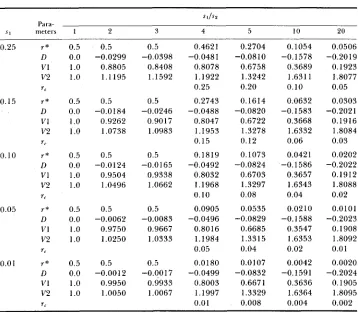
4SlA two-locus genetic system with such a fitness matrix represents a special case of the general symmetric viability model, a detailed analysis of which has been presented by BODMER and FELSENSTEIN (1967) and by KARLIN and FELDMAN (1970). When applied to a genetic system with the fitness matrix, as in (3), the analysis reveals that for any set of selection parameters, S I and sp, there always
TABLE 1
Stable polymorphic states for the two-locus model
0.25 r*
D
VI v2
rr
0.15 r*
D v1 v2
rr
0.10 r*
n
v1 v2
r,
0.05 r*
D V I
v2 r,
0.01 r*
D
v1 v2 r,
0.5 0.5
1.0 0.8805
1.0 1.1195
0.0 -0.0299
0.5 0.5
0.0 -0.0184
1.0 0.9262
1.0 1.0738
0.5 0.5
0.0 -0.0124
1.0 0.9504
1.0 1.0496
0.5 0.5
0.0 -0.0062
1.0 0.9750
1.0 1.0250
0.5 0.5
0.0 -0.0012
1.0 0.9950
1.0 1.0050
0.5 -0.0398 0.8408 1.1592 0.5 0.9017 1.0983 -0.0246 0.5 -0.0165 0.9338 1.0662 0.5 0.9667 1.0333 -0.0083 0.5 -0.0017 0.9933 1.0067 0.4621 -0.0481 0.8078 1.1922 0.25 0.2743 -0.0488 0.8047 1.1953 0.15 0.1819 -0.0492 0.8032 1.1968 0.10 0.0905 -0.0496 0.8016 1.1984 0.05 0.0180 -0.0499 0.8003 1.1997 0.01 0.2704 0.6758 1.3242 0.20 0.1614 0.6722 1.3278 0.12 0.1073 -0.0824 0.6703 1.3297 0.08 0.0535 -0.0829 0.6685 1.3315 0.04 0.0107 -0.0832 0.6671 1.3329 0.008 -0.0810 -0.0820 0.1054 -0.1578 0.3689 1.6311 0.10 0.0632 -0.1583 0.3668 1.6332 0.06 0.0421 0.3657 1.6343 0.04 0.02 10 -0.1588 0.3547 1.6353 0.02 0.0042 0.3636 1.6364 0.004 -0.1586 -0.1591 0.0506 -0.2019 0.1923 1.8077 0.05 0.0303 -0.2021 0.1916 1.8084 0.03 0.0202 -0.2022 0.1912 1.8088 0.02 0.0101 -0.2023 0.1908 1.8092 0.0 1
0.0020 -0.2024
0.1905 1.8095 0.002
Abbreviations: $ 1 and s z = selection parameters; r* = critical value of recombination coefficient; I ) = linkage disequilibrium; VI and V2 = genetic variances; r, = 4 s ~ .
both loci and with the gametic frequencies
P A b = P a B = 1/4
-
D ,
TWO ADDITIVE CHARACTERS
721
rent equations for the dynamics of a two-locus genetic system (e.g., BODMER and FEUENSTEIN 1967, eq. 1) was linearized around the equilibrium
(4),
and the eigenvalues of the linear system were calculated. If the absolute values of all the eigenvalues were <1, the chosen value of the recombination coefficient was considered as r*. If the absolute value of at least one of the eigenvalues was >1, a smaller value of the recombination coefficient was chosen, and the calculations were repeated with the new value. Thus, for a given set of selec- tion parameters the critical value, r*, in Table 1 represents the largest (to five decimal points) recombination coefficient for which there is a stable poly- morphic equilibrium. Also shown in Table 1 are the equilibrium values of linkage disequilibrium, D, corresponding to r*.
T h e gametic frequencies (4) can be used to compute the means and variances of the two characters at the equilibrium. T h e means are the same for both characters, and they are equal to the “optimal” value:
T h e equilibrium variances, VI and V f , of the two characters are presented in Table 1 . Notice that the amount of genetic variation maintained by either of the two characters at the equilibrium (as measured by the variances V I and V2) can be quite high. In the case of similar selection on both characters, i.e., when s J s 2 = 1, it is equal to the maximum amount of genetic variation that
can be maintained under random mating without selection, which is 1 . In the case of s 1
>
sp, the genetic variation maintained by the second character iseven higher than under random mating without selection. Notice also that a substantial negative linkage disequilibrium can be generated in the latter case. It should be noted that the polymorphic equilibrium (4) may not be the only stable equilibrium for a given recombination coefficient. According to BODMER and FELSENSTEIN (1967, table 6), the monomorphic equilibria p A b = 1 and
pa,
= 1 are stable when 1
-
4 s 2>
(1-
sl)(l-
sq), if r>
r,, where r, = 4sp. Thus, there can be three simultaneously stable equilibria: one polymorphic (4)and two monomorphic when sI/s2
<
3+
S I and r,<
r<
r*. T h e values of r,are presented in Table 1 .
Because of the interaction between direct and indirect effects of selection, individuals with the same value of one of the characters, say
X I ,
may have different fitnesses. It makes no sense, therefore, to cmsider the fitness of an individual with a specified value of one of the characters, but only to consider the expected fitness of such an individual. T h e expected fitness, wT(XI), of an individual whose value of the first character isXI,
resulting from the direct as well as indirect effects of selection on the character, can be computed aswhere Gk
(k
= 1 ,.
-, 9) denoLes a two-locus diallelic genotype; w(G,) ih Lhe fitness of the genotype Ga that can be found from the fitness matrix (3), andp(Gk
I
X I ) is the probability for an individual with the value of the first char-TABLE 2
Fitness “profiles” of additive characters
X
Fit-
S I I S 2 ness 0 1 2 3 4
W T w; W : Wf W T Wf W : W f W : W ; W : Ws* W t W f 1 2 3 4 5 10 20 0.0000 0.0000 0.0000 0.5000 0.0000 0.6667 0.0000 0.7500 0.0000 0.8000 0.0000 0.9000 0.0000 0.9500 0.5625 0.5625 0.6563 0.6563 0.6875 0.6875 0.7031 0.703 1
0.7125 0.7125 0.73 13 0.73 13 0.7406 0.7406 0.6667 0.6667 0.8091 0.7235 0.8680 0.7436 0.8983 0.7607 0.91 15 0.8288 0.9512 0.9536 0.975 1 0.9889 0.5625 0.5625 0.6563 0.6563 0.6875 0.6875 0.7031 0.703 1 0.71 25 0.7125 0.7313 0.7313 0.7406 0.7406 0.0000 0.0000 0.0000 0.5000 0.0000 0.6667 0.0000 0.7500 0.0000 0.8000 0.0000 0.9000 0.0000 0.9500 ~~
Abbreviations: X = value of a character; s I and 5 2 = selection parameters; w: and w f = expected
fitnesses of characters X I and X p ; S I = 0.25.
any given gametic frequencies under the assumption of random mating. T h e expected fitness of an individual with a given value of the second character can be determined in the same way. T h e expected fitnesses for different values of a character, X , at the stable polymorphic equilibrium are shown in Table
2
for s 1 = 0.25, and a number of values sI/sp. Notice that when sI/sg
<
3(actually, when s I / s z
<
3+
s p ) , the “profiles” of the fitnesses for both charactersat the equilibrium have a distinct “stabilizing” shape with the “optimum” value at X = 2 and with descending fitnesses for values farther away from the optimum. When s I / s 2
>
3+
s g , the fitness profile for the first characterremains strictly “stabilizing,” whereas the profile for the second character has two intermediate minima with the value of
2
still being the “optimum,” i.e., having the maximum fitness.TWO ADDITIVE CHARACTERS 723
DISCUSSION
Imagine an investigator whose interests are in one of the characters, say X I , and who may not even be aware of the existence of the other character, X p . He (or she) observes that a substantial amount of genetic variation is main- tained in a population by the character X 1 , and in an attempt to discover the source of the maintained variation, he undertakes a thorough analysis of the character. It is clear that, whatever methods of analysis he chooses, the correct outcome should be that only an additive component of genetic variance is present, because allelic contributions to the character are actually additive, and that the fitness function for the character has a profile similar to one of the rows marked as w? in Table 2, indicating that the character is under stabilizing selection.
To an investigator who knows that no genetic variation can be maintained by an additive quantitative character under stabilizing selection, this outcome should clearly indicate a necessity to look for an additional source of variation. T h e most obvious source to consider would be mutation, since mutation-selec- tion balance could possibly account for the presence of genetic variation main- tained by the character X 1 in equilibrium. However, the high level of genetic variation maintained even under strong selection would require unrealistically high mutation rates, and therefore, mutation should be ruled out as a signifi- cant factor contributing to the maintenance of genetic variation by the char- acter X I .
If the investigator is aware of the possibility of an indirect effect on character X I of selection for some other character biologically connected with X I , he may try to find such a character. Notice, however, that it will be a very difficult task to identify X 2 as being such a character. Indeed, there are two main
indicators of a biological connection between two characters: the characters may be functionally related (due to correlated effects on fitness) or they can be genetically correlated (due to pleiotropy or linkage). As for the characters X I and X p , they are functionally unrelated [see (l)], and what is more, they are genetically uncorrehted in a population in equilibrium. Indeed, as it is shown in the APPENDIX, the genetic correlation between characters X1 and X s is zero at the polymorphic equilibrium (4), even though they are pleiotropically related. Hence, even if the investigator will be lucky enough to come across the character X p , he is almost certain to discard it as having no biological
connection with the character X I .
Thus, the model presented in this paper demonstrates that two additive quantitative characters, each being under direct stabilizing selection, can main- tain a high level of genetic variation in absence of mutation, if the characters have a particular (mixture of equivalent and antagonistic) pleiotropic relation. Unfortunately, the model also demonstrates that such a pleiotropic relation between characters may be quite difficult to detect.
LITERATURE CITED
BODMER, W. F. and J. FELSENSTEIN, 1967
BULMER, M. G., 1971
BULMER, M. G., 1972
Linkage and selection: theoretical analysis of the deterministic two-locus model. Genetics 57: 237-265.
T h e stability of equilibria under selection. Heredity 27: 157-162.
T h e genetic variability of polygenic characters under optimizing selection,
T h e maintenance of the genetic variability of polygenic characters by
Introduction to Quantitative Genetics, Ed. 2. Longman, London.
The Genetical Theory of Natural Selection. Clarendon Press, Oxford. mutation and drift. Genet. Res. 19: 17-25.
BULMER, M. G., 1973
heterozygous advantage. Genet. Res. 22: 9-1 2.
FALCONER, D. S., 1981
FISHER, R. A., 1930
GILLESPIE, J. H., 1984
KARLIN, S. AND M. W. FELDMAN, 1970
Pleiotropic overdominance and the maintenance of genetic variation in
Linkage and selection: two-locus symmetric viability
A stochastic model concerning the maintenance of genetic variability in quan-
Stable equilibria for the optimum model. Proc. Natl. Acad. Sci. USA 4 5 989-
T h e maintenance of genetic variability by mutation in a polygenic character
T h e measurement of selection on correlated characters. polygenic characters. Genetics 10’7: 321-330.
model. Theor. Pop. Biol. 1: 39-71.
titative characters. Proc. Natl. Acad. Sci. USA 54: 731-736.
KIMURA, M., 1965
KOJIMA, K., 1959
LANDE, R., 1976 993.
with linked loci. Genet. Res. 26: 221-235.
LANDE, R. and S. J. ARNOLD, 1983
LATTER, B. D. H., 1960
LEWONTIN, R. C., 1964
PEARSON, K., 1903
Evolution 37: 1210-1226.
Natural selection for an intermediate optimum. Aust. J. Biol. Sci. 13:
T h e interaction of selection and linkage. 11. Optimum models. Genetics
Mathematical contributions to the theory of evolution. XI. On the influence of natural selection on the variability and correlation of organs. Philos. Trans. R. Soc. Lond. A Math. Phys. Sci. 200: 2-66.
T h e efect of selection against extreme deviants based on deviation or on
Antagonistic pleiotropy, dominance, and genetic variation. Heredity 48: 63-78.
Heritable genetic variation via mutation-selection balance: Lerch’s zeta meets
Effects of pleiotropy on predictions concerning mutation-selection balance
Evolution in populations in approximate equilibrium. J. Genet. 3 0 257-266.
Communicating editor: B. S. WEIR
30-35.
5 0 757-782.
ROBERTSON, A., 1956
homozygosis. J. Genet. 54: 236-248.
ROSE, M., 1982
TURELLI, M . , 1984
the abdominal bristle. Theor. Pop. Biol. 25: 138-193.
for polygenic traits. Genetics 111: 165-195.
TURELLI, M., 1985
TWO ADDITIVE CHARACTERS
725
APPENDIX
Let X I a n d x2 be t he contributions by a gamete to the first and second characters, respec-
tively. T h e contributions of th e four types of gametes a r e as follows:
XI x2
AB 0 1
Ab 1 0
aB 1 2
ab 2 1
At the equilibrium (4) t h e mean values of X I and x2:
ml = m2 = 1. ( AI )
COVlZ = 2cov12, ('42)
If COVIZ is t h e covariance between characters X I and X2, then under random mating,
where C O V I Z is t he covariance between x1 and x p , which can be computed as
COVIZ = E ( x 1 x 2 )
-
mlmZ= 2pnE
-+
2p.b-
m I m 2 .Substituting (4) a nd ( A l ) yields cov12 = 0, and hence, Covl2 = 0 . Th us , t he coefficient of