Errors in Computational Complexity Proofs for
Protocols
?Kim-Kwang Raymond Choo & Colin Boyd & Yvonne Hitchcock
Information Security Institute Queensland University of Technology GPO Box 2434, Brisbane, QLD 4001, Australia
{k.choo,c.boyd,y.hitchcock}@qut.edu.au
Abstract. Proofs are invaluable tools in assuring protocol implementers about the security properties of protocols. However, several instances of undetected flaws in the proofs of protocols (resulting in flawed protocols) undermine the credibility of provably-secure protocols. In this work, we examine several protocols with claimed proofs of security by Boyd & Gonz´alez Nieto (2003), Jakobsson & Pointcheval (2001), and Wong & Chan (2001), and an authenticator by Bellare, Canetti, & Krawczyk (1998). Using these protocols as case studies, we reveal previously un-published flaws in these protocols and their proofs. We hope our analysis will enable similar mistakes to be avoided in the future.
1 Introduction
Despite cryptographic protocols being fundamental to many diverse se-cure electronic commerce applications, and the enormous amount of re-search effort expended in design and analysis of such protocols, the design of secure cryptographic protocols is still notoriously hard. The difficulty of obtaining a high level of assurance in the security of almost any new or even existing protocols is well illustrated with examples of errors found in many such protocols years after they were published. The many flaws dis-covered in published protocols for key establishment and authentication over many years, have promoted the use of formal models and rigorous security proofs, namely the computational complexity approach and the computer security approach.
Computer Security Approach. Emphasis in the computer security approach is placed on automated machine specification and analysis. The Dolev & Yao (1983) adversarial model is the de-facto model used in for-mal specifications, where cryptographic operations are often used in a
? The abridged version of this paper is going to appear in the proceedings of Asiacrypt
“black box” fashion ignoring some of the cryptographic properties, re-sulting in possible loss of partial information. The main obstacles in this automated approach are undecidability and intractability, since the ad-versary can have a large set of possible actions which results in a state explosion. Protocols proven secure in such a manner could possibly be flawed – giving a false positive result.
Computational Complexity Approach. On the other hand, the com-putational complexity approach adopts a deductive reasoning process whereby the emphasis is placed on a proven reduction from the prob-lem of breaking the protocol to another probprob-lem believed to be hard. The first treatment of computational complexity analysis for cryptog-raphy began in the 1980s (Goldwasser & Micali 1984) but it was made popular for key establishment protocols by Bellare & Rogaway. In fact, Bellare & Rogaway (1993) provided the first formal definition for a model of adversary capabilities with an associated definition of security. These human-generated proofs provide a strong assurance that the security properties of the protocols are satisfied. However, it is often difficult to obtain correct proofs of security and the number of protocols that possess a rigorous proof of security remains relatively small. Furthermore, such proofs usually entail lengthy and complicated mathematical proofs, which are daunting to most readers (Koblitz & Menezes 2004). The breaking of provably-secure protocols after they were published is evidence of the difficulty of obtaining correct computational proofs of protocol security. Despite these setbacks, proofs are invaluable for arguing about security and certainly are one very important tool in getting protocols right.
a damaging effect on the trustworthiness and the credibility of provably-secure protocols in the real world.
In this work, we advocate the importance of proofs of protocol secu-rity, and by identifying some situations where errors in proofs arise, we hope that similar structural mistakes can be avoided in future proofs. We use several protocols with claimed proofs in the Bellare–Rogaway model as case studies, namely the conference key agreement protocol due to Boyd & Gonz´alez Nieto (2003), the mutual authentication and key establishment protocols (JP-MAKEP) due to Jakobsson & Pointcheval (2001) and WC-MAKEP due to Wong & Chan (2001). We also examine an encryption-based MT authenticator due to Bellare et al. (1998).
In the setting of the reductionist proof approach for protocols, the se-curity model comprises protocol participants and a powerful probabilis-tic, polynomial-time (PPT) adversaryA, where the latter is in control of all communication between all parties in the model. The original BR93 proof model was defined only for two-party protocols. In subsequent work, the model is extended to analyse three-party server-based proto-cols (Bellare & Rogaway 1995) and multi-party protoproto-cols (Bresson et al. 2001).
Boyd–Gonz´alez Nieto Protocol. An inappropriate proof model envi-ronment is one of the likely areas where protocol proofs might go wrong. In the existing proof of the Boyd–Gonz´alez Nieto conference key agree-ment protocol (Boyd & Gonz´alez Nieto 2003), we observe that the proof model environment has the same number of parties in the model as in the protocol. This effectively rules out a multi-user setting in which to analyse the signature and encryption schemes. This shortcoming fails to include the case whereAis able to corrupt a player who does not partici-pate in the particular key agreement protocol session, and obtains a fresh key of any initiator principal by causing disagreement amongst parties about who is participating in the key exchange.
claim this credit deposit as his. Also, a malicious adversary,A, can exploit such an attack in a number of ways if the established session key is sub-sequently used to provide encryption (e.g., in AES) or integrity (Kaliski 2001).
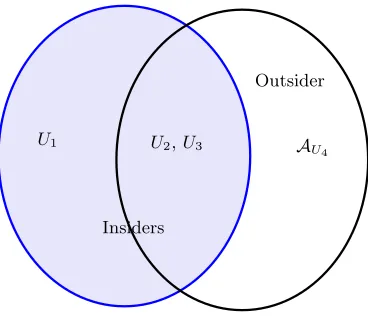
In the attack on Boyd–Gonz´alez Nieto protocol, A is able to reveal the key of a non-partner oracle whose key is the same as the initiator princi-pal, thus violating the key establishment goal. The existence of this attack means that the proof of Boyd–Gonz´alez Nieto’s protocol is invalid, since the proof model allowsCorruptqueries. Protocols proven secure in a proof model that allows the “Corrupt” query (in the proof simulation) ought to be secure against the unknown key share attack, since if a key is to be shared between some parties, U1, U2, andU3, the corruption of some other (non-related) player in the protocol, say U4, should not expose the session key shared betweenU1,U2, andU3. In the proof simulations of the protocols on which we perform an unknown key share attack, Adoes not corrupt the owner or the perceived partners of the targetTestsession, but instead corrupts some other (non-related) player in the protocol that is not associated with the targetTestsession or a member of the “attacked” protocol session.
JP-MAKEP. We also describe an unknown key share attack on the JP-MAKEP which breaks the reduction of the proof from JP-MAKEP to the discrete logarithm problem. Similarly to the Boyd–Gonz´alez Nieto protocol, the proof model allows Corrupt queries for clients, and hence secure protocols ought to be immune to unknown key share attacks.
WC-MAKEP. An attack against WC-MAKEP is described where an adversaryAis able to obtain a fresh key of an initiator oracle by revealing a non-partner server oracle sharing the same session key. The proof was sketchy and failed to provide any simulation.
in the proof. We also demonstrate how the flaw in this MT authenticator invalidates the proof of protocols that use the MT-authenticator using protocol 2DHPE (Hitchcock et al. 2003) as a case study.
Organization of Paper. Section 2 briefly explains the Bellare-Rogaway and the Canetti–Krawczyk models. Section 3 revisits the Boyd–Gonz´alez Nieto conference key agreement protocol, the JP-MAKEP, and the WC-MAKEP. Previously unpublished attacks on these protocols are demon-strated and flaws in the existing proofs are revealed. We conclude this sec-tion by proposing fixes to the protocols. Fixed protocols are not proven secure, and are presented mainly to provide a better insight into the proof failures. Section 4 revisits the encryption-based MT-authenticator proposed by Bellare et al. (1998). Finally, Section 5 presents the conclu-sions.
2 Informal Overview of the Bellare-Rogaway and Canetti–Krawczyk Models
Throughout this paper, the Bellare & Rogaway 1993 model, 1995 model (Bellare & Rogaway 1993, 1995), the Bellare, Pointcheval, & Rogaway 2000 model (Bellare et al.
2000), and the Canetti & Krawczyk 2001 model (Bellare et al. 1998, Canetti & Krawczyk 2001) model will be referred to as the BR93, BR95 BPR2000, and CK2001 models respectively. Collectively, the BR93, BR95, and BPR2000 models are known as the Bellare-Rogaway model.
2.1 Bellare-Rogaway Models
In the Bellare-Rogaway model, the adversary, A, is defined to be a prob-abilistic machine that is in control of all communications between parties and is allowed to intercept, delete, delay, and/or fabricate any messages at will. Ainteracts with a set ofΠi
Uu,Uv oracles (i.e.,Π
i
Uu,Uv is defined to
be the ith
instantiation of a principal Uu in a specific protocol run and
Uv is the principal with whomUu wishes to establish a secret key). Letn
denote the number of players allowed in the model, wherenis polynomial in the security parameter k. The predefined oracle queries are shown in Table 1.
A Send(Uu, Uv, i, m) query to oracle ΠUiu,Uv computes a response according to the
protocol specification and decision on whether to accept or reject yet, and returns them to the adversaryA. If the client oracle,ΠUiu,Uv, has either accepted with some
session key or terminated, this will be made known toA.
TheReveal(Uu, Uv, i) query captures the notion of known key security. Any client
oracle,ΠUiu,Uv, upon receiving such a query and if it has accepted and holds some
session key, will send this session key back toA.
The Corrupt(Uu, KE) query captures unknown key share attacks and insider attacks. This query allowsAto corrupt the principalUuat will, and thereby learn
the complete internal state of the corrupted principal. Notice that aCorruptquery does not result in the release of the session keys sinceA already has the ability to obtain session keys throughRevealqueries. In the BR95 model, this query also gives
Athe ability to overwrite the long-lived key of the corrupted principal with any value of her choice (i.e.KE).
TheTest(Uu, Uv, i) query is the only oracle query that does not correspond to any
ofA’s abilities. IfΠi
Uu,Uv has accepted with some session key and is being asked a
Test(Uu, Uv, i) query, then depending on a randomly chosen bitb,Ais given either the
actual session key or a session key drawn randomly from the session key distribution.
Table 1.Informal description of the oracle queries
is trying to guess. An important difference between the three Bellare– Rogaway models is in the way partner oracles are defined (i.e. the def-inition of partnership). The BR93 model defines partnership using the notion of matching conversations, where a conversation is defined to be the sequence of messages sent and received by an oracle. The sequence of messages exchanged (i.e., only theSendoracle queries) are recorded in the transcript,T. At the end of a protocol run,T will contain the record of the
Send queries and the responses. Definition 1 gives a simplified definition of matching conversations.
Definition 1 (BR93 Matching Conversations) Let nS be the
max-imum number of sessions between any two parties in the protocol run. Πi
A,B and Π
j
B,A are said to be partners if they both have matching
con-versations, where
CA= (τ0,0start0, α1),(τ2, β1, α2)
CB= (τ1, α1, β1),(τ3, α2,∗), for τ0 < τ1< . . .
Partnership in the BR95 model is defined using the notion of a part-ner function, which uses the transcript (the record of all SendClientand
function. Two oracles are BR95 partners if, and only if, the specific part-ner function in use says they are.
BPR2000 partnership is defined based on the notion of session identifiers (SIDs) where SIDs are suggested to be the concatenation of messages exchanged during the protocol run. In this model, an oracle who has ac-cepted will hold the associated session key, a SID and a partner identifier (PID). Note that any oracle that has accepted will have at most one part-ner, if any at all. Definition 2 describes the definition of partnership in the BPR2000 model.
Definition 2 (BPR2000 Partnership) Two oracles, ΠA,Bi andΠB,Aj , are partners if, and only if, both oracles have accepted the same session key with the same SID, have agreed on the same set of principals (i.e. the initiator and the responder of the protocol), and no other oracles besides ΠA,Bi andΠB,Aj have accepted with the same SID.
2.2 Canetti-Krawczyk Model
In the CK2001 model, there are two adversarial models, namely the unathenticated-links adversarial model (UM) and the authenticated-links adversarial model (AM). Let AUM denote the adversary in the UM, and AAM denote the adversary in the AM. The difference betweenAAM and AUM lies in their powers. Table 2 provides an informal description of the oracle queries allowed for bothAAM andAUM. Let ndenote the number of players allowed in the model, where n is polynomial in the security parameterk.
Oracle ΠUiu,Uv, upon receiving aSession-State Reveal(Uu, Uv, i) query and if it has
neither accepted nor held some session key, will return all its internal state (including any ephemeral parameters but not long-term secret parameters) to the adversary.
Session−Key Reveal,Corrupt, andTestare equivalent to theReveal,Corrupt, andTest
queries in Table 1 respectively.
Send(Uu, Uv, i, m) is equivalent to the Sendquery in Table 1. However, AAM is
re-stricted to only delay, delete, and relay messages but not to fabricate any messages or send a message more than once.
A protocol that is proven to be secure in the AM can be translated to a provably secure protocol in the UM with the use of an authenticator. Definition 3 provides the definition of an autheticator.
Definition 3 (Definition of an Authenticator) An authenticator is defined to be a mapping transforming a protocol πAM in the AM to a protocol πUM in the UM such that πUM emulates πAM.
In other words, the security proof of a UM protocol depends on the secu-rity proofs of the MT-authenticators used and that of the associated AM protocol. If any of these proofs break down, then the proof of the UM protocol is invalid. CK2001 partnership can be defined using the notion of matching sessions, as described in Definition 4.
Definition 4 (Matching Sessions) Two sessions are said to be match-ing if they have the same session identifier (SIDs) and correspondmatch-ing partner identifier (PIDs).
2.3 Definition of Freshness
Freshness is used to identify the session keys about which A ought not to know anything because A has not revealed any oracles that have ac-cepted the key and has not corrupted any principals knowing the key. Definition 5 describes freshness, which depends on the respective notion of partnership. The following definition of freshness does not incorporate the notion of forward secrecy, or the notions of session expiry and expo-sure in the Canetti–Krawczyk model since these notions are not necessary to explain our attacks.
Definition 5 (Definition of Freshness) OracleΠi
A,Bis fresh (or holds
a fresh session key) at the end of execution, if, and only if, (1)ΠA,Bi has accepted with or without a partner oracle ΠB,Aj , (2) both Πi
A,B andΠ
j B,A
oracles have not been sent a Reveal query (or Session-State Reveal in the CK2001 model), and (3) A and B have not been sent a Corrupt query.
2.4 Definition of Security
Security in the models is defined using the game G, played between a malicious adversary A and a collection of ΠUix,Uy oracles for players Ux, Uy ∈ {U1, . . . , UNp} and instances i∈ {1, . . . , Ns}. The adversary A
Stage 1: A is able to send any oracle queries at will.
Stage 2: At some point duringG,Awill choose a fresh session on which to be tested and send aTest query to the fresh oracle associated with the test session. Depending on the randomly chosen bit b, Ais given either the actual session key or a session key drawn randomly from the session key distribution.
Stage 3: Acontinues making any oracle queries at will but cannot make
Corrupt or Session-State/Key Reveal queries that trivially expose the test session key.
Stage 4: Eventually, A terminates the game simulation and outputs a bitb0, which is its guess of the value of b.
Success ofAinGis measured in terms ofA’s advantage in distinguishing whetherAreceives the real key or a random value.Awins if, after asking aTest(U1, U2, i) query, whereΠUi
1,U2 is fresh and has accepted, A’s guess
bit b0
equals the bit b selected during the Test(U1, U2, i) query. Let the advantage function of Abe denoted by AdvA(k), where
AdvA(k) =2×Pr[b=b0]−1.
The notions of security for entity authentication are client-to-server au-thentication, server-to-client auau-thentication, and mutual authentication. An adversary is said to violate client-to-server authentication if some fresh server oracle terminates with no partner. Similarly, an adversary is said to violate server-to-client authentication if some fresh client oracle terminates with no partner. An adversary is said to violate mutual au-thentication if some fresh oracle terminates with no partner.
Definitions 6, 7, and 8 describes the definition of security for the BR95 model, the BPR2000 model, and both the BR93 and CK2001 models respectively.
Definition 6 (BR95 Definition of Security) A protocol is secure in the BR95 model if both the following requirements are satisfied: (1) When the protocol is run between two oracles ΠA,Bi and ΠB,Aj in the absence of a malicious adversary, both Πi
A,B andΠ
j
B,A accept and hold the same
session key. (2) For all probabilistic, polynomial-time (PPT) adversaries A, AdvA(k) is negligible.
When the protocol is run between two oracles ΠA,Bi and ΠB,Aj in the ab-sence of a malicious adversary, both ΠA,Bi and ΠB,Aj accept and hold the same session key. (2) For all probabilistic, polynomial-time (PPT) adver-saries A, the advantage that A has in violating entity authentication is negligible, and AdvA(k) is negligible.
Definition 8 (BR93 and CK2001 Definitions of Security) A pro-tocol is secure in the BR93 and CK2001 models if both the following re-quirements are satisfied: (1) When the protocol is run between two oracles ΠA,Bi and ΠB,Aj in the absence of a malicious adversary, both ΠA,Bi and
ΠB,Aj accept and hold the same session key, and (2) For all PPT adver-saries A, (a) If uncorrupted oracles ΠA,Bi and ΠB,Aj complete matching sessions, then both ΠA,Bi and ΠB,Aj must hold the same session key, and (b) AdvA(k) is negligible.
3 Flawed Proofs in the Bellare–Rogaway Model
3.1 Boyd–Gonz´alez Nieto Conference Key Agreement Protocol
The conference key agreement protocol (Boyd & Gonz´alez Nieto 2003) shown in Figure 1 carries a claimed proof of security in the BR93 model, but uses a different definition of partnership than that given in the original model description. Although this protocol was proposed fairly recently, it has been widely cited and used as a benchmark. In the protocol, the notation (eU, dU) denotes the encryption and signature keys of principal
U respectively, {·}eU denotes the encryption of some message under key
eU, σdU(·) denotes the signature of some message under the signature
keydU,NU denotes the random nonce chosen by principal U, Hdenotes
some secure one-way collision-resistant hash function, and SKU denotes
the session key accepted by U. The protocol involves a set of p users, U ={U1, U2, . . . , Up}.
The initiator, U1, randomly selects a k-bit challenge N1, encrypts N1 under the public keys of the other participants in the protocol, signs the encrypted nonces {N1}eU2, . . . ,{N1}eUp and broadcasts these messages
the protocol is defined to be the concatenation of messages received and sent. Note that the adversary, A, is allowed to capture and suppress any broadcasted messages in the network.
1.U1→ ∗:U={U1, U2, . . . , Up}, σdU1(U,{N1}eU2, . . . ,{N1}eUp)
2.U1→ ∗:{N1}eUi for 1< i≤p
3.Ui→ ∗: Ui, Ni
The session key isSKUi=H(N1||N2||. . .||Np).
Fig. 1. Boyd–Gonz´alez Nieto conference key agreement protocol
3.1.1 Unknown Key Share Attack Figure 2 shows the execution of the Boyd–Gonz´alez Nieto conference key agreement protocol in the presence of a malicious adversary, A. For simplicity, let U ={U1, U2, U3} and UA ={A, U2, U3}, which denote two different sessions.
U1 U2 A U3
U, σdU1(U,{N1}eU2,{N1}eU3)
{N1}eU2,{N1}eU3
UA, σdA(UA,{N1}eU2,{N1}eU3) UA, σdA(UA,{N1}eU2,{N1}eU3)
{N1}eU2,{N1}eU3 {N1}eU2,{N1}eU3
U2, N2 U3, N3
U2, N2, U3, N3 U2, N2
Fig. 2. Unknown key share attack
In Figure 2, the actions of the entities are as follows:
1. The initiator, U1, encrypts N1 under the public keys of the other participants in the protocol (i.e., U \U1), signs the encrypted nonces {N1}eU2,{N1}eU3 together with U, and broadcasts these messages in
protocol flows 1 and 2.
2. A malicious adversary, A, intercepts the broadcasted messages sent by U1; that is, the broadcast messages sent by U1 never reach the intended recipients,U2 and U3.
– A then signs the intercepted encrypted nonces {N1}eU2,{N1}eU3
– Anow acts as theinitiatorin adifferent sessionand broadcasts these messages in protocol flows 1 and 2.
3. U2 and U3 upon receiving the broadcasted messages, will reply to A with their identity and a random nonce.
4. A impersonates U2 and U3 and forwards the messages from U2 and U3 to U1.
5. U1, U2, and U3 are then able to compute the shared session key SKUi =H(N1||N2|,|. . .||Nn).
Table 3 describes the internal states of players U1, U2, and U3 at the end of the protocol execution shown in Figure 2. We observe that U1 is not partnered with either U2 or U3 according to Definition 2, since U1 does not have matching SIDs or agreeing PIDs (Krawczyk termed such an attack a key-replication attack (Krawczyk 2005) whereby A succeeds in forcing the establishment of a session, S1, other than the Test session or its matching session that has the same key as theTest session. In this case, A can distinguish whether theTest-session key is real or a random value by asking a Reveal query to the oracle associated with S1).
U sidU pidU
U1 U, σdU1(U,{N1}eU2,{N1}KU3),{N1}eU2,{N1}eU3, U2, N2, U3, N3 {U2, U3}
U2UA, σdA(UA,{N1}eU2,{N1}eU3),{N1}eU2,{N1}eU3, U2, N2, U3, N3 {A, U3}
U3UA, σdA(UA,{N1}eU2,{N1}eU3),{N1}eU2,{N1}eU3, U2, N2, U3, N3 {A, U2}
Table 3.Internal states of players U1, U2, andU3
U1 believes that the session key SKU1 is being shared with U2 and U3,
butU2 (and U3 respectively) believes the key SKU2 =H(N1||N2||N3) =
SKU3 = SKU1 is being shared with A and U3 (and U2 respectively),
when in fact, the key is being shared among U1, U2, and U3. However, SKU1 = SKU2 = SKU3 = H(N1||N2||N3). Although the adversary A
does not know the value of the session key (since A does not know the value of N1), A is able to send a Reveal query to the session associated with either U2 orU3 and obtain SKU2 =H(N1||N2||N3) =SKU3, which
has the same value asSKU1. Hence, the Boyd–Gonz´alez Nieto conference
3.1.2 An Improved Conference Key Agreement Protocol It would appear that by changing the order of the application of the sig-nature and encryption schemes, the attack shown in Figure 2 can be avoided. At a first glance, however, this may appear to contradict the result of An et al. (2002) that no matter what order signature and en-cryption schemes are applied, the result can still be secure. A closer in-spection reveals that our observation actually supports the findings of An et al., since the protocol operates in a multi-user setting. Although An et al.found that signature and encryption schemes can be applied in either order in the two user setting, they found some further restrictions in the multi-user setting. These restrictions are that the sender’s identity must be included in every encryption and the recipient’s identity must be included in every signature. In this case, swapping the order of the encryption and signature schemes happens to cause the protocol to fulfil these requirements.
An alternative way to prevent the attack is to include the sender’s identity in each encryption and also the session identifier, sid, in the key deriva-tion funcderiva-tion. We use the same construct for sid(i.e., the concatentation of all messages received) as used by Boyd & Gonz´alez Nieto. In the im-proved protocol, the adversary A will not be able to “claim” ownership of the encrypted message {N1, U1}eUi since the identity of the initiator is
included in the encryption. Since the construct of the session key in the improved protocol comprises the associatedsid, a different sidwill imply a different session key. Hence, the attack shown in Figure 2 will no longer be valid against this improved protocol. Figure 3 describes the improved protocol.
1.U1→ ∗:U={U1, U2, . . . , n}, σdU1(U,{N1, U1}KU2, . . . ,{N1, U1}KUn)
2.U1→ ∗:{N1, U1}eUi for 1< i≤n
3.Ui→ ∗:Ui, Ni
sid=U||σdU1(U,{N1, U1}KU2, . . . ,{N1, U1}KUn)||{N1, U1}eUi||Ui||Ni
The session key isSKUi =H(N1||sid).
Fig. 3. Improved Boyd–Gonz´alez Nieto conference key agreement proto-col
the encryption and signature schemes used. The number of protocol par-ticipants in the proof simulation,p, is assumed to be equal to the number of players allowed in the model,n, wherenis polynomial in the security parameter k. In its reductionist approach, the proof assumes that there exists an adversaryAwho can gain a non-negligible advantage, AdvA(k), in distinguishing the test key from a random one. An attacker is then con-structed that usesAto break either the underlying encryption scheme or the signature scheme.
In the context of the attack shown in Figure 2, assume that the num-ber of protocol participants in the proof simulation is three. The proof then assumes that the number of parties in the model is also three. How-ever, in order to carry out the attack, we have to corrupt a 4th
player (i.e., U4, an outsider as shown in Figure 4) to obtain the signature key of U4.
PSfrag replacements
U1 U2,U3 AU4
Insiders
Outsider
Fig. 4. Insiders vs outsider
In the proof simulation of the protocol execution shown in Figure 2, A corrupts U4, an outsider in the target session, and assumes U4’s iden-tity. Since U4 does not exist in the model assumed by the proof, the at-tacker against the encryption and signature schemes cannot simulate the
envi-ronment effectively did not allow a multi-user setting in which to analyse the signature and encryption schemes.
3.2 Jakobsson–Pointcheval MAKEP
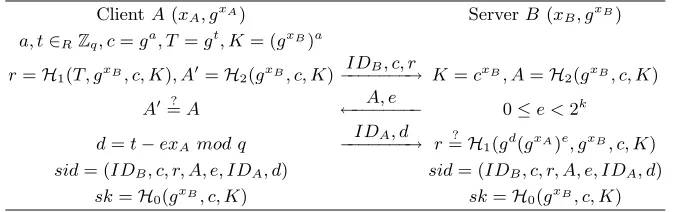
Figure 5 describes the published version of JP-MAKEP (Jakobsson & Pointcheval 2001), which was designed for low power computing devices1. JP-MAKEP
carries a claimed proof of security in the BR93 model but uses the notion of SIDs in the definition of partnership. There are two communicating principals in MAKEP, namely the server B and the client of limited computing resources, A. The security goals of the protocol are mutual authentication and key establishment between the two communicating principals.AandB are each assumed to know the public key of the other party (i.e., gxB and gxA respectively).
ClientA(xA, gxA) ServerB (xB, gxB) a, t∈RZq, c=ga, T =gt, K= (gxB)a
r=H1(T, gxB, c, K), A0=H2(gxB, c, K)−−−−−−−→IDB, c, r K=cxB, A=H2(gxB, c, K)
A0=? A ←−−−−−−−A, e 0≤e <2k
d=t−exAmod q
IDA, d
−−−−−−−→ r=? H1(gd(gxA)e, gxB, c, K)
sid= (IDB, c, r, A, e, IDA, d) sid= (IDB, c, r, A, e, IDA, d) sk=H0(gxB, c, K) sk=H0(gxB, c, K)
Fig. 5. Jakobsson–Pointcheval MAKEP
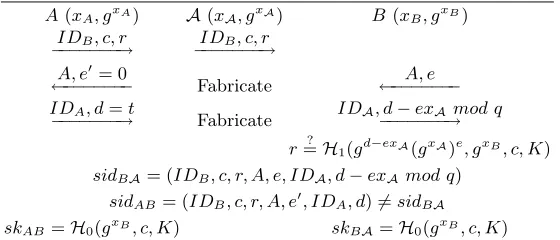
3.2.1 Unknown Key Share Attack Figure 6 depicts an example execution of JP-MAKEP in the presence of a malicious adversary A. At the end of the attack, B believes he shares a session key, skBA =
H0(gxB, c, K), with the adversaryA, when in fact the key is being shared
withA (i.e., unknown key share attack). Aand B are not partners since they have different SIDs,sidBA= (IDB, c, r, A, e, IDA, d−exA mod q)6=
sidAB, and different perceived partners (i.e.,P IDA=AandP IDB =A).
1 The original version appeared in the unpublished pre-proceedings of Financial
A(xA, gxA) A(xA, gxA) B (xB, gxB) IDB, c, r
−−−−−−−→ −−−−−−−→IDB, c, r A, e0= 0
←−−−−−−− Fabricate ←−−−−−−−A, e
IDA, d=t
−−−−−−−→ Fabricate IDA, d−−−−−−−→−exAmod q
r=? H1(gd−exA(gxA)e, gxB, c, K)
sidBA= (IDB, c, r, A, e, IDA, d−exAmod q) sidAB= (IDB, c, r, A, e0, IDA, d)6=sidBA skAB=H0(gxB, c, K) skBA=H0(gxB, c, K)
Fig. 6. Unknown key attack on Jakobsson–Pointcheval MAKEP
From Figure 6, we observe that A has terminated the protocol without any partners, in violation of the server-to-client authentication goal. On the other hand, the server, B, has terminated the protocol with the ad-versary,A, as its partner. Hence, the client-to-server authentication is not violated. Consequently, JP-MAKEP is not secure since the adversary is able to obtain a fresh session key of A by revealing a non-partner oracle of A (i.e., an oracle ofB), in violation of the security definition given in Definition 8. A fix for JP-MAKEP is to change 0≤e <2kin the protocol
specification to 0< e <2k.
3.2.2 Flaws in Existing Proof In the proof simulation of the proto-col, let P be another client where P 6=A, B. P is clearly the “outsider” in the target session of Figure 6 that A is attacking. A then corrupts P, the outsider, and assumesP’s identity. This is allowed in the existing proof (Jakobsson & Pointcheval 2001, Lemma 3) for the server-to-client authentication, since it is claimed that the JP-MAKEP provides partial forward-secrecy whereby corruption of the client may not help to recover the session keys.
The proof assumes that the probability ofAviolating the server-to-client authentication is negligible. In the context of the attack shown in Figure 6, Amanaged to violate the server-to-client authentication by corrupting a non-partner player,P. By violating the server-to-client authentication, A is then able to distinguish a real key or a random key by asking a Reveal
a non-negligible probability of breaking the discrete logarithm problem, contradicting the underlying assumption in the proof. Consequently, the proof simulation fails (the result of Reveal and Corrupt queries were not adequately considered in the simulation).
3.3 Wong–Chan MAKEP
Figure 7 describes WC-MAKEP (Wong & Chan 2001), which was pro-posed as an improvement to the original unpublished version of JP-MAKEP. Note that Figure 7 describes the corrected version of WC-MAKEP, where the computation of σ = (rA⊕rB) by A is replaced by
σ = (rA⊕rB)||IDB.
A(a, ga) B(SK
B, P KB) rA∈R{0,1}k, x={rA}P KB
b∈RZq\ {0}, β=gb
CertA, β, x
−−−−−−−→ Decryptx
σ= (rA⊕rB)||IDB
y=aH(σ) +b mod q {rB, IDB}rA
←−−−−−−− rB∈ {0,1}k
SKAB=H(σ)
y
−−−−−−−→ gy= (? ga)H(σ)β, SK
BA=H(σ)
Fig. 7.Wong–Chan MAKEP
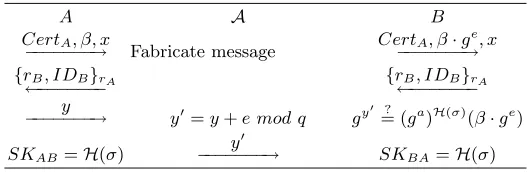
3.3.1 A New Attack Figure 8 depicts an example execution of WC-MAKEP, where at the end of the protocol execution, A and B accept with the same session key, SKAB =H(σ) =SKBA.
A A B
CertA, β, x
−−−−−−−→ Fabricate message CertA, β·g
e, x −−−−−−−→ {rB, IDB}rA
←−−−−−−− {rB, IDB}rA
←−−−−−−− y
−−−−−−−→ y0=y+e mod q gy0= (? ga)H(σ)(β·ge)
SKAB=H(σ)
y0
−−−−−−−→ SKBA=H(σ)
However, according to Definition 1, bothAandB are not partners asB’s replies are not in response to genuine messages sent byA(i.e., bothAand B will not have matching conversations given in Definition 1). Since two non-partner oracles, ΠA,B and ΠB,A, accept session keys with the same
value, the adversary A can reveal a fresh non-partner oracle, ΠB,A, and
find the session key accepted by ΠA,B. This violates Definition 8. Both
oracles of A and B have terminated the protocol without any partners, in violation of the mutual authentication goal. WC-MAKEP, therefore, is insecure in the BR93 model since the attack outlined in Figure 8 shows that both the key establishment and mutual authentication goals are violated.
3.3.2 Preventing the Attack A possible fix to WC-MAKEP is to change the construction of the session key to SK = H(A, B, β, x, y, σ). The inclusion of the sender’s and responder’s identities and messages (β, x, y) in the key derivation function effectively binds the session key to all messages sent and received by bothAandB(Choo et al. 2005). If the adversary changes any of the messages in the transmission, the session key will also be different. Intuitively, the attack shown in Figure 8 will no longer be valid against WC-MAKEP.
3.3.3 Flaws in Existing Proof The existing (sketchy) proof fails to provide a proof simulation. In the absence of a game simulation in the existing proof, we may only speculate that the proof fails to adequately consider the simulation of Sendand Reveal queries (in the same sense as outlined in Section 3.2.2).
In the flaws in the AMP protocol (Kwon 2001) and EPA protocol (Hwang et al. 2003) revealed by Wan & Wang (2004), both proofs fail to provide any proof simulations. These examples highlight the importance of detailed proof simulations, as the omission of such simulations could potentially result in protocols claimed to be secure being, in fact, insecure.
4 Flaw in the Proof of an Encryption-Based MT-Authenticator
flaw in the proof of the encryption-based MT-authenticator results in the violation of the key establishment goal in the protocol 2DHPE where a malicious adversary is able to learn a fresh session key. The attack we reveal on the protocol 2DHPE also applies to protocol 14 that ap-pears in the full version of (Hitchcock et al. 2004). Surprisingly, the in-adequacy in the specification was not spotted in the proof simulation of the MT-authenticator, and has not previously been spotted in other pro-tocols (Hitchcock et al. 2004, 2003) using this MT-authenticator.
We may speculate that if protocol designers fail to spot this inadequacy in the specification of their protocols, the protocol implementers are also highly unlikely to spot this inadequacy until specific attacks have been demonstrated, as suggested by Bleichenbacher (2005).
Having identified the flaw in the proof of the MT-authenticator, we pro-vide a fix to the MT-authenticator specification. As a result of this fix, protocols using the revised encryption based MT-authenticator will no longer be flawed due to their use of this MT-authenticator. The notation used throughout this section is as follows: the notation {·}KU denotes an
encryption of some messagem underU’s public key,KU, andMACK(m)
denotes the computation of MAC digest of some message m under key K.
4.1 Bellare–Canetti–Krawczyk Encryption-Based MT-Authenticator
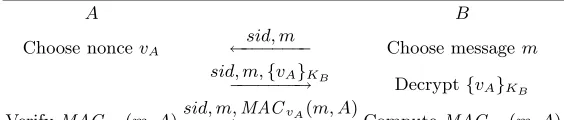
Figure 9 describes the encryption based MT-authenticator, which is based on a public-key encryption scheme indistinguishable under chosen-ciphertext attack and the authentication technique used by Krawczyk (1996). Note that the specification of the encryption-based MT-authenticator does not specify the deletion of the received nonce vA (incidentally, vA is also the
one-time MAC key) from B’s internal state before sending out the last message.
4.2 Flaw in Existing Proof of MT-Authenticator
A B
Choose noncevA
sid, m
←−−−−−−− Choose messagem sid, m,{vA}KB
−−−−−−−→ Decrypt{vA}KB
VerifyMACv
A(m, A)
sid, m,MACv
A(m, A)
←−−−−−−− ComputeMACv
A(m, A)
Fig. 9. Bellare–Canetti–Krawczyk encryption-based MT-authenticator
forger,F, can be used to break the encryption scheme.F who has access to a MAC oracle, is easily constructed as follows:
– guess at random an indexi,
– for all but the i-th session, generate a key vk and answer queries as
expected,
– if A calls a Session-State Reveal2 on any session other than the i-th session, the response can easily be simulated,
– ifAcalls aSession-State Revealon the i-th session, F aborts.
The assumption is that if A has a non-negligible advantage against the underlying protocol, then F has a non-negligible probability of forging a MAC digest.
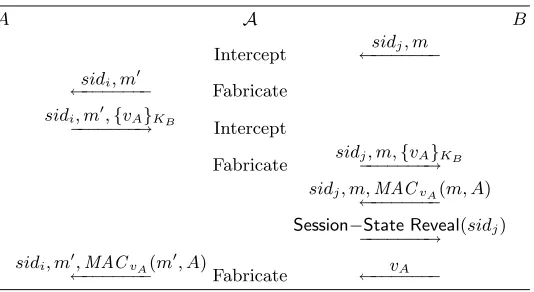
Consider the scenario shown in Figure 10. When A asks for the one-timeMAC key (i.e., vk) with a Session-State Reveal query, it is perfectly
legitimate since this session with SID of sidj is not the i-th session with
SID ofsidi. Recall that sessions with non-matching SIDs (i.e.,sidi 6=sidj)
are non-partners.
Clearly, F is unable to answer such a query sincevAis a secret key (note
that theMAC oracle to whichF has access is associated withvA, but F
does not know vA). Hence, the proof simulation is aborted and F fails.
Consequently, F does not have a non-negligible probability of forging a MAC digest (since it fails) although A has a non-negligible advantage against the security of the underlying protocol, in violation of the under-lying assumption in the proof.
We note that in a later independent yet related work by Tian & Wong (2006),the same flaw in the proof of the encryption-based MT-authenticator described in Figures 9 and 10 is discovered.
2 Note that in the original paper of Bellare et al. (1998), a Session-State Reveal is
A A B
Intercept ←−−−−−−−sidj, m sidi, m0
←−−−−−−− Fabricate
sidi, m 0
,{vA}KB
−−−−−−−→ Intercept
Fabricate sidj, m,{vA}KB
−−−−−−−→ sidj, m,←−−−−−−−MACvA(m, A)
Session−State Reveal(sidj) −−−−−−−→ sidi, m0,MACvA(m
0 , A)
←−−−−−−− Fabricate ←−−−−−−−vA
Fig. 10.Execution of encryption-based MT-authenticator in the presence of a malicious adversary,A
4.3 Proposed Fix to the Encryption-Based MT-Authenticator
In this section, we provide a fix to the encryption-based MT-authenticator by requiring that the party concerned delete the received nonce from its internal state before sending out the MAC digest computed using the received nonce. With the fix, the adversary will not be able to obtain the value of vAusing aSession-State Revealquery. Hence, in the proof of the
security of the MT-authenticator, F will be able to answer such a query because F is no longer required to return the value ofvA. Therefore, the
attack shown in Figure 10 will no longer be valid, since A will no longer be able to obtain the value of vA and fabricate a MAC digest.
4.4 An Example Protocol as A Case Study
Figure 11 describes a password-based protocol 2DHPE due to Hitchcock et al. (2003). Using the protocol 2DHPE as an example, we demonstrate that as a result of the flaw in the proof of the encryption-based MT-authenticator, the proof of protocol 2DHPE is also invalid. In the example protocol, both A and B are assumed to share a secret password, πA,B, and the public
keys of both A and B (i.e., KA and KB respectively) are known to all
participants in the protocol. The protocol uses the encryption-based MT-authenticator to authenticate the message B, sid, gy fromB.
A(πA,B) B (πA,B)
x∈RZq, vA∈R{0,1}k
A, sid, gx,{v A}KB
−−−−−−−→ y∈RZq
v0
A=DdB({vA}KB), NB ∈R{0,1}
k
SKA,B= (gy)x
B, sid, gy, NB,MACv0
A(B, sid, g
y , A)
←−−−−−−− sid,{A, sid, gx, N
B, πA,B}KB
−−−−−−−−−−−−−−−−→ SKB,A= (gx)y
Fig. 11.Hitchcock, Tin, Boyd, Gonz´alez Nieto, & Montague (2003) pro-tocol 2DHPE
in Figure 12, oracleΠA,Bsid has accepted a shared session keySKA,B =gxz
withΠB,Asid . However, such an oracle (i.e., ΠB,Asid ) does not exist. By send-ing a Session-State Reveal query to oracle ΠsidA
B,A, A learns the internal
state of ΠsidA
B,A, which includes v 0
A. With v 0
A, A can fabricate and send a
MAC digest to A. Hence, the adversary is able to obtain a fresh session key ofΠA,Bsid (i.e., SKA,B=gxz) since Aknowsz (in fact,z is chosen by
A).
A A B
A, sid, gx,{vA}KB
−−−−−−−→ A, sidA, g
x
,{vA}KB
−−−−−−−→ v0A=DdB({vA}KB)
B, sidA, gy, N
B,MACv0
A(B, sid, g
y, A) ←−−−−−−−
Session−State Reveal(B, sidA)
−−−−−−−→ B, sid, gz, NB,MACvA0(B, sid, g
z , A)
←−−−−−−− v
0 A ←−−−−−−− sid,{A, sid, gx, N
B, πA,B}KB
−−−−−−−→ SKA,B=gxz
Fig. 12. Execution of protocol 2DHPE in the presence of a malicious adversary
If the encryption-based MT-authenticator requires B to delete the re-ceived nonce v0A from B’s internal state before sending out message 3, then A will not be able to obtain the value of v0
A with a Session-State
Reveal query and fabricate MACv0
A(B, sid, g
y, A). Protocol 2DHPE will,
5 Conclusion
Through a detailed study of several protocols and an authenticator with claimed proofs of security, we have concluded that specifying correct com-putational complexity proofs for protocols remains a hard problem. We have identified three areas where protocol proofs are likely to fail; namely
– an inappropriate proof model environment,
– Send, Reveal and Corrupt queries not adequately considered in the proof simulations, and
– omission of proof simulations.
We also observe that certain constructions of session keys may contribute to the security of the key establishment protocol. This observation sup-ports the findings of recent work of Choo et al. (2005), who describe a way of constructing session keys, as described below:
– The identities and roles of the participants to provide resilience against unknown key share attacks and reflection attacks since the inclusion of the identities of both the participants and role asymmetry effectively ensures some sense of direction. If the role of the participants or the identities of the (perceived) partner participants change, the session keys will also be different.
– The unique SIDs ensure that session keys will be fresh. If SIDs are de-fined as the concatenation of messages exchanged during the protocol execution, messages altered during the transmission will result in dif-ferent session keys. This prevents the key replicating attack (Krawczyk 2005) in the Bellare–Rogaway and Canetti–Krawczyk models.
6 Acknowledgements
Bibliography
An, J. H., Dodis, Y. & Rabin, T. (2002), On the Security of Joint Signa-ture and Encryption, in L. R. Knudsen, ed., ‘Advances in Cryptology - Eurocrypt 2002’, Springer-Verlag, pp. 83–107. Volume 2332/2002 of Lecture Notes in Computer Science.
Bellare, M., Canetti, R. & Krawczyk, H. (1998), A Modular Approach to The Design and Analysis of Authentication and Key Exchange Proto-cols,in J. Vitter, ed., ‘30th ACM Symposium on the Theory of Com-puting - STOC 1998’, ACM Press, pp. 419–428.
Bellare, M., Pointcheval, D. & Rogaway, P. (2000), Authenticated Key Exchange Secure Against Dictionary Attacks, in B. Preneel, ed., ‘Ad-vances in Cryptology – Eurocrypt 2000’, Springer-Verlag, pp. 139 – 155. Volume 1807/2000 of Lecture Notes in Computer Science.
Bellare, M. & Rogaway, P. (1993), Entity Authentication and Key Distri-bution,inD. R. Stinson, ed., ‘Advances in Cryptology - Crypto 1993’, Springer-Verlag, pp. 110–125. Volume 773/1993 of Lecture Notes in Computer Science.
Bellare, M. & Rogaway, P. (1995), Provably Secure Session Key Distri-bution: The Three Party Case, in F. T. Leighton & A. Borodin, eds, ‘27th ACM Symposium on the Theory of Computing - STOC 1995’, ACM Press, pp. 57–66.
Bleichenbacher, D. (2005), Breaking a Cryptographic Protocol with Pseu-doprimes,inS. Vaudenay, ed., ‘Public Key Cryptography - PKC 2005’, Springer-Verlag, pp. 9–15. Volume 3386/2005 of Lecture Notes in Com-puter Science.
Boyd, C. & Gonz´alez Nieto, J. M. (2003), Round-optimal Contributory Conference Key Agreement,inY. Desmedt, ed., ‘Public Key Cryptog-raphy - PKC 2003’, Springer-Verlag, pp. 161–174. Volume 2567/2003 of Lecture Notes in Computer Science.
Boyd, C. & Mathuria, A. (2003), Protocols for Authentication and Key Establishment, Springer-Verlag.
Bresson, E., Chevassut, O. & Pointcheval, D. (2001), Provably Authen-ticated Group Diffie–Hellman Key Exchange — The Dynamic Case, inC. Boyd, ed., ‘Advances in Cryptology - Asiacrypt 2001’, Springer-Verlag, pp. 209–223. Volume 2248/2001 of Lecture Notes in Computer Science.
ver-sion available fromhttp://eprint.iacr.org/2001/040/),inB. Pfitz-mann, ed., ‘Advances in Cryptology - Eurocrypt 2001’, Springer-Verlag, pp. 453–474. Volume 2045/2001 of Lecture Notes in Computer Science. Choo, K.-K. R., Boyd, C. & Hitchcock, Y. (2005), On Session Key Con-struction in Provably Secure Protocols (Extended version available
from http://eprint.iacr.org/2005/206), in E. Dawson & S.
Vau-denay, eds, ‘1st International Conference on Cryptology in Malaysia - Mycrypt 2005’, Springer-Verlag, pp. 116–131. Volume 3715/2005 of Lecture Notes in Computer Science.
Diffie, W., van Oorschot, P. C. & Wiener, M. J. (1992), ‘Authentica-tion and Authenticated Key Exchange’,Journal of Designs, Codes and Cryptography2, 107–125.
Dolev, D. & Yao, A. C. (1983), ‘On the Security of Public Key Protocols’, IEEE Transaction of Information Technology 29(2), 198–208.
Goldwasser, S. & Micali, S. (1984), ‘Probabilisitic Encryption (Available
from http://theory.lcs.mit.edu/∼joanne/shafi-pubs.html)’,
Journal of Computer and System Sciences28, 270–299.
Hitchcock, Y., Boyd, C. & Gonz´alez Nieto, J. M. (2004), Tripartite Key Exchange in the Canetti-Krawczyk Proof Model (Extended ver-sion available from http://sky.fit.qut.edu.au/∼boydc/papers/),
inA. Canteaut & K. Viswanathan, eds, ‘5th International Conference on Cryptology in India - Indocrypt 2004’, Springer-Verlag, pp. 17–32. Volume 3348/2004 of Lecture Notes in Computer Science.
Hitchcock, Y., Tin, Y.-S. T., Boyd, C., Gonz´alez Nieto, J. M. & Montague, P. (2003), A Password-Based Authenticator: Security Proof and Appli-cations,inT. Johansson & S. Maitra, eds, ‘4th International Conference on Cryptology in India - Indocrypt 2003’, Springer-Verlag, pp. 388–401. Volume 2904/2003 of Lecture Notes in Computer Science.
Hwang, Y. H., Yum, D. H. & Lee, P. J. (2003), EPA: An Effi-cient Password-Based Protocal for Authenticated Key Exchange, in R. Safavi-Naini & J. Seberry, eds, ‘8th Australasian Conference on In-formation Security and Privacy - ACISP 2003’, Springer-Verlag. Vol-ume 2727/2003 of Lecture Notes in Computer Science.
Jakobsson, M. & Pointcheval, D. (2001), Mutual Authentication and Key Exchange Protocol for Low Power Devices, in P. F. Syverson, ed., ‘5th International Conference on Financial Cryptography - FC 2001’, Springer-Verlag, pp. 169–186. Volume 2339/2002 of Lecture Notes in Computer Science.
Koblitz, N. & Menezes, A. (2004), Another Look at “Provable Security”, Technical report CORR 2004-20, Centre for Applied Cryptographic Research, University of Waterloo, Canada.
Krawczyk, H. (1996), SKEME: A Versatile Secure Key Exchange Mecha-nism for Internet,in ‘ISOC Network and Distributed System Security - NDSS 1996’, IEEE Internet Society Press, pp. 114–127.
Krawczyk, H. (2005), HMQV: A High-Performance Secure Diffie-Hellman Protocol (Extended version available from
http://eprint.iacr.org/2005/176/), in V. Shoup, ed.,
‘Ad-vances in Cryptology - Crypto 2005’, Springer-Verlag, pp. 546–566. Volume 3621/2005 of Lecture Notes in Computer Science.
Kwon, T. (2001), Authentication and Key Agreement via Memorable Passwords, in A. Juels & J. Brainard, eds, ‘ISOC Networks and Dis-tributed Security Systems - NDSS 2001’, Internet Society Press. Rogaway, P. (2004), On the Role Definitions in and Beyond
Cryptogra-phy, in M. J. Maher, ed., ‘9th Asian Computing Science Conference -Asian 2004’, Springer-Verlag. Volume 3321/2004 of Lecture Notes in Computer Science.
Tian, X. & Wong, D. S. (2006), Session Corruption Attack and Improve-ments on Encryption Based MT-Authenticators,inD. Pointcheval, ed., ‘Cryptographers’ Track at RSA Conference - CT-RSA 2006’, Springer-Verlag. Lecture Notes in Computer Science.
Wan, Z. & Wang, S. (2004), Cryptanalysis of Two Password-Authenticated Key Exchange Protocols, in H. Wang, J. Pieprzyk & V. Varadharajan, eds, ‘9th Australasian Conference on Information Se-curity and Privacy - ACISP 2004’, Springer-Verlag. Volume 3108/2004 of Lecture Notes in Computer Science.