Design Principles for Iterated Hash Functions
e-print (September 29, 2004)
Stefan Lucks
University of Mannheim, Germany
http://th.informatik.uni-mannheim.de/people/lucks/
Abstract. This paper deals with the security of iterated hash functions against generic attacks, such as, e.g., Joux’ multicollision attacks from Crypto 04 [6]. The core idea is to increase the size of the internal state of ann-bit hash function tow > nbit. Variations of this core idea allow the use of a compression function withnoutput bits, even if the compression function itself is based on a block cipher.
In a formal model, it is shown that these modifications quantifiably im-prove the security of iterated hash functions against generic attacks.
Keywords: hash function, Joux attack, provable security, black-box model
1 Introduction
Recently, Joux [6] surprised the cryptographic community with a generic
multi-collision attack against iterated hash functions, able to find K -Collisions in timeO(log(K)∗2(n/2)), instead of timeΩ(2(K−1)n/K), as we
would expect from an ideal hash function. This and other recent results constitute a great deal of progress in hash function cryptanalysis. As suggested in [11], it may be time for the cryptographic community to design new and more secure hash algorithms. The current paper studies improved hash function design principles.
A hash functionH :{0,1}∗ → {0,1}nis used to compute ann-bit
In their landmark papers, Merkle and Damg˚ard [8, 3] showed that a col-lision resistant compression function implies a colcol-lision resistant iterated hash function. On the other hand, if the adversary is powerful enough to find collisions (this takes time Ω(2n/2) for a random oracle), many interesting attacks against iterated hash functions become possible, far beyond plain collision-finding.
Using the abovely mentioned multi-collision attack as a tool, Joux [6] shows that the (parallel) cascade of several hash functions is not as secure as expected. In a similar spirit, Kelsey [7] describes additional attacks against iterated hash functions. All these attacks are generic, i.e., are applicable if we replace the compression function by some abstract oracle. In the current paper, we propose and analyse modifications of the Merkle-Damg˚ard design for iteratedn-bit hash functions. The core idea is to use more than n bit for the internal hash values. We formally prove that these modifications improve security against generic attacks.
1.1 Notions and Abstractions
Iterated Hash Functions. Cryptographic hash functions take a
mes-sage M ∈ {0,1}∗ of any length, to compute an n-bit output H(M).
(In practice, “any length” may be actually be bounded by some huge constant, larger than any message we ever would want to hash.) For an iterated hash, we split the message M into fixed-sized chunks M1, M2, . . . , ML ∈ {0,1}m, which gives the expanded message (M1, . . . ML). An
iterated hashHiterates an underlying “compression function”C, and the final hash depends on C(C(. . . C(C(H0, M1), M2). . .), ML), where H0 is some constant “initial value”.
The one or two last chunks of the expanded message are padded, and the last chunkMLmay contain additional information, such as the length|M|
of the non-expanded messageM. Thus,L∈ {d|M|/me,d|M|/me+ 1}. In any case, the message expansion is deterministic, and if the firstmi bits of two messages M and M0 are identical, then M
Avariably-sized random oracleis a random functiong:{0,1}∗→ {0,1}b,
accessible by a public oracle. Equivalently, it can be viewed as an infinite set of fixed-size random oracles, one oraclega:{0,1}a→ {0,1}b for each
a∈ 0.
We view a fixed-size random oracle as anideal compression function, and a variably-sized random oracle as an ideal hash function.
Shannon Cipher (ideal block cipher). A Shannon cipher is the
in-vertible counterpart of a random oracle. Consider a functionE:{0,1}n× {0,1}m → {0,1}n, such that for eachM ∈ {0,1}m, the functionE(·, M) =
EM(·) is a permutation, i.e., an inverse function E−1(·, M) exists. A
Shannon (block) cipher E is uniformly chosen at random from all such functions. Again, we can’t implement a Shannon cipher, but we assume a “Shannon oracle”: Given x and M, one can ask the oracle for y = E(x, M), and, giveny andM, one can ask the oracle forx=E−1(y, M).
Adversary. As usual in the context of the Shannon and random oracle
models, we consider a a computationally unbounded adversary with ac-cess to some Shannon or random oracle. The adversaries “running time” is determined by her number of oracle queries.
In the current paper, adversaries are probabilistic algorithms, and we concentrate on the expected running time (i.e., the expected number of oracle queries). We will describe the running time asymptotically, but omit asymptotic notation when possible. In a formal context, though, we are using the symbols O (“big-Oh”, for “the expected running time is asymptotically at most”) and Ω (“big-Omega”, “the expected running time is asymptotically not less than”). 1
1.2 Types of Attacks for Hash Functions
Informally, a real hash function H should behave like an ideal one (i.e., like a random oracle). This would not be useful for a formal definition, though (see [2]). Instead, one considers somewhat simpler security goals. Let a hash functionH :{0,1}∗→ {0,1}nbe given. Some “classical” types
of attack are
1
Collision attack: Find two messagesM 6=M0 withH(M) =H(M0).
Preimage attack: Given a random value Y ∈ {0,1}n, find a message
M withH(M) =Y.
2nd preimage attack: Given a message M, find a message M0 6= M
withH(M) =H(M0).
Additionally, the following natural extensions have been studied:
K-collision attack for K ≥ 2: Find K different messages Mi, with
H(M1) =· · ·=H(MK).
K-way (2nd) preimage attack forK≥1:GivenY (orM withH(M) =
Y), findK different messages Mi, withH(Mi) =Y (andMi 6=M).
If the adversary is powerful enough, then the attacks are obviously pos-sible. To measure the security of a hash function H, one compares the resistance of H against these attacks with the amount of resistance, a random oracle would provide:
Fact 1 Model H : {0,1}∗ → {0,1}n as a random oracle. Finding a K -collision for H takes time Ω(2(K−1)n/K), and finding a K-way preimage or a K-way 2nd preimage for H takes timeΩ(K2n).
A part of our security analysis depends on idealised building blocks for iterated hash functions. The above attacks against hash functions (i.e., variably-sized random oracles) generalise for compression functions (fixed-size random oracles). The following two facts describe the basic security properties of fixed-size random oracles against multiple collision and (2nd) preimage attacks, and the security of an idealised block cipher, with fixed plaintexts.
Fact 2 ModelC :{0,1}n+m → {0,1}nas a random oracle. Finding aK -collision for C takes time Ω(2(K−1)n/K), and finding a K-way preimage or a K-way 2nd preimage for C takes timeΩ(K2n).
Fact 3 Model E:{0,1}n× {0,1}m → {0,1}nas a Shannon oracle. Con-sider a fixed random value S ∈ {0,1}n. Regarding collision and (2nd) preimage attacks, the function f : {0,1}m → {0,1}n, f(M) = E
2 Weaknesses of Current Iterated Hashes
2.1 Iterated Hashing: the Merkle-Damg˚ard Hash
Recall that we have a fixed-size compression function C : {0,1}n × {0,1}m → {0,1}n, and our goal is to implement a hash function H : {0,1}∗ → {0,1}n. Given a (randomly chosen) fixed initial value H
0 and a message M ∈ {0,1}∗, the Merkle-Damg˚ard (MD) hash H(M) is
com-puted as follows:
– ExpandM to (M1, . . . , ML) ∈ {0,1}mL.
MD strengthening: The last block ML takes the length|M|in bits.2 – Foriin 1, . . . ,L: computeHi :=C(Hi−1, Mi).
– Finally: setH(M) =HL.
H[0] H[1] H[2]
M[2] M[0]
C C
H[L] H[L−1]
M[L]
C
Fig. 1.The Merkle-Damg˚ard Hash
2.2 Length Extension
This is a well-known weakness of the MD hash (see e.g. [4, Section 6.3.1]): givenH =H(M), it is straightforward to computeM0 andH0, such that
H0 = H(M||M0) – even for unknown M (but for known length |M|).
The attack is based on using H(M) as an internal hash for computing H(M||M0).
2.3 Joux’ Attacks
At Crypto 04, Antoine Joux described an attack to find 2k-Collisions for
a MD hash H in time O(k2n/2), instead of Ω(2n(2k−1)/2k
):
2
Thus, if|M| 6=|M0|, thenM
– Foriin 1 . . . ,k: find a local collisionMi0 6=Mi1withHi =C(Hi−1, Mi0) =
C(Hi−1, Mi1). All the 2kmessages (M10, . . . ,Mk0), (M10, . . . ,Mk−0 1, Mk1),
. . . , (M1
1, . . . , Mk1) hash to the same valueHk.
Note that all messages are of the same (not too large) size of kblocks. As Joux pointed out, this technique can be used to attack cascaded hash functions. Let a hash H : {0,1}∗ → {0,1}n be defined as H(M) =
H(H1(M)||H2(M)) with two independent n-bit hashes H1 and H2. If bothH1 and H2 are independently defined as random oracles, then find-ing collisions for H takes time 2n. If, however, either is constructed as a MD hash, finding a collision for H only takes time O((n/2)∗2n/2). W.l.o.g., let H1 be the MD hash:
– Find 2(n/2)-collisions forH1 (in (n/2)∗2n/2 units of time). Statistically, one such collision also collides forH2 (and thusH). Joux also demonstrated the applicability of the multi-collision attack as a tool to find multiple (2nd) preimages very efficiently. Given a target Y ∈ {0,1}n, the attack proceeds as follows:
– Generate 2k colliding k-block messages M1, . . . , M2k
with Hk =
H(M1) =· · ·=H(M2k).
– Find a message chunkMk+1, such that C(Hk, Mk+1) =Y.
This provides a 2k-way preimage. The first step takes timek∗2n/2, which is marginal, compared to the second step. This takes about the time for a single preimage attack, i.e.,O(2n). For a 2nd preimage message attack with the target message M, just set Y :=H(M).
2.4 The Davies-Meyer Hash and Kelsey’s Attack
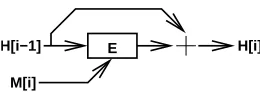
Joux’ attack is applicable for any compression function C. Often, com-pression functions are designed according to the “Davies-Meyer” princi-ple: given a block cipher like E, the functionC is defined by
H[i] E
M[i] H[i−1]
Fig. 2.The Davies-Meyer Construction
Here “+” is any group operation over {0,1}n, and we write 0n for the
neutral element.EMi is invertible for allMi (like anyn-bit block cipher).
This allows the adversary to compute (random) fixed points forC:
– Select a messageMi and computeHi−1:=EM−1i(0
n).
This is a fixed point, since Hi = C(Hi−1, Mi) = EMi(Hi−1) +Hi−1 =
0n+Hi−1. Finding such a fixed point takes one “decryption”E−1. Note
that the fixed point Hi−1=Hi depends on the choice ofMi, but for any
Mi such a fixed point exists.
Let a messageMbe given, and let the expansion (M1, . . . ,ML) ofM beL
chunks long. Using the fixed point finder as a tool, Kelsey [7] describes an algorithm to compute a 2nd preimage forM in timeO(max{2n/2,2n/L}). In an extreme case, i.e., for T ≈ 2n/2, the entire attack asymptotically takes time 2n/2 to compute a 2nd preimage – instead of time 2n, as would
be expected for a random oracle.
2.5 Security against Generic Attacks
The above attacks are generically applicable against a wide class of hash functions. Joux’ attack is applicable against all MD hashes, and the com-pression function C can be realised by a random oracle. Further, the attack can be made to work even if the adversary only has oracle access to the hash functionH, but not to the compression functionC. So Joux’ attack is generic in a very strong sense.
Kelsey’s attack requires the compression functionC(H, M) =EM(H)+H
to be a Davies-Meyer compression function.3In contrast to Joux’ attack, Kelsey’s would not work with oracle access to H only – the adversary needs oracle access to E−1. But Kelsey’s attack is still generic, since it
3
does not assume any specific weakness for E – E can be as strong as a Shannon cipher.
The target of the current paper is a modified MD design for hash func-tions, provably secure against all generic attacks, including, but not lim-ited to Joux’ and Kelsey’s.
3 The Wide-Pipe Hash: A Modified MD Hash
Since both Joux’ and Kelsey’s attacks are based on finding internal colli-sions, it appears to be an obvious idea to “widen” the internal pipe from n bit to w > n bit to improve protection against finding internal colli-sions.4 Let H0 ∈ {0,1}w be a (randomly chosen)initial value. Usingtwo compression functions
– C0 :{0,1}w× {0,1}m → {0,1}w and – C00 :{0,1}w→ {0,1}n,
we compute the wide-pipe iterated hash H:
– Foriin 1, . . . ,L: computeHi :=C0(Hi−1, Mi). – Finally: setH(M) =C00(H
L).
We callHL the “intermediate hash”.
H[1]
M[2]
C’ C’
H[2]
M[0]
H[L]
M[L]
C’’ C’
H[L−1] H[0]
Fig. 3.The Wide-Pipe Hash
3.1 K-Collision Attacks
As an upper bound on the security ofH, observe that Joux’ attack finds 2k-collisions in time min{k∗2w,2n(2k−1)/2k
}. As it turns out, this bound
4
is tight, up to the (logarithmic) factor k. If we write T0 for the time to
find an internal collision, i.e., a collision forC0, andT00(K) for the time to
find aK-collision forC00, we get the following lower bound on the security
of H:
Lemma 4 Finding a K-collision for the wide-pipe iterated hash H
re-quires at least time Ω(min{T0, T00(K)}).
Proof. Consider a collision M 6=N with H(M) =H(N). M and N are expanded to sequences (M1, . . . , ML) 6= (N1, . . . , NL0). Denote HiM and
HjN for the internal hash values when computing H(M) and H(N). We distinguish three different types of collisions:
Final collision: HLM 6=HLN0, andC
00(HM
L ) =C00(HLN0).
Different length: L 6= L0 implies M
L 6= NL0 (cf. Footnote 2). Thus,
eitherHLM =HLN0 implies an internal collision (see below), or HLM 6=
HN
L0, implies a final collision (see above).
Internal collision: (HM
L , ML) = (HLN0, NL0), and thus L = L0. Since
(M1, . . . , ML)6= (N1, . . . , NL0), there exists a collision forC0, i.e.,
val-ues (HM
i , Mi)6= (HiN, Ni) withC0(HiM, Mi) =C0(HiN, Ni).
A K-collision forH reduces to either aK-collision for the final compres-sion function C00, or to at least one (“internal”) collision for C0. ut
As an immediate consequence, we get the following theorem.
Theorem 5. If we model the compression functions C0 and C00 as
in-dependent random oracles, finding K-collisions for the wide-pipe iterated hash H takes timeΩ(min{2w/2,2n(K−1)/K}).
To ensure that H is (asymptotically) as secure against multi-collision attacks as an ideal hash, w ≥2nis thus sufficient in the random oracle model.
3.2 K-way (2nd) Preimage Attacks
below, this bound is tight, except for the (logarithmic) factor k. Let T0
denote the time to find a collision forC0 (as in the previous section) and
P00(K) the time to find a K-way preimage for C00. Our lower bound on
the security of H is now:
Lemma 6 Consider the wide-pipe hash H:
1. Finding a single preimage for H takes timeΩ(P00(1)).
2. Finding K-way preimages for H takes time Ω(min{T0, P00(K)}). Proof. First bound: observe that finding a preimage forH(someM with H(M) =Y) implies finding a preimage HLforC00, sinceC00(HL) =Y.
Second bound: finding K different preimages M1, . . . ,MK forH either
implies finding at least one collision for C0, or implies findingK different
inputsHL11, . . .HLKK withC
00(H1
L1) =· · ·=C 00(HK
LK) =Y, i.e., a K-way
preimage forC00. ut
Why don’t we prove the security of H against (multiple) 2nd preimage attacks, similarly to the second bound? A 2nd preimage attack against C00means that, givenX ∈ {0,1}w, the adversary has to findX0∈ {0,1}w
withX06=XandC00(X) =C00(X0). To reproduce the reduction from the
2nd bound of the above proof, we would have to find a messageM with HL=X for the intermediate hashHL ofM. This is (or should be) hard.
In the random oracle model, a little trick allows us to show that finding 2nd preimages is as infeasible as finding plain preimages.
Theorem 7. Consider the wide-pipe hash function H. If we model the
compression functions C0 and C00 as independent random oracles, then
– finding a single preimage takes timeΩ(2n),
– finding aK-way preimage takes time Ω(min{2w/2, K2n}), and – finding aK-way 2nd preimage takes timeΩ(min{2w/2, K2n}), as well. Proof. The first two bounds are direct consequences of Lemma 6 For the thrird bound, we choose an arbitrary messageM with the expansionM1, . . . , ML, query the C0-oracle for the internal hash values H1, . . . , HL,
and define
C000 :{0,1}w → {0,1}n:
C000(H
L) =C00(X),
C000(X) =C00(H L),
Note that if X =HL, then C00=C000. Now we run the adversary to find
single or multiple 2nd preimages forM, replacingC00byC000. Observe that
X is a random value, and, since C0 is a random oracle, H
L is random,
too. Thus,C000is uniformly distributed random function, just likeC00– the
adversary can’t distinguish betweenC00and C000. Our little manipulation
(replacing C00 by C000 for the adversary) does not affect her probability
of success or running time. We write H000 for the wide-pipe hash function
using C0 and C000.
If the adversary succeeds, she finds 2nd preimage(s) Mi with H000(M) =
H000(Mi). Consider the corresponding inputs Hi
Li for C
000. If Hi
Li =HL,
we have found a collision forC0. Else, Hi
Li is a 2nd preimage for C00. ut
Note that increasingwimproves the security ofH against multiple (2nd) preimage attacks, but an unlimited adversary can always benefit from the structure of any iterated hash by applying Joux’ multiple preimage attack.
4 The Double-Pipe Hash (Two Twined Pipes)
The wide-pipe design in Section 3 suffers from one serious drawback: To achieve the amount of security an n-bit hash function should have, we need an internal building block with an extremely high level of security. Namely, any collision attack for the w-bit compression function C00 has
to take at least time 2n (w≥2nis necessary, but not sufficient).
Can we design iterated hashes and prove their security without making the assumption that some internal building block is much stronger than the hash function itself?5
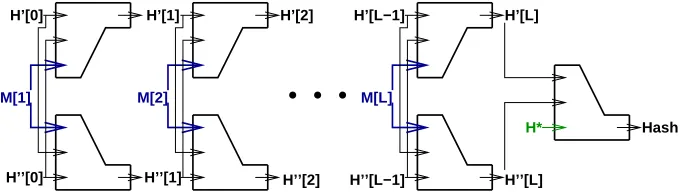
Usingone single narrow-pipe compression function
– C:{0,1}n× {0,1}n+m → {0,1}n,
with m ≥ n and three distinct (random) initial values H0
0, H000, H∗ ∈
{0,1}w, we compute the double-pipe hash H:
– Foriin 1, . . . ,L: compute
5
• H0
i :=C(Hi−0 1, Hi−00 1||Mi) and • H00
i :=C(Hi−00 1, Hi−0 1||Mi) – Finally: setH(M) =C(H∗, H0
L||HL00||0m−n).
H’[L−1]
H’’[2] H’’[0]
H’[L] H’[2]
H’’[1]
Hash
H*
M[1]
H’’[L−1] H’’[L]
H’[1] H’[0]
M[2] M[L]
Fig. 4.The Double-Pipe Hash
4.1 K-Collision Attacks
Similarly to the wide-pipe design, we distinguish internal collisions (cor-responding to collisions forC0) and final collisions (corresponding toC00): Final collision: (H0, H00)6= (G0, G00) with
C(H∗, H0||H00||0m−n) =C(H∗, G0||G00||0m−n)).
Internal collision: (H0, H00, M)6= (G0, G00, N) with
C(H00, H0||M) =C(G00, G0||N) and C(H0, H00||M) =C(G0, G00||N).
The improved security of the wide-pipe hash over the plain MD hash depends on internal collision resistance being much stronger than final collision resistance. Unfortunately, this reasoning does not hold for the double-pipe construction. Finding internal collisions with H0 = H00 and
G0 = G00 may be as “easy” as finding collisions for C, i.e., as finding
final collisions. To deal with this, we define two special cases of internal collisions:
Internal cross collision: H0
i−16=Hi−00 1,Mi with
C(H0
i−1, Hi−00 1||Mi) =Hi0 =Hi00=C(Hi−00 1, Hi−0 1||Mi).
WriteTs for the time to find a strict internal collision,Tx for an internal
cross collision, andT(K) for the time to find a final K-collision.
Lemma 8 Consider the double-pipe iterated hash H:
1. Any internal collision either reduces to a strict or to a cross collision. 2. Finding a K-collision requires timeΩ(min{Ts, Tx, T(K)}).
Proof. For the first claim, observe that the initial values H0
0 and H000 are different. Any non-strict internal collision implies a triple (H0
i−1, Hi−00 1, Mi) with Hi−0 1 = Hi−00 1. This implies the existence of a cross-colliding triple (H0
j,Hj00,Mj+1), withj≤i−2,Hj0 6=Hj00, and
H0
j+1 =C(Hj0, Hj00||Mj+1) =C(Hj00, Hj0||Mj+1) =Hj00+1.
For the second claim, we argue similarly to the proof of Lemma 4. A K-collision for H reduces to either a final K-collision (which takes time T(K)), or to an internal collision. Due to the first claim, an internal collision is either strict (and needs time Ts), or is a cross collision (time
Tx). ut
Theorem 9. Consider the double-pipe hashH. If we model the
compres-sion function C as a random oracle, then
1. Tx=Ω(2n),Ts =Ω(2n), and
2. finding K-collisions for H takes timeΩ(2n(K−1)/K).
Proof. Consider finding internal cross collisions. Each time we choose H0 6= H00 and M, there is a 2−n-chance for a collision C(H0, H00||M) =
C(H00, H0||M). Thus, a cross collision needs Ω(2n) oracle queries, i.e.,
Tx=Ω(2n).
Now consider finding strict internal collisions. For any triple (G0, G00, M)
withG0 6=G00, the pair (H0, H00)∈ {0,1}2n with
is a uniformly distributed 2n-bit random value, independently from all the other C(·)-values. If the adversary choosesq such triples (G0, G00, M)
and makes q queries to the C-oracle, then her probability of success is
P
0≤j<qj/22n =Ω(q2/22n). Again, we expect to make q =Ω(2n) oracle
queries, before the first strict internal collision. Hence,Ts =Ω(2n).
The second claim follows from the first claim, Lemma 8, and Fact 2. ut
4.2 K-way (2nd) Preimage Attacks
Our treatment of K-way preimage and 2nd preimage attacks is quite similar to Section 3.2. Recall the notions of strict internal collisions and internal cross collisions. Finding such collisions requires timeTs for strict
and timeTx for cross collisions. WriteP(K) for the time to find a
preim-age forC. Very similar to Section 4.2 we get the following results:
Lemma 10 Consider the double-pipe hash H:
1. Finding a single preimage for H takes timeΩ(P(1)).
2. Finding K-way preimages for H takes time Ω(min{Ts, Tx, P(K)}).
Proof. First claim: See proof of Lemma 6. Second claim: Follows from
claim 1 of Lemma 8. ut
Theorem 11. Consider the double-pipe hash function H. If we model
the compression functionsC as a random oracle, then finding a single or
K-way preimage or a single or K-way 2nd preimage takes time Ω(2n).
The proof of Theorem 11 is straightforward and omitted here. The result may appear rather unimpressive – but it is tight, except for the factor k = log(K). Joux’ preimage attack allows to find 2k-way preimages in timeΩ(k2n).
5 Double-Pipe Hash with Davies-Meyer (DM)
additional handles. If we use such a compression function for the Double-Pipe Hash (as motivated in Footnote 5), we must re-examine the security of the double-pipe hash.
In this section, we consider the double-pipe hash H, using a DM-based compression function
C :{0,1}n× {0,1}m → {0,1}n, C(Hi−1, Ei) =EMi(Hi−1) +Hi−1.
For eachM ∈ {0,1}m, the functionEM is a permutation over {0,1}n.
5.1 Conventions
For our formal treatment, we consider an adversary A with access to a Shannon oracle for E and E−1. Similarly to [1], we assume:
– The adversaryA never asks a query in which the response is already known. Namely, ifAasks forEk(x) and receivesy, she neither asks for
E−1
k (y), nor forEk(x) again. Similarly, if she has asked for forE −1
k (y)
and receivedx.
– Recall that for the type of attacks we consider, a successful adversary always outputs one or more messagesMi, which either collide or
con-stitute some (2nd) preimages. Before finishing, the adversary makes all the oracle calls to compute all hash valuesH(Mi).
– We define a simulator, to respond toA’s oracle queries:
• Initially:
∗ set i:= 0; clear the logbook;
∗ for all (k, x): mark Ek(x) as undefined; • Responding to an oracle queryEk(x):
∗ set i:=i+ 1
∗ randomly choosey from range(Ek)
∗ append (xi, ki, yi) := (x, k, y) to the logbook; ∗ respond y;
• Responding to an oracle queryE−k1(y):
∗ set i:=i+ 1
∗ randomly choosex from domain(Ek)
∗ append (xi, ki, yi) := (x, k, y) to the logbook; ∗ respond x;
Here, domain(Ek) is the set of points x where Ek(x) is still
unde-fined. Similarly,range(Ek) is the set of pointsywhereE−1
k (y) is still
undefined.
This is without loss of generality: any adversary not following the first two conventions can easily be transformed into an equivalent one fol-lowing them. And an adversary folfol-lowing the first two conventions can’t distinguish the simulator from a “true” random oracle.
5.2 Internal Collisions
Note that Lemma 8 is still valid in the current context. Recall the defini-tions of Ts and Tx .
Theorem 12. Consider the DM-based double-pipe hash H. If we model
E by a Shannon oracle, thenTx=Ω(2n) and Ts =Ω(2n).
Proof. For the proof, we assume that the adversary does not make more thanq ≤2n−1 queries. This is technically correct, since 2n−1=Ω(2n).
Time Tx to find internal cross collisions: a cross collision is described by
H0
i−1 6=Hi−00 1,Mi with
C(H0
i−1, Hi−00 1||Mi) =Hi0 =Hi00 =C(Hi−00 1, Hi−0 1||Mi). (1)
In time q, we can check at most q/2 such triples (H0
i−1, Hi−00 1, Mi) for
cross collisions. Now we argue that for q≤2n−1, for each such triple the probability px to satisfy Equation 1 is at most 1/2n−1. This implies that
the expected number of oracle queries we need to make before we get the first cross collision isTx=Ω(2n), as claimed.
We still have to show px ≤2n−1. Observe that if the adversary’s answer
involves a cross collision, then, by the above conventions, the simulator’s logbook contains two triples (xa, ka, ya) and (xb, kb, yb) witha6=b,
xa=Hi−0 1,ka= (Hi−001||Mi), ya=Eka(xa),
xb=Hi−00 1,kb = (Hi−0 1||Mi), andyb =Ekb(xb).
Thus, we can rewrite Equation 1 by
ya
z }| {
Eka(xa) +xa=
yb
z }| {
Ekb(xb) +xb,
which corresponds to
ya+xa=yb+xb. (2)
If (w.l.o.g.)a < b, then eitheryb orxb is a uniformly distributed random
– If theb-th oracle query has been Ekb(xb), then yb is a random value
fromrange(Ek
b).
– Elsexb is a random value from domain(Ekb).
Since |range(Ek
b)|= |domain(Ekb)|= 2
n−b+ 1≥2n−q, and due to
q ≤2n−1, we getp
x ≤1/2n−1, as claimed.
Time Ts to find strict internal collisions: for triples (G0, G00, M) withH0 6=
H00, we consider pairs (H0, H00)∈ {0,1}2n, where
H0 =C(G0, G00||M) and H00=C(G00, G0||M). (3)
A strict internal collision are two different triples, where the corresponding H0 and H00 values both collide. When making q oracle queries, there are
Ω(q2) such pairs. We claim that for q ≤ 2n−1, the probability p
s to
satisfy Equation 3 is ps ≤ 1/22(n−1). Hence, the expected number of
oracle queries to get a strict collision isTs =Ω(2n).
It remains to prove ps ≤ 1/22(n−1). Consider a triple (xa, ka, ya) with
xa = G0, ka = (G00||M), and ya = Eka(xa) from the simulator’s logfile.
We only have a chance for a strict collision, if the logfile contains another triple (xb, kb, yb) with xb = G00, kb = (G0||M), and yb = Ekb(xb). Note
that xb and kb are uniquely determined by xa and ka, and vice versa.
Equation 3 can then be rewritten as H0 =E
ka(xa) +xa=ya+xa and H
00=E
kb(xb) +xb =yb+xb.
A strict collision implies the adversary to handle a colliding triple (F0, F00, N),
i.e., H0 = C(F0, F00||N) and H00 = C(F00, F0||N). This information
cor-responds to two more triples (xc, kc, yc) and (xd, kd, yd) on the server’s
logfile with
H0 =ya+xa=yc+xc (4)
H00=y
b+xb =yd+xd. (5)
5.3 K-Collisions
Theorem 13. Consider the DM-based double-pipe hash H. If we model
Eby a Shannon oracle, then findingK-collisions forHtakes timeΩ(2n(K−1)/K).
Proof. Due to the first claim of Lemma 8 and Theorem 12, we know that an internal collision would take timeΩ(2n). Thus, in timeΩ(2(n−1)(K−1)/K) we don’t find any such collision. In order to find a K-collision faster than in time Ω(2n), we must find a final K-collision. In the remainder
of this proof, we will show that finding a final K-collision takes time Ω(2n(K−1)/K).
A finalK-collision consists ofK different pairs (Gi, Hi)∈({0,1}n)2 with C(H∗, G1||H1||0m−n) =· · ·=C(H∗, GK||HK||0m−n).
Hence, after a possible permutation of triples, we have to find K triples (H∗, k
1, y1), . . . , (H∗, kK, yK) in the simulator’s logbook with differentki
but
y1
z }| {
Ek1(H ∗
) +H∗=· · ·=
yK
z }| {
EkK(H
∗
) +H∗, or equivalently
y1
z }| {
Ek1(H∗) =· · ·= yK
z }| {
EkK(H
∗).
By fixing the inputH∗forE, we turn the Shannon-oracle into an ordinary
random oracle, see Fact 2. According to Fact 2, finding aK-collision takes
timeΩ(2(K−1)n/K). ut
5.4 K-way (2nd) Preimages
Theorem 14. Consider the DM-based double-pipe hash H. If we model
E by a Shannon oracle, then finding a single or K-way preimage or a single or K-way 2nd preimage takes time Ω(2n).
Proof. Finding K-way (2nd) preimages isn’t faster than finding single (2nd) preimages. Thus, we concentrate on single ones. Due to Lemma 10, finding a single preimage forHtakes timeΩ(P(1)).P(1) =Ω(2n) follows
Now assume an algorithm exists to find 2nd preimages for H. Con-sider we are given X ∈ {0,1}n+m, and searching for some 2nd preim-age key Y 6= X with EY(H∗) = EX(H∗) for E. The proof is quite
similarly to the proof of Theorem 7. We choose some message M and compute the internal hashes H0
1, H100, . . . , HL0, . . . , HL00. Assume X 6∈ {(H0
i||Hi00||Mi),(Hi00||Hi0||Mi)|1 ≤i≤ L} (this holds with overwhelming
probability). Set HL:= (HL0||HL00||0n−m). We define the function
E0 :{0,1}n→ {0,1}n+m → {0,1}n:
E0
X(·) =EHL(·)
E0
HL(·) =EX(·)
E0
Z(·) =EZ(·) for Z 6∈ {X, HL}
Now we run the adversary, replacing the (Shannon-) oracle for E and E−1 by an oracle for E0 and its inverse. Both E and E0 are random
permutations over {0,1}n. If the adversary succeeds in finding a 2nd preimage for M, she either has found an internal collision (which would take time Ω(2n)), or Y := H
L 6= X is a solution to the 2nd preimage
problem for E. By Facts 2 and 3, this would take time Ω(2n). In any case, finding a 2nd preimage forM reduces to solving a problem we know
to take time Ω(2n). ut
6 Discussion
6.1 Lessons to be Learned
The main lecture from [6, 7] and the current paper is thatthe sizewof the internal hash values is a security parameter of its own right, withw≥n, but otherwise independent from the final hash size n.
Any security architect, choosing a cryptographic hash, should choose both wandnaccording to her specific security requirements (also considering, of course, efficiency concerns, compatibility issues, . . . ). For some appli-cations, the Merkle-Damg˚ard setting with w = n may be appropriate, while others may requirew > n.
variant of A to feasibly find multi-collisions. Nevertheless, Joux’ attack allows to feasibly find large multi-collisions for the plain MD hash. I.e., finding 2k-collisions takes time k∗time(A). Observe that the speed-up
over attacking an ideal hash quickly grows withk. If we use the same com-pression for a double-pipe hash, the failure of the comcom-pression function would be less catastrophic. The speed-up for finding K-collisions for the double-pipe hash (in comparison to an ideal hash) would be 2n/2/time(A). This does not depend on K at all.
Note that the hash functions proposed here do not suffer from the straight-forward length extension attack, in contrast to the plain MD hash.
6.2 Examples
As a concrete example, consider an AES-based MD hashHmd
aes, using the
AES block cipher in Davies-Meyer mode. Since the AES block size is 128 bit,Haesmd is a 128-bit hash. For applications which do not require collision
resistance, it may be fine to use a 128-bit hash. But resistance against multi-collision attacks or 2nd preimage attacks could be a concern for these applications – and from Joux’ and Kelsey’s attacks, we know that Hmd
aes is much less resistant against these attacks than we would expect
from a 128-bit hash. For a reasonably funded and motivated adversary, it is possible to find, say, a 216-collision forHaesmd.
In contrast to Haesmd, its double-pipe counterpart provides a greatly
im-proved protection against these attacks (assuming the AES does not suf-fer from some still unknown cryptanalytic weaknesses). Even finding a 3-collision for a double-pipe 128-bit hash would take more than 280units of running time and therefor seems to be infeasible, today.
Interestingly, two of the five hash functions from the SHA standard [9], namely SHA-224 and SHA-348, have already been designed according to this paper’s “wide-pipe” paradigm, see Table 1. This may have been motivated by the intention to re-use compression functions,6but one could as well imagine the immediate truncation of the internal hash values after each iteration. In the light of this paper, the designers of SHA-224 and SHA-348 did choose well.
6
n w SHA-1 160 160 SHA-224 224 256 SHA-256 256 256 SHA-384 384 512 SHA-512 512 512
Table 1.SHA standard hash functions: final hash sizenand internal hash sizew[9].
6.3 Cascading
The idea to improve the security of hash functions by cascading has been discussed for a long time, see, e.g., [10]. Cascading looks like an obvious technique to improve the security of hash functions – but due to Joux’ attack, cascading iterated hash functions is not such useful. On the other hand, the double-pipe construction can be seen as a cascade of compres-sion functions. As our results indicate, cascading compression functions can greatly improve the security. Indeed, one could extend the double-pipe hash and define some “t-tuple hash”, to provide improved resistance against K-way (2nd) preimage attacks.
Thus, in the context of cascading and iterated hash functions, we argue that cascading compression function(s) is more desirable than cascading hash function(s).
6.4 Summary
In the current paper, we took a rather abstract and proof-centric look at the design of hash functions. Similarly to others, the current author con-siders this style a “feasible and useful step for understanding the security” [1] of iterated hash functions, thereby complementing the attack-centric approach [6, 7], though not replacing it.
Given “good” compression functions, this paper shows how to compose “good” hashes. Though the random oracle model is quite useless to de-fine what it means to be a “good” compression function [2], our lemmas provide some specific requirements for the compression functions.
Acknowledgement
References
1. Black, Rogaway, Shrimpton. Black-box analysis of the block-cipher based hash-function construction from PGV. Crypto 02.
2. R. Canetti, O. Goldreich, S. Halevi. The random oracle methodology, revisited. 30th STOC 1998, pp. 209–218.
3. I. Damg˚ard. A design principle for hash functions. Crypto 89, LNCS 435, pp. 416– 427.
4. N. Ferguson, B. Schneier. Practical Cryptography. Wiley Publishing, 2003. 5. H. Finney. More problems with hash functions. The cryptography mailing list. 24
Aug 2004. http://lists.virus.org/cryptography-0408/msg00124.html
6. A. Joux. Multicollisions in iterated hash functions, application to cascaded con-structions. Crypto 04, LNCS 3152, pp. 306–316.
7. J. Kelsey. A long-message attack on SHAx, MDx, Tiger, N-Hash, Whirlpool, and Snefru. Draft. Unpublished Manuscript.
8. R. Merkle. One-way hash functions and DES. Crypto 89, LNCS 435, pp. 428–446. 9. National Institute of Standards and Technology (NIST). Secure hash standard. FIPS
180-2. August 2002.
10. B. Preneel. Analysis and design of cryptographic hash functions. PhD thesis, Katholieke Universiteit Leuven, 1993.