G
RASP
-S
ENSITIVE
S
URFACES
Utilizing Grasp Information for
Human-Computer Interaction
D
ISSERTATION
an der Fakultät für Mathematik, Informatik und Statistik
der Ludwig-Maximilians-Universität München
vorgelegt von
Diplom-Medieninformatiker
R
APHAEL
W
IMMER
geboren am 26. Dezember 1980 in Bad Tölz
iii
Erstgutachter:
Prof. Dr. Heinrich Hußmann,
Ludwig-Maximilians-Universität München
Zweitgutachter: Prof. Roderick Murray-Smith, PhD,
University of Glasgow
Abstract v
A
BSTRACT
Grasping objects with our hands allows us to skillfully move and manipulate them. Hand-held tools further extend our capabilities by adapting precision, power, and shape of our hands to the task at hand.
Some of these tools, such as mobile phones or computer mice, already incorporate infor-mation processing capabilities. Many other tools may be augmented with small, energy-efficient digital sensors and processors. This allows for graspable objects to learn about the user grasping them - and supporting the user’s goals.
For example, the way we grasp a mobile phone might indicate whether we want to take a photo or call a friend with it - and thus serve as a shortcut to that action. A power drill might sense whether the user is grasping it firmly enough and refuse to turn on if this is not the case. And a computer mouse could distinguish between intentional and unintentional movement and ignore the latter.
This dissertation gives an overview of grasp sensing for human-computer interaction, focusing on technologies for building grasp-sensitive surfaces and challenges in design-ing grasp-sensitive user interfaces.
It comprises three major contributions: a comprehensive review of existing research on human grasping and grasp sensing, a detailed description of three novel prototyping tools for grasp-sensitive surfaces, and a framework for analyzing and designing grasp interaction:
For nearly a century, scientists have analyzed human grasping. My literature review gives an overview of definitions, classifications, and models of human grasping. A small number of studies have investigated grasping in everyday situations. They found a much greater diversity of grasps than described by existing taxonomies. This diversity makes it difficult to directly associate certain grasps with users’ goals.
In order to structure related work and own research, I formalize a generic workflow for grasp sensing. It comprisescapturingof sensor values, identifyingthe associated grasp, andinterpretingthe meaning of the grasp.
A comprehensive overview of related work shows that implementation of grasp-sensitive surfaces is still hard, researchers often are not aware of related work from other disciplines, and intuitive grasp interaction has not yet received much attention.
In order to address the first issue, I developed three novel sensor technologies designed for grasp-sensitive surfaces. These mitigate one or more limitations of traditional sens-ing techniques:
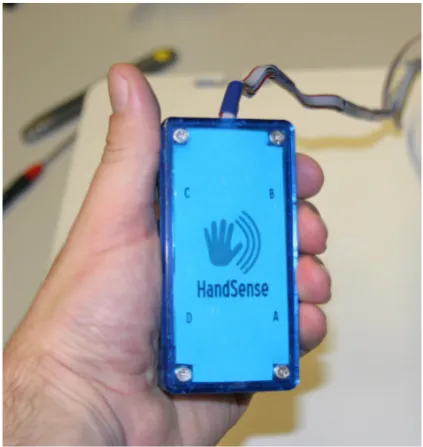
HandSenseuses four strategically positioned capacitive sensors for detecting and
sensors. User tests showed a recognition rate of 81%, comparable to that of a system with 72 binary sensors.
FlyEyeuses optical fiber bundles connected to a camera for detecting touch and
prox-imity on arbitrarily shaped surfaces. It allows rapid prototyping of touch- and grasp-sensitive objects and requires only very limited electronics knowledge. For FlyEye I de-veloped arelative calibration algorithm that allows determining the locations of groups of sensors whose arrangement is not known.
TDRtouchextends Time Domain Reflectometry (TDR), a technique traditionally used
for inspecting cable faults, for touch and grasp sensing. TDRtouch is able to locate touches along a wire, allowing designers to rapidly prototype and implement modular, extremely thin, and flexible grasp-sensitive surfaces.
I summarize how these technologies cater to different requirements and significantly expand the design space for grasp-sensitive objects.
Furthermore, I discuss challenges for making sense of raw grasp information and cat-egorize interactions. Traditional application scenarios for grasp sensing use only the grasp sensor’s data, and only for mode-switching. I argue that data from grasp sensors is part of the general usage context and should be only used in combination with other context information.
For analyzing and discussing the possible meanings of grasp types, I created the GRASP model. It describes five categories of influencing factors that determine how we grasp an object:
Goal– what we want to do with the object, Relationship– what we know and feel about the object we want to grasp, Anatomy – hand shape and learned movement patterns,
Setting – surrounding and environmental conditions, and Properties – texture, shape, weight, and other intrinsics of the object
Zusammenfassung vii
Z
USAMMENFASSUNG
Die Fähigkeit, Gegenstände mit unseren Händen zu greifen, erlaubt uns, diese vielfältig zu manipulieren. Werkzeuge erweitern unsere Fähigkeiten noch, indem sie Genauigkeit, Kraft und Form unserer Hände an die Aufgabe anpassen.
Digitale Werkzeuge, beispielsweise Mobiltelefone oder Computermäuse, erlauben uns auch, die Fähigkeiten unseres Gehirns und unserer Sinnesorgane zu erweitern. Diese Geräte verfügen bereits über Sensoren und Recheneinheiten. Aber auch viele andere Werkzeuge und Objekte lassen sich mit winzigen, effizienten Sensoren und Rechenein-heiten erweitern. Dies erlaubt greifbaren Objekten, mehr über den Benutzer zu erfahren, der sie greift - und ermöglicht es, ihn bei der Erreichung seines Ziels zu unterstützen. Zum Beispiel könnte die Art und Weise, in der wir ein Mobiltelefon halten, verraten, ob wir ein Foto aufnehmen oder einen Freund anrufen wollen - und damit als Shortcut für diese Aktionen dienen. Eine Bohrmaschine könnte erkennen, ob der Benutzer sie auch wirklich sicher hält und den Dienst verweigern, falls dem nicht so ist. Und eine Computermaus könnte zwischen absichtlichen und unabsichtlichen Mausbewegungen unterscheiden und letztere ignorieren.
Diese Dissertation gibt einen Überblick über Grifferkennung (grasp sensing) für die Mensch-Maschine-Interaktion, mit einem Fokus auf Technologien zur Implementierung griffempfindlicher Oberflächen und auf Herausforderungen beim Design griffempfind-licher Benutzerschnittstellen. Sie umfasst drei primäre Beiträge zum wissenschaftli-chen Forschungsstand: einen umfassenden Überblick über die bisherige Forschung zu menschlichem Greifen und Grifferkennung, eine detaillierte Beschreibung dreier neu-er Prototyping-Wneu-erkzeuge für griffempfindliche Obneu-erflächen und ein Framework für Analyse und Design von griff-basierter Interaktion (grasp interaction).
Seit nahezu einem Jahrhundert erforschen Wissenschaftler menschliches Greifen. Mein Überblick über den Forschungsstand beschreibt Definitionen, Klassifikationen und Mo-delle menschlichen Greifens. In einigen wenigen Studien wurde bisher Greifen in all-täglichen Situationen untersucht. Diese fanden eine deutlich größere Diversität in den Griffmuster als in existierenden Taxonomien beschreibbar. Diese Diversität erschwert es, bestimmten Griffmustern eine Absicht des Benutzers zuzuordnen. Um verwand-te Arbeiverwand-ten und eigene Forschungsergebnisse zu strukturieren, formalisiere ich einen allgemeinen Ablauf der Grifferkennung. Dieser besteht aus dem Erfassen von Sensor-werten, derIdentifizierung der damit verknüpften Griffe und derInterpretation der Be-deutung des Griffes. In einem umfassenden Überblick über verwandte Arbeiten zeige ich, dass die Implementierung von griffempfindlichen Oberflächen immer noch ein her-ausforderndes Problem ist, dass Forscher regelmäßig keine Ahnung von verwandten Arbeiten in benachbarten Forschungsfeldern haben, und dass intuitive Griffinteraktion bislang wenig Aufmerksamkeit erhalten hat.
Schwächen traditioneller Sensortechniken:
HandSenseverwendet vier strategisch positionierte kapazitive Sensoren um
Griffmus-ter zu erkennen. Durch die Verwendung von selbst entwickelten, hochauflösenden Sen-soren ist es möglich, schon die Annäherung an das Objekt zu erkennen. Außerdem muss nicht die komplette Oberfläche des Objekts mit Sensoren bedeckt werden. Benutzertests ergaben eine Erkennungsrate, die vergleichbar mit einem System mit 72 binären Senso-ren ist.
FlyEyeverwendet Lichtwellenleiterbündel, die an eine Kamera angeschlossen werden,
um Annäherung und Berührung auf beliebig geformten Oberflächen zu erkennen. Es ermöglicht auch Designern mit begrenzter Elektronikerfahrung das Rapid Prototyping von berührungs- und griffempfindlichen Objekten. Für FlyEye entwickelte ich einen
relative-calibration-Algorithmus, der verwendet werden kann um Gruppen von Senso-ren, deren Anordnung unbekannt ist, semi-automatisch anzuordnen.
TDRtoucherweitert Time Domain Reflectometry (TDR), eine Technik die üblicherweise
zur Analyse von Kabelbeschädigungen eingesetzt wird. TDRtouch erlaubt es, Berüh-rungen entlang eines Drahtes zu lokalisieren. Dies ermöglicht es, schnell modulare, ex-trem dünne und flexible griffempfindliche Oberflächen zu entwickeln.
Ich beschreibe, wie diese Techniken verschiedene Anforderungen erfüllen und den de-sign spacefür griffempfindliche Objekte deutlich erweitern. Desweiteren bespreche ich die Herausforderungen beim Verstehen von Griffinformationen und stelle eine Eintei-lung von Interaktionsmöglichkeiten vor. Bisherige Anwendungsbeispiele für die Grif-ferkennung nutzen nur Daten der Griffsensoren und beschränken sich auf Moduswech-sel. Ich argumentiere, dass diese Sensordaten Teil des allgemeinen Benutzungskontexts sind und nur in Kombination mit anderer Kontextinformation verwendet werden soll-ten.
Um die möglichen Bedeutungen von Griffarten analysieren und diskutieren zu können, entwickelte ich das GRASP-Modell. Dieses beschreibt fünf Kategorien von Einflussfak-toren, die bestimmen wie wir ein Objekt greifen:
Goal – das Ziel, das wir mit dem Griff erreichen wollen, Relationship – das Verhältnis zum Objekt,Anatomy– Handform und Bewegungsmuster, Setting – Umgebungsfakto-ren und Properties – Eigenschaften des Objekts, wie Oberflächenbeschaffenheit, Form oder Gewicht.
Danksagung ix
D
ANKSAGUNG
Wie oft wurde derKairosder Fertigstellung durch meta-wissenschaftliche und lehrende “Ablenkung” versäumt, bevor die Erkenntnis dieses traurigen Faktums einer bemer-kenswerten Mischung aus eherner professoraler Geduld (wie Liebenswürdigkeit), sanf-tem aber unerbittlichem familiärem Druck und wohl auch ein wenig der beklagenswer-ten Eitelkeit weichen durfte.
Umso umfangreicher ist deshalb die Liste von Personen, denen ich aus ganzem Herzen danken möchte.
Meinem Doktorvater Heinrich Hußmann danke ich für das Vertrauen und die unbe-dingte Unterstützung und Förderung meiner Promotion und vielgestaltiger Nebenpro-jekte.
Bei meinem ZweitgutachterRod Murray-Smithmöchte ich mich für die unkomplizierte Begutachtung und sein geduldiges Warten auf die Fertigstellung bedanken.
Beiden Gutachtern danke ich für ihr positives und konstruktives Feedback, das sie mir vor und nach der Abgabe dieser Dissertation zukommen ließen.
“E pluribus unum” - “aus vielem eines” - so könnte das Motto dieser Dissertation lauten. Zu ihr haben - auf direkte und indirektere Weise - viele Menschen beigetragen, die ich kennenlernen durfte.
Besonders bedanken möchte ich mich bei den Mitgliedern der damaligen Nachwuchs-forschungsgruppe Embedded Interaction, Albrecht Schmidt, Matthias Kranz und Paul
Holleis. Diese führten mich - und viele andere Studenten an der LMU - in die
wissen-schaftliche Praxis ein und schufen ein Umfeld, das in mir den Wunsch zur Promotion weckte. In dieser Gruppe entstanden meine ersten Experimente mit kapazitiven Senso-ren, die den Grundstein für meine weitere Arbeit bildeten.
Der praktische Teil meiner Dissertation entstand von 2006 bis 2011 am Lehrstuhl für Medieninformatik der Ludwig-Maximilians-Universität München.
Ich möchte dem kongenialen, wundervollen Team dort danken, besondersRainer Fink, der immer da ist, wenn man ihn braucht (und auch sonst immer),Doris Hausen, mei-ner umei-nersetzbaren Büro-Gattin, Lebensretterin und Tratschtante, Dominikus Baur, mit dem ich Passwort und Pessimisums teilte,Sebastian Boring, mit dem ich schon Büro und Bett teilte,Sebastian Löhmann, mit dem ich Freud und Leid der Hardware teilte,
Alexander Wiethoff, mit dem ich meinen LieblingskursSketching with Hardware teilte,
Alexander De Luca, der immer sagt, was Sache ist, Andreas Butz, der immer hinter
einem steht, wenn man ihn braucht, Heiko Drewes, der immer für eine Diskussion zu haben ist, Fabian Hennecke, Meister des Flachwitzes, mit dem zusammen ich das
Disserta-tionsprokrastination verbindet,Max Maurer, unverdrießlicher Meister des Barkeepers,
Alina Hang, die positivste Pessimistin, die ich kenne,Sara Streng, die den Lehrstuhl
zu-sammengebracht hat,Bettina Conradi, von der ich lernte, dass dieBaneeigentlichGotto
heißt,Richard Atterer, ofDestrictor fame, der umfassende Kompetenz mit sonnigstem Charakter kombiniert,Andreas Pleuß,Arnd VitzthumundSiegfried Wagner, die den Lehrstuhl aufbauten und mir viele wichtige Grundlagen vermittelten und den Sekre-tärinnen des Lehrstuhls,Sybille Thomsen, Anita Szaszund Franziska Schwamb, die aus einem Haufen kleiner Doktoranden ein effektives und glückliches Team gemacht haben.
Aus familiären Gründen wechselte ich 2011 an den Lehrstuhl für Medieninformatik der Universität Regensburg, wo ich dann neben meiner Lehrtätigkeit meine Dissertation schrieb.
Auch hier hatte ich das Glück, Teil eines wundervollen Teams werden zu dürfen. Ich danke besonders Christian Wolff, der mir stets Rückhalt, Freiraum und Denkanstöße
gab, Markus Heckner, der mir den Wechsel nach Regensburg ermöglichte, den
Ein-stieg erleichterte, und vieles vorantrieb, Alexander Bazo, mit dem ich viele Ansichten und auch ein Zimmer teile,Patricia Böhm, Spezialistin für tiefgründige Gespräche,
Vic-toria Böhm, wunderbar wertende Stimmungsdetektorin,Manuel Burghardt, digitaler
Humanist im breitesten Sinne, Martin Brockelmann, harter Kern des Lehrstuhls und dreidimensionaler Meister,Florian Echtler, omnikompetenter Hacker und langjähriger Freund,Felix Raab,Tim Schneidermeier,Thomas Wilhelm, drei überaus angenehmen Kollegen undIngrid Stitz,Ingrid BöhmundSusanne Klinger, die Ordnung und Wär-me in diesen Lehrstuhl bringen.
Das finale Projekt im Rahmen meiner Dissertation, TDRtouch, entstand in intensiver Zusammenarbeit mit Patrick Baudisch, dessen Vertrauen, Wissen und sanfter Druck mir unendlich geholfen haben. Auch den Mitgliedern seines Lehrstuhls, insbesondere
Christian Holz, Stefanie Müller, Sean Gustafson,Anne Roudaut,Henning Pohl,
Pe-dro Lopesund Sieglinde Tholen möchte ich für die Gastfreundschaft und die vielen
interessanten Gespräche danken.
Mit Katrin Wolf, Thomas Feix und Tobias Große-Puppendahl - die ich erstmals als
Doktoranden in Berlin, Wien und Darmstadt kennenlernen durfte, verbinden mich er-füllende Diskussionen über technische, wissenschaftliche, und berufsperspektivische Themen, die ich nicht missen möchte.
Auch wenn er sich vermutlich nicht mehr daran erinnert, möchte ichMark Gross da-für danken, dass er mir bei meiner ersten TEI-Demo gesagt hat, wie schlecht ich die-se prädie-sentieren würde, und was ich stattdesdie-sen machen sollte. Diedie-ses unerbetene und gleichzeitig so hilfreiche Feedback hat einem einsamen Doktoranden auf einer fremden Konferenz das Gefühl gegeben, in dieser Community doch ganz gut aufgehoben zu sein.
Danksagung xi
entstanden, und sie enthält fraglos Fehler. Und über jeden einzelnen dieser Fehler bin ich selbst am unglücklichsten.
Deshalb bin ich meinem Bruder Johannes Wimmerzu besonderem Dank verpflichtet, der sich große Teile dieser Dissertation vor Fertigstellung durchgelesen und mir wert-volle Hinweise zur Verbesserung gegeben hat.
Auch meinen anderen Geschwisternund meinen Eltern möchte ich für die stete und liebevolle Unterstützung seit vielen Jahrzehnten und besonders in den letzten Jahren danken.
Vor allem aber möchte ich meiner FrauMonika und meinen Söhnen Noah, Elija und
Samueldanken, die viel zu lange und zu oft hinter meiner Arbeit zurückstehen
muss-ten, und mich trotzdem jede Minute davon unterstützten und mich erdeten.
T
ABLE OF
C
ONTENTS
I
I
NTRODUCTION ANDR
ELATEDW
ORK1
1 Introduction
31.1 Introduction . . . 3
1.2 Why Grasp Interaction? . . . 4
1.3 Research Approach . . . 7
1.4 Structure of the Dissertation . . . 8
2 Human Grasping
11 2.1 The Human Hand . . . 112.2 What Does “Grasping” Mean? . . . 13
2.2.1 Grasping, Gripping, and Prehension . . . 14
2.2.2 Grasp Phases . . . 15
2.2.3 Existing Definitions forGrasping . . . 16
2.3 Grasp Taxonomies and Descriptions . . . 17
2.4 How Do People Grasp? . . . 21
2.4.1 Grasping in Everyday Tasks . . . 22
2.4.2 Similarity of Grasps Across Users . . . 24
2.4.3 Similarity of Grasps by a Single User . . . 25
2.4.4 Discussion . . . 26
2.5 Summary . . . 27
3 Grasp Sensing: Definitions and Workflow
29 3.1 Introduction . . . 303.2 Limiting Grasp Sensing to Static Grasps . . . 30
3.3 An Interaction-Centric Definition of Grasping . . . 31
3.4 Definitions . . . 33
3.5 Grasp Sensing Workflow . . . 35
3.5.1 Capturing Grasps . . . 36
3.5.2 Identifying Grasps . . . 37
3.5.4 Discussion . . . 39
4 Grasp Sensing Techniques
41 4.1 Introduction . . . 414.2 Instrumenting the Environment . . . 42
4.3 Instrumenting Users . . . 44
4.4 Instrumenting Objects . . . 49
4.4.1 Technologies for Grasp-Sensitive Surfaces . . . 49
4.4.2 Relationship to Touch-Sensitive Surfaces . . . 51
4.4.3 Early Research on Grasp Sensing . . . 52
4.4.4 Secure Grip Project . . . 53
4.4.5 Touch Detection System for Mobile Terminals . . . 56
4.4.6 Tango . . . 58
4.4.7 Samsung Prototype . . . 60
4.4.8 Graspables . . . 62
4.4.9 GraspZoom . . . 65
4.4.10 Touché . . . 66
4.4.11 Apple Patents . . . 67
4.4.12 Driver Verification Based on Handgrip Recognition on Steering Wheel . . 68
4.4.13 Grips and Gestures on a Multi-Touch Pen . . . 69
4.4.14 GripSense . . . 71
4.4.15 iRotate Grasp . . . 72
4.4.16 iGrasp . . . 74
4.4.17 FlexAura . . . 76
4.4.18 Grip Force Authentication (NTT Docomo) . . . 77
4.4.19 Grip UI (NTT Docomo) . . . 78
4.4.20 28 Frames Later . . . 79
4.4.21 Sensing Techniques for Tablet+Stylus Interaction . . . 81
4.5 Summary . . . 82
4.5.1 Benefits and Applications of Grasp-Sensitive Surfaces . . . 83
4.5.2 Lack of Knowledge of Previous Research . . . 84
TABLE OF CONTENTS xv
II
N
OVELT
ECHNIQUES FORP
ROTOTYPINGG
RASP-S
ENSITIVES
URFACES87
5 CapToolKit and HandSense: Grasp Sensing Using Only Few Capacitive
Sensors
915.1 Motivation . . . 92
5.2 CapToolKit . . . 93
5.3 The HandSense Prototype . . . 95
5.4 Use Cases and Grasp Types . . . 97
5.5 Grasp Recognition Using Heuristics . . . 99
5.5.1 Mapping Raw Data to Grasp Types . . . 99
5.5.2 Handedness Recognition . . . 100
5.5.3 Evaluation Setup . . . 100
5.5.4 Results and Discussion . . . 102
5.6 Grasp Recognition Using Machine Learning . . . 104
5.7 Comparison to Related Work . . . 105
5.7.1 Sensor Resolution . . . 105
5.7.2 Sensor Count . . . 106
5.7.3 Classification Approach . . . 106
5.8 Discussion . . . 107
6 FlyEye: Non-Planar, Deformable Grasp Sensors Using Optical Fiber
109 6.1 Motivation and General Concept . . . 1106.2 Related Work . . . 111
6.3 Hardware Design . . . 113
6.3.1 Fiber Choice and Placement . . . 113
6.3.2 Active, Differential IR Illumination . . . 116
6.4 Relative Mapping . . . 118
6.4.1 Mapping of Fibers: Absolute vs. Relative . . . 120
6.4.2 Identifying Individual Fibers . . . 121
6.4.3 Finding Neighbors . . . 121
6.4.4 Untangling the Neighbors . . . 122
6.4.5 Potential Optimizations . . . 122
6.5 FlyEye Prototypes . . . 123
6.6 Limitations . . . 124
7 TDRtouch: Versatile, Flexible Grasp Sensing Using a Single Cable
1277.1 Motivation . . . 128
7.2 Time Domain Reflectometry (TDR) . . . 129
7.2.1 General Principle . . . 129
7.2.2 Range and Resolution . . . 131
7.2.3 Pulse vs. Step Signals . . . 132
7.2.4 Applications of Time Domain Reflectometry . . . 133
7.3 Using TDR for Touch Sensing . . . 133
7.3.1 History and Related Work . . . 133
7.3.2 Cable Choice for TDR-based Touch Sensing . . . 135
7.3.3 Covering Surfaces . . . 138
7.4 TDR as a Prototyping Technique for Grasp-Sensitive Objects . . . 140
7.4.1 Building Extremely Thin Sensors . . . 141
7.4.2 Sketching Sensors . . . 142
7.4.3 Deformability . . . 143
7.4.4 Modularity . . . 145
7.4.5 Identification . . . 146
7.4.6 Emulating Lower Resolutions . . . 146
7.5 Our Low-Cost Implementation . . . 147
7.5.1 Hardware . . . 148
7.5.2 Software . . . 150
7.6 Performance Measurements . . . 152
7.6.1 Measuring Setup . . . 152
7.6.2 Signal to Noise Ratio . . . 154
7.6.3 Precision and Positional Jitter . . . 155
7.6.4 Minimum Distance Between Individual Touches . . . 156
7.6.5 Sensing Range Along the Cable . . . 157
7.6.6 Latency . . . 157
7.6.7 Discussion . . . 158
7.7 Discussion and Impact . . . 159
7.8 Future Work . . . 160
7.8.1 Reducing Price . . . 160
7.8.2 Reducing Size . . . 161
7.8.3 Increasing Range, Resolution, and Sensitivity . . . 161
7.8.4 Expanding Applications . . . 162
7.8.5 Easing Prototyping . . . 162
TABLE OF CONTENTS xvii
8.1 Introduction . . . 163
8.2 Comparison: HandSense, FlyEye, TDRtouch . . . 165
8.2.1 Spatial Resolution . . . 165
8.2.2 Sensor Bit Depth . . . 166
8.2.3 Latency . . . 167
8.2.4 Support for Arbitrarily Shaped Surfaces . . . 167
8.2.5 Deformability . . . 168
8.2.6 Proximity Sensing . . . 168
8.2.7 Ease of Use . . . 169
8.2.8 Cost . . . 170
8.2.9 Incremental Refinement . . . 170
8.2.10 Summary: Good, Fast, Cheap, Pick Any Two . . . 171
8.3 Comparison to Related Work . . . 173
8.3.1 Grasp-Sensitive Surfaces . . . 173
8.3.2 Prototyping Techniques . . . 174
8.4 Summary . . . 175
III
T
OWARDSG
RASPI
NTERACTION177
9 Challenges for Grasp Interaction
179 9.1 Introduction . . . 1799.2 A More Realistic Scenario . . . 180
9.3 Getting Grasp Interaction Right . . . 182
10 How Do People Grasp a Mobile Phone?
183 10.1 Motivation . . . 18310.2 Participants . . . 184
10.3 Phone Form Factors . . . 184
10.4 Tasks . . . 185
10.5 Study Design . . . 186
10.6 Results . . . 187
10.6.1 Picking Up the Phone . . . 187
10.6.2 Holding the Phone to the Ear . . . 187
10.6.3 Taking a Photo . . . 189
10.7 Discussion . . . 192
11 GRASP - a Descriptive Model of Meaning in Grasps
195 11.1 Which Factors Determine a Grasp? . . . 19511.2 Properties . . . 199
11.3 Goal . . . 200
11.3.1 Extrinsically and Intrinsically Selected Grasps . . . 201
11.3.2 Explicit and Implicit Grasp Interaction . . . 201
11.3.3 Exerting and Supporting Grasps . . . 202
11.4 Anatomy . . . 204
11.5 Setting . . . 205
11.6 Relationship . . . 205
11.7 Applying GRASP to Practical Problems . . . 206
11.8 Discussion of GRASP . . . 209
12 Grasp Interaction in Context
211 12.1 Relationship to Tangible User Interfaces . . . 21212.2 Relationship to Gestural User Interfaces . . . 212
12.3 Relationship to Intrabody Near-Field Communication . . . 213
12.4 Grasp information as context . . . 213
12.5 Suggestions for Designing Grasp-Sensitive User Interfaces . . . 214
13 Summary, Discussion and Outlook
217 13.1 Summary . . . 21813.2 Discussion . . . 220
13.2.1 Applications for Grasp Sensing . . . 220
13.2.2 State of Research . . . 221
13.2.3 Limitations of This Dissertation . . . 222
13.3 Future Work . . . 222
13.3.1 Grasp-Sensitive Surfaces . . . 222
13.3.2 Grasp Identification . . . 223
TABLE OF CONTENTS xix
I
I
NTRODUCTION AND
R
ELATED
Chapter
1
Introduction
The ability to grasp objects, manipulate them, and use them as tools, is one of the most promi-nent traits of homo sapiens. Human hand function and prehensile manipulation have been subject of intensive research for over a century. In robotics, researchers take inspiration from human grasping to develop better robotic grippers. Only in recent years have researchers started to explore how human grasping might be utilized in human-computer interaction. In this dis-sertation I propose grasp interactionas a novel concept for interacting with graspable objects. Here, the information about the way persons grasp objects is used to support them in interacting with the object, or the digital information it represents. This dissertation is divided into three ma-jor parts: an overview of existing research on human grasping and grasp sensing, descriptions and discussions of three grasp sensing techniques I developed that support rapid prototyping of grasp-sensitive objects, and a broad discussion of important issues in grasp interaction.
Attribution: This dissertation is based on and expands on research I conducted alone
and together with others from 2006 to 2011. Parts of this research have been published previously. In order to document the origins and authors of all ideas and insights, I attribute such publications and my collaborators at the beginning of each chapter. This introductory chapter only contains original content and is not directly based on previous work.
1.1
Introduction
Major waypoints of mankind’s cultural development - making fire, weaving clothes, building spears, carving a wheel, writing down laws and lore, constructing a sailboat, painting the Mona Lisa, assembling a steam engine, or programming a computer - were all made possible only because several million years ago, our predecessors gained an opposable thumb, enabling them to grasp their environment and utilize it.
At least 3.39 million years ago predecessors ofhomo sapiensstarted using stone tools for removing flesh from bones and cracking these (McPherron et al. 2010). Since then, tools have made the human hand more and more powerful, the rock being superseded by knifes, guns, and recently joysticks allowing control of armed drones. Tools have also significantly increased the hand’s precision in the form of pliers, tweezers, or remote-controlled robot-hands for minimally invasive surgery.
However, hand-held tools not only allow powerful and precise manipulation of the physical world. With the advent of the digital realm, keyboard, mouse, digital pens, and various specialized input devices have emerged as new tools that allow us to ac-cess and modify digital information. Touch screens put information directly under our fingertips. More recently, Tangible User Interfaces (TUIs) allow perception and manipu-lation of digital information through physical artifacts (Fitzmaurice, Ishii, and Buxton 1995; Ishii and Ullmer 1997). All these tools - many of them graspable - aim to make human-computer interaction more efficient, intuitive, or fulfilling.
However, these tools only capture and use a small portion of the hand’s capabilities. Common input devices only sense the location of one or more fingertips - using dis-crete buttons or touch-sensitive surfaces - and sometimes the movement of the whole hand grasping the input device. The expressiveness of the human hand is more or less ignored. What if we could sense in which way a person grasps a hand tool, an input device, or a TUI, and use this information to make their interaction with the physical or digital world more expressive? I call this concept of utilizing grasp information for interacting with grasp-sensitive objectsgrasp interaction.
1.2
Why Grasp Interaction?
Grasping offer a yet mostly unused, very expressive input channel for interaction with smart objects. This input channel is always present while we are interacting with the object, and it is bi-directional, as the object can give immediate haptic feedback to the grasping hand.
Grasp interaction can enhance usability of many different graspable artifacts. A good example to illustrate the concept of grasp interaction is the grasp-sensitive mobile phone - a popular theme in research (Kim et al. 2006; Wimmer and Boring 2009; Tsukamoto, Yuta, and Okada 2014). The following‘day in the life’scenario gives an overview of appli-cations for such a device. The user’s actions triggering grasp interaction are highlighted
1.2 Why Grasp Interaction? 5
Tom wakes up to the sound of his mobile phone’s wakeup alarm. It is Thurs-day, 07:00. He slightlysqueezesit, thereby silencing the alarm tone and acti-vating the snooze function. When the phone reminds him for the third time to stand up already, Tom finally gets up andpicks upthe phone. The phone senses that Tom is standing while holding it, infers that he has to be awake to do this, and decides to switch off the alarm.
When Tom leaves the house, he picks up the phone from the table and‘feels’
its battery status like he would feel the pulse of a person. The phone recog-nizes this gesture and responds with a certain haptic feedback patternthat in-dicates a nearly full battery. Tomputs the phone into his pocket. The phone de-tects this and switches from acoustic to haptic notifications. It also locks the touchscreen to avoid inadvertent calls and immediately turns off the screen to save power.
At work, Tom’s phone starts vibrating in his pocket. As soon as he starts pulling it outof the pocket, the phone recognizes that he might want to iden-tify the caller. It reduces the strength of the vibration and activates the dis-play. Additionally, the phone automatically identifies Tom as the person hold-ing it, based on Tom’s characteristic grip pattern. The phone display shows that a client of Tom’s company is calling. Tom is very busy at this moment, so hehands it over tohis coworker, Sally. The phone recognizes Tom’s hand, Sally’s hand, and the handover from Tom to Sally. It infers that Tom wants to allow Sally to use it. Therefore, it grants Sally limited access rights, including the right to accept the incoming call Sally holds the phone to her ear, thereby signaling to the phone that she wants to accept the call. She confirms the important meeting taking place on the following day andenters the event into the calendar on Tom’s phone. The phone allows this due to the credentials set up when Tom handed her the phone.
Before Tom leaves the office later in the day, he takes his phone,holds it like a text marker, and circles several files on his computer screen that he wants to take home with him. The phone, having switched to ‘selection mode’, instantly copies these files into internal storage.
In the subway, Tom needs to write a text message. As soon as Tomholds the phone in both hands, thumbs on the display, the phone automatically activates the on-screen keyboard and show the ‘compose text message’ dialog. When Tom has to leave the subway, he has to pick up his briefcase while still typing the message. The phone recognizes that Tom nowholds it with only one hand
Outside the subway station, Tom sees a peacock sitting on a huge smiling cat. As this is not a common sight in such scenarios, Tom pulls out the phone and
holds it in landscape orientation like a digital camera. The phone recognizes this grasp and it automatically activates the camera application, allowing Tom to focus on taking the photo. Tom takes the photo andgently strokeshis versatile and attentive phone. The phone responds with soft purring because its designers thought this would be cute.
As explored in this scenario, identifying who grasps an object and inferring their goal offers many opportunities for enhancing human-computer interaction, making it more efficient, secure, or enjoyable. Furthermore, grasp interaction may also augment exist-ing, limited input techniques on mobile devices.
With tangible user interfaces, digital information is traditionally manipulated by mov-ing, rotatmov-ing, or deforming physical representations. Knowing who grasps a tangible artifact - and with which goal - makes tangible interaction more expressive. Grasp in-teraction may also augment the coarse movements with a further layer of prehensile movements.
Classic tools may benefit from grasp sensing, too. For example, a power drill might only turn on when it is held in a secure grasp, reducing injuries. A golf club might offer suggestions on how to improve the grip. And a children’s toy might make different sounds, depending on the way it is being held.
At the time of writing (2012 - 2014), grasp interaction is still in its infancy. As I discuss in this dissertation, research on grasp interaction has come a long way but is still limited by three systematic weaknesses.
a) Research on grasp sensing has been conducted in various fields, such as robotics, prosthetics, neuroscience, and human-computer interaction. However, oftentimes researchers are apparently not aware of existing approaches in their own and re-lated fields. Therefore, researchers duplicate work without necessity, are unaware of existing (better) solutions for their problems, and fail to address important gen-eral issues identified earlier.
b) Most research prototypes use custom-built grasp-sensitive surfaces. As the effort to design and implement such hardware is high, researchers have little time and incentive to explore the design space more thoroughly. Thus, the research pro-totypes presented so far support only narrow, pre-defined interactions. The lack of versatile, easily usable prototyping tools for grasp interaction discourages re-searchers without a background in electrical engineering.
1.3 Research Approach 7
Therefore, this dissertation contains three core contributions:
a) I provide a comprehensive overview and discussion of research on human grasp-ing, grasp taxonomies, and grasp-sensing approaches
b) I present three novel techniques for prototyping grasp-sensitive surfaces: Cap-ToolKit, FlyEye, and TDRtouch.
c) I propose and discuss important concepts in grasp interaction, including GRASP, a descriptive model of meaning in grasps.
1.3
Research Approach
This dissertation presents cross-disciplinary, exploratory research in human-computer interaction (HCI). Grasp interaction incorporates research from many other related ar-eas: human anatomy and behavior, ergonomics, sensor design, digital signal process-ing, machine learnprocess-ing, rapid prototypprocess-ing, mobile interaction, tangible interaction, and model theory. Therefore, the core contributions mentioned above had to be discovered and defined incrementally along the way instead of being postulated beforehand.
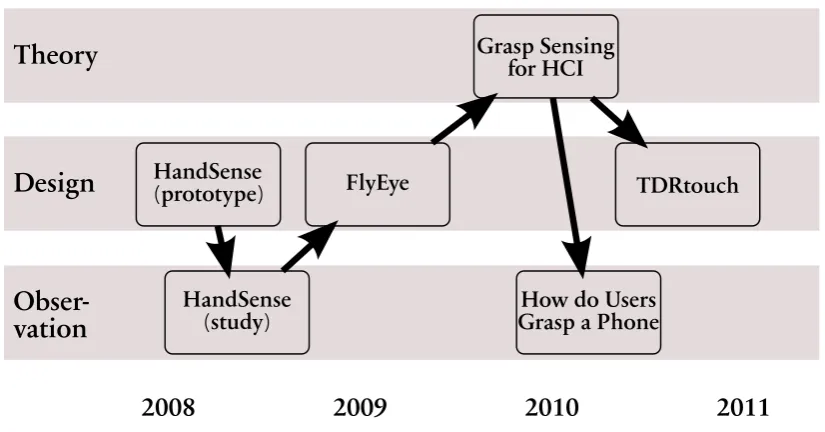
Mackay and Fayard (1997) propose a triangulationframework for scientific research in HCI which comprises three main classes of research: theory, design, and observation. Research within each of these classes inspires and requires research within the other classes. The framework allows for structuring the individual steps that comprise this dissertation (Figure 1.1).
HandSense (Wimmer and Boring 2009) - the first of three hardware prototypes devel-oped for this dissertation - was originally intended as a proof-of-concept application for CapSense - a capacitive sensing toolkit I developed from 2006 to 2008. The user study, a demonstration at TEI 2009, subsequent discussions, and a literature review on this topic shaped subsequent research.
As it became apparent that research pertaining to grasp interaction was scattered across several, isolated disciplines, gathering and organizing this research was necessary. Pre-liminary results and thoughts were first published in my paper “Grasp Sensing for Human-Computer Interaction” (Wimmer 2011a).
The literature review also showed that research on grasp sensing was mainly technology-driven. In order to allow non-technical scientists to contribute to this re-search area, easily adaptable prototyping techniques are required. My rere-search on such techniques (Wimmer and Boring 2009; Wimmer 2010a; Wimmer and Baudisch 2011) in-formed my theoretical research in turn.
Theory
Design
Obser-vation
2009
2010
2011
HandSense (prototype)
HandSense (study)
2008
FlyEye TDRtouch Grasp Sensing
for HCI
How do Users Grasp a Phone
Figure 1.1:Timeline of my research on grasp interaction, loosely based on thetriangulation
framework by Mackay and Fayard (1997).
on variability in grasps (see Section 2.4) and proposed a descriptive model of meaning in grasps (Wimmer 2011a).
This dissertation links the findings together and gives a thematic structure to the insight that I experienced in chronological order.
1.4
Structure of the Dissertation
The dissertation is organized into three major parts, each comprised of multiple chap-ters:
Part I, Introduction and Related Work, continues with an overview of human grasping, grasp taxonomies, and research on everyday grasping (Chapter 2).
Chapter 3 introduces the focus of my research, presenting a new, interaction-centric definition of grasping, important definitions, and a generic grasp sensing workflow.
In Chapter 4 I give a comprehensive and in-depth overview of previous research on grasp sensing and discuss properties and limitations of existing approaches.
Part II,Technologies for Grasp-Sensitive Surfacescomprises descriptions and discussions of three grasp sensing techniques that I designed, implemented, and evaluated:
1.4 Structure of the Dissertation 9
FlyEye (Chapter 6), a rapid prototyping technique using optical fiber which does not require an understanding of electronics, and
TDRtouch(Chapter 7), which allows for sensing multiple simultaneous touches along a single cable.
In Chapter 8 I discuss and compare the properties of these techniques.
Part III,Towards Grasp Interaction, discusses important issues on the path from reliable grasp sensing to rich grasp interaction.
Chapter 9 gives an introduction into challenges and promising approaches in grasp in-teraction.
Chapter 10 introduces a yet unpublished study investigating how users grasp a mo-bile phone, showing that grasps vary significantly between individuals even for simple, constrained everyday tasks.
Chapter 11 presents GRASP, a descriptive model of meaning in grasps, which allows for discussing and analyzing human grasping and serves as a framework for developing grasp-sensitive applications.
Chapter 12 discusses the relationship between grasp interaction and other interaction paradigms, such as tangible interaction. It also contains a list of design suggestions for grasp-sensitive applications.
A final discussion concludes the dissertation (Chapter 13).
Most of my research has already been published in peer-reviewed venues. Therefore, this thesis explicitly builds upon these publications. The theoretical concepts and use cases presented in this thesis were developed in conjunction with the hardware proto-types, and were therefore originally distributed across different publications. To ease reading, I have collected theoretical discussion, concepts, and use cases in separate, co-hesive chapters. Each chapter has a short summaryat its beginning that is intended to aid in skimming the thesis.
While I am the sole author of this dissertation, it is based on previous publications and the work I did together with others. Therefore, each chapter also contains anattribution
paragraph that references the publications and persons that contributed to the research described in the chapter.
All websites mentioned in footnotes within this dissertation have been archived with WebCite1. To access the archived copies, prepend http://www.webcitation.org/query?date=2015-04-19&url= to the URL (without the “http://” protocol identifier).
Chapter
2
Human Grasping
This chapter gives an overview of research on human grasping. Since the beginning of the 20th century, researchers have proposed classification, taxonomies, and models for describing grasps. Napier (1956) proposed the most commonly cited distinction betweenpower graspsinvolving the palm andprecision graspsinvolving only the fingertips. Feix et al. (2009b) collected and consolidated many existing classification schemes for human grasps into a common taxonomy containing 33 distinct grasp types. While research on human grasping was driven by rehabilita-tion medicine in the first half of the last century, neuroscience and robotics have since contributed greatly to our knowledge. Only recently, grasping has become a topic of research within the human-computer interaction community. A small number of studies have investigated grasping in everyday situations. They found a much greater diversity of grasps than existing taxonomies propose. Grasp variability, i.e. how much a grasp changes when repeated, depends on the person, the object, and on how frequently the grasp is conducted.
Attribution: Parts of this chapter are based on my paper “Grasp Sensing for
Human-Computer Interaction”. The extensive discussions of related work by MacKenzie and Iberall (1994) and Feix (2011) probably influenced which publications I chose to present in detail.
2.1
The Human Hand
“Die Hand macht den Menschen, das vernünftige Tier, geschickt für die Handhabung aller Dinge; sie ist sein äußeres Gehirn”
Immanuel Kant, as cited by (Schlesinger 1919, p.321)
2.1) . The thumb is opposable which means that it can be positioned in a certain way so that its tip opposes the other fingertips. This allows the hand to grasp objects be-tween the thumb and the other fingers. Hand size varies significantly bebe-tween humans, depending on age, sex (Dreyfuss 1966), nationality (Imrhan 2000), occupation, and pos-sibly other factors. Average hand length within the U.S. male/female adult population is approximately 19/17.5 cm; average hand width is 10/8.5 cm (Dreyfuss 1966).
wrist
distal phalanges (tips)
intermediate phalanges
proximal phalanges
palm (incl. metacarpal
and carpal bones)
thumb
index
finger
middle
finger
ring
finger
little
finger
Figure 2.1: The human hand has a palm and five fingers. The thumb consists of two pha-langes (finger bones), whereas the other fingers consist of three phapha-langes. The wrist con-nects the hand to the lower arm. Illustration adapted from Jackson (1865) (Public Domain).
When discussing the anatomy and movements of the hand, directions are designated by the termspalmarorvolar(referring to the inside of the hand),dorsal(back of the hand),
distal(towards the fingertips) andproximal (towards the wrist). Adductiondescribes the act of closing the fingers together so that their sides touch each other. Abduction de-scribes the act of spreading the fingers. Flexionmeans bending the fingers inwards to-wards the palm. Extensionmeans bending the fingers outwards into a straight posture (Figure 2.2). For further reference, Jones and Lederman (2006) discuss anatomy and function of the human hand in great detail.
2.2 What Does “Grasping” Mean? 13
proximal
a)
b)
fingers extended, abducted
palmar/
volar
distal
dorsal
fingers flexed, adducted
Figure 2.2: All fingers of the human hand can be extended (a) or flexed (b). Furthermore, fingers can be abducted (i.e. spread, a) or adducted (b). The terms palmar/volar, dorsal, distal, and proximal indicate directions on the hand. Illustrations adapted from Jackson (1865) (Public Domain).
MacKenzie and Iberall (1994 p.6) claim that grasping a tool enhances either the hand’s power or its precision. It can be argued that tools enhance the hand in even more ways. They also change the rigidity (hammer) and shape (screwdriver) of the contact area between human and object. Hand-operated controls are also used for steering automo-biles, ships, and aircraft, combining a human’s perception and information processing with a machine’s power, precision, and speed. During the last century, hand-held tools also started to improve our cognitive capabilities. Pocket calculators, mobile phones, music players, digital cameras, or computer mice changed the way we process and cre-ate information.
2.2
What Does “Grasping” Mean?
sie durch die Umspannung des Werkzeuges ein Ganzes bildet.”
Schlesinger (1919), p.322
As the Latin roots of the word definition suggest, the goal of a definition is to include certain concepts and exclude others, precisely delimiting what falls within the definition and what not. However, in reality, numerous imprecise - often contradicting - definitions exist for most concepts. This circumstance may have different reasons. There might be disagreement between researchers whether certain border-cases should be included in a definition or not, resulting in competing definitions. Sometimes, different terms are used for describing the same concept. Often, incompatible definitions of the same concept emerge in different fields of science in parallel.
In the following, I discuss different definitions of “grasping” from related work and provide an own definition based on the functions of a grasp.
2.2.1
Grasping, Gripping, and Prehension
The substantivesgripandgraspand their accompanying verbs are both used regularly to describe the same or similar states and actions1.
The American Heritage Dictionary (2011) offers the following definitions forgraspand
grip:
grasp: “[a] firm hold or grip”
grip: “[a] tight hold; a firm grasp”
This recursive (and slightly nonsensical) definition implies that both terms may be used in place of each other.
There seems to be a preference for employing the term grasping for thedynamic act of reaching for an object and closing the fingers around it , whereasgrippinghas more of a
staticconnotation, describing only the act of holding an object.
Grasp seems to be more prevalent than grip in robotics research. In human-computer interaction, there seems to be no clear preference for either term. For example, Kry and Pai (2006a) and Taylor and Bove (2009) choosegraspwhereas Veldhuis et al. (2004) and Kim et al. (2006) prefergrip. I have usedgripin my first paper on this topic (Wimmer and Boring 2009) but switched tograspin subsequent publications (Wimmer 2010a; Wimmer 2011a; Wimmer 2011b; Wimmer and Baudisch 2011).
1 As of 25.01.2013, Google Scholar lists 668,000 hits for the search terms ‘grasp hand’ and 697,000 hits for ‘grip
2.2 What Does “Grasping” Mean? 15
Prehensionis another term that is regularly used instead ofgraspingin the life sciences.
Again, the American Heritage Dictionary (2011) offers little help in determining seman-tical differences between both terms:
prehension: “[t]he act of grasping or seizing.”
Other dictionaries contain very similar definitions. The termprehensionis rarely used in human-computer interaction and robotics.
Overall, there seem to be few commonly accepted semantic differences between grip-ping, grasping, and prehension. Researchers usually choose one of the three terms with-out justifying their choice, or use the terms interchangeably2. To my knowledge, the distinction between those terms has not been discussed in scientific literature. To avoid ambiguity,graspandgraspingare used throughout this dissertation.
2.2.2
Grasp Phases
Many researchers describe grasping as an action composed of three phases (Kang and Ikeuchi 1991; Jones and Lederman 2006, p.101):
• pre-grasp or reaching phase, wherein the hand is being moved towards the object
and assumes a compliant posture
• grasp phase, wherein the fingers close around the object, and
• manipulation phase, wherein the grasped object is used or manipulated.
There has been some discussion on whether the reaching phase (often also called reach-to-grasp movement) and the grasp phase might be better described as one combined movement. Jeannerod (1986) argues that both are distinct, as experiments show that the characteristics of the reaching motion are determined only by the object’s location while the grasping movement is determined only by the object’s intrinsic properties. Whether both motions are really controlled separately has been a topic of discussion since (Smeets and Brenner 1999; Kamp and Zaal 2007). Unless explicitly mentioned, the research presented in the following pertains to grasp phase and manipulation phase.
2 For example, Kroemer (1986) (who proposes a classification of grasps without referencing relevant earlier work)
2.2.3
Existing Definitions for
Grasping
Most publications discussing grasps do not propose or reference a definition of their subject. However, there are a few exceptions:
Cutkosky (1989) define agraspas
“a set of contacts on the surface of the object”
This or a similar definition can be found in various other robotics papers. In contrast to most other definitions, it does not require a human hand (or any hand at all) to be involved.
Despite naming their book “The Grasping Hand”, MacKenzie and Iberall do not pro-vide a definition of grasping. However, they propose an extremely broad definition of
prehension(MacKenzie and Iberall 1994, p.6):
“the application of functionally effective forces by the hand to an object for a task, given numerous constraints”
They note that prehensile behavior can also be accomplished by other body parts, such as tails, tongues or teeth (MacKenzie and Iberall 1994, p.6).
Feix et al. (2009a) define agraspas:
“every static hand posture with which an object can be held securely with one hand, irrespective of the hand orientation.”
In his subsequent PhD thesis, Feix (2011) concedes that this definition excludes grasps with intrinsic hand movements, bi-manual grasps, and grasps where the object is held to the hand only due to gravity. Due to these restrictions, Feix states that“[f]or the remainder of the thesis the term grasp will refer to all kind of grasps, not only ones that are in accordance with the grasp definition.”(Feix 2011, p.31)
Böhme (2011) offers a relatively precise definition ofgraspingin his dissertation on grasp affordances:
2.3 Grasp Taxonomies and Descriptions 17
He notes that this definition is intentionally restricted to one hand and does not cover
form closuregrasps such as thehook grasp3.
In Section 3.3 I analyze limitations of these definitions and provide a new, interaction-centric definition. Until then, any of the aforementioned definitions is sufficient. How-ever, the following terms will be used throughout this dissertation to reduce ambiguity:
specific grasp a unique grasp, i.e. a concrete grasp that can be observed (used for em-phasizing the distinction to a grasp type).
grasp type an abstraction of a grasp which comprises functionally or anatomically simi-lar specific grasps.
hand posture a certain configuration of finger joints - which is not necessarily a grasp as the hand might not be in contact with an object.
2.3
Grasp Taxonomies and Descriptions
Over the last 100 years, researchers have proposed a variety of approaches for describ-ing and classifydescrib-ing grasps. These can roughly be divided intaxonomies- which arrange exemplary phenotypes of grasps in a hierarchical tree structure - and descriptive models
which offer a method for describing arbitrary grasps based on their properties. With taxonomies, authors usually present a set of grasp types and argue that this set covers most or all grasps, and that all grasp types are distinct. Taxonomies and descriptions are usually invented for a specific purpose, such as identifying which types of grasps an artificial hand has to implement. Therefore, different areas of research prefer different taxonomies and descriptions. Both taxonomies and descriptions generally focus on de-scribing static grasps. Reaching phase and manipulation phase are generally excluded.
Most of the taxonomies have also been incorporated into the comprehensive grasp tax-onomy assembled by Feix et al. (2009b). It condenses 147 descriptions of grasps found in 17 publications into a set of 33 unique grasps. Grasps are classified by Napier’s power/precision distinction, opposition type, thumb position, and involved fingers . The hook grasp is not included because the taxonomy requires at least two contact sur-faces to apply opposing forces.
While the hand’s anatomy has been subject of research for centuries4, scientific interest into human grasping increased greatly during and after World War I, when surgeons and engineers had to develop prosthetic arms and hands for mutilated veterans. In or-der to define which actions a prosthetic hand should be able to perform, it was necessary to first describe existing grasps whose functions should be replicated.
3 see Section 2.3.
4 While Bell (1833) seems to be the first scientific publication on the anatomy of the human hand, it does not
In a talk given in 1915, Bonnet distinguishes two functionally different types of grasps: plier grasps (“Zangengriff”) involving the thumb and one or more other fingers, and hook grasps (“Hakengriff”) which do not involve the thumb (Bonnet 1915, p.9).
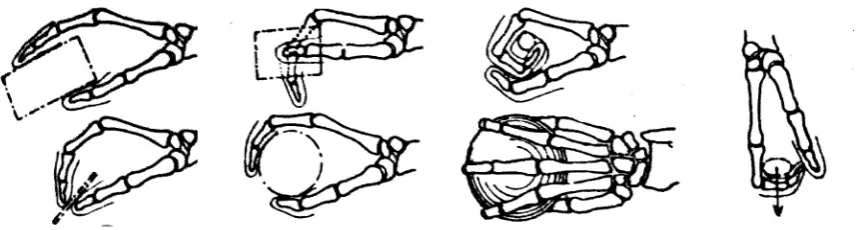
Figure 2.3: Schlesinger’s list of unique grasps that an artificial hand should be able to conduct. Illustration slightly adapted from (Schlesinger 1919, 503)
Schlesinger (1919) whose focus of research was the construction of artificial limbs -is generally seen as the first author to present a systematic l-ist of functional grasps5. He identified twelve grasps which were often used in everyday tasks. Several of them are very similar. From these grasps Schlesinger selected seven grasps that an artificial hand should be able to conduct (Figure 2.3). He not only consolidated similar grasps but also eliminated grasps which he believed an artificial limb would not need to be able to conduct. This included grasps which could be conducted as well with the other, healthy hand. Another grasp - holding a file - was eliminated from the list of grasps because Schlesinger thought that an artificial hand would not be well-suited for this task. Although Schlesinger’s list is sometimes described as a taxonomy of human grasps (Heumer et al. 2007; Saponas et al. 2009; Feix 2011), it is not a taxonomy, as it does not describe a hierarchy or grouping of grasps. It also does not pertain to human grasps but to selected grasps for artificial limbs.
Slocum and Pratt (1946) define three fundamental hand functions: grasp(involving the palm),pinch(involving the fingertips), andhook(“simply what the word implies”).
Napier (1956) published the most widely cited scientific classification of grasps by dis-tinguishing between precision grips which only involve the finger tips and power grips
5 To my knowledge, my dissertation contains the first correct illustration of Schlesinger’s list of grasps. Schlesinger’s
work was incorrectly summarized by Taylor and Schwarz (1955), who claim to show six basic grasps “as defined by Schlesinger” whereas Schlesinger proposes seven basic grasps (Schlesinger 1919, p.503). Additionally, two of Schlesinger’s original grasps cannot be found in the list by Taylor and Schwarz. They also attribute a “tip grasp” to Schlesinger which is not actually in Schlesinger’s list. Most authors refer to this summary when citing Schlesinger. Not all authors make clear that they follow Taylor and Schwarz, however.
2.3 Grasp Taxonomies and Descriptions 19
which involve the palm of the hand. This basic distinction has found wide-spread ac-ceptance6. As Böhme argues, Napier did not merely give new names to Slocum and Pratt’s grasps. Instead, “Napier focused his classification on the question why certain prehensile actions are chosen instead of only asking which prehensile postures the hu-man hand can adopt” (Böhme 2011, 10)
Napier also presents examples of specific grasps for both classes. Often, a screwdriver is used as an example for a tool that can be held in a tight power grasp for hard work but also in a precision grasp between fingertips for fine manipulation.
However, Landsmeer (1962) argues that the term precision grip is misleading. To Landsmeer, a precision gripis intended for manipulating the object being held. There-fore, Landsmeer argues, it is not sensible to distinguish between a static precision grip and a dynamic manipulation phase. He proposesprecision handlingas a better term. This re-definition has not been widely accepted, however.
Another approach for classifying grasps is to distinguish betweenform closureandforce closure. Both Bicchi (1995) and Ponce et al. (1997) note that this distinction has been commonly accepted for some time, without providing a source. Form closure grasps are grasps that restrict an object’s movement by obstructing all directions in which the object might move. No force has to be exerted at the contact points. An example of a form closure grasp is holding a small marble in the palm of the hand with all fingers closed around it. In contrast,force closuregrasps depend on friction at the contact points. To effect this friction, the fingers have to exert force. An example of a force closure grasp is holding a small marble between thumb and index finger.
Arbib, Iberall, and Lyons (1985) propose a simplified, functional description of grasps using virtual fingers. They argue that force closure grasps can be modeled as just two virtual fingers , VF1 and VF2 which hold an object by exerting opposing forces on it. Sometimes, a third virtual finger, VF3, may be used for stabilizing the grasped object. A virtual finger may be either the thumb, one or more fingers, or the palm. For example, when holding a pen, thumb and index finger act as VF1 and VF2. The middle finger acts as VF3, stabilizing the pen.
Cutkosky and Wright (1986) argue that “when people use objects in everyday tasks, the choice of grasp is dictated less by the size and shape of objects than by the tasks they want to accomplish”. Therefore, “grasps should be categorized according to function instead of appearance”. They propose a taxonomy that organizes 16 functionally differ-ent types of grasps within a tree which is arranged along two axes: power vs. precision
andtask-oriented vs. object-oriented.
Cutkosky and Wright concede that their classification does not cover all possible grasp
6 However, researchers sometimes redefine the meaning of these two categories to better fit their goal. For example,
Mortensen and Bærentsen (2013) write:“A precision grasp is defined as one or more fingers on the remote control
buttons. A power grasp is defined as all fingers locked around the remote control.”. While these definitions are
types. However, they argue, any other potential grasp can be replaced by a function-ally equivalent grasp from their taxonomy. Therefore, they deem their list of grasps as sufficient for discussing new designs for artificial limbs or robotic grippers.
Kang and Ikeuchi (1991) argue that previous grasp classifications do not aim to describe actual grasps but rather tell which grasps might be used for a certain task or object. They present a method for describing arbitrary grasps using acontact web. The contact web is a data structure containing acontact pointfor each finger segment that is in contact with the grasped object. For each contact point, the 3D position is recorded. A specific grasp is represented as a set of contact points, the contact web. Building upon this concept, Kang and Ikeuchi also describe a method for recognizing certain grasp types based on their associated contact web. To this end, contact points are algorithmically clustered into virtual fingers. The arrangement of the virtual fingers is then translated into one of the grasp types proposed by Arbib, Iberall, and Lyons (1985). However, the contact web does not describe all aspects of a grasp. Neither size of the contact area nor grasp force are included in the model. In addition, the contact web does not distinguish between the sides of a finger segment. This means that a cigarette held between index and middle finger and a pen lying on the middle segments of both fingers would result in the same contact web. Overall, the contact web is the most precise formal description of grasps published so far7.
To generate the aforementioned taxonomies and models, scientists merged and ab-stracted specific grasps that they assumed to be representative of human grasps in gen-eral. However, almost none of the existing taxonomies are based on a collection of spe-cific grasps recorded ‘in the wild’. For example, Schlesinger simply posits that the 13 specific grasps shown in Figure 309-321 of his work (Schlesinger 1919, 500) ‘show the hand in its most important usage postures’ (“Gebrauchsstellungen”) (Schlesinger 1919, 501). Other researchers asked study participants to grasp predefined objects in labo-ratory settings (Kamakura et al. 1980). A notable exception are Cutkosky and Wright (1986) who show twelve grasps that they observed being employed by machinists dur-ing their work. These grasps are then organized in the presented taxonomy. However, Cutkosky and Wright do not mention whether these 12 grasps were indeed the only grasps they observed, or how prevalent they were.
In summary, there exists a diverse set of tools for describing and classifying grasps. In particular, the comprehensive grasp taxonomy by Feix et al., and thecontact webmodel by Kang and Ikeuchi offer a precise language for characterizing grasps8. However, tax-onomies only tell little about the importance, prevalence, and usage of different grasps.
7 While not focused on grasps but on hand postures in general, the “Natural Human Hand Model” (NHHM) (Nierop
et al. 2008) allows for meticulously describing the exact hand posture used for a grasp. The NHHM takes into account the constraints of each joint within a hand and also the hand’s skin.
8 See also the Columbia Grasp Database,http://grasping.cs.columbia.edu/, a database containing 3D
2.4 How Do People Grasp? 21
2.4
How Do People Grasp?
In order to design and implement interactive systems that employ grasping as an input modality, it is important to know how people actually grasp, instead of defining grasp types that trigger specific actions. This understanding is necessary for four reasons:
• First, grasp interaction should not accidentally overlap with everyday grasping.
For example, simply picking up an object in order to look at it should not trigger any explicit reaction of the object in most cases.
• Second, there might be certain commonly employed grasp types which lend
them-selves to be used as intuitive triggers for certain actions. For example, holding a mobile phone in a landscape orientation with both hands might be a universally understood action for activating the phone’s camera application.
• Third, grasps of a certain object by a single user may vary significantly depending
on the user’s physical and mental state, external conditions, and time. Training a grasp-classification algorithm using only data from a single training session can result in bad recognition performance in different settings.
• Fourth, grasps might significantly differ between users, even when conducting the
same tasks. Designing grasp interaction based on the preferred grasps of a single user could result in grasps that a majority of users do not see as natural.
These issues lead to two basic questions that need to be answered:
a) Which grasps do people employ in everyday situations?
b) How similar are grasps of a single user or of a group of users across multiple interactions with an object?
The implications of these questions for grasp interaction are discussed in more detail in Chapter 9.
For many of the taxonomies presented in the previous chapter, the creators apparently did not conduct surveys but used their own imagination to determine ‘common’ grasp types. However, other researchers have investigated everyday human grasping and grasp variability in more detail. A small number of field studies have been conducted in order to analyze everyday grasping. In these cases, video recordings of manual actions were annotated with the observed grasp types. For determining how variably persons grasp specific objects, controlled laboratory experiments were conducted where partici-pants’ hands can be tracked or photographed more reliably.
2.4.1
Grasping in Everyday Tasks
A common approach for classifying everyday grasps is to record a person doing manual tasks on film or video. This is then annotated by one or more researchers who mark duration and/or type of each grasp recognized in the video9.
Sperling and Jacobson-Sollerman (1977) conducted a study investigating common grasps while serving food, eating, and drinking. 30 study participants (15 female, 5 left-handed) were filmed eating a “normal meal” - sliced meat, salad, a beverage, dessert, coffee, and cake. The films were manually annotated, resulting in 1277 coded grasps. Participants were instructed grasp each of the 15 different involved objects - includ-ing cutlery and porcelain but also e.g., a lump of sugar - at least three times durinclud-ing the “meal”. Symmetrical objects were selected to avoid influencing which hand was used. The three most common grasps for each object were documented. Sperling and Jacobson-Sollerman devised their own classification scheme, distinguishing between three general grasp types. A “volar grip” involving the palm, a “finger grip” involving only the fingers, and a “web-of-thumb grip” involving the dorsal area between thumb and index finger. The first two grasp types are similar to Napier’s power grasp and precision grasp. Furthermore, contact surface between hand segments and objects were documented.
While 77% of all grasps were conducted with the dominant hand, left-handed partici-pants employed their left hand only in 68% of the grasps they performed. Sperling an Jacobson-Sollerman suggest that “it may be assumed that left-handed persons, through continuous social influence, will have learned to use their right hand to a greater extent than their hand dominance originally allowed”.
Thumb and index finger were involved in almost all grasps, the middle finger in 95% of all grasps. The other two fingers were used rarely and mostly to provide additional support.
In an unpublished experiment, Feix and Jaworski (2009) investigated which types of grasps a (single) user employed while performing everyday tasks. These tasks included putting dishes into a dishwasher or using a garden hose. The captured video was man-ually annotated with information about each visible grasp10. In the analyzed video seg-ment of 32 minutes length, 208 grasps were annotated (6-7 unique grasps per minute). Four grasp types accounted for 67% of all grasps: Large Diameter , Prismatic 4 Finger , Lateral , and Extension Type according to Feix’ taxonomy. At least for objects weighing less than 1000 g, Feix and Jaworski could not find an obvious effect of object weight on the employed grasp type. However, they found that theLarge DiameterandPrismatic 4
9 There are also other approaches, as discussed in Chapter 4. For example, Ingram et al. (2008) recorded hand
postures in everyday settings using data gloves. In personal communication (e-mail, 27.07.2010), Ingram was skeptical about extracting grasp information from the data. As they did not measure contact forces, he deemed it very difficult to determine whether a certain hand posture belonged to a grasp. Ingram declined to share raw data.