Conditional Reactive Simulatability
Michael Backes1, Markus Dürmuth1, Dennis Hofheinz2, and Ralf Küsters3
1
Saarland University,{backes|duermuth}@cs.uni-sb.de 2
CWI, Cryptology and Information Security Group, Prof. Dr. R. Cramer,[email protected] 3
Christian-Albrechts-Universität zu Kiel,[email protected]
Abstract. Simulatability has established itself as a salient notion for defining and proving the security of crypto-graphic protocols since it entails strong security and compositionality guarantees, which are achieved by universally quantifying over all environmental behaviors of the analyzed protocol. As a consequence, however, protocols that are secure except for certain environmental behaviors are not simulatable, even if these behaviors are efficiently identifiable and thus can be prevented by the surrounding protocol.
We propose a relaxation of simulatability by conditioning the permitted environmental behaviors, i.e., sim-ulation is only required for environmental behaviors that fulfill explicitly stated constraints. This yields a more fine-grained security definition that is achievable i) for several protocols for which unconditional simulatability is too strict a notion or ii) at lower cost for the underlying cryptographic primitives. Although imposing restrictions on the environment destroys unconditional composability in general, we show that the composition of a large class of conditionally simulatable protocols yields protocols that are again simulatable under suitable conditions. This even holds for the case of cyclic assume-guarantee conditions where protocols only guarantee suitable behavior if they themselves are offered certain guarantees. Furthermore, composing several commonly investigated proto-col classes with conditionally simulatable subprotoproto-cols yields protoproto-cols that are again simulatable in the standard, unconditional sense.
1 Introduction
As a tool to define and prove the security of cryptographic protocols, the concept of simulatability has a long history, e.g., [34, 23, 22, 10, 30]. In recent years, in particular the general simulatability frameworks of reactive simulatability [7, 5] and universal composability [13, 15] proved useful for analyzing security properties of cryptographic protocols in distributed systems. In such a simulatability framework, a protocol is compared to an ideal specification of the respective protocol task, usually given by a single machine called trusted host that is immune to any adversarial attacks by construction. A protocol is said to be secure, if for every adversary interacting with the real protocol there exists another adversary interacting with the ideal specification such that no protocol environment can distinguish the ideal specification (with the ideal adversary) from the real implementation (with the real adversary). This essentially means that every attack that an adversary may successfully mount against the real implementation can be mounted as well against the ideal specification. In that sense, the real protocol is at least as secure as the ideal specification.
This definition is very appealing due to its simplicity, and at the same time it provides very strong security guarantees. Specifically, both mentioned frameworks allow for very general composition theorems (see, e.g., [32, 13, 6]). In a nutshell, these theorems guarantee that a secure protocol can be composed with arbitrary other protocols and still retains its security. These strong results are essentially entailed by the universal quantification over all protocol environments. However, such strong compositionality properties are bought at the price that several protocol tasks are not securely realizable at all in the sense of simulatability. This includes important cryptographic tasks such as bit commitment, zero-knowledge, oblivious transfer [16, 13], and (authenticated) Byzantine agreement [29], classes of secure multi-party computation [17], classes of functionalities that fulfill certain game-based definitions [18], and Dolev-Yao style abstractions of symmetric encryption, XOR, and hash functions [2, 3, 8].
restricted adversary models and thus in less realistic scenarios. A more detailed review of related work is given below.
Our Contribution. In this paper, we also endeavor to circumvent a specific class of the aforementioned
impossibility results, namely those that arise due to certain environmental behaviors that cannot be prop-erly simulated. The prime example contained in this class is Dolev-Yao style symmetric encryption, i.e., symbolic abstractions of symmetric encryption as constructors of a term algebra with a small set of alge-braic properties. This kind of encryption can only be correctly simulated if the protocol using the encryption scheme does not cause a so-called commitment problem. Our approach for circumventing impossibility in these cases does however not follow the prevalent idea of augmenting or constraining the capabilities of the adversary. Instead, we limit the number of protocol environments in which a protocol is required to be secure. This idea applies particularly nicely to protocols that can be securely realized except for certain dis-tinguished environmental behaviors, especially if these behaviors are efficiently identifiable and thus can be prevented by the surrounding protocol; among others, Dolev-Yao style symmetric encryption is of this kind. The resulting security notion is named conditional reactive simulatability. In addition to circumvent known impossibility results for unconditional simulatability, the notion of conditional reactive simulatability may also allow for securely realizing ideal functionalities at lower cost on the underlying cryptographic prim-itives. For instance, if Dolev-Yao style symmetric encryption permits the construction of key cycles, e.g., encrypting a key with itself, it is only securely realizable by encryption schemes that fulfill certain strong, non-standard assumptions such as dynamic KDM security [4]. When, however, conditioning the function-ality to those cases that exclude key cycles, successful simulation based on weaker, more standard security notions such as IND-CCA2 security is possible.
Despite imposing restrictions on the surrounding protocol and thus giving up the universal quantifi-cation of environments that allows for general compositionality, we show that the notion of conditional reactive simulatability still entails strong compositionality guarantees. More specifically, we prove that if one composes protocols each of which is conditionally simulatable provided that their surrounding proto-col fulfills an arbitrary trace property, and if these properties do not give rise to cyclic dependencies, then the composition of these protocols is conditionally simulatable under natural conditions on the (overall) surrounding protocol. Technically, the theorem establishes a cryptographic statement on the acyclic compo-sition of assume-guarantee specifications, i.e., specifications that guarantee suitable behaviors only if they themselves are offered suitable guarantees. Assume-guarantee specifications have been well investigated in the past, mostly for non-security-specific contexts [31, 26, 1, 20] but also specifically for security aspects [24] (but without investigations of simulatability and composition). The postulation of acyclicity applies to most cases in practice, e.g., to protocols that provide specific security guarantees to their subprotocols without making these guarantees dependent on the outputs they obtain from these subprotocols.
Interestingly, we can even prove compositionality for cyclic dependencies of such specifications, i.e., compositions of protocols that mutually promise to adhere to a certain behavior only if they mutually receive guarantees from each other. This case is technically more demanding since an inductive proof by proceeding through the acyclic dependency graph as done in the proof of the acyclic case is no longer possible. In fact, it is easy to show that for cyclic dependencies, subprotocols that are conditionally simulatable under arbitrary trace properties might not be securely composable. However, we show that the theorem for the acyclic case can be carried over to the cyclic case if one constraints the protocols to be conditionally simulatable under safety properties. Safety properties arguably constitute the most important class of properties for which conditional simulatability is used, especially since liveness properties usually cannot be achieved unless one additionally constraints the adversary to fair scheduling.
Our results are formalized in the Reactive Simulatability framework. However, we do not use any spe-cific characteristics of this framework, so our results can naturally be carried over to the Universal Compos-ability framework.
Related Work. As mentioned already, there have been several attempts to relax simulatability to avoid
impossibility results. The work closest to ours is the work on proving Dolev-Yao style symmetric encryption sound in the sense of simulatability [2]. There it was shown that Dolev-Yao style symmetric encryption can be securely realized if the environmental protocol does not cause the commitment problem and in addition key cycles are excluded. This definition thus constitutes a special case of conditional reactive simulatability yet without investigating more general conditions or corresponding compositionality aspects. Nevertheless, our work is inspired by their idea of augmenting simulatability with conditions on environments.
The impossibility of simulating a specific bit commitment was shown in [16]. The remedy proposed there was to augment the real protocol with certain “helping trusted hosts” which are, by definition, immune to any attack on the real protocol; thus, effectively this weakens the real adversary. More specifically, [16] presented simulatably secure protocols for bit commitment and zero-knowledge. However, these protocols rely on a so-called Common Reference String (CRS), which is a form of a trusted setup assumption on the protocol participants. In a similar vein, [17] shows that basically every trusted host can be realized using a CRS as a helper functionality. One point of criticism against the CRS approach is that the proposed protocols lose security in a formal and also very intuitive sense as soon as the CRS setup assumption is invalidated. The related approach [25] uses a Random Oracle (RO) instead of a CRS to help real protocols achieve simulatable security. The benefit of their construction is that the proposed protocols retain at least classical (i.e., non-simulatable) security properties when the RO assumption is invalidated. However, also there, simulatability in the original sense is lost as soon as this happens.
In [33], the real and ideal adversaries are equipped with a so-called imaginary angel. This is an oracle that (selectively) solves a certain class of hard computational problems for the adversary. Under a very strong computational assumption, this notion could be shown to avoid known impossibility results for simulatabil-ity. Yet, as the imaginary angels behave in a very specific way tailored towards precisely circumventing these impossibility results, e.g., these angels make their response dependent on the set of corrupted parties, the model might be considered unintuitive.
In [9], it is shown how to realize any trusted host in a simulatable manner, if the ideal adversary is freed from some of its computational restrictions. In the process, several highly sophisticated constructions are used to implement, e.g., a simulatably secure Zero-Knowledge proof system. The eventual result of their construction is a class of protocols for, in the style of [17], realizing basically any trusted host. However, it is substantial that in their security notion, the ideal adversary is not restricted to polynomial-time, but the real adversary is. So in particular, the security notion they consider is not transitive and it is generally not easy in their framework to construct larger protocols modularly.
Outline. We first review the underlying Reactive Simulatability framework in Section 2 and subsequently
define the more fine-grained version of conditional reactive simulatability in Section 3. The bulk of the paper is dedicated to the investigation of the compositionality aspects of this new security notion for both acyclic and cyclic assume-guarantee conditions, which is done in Section 4. The usefulness of conditional reactive simulatability is further exemplified in Section 5 by showing how this notion can be exploited to cryptographically justify common idealizations of cryptography. Section 6 concludes.
2 Review of the Reactive Simulatability Framework
2.1 Overall Framework
A protocol is modeled as a structure (M, S) consisting of a set of protocol machines and a set of service
ports, to which the protocol user connects1. Machines are probabilistic, polynomial-time I/O automata, and are connected by ports. The model differentiates in-ports and out-ports, where each out-port is connected to exactly one in-port by naming convention. Moreover, in- and out-ports may be service or non-service ports. In what follows, bySinwe denote the service in-ports ofS and bySC,outthe complement ofM’s service out-ports, i.e., the set of service in-ports of machinesMconnects to.
Two structures(M1, S1)and(M2, S2)are composable iff they connect through their respective service
ports only. Their composition is given by(M1∪M2, S)whereSincludes all ports fromS1andS2that are
not connected to another machine inM1∪M2.
A set of machinesM is closed iff all ports are connected to corresponding ports of machines that are in the same set. A structure can be complemented to a closed set by a so-called honest userHand an adversary
A, whereHconnects to service ports only, andAconnects to all remaining open ports, and both machines may interact. The tuple(M, S,H,A)is then called a configuration of(M, S)where one of the machinesH
orAplays the role of the master scheduler, i.e., if no machine was activated by receiving a message, the master schedule is activated. A closed setC is a runnable system. The transcript of a single run is called a
trace (often denoted by t and decorations thereof) and is defined to be a sequence of transitions performed
by the machines. A transition of a machineMis of the form(p, s, s′, p′)wherepdescribes the in-ports ofM
along with the current message written on these ports,sis the current configuration ofM,s′ is a successor configuration (computed depending onpands), andp′are the out-ports along with the output produced. We denote byrunC,k the distribution of traces induced by runs ofCwith security parameterk. The restriction
t⌈Sof a trace t to a set of in-portsSis defined in the obvious way. (Note that t⌈S only depends on the first component (p) of the transitions of t). Now,runC,k⌈Sdenotes the distribution of the traces induced by runs ofCwith security parameterkwhen restricted toS. The restriction of a trace t to a machineMis obtained from t by removing all transitions not done byM. Now, the distribution of such traces givenkis denoted by viewC,k(M). We refer to thek-indexed family{viewC,k(M)}kof these views byviewC(M).
2.2 Simulatability
Simulatability is used in different areas of cryptography. Informally speaking, for reactive systems it says that whatever might happen to a protocol (M, S) can also happen to another protocol(M′, S). Here both protocols need to have the same set of service ports S to allow for a meaningful comparison. Typically,
(M′, S)is an idealization, or specification, of the protocol task that(M, S)is to implement. We therefore call
(M, S)the real and(M′, S)the ideal protocol. For simulatability one requires that for every configuration
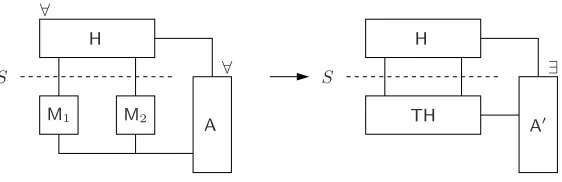
(M, S,H,A), with honest userHand real adversaryA, there is a configuration(M′, S,H,A′)of(M′, S), with the same honest userHand a (possibly different) ideal adversary A′, such thatHcannot distinguish both scenarios. This is illustrated in Figure 1.
The notion that H cannot distinguish both scenarios is captured by the notion of computational in-distinguishability: Two families (vark)k∈N, (var′k)k∈N of random variables on common domains Dk are
computationally indistinguishable (“≈”) if no polynomial-time algorithm can distinguish both distributions with non-negligible probability, i.e., if for all polynomial-time algorithmsDisthe following holds:
Pr
h
Dis(1k,vark) = 1
i
−PrhDis(1k,vark) = 1
i
is negligible ink,
1
∀
∀ ∃
H H
A A′
M1 M2 TH
S S
Fig. 1. Simulatability: The two views ofHmust be indistinguishable
where a functiong : N → R≥0 is said to be negligible iff for all positive polynomials Q,∃k0∀k ≥ k0 : g(k)≤1/Q(k).
Definition 1 (Reactive Simulatability). Let structures(M, S) and(M′, S) with identical sets of service ports be given. We write(M, S) ≥polysec (M′, S), where≥polysec is read as computationally at least as secure
as or securely realizes, if for every configurationconf = (M, S,H,A), there exists a configurationconf′= (M, S,H,A′)(with the sameH) such that
viewconf(H)≈viewconf′(H).
3
One also defines universal simulatability, whereA′ inconf′does not depend onH, i.e., the order of quanti-fiers is reversed, and blackbox simulatability, whereA′is the composition of a fixed partSim(the simulator) andA. In the sequel, we omit the superscriptpoly.
3 Conditional Reactive Simulatability
Reactive simulatability (Definition 1) permits configurations with arbitrary honest usersH(satisfying some syntactic requirements on ports). In other words, reactive simulatability requires a faithful simulation of the combination of the real adversary and real protocol by the ideal adversary and ideal protocol for every honest user. This universal quantification over all honest users allows for a general composition theorem [32, 6], which says that if protocol(M, S)is as secure as protocol(M′, S), then(M, S)can be substituted for
(M′, S) in any larger protocol without invalidating simulatability. For this type of compositional property, simulatability can even be shown to be necessary [28].
Following this idea, we propose a relaxation of reactive simulatability, called conditional reactive simu-latability, where instead of quantifying over all honest users, we quantify only over those honest users which satisfy a certain condition. In this way troublesome honest users which would not occur in the application anyway can be ruled out.
The conditions on honest users are expressed in terms of what we call predicates. A predicate, which is defined with respect to a set S of ports (typically service in-ports), is a set of sequences of bit strings for every port ofS. Using predicates, we can restrict the kind and the order of messages on ports ofSin a run of a system. To formally define these predicates, we need the following notation: For setsAandB, we denote byBAthe set of mappings fromAtoB. IfAis a finite set, then the elements ofBAcan be considered to be tuples where every component corresponds to an element ofA. Fori≥0and a setA, we denote byAi the set of all words overAof lengthi. Now, predicates are defined as follows:
Definition 2 (Predicates). LetSbe a set of ports. We call a setπ with
π ⊆[ i≥0
(({0,1}∗)S)i.
a predicateπoverSif the following conditions are satisfied:
1. Ifπ =s1· · ·si,sj ∈({0,1}∗)S, then we have that for everyj ∈ {1, . . . , n}there existsp∈Ssuch that
sj(p)6=ε, i.e., for everysj at least one port contains a non-empty message.
2. πis decidable in polynomial-time, i.e., there is a probabilistic polynomial-time algorithm that, on input t, outputs whether or nott∈π.
We callt∈πanS-trace. 3
Instead of a single predicate, one could also consider a family of predicates indexed by the security parame-ter. However, for the application presented in this paper, simple predicates suffice. Also, all results presented in this paper easily carry over to the case of families of predicates.
We will use the following notation. We write π = true for a predicate π over S with π =
S
i≥0(({0,1}∗)
S)i. Furthermore, for two predicates π
1 and π2 over two disjoint port sets S1 and S2, we
writeπ1∧π2for the predicate containing all(S1∪S2)-traces such that for every trace inπ1∧π2its
restric-tion toS1 and S2 belongs toπ1 andπ2, respectively. Intuitively,π1∧π2 represents the conjunction ofπ1
andπ2.
AnS-tracet′is a prefix of anS-tracetif there existt′′such thatt=t′·t′′where ‘·’ denotes concatenation. A predicateπover Sis prefix-closed iff for everyS-tracet∈π every prefix oftbelongs toπas well. We also call such a predicate a safety property since once it is violates it stays violated.
Now, we say that a set of machinesM fulfills a predicateπ over a set of portsS, if in runs ofM with any other set of machines the sequences of messages written on ports inS belong toπ. More precisely, it suffices if this is true with overwhelming probability:
Definition 3 (Predicate Fulfillment). Let M be a set of machines with service ports S and let π be a predicate over a subset S′ of SC,out.2 Then, M fulfills π if for any set of machines M such that C := {M, M}is closed,
Prt←runC,k[t⌈S′∈π] is overwhelming as a function ink.
3
We are now ready to present the definition of conditional reactive simulatability.
2
Definition 4 (Conditional Reactive Simulatability). Let structures(M, S)and(M′, S)with identical set Sof service ports be given, and letπbe a predicate over a subset of the service in-ports ofS. We say that (M, S) is at least as secure as (or realizes) (M′, S) under condition π (written (M, S) ≥π
sec (M′, S)) if for every configuration conf = (M, S,H,A) such that Hfulfillsπ, there exists a configuration conf′ = (M′, S,H,A′)(with the sameH) such that
viewconf(H)≈viewconf′(H).
3
Conditional universal simulatability and conditional blackbox simulatability are defined with the obvious
modifications.
4 Composition Under Conditional Reactive Simulatability
In this section, we present composition theorems for conditional reactive simulatability. As mentioned in the introduction, when composing protocols which assume certain conditions (predicates) to hold on their service in-ports and in turn guarantee certain conditions (predicates) to hold on service in-ports of other pro-tocols, cyclic dependencies may occur. In what follows, we first introduce the general setting (Section 4.2) and then present general composition theorems both for the acyclic and cyclic case (Section 4.2 and 4.3). While for the acyclic case no restrictions on predicates are put, for the cyclic case we require predicates to be safety properties.
4.1 The General Setting
One would expect that a protocol M0 (for brevity we omit the service ports) that is simulatable under
condition π can be securely composed with a protocol M1 that fulfillsπ. In some applications, the larger
protocolM1may fulfillπonly ifM1itself is used in a “sane” way, i.e., a predicate, sayτ, is fulfilled on the
service in-ports ofM1. Then, one would expect thatM0securely composes withM1as long asτ is fulfilled.
More generally, we consider the composition of several protocols with assume-guarantee conditions among them. In what follows, this is formalized.
Letπandτ be predicates overSπandSτ, respectively, and let t be a trace. We say that t satisfiesτ →π if t⌈Sτ∈τ implies t⌈Sπ∈π.
Definition 5 (Conditional Predicate Fulfillment). LetM be a set of machines with service portsS,τ be a predicate over a subsetSτ ofSin, andπbe a predicate over a subsetSπofSC,out.
Then,M fulfillsπunder conditionτ ifτ →πis satisfied with overwhelming probability no matter with which machinesM interacts, i.e., for all sets M of machines such that C := {M, M}is closed, we have that
Prt←runC,k[t satisfiesτ →π] is overwhelming as a function ink.
3
In what follows, for everyi= 1, . . . , n, letPi := (Mi, Si)andPi′ := (Mi′, Si)be real and ideal protocols, respectively. We consider the following predicates for these protocols.
Let τij be a predicate over SjC,out ∩Sin
i (service in-ports of Pi to which Pj connects) and τiH be a predicate overSin
i \
Sn
j=1S
C,out
j (service in-ports ofPito which no other protocol connects). Intuitively,τ j i denotes the guarantees theith protocol expects from thejth one. Analogously,τH
theith protocol expects fromH. (Note thatHmay connect to all service in-ports ofPi the other protocols do not connect to.) We denote by
τi =τiH∧
^
j6=i
τij (1)
the guarantees theith protocol expects from other protocols. Note thatτiis a predicate overSiin.
Similarly, we now define the guarantees theith protocol provides to other protocols. Letπji be a predicate over SiC,out ∩Sin
j (service in-ports of Pj to which Pi connects). Intuitively, πji denotes the guarantees the ith protocol gives to the jth one. Note that we do not consider a predicate πH
i . This simplifies our presentation and is without loss of generality since we are only interested in the compositionality properties of the composed protocol. We denote by
πi =
^
j6=i
πij. (2)
the guarantees theith protocol provides to other protocols. Note thatπi is a predicate over
S
j6=i(S C,out
i ∩
Sin j ).
In order for the composition theorems to hold, we clearly need that
πji ⊆τij, (3)
i.e., the guaranteesτij theith protocol expects from thejth one are actually met by the guaranteesπji thejth protocol offers to theith protocol.
Obviously, in the setting above the guarantees among the protocols may be cyclic: the ith protocol provides guarantee πij (and hence,τji) to the jth protocol only if thejth protocol guarantees τij, and vice versa, i.e., thejth protocol provides guaranteeπi
j(and hence,τ j
i) to theith protocol only if theith protocol guaranteesτi
j. Hence, in caseτji 6=trueandτ j
i 6=truethe dependencies between theith andjth protocol are cyclic. The following is a concrete example.
Example 1. Say that an encryption systemP1guarantees that the secret key is not output in plain as long as
this secret key is not submitted as part of a plaintext for encryption. However, a larger protocolP2that uses
that encryption system might want to encrypt plaintexts multiple times, possibly tagged with some syntactic type information. In particular, as long as no ciphertext itself contains the secret key in plain, this secret key will not be submitted for encryption. In other words, there is a mutual dependency betweenP1andP2.
(Obviously, in this particular case secure composition is possible.)
More generally, cyclic dependencies are defined as follows: Let the (directed) dependency graphG= (V, E)
be given by
V ={V1, . . . , Vn}, E={(Vi, Vj) : τij 6=true}. (4) IfGis acyclic, we say that the dependencies between the protocols are acyclic or non-mutual, and otherwise, we say that they are cyclic or mutual.
4.2 Composition in the Acyclic Case
In this section, we prove the following general composition theorem for the case of acyclic dependencies between the protocols.
Theorem 1. For everyi= 1, . . . , n, letPi = (Mi, Si)andPi′= (Mi′, Si)be protocols as introduced above
withPi ≥τseci Pi′, and assume thatMi′fulfillsπiunder conditionτiwhereπiandτiare defined as above and
condition (3) is satisfied. If the dependencies between the protocols are acyclic, we have, for everyi, that
P1||. . .||Pn ≥τsec P1||. . .||Pi−1||Pi′||Pi+1||. . .||Pn, (5)
whereτ :=Vn
j=1τjH. Moreover,
P1||. . .||Pn ≥τsec P1′||. . .||Pn′. (6)
2
Before we prove this theorem, we present useful corollaries of this theorem. The first corollary considers the case of two protocols and it easily follows from Theorem 1 using thatP2 ≥secP2.
Corollary 1 (Conditional Subroutine Composition). Assume thatP1 ≥πsec P1′. LetP2 = (M2, S2)be a protocol such thatM2 i) connects to all ports over whichπ is defined and ii) fulfills π under conditionτ whereτ is a predicate over the service in-ports ofP2to whichP1 does not connect. Then,
P1||P2 ≥τsecP1′||P2.
Ifτ =true, i.e.,M2 fulfillsπunconditionally, we obtain
P1||P2 ≥secP1′||P2.
2
Theorem 1 also allows to combine two protocols that are not connected via service ports:
Corollary 2 (Parallel Composition). Assume thatP1 ≥πsec1 P1′andP2 ≥πsec2 P2such thatP1andP2are not connected via service ports. Then,
P1||P2 ≥secπ1∧π2 P1′||P2′.
2
Proof of Theorem 1. The proof relies on the following definition:
Definition 6. LetM, τ, πbe as in Definition 5. Then,Mfulfillsπunder enforced conditionτif the predicate πis true with overwhelming probability whenM interacts with machines that fulfillτ, i.e., for all setsMof machines that fulfillτ and such thatC:={M, M}is closed, it holds that
Prt←runC,k[t satisfiesπ] is overwhelming as a function ink.
Obviously, ifM fulfillsπunder conditionτ, thenM fulfillsπunder enforced conditionτ. As a preparation for our proof, note that for i = 1, . . . , n, both M′
i and Mi fulfill πi under enforced conditionτi. ForMi′, this is clear by assumption, and forMiit follows fromMi ≥τsec Mi′. (Assuming that it is not true forMi, one obtains an honest user which cannot be simulated, contradicting the assumption that
Mi ≥τsec Mi′.) Now fixi∈ {1, . . . , n}and set
˜
Pi:=P1||. . .||PnandP˜i′ :=P1||. . .||Pi−1||Pi′||Pi+1||. . .||Pn.
Theorem statement (5): We need to show that for every configuration conf = ( ˜Pi,H,A) ofP˜i, where H fulfillsτ, there is a valid configurationconf′= ( ˜P′
i,H,A′)ofP˜i′with the sameHsuch that
viewconf(H)≈viewconf′(H). (7)
Step 1: We construct a new userHi as a combination of Hwith all protocol machines Mj except forMi. Note thatHiis polynomial-time, so in any case,confi:= (Pi,Hi,A)is a configuration ofPi.
Hi fulfillsτi: Note that this statement makes sense becauseHi connects to all of Mi’s service ports. The somewhat technical proof can be found in the appendix (Lemma 2). In this proof we use thatMifulfillsπi under enforced conditionτi.
Step 2: Now, sinceHi fulfillsτi, the conditional simulatability ofMi guarantees the existence of a configu-rationconf′i := (Pi′,Hi,A′)with
viewconfi(Hi)≈viewconf′i(Hi).
In particular, this yields
viewconfi(H)≈viewconf′i(H) (8)
for the submachineHofHi.
Step 3: Decomposing Hi into Hand the machinesMj (j 6= i) yields a valid configuration ( ˜Pi′,H,A′)of protocolP˜i′ such that (7) follows from (8) as desired.
Theorem statement (6): We show
P1′||. . .||Pi−′ 1||Pi. . .||Pn ≥secτ P1′||. . .||Pi′||Pi+1. . .||Pn (9) fori= 1, . . . , nby repeatedly applying (5). The casei= 1is directly implied by (5), and fori >1, allPj withj < ican be set toP′
j. Then by transitivity, (9) implies (6), which completes the proof.
4.3 Dealing with Mutual Dependencies – Composition in the Cyclic Case
In this section, we show that protocols can securely be composed even in case of cyclic dependencies given that the predicates considered are safety properties.
Theorem 2. For everyi = 1, . . . , n, let Pi = (Mi, Si)and Pi′ = (Mi′, Si) be protocols as introduced in
Section 4.1 withPi ≥τseci Pi′, and assume thatMi′ andMi fulfillsπiunder conditionτi whereπiandτi are
defined as in Section 4.1 and condition (3) is satisfied. Also, assume that all predicatesτij,τiH, andπij are safety properties. Then, for alli, we have:
P1||. . .||Pn ≥τsec P1||. . .||Pi−1||Pi′||Pi+1||. . .||Pn, (10)
whereτ :=Vn
j=1τjH. Moreover,
We note that in Theorem 2 the requirement that Mi fulfillsπi under condition τi can be dispensed with if service out-ports are scheduled locally (which in most scenarios is the case): The reason is that, as in the proof of Theorem 1, it easily follows that ifMi′ fulfillsπiunder condition τi, thenMifulfillsπi under enforced conditionτi. Now, it is not hard to see that if service out-ports are scheduled locally, then the notion of Definition 6 implies the one of Definition 5. Hence,Mifulfillsπiunder conditionτi.
Proof of Theorem 2. For the proof of Theorem 2, we need some terminology. For a trace t and predicatesτ
andπsuch thatτ andπare safety properties, we say that t satisfiesτ →πat any time if t′ satisfiesτ →π
for every prefix t′of t.
Definition 7. LetM, π, τ be as in Definition 5 such thatπand τ are safety properties. Then,M fulfillsπ
under conditionτ at any time if the predicateτ →πis satisfied at any time with overwhelming probability, no matter with which machinesMinteracts, i.e., for all setsM such thatC :={M, M}is closed, it holds that
Prt←runC,k[t satisfiesτ →πat any time] is overwhelming as a function ink. (12)
3
We can show that the above notion is equivalent to the one defined in Definition 5.
Lemma 1. LetM,π, andτ be as in Definition 7, and such thatM contains no master scheduler. Then we have thatMfulfillsπunder conditionτ at any time iffMfulfillsπunder conditionτ. 2
Proof. The implication from left to right is obvious. To see the converse direction, let M be a set of ma-chines such thatC = {M, M}is closed and let the polynomial p(k)bound the runtime of M. (Note that
M necessarily contains a master scheduler.) First, by definition, if a trace t ofC does not satisfyτ → π
at any time, then there exists a prefix t′ of t which does not satisfy τ → π, i.e., t′⌈Sτ∈ τ but t′⌈Sπ∈/ π.
Let t′ be of minimal length with this property. It is easy to see that the last transition of t′ must be a tran-sition of M. Now, assume that (12) is not satisfied, i.e.,Prt←runC,k[t does not satisfyτ →πat any time]
is a non-negligible function ink. Consider the machineM∗ which simulates M but at the beginning ran-domly chooses a position i ∈ {1, . . . , p(k) + 1}and when activated for the ith time it stops (simulating
M). Let C∗ = {M, M∗}. Intuitively, M∗ has a high probability to stop a run of C∗ exactly when the trace produced so far does not satisfy τ → π. In fact, using that (12) is not satisfied it is easy to verify thatPrt←runC∗,k[t does not satisfyτ →π] is a non-negligible function ink. This implies thatM does not
fulfillπ under conditionτ.
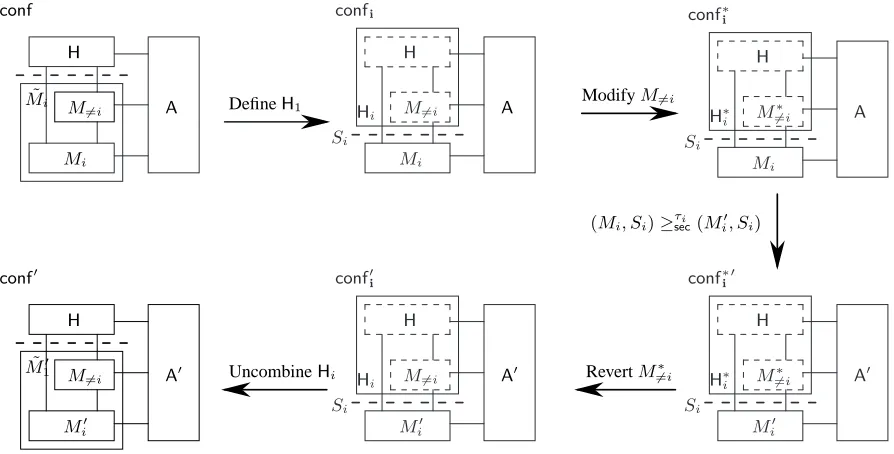
We can now prove Theorem 2. For an overview of the proof, see Figure 2. We first prove (10), from which then (11) follows as in the proof of Theorem 1. Fixi∈ {1, . . . , n}and set
˜
Pi:=P1||. . .||PnandP˜i′ :=P1||. . .||Pi−1||Pi′||Pi+1||. . .||Pn.
We need to show that for every configurationconf = ( ˜Pi,H,A)ofP˜i, whereHfulfillsτ, there is a valid configurationconf′ = ( ˜Pi′,H,A′)ofP˜i′with the sameH, such that
viewconf(H)≈viewconf′(H). (13)
H
Mi
Si
confi
Hi M6=i
H
Si
M′
i
conf′i
Hi M6=i
H
Si
M′
i
H∗i M6=∗i A′
conf∗i′ H
Mi
Si
H∗i M6=∗i A
conf∗i
H
Mi ˜
Mi A
conf
H
˜
M1′
M′ i
A′ conf′
UncombineHi
M6=i DefineH1
M6=i
ModifyM6=i
RevertM6=∗i
(Mi, Si)≥secτi (Mi′, Si)
A
A′
Fig. 2. Overview of the proof of Theorem 2.
Step 2: We modify Hi into a new userH∗i such that H∗i fulfillsτi. This is done by substituting all sets of submachines Mj (j 6= i) ofHi by sets of machines Mj∗ that fulfill their respective predicates πj without
any preconditions. More specifically,M∗
j simulates Mj and in addition checks whetherτj is fulfilled, i.e., whether the observed sequence of inputs on in-ports of Mj lies in τj. By assumption, this can be done efficiently. Ifτj is not fulfilled, thenMj∗halts immediately.
First claim regardingH∗i: We claim that the view of the submachineHofHiis not changed (non-negligibly) by this modification, i.e., we claim
viewconfi(H)≈viewconf∗i(H) (14)
whereconf∗i = (Pi,H∗i,A).
Assume for contradiction that (14) does not hold. Then the probability that some τj (j 6= i) is not fulfilled in a run of confi is non-negligible (since otherwise, confi andconf∗i behave identical). Letj be such thatτj is with non-negligible probability the first of all predicatesτℓ(1≤ℓ≤n) to become false in a run ofconfi. By “first”, we mean that there is a prefix of the considered run that does not lie inτj, but all shorter prefixes lie in allτℓ. (Note that by the prefix-closeness of allτℓ such a prefix must exist for somej.) Because of (1), there is thus aτjr(withr∈ {1, . . . , n,H}\{j}) such that with non-negligible probability,
τr
j becomes false before any other predicateτℓ,ℓ6=j, andτr
′
j ,r′ 6=r, does. Asr =Hdirectly contradicts the assumption onH, we may assumer6=H.
Now by assumption, Mr fulfillsπr, and thus, by (3) and (1), alsoτjr under condition τr (in the sense of Definition 5). By Lemma 1 and the just derived statement aboutτr
j, this implies that with non-negligible probability,τris false beforeτj is. This is a contradiction to the choice ofj.
Second claim regardingH∗i: We claim thatH∗i fulfillsτi(without any precondition). By (1) and the assump-tion onH, it suffices to prove that for anyj 6= i,M∗
j fulfillsτ j
By construction, Mj∗ and Mj behave identically unless τj becomes false. That is, alsoMj∗ fulfillsπj under conditionτj at any time. In particular, by definition ofMj∗, with overwhelming probabilityπjis true whenMj∗ halts. It is also easy to see thatπj cannot become false afterMj∗ has halted. Hence, Mj∗ fulfills
πj, and thus,τij unconditionally.
Step 3: AsH∗i fulfills τi, the conditional simulatability of Mi guarantees the existence of a configuration conf∗i′ := (P′
i,H∗i,A′)with
viewconf∗
i(H
∗
i)≈viewconf∗
i′(H
∗ i).
In particular, this yields
viewconf∗
i(H)≈viewconf∗i′(H) (15)
for the submachineHofH∗i.
Step 4: We substituteH∗i again byHi. Since, by assumption, Mi′ fulfillsπiunder conditionτi, analogously to Step 2 we can show that
viewconf∗
i′(H) ≈viewconf′i(H) (16)
whereconf′i= (Pi′,Hi,A′).
Step 5: Decomposing Hi into Hand the machinesMj (j 6= i) yields a valid configuration ( ˜Pi′,H,A′)of protocolP˜′
i such that (10) follows from (14), (15) and (16) as desired.
5 Applications and Examples
In this section, we provide examples substantiating the claim that conditional reactive simulatability con-stitutes a suitable security notion for circumventing known impossibility results of simulating interesting abstractions of cryptography. In addition, we illustrate that imposing suitable constraints on the environ-ment may allow for a simulation proof based on much weaker assumptions on the underlying cryptography. Generally speaking, conditional reactive simulatability allows for exploiting knowledge of which protocol class will use the protocol under investigation, resulting in more fine-grained reasoning about cryptographic protocols.
More specifically, we prove that Dolev-Yao style abstractions of symmetric encryption can be correctly simulated by conditioning environments to those cases that do not cause a so-called commitment problem. For unconditional simulatability, Dolev-Yao style symmetric encryption is known not to be simulatable at all [2]. If one further constraints the environment not to create key cycles, e.g., encrypting a key with itself, we can even establish conditional simulatability based on considerably weaker assumptions on the underlying cryptographic encryption scheme. Finally, we show that conditional simulatability may naturally entail unconditional simulatability for composed protocols again.
5.1 Conditional Simulatability of Dolev-Yao Style Symmetric Encryption
sent and has to simulate it by some bitstring, which the adversary sees. Later the simulator sees abstractly that a key becomes known and that the ciphertext contains a specific application message. It cannot change the application message, thus it must simulate a key that decrypts the old ciphertext bitstring (produced without knowledge of the application message) to this specific message.
We omit a rigorous definition of the absence of the commitment problem for Dolev-Yao style symmetric encryption as given in [2, 4] but only give an informal definition for the sake of readability:
Definition 8 (No Commitment Property of Dolev-Yao Style Symmetric Encryption, informally). The No Commitment property NoComm of Dolev-Yao style symmetric encryption consists of those traces of Dolev-Yao style symmetric encryption that satisfy the following trace predicate: If a term is encrypted at timet1in this trace by an honest useruwith secret keysk, and at this timeskis not known to the adversary, then the adversary does not learn the keysk at any future timet2in this trace. 3
Technically, the requirement that an adversary does not learn certain keys relies on the state of the Dolev-Yao model which keeps track of who knows which term; thus Definition 8 is syntactically not a predicate in the sense of Definition 2. However, those parts of the state that capture if an adversary already knows keys generated by honest users are uniquely determined by the preceding inputs at the service in-ports. Thus
NoCommcan naturally be recast as a property that is only defined at the service in-ports of the Dolev-Yao model and thus as a predicate in the sense of Definition 2 (however with a much more tedious notation).
The main result of [4] provides a simulation for those cases in whichNoCommis fulfilled provided that the cryptographic encryption scheme fulfills the notion of dynamic KDM security [4]. We can now rephrase their result in our formalism to benefit from the compositionality guarantees entailed by our composition theorems. In the following, let({THcryH_sym,id}, SH)and ({McryE,u_sym,real |u ∈ H}, SH)denote the Dolev-Yao model of symmetric encryption and its cryptographic realization from [2, 4], respectively, for a set H ⊆ {1, . . . , n}of honest users, and an encryption schemeE.
Theorem 3 (Conditional Reactive Simulatability of Dolev-Yao Style Symmetric Encryption). For all symmetric encryption schemes E that satisfy dynamic KDM security, and for all setsH ⊆ {1, . . . , n}of honest users, the realization of the Dolev-Yao model is at least as secure as the Dolev-Yao model under conditionNoComm, i.e.,({McryE,u_sym,real|u∈ H}, SH)≥NoCommsec ({TH
cry_sym,id
H }, SH). 2
5.2 Securely Realizing Dolev-Yao Style Symmetric Encryption with Weaker Cryptography
While Theorem 3 shows that Dolev-Yao style symmetric encryption can be conditionally simulated by ex-cluding the commitment property, it still relies on the strong assumption that the underlying encryption scheme satisfies dynamic KDM security – a very strong, non-standard notion for which no realization in the standard model of cryptography is known. However, it turns out that this strong notion is only neces-sary to deal with the quite exotic case that symmetric keys are encrypted in a cyclic manner, e.g., a key with itself. Most protocols however avoid such constructions by definition, and indeed further constraining simulatability to traces that do not contain key cycles yields a simulatability result based on considerably weaker assumptions on the underlying encryption scheme. More precisely, it suffices that the encryption scheme satisfies indistinguishability under adaptive chosen-ciphertext attacks as well as integrity of cipher-texts. This is the standard security definition of authenticated symmetric encryption [12, 11], and efficient symmetric encryptions schemes provably secure in this sense exist under reasonable assumptions [21, 27].
Theorem 4 (Conditional Reactive Simulatability of Dolev-Yao Style Symmetric Encryption w/o Key Cycles). For all authenticated symmetric encryption schemes E and all sets H ⊆ {1, . . . , n} of honest users, the realization of the Dolev-Yao model is at least as secure as the Dolev-Yao model under condition NoComm∧NoKeyCycles, i.e.,({ME,ucry_sym,real |u ∈ H}, SH) ≥NoCommsec ∧NoKeyCycles ({THHcry_sym,id}, SH). 2
5.3 Simulatable Protocols from Conditionally Simulatable Subprotocols
We finally illustrate, exploiting Corollary 1, that conditional simulatability can often be turned into uncon-ditional simulatability again (and in fact, this seems rather the rule than the exception). Consider a secure channel between two parties that uses Dolev-Yao style symmetric encryption as a subprimitive, which itself is only conditionally simulatable. The secure channel consists of two machines M1 andM2.M1 expects a message mas input at a service port in?, and encrypts this message with a symmetric key kshared with
M2. The encryption is computed using Dolev-Yao style symmetric encryption as a subprimitive, i.e., m
is output at a service portenc_out1!and the resulting encryptioneis obtained at a service port enc_in1?.
M2 outputs the message at a service portout!. We do not give a rigorous definition of this behavior here since this would presuppose introducing a significant amount of notion from [2] but it should be clear al-ready that this secure channel neither causes a commitment problem nor any key cycles by construction. Let
(Msc, Ssc) := ({M1,M2},{in?,out!,enc_out1!,enc_in1?})denote the secure channel.
Theorem 5. For all authenticated symmetric encryption schemesE, and forH={1,2}, the secure channel based on the realization is unconditionally at least as secure as the secure channel based on the Dolev-Yao model, i.e.,(Msc, Ssc)||({Mcry_sym,real
E,u |u∈ H}, SH)≥sec (Msc, Ssc)||({THcryH_sym,id}, SH). 2
6 Conclusion
We presented a relaxation of simulatability, one of the central concepts of modern cryptography for defin-ing and analyzdefin-ing the security of multi-party protocols, by permittdefin-ing to constrain environments to adhere to certain behaviors. The resulting notion is called conditional reactive simulatability. It constitutes a more fine-grained security notion that is achievable i) for several protocols for which traditional simulatability is too strong a notion, and ii) based on weaker requirements on the underlying cryptography. In addition, conditional reactive simulatability maintains the interesting property that for various protocol classes, com-position of conditionally simulatable protocols yield protocols that are simulatable in the traditional sense.
We furthermore showed that despite imposing restrictions on the surrounding protocol and thus giving up the universal quantification of environments that naturally allowed for compositionality proofs in ear-lier works, the notion of conditional reactive simulatability still entails strong compositionality guarantees. In particular, this holds for the common case of composing so-called assume-guarantee specifications, i.e., specifications that are known to behave properly if offered suitable inputs, provided that these assumptions and guarantees constitute arbitrary trace properties that do not give rise to cyclic dependencies. We fur-ther investigated the theoretically more demanding (but arguably practically less interesting) case of cyclic dependencies among such specifications and proved a similar composition theorem under the additional assumption that conditions are expressible as safety properties.
Acknowledgments. We thank Martín Abadi for interesting discussions.
References
2. Michael Backes and Birgit Pfitzmann. Symmetric encryption in a simulatable Dolev-Yao style cryptographic library. In 17th
IEEE Computer Security Foundations Workshop, Proceedings of CSFW 2004, pages 204–218. IEEE Computer Society, 2004.
Online available athttp://eprint.iacr.org/2004/059.ps.
3. Michael Backes and Birgit Pfitzmann. Limits of the cryptographic realization of Dolev-Yao-style XOR. In Sabrina De Capitani di Vimercati, Paul F. Syverson, and Dieter Gollmann, editors, Computer Security, Proceedings of ESORICS
2005, number 3679 in Lecture Notes in Computer Science, pages 178–196. Springer-Verlag, 2005. Online available at
http://eprint.iacr.org/2005/220.ps.
4. Michael Backes, Birgit Pfitzmann, and Andre Scedrov. Key-dependent message security under active attacks. ePrint Archive, 2005/421, 2006.
5. Michael Backes, Birgit Pfitzmann, and Michael Waidner. A composable cryptographic library with nested operations. In 10th
ACM Conference on Computer and Communications Security, Proceedings of CCS 2003, pages 220–230. ACM Press, 2003.
Extended abstract, extended version online available athttp://eprint.iacr.org/2003/015.ps.
6. Michael Backes, Birgit Pfitzmann, and Michael Waidner. A general composition theorem for secure reactive systems. In Moni Naor, editor, Theory of Cryptography, Proceedings of TCC 2004, number 2951 in Lecture Notes in Computer Science, pages 336–354. Springer-Verlag, 2004. Online available athttp://www.zurich.ibm.com/security/publications/ 2004/BaPfWa2004MoreGeneralComposition.pdf.
7. Michael Backes, Birgit Pfitzmann, and Michael Waidner. Secure asynchronous reactive systems. Cryptology ePrint Archive, Report 2004/082, 2004.http://eprint.iacr.org/.
8. Michael Backes, Birgit Pfitzmann, and Michael Waidner. Limits of the Reactive Simulatability/UC of Dolev-Yao models with hashes. Cryptology ePrint Archive 2006/068, 2006.
9. Boaz Barak and Amit Sahai. How to play almost any mental game over the net — concurrent composition via super-polynomial simulation. In 46th Annual Symposium on Foundations of Computer Science, Proceedings of FOCS 2005, pages 543–552. IEEE Computer Society, 2005. Extended version online available athttp://eprint.iacr.org/2005/106.ps.
10. Donald Beaver. Foundations of secure interactive computing. In Joan Feigenbaum, editor, Advances in Cryptology,
Proceed-ings of CRYPTO ’91, number 576 in Lecture Notes in Computer Science, pages 377–391. Springer-Verlag, 1992.
11. Mihir Bellare and Chanathip Namprempre. Authenticated encryption: Relations among notions and analysis of the generic composition paradigm. In Advances in Cryptology - ASIACRYPT 2000, pages 531–545, 2000.
12. Mihir Bellare and Phillip Rogaway. Encode-then-encipher encryption: How to exploit nonces or redundancy in plaintexts for efficient constructions. In Advances in Cryptology - ASIACRYPT 2000, pages 317–330, 2000.
13. Ran Canetti. Universally composable security: A new paradigm for cryptographic protocols. In 42th Annual Symposium on
Foundations of Computer Science, Proceedings of FOCS 2001, pages 136–145. IEEE Computer Society, 2001. Full version
online available athttp://www.eccc.uni-trier.de/eccc-reports/2001/TR01-016/revisn01.ps. 14. Ran Canetti. Universally composable security: A new paradigm for cryptographic protocols. In 42th Annual Symposium on
Foundations of Computer Science, Proceedings of FOCS 2001, pages 136–145. IEEE Computer Society, 2001.
15. Ran Canetti. Universally composable security: A new paradigm for cryptographic protocols. IACR ePrint Archive, January 2005. Full and revised version of [14], online available athttp://eprint.iacr.org/2000/067.ps.
16. Ran Canetti and Marc Fischlin. Universally composable commitments. In Joe Kilian, editor, Advances in Cryptology,
Pro-ceedings of CRYPTO 2001, number 2139 in Lecture Notes in Computer Science, pages 19–40. Springer-Verlag, 2001. Full
version online available athttp://eprint.iacr.org/2001/055.ps.
17. Ran Canetti, Yehuda Lindell, Rafail Ostrovsky, and Amit Sahai. Universally composable two-party and multi-party secure computation. In 34th Annual ACM Symposium on Theory of Computing, Proceedings of STOC 2002, pages 494–503. ACM Press, 2002. Extended abstract, full version online available athttp://eprint.iacr.org/2002/140.ps.
18. Anupam Datta, Ante Derek, John C. Mitchell, Ajith Ramanathan, and Andre Scedrov. Games and the impossibility of realizable ideal functionality. In To appear in Proceedings of Theory of Cryptography (TCC 2006), 2006.
19. Anupam Datta, Ralf Küsters, John C. Mitchell, and Ajith Ramanathan. On the relationships between notions of simulation-based security. In In Theory of Cryptography, Proceedings of TCC 2005, pages 476–494, 2005.
20. Dimitra Giannakopoulou, Corina S. Pasareanu, and Jamieson M. Cobleigh. Assume-guarantee verification of source code with design-level assumptions. In Proceedings 26th International Conference on Software Engineering, pages 211–220, 2004. 21. Virgil D. Gligor and Pompiliu Donescu. Fast encryption and authentication: Xcbc encryption and xecb authentication modes.
In Proceedings 8th Fast Software Encryption", pages 82–108, 2001.
22. Oded Goldreich, Silvio Micali, and Avi Wigderson. How to play any mental game—a completeness theorem for protocols with honest majority. In Nineteenth Annual ACM Symposium on Theory of Computing, Proceedings of STOC 1987, pages 218–229. ACM Press, 1987. Extended abstract.
23. Shafi Goldwasser, Silvio Micali, and Charles Rackoff. The knowledge complexity of interactive proof systems. SIAM Journal
on Computing, 18(1):186–208, 1989.
24. Heather Hinton. Composing partially-specified systems. In IEEE Symposium on Security and Privacy, Proceedings of
SSP 1998, pages 27–39. IEEE Computer Society, 1998. Online available athttp://www.zurich.ibm.com/~mbc/
25. Dennis Hofheinz and Jörn Müller-Quade. Universally composable commitments using random oracles. In Moni Naor, edi-tor, Theory of Cryptography, Proceedings of TCC 2004, number 2951 in Lecture Notes in Computer Science, pages 58–76. Springer-Verlag, 2004.
26. C. Jones. Specification and design of (parallel) programs. In Information Processing 83: Proceedings 9th IFIP World Congress, pages 321–322, 1983.
27. Charanjit Jutla. Encryption modes with almost free message integrity. In Advances in Crptology - EUROCRYPT 2001, pages 529–544, 2001.
28. Yehuda Lindell. General composition and universal composability in secure multi-party computation. In 44th Annual
Sympo-sium on Foundations of Computer Science, Proceedings of FOCS 2003, pages 394–403. IEEE Computer Society, 2003. Full
version online available athttp://eprint.iacr.org/2003/141.ps.
29. Yehuda Lindell, Anna Lysyanskaya, and Tal Rabin. On the composition of authenticated byzantine agreement. In 34th Annual
ACM Symposium on Theory of Computing, Proceedings of STOC 2002, pages 514–523. ACM Press, 2002. Full version online
available athttp://eprint.iacr.org/2004/181.ps.
30. Silvio Micali and Phillip Rogaway. Secure computation. In Joan Feigenbaum, editor, Advances in Cryptology, Proceedings of
CRYPTO ’91, number 576 in Lecture Notes in Computer Science, pages 392–404. Springer-Verlag, 1992. Abstract.
31. J. Misra and M. Chandy. Proofs of networks of processes. IEEE Transactions of Software Engineering, 7(4):417–426, 1981. 32. Birgit Pfitzmann and Michael Waidner. A model for asynchronous reactive systems and its application to secure message
transmission. In IEEE Symposium on Security and Privacy, Proceedings of SSP 2001, pages 184–200. IEEE Computer Society, 2001. Full version online available athttp://eprint.iacr.org/2000/066.ps.
33. Manoj Prabhakaran and Amit Sahai. New notions of security: Achieving universal composability without trusted setup. In 36th
Annual ACM Symposium on Theory of Computing, Proceedings of STOC 2004, pages 242–251. ACM Press, 2004. Extended
version online available athttp://eprint.iacr.org/2004/139.ps.
34. Andrew Chi-Chih Yao. Theory and applications of trapdoor functions. In 23th Annual Symposium on Foundations of Computer
Science, Proceedings of FOCS 1982, pages 80–91. IEEE Computer Society, 1982.
A Postponed Proofs
Lemma 2. In the situation of the proof of Theorem 1, userHifulfills predicateτi. 2
Proof. In the situation and using the notation from the proof of Theorem 1, consider running Algorithm 1.
We will prove some facts about this algorithm (when run in the situation of the proof of Theorem 1).
Algorithm 1
1: R← {1, . . . , n}
2: repeat
3: S← {s∈R | ∀r∈R:τsr=true}
4: R←R\S 5: untilR=∅orS=∅
First claim: First, we claim that Algorithm 1 always terminates withR =∅. It obviously suffices to prove thatS 6=∅in each execution of Step 3:S =∅after any execution of Step 3 would imply that every vertex in the graphGR:= (VR, ER)with
VR={Vr | r ∈R}, ER={(Va, Vb) : τab6=true}.
has nonzero out-degree, soGRcontains a cycle. But this is a contradiction, sinceGRis a subgraph of the graphG(as defined in (4)), and hence, must be acyclic by assumption.
Second claim: For anyT ⊆ {1, . . . , n}, letHT be the combined machine that consists ofHand all machines
Mtwitht6∈T. We claim that at any point during a run of Algorithm 1, the machineHRfulfills the predicate
πR:=
^
r6∈R
πr
∧
n
^
j=1 τjH
Initially, R = {1, . . . , n}, so HR = Hand πR = Vn
j=1τjH = τ, hence the statement is initially true by assumption about H. So suppose the statement is true at the start of a “repeat” loop of Algorithm 1. We need to show that the statement is also true after that loop.
In other words, we may assume thatHRfulfillsπRand need to show that combining the machinesMs (s∈S) withHRyields a machineHR\Sthat fulfillsπR\S.
By definition of combination and property fulfillment, it suffices to show that each newly added subma-chine Ms(s ∈ S) fulfills πs, so fix ans ∈ S. SinceMsfulfills πs under enforced conditionτs, we only need to show that in all contexts in whichHR\Sis run,Ms’s preconditionτsis fulfilled with overwhelming probability. But by (1) and the definition of S, τs is fulfilled whenever τsH and allτsr (with r 6∈ R) are fulfilled.
Using (3),τr
s is implied byπsr and thus, using (2), also byπr. But by assumption,HR, and hence also
HR\SfulfillsπRandτH
s . Sinceswas arbitrary, this shows thatHR\S fulfills allπs(s∈S) and henceπR\S.