Rear Area and Base Security
The base commander's plan of action must achieve adequate protec-tion to ensure accomplishment of missions by base elements with as small a force as necessary, since any drain of time and personnel from operational activities will adversely affect the accomplishment of their mlsswns.
Preface, FM 31-81 (Test), Base Defense, March 1970
This appendix provides basic guidance for commanders and staff officers on the organization of forces, control measures, and planning, preparing, and executing considerations pertaining to rear area and base security and route and convoy security operations. The tactics and techniques ex-pressed in this appendix are applicable across the full spectrum of opera-tions (offense, defense, stability, and support). However, commanders must interpret them in accordance with the enemy's capabilities. For ex-ample, the physical layout of a base will be vastly different if the enemy has a significant air capability than if the enemy has no air capability. The purpose of rear area and base security operations is to prevent inter-ruption of current and future operations. Rear area and base security op-erations constitute one of the five elements that constitute sustaining op-erations. (See FM 3-0 for a discussion of sustaining operations as part of the battlefield framework.)
CONTENTS
Command Responsibilities E-1
DOD Civilians and Contractors E-2
Command Relationships E-3
Base E-4
Base Cluster E-6
Control Exercised by US Area
Commanders E-7
Threat Levels E-7
Utility of Different Locations E-8 Political Considerations Impacting
the Rear Area E-9
Base and Base Cluster Defense E-10
Organization of Forces E-10
Control Measures E-15
Planning Considerations E-15
Preparing a Base Defense E-23
Executing a Base Defense E-25
Route Security E-31
Passive Security E-32
Route Reconnaissance E-32
Cordon Security E-32
Combat Security E-33
Convoy Security E-33
Organization of a Convoy Escort E-34
Convoy Control Measures E-35
Planning Convoy Operations E-36 Preparing Convoy Security Measures.. E-38 Executing Convoy Security
COMMAND RESPONSIBILITIES
E-l.
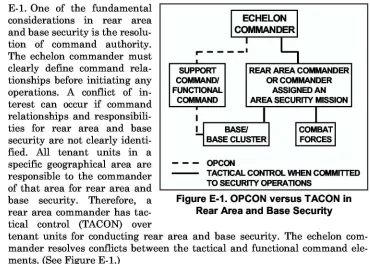
One of the fundamental considerations in rear area and base security is the resolu-tion of command authority. The echelon commander must clearly define command rela-tionships before initiating any operations. A conflict of in-terest can occur if command relationships and responsibili-ties for rear area and base security are not clearly identi-fied. All tenant units in a specific geographical area are responsible to the commander of that area for rear area and base security. Therefore, a rear area commander has tac-tical control (TACON) overtenant units for conducting rear area and base security. The echelon com-mander resolves conflicts between the tactical and functional command ele-ments. (See Figure E-l.)
SUPPORT COMMANDI FUNCTIONAL
COMMAND
REAR AREA COMMANDER OR COMMANDER
ASSIGNED AN AREA SECURITY MISSION
BASEl BASE CLUSTER
OPCON
TACTICAL CONTROL WHEN COMMITTED TO SECURITY OPERATIONS
Figure E-1. OPCON versus TACON in Rear Area and Base Security
E-2. There are units subordinate to commanders other than the echelon com-mander located throughout an echelon's rear area. Many units operating in the rear areas of a corps, division, or brigade are not organic to those eche-lons. For example, units from the theater support command and other thea-ter organizations, such as the theater signal command or theater engineer command, operate within the corps rear area. The division has elements of corps support groups (forward) and other corps organizations, such as a corps signal battalion, operating within the division rear area. The brigade many have elements of theater, corps, and division organizations operating within its rear area.
E-3. However, an echelon rear area, base cluster, or base commander is re-sponsible for the rear area and base security of all units in his assigned area. The echelon rear area commander has the authority for terrain management within the echelon rear area and assigns every unit to a base or base cluster. All units assigned to a base or base cluster are TACON to the commander of that base or base cluster when an emergency or tactical situation requires the implementation of rear area and base security measures unless specifi-cally exempted by order of the echelon commander.
E-4. The echelon commander establishes the relationships between the sub-ordinate forces of different countries occupying the same geographical area. This structure unifies the different forces to the maximum degree feasible. Resulting language, doctrinal, and philosophical differences may be resolved
.
Combining units of different nationalities only where a clear require-ment exists..
Cross-assigning liaison personnel to improve understanding..
Organizing area responsibilities along national lines..
Establishing a mutually supporting warning system.E-5. Using host nation forces presents a distinct advantage to a commander responsible for rear area and base security because of their knowledge of the area, its language, and customs. Commanders involved in sustaining opera-tions take all possible efforts to use these assets effectively.
DOD CIVILIANS AND CONTRACTORS
E-6. Civilian employees supporting US military forces are subject to hostile action. Protecting DOD civilians and contractors providing battlefield support to Army units is the responsibility of the commander of the host base. The supported base or military unit assures the protection of its operations and personnel. DOD civilians and contractor personnel cannot take an active role in conducting security operations, but retain the inherent right to self-de-fense.
E-7. Commanders and staff planners assess the need for protecting these in-dividuals and designate forces to provide security when appropriate. The mis-sion, threat, and location where DOD civilians or contractors operate deter-mine the degree of security required.
E-8. Protecting DOD civilians and contractors involves not only active protec-tion through the use of armed military forces to provide escort or perimeter security, but also training and equipping of these personnel for self-protec-tion. Base cluster commanders may train and equip DOD civilian and con-tractor personnel, if they agree, to work in a nuclear, biological, and chemical (NBC) environment and to carry individual, military specification weapons for personal protection when the threat exists and the geographic combatant commander grants approval.
E-9. The base commander identifies specific security and protection require-ments for DOD civilians and contractors located on or transiting the base and designates resources and forces to address those requirements. He includes these decisions in the base's OPLANs/OPORDs and their supporting plans and standing operating procedures (SOP). This allows the base's tenant units and civilians to properly integrate these protection requirements into their operational procedures.
COMMAND RELATIONSHIPS
E-l1. The success of rear area and base security hinges on binding together diverse resources. The commander must meet the following requirements to eliminate a potential confusion and to achieve a cohesive
effort-.
There must be a single responsible commander..
Geographical areas of operations (AOs) and thus responsibility must be clearly defined.E-12. Overall responsibility for conducting sustaining operations in a com-mander's AO rests with the commander. Because the commander cannot af-ford to focus strictly on sustaining operations he assigns that responsibility to another officer and gives that individual a staff to help him accomplish that operation. The individual responsible for a tactical echelon's sustaining op-erations is called the rear area commander.
E-13. A corps commander normally assigns the mission of sustaining opera-tion to the deputy corps commander. In a similar manner, the assistant divi-sion commander (support) is responsible to the division commander for sus-taining operations in the division rear area. The forward support battalion commander supporting the brigade is normally responsible to the maneuver brigade commander for sustaining operations in the brigade rear area. While the echelon commander has the authority to designate someone else as the echelon's rear area commander, doing so complicates staff relationships.
E-14. The responsible rear area commander at each of these three echelons uses the echelon rear command post to monitor the echelon's sustaining op-erations. This assures the synchronization of the five elements of sustaining operations and an orderly, effective, and timely escalation when conducting rear area and base security. This encompasses the use of host nation and or-ganic combat support (CS) and combat service support (CSS) units through employing a tactical combat force (TCF). The echelon rear command post de-velops plans integrating the rear area and base security activities of all units located within the echelon rear area. Each echelon rear area commander has the authority to further divide the echelon rear area into subordinate AOs, base clusters, and bases.
E-15. A rear operations center (ROC) provides the corps or division rear area commander with the nucleus of an operations cell within the corps or division rear command post. It is a reserve component organization since the func-tions it performs are not required in garrison. It contains no organic life sup-port capabilities, such as mess, supply, and maintenance, and relies on the echelon headquarters' commandant for those functions. The soldiers assigned in peacetime to these organization lose their separate identity after being activated and deployed. They are assigned to the corps or division head-quarters company and become the rear command post representatives of the echelon G2 and G3.
BASE
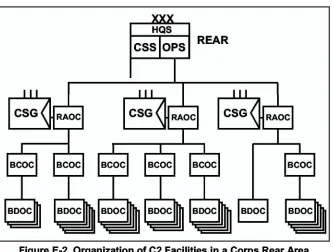
within his AO. It also provides him a limited capability to conduct liaison with subordinate base cluster defense operations centers (BCOCs) and base defense operations centers (BDOCs). (See Figure E-2.)
REAR
Figure E-2. Organization of C2 Facilities in a Corps Rear Area
E-17. Like a ROC, a RAOC is a reserve component organization that contains no organic life support capabilities, such as mess, supply, and maintenance. It must rely on its assigned CS/CSS brigade/group headquarters to which they are assigned for those functions. The soldiers assigned to a RAOC main-tain their separate identity after being activated and deployed, unlike those assigned to a ROC. Therefore, the corps rear area commander can move them as necessary to provide additional command and control (C2) capabilities within the corps rear area.
E-18. Responsibility for overall rear area and base security, as well as de-fense against large enemy attacks, belongs to the echelon rear area com-mander. He charges each base and base cluster commander with responsibil-ity for his local and internal security to safeguard the baselbase cluster and its facilities from infiltration and small-scale attacks. Each base and base cluster defense plan is coordinated with, and becomes a part of, the echelon rear area defense plan.
Bases may be further organized into base clusters or organized as a separate bases that report directly to the ROC or RAOCs controlling rear area and base security for the AO where the base is located. A commander may name his base or use a mixture of alphanumeric characters to designate it.
Base Commander
E-20. In base defense operations, the base commander is the officer assigned to command a base (JP 1-02). The base commander is responsible for de-fending his base. He is normally the senior Army competitive category officer on the base unless the base contains only medical units. He exercises C2 over the base and necessary control of resident and transient units. The base com-mander's responsibilities include establishing the overall base defense org-anization as well as planning, preparing, executing, and assessing all local security measures. This includes the tactical control of US Navy, Air Force, and Marine Corps forces assigned to the base primarily for the purpose of local base defense, such as a US Air Force security flight. Forces of other ser-vices or functional components assigned or attached to the base for primary purposes other than local base defense will support local base defense during an imminent attack or threat of an attack. For more information on joint rear area and base security see JPs 3-10 and 3-10.1.
E-21. The base commander uses all assets within the base perimeter to create the required level of local security. He has the authority to position units as-signed to his base in mutually supporting positions. He directs employing of obstacles, such as wire- and command-detonated antipersonnel mines, to de-fend each base within the guidance of his rules of engagement (ROE). He identifies shortages in materiel or weaknesses in required defensive capabili-ties early and requests the necessary reinforcements and supplies to correct those weaknesses.
E-22. A base commander is also usually a battalion commander, and the BDOC forms around the nucleus provided by his battalion staff. The echelon rear area commander normally does not assign the function of base command to MP commanders because of their need to exercise command over MP ele-ments responding to Level II threats within the echelon rear area.
Base Defense Operations Center
E-23. The base defense force (BDF) commander needs a BDOC to ensure the integration of defense plans and maximum effectiveness of the total base de-fense effort. A base defense operations center is a command and control facility established by the base commander to serve as the focal point for base security and defense. It plans, directs, integrates, coordinates, and controls all base defense efforts, and coordinates and integrates into area security operations with the rear area operations center/rear tactical operations center (JP 3-10.1). The nature of the BDOC depends on the combination of forces involved and may be joint, interagency, or multinational depending on the combination of forces involved.
the BDOC. The base commander provides other BOS representatives to his BDF commander on an "as required" basis. Multiservice, other agency, and multinational representation, with decision making authority, is present in the BDOC when elements of their armed forces, police, or paramilitary forces are directly involved in the overall base defense effort.
E-25. The center consists of two primary sections-the command section and the plans and operations section-with additional sections as deemed neces-sary. These additional sections could include a CSS section to plan the provi-sion of services and support to the base, and an ADC section that provides in-spection, planning, and control of the base's ADC resources. This center is fully manned and operates continuously. It primary functions
are-.
Keeping the base commander informed of the current situation within his AO, including enemy, friendly, and civilian activities..
Preparing comprehensive plans to implement the commander's overall base defense and security guidance..
Ensuring the participation of all units within the base perimeter in conducting active and passive defense and security measures..
Reducing any conflicting interests inherent in multiservice or multina-tional BDF environment..
Providing centralized collection and processing of information from various intelligence and operational sources and disseminating resul-tant intelligence products as appropriate..
Providing the essential C2 organization necessary to conduct coordi-nated defensive operations.E-26. The base commander establishes the BDF from available base CS and CSS assets if MP and combat arms units are not available to provide the nec-essary local security. He designates the BDF commander to avoid confusion and provides that individual necessary guidance.
BASE CLUSTER
E-27. A base cluster in base defense operations, is a collection of bases, geo-graphically grouped for mutual protection and ease of command and control (JP 3-10). A base cluster normally does not have a defined perimeter or estab-lished access points. The base cluster is normally the next higher tactical C2 headquarters of the base. A base cluster typically contains five bases but can range from two to seven bases. The rear area commander designates each base cluster and assigns it either a name or an alphanumeric designation.
Base Cluster Commander
Base Cluster Operations Center
E-29. The BCOC keeps the base cluster commander informed of the situation in his area and of the resources available to cope with emergencies. It repre-sents the commander's planning capability and provides him a C2 system to control the execution of rear area and base security missions. The BCOC can provide functional elements with current information they may require to conduct their normal CS and CSS functions. This
includes-.
Highway road conditions, new unit or activity locations, security and support activities, refueling points, emergency maintenance and re-covery facilities, medical facilities, rest stops, and reroutes..
Intelligence data, including weather, terrain, and civil considerations..
Location of area communications sites that units, convoys, or soldiers on the move can link into to maintain a current common operational picture..
Location and level of contamination from enemy use of weapons of mass destruction or chemical contamination resulting from the use of conventional munitions and industrial accidents..
Location of hazards resulting from battlefield activities of both sides..
Available explosive ordnance disposal (EOD) support.CONTROL EXERCISED
BY US AREA COMMANDERS
E-30. There are three basic considerations in determining command policies governing the authority and limitations of the echelon rear area commander. These three factors
are-.
The threat levels and situation within the echelon rear area..
The utility of different locations within the echelon rear area..
Political considerations.THREAT LEVELS
E-31. Threats to bases in the rear area are categorized by the three levels of defense required to counter them. Any or all levels may exist simultaneously in the rear area. Emphasis on specific base defense and security measures may depend on the anticipated threat level. A Level I threat is a small ene-my force that can be defeated by CS and CSS units operating in the rear area or by the perimeter defenses established by friendly bases and base clusters. A Level I threat for a typical base consists of a squad-size unit or smaller groups of enemy soldiers, agents, or terrorists. Typical ob-jectives for a Level I threat include supplying themselves from friendly sup-ply stocks; disrupting friendly C2, logistics, and facilities; and interdicting friendly lines of communication (LOC).
E-33. A Level III threat is beyond the defensive capability of both the base and base cluster and any local reserve or response force. It nor-mally consists of a mobile enemy force. The friendly response to a Level III threat is a TCF. Possible objectives for a Level III threat include seizing key terrain, interfering with the movement and commitment of reserves and artillery, and destroying friendly combat forces. Its objectives could also in-clude destroying friendly CSS facilities, supply points, command post facili-ties, airfields, aviation assembly areas, arming and refueling points, and in-terdicting LOCs and major supply routes.
UTILITY OF DIFFERENT LOCATIONS
E-34. The utility of a given location is a vital factor to the rear area com-mander. Some areas are critical to conducting the echelon's sustaining opera-tions. Others are priority areas important to conducting the echelon's sus-taining operations. Still others are areas where he must exercise some general control but which are neither critical nor priority areas. Finally, there are areas of no importance in the echelon's sustaining operations.
E-35. A critical area is an area or geographical point essential to accomplish-ing the echelon's sustaining operations. The loss, neutralization, or interdic-tion of this area allows no alternate operations and adversely affects sustain-ing operations. An example of a critical area would be the only available port within an AO.
E-36. A priority area is also an area or geographical point essential to accom-plishing the echelon's sustaining operation except that within an acceptable amount of time sustaining operations functions can be transferred to an al-ternate location without an immediate significant impact on the total CSS ef-fort. An example of a priority area would be a supply point containing the ammunition designed to support an offensive operation or an installation per-forming an important function, such as repairing thermal sights. Another ex-ample of a priority area would be a bridge over a major waterway.
E-37. Areas retained under general control are normally the best areas for their designated purpose, but sustaining operations conducted within them can move to other locations without major problems. Examples of areas over which the rear area commander must have some general control are LOCs and main supply routes.
E-38. The rear area commander coordinates with the host nation, using avail-able civil affairs (CA) and operational law personnel to obtain the necessary authority to conduct security measures required by the sensitivity of the area and the situation. These security measures include conducting patrols out-side of base perimeters, establishing procedures for clearing indirect fires, and conducting counterintelligence operations. Negotiations also address such measures as establishing a curfew, imposing circulation control over civilian traffic, and similar policies for the host nation civilian populace as dictated by the factors ofMETT-TC.
the responsibility for detecting and countering enemy activity in those areas to the host nation.
POLITICAL CONSIDERATIONS IMPACTING THE REAR AREA
E-40. The degree of control that the rear area commander has over host na-tion authorities and the civilian population depends primarily on the political conditions under which US forces entered the AO. Generally, US military presence occurs in one of two ways:
.
Entry by invitation of the host nation..
Forcible entry.The extent of and limitations on military activities are prescribed by custo-mary international law or by international agreements to which the US is a party, or by both in either environment.
E-41. The rear area commander may encounter a range of situations extend-ing from a host-guest relationship to total US authority under conditions of military government. He may have no power over the host nation authorities and civilian population except what he can exert through influence and co-ordination in some cases. Populace controls, mutual support between civilian and military resources, and the coordination of civilian and military security and damage control measures are of utmost importance to rear area and base security. The commander must constantly be aware of and understand his re-lationship with host nation authorities and the civilian population. A clear understanding of his authority is essential to the rear area commander in exercising that degree of control necessary to ensure security and safety to all friendly military forces and the civilian population located within the AO.
Assisted Unopposed Entry
E-42. Through legitimate agreement by the interested governments, a host nation may request US forces to assist the host nation for a mutually agreed reason. Liaison and coordination are the primary means of establishing ac-ceptable military-civilian communications. The commander's initial require-ment is the provision of maximum civilian support for and the prevention of civil interference with military operations. Host nation forces may be effec-tive in rear area and base security because of their knowledge of the area, its language, and customs. US military advice and assistance rendered in ac-cordance with applicable laws and regulations may enhance their effective-ness.
Forcible Entry
movement control, public order, and similar matters. Civil affairs units ini-tiate, coordinate, and supervise local compliance with these directives.
US-Host Nation Relationships
E-44. The rear area commander must have the authority to protect and se-cure his installations and protect resources traveling along LOCs within his AO. Since this control affects the host nation governmental agencies and the civilian populace, he must not use that authority in a manner that alienates those audiences to the US mission and objectives.
E-45. Within the limits of the authority granted to them under local law, host nation civil officials may delegate political authority over local government to the military commanders of their own nation. The rear area commander must coordinate his operations with the host nation military area commander in conformance with US policy directives and requirements when this condition exists. Otherwise, the rear area commander coordinates his operations with the appropriate host nation agency.
E-46. The host nation military commander normally assumes responsibility for reconnaissance and security outside the perimeter of US military bases. The base commander provides for interior guard and control within the con-fines of his base and the security of his perimeter. The rear area commander may not have exclusive authority over local national civilian employees with-in his with-installation. Authority to hire and fire, investigative jurisdiction in matters of sabotage or espionage, and other vital matters of mutual concern to both the US command and the host nation must be delineated and agreed on for effective rear area and base security. The US rear area commander must maintain authority to control access to his bases when the situation warrants. Counterintelligence units are responsible for investigating sabo-tage, espionage, and subversion. Military police criminal investigation teams assist them as appropriate. In response to events having significant high-level interest, other governmental agencies, such as the FBI, may participate in these investigations.
BASE AND BASE CLUSTER DEFENSE
E-47. Base and base cluster defense is the cornerstone of an echelon's suc-cessful rear area and base security effort. The following paragraphs outline the organization of forces, control measures, and considerations pertaining to planning, preparing, and executing base and base cluster defense.
ORGANIZATION OF FORCES
E-48. The rear area commander uses a combination of base and base cluster defense forces, designated response forces, and TCF, to provide the required security within the echelon rear area. Special operations forces (SOF) may conduct counterterrorism operations within the rear area on an exception basis.
Base Defense Force
assets provided by each unit on the base toward the ongoing security re-quirements of the base. These assets include crews, weapon systems, and radios of combat vehicles temporarily located on the base for maintenance or other reasons. It may consist of MP, infantry, armor, or cavalry units when the echelon commander's mission focuses on stability or support operations. The mission of the BDF is to conduct reaction operations to deter, resist, or destroy an enemy Level I force attacking the base. The BDF must be suffi-ciently flexible to defend the base perimeter, provide for the base's interior guard requirements, and conduct local offensive operations beyond the base perimeter if allowed by the host nation.
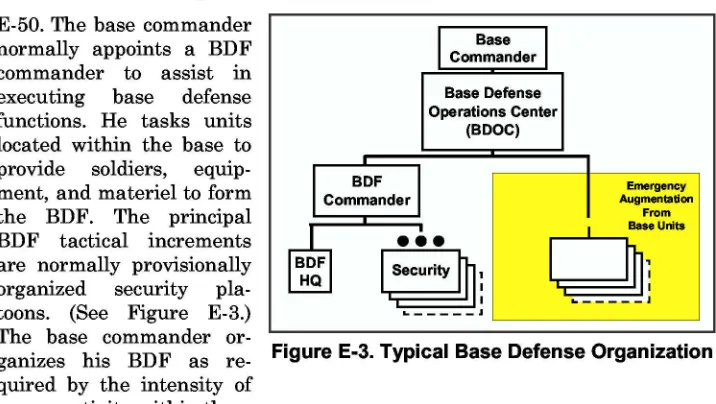
E-50. The base commander normally appoints a BDF commander to assist in executing base defense functions. He tasks units located within the base to provide soldiers, equip-ment, and materiel to form the BDF. The principal BDF tactical increments are normally provisionally organized security pla-toons. (See Figure E-3.) The base commander or-ganizes his BD F as re-quired by the intensity of
enemy activity within the rear area.
E-51. A BDF should have a high degree of direct-fire lethality provided by a mixture of small arms, automatic weapons, and antitank systems. It should also have access to supporting indirect fires, a high degree of tactical mobil-ity, and a reasonable span of control. It should be capable
of-.
Conducting reconnaissance patrols for detecting and reporting the loca-tion, strength, and capabilities of enemy forces located near the base..
Developing positions within and outside the base from which enemy advances can be stopped or destroyed..
Using reserve elements to attack relatively small enemy units that threaten to penetrate the base perimeter..
Providing internal security for critical capabilities located on the base. The base commander must reconcile any issues about personnel and equip-ment resources shortfalls affecting the BDF and the desired level of security.Base Defense Operations Center
(BDOC)
...
I.~curi~
~:
JEmergency Augmentation
From
g"-1
Figure E-3. Typical Base Defense Organization
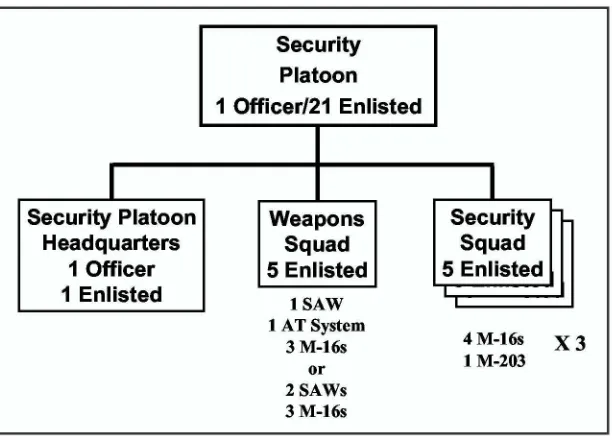
Security
Platoon
1 Officer/21 Enlisted
I
I
Security Platoon Weapons Security
Headquarters Squad Squad
1 Officer 5 Enlisted 5 Enlisted
1 Enlisted 1 SAW
his reserve. In an emergency, the BDF is augmented by the defensive efforts of all units assigned to or transiting the base.
1 AT System 3 M-16s
or 2 SAWs 3 M-16s
4 M-16s 1 M-203 X3
Figure E-4. Security Platoon
E-53. Operational requirements frequently modify a unit's ability to contri-bute resources to the defense effort of its base. Responsibility for reporting such modifications rests with the individual unit. The base commander brings these unrelated and unfamiliar groups together when creating his BDF. Every effort must be made to retain the unit integrity of these security platoons while assigning security tasks to the BDF.
E-54. Providing a BDF from es and ess organizations results in two un-desirable
conditions-.
Reduced operational effectiveness of the units from which the resources are drawn..
Soldiers performing duties other than those for which they are specifi-cally trained.The unit commanders providing these security platoons assign personnel to them. Soldiers assigned to the BDF should remain there if operations permit, in order to facilitate training, provide for continuity of defense operations, and ensure force efficiency.
between forces at the national level. Special considerations for US employ-ment of host nation eleemploy-ments
include-.
Designated host nation security force must be responsive to the de-mands of the base commander..
Caution may be necessary when assigning host nation security forces tasks requiring specialized equipment or skills..
The base commander should consult with the appropriate civil-military operations office to clarify any restrictions that might apply to the use of these forces.Base Cluster Defense Force
E-56. The base cluster defense force consists of all of the BDFs within the base cluster. The base cluster commander can direct the employment of BDFs within the base cluster or segments of those BDFs to counter identified Level II threats within the geographical area of the base cluster. The more normal course of action (COA) is to have a response force engage these Level II threats. Base commanders must reconstitute those portions of their BDFs committed to these missions.
Rear Area Security Forces
E-57. The purpose of rear area security forces is to facilitate a base's ability to return to mission accomplishment as quickly as possible rather than devoting CS and CSS resources to limited tactical operations. Rear area security forces can be further broken down into response forces and TCFs.
E-58. Response Forces. A response force is a mobile force with appropriate fire support designated, usually by the area commander, to deal with Level II threats in the rear area (JP 1-02). It usually consists of MP forces supported by available fire support and Army aviation assets. They are usually either platoon- or company-size forces. Military police elements may be temporarily or permanently unavailable in sufficient strength for response force opera-tions because of their commitment to other missions. The commander should designate alternative response forces before this occurs. Other possible re-sponse force options include engineer units, chemical units, transiting combat units, elements of the reserve, or host nation assets. The rear command post coordinates with the echelon G3/S3 before committing forces other than MP units to response force missions.
E-59. The MP chain of command directs the size and composition of the re-sponse force when the echelon is primarily focused on conducting offensive and defensive operations. The nature and size of the threatening enemy force influences the size and number of MP elements that make up the response force. So, too, does the current rear intelligence preparation of the battlefield (IPB) and the echelon's rear area commander's risk assessment. The echelon provost marshal, in coordination with his rear area commander,
considers-.
The priority of ongoing operations..
The criticality of the base under attack..
The amount of time needed for given elements to consolidate.E-60. Tactical Combat Forces. A tactical combat force (TCF) is a combat
unit, with appropriate combat support and combat service support assets, that is assigned the mission of defeating Level III threats (JP 1-02). These threats can result from enemy forces infiltrating friendly positions or pene-trating friendly defensive positions and moving into the friendly rear area, or conducting airborne/air assault operations. A successful defense against such a Level III threat requires planning and preparing for the TCF's employment. The echelon commander can dedicate a TCF to deal with such a threat, desig-nate another force as the on-order TCF, or accept the risk of not having a des-ignated TCF. A dedicated TCF has the necessary assets, such as artillery and combat engineers, allocated to it to accomplish the mission. The echelon com-mander decides the exact composition of the TCF after weighing the risk of allocating forces to the TCF and thus decreasing the combat power available for his decisive operation.
E-61. The echelon G3 designates the number of TCFs in accordance with the situation and the echelon commander's guidance. Designating more than one TCF provides flexibility of response to competing needs. The primary advan-tage of having a dedicated, rather than an on-order, TCF is the assurance that it will be available when needed. Other advantages include the ability of the TCF staff to focus the force's planning and preparing activities on just one mission. This includes establishing liaison and communications with support-ed bases or base clusters and echelon Level II response forces. It also allows the dedicated TCF to rehearse its plans. When the commander assigns a sub-ordinate unit an on-order TCF mission, he must establish criteria on when to commit that unit as the TCF.
E-62. A TCF can expect support from the following types of assets:
.
MPs with working dogs..
Military intelligence (includes counterintelligence)..
Field artillery..
Engineers..
Army aviation (attack, air cavalry, air assault, C2, and possibly special electronic mission aircraft)..
Public affairs..
Air defense artillery..
Area signal nodes..
Civil affairs assisted by psychological operations (PSYOP) elements..
CSS elements required to sustain the force conducting area security. Any or all of these types of assets may not be immediately available to the TCF on its commitment. They are limited assets and may be engaged in other missions. The force conducting the rear area security mission may also re-ceive support from other US and allied services, including the host nation.between units common to the rear area. The TCF must be as mobile as the enemy. It should be capable of destroying armor-protected vehicles and dis-mounted infantry and of suppressing enemy shortrange air defense (SHORAD) systems. Consequently, a TCF typically consists of infantry, Army aviation (attack and utility helicopters), and air cavalry elements with engi-neer and field artillery support. The commander may also organize a TCF with armored cavalry, armor, and mechanized infantry units if the situation so dictates.
E-64. The commander strives to obtain tactical self-sufficiency within both the response force and the TCF. He does this by attaching or placing in direct support adequate fire support, CS, and CSS elements so that they can per-form semiindependent operations. In addition, he must obtain resources, such as CA, PSYOPS, and interpreters, for interacting with the civilian popu-lation of the area being secured.
Special Operations Forces
E-65. Special operations forces other than CA and PSYOP may combat terror-ism within the AO of a conventional unit. A unit conducting rear area and base security may be tasked by a higher headquarters to provide conven-tional support to SOF elements conducting counterterrorism operations with-in its AO. If SOF operate in the area, a special operations command and con-trol element (SOCCE) will normally be deployed at the Army forces or corps echelon, with liaisons attached lower for a specific mission to the unit respon-sible for the appropriate AO for the duration of the SOF mission.
CONTROL MEASURES
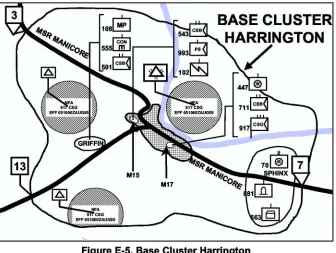
E-66. Control measures in base defense operations are the same as those used in other defensive operations. (See Figure E-5, page E-16.) The head-quarters establishing the base or base cluster designates the base's AO using rear, lateral, and forward boundaries. The AO for the base mayor may not be contiguous to the AO of other units. The echelon rear area commander may further subdivide his assigned area into subordinate AOs, bases, and base clusters. He can assign maneuver forces to assembly areas and battle posi-tions. He establishes phase lines, contact points, objectives, and checkpoints as necessary to control his maneuver. He establishes fire support coordi-nating measures (FSCM) to permit or restrict fires in and around the base. (See Chapters 2, 3, and 8 and FM 3-09 for a discussion of FSCM.) No-fire areas may be required to protect civilians, prevent disruption of sustaining operations, or protect combat outposts, observation posts, and patrols from friendly fire. All established control graphics are coordinated with host nation agencies to minimize interference, misunderstandings, and unnecessary col-lateral damage. The BDF commander, in coordination with the base com-mander, designates the base perimeter, target reference points, and sectors of fire to organizations located within the base.
PLANNING CONSIDERATIONS
E-67. The echelon commander designs his rear area and base security system to
.
Minimum degradation to unit mission performance while providing the unit's contribution to the BDF..
Combat arms units are not diverted to provide dedicated rear area and base security forces.E-68. Commanders in the rear area can improve their capability to effectively use available manpower and materiel by establishing logical priorities. The commander must allocate resources available to protect personnel, supplies, and facilities in consonance with the degree of risk involved. Sufficient per-sonnel and materiel will not usually be available in the rear area to provide simultaneous protection to all of the echelon's sustaining operations.
E-69. Base defense plans are flexible and allow for differing degrees of secur-ity based on the probability of threat activity to maximize unit mission ac-complishment. The common defensive planning considerations outlined in Chapter 8 apply to planning for base security. The following paragraphs ex-plain fundamental principles of rear area and base security. They also ad-dress BOS specific planning considerations that apply to base security.
BASE CLUSTE
HARRINGTON
/
Figure E-5. Base Cluster Harrington
Fundamentals of Base Defense
E-70. The fundamentals of base defense
are-.
Understand the enemy..
See the AO..
Use the defender's advantages..
Concentrate at critical times and places..
Conduct counterreconnaissance and counterattacks..
Coordinate critical defense assets..
Know the ROE..
Responsiveness.E-71. Understand the Enemy. Defenders must be familiar with the capa-bilities and limitation of enemy forces, weapons, equipment, and tactics. The base commander also must have access to the latest intelligence concerning probable enemy intent.
E-72. See the AO. Intelligence operations are key to assembling an accurate picture of the AO. The IPB process provides the commander a continuous, integrated, and comprehensive analysis of the effects of enemy and neutral capabilities, terrain, and weather on operations. It helps the commander anticipate events and develop the priority intelligence requirements and in-formation requirements tied to those events. Intelligence and multidiscipline counterintelligence estimates are prepared, continuously updated, and inte-grated into the base commander's staff decision making process. Space-based, airborne, and ground sensors, patrols, and counterintelligence activities are all means that rear area commanders can employ to detect possible indicators of planned enemy action.
E-73. Use the Defender's Advantages. Defender's advantages may permit a numerically inferior force to defeat a much larger one. Some of these advan-tages are:
.
The ability to fight from cover..
More detailed knowledge of local terrain and environment..
The ability to prepare positions, routes between them, obstacles, and fields of fire in advance..
The ability to plan communications, control measures, indirect fires, and logistic support to fit any predictable situation..
The ability to deceive enemy forces about friendly defensive capabili-ties, dispositions, and execution of operations.E-74. Concentrate at Critical Times and Places. A base commander must measure and continually evaluate the various risks to his base. An ene-my usually concentrates his resources on the most sensitive or vulnerable targets. Defense of a base is normally conducted along interior lines, permit-ting the timely and secure movement of forces to engage the most critical threats. The commander must mass enough combat power at points of deci-sion by economizing in some areas, employing a reserve, and maneuvering to gain local superiority at critical points.
E-75. Conduct Counterreconnaissance and Counterattacks. A major contributing factor to vulnerability in the rear area is the relatively fixed na-ture of operations. An enemy can study the operational patterns of semifixed units and installations to determine their existing defensive measures. Fur-ther, fixed bases having well-established perimeters usually have limited depth. Counterreconnaissance and counterattack add depth to the battle out-side the perimeter, allowing the base to continue its primary mission with minimal interference.
can produce a combined arms effect. Synchronizing forces and fires produces a synergy capable of defeating a larger enemy force. This synergy results from making enemy movement difficult or impossible and by causing a reac-tion that may make enemy forces more vulnerable to other friendly capabili-ties. Periodic rehearsals of security plans ensure effectiveness of the alert system, proficiency of key individuals, and identification of potential problem areas.
E-77. Balance Base Security with Political and Legal Constraints. Base security may have to be designed around numerous political con-straints.
E-78. Know the ROE. The base commander and his subordinates must com-ply with established ROE. He ensures the reconciliation of any inconsisten-cies between service component and multinational ROE.
E-79. Responsiveness. The echelon rear area commander and his subordi-nate base cluster and base commanders have the authority and the capability to communicate operational requirements directly to units located within their AOs. The chain of command frequently changes from the functional to the tactical chain of command after implementing a rear area and base secur-ity plan. Therefore, the rear area commander must critically analyze and test his communication systems that filter through various levels of command to assure that they are responsive under given emergency conditions. The eche-lon rear area commander establishes direct communication links between the echelon rear command post and its subordinate base cluster and base opera-tions centers if existing information systems are not adequate to transmit rear area and base security-related information to those centers in a timely manner.
E-80. Responsiveness may be attained by many different procedures and capabilities, some of which are listed below:
.
Clearly established authority granted to base cluster and base com-manders..
A wide-area information system that provides a flexible warning sys-tem for a large variety of situations..
Continuous identification and tracking of resources that can assist in providing rear area and base security, such as maintenance float wea-pon systems and replacement crews..
Response forces have communication systems capable of using the existing wide-area information systems to communicate directly with the threatened BDOC. They also can communicate with the BCOC lo-cated in the threatened base cluster and the echelon rear command post..
MP forces responding to Level II rear area threats have combat vehi-cles with a mixture of firepower, armor protection, and a high degree of tactical mobility.Other Planning Considerations
E-81. When the rear area commander commits his forces to semifIxed instal-lations or sites, the rear area security mission may become defensive in na-ture. Therefore, he must carefully balance his approach with the need for of-fensive action. Detecting enemy activity early is critical when conducting rear area security; it provides the commander with time to react to any threat. Proper integration of the BaS is key to successful operations.
E-82. Intelligence. A review is made of all available information about the general area before occupying a site. The IPB process addressing the rear area includes not only enemy information, but terrain, weather, and informa-tion about the civilian population and infrastructure. Intelligence, cavalry, scout, and CA organizations obtain relevant information about the area from host nation governmental organizations and the civilian population.
E-83. In the commander's visualization of the factors of METT-TC for the rear area security mission, he focuses on the enemy situation to determine how to organize and conduct the mission. Tactical intelligence is the key to defeating enemy operations directed against friendly sustaining operations. It provides the commander with information on current and possible future enemy locations, activities, strengths, weaknesses, and plans, which helps him seize the initiative. The commander should exploit all relevant sources of information within his AO, including information provided by civilian agencies and individuals. The IPB process is a vital part of answering the commander's intelligence requirements which
include-.
Size and capabilities of enemy forces within the commander's AO..
Natural defensive characteristics of the terrain..
Movement corridors throughout the AO for mounted and dismountedoperations.
.
Conditions of existing roads, railways, pipelines, and waterways for use as both military LaCs and civilian commerce..
Proximity of enemy forces to critical facilities and installations, such as airfIelds, power generation plants, petroleum tank farms, and civic buildings.E-84. Maneuver. The commander should not employ any organization in a role or confIguration for which it is not principally designed unless such ac-tion is unavoidable. Rear area commanders employ the defensive potential of CS and CSS units to counter enemy actions. The defensive potential of each unit is that portion of a CS or CSS unit that may be used to provide rear area and base security with minimum degradation to overall mission capability. The echelon commander does not divert his combat forces to provide rear area and base security unless required by the factors of METT-TC. The rear area commander takes maximum advantage of host nation capabilities to provide response forces and TCFs.
in a cleared area, occupying high ground with sufficient vegetation to conceal base facilities from observation. The worst site contains complex terrain and large numbers of noncombatants. The former extremely limits observation and fields of fire from the base and the latter limits the firepower that can be employed to defend the base. The most common tendency is to occupy the low ground through which most roads run, a balance between operational re-quirements and security requirements. A commander can justify the cost, time, and manpower needed to relocate a site to more defensible terrain rather than secure a poor position. The base commander locates his base in a place that enhances its physical security. The base cluster and echelon rear area commanders must approve the location.
E-86. Forces engaged in rear area security must be flexible and able to adapt to rapidly changing tactical situations. Rear area and base security are nor-mally the domain of small units. The organization of forces for base defense also differs, depending on how the commander plans to accomplish his mis-sion. The base commander task-organizes his forces into combined arms ele-ments to counter the level of enemy capabilities as determined by his intelli-gence assets. This enables him to find the enemy with the smallest possible element, maintain contact without risking the destruction of the element in contact before it can receive outside support, and mass his combat power rap-idly to destroy the detected enemy.
E-87. All security measures must have an inherent offensive capability. The echelon TCF, response forces provided by echelon MP and other assets, and local security measures undertaken by bases and base clusters contain the rear area commander's offensive capabilities. The base commander uses the potential combat power available within CS and CSS units located within his AO to provide those local security measures. He organizes and trains that identified potential combat power to conduct limited offensive operations against confirmed enemy Level I threats that threaten his bases and base clusters.
E-88. Absent a direct enemy threat, there is a tendency to relax security measures after completing the base's fighting and survivability positions. However, well-established security patterns allow enemy elements to recon-noiter the base and determine its points of vulnerability with little risk.
E-89. The base commander designates reconnaissance and patrol areas out-side the base's perimeter to provide additional security if allowed to do so by the host nation. The objective is to provide the base additional early warning.
E-90. The factors ofMETT-TC and unit capabilities determine the specific se-curity element tasks of subordinate maneuver units. For example, mounted forces are more suited to secure key points, such as major road junctions, bridges, tunnels, canal locks, dams, and power plants; while dismounted forces are well-suited for securing areas containing restricted terrain or large numbers of civilians.
friendly force. Soldiers must understand this and follow strict ROE when conducting sustaining operations.
E-92. Because of the decentralized nature of sustaining operations and the intermingling of military forces and civilians, the commander must address fratricide prevention when planning for rear area and base security. Fires that miss their intended targets can affect other forces, routes, and installa-tions in the secured area. When considering a COA, the commander weighs the risk of fratricide against losses to enemy fire.
E-93. Fire Support. Artillery and mortars, if available, are the fastest means of responding to intruders beyond the base perimeter in the absence of maneuver forces positioned there. The commander desires the designation of a free-fire area beyond the base perimeter to allow for the optimum employ-ment of available fire support systems. He positions no-fire or restricted fire areas over locations occupied by civilians and friendly forces operating out-side the base, such as patrols and observation posts. These areas are large enough to provide the necessary degree of standoff protection.
E-94. Air Defense. Air and missile attacks are perhaps the greatest threats to units in the rear area. Rear area bases normally rely on passive air defense for protection against enemy air threats. Most rear area bases will not be supported by SHORAD systems. They will normally be located within the coverage provide by high- to medium-altitude air defense (HIMAD) systems. They will not normally control the positioning of HIMAD systems. (Chapter 8 discusses passive and active air defense considerations. Ballistic missile de-fense is an operational-level task addressed in FM 3-01.12.)
E-95. Mobility/Countermobility/Survivability. The commander directs the construction and improvement of perimeter barriers. This includes estab-lishing clear fields of fire and implementing physical security measures, such as checkpoints on vehicle and pedestrian routes leading into the base, to im-prove overall base security. Barriers, natural obstacles, and aggressive offen-sive actions deny enemy access to the area immediately surrounding the base. If the force keeps the enemy at a distance, he cannot launch damaging attacks toward the base. The commander continues to direct improvement in his base defenses, as time and other resource permit, to ensure a stable se-curity system.
E-96. Force protection considerations against terrorist attack are part of base defense planning. The base commander assesses the vulnerability of the base to terrorist attack and other nonbattlefield threats. He must assess the base's vulnerability to each identified threat. Risk and vulnerability assessments are the foundation for priorities of work and resource distribution.
E-98. Combat Service Support. Since base security forces generally oper-ate in close proximity to the base, the commander tailors the load carried by his dismounted elements to the immediate requirements of METT-TC. Re-supply of dismounted elements takes place using ground or air modes.
E-99. Command and Control. Planning for rear area and base security op-erations, like all planning, requires the rear area commander to have an ac-curate common operational picture of his AO. This includes the strength and security potential of available units, terrain and environmental data, and in-telligence information. The rear area commander uses existing echelon rear command posts and information systems to provide him and his subordinate commanders that common operational picture.
E-lOO. In planning for base security, a simple, flexible defensive plan dis-seminated to the lowest level of command is normally the best COA. The plan should include the maximum use of standing operating procedures (SOPs) and battle drills at the user level. It should incorporate adequate control measures to ensure the safety of friendly troops and civilians. Such a plan minimizes the impact of the inevitable miscues that accompany any combat operation.
E-lOl. The base commander integrates the base security plans with those of its base cluster and supporting rear area security forces. He periodically re-views the base defense plan. Alterations in the units assigned to the base and changes to their defense capabilities because of mission requirements also re-quire updating the base defense plan. Frequent alterations of base security procedures reduce the base's vulnerability. The continuous monitoring of plans also allows adjustments based on experience to be incorporated into those plans.
E-102. The base commander establishes communications with the BCOC (or the echelon rear command post if the base in not part of a base cluster). He also establishes communications with the headquarters of the designated Level II response force.
E-I03. Communication problems can occur in information exchanges during the planning for base security involving multinational forces. The commander must address any language barriers because units operating in the rear area normally need to communicate with various host nation governmental agen-cies and the civilian population. The ability to communicate with these differ-ent agencies and the local population helps to protect the force.
PREPARING A BASE DEFENSE
E-105. Preparing for base defense begins before base units arrive, if possible. Normally, combat units provide the initial defense in the base area, as they are the first forces into an area. An exception may occur when conducting force projection operations supported by a host nation. In this case, the host nation's forces are the first forces into the area. These forces can be conven-tional military forces or police and internal security forces.
E-I06. The rear area commander uses his available resources to initiate an area reconnaissance to determine the physical characteristics of the area and the presence or absence of enemy forces. Since rear area and base security is normally an economy of force measure, it is unlikely that sufficient forces will be available to secure the echelon's entire rear area at one time. Therefore, they concentrate on those areas immediately adjacent to the protected ele-ment, such as friendly forces. It is essential that base, base cluster, and other rear area security forces conduct continuous reconnaissance operations. They may focus their efforts on people, materiel, buildings, or terrain.
E-107. Reconnaissance operations that involve only US forces may not be ef-fective if language problems prevent communication with the local popula-tion. In these instances, interpreters-US Army or host nation-should ac-company forces conducting reconnaissance. When possible, host nation auth-orities, such as the civil police, should also accompany the reconnaissance force. Distributing leaflets and handbills before or during an area reconnais-sance and using loudspeaker teams during the reconnaissance can aid the re-connaissance effort by informing civilians of what information the US recon-naissance force is seeking and how they can report that information to US forces.
E-108. The rear area commander directs units within his AO to establish bases and base clusters even while this initial area reconnaissance is on-going. These bases and base clusters provide security to units located within them and can provide perimeter security around critical locations. Perimeters vary in shape depending on the factors of METT-TC. The perimeter shape conforms to the terrain features that offer the best use of observation and field of fire.
E-109. When the units constituting the base arrive, they immediately start organizing the defense of the base. Many tasks occur simultaneously, but some may require priority. The base commander specifies the sequence for preparing the defense system. (Chapter 9 provides a recommended sequence in its discussion of the preparation for an area defense.)
E-ll1. Units may construct fighting positions or prefabricate and move them into position for assembly. These bunkers are constructed to withstand a di-rect hit by a medium antitank missile on the front and sides and a direct hit by a mortar on the top. Installing chain link fences around these positions can prematurely detonate shaped-charge warheads.
E-112. Constructing revetments for critical resources provides protection against mortar or rocket fragmentation. These revetments may be sand-filled, double-walled construction with either plywood or steel plate sides. Units within the base provide overhead cover for critical facilities and func-tions when possible. The base commander's preventive measures to avoid or minimize effects of enemy attacks also contribute to his ADC efforts by pro-viding units, soldiers, facilities, and supplies on the base protection from major accidents and natural disasters as well.
E-113. The commander uses tactical wire barriers within the perimeter to limit and canalize penetrations by enemy groups or individuals. These inter-ior barriers can be as simple as a single roll of concertina wire. Generally, the commander should place them to prevent a direct approach to vital facilities within the base. He should make provisions to cover these barriers by auto-matic weapons. The base should construct inconspicuous barriers and peri-odically relocate them to prevent counterplanning by the enemy. Further, the barriers should not be so intensive as to preclude freedom of movement by the reaction or reserve force. These forces, as well as all soldiers, should be familiarized with the location of all barriers through daylight and night drills.
E-114. Base defense training is an essential element of preparing to conduct a base defense. Base defense requires integrating the BDF and its emergency augmentation by all units on the base. Because they rarely function together, the commander can form an efficient fighting entity only through proper training. The BDF commander carefully coordinates the training of base units for base defense operations with the support operations of the base. All individuals receive training to allow them to participate, at least to a limited degree, in the base's defense. All units receive training to provide at least limited local security for the facilities they operate. Conducting rehearsals that test the base defense plan is an essential part of base defense training. Some equipment deemed necessary for base defense or for training purposes may not be available. The BDF commander must use his initiative to over-come these shortfalls.
E-115. Most of the training required to support base defense operations is currently a part of individual and unit training programs. Soldiers desig-nated to take any part in base defense operations will probably require addi-tional training in the following areas as applicable to their roles in the base defense effort:
.
Ambush techniques and defensive measures against enemy ambushes..
Use of hearing, sight, and smell as detection means..
Police-type patrolling and operating roadblocks and checkpoints..
Limited-visibility operations to include using night vision devises, sen-sors, and techniques for using sign and countersign procedures..
Observation post operations with emphasis on security, sound and light discipline, and reporting procedures..
Operation and operator maintenance of base defense equipment, such as sensors, night observation devices, radios, and computer systems..
Cross-training on all communications equipment available within the base and communication techniques..
Barrier construction and, if authorized, using mines and booby traps..
Patrolling..
Small-unit attacks, such as the employing movement formations, rushes, and a base of fire..
Fire control and fire distribution of available weapons.E-116. The existence of a common operational picture and the commander's situational understanding are the keys to knowing how and when a response force will be needed. Separate bases and base clusters establish continuous communications with the echelon rear command post to allow timely res-ponse and information dissemination.
E-ll 7. The commander of the response force has a copy of the base defense plan so he can effect necessary coordination between the base and the re-sponse force once the latter is activated for the response mission. This coordi-nation occurs through the BDOC. The response force commander coordinates with the base to ensure that he understands the base defense plan, to in-
clude-.
Method of contacting the BDOC or BCOC, including call signs and fre-quenCIes..
Base defense plans and layouts toinclude-.
Positions of critical internal assets, external coordination points, and no-fire areas.. Locations of any obstacles or mines near the base.
.
Locations and direction of fire of crew-served weapons..
Locations of target reference points and preplanned fires..
Locations of OPs and friendly patrols if employed by the base..
Signal for final protective fires..
How to obtain available fire support.E-118. The response force commander designated for each base must have the capability to mass the effect of supporting fires and support TCF opera-tions. He must know which fire support targets are approved for engagement and the locations of the nearest medical treatment facility, NBC decontami-nation site, and ammunition supply point. He must be able to communicate
with-.
Any supporting artillery and Army aviation units tasked to respond..
The TCF, BDOC, BCOC, and the echelon rear command post.EXECUTING A BASE DEFENSE
commander. However, the individual conducting rear area security may be forced to adopt a primarily defensive posture because
of-.
The size of the rear area..
A lack of resources..
Inability to detect and track the enemy..
Enemy capabilities in relation to the friendly force capabilities.E-120. Forces engaged solely in base defense operations conduct aggressive patrols, develop and occupy defensive positions within their assigned AOs, and provide security forces to counter enemy attacks. These actions may be multiservice or multinational depending on the composition of the base.
E-121. Rear area commanders at all echelons request ground maneuver forces to use as BDFs when the net effect of enemy activities in the echelon's rear area is beyond the limited defensive capabilities of CS or CSS resources. If a threat exceeds a base's ability to defend itself, the base commander re-quests response force support through his BCOC or the echelon rear com-mand post if he comcom-mands a separate base.
E-122. The conduct of base defensive operations against a ground attack is the same as for conducting a perimeter defense. (Chapter 8 discusses the perimeter defense.) The paragraphs below discuss those execution considera-tions unique to base defense.
Patrols
E-123. Base defense operations to counter small enemy forces include ag-gressive, frequent patrolling by squad- and platoon-size forces to detect and capture or destroy small enemy bands. Host nation personnel are well suited to assist BDF patrols. Their knowledge of the terrain, inherent ability to op-erate effectively in the environment, language skills, and familiarity with local customs increases the effectiveness of these patrols.
E-124. Small, highly mobile units conduct patrols by moving on foot or by land, water, or air vehicles during daylight and darkness. They search popu-lated areas contiguous to the base and establish surprise checkpoints along known or suspected routes used by enemy forces.
E-125. The BDF mans dug-in or concealed night ambush sites located outside of the base's external barrier system on a random basis. Host nation security personnel should accompany patrols traveling through populated areas. The base develops fire support targets to support the ambush in accordance with their availability and the ROE. If the area adjacent to the base perimeter is a free fire area, it is seldom necessary to occupy ambush sites there. When local restrictions preclude establishing a free-fire area, ambush sites are manned forward of the perimeter and the BDF is prepared to assist those elements conducting the ambush as necessary.
Static Positions
may confirm or deny the presence of enemy activity in named areas of in-terest located near to base.
E-127. The base uses any available small boats to patrol nearby rivers and coasts. An infiltrating enemy takes advantage of waterways to transport heavy weapons because of their weight and bulk. Detecting these weapon sys-tems is an important river and coastal surveillance mission for the BDF com-mander. The Army has type-classified small watercraft suitable for use in this type of patrol, as does the Navy and Coast Guard.
E-128. Military working dogs are a valuable asset in base defense operations. Their employment should habitually be considered in planning all patrol and security operations. Successfully using these dogs depends on the skill of the handler and the knowledge and full understanding of the capabilities and limitations of the dogs by employing commanders and staffs. (Army Regula-tion 190-12 provides this information.)
E-129. During base security operations, the base commander monitors the lo-cation of friendly troops and their relationship to friendly fires. The base com-mander must be constantly aware of the relative location of enemy, friendly, and neutral personnel. Subordinate elements, such as patrols, must under-stand the importance of accurately reporting their positions. Automation and navigation aids, such as the global positioning system (GPS) tied to combat net radios, assist in maintaining a common operational picture. When em-ploying artillery, mortars, and air support, the commander must exercise pos-itive control, whereby an observer must be able to see the target area. Unit SOP at all levels must address specific procedures for clearing indirect fires directed against identified targets located within the rear area.
E-130. The static positions of the base defense consist primarily of the bunk-ers and towbunk-ers forming the base's defensive positions. Positioning bunkers and towers correctly affords maximum observation and mutually supporting fires over the area forward of the perimeter to include the perimeter barrier and sensor system.
E-131. The base commander establishes communications between the BDOC, the command posts of the units occupying the base, and the base's bunkers, towers, and reserve. In addition, each node be able to communicate laterally with adjacent units and defensive positions.
E-132. Bunkers. Although full-time observation and all-around defense of the base are essential, the BDF commander may reduce the number of sol-diers conducting static defense mission by designating key bunkers around the perimeter to be manned at all times, with the remainder to be fully man-ned during periods of reduced visibility and increased enemy threat. The base prepares individual fighting positions near the bunkers to provide supporting fires. Night vision devices, binoculars, automatic weapons, grenade launch-ers, and hand grenades are commonly available within the bunker positions, and antitank systems cover possible ground vehicle approaches.