ABSTRACT
EZEN CAN, AYSU. Unsupervised Dialogue Act Modeling for Tutorial Dialogue Systems. (Under the direction of Dr. Kristy Elizabeth Boyer.)
Tutorial dialogue systems interact with students using rich natural language, in support of a learning task. These systems have been shown to be effective at supporting student learning, in some cases rivaling the effectiveness of human tutors. However, due to the engineering effort required within their various components, building and developing tutorial dialogue systems is a challenging task. To address this challenge, machine learning approaches that automatically learn from human-human dialogue are the focus of increasing attention. One of the most important tasks for a tutorial dialogue system is to understand students’ natural language input in order to respond accordingly. This dissertation research focuses on techniques for understanding dialogue acts, which are used to represent the intention of an utterance.
The approach presented here leverages unsupervised machine learning to model dialogue acts. The goal of this approach is to dramatically decrease the manual effort required for engineering the dialogue management module of tutorial dialogue systems, including the work required to manually label large corpora for training dialogue act classifiers. Unsupervised models represent directly data-driven groupings of student utterances into the most natural clusters, rather than manually labeled tags that were created based upon dialogue taxonomies. The work presented in this dissertation shows that unsupervised models can be effectively used for modeling student dialogue acts. As part of this dissertation research, several types of unsupervised dialogue act classifiers have been built and investigated, including two models that adapt information retrieval approaches for the task of dialogue act clustering, and another model that explicitly models task events and learner characteristics. In addition, an extended set of features including multimodal features were explored and shown helpful for particular dialogue acts. Initial evaluations of the dialogue act classifiers utilized manually labeled data for computing accuracy.
© Copyright 2015 by Aysu Ezen Can
Unsupervised Dialogue Act Modeling for Tutorial Dialogue Systems
by Aysu Ezen Can
A dissertation submitted to the Graduate Faculty of North Carolina State University
in partial fulfillment of the requirements for the Degree of
Doctor of Philosophy
Computer Science
Raleigh, North Carolina
2015
APPROVED BY:
Dr. Tiffany Barnes Dr. Munindar Singh
DEDICATION
To my loving family, my mom, dad, mother-in-law, father-in-law, sister, brothers, Leyla Gun, and mostly to my dear husband, whose unconditional support and encouragement made it
BIOGRAPHY
ACKNOWLEDGEMENTS
First and foremost, I would like to express my deepest appreciation to my advisor Dr. Kristy Elizabeth Boyer for her help. She has been a great advisor throughout the years of collaboration. I am deeply grateful to the members of my committee, Tiffany Barnes, Munindar Singh and Jimmy Scherrer for their insightful comments and suggestions. My colleagues in the LearnDialogue Group have provided vital support and collaboration.
TABLE OF CONTENTS
LIST OF TABLES . . . .viii
LIST OF FIGURES . . . x
Chapter 1 Introduction . . . 1
1.1 Motivation . . . 1
1.2 Research Questions and Hypotheses . . . 2
1.3 Approach . . . 4
1.4 Contributions . . . 4
1.5 Organization . . . 6
Chapter 2 Background and Related Work . . . 7
2.1 Tutorial Dialogue Systems . . . 7
2.2 Dialogue Act Classification . . . 12
2.2.1 Supervised Dialogue Act Classification . . . 13
2.2.2 Unsupervised Dialogue Act Classification . . . 13
Chapter 3 Corpora . . . 16
3.1 JavaTutor 2007 Corpus . . . 16
3.2 JavaTutor 2011 Corpus . . . 17
Chapter 4 Dialogue Act Classification: Query-Likelihood Clustering . . . 22
4.1 Query-Likelihood Clustering Methodology . . . 23
4.1.1 Natural Language Preprocessing . . . 23
4.1.2 Query-Likelihood Representation . . . 24
4.1.3 Clustering . . . 24
4.2 Experiments with Query-Likelihood Clustering . . . 25
4.2.1 Parameter Tuning . . . 26
4.2.2 Accuracy in Identifying Manually Labeled Dialogue Acts . . . 29
4.2.3 Analysis of Clusters . . . 31
4.3 Query-Likelihood Clustering: Discussion . . . 32
Chapter 5 Dialogue Act Classification: Markov Random Field Based Approach 35 5.1 Unsupervised Dialogue Act Modeling . . . 35
5.1.1 Utterance Similarity Calculation . . . 36
5.1.2 Clustering . . . 40
5.2 Experiments with Comparisons . . . 41
5.3 Evaluation of MRF-Based Clustering . . . 41
5.3.1 Test Set Accuracy, Precision and Recall . . . 42
5.3.2 Qualitative Evaluation . . . 44
5.4 Discussion: MRF-Based Clustering . . . 46
6.1 Features . . . 49
6.1.1 Lexical Features . . . 49
6.1.2 Dialogue Context Features . . . 50
6.1.3 Task Features . . . 50
6.2 Enriched Feature Set: Methodology . . . 51
6.2.1 Dialogue Act Modeling Withk-medoids Clustering . . . 51
6.2.2 Experimental Results . . . 53
6.2.3 Utilizing Dialogue History . . . 53
6.3 Results . . . 55
Chapter 7 Incorporating Learner Characteristics into Dialogue Act Models. . 59
7.1 Dialogue Act Modeling with Learner Characteristics: Methodology . . . 60
7.1.1 Experimental Design . . . 63
7.1.2 Unsupervised Dialogue Act Modeling with Learner Characteristics . . . . 64
7.2 Results of Dialogue Act Classification by Learner Characteristics . . . 66
7.3 Discussion: Learner Characteristics and Dialogue Act Classification . . . 69
Chapter 8 Incorporating Multimodal Features into Dialogue Act Models . . . 73
8.1 Features . . . 74
8.2 Methodology: Clustering with Multimodal Features . . . 76
8.3 Experiments: Clustering with Multimodal Features . . . 79
8.4 Results: Clustering with Multimodal Features . . . 80
Chapter 9 Preliminary In-Context Evaluation of Unsupervised Dialogue Act Classifiers . . . 86
9.1 Preliminary Evaluation: Methodology . . . 86
9.1.1 Unsupervised Dialogue Act Classifier Being Evaluated . . . 87
9.1.2 Evaluation Framework . . . 88
9.2 Preliminary In-Context Evaluation: Results . . . 91
9.3 Preliminary In-Context Evaluation: Discussion . . . 91
Chapter 10 A Tutorial Dialogue System for Real-Time Evaluation of Unsu-pervised Dialogue Act Classifiers . . . 93
10.1 System Design . . . 94
10.1.1 Tutorial Policies and Utterance Generation . . . 96
Chapter 11 Evaluation Study I: In-Class Participants . . . .102
11.1 Evaluating System Outcomes . . . 103
11.2 Exploring the Relationship Between Learner Personality, Attitudes, and Tutorial Dialogue Participation . . . 105
11.2.1 Analysis . . . 106
11.2.2 Modeling Level of Participation . . . 107
Chapter 12 Evaluation Study II: Volunteer Participants . . . .112
12.1 Learning Gains in JavaTutor-U and JavaTutor-S . . . 113
12.3 Student Participation in JavaTutor-U and JavaTutor-S . . . 115
12.4 Incoming Student Characteristics . . . 117
12.5 Discussion . . . 118
Chapter 13 Conclusion . . . 121
13.1 Hypotheses Revisited . . . 121
13.2 Summary . . . 122
13.3 Threats to Validity . . . 123
13.4 Future Work . . . 123
13.5 Concluding Remarks . . . 124
References. . . .125
Appendices . . . 137
Appendix A Tutoring Tasks . . . 138
Appendix B Main Pre-survey . . . 141
Appendix C Lesson 1 Student Pre-test . . . 149
Appendix D Lesson 1 Student Post-test and Post-survey . . . 153
LIST OF TABLES
Table 3.1 Dialogue act tags from JavaTutor 2007 corpus with examples and student
frequencies. . . 18
Table 3.2 Excerpt from the JavaTutor 2007 corpus. . . 19
Table 3.3 Student dialogue act tags and their frequencies for JavaTutor 2011 corpus. . . 19
Table 3.4 Excerpt of dialogue from the JavaTutor 2011 corpus and the task action that follows utterances. . . 21
Table 4.1 Original utterances, their processed versions and query combinations. . . 25
Table 4.2 Sample queries and their top three query-likelihood results. . . 26
Table 4.3 Query-likelihood clustering algorithm. . . 27
Table 4.4 Mean average precision (MAP) results for weighting interrogative parts of speech and punctuation. . . 27
Table 4.5 b-value MAP results. . . 28
Table 4.6 n-value MAP results with set b-value. . . 28
Table 4.7 Student utterance distributions over clusters using manual tags. . . 31
Table 4.8 Utterances from selected clusters with manual tags. . . 34
Table 5.1 Markov Random Field-based clustering algorithm. . . 40
Table 5.2 Example utterances from each cluster. . . 47
Table 6.1 Dialogue context features and their descriptions. . . 50
Table 6.2 Task features extracted from student computer programming activities. . . 51
Table 6.3 Test set accuracies and Kappa for the flat clustering model. . . 54
Table 6.4 The number of student utterances after branching on the previous tutor dialogue act. . . 55
Table 6.5 Test set accuracies and Kappa for branching on previous tutor dialogue act. . 56
Table 6.6 Accuracies for individual dialogue acts. Acts with fewer than 10 utterances after branching are omitted from the table. . . 58
Table 7.1 Excerpt of dialogue with a female student in the low self-efficacy and low skill perception groups. . . 60
Table 7.2 Excerpt of dialogue with a male student in the low self-efficacy and low skill perception groups. . . 61
Table 7.3 Average percentage of utterance length. . . 63
Table 7.4 Average test set accuracies for each learner characteristic. . . 68
Table 7.5 Selected utterances from clusters tailored to gender. . . 70
Table 7.6 Selected utterances from clusters tailored to skill perception. . . 71
Table 7.7 Selected utterances from clusters tailored to self-efficacy. . . 72
Table 8.3 Sample utterances that were incorrectly classified when multimodal features were used but were correctly classified by the model that did not use posture
and gesture features. . . 85
Table 9.1 Example student utterances and tutor responses. . . 90
Table 10.1 Sample tutor moves from the dialogue policy in the JavaTutor-U condition. . 98
Table 10.2 Sample tutor moves for each dialogue act in the JavaTutor-S condition. . . 99
Table 10.3 Sample tutor moves for each hand-written rule. The rules are the same for both JavaTutor-U and JavaTutor-S. . . 100
Table 10.4 Regular expressions for capturing errors in student’s code and their corre-sponding tutor moves. . . 101
Table 11.1 Predictor variables from pre-survey and pre-test. . . 110
Table 11.2 Stepwise linear regression model for the number of utterances. . . 110
Table 11.3 Stepwise linear regression model for number of compile/run events. . . 111
Table 11.4 Stepwise linear regression model for number of tutor messages received. . . 111
LIST OF FIGURES
Figure 3.1 The tutorial dialogue interface of JavaTutor 2007 study. . . 17
Figure 3.2 The tutorial dialogue interface with four windows. . . 20
Figure 4.1 The query-likelihood clustering framework. . . 25
Figure 4.2 Accuracy results (%) for query-likelihood clustering, Rus et al. approach with 5 leading tokens and majority baseline. . . 30
Figure 5.1 The MRF-based clustering framework. . . 38
Figure 5.2 Comparison of query-likelihood clustering, MRF-based clustering, Rus et al. approach. . . 42
Figure 5.3 BIC values for varying number of clusters. . . 43
Figure 5.4 Confusion matrix for leave-one-student-out cross validation. . . 44
Figure 5.5 Distribution of dialogue acts over clusters in one of the folds. Bold face indicates the majority dialogue act in each cluster. . . 45
Figure 6.1 Intra-cluster distances with varying number of clusters. . . 52
Figure 6.2 Branching student utterances according to previous tutor dialogue act. . . 55
Figure 6.3 Confusion matrix for hierarchical model utilizing all features: T+D+L. . . . 57
Figure 7.1 Distribution of students in the corpus. . . 61
Figure 7.2 Distributions of students with respect to learner characteristics (data points jittered to reveal overlap). . . 64
Figure 7.3 Leave-one-student-out test set accuracies for models by gender. . . 67
Figure 7.4 Leave-one-student-out test set accuracies for models by self-efficacy. . . 68
Figure 7.5 Leave-one-student-out test set accuracies for models by skill perception. . . . 69
Figure 8.1 Output of the posture algorithm. . . 76
Figure 8.2 Output of the gesture algorithm showing the one-hand-to-face feature. . . 77
Figure 8.3 Output of the gesture algorithm showing the two-hands-to-face feature. . . . 78
Figure 8.4 Branching student utterances according to previous tutor dialogue act and choosing which clustering group to use for unseen utterances. . . 79
Figure 8.5 Confusion matrix for the modelwithout posture and gesture (61.8% accuracy). 81 Figure 8.6 Confusion matrix for the modelwith posture and gesture (67.05% accuracy). 82 Figure 9.1 Sum of squared errors graph. . . 87
Figure 9.2 Clusters from unsupervised dialogue act modeling and corresponding dialogue policy. . . 89
Figure 9.3 Evaluation framework structure. . . 89
Figure 10.1 Screenshot from the tutorial dialogue system. . . 94
Figure 10.2 System architecture diagram. . . 95
Figure 11.1 Multivariate linear regression analyses for describing the outcomes of the
system using measures from pre-survey and from tutorial interaction. . . 105
Figure 11.2 Scatter plots of various predictors and response variables. . . 108
Figure 12.1 Bar charts visualizing students’ pre and post-test scores in the unsupervised condition. . . 114
Figure 12.2 Bar charts visualizing students’ pre and post-test scores in the supervised condition. . . 115
Figure 12.3 Box plots showing learning gains for both conditions . . . 116
Figure 12.4 Box plots showing learning gains for both conditions considering the students who scored less than 75% of the questions correctly in the pre-test. . . 117
Figure 12.5 Box plots showing system usability scores for both conditions. . . 118
Figure 12.6 Box plots showing tutor feedback evaluation scores for both conditions. . . . 119
Figure 12.7 Percentage of utterances binned with 5 utterance increments. . . 120
Figure 12.8 Percentage of compile/run events binned with 50 event increments. . . 120
Figure B.1 Computer Science Attitudes Instrument . . . 142
Figure B.2 New General Self-Efficacy Instrument (8 items) followed by Goal Orientation Instrument (12 items) . . . 143
Figure B.3 Big Five Inventory . . . 145
Figure B.4 Achievement Goals Questionnaire . . . 146
Figure B.5 Demographics Questionnaire . . . 148
Figure C.1 JavaTutor Lesson 1 pre-test. . . 152
Figure D.1 User Engagement Scale . . . 154
Figure D.2 User Engagement Scale continued . . . 155
Figure D.3 NASA-TLX workload index . . . 155
Chapter 1
Introduction
1.1
Motivation
One-on-one tutoring is highly effective for supporting student learning and generally results in higher learning gains than classroom instruction (Bloom, 1984; Chi, Siler, Jeong, Yamauchi, & Hausmann, 2001; P. A. Cohen, Kulik, & Kulik, 1982; VanLehn et al., 2007). In order to bring this high level of effectiveness in learning to a broader range of students, intelligent tutoring systems, adaptive systems that teach a predefined curriculum without requiring human tutors, have been an active area of investigation for several decades (Wenger, 1987). However, today’s intelligent tutoring systems are not yet as effective as expert one-on-one tutoring (VanLehn, 2008). In order to enhance the performance of ITSs, one of the hypotheses under investigation involves enriching the interaction from questions and menu-based interaction to natural language communication (Graesser, Person, & Magliano, 1995). According to the natural language tutoring hypothesis, in order for intelligent systems to be as successful as human tutoring, it is necessary for ITSs to provide rich natural language dialogue with students. To this end, improving natural language interaction is crucial for development of intelligent tutoring systems.
system to understand users and generate responses (Austin, 1975). For example, in a tutorial dialogue system, distinguishing whether the student is asking a question, requesting feedback or approval helps subsequent tutorial move selections which motivates the research on improving dialogue act classification.
Dialogue act classification has been studied extensively for decades. The approaches can be considered as two main groups: supervised and unsupervised modeling techniques. Supervised modeling builds on the pipeline of engineering a dialogue act annotation scheme, manually labeling all utterances in the training set according to the dialogue act taxonomy, building a classifier and using the classifier to label unseen utterances. In contrast, unsupervised modeling investigates groupings in the corpus without the dialogue act taxonomy engineering and labeling efforts. While supervised methods require long hours of engineering effort for designing and labeling corpora, unsupervised methods directly build on the corpus. Because dialogue act tags are not yet domain-independent, the need for engineering dialogue act taxonomies and tagging utterances rises each time a new corpus is to be studied. For fast development of tutorial dialogue systems, it is important to be able to process and model corpora quickly, which is the overarching goal of unsupervised dialogue act modeling.
In spite of the critical need for development of unsupervised techniques, these techniques have not yet been explored within today’s tutorial dialogue systems. This dissertation project is the first investigation of unsupervised dialogue act modeling frameworks and their evaluation within a fielded tutorial dialogue system. The overarching goal is to build effective unsupervised dialogue act modeling techniques that model student utterances successfully without needing manual annotations, which will help to develop tutorial dialogue systems more quickly and easily. Accomplishing this goal requires addressing numerous technical challenges, many of which have been addressed in this dissertation project as described later in this document. For example, a challenge arises regarding how to evaluate unsupervised models. Typically, manual tags are used to evaluate unsupervised models: by this metric unsupervised approaches achieve accuracy well below that achieved by supervised techniques. In order to address this weakness, several techniques and different feature sets have been utilized recently as presented in Chapters 4, 5, 6, 7, 8 of this dissertation; however, it is not clear that comparing against manual tags is the optimal approach for evaluating these models. Rather, an end-to-end evaluation such as the one presented here is needed within a fielded system.
1.2
Research Questions and Hypotheses
that do not rely on manually labeled corpora, but that facilitate effective tutorial
dialogue?”To this end, the primary goal of this work is to investigate approaches to improve unsupervised dialogue act classifiers and to implement an unsupervised model in its intended usage environment (i.e., tutorial dialogue system). The first phase consists of modeling human-human tutoring data and building unsupervised dialogue act classification models. The second phase, which involves implementation of the tutorial dialogue system, data collection and analysis, evaluated an unsupervised dialogue act classifier in real-time and compared it to a supervised classifier. Data collection includes two versions of the system: one that relies on an unsupervised dialogue act classifier utilizing hierarchical clustering (JavaTutor-U) and one that uses a supervised dialogue act classifier utilizing a decision tree classifier (JavaTutor-S). These phases correspond to the hypotheses below. The hypotheses center around the notion that unsupervised dialogue act modeling will support learning and user satisfaction, while being substantially less time-consuming to build than supervised dialogue act models.
Hypothesis 1: A tutorial dialogue system that relies on unsupervised dialogue act models will support significant student learning.
Hypothesis 1.1: The learning gain, computed by the improvement of student’s knowledge from pre-test to a post-test, will be positive with JavaTutor-U.
Hypothesis 1.2: The learning gains of students who interact with JavaTutor-U will be higher than the learning gains of students who interact with JavaTutor-S. This hypothesis is motivated by the fact that the unsupervised models represent directly data-driven groupings of student utterances into the most natural clusters, rather than manually labeled tags that were created based upon dialogue taxonomies. Therefore, the tutor responses based on the clusters may be more contextually appropriate, resulting in higher learning gains than responses based on manual labels.
Hypothesis 2: A tutorial dialogue system that relies on unsupervised dialogue act models can provide students with a satisfying user experience.
Hypothesis 2.1:The user satisfaction obtained by post-survey will be positive with JavaTutor-U.
1.3
Approach
This project utilizes a data-driven approach for facilitating improvement of tutorial dialogue systems. To this end, the following research phases were conducted to address the hypotheses above.
1. Extracted unsupervised dialogue act classifiers from human-human corpora of tutoring (Chapters 4, 5, 6, 7, 8)
2. Implemented two versions of a tutorial dialogue system that leverage two different dialogue act classifiers: the unsupervised dialogue act classifier and a baseline supervised classifier
3. Conducted an evaluation study with students using the implemented tutorial dialogue systems
4. Analyzed the resulting data to determine whether the evidence supports the hypotheses.
1.4
Contributions
The work reported in this dissertation has made the following novel contributions to the natural language processing community and the results are also of importance to the intelligent tutoring systems community1.
• A novel dialogue act classification technique, query-likelihood clustering, show-ing the applicability of information retrieval methodologies to the dialogue act classification task (Ezen-Can & Boyer, 2013b). This approach utilizes query-likelihood modeling tech-nique to retrieve similar utterances to a target utterance and utilizes the similarities for clustering purposes.
• A novel dialogue act classification technique,Markov random field-based clus-tering, improving upon query-likelihood clustering by taking word orderings into account and further demonstrating the applicability of information retrieval methodologies to the dialogue act classification task (Ezen-Can & Boyer, 2015c).
• Incorporation of task-context featuresderived from complex task-oriented tutorial dialogue into unsupervised dialogue act classification (Ezen-Can & Boyer, 2014a). The model produced by this work is designed to take the complex task-oriented domain into account to more accurately model student utterances.
1
• Novel representation of dialogue historyfor dialogue act classification for incorpo-rating dialogue-context features into modeling phase (Ezen-Can & Boyer, 2014a). This model groups student utterances in a more granular way according to the dialogue history so that the produced clusters are purer.
• Results showing the role of learner characteristicssuch as gender, self-efficacy and skill perception for adaptive dialogue act modeling (Ezen-Can & Boyer, 2014b, 2014c). The results demonstrate that learner characteristics are important factors affecting students’ language choice.
• Incorporation of multimodal features derived from student postures and gestures during tutorial interaction into unsupervised dialogue act classification (Ezen-Can, Graf-sgaard, Lester, & Boyer, 2015). This model is designed to utilize as many information sources as possible for the dialogue act classification task, including visual cues obtained from the tutoring session. The results show that posture and gesture features are strong predictors of dialogue acts.
• Simulated evaluation of unsupervised dialogue act models (Ezen-Can & Boyer, 2013a). The results of this study, showing that unsupervised dialogue act classifiers can be effective for tutor move selection, motivate the implementation of a tutorial dialogue system that relies on an unsupervised model.
• First system to implement unsupervised dialogue act classificationwithin tuto-rial dialogue systems (Ezen-Can & Boyer, 2015b). The system built for evaluating an unsupervised dialogue act classifier within its intended usage environment utilizes the cluster choices of the model to select tutor moves. Two versions of the system, one relying on an unsupervised model and the other on a supervised model, allows us to compare different approaches in terms of their applicability and practicality for dialogue systems. • The relationship between student personalities/attitudes and the level of
par-ticipation with the tutorial dialogue system(Ezen-Can & Boyer, 2015a). The results of this work shows that incoming attitudes of students as well as their personalities are significantly predictive of their participation with a tutorial dialogue system.
From a broader perspective, this dissertation has made significant improvements on both unsupervised dialogue act models and on evaluation of unsupervised techniques in general. The techniques presented in this dissertation improved the state-of-the-art in unsupervised dialogue act models up to ∼70% test-set accuracy. In addition, the system presented in this dissertation for evaluation of unsupervised dialogue act models is not only the first tutorial dialogue system relying on an unsupervised dialogue act classifier, but also the first dialogue system utilizing an unsupervised dialogue act model considering other domains. The results motivate further research on evaluation of unsupervised models in real-time and comparing them to their counterparts for the task that they are intended for.
1.5
Organization
Chapter 2
Background and Related Work
This dissertation project falls at the intersection of two different fields: natural language dialogue and tutorial dialogue systems. Tutorial dialogue system research focuses on improving natural language interaction in intelligent tutoring systems so as to support learners more effectively. Section 2.1 presents background from this literature by providing an overview of existing tutorial dialogue systems to highlight that none of the tutorial dialogue systems currently rely on an unsupervised dialogue act classifier.
The second field this dissertation draws from is natural language dialogue, specifically dialogue act classification which is concerned with modeling user utterances according to their actions and intentions. Background from this literature is presented in Section 2.2, where the techniques are grouped as supervised (Subsection 2.2.1) and unsupervised (Subsection 2.2.2). These sections highlight existing techniques that can be further improved to increase unsupervised dialogue act classifiers’ performance.
2.1
Tutorial Dialogue Systems
One-on-one tutoring is shown to be more effective than classroom instruction (Bloom, 1984; P. A. Cohen et al., 1982). Researchers have been working on understanding the factors that make one-on-one tutoring so effective. It is known that there are several factors affecting the effectiveness of tutoring. One factor that is believed to be particularly influential is interactivity (VanLehn, 2008; Chi et al., 2001). Tutorial interaction is highly valuable, and in particular
& Litman, 2006a) have also been found associated with learning. Isolating the tutor-student interactivity showed that effectiveness of tutoring highly depends on the interaction effect between collaborators (Chi et al., 2001). For cases when student’s background knowledge does not match the expected target audience of learning materials, tutorial dialogue has been found to be even more effective (VanLehn et al., 2007). Tutorial dialogue captures rich information about student’s learnings and affective states. Today, most intelligent tutoring systems (ITSs) do not support tutor-student dialogue. Only a small portion of ITSs support natural language interaction and today’s systems are not yet as effective as expert one-on-one tutoring (VanLehn, 2008). Motivated by the proven contribution of tutorial dialogue to tutorial effectiveness, there is a growing body of work in improving natural language interaction in tutorial dialogue systems.
In order to provide the effectiveness of one-on-one tutoring within intelligent tutoring systems, tutorial dialogue has been worked on extensively. Studies showed that in tutorial instruction, a common pattern is formed consisting of five levels: tutor asking question, learner answering question, tutor giving short feedback on quality of the answer, collaboratively improving the answer, and tutor assessing learner’s understanding (Graesser et al., 1995). The last two steps involve natural language interaction, which is present in tutorial dialogue systems as opposed to ITSs without dialogue support.
Based on the last two steps of the common pattern (collaboratively improving the answer and tutor assessing learner’s understanding), natural language interaction has been focus of researchers. Improving natural language interaction is a challenging task due to the engineering effort required to build and integrate natural language dialogue components. To date, several tutorial dialogue systems have been built by manual efforts such as AutoTutor (Graesser, Chipman, Haynes, & Olney, 2005), Rimac (Jordan et al., 2013), Why2-Atlas (VanLehn et al., 2002), and ITSPOKE (Litman & Silliman, 2004) for teaching physics, DeepTutor for complex science topics in the classroom (Rus, D’Mello, Hu, & Graesser, 2013), iList for basic data structures and algorithms (Fossati, Di Eugenio, Brown, & Ohlsson, 2008), BeeDiff for symbolic differentiation problems (Callaway et al., 2007), ProPL for introductory programming problems (Lane & VanLehn, 2005), CycleTalk for thermodynamics (Ros´e, Aleven, & Torrey, 2004), The Geometry Explanation Tutor for geometry (Aleven, Popescu, & Koedinger, 2001) and Circsim-Tutor for the human circulatory system (Evens et al., 1997). In the following, these tutorial dialogue systems are explained.
AutoTutor. AutoTutor is a tutorial dialogue system that was adapted to several domains
The natural language generation module relies on a set of correct answers (expectations) and frequently expressed invalid answers (misconceptions) to evaluate how correct each student explanation is. Semantic pattern matching (Latent Semantic Analysis (Landauer & Dumais, 1997)) is conducted to measure correctness of explanations and pattern completion is used to provide responses that the students need to fill in missing information. The semantic matching algorithm combines Latent Semantic Analysis technique, regular expressions and word overlaps. The addition of regular expressions was intended to overcome the challenges produced by LSA (i.e., word ordering and negations). Two high-level goals are conducted through the tutor discourse: eliciting information from the student or delivering. AutoTutor has several move types (main question, pump, hint, prompt, short feedback, connection, assertion, answer, summary) that determine tutor’s discourse. Based on the move types, production rules are used to drive dialogue.
Why2-Atlas. Why2-Atlas is a tutoring system that teaches qualitative physics by having
students write explanations of their ideas in paragraph format (VanLehn et al., 2002). Then the system converts students’ essays into proofs. Why2-Atlas and AutoTutor research groups collaborated on trying different natural language processing techniques where the Why2-Atlas version is based on deep syntactic analysis and Why2-AutoTutor is based on Latent Semantic Analysis. Similar to AutoTutor, if Why2-Atlas identifies any misconceptions in the essay, remedial dialogue takes place and the system asks the student to correct the essay.
The natural language module behind the system is composed of four modules. The first module is the sentence-level understanding module which processes student’s essay and converts it into first-order logic by using lexical preprocessing to stem words. The module parses input to create syntactic trees and uses a Bayesian bag-of-words classifier to compute most likely classifications. The second module is discourse level understanding module that turns the logical form into a proof. Then the tutorial strategist module is run, which finds flaws in the proof to remedy. The dialogue engine module uses knowledge construction dialogues to remedy misconceptions found by the tutorial strategist module. The knowledge construction dialogue module builds on finite state networks where each node is a question asked to the student and each link are students’ responses to questions. If nodes in the finite state machine are exhausted, the system elicits the solution to the student.
analysis. Then the text response produced by Why2-Atlas is sent to the text-to-speech system. Several findings have been published from ITSPOKE system regarding students’ affective states (Forbes-Riley & Litman, 2006b; Forbes-Riley, Litman, & Rotaru, 2008; Forbes-Riley & Litman,
2009a).
Andes. The Andes physics tutoring system aims at increasing learning gains by improving problem-solving support for homework problems (VanLehn et al., 2005). Andes asks students to enter whole derivation rather than only the answer. By providing immediate feedback in each step of the problem solution rather than only at the end, the system achieves higher success than systems that take only the answer into account (VanLehn et al., 2005). Immediate feedback is not necessarily a tutor utterance, but includes coloring student’s responses into green for correct and red for incorrect. There are three types of help that the system provides: error messages for cases probably due to lack of attention rather than lack of knowledge, explaining the error in a red entry and helping with the next step to do. The feedback moves are designed utilizing templates, leaving dynamic parts such as variable names and values to be filled in real time.
BEETLE-II. The BEETLE-II tutorial dialogue system teaches introductory electrics
and electronics concepts while aiming to make the system generalizable to different domains (Dzikovska, Steinhauser, Farrow, Moore, & Campbell, 2014). The system utilizes both
domain-independent and domain-dependent components for interpreting student utterances. The pipeline of interpretation starts with a parser, which produces a domain-independent semantic represen-tation. The output of the parser is combined with a contextual interpreter and and ontology mapping mechanism to turn the reasoning into a domain-specific representation showing ob-jects and relations between them. The domain-specific information is stored in a knowledge base consisting of 14 objects. The student explanations are evaluated in terms of two criteria: factual correctness, measuring if the student’s explanation is factually correct, and explanation correctness, evaluating if the explanation helps to solve the problem. The factual correctness category utilizes the knowledge base whereas the explanation correctness category make use of heuristic matching algorithm.
Once the interpretation phase is completed, one or more tutorial strategies are chosen using an information-state update approach. The tutorial strategies include acknowledging correct part of student’s answer, suggesting reading material, prompting for missing parts of the answer, hinting and eliciting the answer (Di Eugenio, Xie, & Serafin, 2010). Utilizing the decision of the tutorial planner, dynamic feedback generation takes place. The natural language generator uses a domain-specific sentence planner.
techniques were used for input understander (Glass & Evens, 2008). The spelling errors are corrected from student’s answer and abbreviations are expanded. Similar to several other systems, CIRCISM-Tutor also uses a finite state machine for planning next steps in the dialogue. A planner module chooses an action and calls discourse planner. Following the planner comes the text generation module that takes the logic forms produced by the planner and produces sentences by filling abstract templates. The system assumes that students answer the most recent tutor question and extracts information taking this information into account.
Rimac. Rimac Tutor is a new natural language tutoring system that teaches physics concepts to high school students (Jordan et al., 2013). Before students interact with the system, a video is shown about a worked-out solution. Then, the students iteratively engage in ‘reflective dialogues’ with the system. The dialogues are system-initiative and system asks short answer questions throughout the dialogue. The system utilizes decision rules to simulate human tutoring (Glass & Evens, 2015).
CycleTalk. The CycleTalk system provides a simulation-based exploratory learning envi-ronment called CyclePad for teaching thermodynamic cycles (Ros´e, Kumar, Aleven, Robinson, & Wu, 2006; Ros´e et al., 2004). The systems aims for students to engage in discovery-based simulation where they can make inferences based on their observations. The desired behavior of the system was determined by analyzing a Wizard-of-Oz study with a human tutor. The tutorial dialogue system builds on knowledge construction dialogues.
ProPL. The ProPL dialogue-based tutoring system taught computer programming for
novices by eliciting program design ideas/pseudocode from the student prior to letting them attempt the solution (Lane & VanLehn, 2005, 2004). The students were asked to identify their programming goals and explain their reasonings for programming problems. The system utilized the Atlas dialogue management system that handled sentence-level understanding and dialogue planning. The system considered student solutions as goals (objectives to solve the programming problem), schemas (methods followed to achieve goals) and objects (the data components to be utilized in the solution).
For understanding student language, a corpus was analyzed and a 5-step student response was identified that helped interpretation (Lane & VanLehn, 2004). With the help of knowledge construction dialogues, the system requested explanation from students about their answers.
(Callaway et al., 2007).
iList. The iList intelligent tutoring system teaches linked lists to college-level computer science classes (Fossati et al., 2008). The system employs a constraint-based modeling approach where domain knowledge is modeled with a set of constraints and the logic units have relevance conditions and satisfaction conditions. Student solutions are matched to constraints: correct ones to satisfied constraints and others as violated constraints.
The Geometry Explanation Tutor. The Geometry Explanation Tutor builds on the idea
that students learn better when they provide explanations for their reasoning and applies this idea to the domain of geometry problem solving (Aleven et al., 2001). Student explanations are matched to a predefined set of correct and partially correct explanations. If this knowledge-based method fails, a statistical classifier is used to model student’s response. The system provides feedback on incomplete or incorrect parts of student solutions and engages in dialogue for students to improve their explanations.
All of the tutorial dialogue systems above aim to enrich students’ experience and achieve higher learning gains through rich natural language interaction. However, because these systems are very labor-intensive due to their domain dependent components, it is challenging and time consuming to improve their performance. As such, tutorial dialogue systems have not yet achieved effect sizes of expert human tutors (Bloom, 1984). The work in this dissertation addresses this challenge by proposing to use fully data-driven unsupervised dialogue act classifiers for understanding student language so that researchers would not have to re-engineer user understanding modules again for each and every different tutorial dialogue system.
2.2
Dialogue Act Classification
2.2.1 Supervised Dialogue Act Classification
Supervised dialogue classification involves creating a dialogue act taxonomy that fits the research goals of the project and manually labeling each utterance in the corpus to build a classifier that predicts dialogue acts of unseen utterances. This process is labor-intensive as it consists of analyzing the corpus, engineering a taxonomy and implementing it for every time a new corpus is to be modeled. Researchers have extensively studied this pipeline, proposing several techniques. These techniques can be grouped in two categories: sequential approaches and vector-based approaches. Sequential approaches rely on the idea of modeling natural language in the form of a Markov chain, assuming that each observation depends on previous observations (Stolcke et al., 2000). The most widely used application of sequential approaches is Hidden Markov Movels (Stolcke et al., 2000; Boyer et al., 2010). Extension of latent semantic analysis with features (Serafin & Di Eugenio, 2004), Maximum Entropy models (Rangarajan Sridhar, Bangalore, & Narayanan, 2009), conditional random fields (Quarteroni, Ivanov, & Riccardi, 2011), decision trees (Shriberg et al., 1998) and support vector machines (Sadohara et al., 2013) are some of the methods proposed by researchers for supervised dialogue act classification.
In addition to the techniques utilized, supervised approaches for dialogue act classification aimed at improving performance by using several features as well, including dialogue structure such as position of the turn (Ferschke, Gurevych, & Chebotar, 2012), speaker of an utterance (Tavafi, Mehdad, Joty, Carenini, & Ng, 2013), previous dialogue acts (Kim, Cavedon, & Baldwin, 2010), lexical features such as words (Stolcke et al., 2000), syntactic features including part-of-speech tags (Bangalore, Di Fabbrizio, & Stent, 2008; Marineau et al., 2000), task-subtask structure (Boyer et al., 2010), acoustic and prosodic cues (Rangarajan Sridhar et al., 2009; Jurafsky, Shriberg, Fox, & Curl, 1998), and body posture (Ha, Grafsgaard, Mitchell, Boyer, & Lester, 2012).
But all of these techniques require engineering a dialogue act taxonomy for each corpus, manually annotating every utterance in the corpus and training a classifier. This pipeline constitutes a bottleneck for development of automated systems. To address this challenge and to reduce the labor-intensive tasks, unsupervised modeling techniques are the focus of the proposed research.
2.2.2 Unsupervised Dialogue Act Classification
acts can be generated for open-topic conversations. Other research has followed this direction by proposing a variation of HMM for asynchronous conversations such as e-mails and forums, defining dialogue act emission distributions as mixture models and adding dialogue structure features (Joty, Carenini, & Lin, 2011). Joty and colleagues showed that taking the conversational structure into account leads to more accurate learning of sequence dependencies.
Dirichlet Process Mixture Models with a non-parametric Bayesian approach for train fares and timetables have also been explored (Crook, Granell, & Pulman, 2009). Crook and colleagues modeled utterances in three levels, from few utterances to more utterances in each class. A subsequent improvement on that work used a hierarchical Dirichlet Process with Hidden Markov Models for extracting semantics from utterances (D. Lee, Jeong, Kim, Ryu, & Lee, 2013). Lee and colleagues used a three-step approach: dialogue act, intent and slot entity recognition applied on spoken language. Similar to Ritter and colleagues, Lee et al. assume that each word is generated by one of three sources: words in the current dialogue act, general words and domain words.
Another non-parametric Bayesian method, infinite HMM, has been explored within a Japanese discussion domain, and the results were compared with those obtained using the Chinese Restaurant Process showing that the infinite HMM performed better in terms of purity and F-measure (Higashinaka et al., 2011). The authors underline an important distinction in corpora and divide corpora into two areas: human-human corpora and human-machine corpora. They state the difficulty of modeling human-human dialogue due to its unpredictable nature, which is also the case for this dissertation in tutorial dialogue systems. There have also been attempts at clustering dialogue acts on educational corpora using k-means (Rus, Moldovan, Niraula, & Graesser, 2012) as well as combining query-likelihood with clustering (Ezen-Can & Boyer, 2013b). Our work and the work of Rus et al. showed that mining educational data yields valuable information in terms of student behavior which can be utilized for developing educational systems.
From the point of features used for modeling, a subset of features utilized in supervised models have also been used in unsupervised models, such as words (Crook et al., 2009), state transition probabilities in Markov models (D. Lee et al., 2013), topic words (Ritter, Cherry, & Dolan, 2010), function words (Ezen-Can & Boyer, 2013b), a smaller subset of words containing the beginning portions of utterances (Rus et al., 2012), part-of-speech tags and dependency trees (Joty et al., 2011).
Chapter 3
Corpora
This dissertation focuses on building unsupervised dialogue act classifiers from human-human tutoring corpora in order to use those models in real-time tutorial dialogue systems. In this chapter, two corpora (which we will refer to as JavaTutor 2007 and JavaTutor 2011) will be described. These corpora were collected in previous work (Boyer et al., 2010; Ha et al., 2012) within human-human tutoring studies for teaching the Java programming language. This dissertation uses them to learn the dialogue act classifiers. Both the JavaTutor 2007 and 2011 corpus reflect tutor-student natural language interaction via a computer-mediated online environment, as detailed below.
3.1
JavaTutor 2007 Corpus
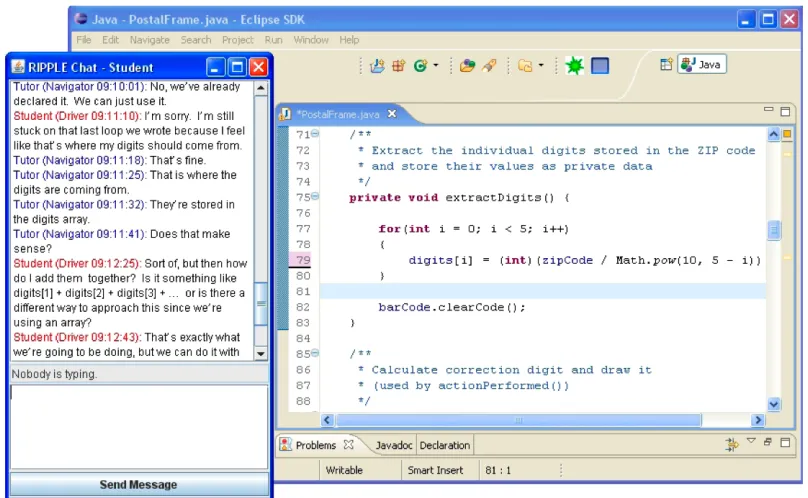
The JavaTutor 2007 corpus consists of dialogues collected between pairs of tutors and students collaborating on the task of solving a programming problem as part of the JavaTutor project during spring 2007. The tutor and student interacted remotely with textual dialogue through computer interfaces (see screenshot in Figure 3.1). There were forty-three dialogues in total, with 1,525 student utterances (averaging 7.54 words per utterance) and 3,332 tutor utterances (averaging 9.04 words per utterance). This dissertation work focuses on classifying the dialogue acts of student utterances only because within an automated tutoring system, tutor utterances are system-generated and their dialogue acts are therefore known.
0.76. An excerpt from the corpus is presented in Table 3.2.
Figure 3.1: The tutorial dialogue interface of JavaTutor 2007 study.
3.2
JavaTutor 2011 Corpus
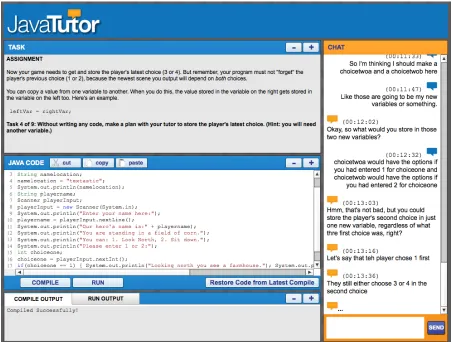
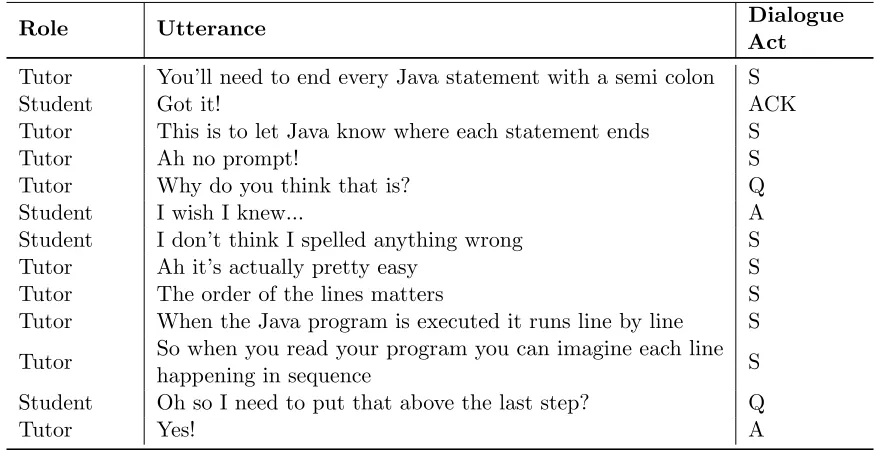
The JavaTutor 2011 corpus was collected in a computer-mediated human tutorial dialogue study. Students (n = 42) and tutors interacted through textual dialogue within an online learning environment for introductory Java programming (Ha et al., 2012). The students were novices, never having programmed in Java previously. The tutorial dialogue interface consisted of four windows, one describing the learning task, another where students wrote programming code, beneath that the output of either compiling or executing the program, and finally the textual dialogue window (Figure 3.2).
Table 3.1: Dialogue act tags from JavaTutor 2007 corpus with examples and student frequencies.
Tag Act Description Freq.
Q Question A general question which is not specific to the task
276
EQ Evaluation Question A question about the task 416
S Statement A statement of fact 211
G Grounding Acknowledgement of previous utterance
192
EX
Extra-Domain
Any utterance that is not related to the task
133
PF Positive
Feedback
Positive assessment of knowledge or task
116
NF Negative
Feedback
Negative assessment of knowledge or task
92
LF Lukewarm
Feedback
Assessment having both positive and negative assessments
32
GRE Greeting Greeting words 57
This annotated set contains 2,564 utterances (1,777 tutor and 787 student). The average number of utterances (both tutor and student) per tutoring session was 122 (min = 74, max = 201). The average number of tutor utterances per session is 84.6 (min=51, max=137) whereas for students it is 37.4 (min=22, max=64) for the annotated set. The average number of words per utterance for students is 4.4 and for tutors it is 5.4. This annotated set is used in the current analysis for both training and testing where cross-validation is applied. As described later, a separate set containing 462 un-annotated utterances is used as a development set for determining the number of clusters.
The dialogue stream of this corpus was manually annotated as part of previous work on supervised dialogue act modeling (Ha et al., 2012). A brief description of the student dialogue act tags is shown in Table 3.3. In the current work, these manually applied dialogue act labels are not utilized during model training, but are only used for evaluation purposes as our models’ accuracies are reported for manual tags on a held-out test set.
Table 3.2: Excerpt from the JavaTutor 2007 corpus.
Student: so obviously here im going to read into the array list and pull what we have in the list so i can do my calculations [S]
Tutor: something like that, yes [LF]
Tutor: by the way, an array list (or ArrayList) is something different in Java. this is just an array. [S]
Student: ok [G]
Student: im sorry i just refer to it as a list because thats what it reminds me it does [S] Student: stores values inside a listbox(invisible) [S]
Tutor: that’s fine [EX]
Tutor: ok, so what are we doing here? [EQ]
Student: im not sure how to read into the array [NF]
Table 3.3: Student dialogue act tags and their frequencies for JavaTutor 2011 corpus.
Student Dialogue Act Distribution
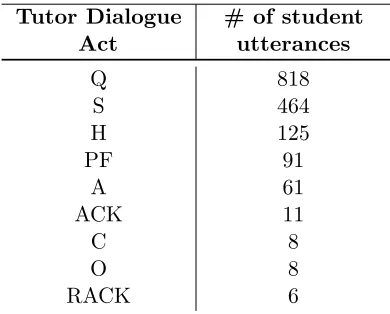
Answer (A) 39.85
Acknowledgement (ACK) 21.31
Sstatement (S) 21.20
Question (Q) 15.15
Request for Feedback (RF) 0.98
Clarification (C) 0.79
Table 3.4: Excerpt of dialogue from the JavaTutor 2011 corpus and the task action that follows utterances.
Tutor: ready? [Q] Student: yep [A]
Tutor moves on to next task
Student: cool [S]
Student compiles and runs the code. Program output: ‘Hello World’
Tutor: excellent [PF]
Tutor: add a space to make the output look prettier [DIR] Student: why doesnt it stop on the next line in this case? [Q]
Program halts
Tutor: it did [A]
Student runs the program successfully.
Chapter 4
Dialogue Act Classification:
Query-Likelihood Clustering
This dissertation project has investigated 5 different approaches to unsupervised dialogue act classification. This chapter and the following four chapters present these classification approaches.
This chapter presents a novel approach toward unsupervised dialogue act classification:
query-likelihood clustering (Ezen-Can & Boyer, 2013b). This approach was inspired by an information retrieval technique, query likelihood, which is used in search engines for finding relevant documents for a given query (Manning, Raghavan, & Sch¨utze, 2008). Applying this approach to dialogue act classification yields a three step process: first, identify utterances that are similar to a target dialogue utterance; second, use these similarities to cluster dialogue utterances; third, evaluate the model. This novel approach was evaluated on the JavaTutor 2007 corpus in Section 4.2.2.
4.1
Query-Likelihood Clustering Methodology
This section describes the novel approach of adapting information retrieval (IR) techniques combined with clustering to the task of unsupervised dialogue act classification. IR is the process of searching available resources to retrieve results that are similar to the query (Ricardo & Ribeiro-Neto, 1999). In the proposed approach, the target utterance that is to be classified is used as a query and its similar utterances are gathered using query likelihood. Then, the query likelihood similarity scores are provided to the clustering technique.
4.1.1 Natural Language Preprocessing
processing is automated using parser therefore, the human-intervention was in deciding on the procedure to use (retain content words, replace function words) not in its implementation.
4.1.2 Query-Likelihood Representation
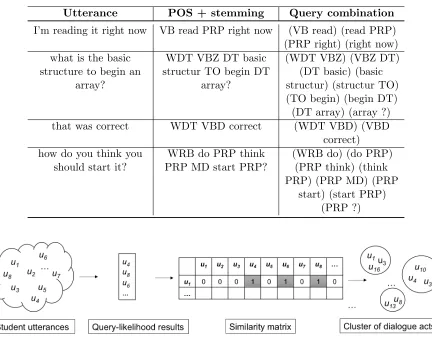
The query likelihood model treats each utterance as a document. The target utterance whose dialogue act is to be predicted becomes the query, and we apply information retrieval by querying the target utterance in the corpus. This query produces a ranked list of documents, from most likely to least likely, and this list is used to identify those utterances that are most similar to the target. The query likelihood implementation from the Lemur Project was used in this work (Strohman, Metzler, Turtle, & Croft, 2005). The ordering of words contains important information about the structure of utterances. For example, the word pair “I am” is mostly found in statements whereas if we regard them separately, “I” can belong to a question such as “What should I do next?” or “am” can be part of a evaluating question “Am I doing this correct?”
(After preprocessing “I am” becomes “PRP (personal pronoun) VBP (present tense singular verb, non third person)” however, the same issue applies to the POS tags as well.) Because of the importance of word ordering on inferring the structure of utterances, we utilized a modified query approach that considers bigrams (pairs of adjacent words occurring in each utterance) rather than unigrams (individual words). Table 4.1 displays several original utterances, their modified forms after POS backoff and stemming, and the query combinations that were submitted to the algorithm. The POS tag VBZ represents third person present tense singular verbs, DT represents determiners, TO is the same as the word “to”, VBD stands for past tense verbs, WDT and WRB are interrogatives, and MD represents modal verbs. Table 4.2 presents two sample queries and top three most similar utterances retrieved by the query-likelihood model.
4.1.3 Clustering
Table 4.1: Original utterances, their processed versions and query combinations.
Utterance POS + stemming Query combination
I’m reading it right now VB read PRP right now (VB read) (read PRP) (PRP right) (right now) what is the basic
structure to begin an array?
WDT VBZ DT basic structur TO begin DT
array?
(WDT VBZ) (VBZ DT) (DT basic) (basic structur) (structur TO) (TO begin) (begin DT) (DT array) (array ?) that was correct WDT VBD correct (WDT VBD) (VBD
correct) how do you think you
should start it?
WRB do PRP think PRP MD start PRP?
(WRB do) (do PRP) (PRP think) (think PRP) (PRP MD) (PRP
start) (start PRP) (PRP ?)
Figure 4.1: The query-likelihood clustering framework.
4.2
Experiments with Query-Likelihood Clustering
Table 4.2: Sample queries and their top three query-likelihood results.
Target utterance Top three most similar student utterances
I am confused - here’s the part I am really confused on is this where I have to call up another class
- and if so, then I guess I am sort of confused about how to retrieve the appropriate values from the table array
- I’m confused on what I am going to put inside the loop how can I solve - how can I pull values out of an array or can I reference them
with code like ARRAY INDEXING
- Is it like I have it on my screen And can I also set how long my array will be when I say private int PARAMETER
-yea but i just can’t remember to how to use the METHOD CALL to get each individual number
4.2.1 Parameter Tuning
In order to train the unsupervised model, three parameters had to be set. Two of these parameters are used within the query phase and the last one applies to the clustering phase. The two parameters to be determined in the query phase areb, the blind relevance feedback threshold, andn, the number of top query likelihood results to be used while creating vectors for clustering. The parameter related to the clustering phase is the distance metric. In order to tune these parameters, a 25% validation set, constituting 10 randomly selected sessions, was drawn from the corpus. The parameter tuning was conducted in a sequential manner that allows the latter steps to use already fixed parameters.
Token weighting. Prior to tuning the parameters, an additional optional set of token weights was tuned for use during querying. This optional parameter was desirable based on observations that some POS tags should be weighted more than others for identifying similar results to a target utterance. For example, interrogatives (question words such as what, where, when, how, and why) and question marks are highly discriminating for question dialogue moves. Weights were learned for this subset of tokens using an incremental approach as shown in Table 4.4. First, the mean average precision values of query likelihood results without any weights were given. Then, weights for WDT (POS tag for what and which) were utilized within the experiments. Having determined the proper weight for WDT, different weights for WRB (POS tag for why, where, how, when) were tried. Finally, the weight for question marks was set.
Table 4.3: Query-likelihood clustering algorithm.
LetDbe a corpus of utterances D=u1, u2, ..., un. Then the goal is: ∀ui ∈D, identify li dialogue act label of¯ ui
Procedure: For eachui
1. Set target utteranceqi =ui 2. Let the query-likelihood result of
utterance u+ibe R=ut, ut+1, ..., uz
such that R is the result ofqueryLikelihood(qi) 3. Create vector of query results indicator variables
Vi= (v1, v2, ..., vj, ...vn) such thatvj = 1 if ui∈R elsevj = 0 Let the total vector beVt= (V1, V2, ..., Nn)
Return clustersC=c1, c2, ..., ck such that C is the result ofkmeans(VT)
Table 4.4: Mean average precision (MAP) results for weighting interrogative parts of speech and punctuation.
Weights MAP
no weight 0.1239 WDT = 10 0.2359 WDT = 100 0.2326
WRB = 10 0.2358 WRB = 100 0.2339
“?” = 10 0.2457 “?” = 100 0.2567
words, the algorithm expands the initial query by appending the newly found terms and running the query again. This procedure of enriching the query with top relevant results is done in order to avoid sparse ranked lists. Like the other parameters described in this section, bwas tuned on a development set. Table 4.5 shows the resulting best b-value of 30. This means that in the models reported here, the top 30 utterances in the initial ranked list returned by the query are assumed as relevant to the query and they are used to expand the initial query. This is intended to prevent sparse result sets.
Table 4.5: b-value MAP results.
b 5 10 15 20 25 30 35
MAP 0.343 0.34 0.342 0.346 0.351 0.352 0.351
Top query threshold (n). Given the b-value, we moved on to tuning n-values, which represent the number of top query-likelihood results to be used in forming the similarity vectors for subsequent clustering. A higher nvalue will treat a larger number of utterances retrieved during querying as “similar” to the target. A minimum ofn=5 was chosen to sufficiently populate the vectors since the non-zero entries determine clusters, and we explored whether larger n
values performed better; however, the optimal value wasn=5 as shown in Table 4.6.
Table 4.6: n-value MAP results with setb-value.
n-value 5 10 15 20 30 100
MAP 0.517 0.432 0.409 0.398 0.395 0.307
retrieved by query likelihood gets the highest rank. This approach reforms vectors in a weighted manner, after which Euclidean distance is applied. Within the development set, cosine distance performed with highest accuracy at 43.43% compared to manual labels. Borda count achieved 42.63%, Euclidean distance 41.64%, and Manhattan distance 41.82%. Since cosine similarity is computed by the dot product of two vectors divided by the product of their magnitudes, it takes the size of vectors into account and provides a ratio of matching 1 values in the same position in both vectors. In this way, intersecting non-zero entries are valued with respect to the size of the vectors.
4.2.2 Accuracy in Identifying Manually Labeled Dialogue Acts
Having tuned the parameter values using the development set, we trained a model on the remainder of the corpus. This unsupervised model did not take manual labels into account during training, but we evaluate its performance with respect to manual labels. Due to the nature of the unsupervised approach, the optimal number of clusters was not known. Therefore, we explored varying numbers of clusters using k-Means, a standard clustering algorithm that aims to cluster observations intok clusters so that each element has the highest similarity to every other element in the cluster (Kanungo et al., 2002). In addition tok-means clustering, we experimented with a non-parametric Bayesian approach used in recent unsupervised dialogue act classification work in a non-tutoring domain (Crook et al., 2009).
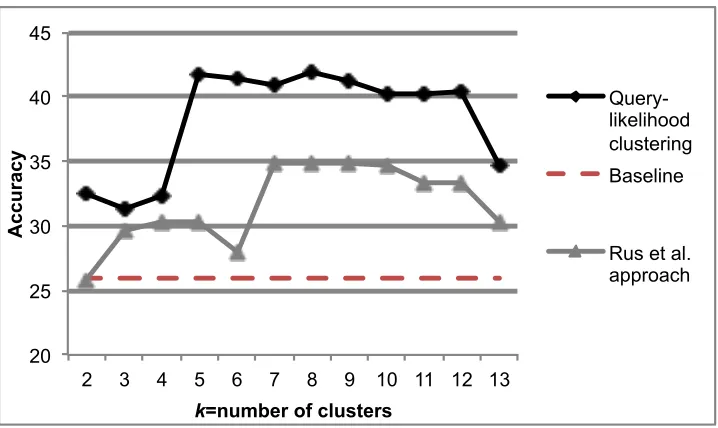
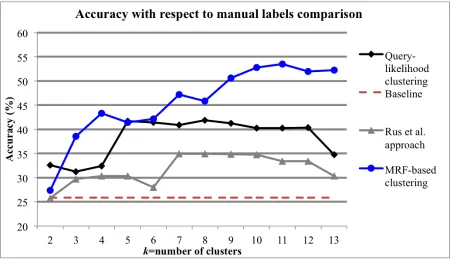
We calculate the accuracy of the approach for classification by comparing to manual labels. Figure 4.2 presents the accuracy of the proposed approach using thek-means clustering algorithm in Weka (Hall et al., 2009). To label a target utterance, the query likelihood results were retrieved for that utterance, and then its vector was provided to the clustering algorithm. The resulting cluster in which the target utterance resides was interpreted as the dialogue act label of the target utterance. The majority label of the cluster was taken as its dialogue act label. For comparison, the accuracy results are compared against the majority class baseline of 25.87%, Evaluation Question (EQ). This is the most commonly occurring student dialogue act in the corpus and therefore represents the expected accuracy of a model that performs equal to chance. Additionally, we compare our implementation against that of the recent approach of Rus et al. (Rus et al., 2012), which clusters utterances via word similarity using a specified number of leading tokens of each utterance.
20 25 30 35 40 45
2 3 4 5 6 7 8 9 10 11 12 13
Accuracy
k=number of clusters
Query-likelihood clustering Baseline
Rus et al. approach
Figure 4.2: Accuracy results (%) for query-likelihood clustering, Rus et al. approach with 5 leading tokens and majority baseline.
games. Their highest accuracy was 37.9%, compared with a majority class baseline of 28.5% (statements). This is a 32.98% improvement over the majority baseline chance. Another algorithm tried by Rus et al. was Expectation Maximization, which achieved 37.9% accuracy on their combined corpus of educational games. This algorithm achieved its highest accuracy of 30.47% with four leading tokens on our corpus. We also experimented with Dirichlet process clustering as used by Crook et al. (Crook et al., 2009). Dirichlet process clustering gave substantially lower results on our corpus after natural language preprocessing, with an accuracy of 24.48% compared to the 41.84% of query-likelihood clustering.2
Finally, in order to evaluate the relative contribution of the query-likelihood clustering components of automatic natural language preprocessing (POS tagging, stemming) and vector enhancement with information retrieval, we performed two experiments omitting each of these components from the procedure. Parameters were re-tuned for each experiment utilizing the same development set split used earlier (25% of the corpus). With the best-performing model size of k=8 clusters, omitting the natural language preprocessing step produced accuracy of 37.59% and omitting the information retrieval step produced accuracy of 35.68%, each of which is substantially lower than the query-likelihood clustering approach of 41.84%. However, these simpler approaches resulted in a smaller number of clusters for their best-fit models, achieving their highest accuracies of 41.06% and 40.45%, respectively, whenk=4. This accuracy is only modestly lower than the query-likelihood clustering accuracy of 41.84%; however, a significant
2
drawback is that the number of clusters is much smaller than are typically distinguished by dialogue act classification schemes, and would likely not result in sufficiently fine-grained distinctions to support dialogue management.
4.2.3 Analysis of Clusters
As shown in Table 4.7, the approach was particularly successful in clustering negative feedback utterances (NF), evaluation questions (EQ) and groundings (G). 64.06% of all NF utterances are grouped in one cluster (Cluster 2), while 64.09% of EQ utterances are in one cluster (Cluster 5) and 94.74% of all G utterances are in another cluster (Cluster 1). The Q and EQ tagged utterances, which are structurally very similar in that they both are questions, were grouped into one cluster (Cluster 5), which constitutes 58.54% of all Q and EQ tagged utterances. In another cluster, 14.26% of all Q and EQ utterances were grouped together (Cluster 6).
Table 4.7: Student utterance distributions over clusters using manual tags.
Clusters/Tags C1 C2 C3 C4 C5 C6 C7 C8
GRE 31 1 0 4 8 0 0 2
EX 22 21 5 16 8 0 1 21
Q 1 13 11 20 121 33 0 36
PF 57 16 6 7 0 1 0 5
S 11 32 21 29 5 0 0 51
G 144 0 0 1 0 0 6 1
EQ 1 18 17 14 191 43 0 14
NF 3 41 9 4 0 0 0 7
LF 1 15 2 3 0 0 0 1
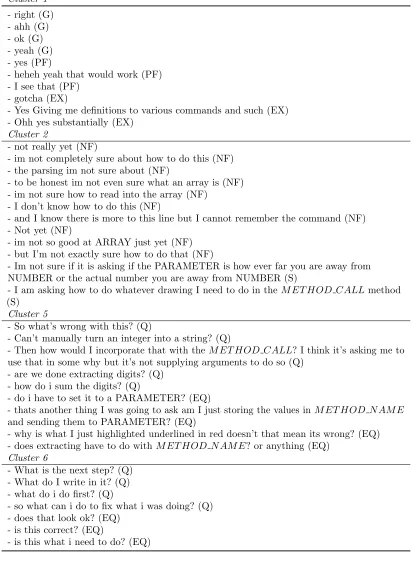
In order to examine the structure of the clusters in more detail, Table 4.8 provides sample utterances from four of the eight clusters. The manual labels of the utterances are also given in parenthesis. Some clusters perform intuitively; for example, Cluster 1 is dominated by grounding, with many positive feedback utterances as well. These positive feedback and grounding utterances have similar surface forms such as “yeah”, “right”, and “oh”, and distinguishing them further will require modeling the broader dialogue structure (for example, a notion of dialogue history, as we explore in Chapter 6.
are highly distinguishable. Most of the statements were in negative tone or expressing confusion. For example, the utterance “Im not sure if it is asking if the PARAMETER is how ever far you are away from NUMBER or the actual number you are away from NUMBER”, which is labeled as statement, shows confusion although it is a statement in terms of its intention.
Cluster 3 and Cluster 4 are highly impure. Closer inspection reveals that Cluster 3 mostly has broken utterances such as “correction digit”, “is in”, “digit” and some statements. Cluster 4 contains statements and extra domain utterances that are primarily statements. Moreover, there are some implicit questions such as “thats another thing I was going to ask am I just storing the values in METHOD NAME and sending them to PARAMETER” and “So I have to call upon the PARAMETER class and use a method in there right?”. Cluster 7 is highly sparse, containing only seven utterances. These tend to be highly similar in structure, such as “oh ok”, and “oh dear”. The very low distance between these utterances pulled them tightly into one cluster that was judged as distinct from the others.
Cluster 5 and Cluster 6 are dominated by evaluation questions (EQ), with a substantial number of general questions (Q) as well. The dominance of EQ in both clusters may relate to its high frequency within the corpus. However, these two question acts tend to exhibit close structural similarity although their roles are different (asking for feedback versus asking a general conceptual question). For example, the utterance “do i have to set it to a PARAMETER?” is a question; however, a deeper analysis shows that it is more specifically an evaluation question that requests feedback on the task.
The presence of impure and sparse clusters prompted an experiment to explore whether other models with similar but slightly lower overall accuracy would yield a more desirable clustering. Therefore, we explored using an information criterion, Hartigan’s rule of thumb, that utilizes the number of parameters in the model. This metric identified ten clusters as optimal, with a slightly lower accuracy (40.28%) compared to eight clusters, and the sparse clusters remained. We also experimented with the X-Means algorithm that utilizes Bayesian Information Criterion for splitting clusters (Pelleg & Moore, 2000), which resulted in four clusters with 36.72% accuracy.
4.3
Query-Likelihood Clustering: Discussion
A strength of unsupervised approaches is that because they do not rely on any manually engineered tagging schemes, they reflect the structure of the corpus in a fully data-driven way. In the case of query-likelihood cluster, the results highlight challenges of utilizing pedagogically driven manual dialogue act classification taxonomies within automated approaches.
Table 4.8: Utterances from selected clusters with manual tags.
Cluster 1
- right (G) - ahh (G) - ok (G) - yeah (G) - yes (PF)
- heheh yeah that would work (PF) - I see that (PF)
- gotcha (EX)
- Yes Giving me definitions to various commands and such (EX) - Ohh yes substantially (EX)
Cluster 2
- not really yet (NF)
- im not completely sure about how to do this (NF) - the parsing im not sure about (NF)
- to be honest im not even sure what an array is (NF) - im not sure how to read into the array (NF)
- I don’t know how to do this (NF)
- and I know there is more to this line but I cannot remember the command (NF) - Not yet (NF)
- im not so good at ARRAY just yet (NF) - but I’m not exactly sure how to do that (NF)
- Im not sure if it is asking if the PARAMETER is how ever far you are away from NUMBER or the actual number you are away from NUMBER (S)
- I am asking how to do whatever drawing I need to do in theM ET HOD CALLmethod (S)
Cluster 5
- So what’s wrong with this? (Q)
- Can’t manually turn an integer into a string? (Q)
- Then how would I incorporate that with theM ET HOD CALL? I think it’s asking me to use that in some why but it’s not supplying arguments to do so (Q)
- are we done extracting digits? (Q) - how do i sum the digits? (Q)
- do i have to set it to a PARAMETER? (EQ)
- thats another thing I was going to ask am I just storing the values inM ET HOD N AM E
and sending them to PARAMETER? (EQ)
- why is what I just highlighted underlined in red doesn’t that mean its wrong? (EQ) - does extracting have to do withM ET HOD N AM E? or anything (EQ)
Cluster 6
- What is the next step? (Q) - What do I write in it? (Q) - what do i do first? (Q)
- so what can i do to fix what i was doing? (Q) - does that look ok? (EQ)
- is this correct? (EQ)