V. R. Sirisha. K.*1, K. Suresh2, K.Vijayasree3, N. Devanna4, P. N. Murthy2 1. Department of Pharmacy, JNTUA, Anantapur, Andhra Pradesh, India.
2. Department of Pharmaceutics, Royal College of Pharmacy and Health Sciences, Andhapasara Road, Berhampur, Orissa, India. 3. Department of Pharmaceutics, Malla Reddy College of Pharmacy, Secunderabad, Andhra Pradesh, India.
4. JNTUA, Oil Technological Research Institute, Anantapur, Andhra Pradesh, India. *Corresponding author’s E-mail:[email protected]
Accepted on: 03-05-2014; Finalized on: 30-06-2014. ABSTRACT
Pelletization technologies are efficient pathways for manufacture of oral multiparticulate drug delivery systems compared to single-unit systems in pharmaceutical industry for more than four decades due to their advent of modified release technology, biopharmaceutical advantages like free, more even, predictable dispersion and transportation in the GIT; flexibility for further modification; increased bioavailability of drugs; and hence gaining much attention in recent times. The present review outlines the recent advancements in pelletization techniques such as melt agglomeration, hot melt extrusion - spheronization, freeze pelletization, cryopelletization, CPS™, ProCell™, MicroPx™ fluid bed pelletizing technologies and minitablets.
Keywords: Pelletization Technologies, Modified Release Technology, Hot Melt Extrusion - Spheronization.
INTRODUCTION
ellets, the multiparticulate drug delivery system has developed a keen interest amongst solid dosage forms to a great extent in the early 1950’s in the pharmaceutical industry due to the magnitude of copious advantages offered by their spherical nature, divided on a plurality of sub-units, individual drug delivery device mechanism of each pellet, improved safety and efficacy of the active agent1. Smith Kline & French (SKF) in 1949, were the first to develop the potential sustained-release tiny drug pellets that could be loaded into capsules2. Pellets are various kinds of subunits with defined less-porous surface, spherical shape and low surface area to volume ratio, suitable for flexible and uniform drug-polymer coating. They offer numerous technological, physiological and therapeutic advantages like predictable distribution and transportation throughout the GIT; maximized drug absorption; less gastric irritation by limiting localized buildup and dose dumping; reduced peak plasma fluctuations and minimized potential side effects with improved drug bioavailability 3; reduced inter and intra patient variability4; more suitable for fabrication of formulations with acid sensitive drugs 5 etc.
Various pelletization techniques include Agitation
(Balling), Compaction (Compression and
Extrusion/Spheronization), Layering (Powder and
Solution/Suspension Layering) and Globulation (Spray drying and Spray Congealing). In recent decades, extensive research conducted to develop pelletization techniques leads in exploring newer techniques such as melt agglomeration, hot melt extrusion - spheronization, freeze pelletization, cryopelletization, CPS™ (Complex Perfect Spheres), ProCell™, MicroPx™ fluid bed pelletizing technologies and minitablets.
Melt Agglomeration AND Hot Melt Extrusion – Spheronization
The techniques Melt agglomeration and Hot Melt
Extrusion - Spheronization find a great advantage to
overcome the problems associated with the pellets produced by layering and extrusion-spheronization.
Melt agglomeration is a process where the solid fine
particles undergo gradual change in size and shape that result in agglomerates with molten binding liquid that melts due to rise in temperature by heat of friction of the high shear mixer. The binder may be added as molten liquid or as dry powder or flakes and the binder may be heated by means of hot air or by heating jacket above its melting point. As the molten binder solidifies by cooling, dry agglomerates are formed. Melting points of the binders used in melt agglomeration ranges from 50ᵒC to 80ᵒC. Below this range, the binder softens and affects the product quality during manufacture and storage. The formation of agglomerates by this technique involves agitation, kneading and layering.
Hot melt extrusion is one of the most applied processing
technologies in the array of plastic, rubber and food industries. It is classified as a molten system under control and semisolid viscous system. In pharmaceutical manufacturing, it is widely employed in the formulation of modified release dosage forms (eg. pellets, granules, tablets, transdermal implants, transmucosal drug delivery systems etc.) as it does not require additional film coating since the drug release is diffusion controlled 6-10. It is also useful in many interesting aspects such as in-situ salt formation, fast dispersing systems with foam like structures, complex formation in the melt and nanoparticles released from molecular dispersions. It is a simple, efficient, solvent free technique that requires
Recent Advances in Pelletization Techniques - A Review
P
fewer processing stages and does not require a lengthy drying stage. This technique finds a great advantage for continuous production of spherical shaped pellets with narrow range particle size distribution; drugs that show sign of degradation during processing and storage due to residual water; reduced loss of coating material during the coating process associated with wet mass extrusion process; preparation and delivery of poorly soluble drugs to solid dispersion and solid solution for improved dissolution rate and bioavailability; masking bitter taste of the active ingredient; incorporation of poorly compatible materials into tablets produced by cutting an extruded rod; uniform dispersion of fine particle; good stability at varying pH and moisture levels 11.
A hot melt extrusion – spheronization line consists of a
feed hopper, extruder with 3 distinct sections in the heating barrel - feed zone, transition zone, metering zone and spheronizer. Extrusion is carried out in a rotating
screw in the heating barrel preferably single screw extruder due to relatively low cost, credibility and ruggedness 12-13 (Figure 1 and 2). The process is similar to wet granulation, except that the binder is in molten state and does not require water or solvent to liquefy it. The process proceeds in 4 steps.
(a) Feeding into extruder and melting or plasticizing the solid material in which drug is dispersed in a thermal carrier usually a low melting point wax or polymers (starting from high molecular weight to low molecular weight polymers) eg. vinyl polymers (polyvinylpyrrolidone, polyvinylpyrrolidone-vinyl
acetate); copovidone; polyethylene oxide;
polyethylene glycol; acrylates; cellulose derivatives (carboxy methyl cellulose, hydroxypropylcellulose,
hydroxypropyl methylcellulose, hydroxypropyl
methylcellulose acetate succinate, cellulose acetate, cellulose acetate phthalate); gelucire 50/13; poloxamer 188; carnauba wax; glyceryl stearate; microcrystalline wax; paraffin wax; stearic acid; stearic alcohol; bees wax; cetyl palmitate; guar gum; xanthan gum; sodium alginate; cyclodextins. Release mechanisms favored are (i) diffusion mechanism for formulations with water-insoluble polymers such as ethylcellulose or carnauba waxes (ii) both by diffusion
and erosion with water-soluble polymers such as
hydroxypropylcellulose.
(b) Conveying of mass, flow through the die and shaping of molten content into uniform cylindrical segments by extruder.
(c) Spheronization of extrudes at high temperature to deform by softening and assist uniform spheroids.
(d) Solidifying spheroids to get the desired shape spheroids, exit from the die and downstream processing. The endplate die connected to the end of barrel determines the shape of extruded products
14-16.
The factors that influence hot-melt extrusion and
spheronization: (a) Process Parameters: barrel
temperature, feed rate, screw speed, motor load, melt pressure, design of the extruder die and operating parameters of the extruder (b) Product Parameters:
nature of extrudates selectively thermoplastic,
composition of extrudates like drug and its melting point, physical and chemical properties of thermal carriers like drug polymer miscibility, polymer stability and function of final dosage form since they get transformed to molten state during the process at low temperature, porosity of the extrudes which influences drug release. In case of thermolabile constituents, incorporation of plasticizer brings down degradation and improves flexibility of the polymer components by reducing the tensile strength and glass transition temperature. Functional excipients such as release modifiers, bulking agents, processing agents also play a key role in formulations by hot melt extrusion14, 17.
A few disadvantages are requirement of high energy input, handling and storage of the lower-melting-point binders, instability for heat-labile materials with higher-melting-point binders as it requires high melting temperatures.
Figure 1: Micro-18 Twin Screw Co-Rotating Leistritz
Extruder
Figure 2: Heating barrels and Co-rotating screws for
Freeze Pelletization
It is an advanced and a most simple technique for the production of spherical pellets by introducing droplets of immiscible molten solid carrier/ matrix containing additives like disintegrants, diluents, surfactants and release modifiers with or without drug into an inert liquid column. The droplets are introduced using needles or nozzles or atomizer into the inlet column of liquid and dropped from a certain height, so that droplets remain intact as they fall into the liquid column. The process can be scaled-up by increasing the number of nozzles (to several hundred) based on the desired rate of production and they can be static or vibrated electrically.
Size of needle gauge ranges from 16-31 depending on the size of the pellets desired. These droplets move either to the top or bottom of the column depending on their density with respect to liquid in the column 18.
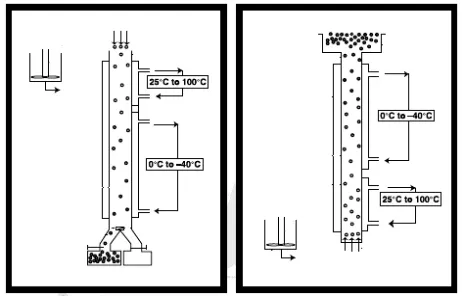
Based on the movement of molten-solid droplets, two apparatus are designed. The former Freeze pelletizer I, with an inlet at the top for introducing droplets and these droplets settle at the bottom of the column as the density of the matrix droplet is more than the liquid column.
Freeze pelletizer II is used when the carrier droplet
density is less than the liquid column which has an inlet at the bottom and the droplets solidify at the top (Figure 3).
The column is 24 inches long and made of borosilicate glass. It is divided into two portions; initial portion with a temperature of 250C to 1000C, a region where the
droplets are introduced. The second is cooling portion at which the droplets solidify and form spherical pellets; having a temperature 00C to -400C maintained using
cooling mixture such as acetonitrile - dry ice or salt-ice.
The carriers used should be solid at room temperature and have melting point below 100°C in order to minimize degradation of the active constituent. The molten solid matrices may be hydrophilic or hydrophobic. For freeze
pelletizer I, hydrophilic carrier matrices used are
polyethylene glycol; polyvinyl alcohol; low melting point sugars like xylitol, dextrose, sorbitol, maltose; water
soluble polyoxyethylene derivatives;
polyethylene-propylene glycol copolymers; polyethylene oxide derivatives; PEG-PEO derivatives. For freeze pelletizer II,
hydrophobic solid carrier matrices used are glyceryl
monostearate; glyceryl palmitostearate; glyceryl
dibehenate; ethylene glycol palmitostearate; cetostearyl alcohol; cetyl alcohol; stearyl alcohol; cholesterol; hydrogenated vegetable oils; phospholipids; lanolin; triglycerides; long chain fatty acids or hydrocarbons; hard fat; cocoa butter and waxes.
In case of hydrophilic carriers, hydrophobic liquid column and for hydrophobic carriers, hydrophilic column is used. For freeze pelletizer I, hydrophobic liquid columns used are low density oils such as silicone oils, mineral oils, vegetable oils, aliphatic long- chain hydrocarbons and for
freeze pelletizer II, hydrophilic columns such as liquid
polyethylene glycols with molecular weight 200-600,
propylene glycol, glycerin, ethyl alcohol, water are used. These carriers are melted at a temperature 5-10°C higher than the melting point of the carrier solids. For sustained release pellets containing mixture of hydrophilic and hydrophobic solids, liquids that are immiscible with both hydrophilic and hydrophobic molten solids are used as cooling liquid in the column 18-20.
This technique involves less process variables and also offers several advantages like production of non-porous spherical pellets with narrow particle size range which are feasible for further coatings like delayed; colon targeted and sustained release coatings. Since the pellets are solid at room temperature, they do not require drying 18.
Figure 3: Freeze pelletizer I and II.
Cryopelletization
It is a technique by which freeze dried or lyophilized pellets are formed by solidifying the droplets of aqueous or organic solutions, suspensions or emulsions using liquid nitrogen as the fixing medium. The technology was initially developed for the nutrition industry to lyophilize viscous bacterial suspensions. It is also used to produce drug loaded pellets for immediate and controlled release formulations. The main advantage of this technique is production of highly porous pellets. The cryopelletizer is shown in Figure 4. The procedure permits instantaneous and uniform freezing of the processed material owing to rapid heat transfer that occurs between the droplets and liquid nitrogen.
The equipment consists of a container equipped with: perforated plates, a reservoir, conveyor belt with transport baffles and storage container. Below the perforated plate, a liquid nitrogen reservoir with a varying speed conveyor belt is present with transport baffles dipped in it. The perforated plates generate droplets that fall and freeze instantaneously as they come in contact with the liquid nitrogen (solidifying medium) below and by the residence time provided by the conveyor belt due to its varying speed. The frozen pellets are transported into a -600C storage container and dried in a freeze dryer to remove water or organic solvents 18, 21- 23.
are: formulation variables, equipment design and process variables.
(a) Formulation Variables: Viscosity and solid content of the liquid formulation should be high enough and not exceed a critical limit which depends on the formulation. The surface tension of the liquid influences droplet formation and size; smaller droplet can reduce the surface tension by the use of surfactants.
(b) Equipment related Variables: The distance between
the perforated plate and the reservoir is arranged in
such a way that it allows the drops to become spherical before it comes in contact with liquid nitrogen. To achieve smaller size pellets, the
diameter of the perforation in the perforated plate
should be small.
(c) Process Variables: The amount of liquid nitrogen required for manufacturing a given quantity depends on the solid content and temperature of the solution
or suspension being processed. The liquid nitrogen
should be continuously stirred to prevent agglomeration, when it is desirable to have pellets with diameter less than 2 mm.
Figure 4: A) Cryopelletizer B) Cryogranulator used to form
Technosphere Insulin Pellets prior to Lyophilization
CPS™ (Complex Perfect Spheres) Pelletizing Technology
In the year 2000, this technology was invented by Glatt
GmbH in Binzen, Germany; an advanced fluid bed rotor
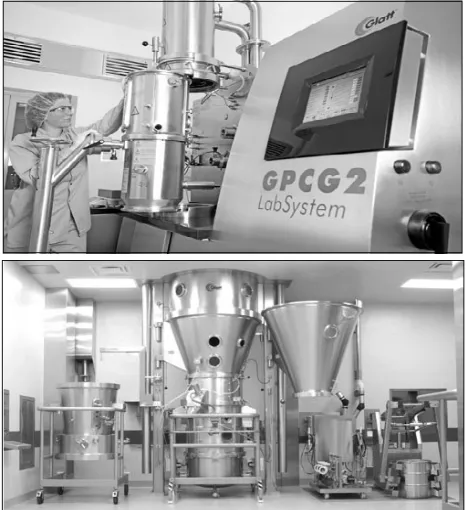
and a direct pelletization technology for the production of matrix type pellets and micropellets. The process equipment consists of a modified fluid bed rotor system with a conical shaped rotating disc and additional devices for direct movement of particles. This is a batch process suitable for drug layering by drug solution, suspension, emulsion etc. on starter cores as well as dry powder layering to achieve a particular drug layer quality. The layering liquid can be aqueous or organic with or without functional compounds. As an option, dry powder may be fed into the process. In powder layering, the endpoint of the pelletization can be measured with the help of torque at the CPS™ rotor. Densification of the particles is achieved by means of a characteristic rolling movement of particles and thereby the application of different forces particularly centrifugal forces on the arising pellet cores by the form and speed of the rotating disc 24- 27.
This process is suitable for drug dose ranging from low to high. It is ideal for functional coating and taste masking coating applications. The ideal features of pellets attained by this process includes spherical shape with mean particle size range: 100 - 1500 µm, narrow particle size distribution: > 90% between 700 - 900 µm, yield typically > 90 %; smooth surface- an ideal substrate for coating applications; drug loading from < 0.1% - 90%; low attrition and friability; high density and low porosity; dust free surfaces. The densification of particles is by means of rolling particle movement.
Figure 5: CPS™ pelletizing equipment- Lab scale and
Production scale
Figure 6: CPS™ pelletization Fluid Bed Capabilities
ProCell™ Technology
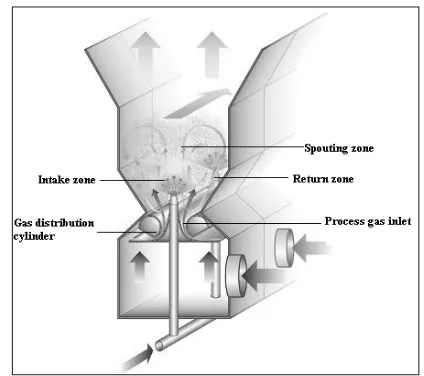
This is a spouted-bed type continuous agglomeration
technology where particles are fluidized in the ProCell™
The cross section of the processing chamber becomes significantly broader towards the top, resulting in a sharp decrease of the fluidizing velocity of the process air. This effect provides a controlled flow pattern and circulation of the particles in the processing chamber. Spray nozzles are usually arranged in the bottom spray position; right in between the two inlet air slots; where in this position they spray at the point of the highest energy input inside the unit 25, 26, 28.
The ProCell™ Technology is a direct granulation and
pelletizing process. No inert starting beads are required
and solutions, suspensions or emulsions containing the API, can be processed. ProCell™ Technology performs in the most effective way when a melt of a material is processed, as in this case neither water nor organic solvents have to be evaporated; the formation of granules and pellets takes place by means of spray solidification and agglomeration. By this means, high through-puts and cost effective processes are possible. The continuously arising product quantities can be fractionated online by means of a zig-zag-sifter or offline by means of a sieving unit. In any case, separated material can be recirculated into the ongoing process so that product losses are minimized in this way.
It is used for the manufacture of very high concentrated, almost spherical pellets with high density and low porosity, resulting in matrix type granules and micropellets with low attrition and friability.
It is originally performed as hot-melt granulation process that provides an interesting and economic option without the need to evaporate water or organic solvents. Drug loading is upto 100% i.e., no additional excipients may be required for the formation of ProCell™ particles due to the design of the process chamber and its unique processing characteristics. The mean particle size range is adjustable over a broad size range from 50-1500 µm. The agglomeration process is in particular suitable for products with inherent stickiness.
.
Figure 7: Equipment and process scheme of ProCell™
Technology
MicroPX™ Fluid Bed Technology
It is a continuous fluid bed pelletizing technology where aqueous-based liquids can be processed for this novel pelletization process – resulting in matrix type, onion-like micropellets by spray solidification and agglomeration. Glatt Pharmaceutical Services offers the Glatt MicroPx™ at both the lab and pilot scales at its center in Binzen,
Germany. Throughput approximately for Glatt Pharmalab is 0.5 – 1 kg/hr and MicroPx Pilot Plant in GPCG 60 basic unit is 2.0 – 10 kg/hr.
Figure 8: MicroPx™ fluid bed technology
This technology is most feasible for taste-masking
applications; controlled release formulations;
compression of pellets into tablets; production of spherical, smooth surfaced, high density-low porosity, high drug loaded particles (> 90%) with a particle size range of 100-500 µm with low attrition and friability. No starter cores are required. API, pharmaceutical binder(s) and other functional ingredients are contained in a spraying liquid (solution, suspension or emulsion) which is fed into the MicroPx™ process via spray guns. The process is a high-through put, cost effective process as the product losses are minimal due to the recirculation of the material into the ongoing process.
of existing seeds. Inorder to prevent excessive spray drying, the product bed must not be too high for easy and continuous performance of the pelletization process 25- 30.
Mini and microtablets
Nordmark Arzneimittek GmbH & Co. KG developed
microtablets, a modern multiple unit dosage forms with diameter and height 2 mm X 2 mm by compaction and
compression. High speed rotary tabletting machine is
equipped with 10 - 19 multi-tip tabletting tools that produce 1 - 2 million microtablets per hour. This design offers flexibility to compress active drug with poor compression properties in large concentrations and high mass uniformity. These compressed core microtablets can be matrix forms or functionally coated to get the desired release profiles. One or more microtablet formulations containing different active ingredients can be filled into capsules at varying dosage strengths. Microtablets are supplied as stickpacks or filled into capsules. These formulations can be used in the therapies of pain relief, AIDS, oncology, hormones, pediatrics, etc. Various marketed formulations include Pancreatin Microtablets enteric coated with Kollicoat®MAE 30 DP (Nordmark), Omeprazole (Ratiopharm), Sodium Valproate (Desitin), Ferrous Sulfate (Teofarma) and Dimethylfumarate (Biogen).
The Eurand minitabs, a unique technology, contains tiny tablets that can be filled into capsules as a final dosage form. These tablets contain gel forming excipients that control drug release rate. Successive layers may be further coated to control the release rate. The main advantages of this technology are high drug loading with more accurate dosing and formulation of combination products with a wide range of release rate designs. The capsules can be opened and the contents used as a "sprinkle" formulation 31, 32.
CONCLUSION
Formulation design and development is the most
promising and impending face of innovative
pharmaceutical technologies in the current epoch for exploring newer formulations with high-quality. Recent and advanced pelletizing technologies like melt agglomeration, hot melt extrusion, freeze pelletization, cryopelletization, minitablets, CPS™, MicroPx™ and ProCell™ represent potential and efficient pathways not only in achieving better therapeutic and financial benefits but also product throughputs such as a small pellet size of < 500 µm, uniformity of particle size distribution, smooth particle surface, high density and high drug loading. In conclusion, these novel technologies due to their unique benefits, in particular are achieving a prominent role in new chemical entity and generic development.
REFERENCES
1. Shaji J, Chadawar V, Talwalkar P, Multiparticulate Drug Delivery System, The Indian Pharmacist, 6(60), June 2007, 21-28.
2. Hirjau M, Nicoara AC, Hirjau V, Lupuleasa D, Pelletization techniques used in pharmaceutical fields, Practica Farmaceutica, 4(3-4), 2011, 206-211.
3. Ghebre-Sellassie I, Knoch A, Pelletization techniques: Encyclopedia of Pharmaceutical Technology, 3rd ed., Informa Healthcare, 2002.
4. Bechgaard H, Neilson GH, Controlled release multiple units and single-unit doses, Drug Development and Industrial Pharmacy, 4, 1978, 53-67.
5. Digenis GA, The invivo behavior of multiparticulate versus single unit dosage formulations: Multipaticulate Oral Drug Delivery, Ghebre-Sellassie I Eds, Marcel Dekker: New York, 1994, 333-355.
6. Schaefer T, Holm P, Kristensen HG, Effect of process variables and binder: Melt pelletization in a high shear mixer, 4, Acta Pharmaceutica Nordica, 1992, 133-140. 7. Breitenbach J, Melt extrusion: from process to drug
delivery technology, European Journal of Pharmaceutics and Biopharmaceutics, 54, 2002, 107-117.
8. Aitken-Nichol C, Zheng F, McGinity JW, Hot-mlet extrusion of acrylic films, Pharmaceutical Research, 13, 1996, 804-808.
9. Repka MA, Gerding TG, Repka SL, McGinity JW, Influence of plasticizers and drugs on the physical-mechanical properties of hydroxypropylcellulose films prepared by hot melt extrusion, Drug Development and Industrial Pharmacy, 25(5), 1999, 625–633.
10. McGinity JW, Koleng JJ, Repka MA, Zhang F, Hot-melt extrusion technology: Encyclopedia of pharmaceutical technology, J. Swarbrick and J.C. Boylan Eds., 19, Marcel Dekker, New York, USA, 2001, 203-226.
11. Chokshi R and Zia HI, Hot melt extrusion technique: A review, Iranian Journal of Pharmaceutical Research, 3, 2004, 3-16.
12.
Tadmor Z, Klein I, Engineering Principles of Plasticating Extrusion, Van Noostrand Reinhold, New York, 1970, 152-158.
13. Akhlaquer Rahman Md, Alka Ahuja, Baboota S, Bhavana, Vikas Bali, Nitin Saigal, Javeed Ali, Recent Advances in Pelletization Techniques for Oral Drug Delivery: A Review, Current Drug Delivery, 6, 2009, 122-129.
14. McGinity JW, Zhang F, Repka MA, Koleng JJ, Hot‐melt extrusion as a pharmaceutical process, American Pharmaceutical Review, 4, 2nd ed., 2001, 25‐36.
15. Breitenbach J, Melt extrusion: from process to drug delivery technology, European Journal of Pharmaceutics and Biopharmaceutics, 54, 2002, 107-117.
16. Choksi R, Zia H, Hot-Melt Extrusion Technique: A Review, Iranian Journal of Pharmaceutical Research, 3, 2004, 3-16. 17. Repka MA, McGinity JW, Zhang F, Koleng JJ, Hot-melt
extrusion technology: In J Swarbrick and J Boylan (Eds.), Encyclopedia of pharmaceutical technology, 2nd ed., Marcel Dekker, New York, 2002, 1488-1505.
M, A Novel Freeze Pelletization Technique for preparing Matrix Pellets, Pharmaceutical Technology, 28, October 2004, 98-110.
19. Cheboyina S, Chabliss WG, Wyandt CM, Wax based sustained release matrix pellets prepared by a novel freeze pelletization technique I. Formulation and process variables affecting pellet characteristics, International Journal of Pharmaceutics, 359, 2008, 158-166.
20. Sreekhar C, Wyandt CM, Wax-based sustained release matrix pellets prepared by a novel freeze pelletization technique: II. In vitrodrug release studies and release mechanisms, International Journal of Pharmaceutics, 359, 2008, 167-173.
21. Buchmuller J, Weyermans G, Device for Controlled freezing of viscous liquids, US patent 4829783, 1989. 22. Schvester, Preparing matrix pellets, International
Publication number WO 01/68231, 2001.
23. Weyermanns G, Freezing and pelletizing process and device for pourable and flowing materials, US patent. 5694777, 1997.
24. Meshram R, Bajaj A, Solid dispersion and enteric coating of pancreatin enzyme using fluidized bed coating and other techniques, Indian Drugs, 42, 12th ed., 2005, 792-796.
25. Robinson RL, Hollenbeck RG, Manufacture of spherical acetaminophen pellets: comparison of rotary processing
with multiple-step extrusion and spheronization, Pharmaceutical Technology, 15, 1991, 48-56.
26. Petersen FJ, Worts O, TSchaefer T, Sojka PE, Effervescent atomization of aqueous polymer solutions and dispersions, Pharmaceutical Development and Technology, vol.6, 2001, 201-210.
27. Turkoglu M, Hem Sakr A, Evaluation of rotary fluidized-bed as wet granulation equipment, European Journal of Pharmaceutics and Biopharmaceutics, 41, 1995, 388-394. 28. Lachman L, Lieberman HA, Kanig JL, Granulation: in The
Theory and practice of industrial pharmacy, 3rd ed., Verghese Publishing House, Bombay, 1991, 58-59. 29. Jager KF, Bauer KH, Effects of material motion on
agglomeration in the rotary fluidized bed granulator, Drugs made in Germany, 25, 1982, 61-65.
30. Vazquez ER, Optimization of drying end point measurement for the automation of Fluidized bed dryer using FT-IR Spectroscopy, M.Sc Thesis, University of Puerto Rico , Mayaguez Campus (2004).
31. Shaji J, Chadawar V, Talwalkar P, Multiparticulate Drug Delivery System, The Indian Pharmacist, 6(60), June 2007, 21-28.
32. Eurand SPA, Corporation, Minitabs in multiparticulate drug delivery, U.S. Patent 75843477, June 17, 2003.