Mingjie Liu1⋆ and Jiazhe Chen2
1 Beijing International Center for Mathematical Research, Peking University, Beijing 100871, China [email protected]
2 CNITSEC, China [email protected]
Abstract. The block cipher used in the Chinese Wireless LAN Standard (WAPI), SMS4, was recently renamed as SM4, and became the block cipher standard issued by the Chinese government3. This paper improves the previous linear cryptanalysis of SMS4 by giving the first 19-round one-dimensional approximations. The 19-round approximations hold with bias 2−62.27; we use one of them to leverage a linear attack on 23-round SMS4. Our attack improves the previous 23-round attacks by reducing the time complexity. Furthermore, the data complexity of our attack is further improved by the multidimensional linear approach.
Key words: Block Cipher, SMS4, Linear Cryptanalysis, Multidimensional Linear Cryptanalysis
1
Introduction
SMS4 was issued in 2006 by the Chinese government as the block cipher used in the wireless LAN products [26], the English translation of the specification can be found in [9]. Recently, in 2012, SMS4 was announced as the Chinese commercial block cipher standard with the name SM4 [25], which implies that this cipher will be more widely used.
Since SMS4 was known to the public, quite a few cryptanalytic results were proposed to evaluate its security. Liu et al. proposed an integral attack on 13-round SMS4 in [18]; Ji and Hu gave an algebraic cryptanalysis by analysing the structure of the cipher [14]. In [20], Lu presented a 14-round rectangle attack and a 16-round impossible differential attack. Later, Toz and Dunkelman claimed that the com-plexities in [20] are underestimated; they made a more comprehensive analysis of the attacks in [20] and further improved the results [30]. Zhang et al. gave a rectangle attack and a differential attack on SMS4 reduced to 16 rounds and 18 rounds, respectively [33]. Several attacks were proposed in [17] by Kim et al., which were rectangle and boomerang attacks on 18-round SMS4, as well as linear and differential attacks on the 22-round version. Etrog and Robshaw also presented a linear attack on 22-round SMS4 and discussed the possibility of extending the attack to 23 rounds by using multiple linear attack [10]. Zhang et al. gave an improved 22-round differential attack in [34]; Liu et al. gave a multiple linear attack on SMS4 reduced to 22 rounds [19]. Su et al. further improved the result in [34] by proposing a differ-ential attack on the 23-round version [29]; the attack is the best previous attack in terms of attacked number of rounds and complexity. Cho and Nyberg responsed to the question in [10] and proposed a multidimensional linear attack on 23-round SMS4 [5]. In addition, Zhang and Jin gave the lower bound of the number of linear active S-boxes for SMS4-like ciphers in [32].
Linear cryptanalysis was proposed by Matsui [21]. The attack first finds the linear approximation between the plaintexts, ciphertexts and the key bits with the highest bias, then recovers one bit of the key information; this method is called Algorithm 1. Matsui also gave another algorithm named Algorithm 2 which is more efficient. Algorithm 2 adds an additional round to the bottom of the linear approximation; the attacker recovers a part of the key of the last round by guessing the partial key and ranking them by the number of plaintext-ciphertext pairs that satisfy the linear approximation. In 2007, Collard et al [6] used Fast Fourier Transform to reduce the off-line time complexity of Matsui’s algorithm 2 fromO(22k)
to O(k2k) wherek is the number of bits in key guessing.
Kaliski and Robshaw proposed multiple approximations linear cryptanalysis that the same key bit information is involved in different approximations [15,16]. Later, Biryukov et al. removed the restric-tion and presented a framework of linear attack using multiple linear approximarestric-tions [3]. The attacks in
⋆
This author is supported by China’s 973 Program Grants No. 2013CB834201 and China Postdoctoral Science Foundation No. 2013M540786
3
[3,15,16] are all based on the assumption that the linear approximations are statistically independent. Using the multidimensional probability distribution and standard statistical methods, Hermelin et al. proposed the frameworks of multidimensional linear attacks without the assumption of statistical inde-pendence for Algorithm 1 and Algorithm 2 in [11] and [12], respectively. Later, Hermelin and Nyberg gave another statistical method to reduce the off-line time complexity of Algorithm 1 [13]. Nguyen et al. improved the on-line complexity of Algorithm 2 in [23].
Our contributions. The linear attacks on SMS4 in [5,10,17,19] are all based on 18-round linear approx-imations whose fundamental parts are 5-round iterative linear approxapprox-imations. The first contribution of this paper is proposing a new family of 19-round linear approximations with a different approach. We give a two-step method for finding the linear approximations. In the first step, the MILP manner proposed in [22] by Mouha et al. is adopted to obtain the framework of a 19-round linear approximation with the smallest number of active S-boxes. Since the result found by MILP is a lower bound that usually cannot be achieved, we add one more active S-box to each active round. Then in the second step, we give an algorithm to search for the linear approximation of this form. A useful observation is given as the starting point of the algorithm. In order to reduce the time complexity caused by the large search space, a time-memory tradeoff method is also used. Our algorithm returns eight 16-round linear approximations, each of which can be extended to 25 19-round linear approximations with the same bias. Our 19-round approximations have the same number of active S-boxes as the previous 18-round ones. While we cannot ensure that each active S-box has the highest bias, our 19-round approximations hold with bias 2−62.27. The second contribution of the paper is improving the previous linear attacks on SMS4. With one of these 19-round linear approximations, we propose a linear attack on 23-round SMS4; the data complexity is 2126.54, the time complexity is about 212223-round encryptions and the memory complexity is about 2116 bytes. By using more linear approximations and applying the multidimensional linear attack, the data complexity of our attack is improved to 2122.6, while the time and memory complexities are increased to 2122.7 encryptions and 2120.6 bytes, respectively.
The rest of the paper is organized as follows. Section 2 briefly describes the SMS4 block cipher and (multidimensional) linear attack, as well as some notations and definitions. Improved linear attacks on SMS4 are illustrated in Sect. 3. Finally, Sect. 4 concludes the paper.
2
Preliminaries
This section first denotes some notations and definitions used throughout the paper, then gives a brief description of SMS4 as well as the method of (multidimensional) linear cryptanalysis.
2.1 Notations and Definitions
– ⊕ bit-wise OR (XOR) – || cascade of two words
– ≪n rotation to the left fornbits
– Vn the space ofn-dimensional binary vectors
– Linear mask: for x = (x0,· · ·, xn−1), y = (y0,· · · , yn−1) ∈ V
n, x is called a linear mask of y if
x·y=x0y0⊕ · · · ⊕xn−1yn−1, where·is the bit-wise inner product.
Definition 1. Given a linear maskΓ, a characteristic functionχ is defined as:
χ(Γ) =
{
1 Γ ̸= 0 0 Γ = 0,
Definition 2. Branch Number [8]. If we denote the byte weight of a vector v as HW(v), the linear branch number of a linear transformation Lis
minb̸=0(HW(b) +HW(Lt(b))),
A functionf:Vn →V1is called a Boolean function. A functionf:Vn→Vmwithf = (f0,· · ·, fm−1), where fi (i= 0,· · ·, m−1) are Boolean functions, is named a vector Boolean function of dimensionm.
The correlation of a Boolean functiong: Vn →V1 is defined as:
c= 2−n(#{ξ|g(ξ) = 0} −#{ξ|g(ξ) = 1}), ξ∈Vn.
The bias of g is ϵ=c/2. Throughout the paper, when we refer to the values of correlations and biases, we mean the absolute values of them.
2.2 Brief Description of SMS4
SMS4 is a block cipher with unbalanced generalized Feistel structure. The block size and key size of the ci-pher are both 128 bits; the number of rounds is 32. Denote the main key of SMS4 asMK=(MK0,MK1,MK2,
MK3), the round subkeys (rk0, rk1,· · · , rk31) are deduced fromMKby the key schedule algorithm, where
MK0,MK1,· · ·,MK3andrki (0≤i≤31) are 32-bit words.
Let the plaintext be (P0, P1, P2, P3) = (X0, X1, X2, X3)∈ (Z232)
4, the encryption procedure can be described as:
Xi+4=F(Xi, Xi+1, Xi+2, Xi+3) =Xi⊕T(Xi+1⊕Xi+2⊕Xi+3⊕rki)
=Xi⊕L◦S(Xi+1⊕Xi+2⊕Xi+3⊕rki), f or i= 0,· · · ,31,
and the ciphertext (C0, C1, C2, C3) =R(X32, X33, X34, X35) = (X35, X34, X33, X32), whereRis the switch transformation4. The decryption procedure is the same as the encryption procedure except that the subkeys are intervened in the reverse order.
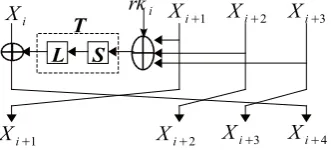
The schematic description of one round of SMS4 is given in Fig. 1. One can know from the figure that the round function F is composed of subkey addition and the function T, where there are two layers in T, which are the non-linear layerS and the linear transformationL. In layerS, an 8×8 S-box is used four times in parallel. The specification of the S-box could be found in [9]. Ltransforms a 32-bit word B to a 32-bit wordD:
D=L(B) =B⊕(B≪2)⊕(B≪10)⊕(B≪18)⊕(B≪24). One can easily verify that the linear branch number of the linear transformation Lis 5.
L S
T
rk
i
Xi X
i+1 Xi+2 Xi+3
X
i+1 Xi+2 Xi+3 Xi+4
Fig. 1.One Round of SMS4
In the key schedule algorithm, first denoteKi∈Z232 (i= 0,· · · ,35) and (K0, K1, K2, K3) = (MK0⊕
FK0,MK1⊕FK1,MK2⊕FK2,MK3⊕FK3), whereFKi (i= 0,1,· · · ,3) are constants. Then the round subkeys are generated by:
rki=Ki+4=Ki⊕T′(Ki+1⊕Ki+2⊕Ki+3⊕CKi),
where the function T′ is the same asT, except the linear transformationLis replaced byL′: L′(B) =B⊕(B ≪13)⊕(B≪23).
CKj (j= 0,1,· · ·,31) are constants, we refer to [9] for the details of them.
Note that, from the key schedule we deduce that if the subkeys of four successive rounds are known, then the main key is uniquely determined.
4
2.3 Linear Attack
Linear cryptanalysis aims to find the linear approximation of a cipher:
ΓP·P⊕ΓC·C=ΓK·K, (1)
whereΓP, ΓCandΓKare called the linear masks ofP, CandK, respectively. DenoteΓK·K=κ, if Eq. (1)
holds with probability 1/2±ϵ, Matsui showed that with about |ϵ|−2 plaintexts, the one bit information κof the key can be recovered. The method is so called Algorithm 1 in [21]. Matsui also provided a more efficient manner (Algorithm 2) by adding an additional round after the linear approximation; the last round key is guessed and ranked. We restate the framework of linear cryptanalysis which follows the principle of Biryukov et al.’s approach [3]:
– Distillation Phase.This phase can be regarded as a phase that preprocesses the plaintexts/ciphertexts. Each plaintext-ciphertext pair is evaluated by the parity of a part of the linear approximation that is related to the plaintext/ciphertext; counters indexed by the key-relevant parts of the plaintext and ciphertext are incremented or decremented accordingly.
– Analysis Phase.This phase guesses a part of the (equivalent) key which is necessary to compute the other part of the linear approximation, evaluates the parity of this part of linear approximation and sets up a counter for each guessed (equivalent) key by utilising the values in the counters of the distillation phase. If we guessk-bit (equivalent) key and would like to geta-bit advantage5, the top 2k−a (equivalent) keys with the highest absolute values are the (equivalent) keys we will keep.
– Search Phase.For each of the kept (equivalent) key, guess the remaining key information and recover the correct key by trial encryption.
A formal way to calculate the success rate PS and the data complexity can be found in [28].
2.4 Multidimensional Linear Attack
Unlike [15] and [16], Biryukov et al. proposed an approach that could use multiple linear approximations with different key bits involved [3]. However, these methods assume that the linear approximations are statistically independent.
Biryukov et al. proved that, if the attacker had m′ linear approximations,ci (i= 0,· · ·, m′−1) are
the theoretical correlations, ˆci (i= 0,· · ·, m′−1) are the empirical correlations, andκ= (κ0,· · · , κm′−1) are the key bits involved in the linear approximations, then the correct key is most likely implied when the minimal value of the following distance happens:
|ˆc−cκ|2=
m∑′−1
i=0
(ˆci−(−1)κici)2,
wherecˆ= (ˆc0,· · · ,cˆm′−1),cκ= ((−1)κ0c0,· · · ,(−1)κm′−1cm′−1). They also gave a heuristic enhancement to this method by adding more approximations that are dependent.
In [11], Hermelin et al. constructed the multidimensional probability distribution; based on this, they proposed the statistical methods for multidimensional linear versions of Algorithm 1 [11] and Algorith-m 2 [12]. We siAlgorith-mply recall these here.
Letf : Vl→Vn be a vector Boolean function, binary vectorsui∈Vlandwi∈Vn (i= 0,· · ·, m−1)
be linear masks such that (ui, wi) are linearly independent. Denote the functionsgi as:
gi(ξ) :=wi·f(ξ)⊕ui·ξ,
the correlation ofgi isci, i= 0,· · ·, m−1.
Lemma 1. (from [24]) Let g = (g0,· · · , gm−1):Vl →Vm be a vector-valued Boolean function and p=
(p0,· · ·, p2m−1) its probability distribution. Then
2lpη= 2−m ∑
b∈Vm ∑
ξ∈Vl
(−1)b·(g(ξ)⊕η), η ∈Vm.
5
a-bit advantage means that with probabilityPSthe right key is ranked among the top 2k−a(equivalent) keys
For allb∈Vm, the combined approximationsb·g has the correlationc(b).
Corollary 1. (from [11]) Let g : Vl → Vm be a Boolean function with probability distribution p and correlationsc(b)of b·g. Then
pη= 2−m ∑
b∈Vm
(−1)b·ηc(b), η∈Vm.
Letq= (q0,· · ·, q2m−1) be the empirical distribution ofp; statistical methods likeχ2-statistic and
LLR-statistic could be used to distinguish the correct key from the wrong ones [12].
Hermelin and Nyberg pointed out that Biryukov et al.’s enhancement is equivalent to the convolution method [13], that is, for Biryukov et al.’s enhancement,
B(κ) = ∑
b∈Vm
((−1)b·κc(b)−ˆc(b))2, κ∈Vm.
The key that minimisesB(κ) is suggested as the right key. Moreover,
B(κ) =−2∑
b∈Vm
(−1)b·κc(b)ˆc(b) + ∑
b∈Vm
(c(b)2+ ˆc(b)2).
Then the key that maximum
G(κ) = ∑
b∈Vm
(−1)b·κc(b)ˆc(b) = 2m ∑
η∈Vm
qηpη⊕κ
is supposed to be the right key. Hermelin and Nyberg also deduced that the LLR-method has the smallest data complexity given the success rate PS, and the data required by the convolution method had the
same order of magnitude as the LLR-method in practice.
Before we present our attack, we recall two important tools to compute matrix multiplication. Given ak-dimensional vectoreand a matrixFof sizek×k, the algorithm to obtainFecan be optimized when every entry of the matrix FsatisfiesF(i, j) = (−1)ij orF(i, j) =e2π√−1ij/k. The former one is called a
Hadamard matrix and the later one is a Fourier matrix. For either Hadamard matrix or Fourier matrix, the vector Fe can be obtained with complexityO(klogk) by Fast Walsh Hadamard Transform [31] or Fast Fourier Transform[7]. In [6], Collard et al. proposed that whenF(i, j) can be denoted as a function ofi⊕j, the computation ofFecan be achieved by three products between a Fourier matrix and a vector. That impliesFe can be computed in O(3klogk) operations whenF(i, j) =f(i⊕j), heref is a known function.
3
Improved Linear Attacks on SMS4
In this section, we first introduce how to construct our new linear approximations which are quite different from the previous ones with a semi-automatic method. Based on one of these linear approximations, we then give a 23-round attack on SMS4. Finally, we improve the data complexity of the attack by multidimensional linear extension.
3.1 A Novel Way to Find the Linear Approximations of SMS4
Biham pointed out that similar to differential cryptanalysis [2], characteristics can be defined in linear cryptanalysis [1]. Consequently, one can find the linear approximations of a cipher by concatenating characteristics of each round. However, there are important differences for the concatenation rule:
– For the XOR operation: Ifx=y⊕z,Γx, Γy andΓz are the masks ofx, y andz, respectively. Then
Γx=Γy=Γz.
– For the branching operation: Ifx=y =z,Γx, Γy and Γz are the masks ofx, yandz, respectively.
ThenΓx=Γy⊕Γz.
– For the linear layerL: Ify=L(x),ΓxandΓyare the masks ofxandy, respectively. ThenΓx=Lt(Γy),
With these rules, one can find a linear approximation just as finding a differential trail. The rest of the task is to design a manner to find a linear approximation that is as long as possible. In this subsection, we propose a new method to search for the linear approximations of SMS4. The purpose of our method is to seek for the linear approximations with as few active S-boxes as possible, which results in non-iterative ones that are different from those in [5,10,17,19]. We use a two-step procedure to achieve this goal.
In thefirst step, we would like to determine the lower bound of the number of active S-boxes of the linear approximation, as well as the positions of the active rounds. As proposed by Mouha et al. in [22], this can be done using Mixed-Integer Liner Programming (MILP). For linear cryptanalysis, Mouha et al. first constructed the equations with extra binary dummy variables for all the branching operations and the linear transformations in the cipher, then they put the equations into a MILP solver for the answer. For example, if the masks of a branching operation are Γx,Γy,Γz and the binary dummy variable isd1, then the equations for this branching operation are:
χ(Γx) +χ(Γy) +χ(Γz)≥2d1 , d1≥χ(Γx),
d1≥χ(Γy),
d1≥χ(Γz).
Similarly, if the input and output byte-masks of a linear transformation areΓin1,Γin2,Γin3,Γin4,Γout1, Γout2,Γout3,Γout4 and the dummy variable isd2, then the equations are:
χ(Γin1) +χ(Γin2) +χ(Γin3) +χ(Γin4) +χ(Γout1) +χ(Γout2) +χ(Γout3) +χ(Γout4)≥bd2 , d2≥χ(Γin1), d2≥χ(Γin2), d2≥χ(Γin3), d2≥χ(Γin4), d2≥χ(Γout1), d2≥χ(Γout2), d2≥χ(Γout3), d2≥χ(Γout4). Where bis the linear branch number, in the case of SMS4,b= 5. Following this method, we generate the MILP for SMS4 and put it to the solver implemented in SAGE [27]. Since the best previous linear approximation is 18 rounds, we try to find a linear approximation with 19 rounds. The solver gives us a 19-round linear approximation with one active S-box in the 1st, 4th, 5th, 8th, 9th, 12th, 13th, 16th and 17th rounds, respectively. However, what we have found is only a lower bound for the number of S-boxes, and one can never find such a linear approximation due to the limitation of degrees of freedom. Our solution is fixing the positions of the active rounds and increasing the number of active S-boxes until we find a valid linear approximation. We find that a linear approximation is probably valid when the number of active S-boxes in each active round is two, i.e., the linear approximation we try to find is with the form:
2−0−0−2−2−0−0−2−2−0−0−2−2−0−0−2−2−0−0.
In thesecond step, we give an algorithm to search for linear approximations with the above form. An observation that is the design criteria of the algorithm will be given first.
Observation 1 In order to form the above 19-round linear approximation, the input masks of the T
functions of the two consecutive active rounds should be the same.
Proof. Denote Γini and Γouti (i = 1,· · · ,6) as the input and output masks of T functions of the six-round linear approximation with the form 0−0−2−2−0−0. Then Γin3 ⊕Γout1 ⊕Γin2 =Γ
4
in⊕Γ
5
out,
Γ4
in⊕Γout6 ⊕Γin5 =Γin3 ⊕Γout2 . Since we haveΓ j in=Γ
j
out= 0 forj= 1,2,5,6, consequently,Γin3 =Γin4.
With Observation 1, we are now ready to introduce our Algorithm 1 which actually searches for the suitable masks of the last 16 rounds in the above 19-round linear approximation. Now let Γi
in andΓouti
let function B(Γi
in, Lt(Γouti )) be the bias of the function T 6, where Lt is the transpose of the linear
transformationLof SMS4. Denote #(Γ) as the number of non-zero bytes in maskΓ.
A time-memory tradeoff is used in Algorithm 1: the algorithm first searches the linear masks of rounds 4-11 and save them in a listL1; then the algorithm searches the linear masks of rounds 8-15, looking for the compatible masks of rounds 8-11 in L1 and save the compatible ones in L2. Finally, we search the linear masks of rounds 16-19 for each mask inL2.
TheΓinj,Γoutj (j= 4,5,8,9,12,13,16,17) output by Algorithm 1 will form a 16-round linear approx-imation. By computingΓout1 :=Γout5 ⊕Γin4 and findingΓ
1
inwhich make the bias of round 1 to be highest,
one can trivially extend the 16-round linear approximation to a 19-round one. By choosingB1= 0.0011 andB2= 2−15we found eight 16-round linear approximations with reasonable bias that can be extended to useful 19 round approximations. The input and output masks (in hexadecimal) of the active T func-tions of these approximafunc-tions are given in Table 1. Our program, which is implemented in C++, runs less than 2 days with a laptop. Note that one can further reduce the running time: Instead of steps 32 and 33, we put the resulting (Γ9
in, Γout8 , Γout9 , Γin12) in a list L3 and parallelize the modified steps 17-33 with steps 1-16. Then find the matches of (Γ9
in, Γout8 , Γout9 ) in L1 andL3 with birthday paradox.
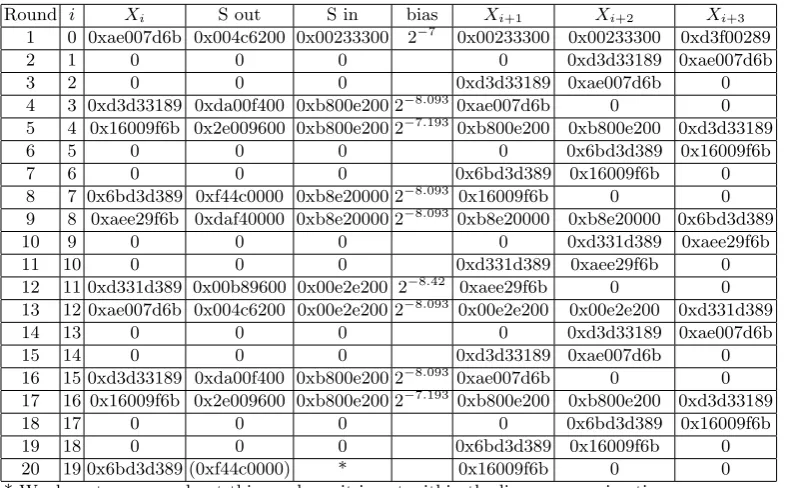
When extending backward to 19 rounds, we known that the number of active S-boxes in the first round is 2. Since for each S-box, there are 5 linear masks that lead to the highest bias, a total number of 200 19-round linear approximations with the same bias can be found. One of these linear approximations can be found in Table 2. In Table 2, the fourth and the fifth columns stand for the output and input masks of the S-box layer, respectively; the sixth column indicates the bias of the round, the rest of the columns give the masks of the intermediate values. We learn from [10] that the piling-up lemma [21] works quite well for SMS4, so the bias of the linear approximation in Table 2 is about 2−62.27.
3.2 Linear Attacks on 23-round SMS4
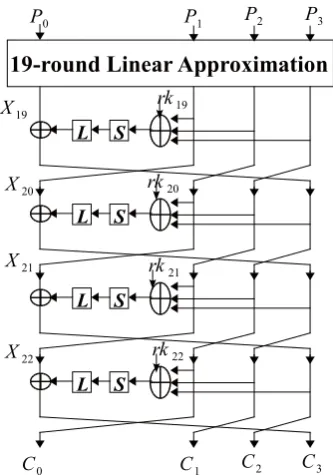
We add four additional rounds to the bottom of the 19-round linear approximation in Table 2 and give a linear attack on 23-round SMS4 (Fig. 2) using Matsui’s Algorithm 2, as well as the technique in [6].
Denoteα= 0xae007d6b,β= 0x00233300,γ= 0xd3f00289,δ= 0x6bd3d389 andζ= 0x16009f6b. Since from the linear approximation, we haveα·P0⊕β·P1⊕β·P2⊕γ·P3⊕δ·X19⊕ζ·X20=κ, we need to guess the subkeys of the last four rounds and rank them.
We haveX22=T(C0⊕C1⊕C2⊕rk22)⊕C3,
X21=T(X22⊕C0⊕C1⊕rk21)⊕C2=T(T(C0⊕C1⊕C2⊕rk22)⊕C0⊕C1⊕C3⊕rk21)⊕C2, X20=T(X21⊕X22⊕C0⊕rk20)⊕C1=T(T(T(C0⊕C1⊕C2⊕rk22)⊕C3⊕C0⊕C1⊕rk21)⊕T(C0⊕ C1⊕C2⊕rk22)⊕C0⊕C2⊕C3⊕rk20)⊕C1,
thenδ·X19=δ·T(m2(X20⊕X21⊕X22⊕rk19))⊕δ·C0=δ·T(m2(T(T(T(C0⊕C1⊕C2⊕rk22)⊕ C3⊕C0⊕C1⊕rk21)⊕T(C0⊕C1⊕C2⊕rk22)⊕C0⊕C2⊕C3⊕rk20))⊕m2(T(T(C0⊕C1⊕C2⊕rk22)⊕ C0⊕C1⊕C3⊕rk21))⊕m2(T(C0⊕C1⊕C2⊕rk22))⊕m2(C1⊕C2⊕C3⊕rk19))⊕δ·C0,
wherem2(x) = 0xffff0000&x.
Further denoteC0=C0⊕C1⊕C2,C1=C0⊕C1⊕C3,C2=C0⊕C2⊕C3,C3=C1⊕C2⊕C3. In our attack, we aim to obtain a 8-bit advantage from the subkey bits we guessed. The reason is that we guess the subkeys of four successive rounds, and we can deduce the main key once these subkeys are known. The procedure of the attack is demonstrated as follows:
Distillation Phase.
1. CollectN = 4|ϵ|−2= 2126.54plaintext/ciphertext pairs.
2. Initialize 2112 counterst[0]· · ·t[2112−1] to zero and regard them as a column vectort.
3. For each plaintext/ciphertext pair, calculate b =α·P0⊕β·P1⊕β ·P2⊕γ·P3⊕δ·C0⊕ζ·C1, increase the countert[C0||C1||C2||m2(C3)] by one ifb= 0; otherwise, decrease it by one.
Analysis Phase.
4. Utilising the technique in [6], we define a conceptual 2112×2112matrixM. The rows ofM are indexed byrk22||rk21||rk20||m2(rk19); the columns ofM are indexed byC0||C1||C2||m2(C3). From [6], we know that each row or column ofM defines the complete matrix. As a result, only the first column ofM would be stored.
6
Algorithm 1:The Second Step for Finding the Linear Approximations
Input: BoundB1,B2, functionB
Output:Γinj,Γ j
out (j= 4,5,8,9,12,13,16,17)
1 forallΓin9 with#(Γ
9
in) = 2do
2 Γ8
in:=Γin9
3 forallΓout9 with#(Lt(Γout9 )) = 2do
4 if B(Γ9
in, Lt(Γout9 ))≥B1 then
5 Γout5 :=Γout9 ⊕Γin9
6 if #(Lt(Γ5
out)) = 2then
7 forallΓout8 with#(Lt(Γout8 )) = 2do
8 if B(Γin8, L t
(Γout8 ))≥B1 then
9 Γout12 :=Γout8 ⊕Γin9
10 if #(Lt(Γout12)) = 2then
11 forallΓ5
in with#(Γin5) = 2do
12 Γin4 :=Γin5
13 if B(Γ5
in, Lt(Γout5 ))≥B1 then
14 Γout4 :=Γout8 ⊕Γin5
15 if #(Lt(Γout4 )) = 2andB(Γ
4
in, L t
(Γout4 ))≥B1 then
16 push the quadruple (Γin9, Γout8 , Γout9 , Γin4) into a listL1
17 forallΓin8 with#(Γin8) = 2do
18 Γin9 :=Γin8
19 forallΓ8
out with#(Lt(Γout8 )) = 2do
20 if B(Γin8, Lt(Γout8 ))≥B1 then
21 Γ12
out:=Γout8 ⊕Γin9
22 if #(Lt(Γout12)) = 2then
23 forallΓout9 with#(L t
(Γout9 )) = 2do
24 if B(Γin9, Lt(Γout9 ))≥B1 then
25 Γout5 :=Γout9 ⊕Γin9
26 if #(Lt(Γ5
out)) = 2then
27 forallΓin12 with#(Γin12) = 2do
28 Γ13
in :=Γin12
29 if B(Γin12, Lt(Γout12))≥B1 then
30 Γ13
out:=Γout9 ⊕Γin12
31 if #(Lt(Γout13)) = 2andB(Γin13, Lt(Γout13))≥B1 then
32 if (Γin9, Γ
8
out, Γout9 )is inL1 then
33 push the quintuple (Γin9, Γout8 , Γout9 , Γin4, Γin12) into a listL2
34 forall the the quintuple inL2 do
35 Γout16 :=Γout12 ⊕Γin13
36 if #(Lt(Γout16)) = 2then
37 forallΓ16
in with#(Γin16) = 2do
38 Γin17:=Γin16
39 Γ17
out:=Γout13 ⊕Γin16
40 if (#(Lt(Γout17)) = 2) and (2×B(Γin16, Lt(Γout16))×B(Γin17, Lt(Γout17))≥B2)then
Table 1.Eight 16-round Linear Approximations
Round 4 5 8 9 12 13 16 17
input b800e200 b800e200 b8e20000 b8e20000 00e2e200 00e2e200 b800e200 b800e200 output d3d33189 16009f6b 6bd3d389 aee29f6b d331d389 ae007d6b d3d33189 16009f6b input 00e200b8 00e200b8 e2e20000 e2e20000 e20000b8 e20000b8 00e200b8 00e200b8 output 009f6b16 d33189d3 007d6bae 31d389d3 e29f6bae d3d3896b 009f6b16 d33189d3 input b800e200 b800e200 00e2e200 00e2e200 b8e20000 b8e20000 b800e200 b800e200 output 16009f6b d3d33189 ae007d6b d331d389 aee29f6b 6bd3d389 16009f6b d3d33189 input 00b800e2 00b800e2 00b8e200 00b8e200 0000e2e2 0000e2e2 00b800e2 00b800e2 output 89d3d331 6b16009f 896bd3d3 6baee29f 89d331d3 6bae007d 89d3d331 6b16009f input e200b800 e200b800 e20000e2 e20000e2 0000b8e2 0000b8e2 e200b800 e200b800 output 9f6b1600 3189d3d3 7d6bae00 d389d331 9f6baee2 d3896bd3 9f6b1600 3189d3d3 input 00e200b8 00e200b8 e20000b8 e20000b8 e2e20000 e2e20000 00e200b8 00e200b8 output d33189d3 009f6b16 d3d3896b e29f6bae 31d389d3 007d6bae d33189d3 009f6b16 input e200b800 e200b800 0000b8e2 0000b8e2 e20000e2 e20000e2 e200b800 e200b800 output 3189d3d3 9f6b1600 d3896bd3 9f6baee2 d389d331 7d6bae00 3189d3d3 9f6b1600 input 00b800e2 00b800e2 0000e2e2 0000e2e2 00b8e200 00b8e200 00b800e2 00b800e2 output 6b16009f 89d3d331 6bae007d 89d331d3 6baee29f 896bd3d3 6b16009f 89d3d331
Table 2.One of the 19-round Linear Approximations
Round i Xi S out S in bias Xi+1 Xi+2 Xi+3 1 0 0xae007d6b 0x004c6200 0x00233300 2−7 0x00233300 0x00233300 0xd3f00289
2 1 0 0 0 0 0xd3d33189 0xae007d6b
3 2 0 0 0 0xd3d33189 0xae007d6b 0
4 3 0xd3d33189 0xda00f400 0xb800e200 2−8.093 0xae007d6b 0 0 5 4 0x16009f6b 0x2e009600 0xb800e200 2−7.193 0xb800e200 0xb800e200 0xd3d33189
6 5 0 0 0 0 0x6bd3d389 0x16009f6b
7 6 0 0 0 0x6bd3d389 0x16009f6b 0
8 7 0x6bd3d389 0xf44c0000 0xb8e20000 2−8.093 0x16009f6b 0 0 9 8 0xaee29f6b 0xdaf40000 0xb8e20000 2−8.093 0xb8e20000 0xb8e20000 0x6bd3d389
10 9 0 0 0 0 0xd331d389 0xaee29f6b
11 10 0 0 0 0xd331d389 0xaee29f6b 0
12 11 0xd331d389 0x00b89600 0x00e2e200 2−8.42 0xaee29f6b 0 0 13 12 0xae007d6b 0x004c6200 0x00e2e200 2−8.093 0x00e2e200 0x00e2e200 0xd331d389
14 13 0 0 0 0 0xd3d33189 0xae007d6b
15 14 0 0 0 0xd3d33189 0xae007d6b 0
16 15 0xd3d33189 0xda00f400 0xb800e200 2−8.093 0xae007d6b 0 0 17 16 0x16009f6b 0x2e009600 0xb800e200 2−7.193 0xb800e200 0xb800e200 0xd3d33189
18 17 0 0 0 0 0x6bd3d389 0x16009f6b
19 18 0 0 0 0x6bd3d389 0x16009f6b 0
L S
L S
L S L S
C0 C1 C2 C3
rk19
rk22 rk20
rk21
X22 X21 X20 X19
19-round Linear Approximation
P0 P1 P2 P3
Fig. 2.Linear Attack on 23-round SMS4
5. Computeg=δ·T(m2(T(T(T(C0⊕rk22)⊕C1⊕rk21)⊕T(C0⊕rk22)⊕C2⊕rk20))⊕m2(T(T(C0⊕ rk22)⊕C1⊕rk21))⊕m2(T(C0⊕rk22))⊕m2(C3⊕rk19))⊕ζ·T(T(T(C0⊕rk22)⊕C1⊕rk21)⊕T(C0⊕ rk22)⊕C2⊕rk20) and insert (−1)g to the corresponding row of the first column ofM.
6. Using the technique in [6], efficiently computeMt=ewith Fast Fourier Transform [7]. Search Phase.
7. Since we aim to get a 8-bit advantage, for each of the top 2104absolute values ine, guess the remaining 16 bits ofrk19, then we can get the main key by the key schedule and test the key by trial encryption. The time complexity of Step 3 is about 2126.54 one-round encryptions, equivalent to 2122 23-round en-cryptions, which is also the dominated complexity of the attack. The time complexity of Step 5 is about 2112 4-round encryptions. In Step 6, eis calculated by the technique in [6], which needs to carry out 3 Fast Fourier Transformations; the complexity is 3×112×2112≈2120.4arithmetic operations. The time complexity of Step 7 is 2120encryptions. The memory complexity is about (126.54×2112+ 2112)/8≈2116 bytes, which is to storetand the first column ofM.
Success Rate. By [28], the success rate PS = Φ(2
√
N|ϵ| −Φ−1(1−2−a−1)) = 86.74%. By the nov-el result in [4],PS=Φ(2
√
N|ϵ| −
√
1 + N
2nΦ−
1(1−2−a−1)) = 73.58%.
As shown in [4], the most deviations between the two models occur when adversary seeks a particularly big advantage or the data complexity gets close to the whole codebook. The advantageain our attack is only 8, thus we try to reduce the data complexity in the next subsection.
3.3 Reducing the Data Complexity of the 23-round Attack by Multidimensional Extension
As mentioned in Section 3.1, for each of the 16-round linear approximations in Table 1, we have 5 input masks with the highest bias for each of the 2 active S-boxes in the first round when extending backward to 19 rounds. For the 16-round linear approximation we used in the previous subsection, the input masks of the 2 active S-boxes in the first round with the highest bias are given in Table 3.
S-box1 S-box2 0x1f 0x33 0x23 0x4e 0x3c 0x8c 0x95 0xbf 0xa9 0xf1
Table 3.The Input Masks of the Two Active S-boxes in the First Round of the 19-round Approximation with Highest Bias
be spanned by m = 6 linearly independent linear approximations, wherem is the number of base ap-proximations. Then we can apply the theory of multidimensional linear attack in [11,12,13] to attack SMS4.
Denote binary vector k = (κ0,· · · , κ5), whereκi(i= 0,· · ·,5) are the one-bit key information involved in the 6 base linear approximations. Since the bias |ϵ| of each of the 19-round linear approximations is 2−62.27, the correlation is c = 2|ϵ| = 2−61.27. The capacity of the 25 linear approximations is C
p =
25×c2= 2−117.9.
Here we use the same notations as the previous subsection except thatβ andγ are not a single value any more, but have different values corresponding to the 25 linear approximations.
Note that in this attack, we also aim to get a 8-bit advantage, the attack procedure is as follows: Distillation Phase.
1. CollectN = 2122.6plaintext-ciphertext pairs.
2. Initialize 25×2112counterst[i][0]· · ·t[i][2112−1] to zero (i= 0,· · ·,24), regardt[i] as a column vector
ti.
3. For each plaintext-ciphertext pair and each of the 25 linear approximations, calculateb=α·P0⊕β· P1⊕β·P2⊕γ·P3⊕δ·C0⊕ζ·C1, increment the countert[i][C0||C1||C2||m2(C3)] ifb= 0; otherwise, decrement it. Fori= 0,· · ·,24.
Analysis Phase.
4. Define conceptual 2112×2112matricesMi. The rows ofMiare indexed byrk
22||rk21||rk20||m2(rk19); the columns ofMi are indexed byC
0||C1||C2||m2(C3). Only the first columns ofMi would be stored. 5. For all the linear approximations, computegi =δ·T(m
2(T(T(T(C0⊕rk22)⊕C1⊕rk21)⊕T(C0⊕ rk22)⊕C2⊕rk20))⊕m2(T(T(C0⊕rk22)⊕C1⊕rk21))⊕m2(T(C0⊕rk22))⊕m2(C3⊕rk19))⊕ζ· T(T(T(C0⊕rk22)⊕C1⊕rk21)⊕T(C0⊕rk22)⊕C2⊕rk20) and insert (−1)g
i
to the corresponding row of the first column ofMi.
6. Efficiently computeMiti=ei with Fast Fourier Transform.
7. Denote the set of 26 linear approximations spanned by the 6 base approximations as I, a binary vector l ∈ V6 indicates the combination of the base approximations for each approximation in I. Consequently, each of the 25 approximations corresponds to a specific value l. Index the ei (i = 0,· · ·,24) obtained in the previous step byel, for an l that indicates an approximation that is out of the 25 ones we used,el =0. Denote the j-th coordinate in el as el
j, where j = 0,· · · ,2112−1.
For eachj and each k, computeG(j,k) = ∑
l∈V6
(−1)l·k(e
l j
N)×c. This step can be calculated using Fast
Walsh-Hadamard Transform [31]. DefineG(j) =maxkG(j, k).
Search Phase.
8. For thej that result the top 2104 G(j), guess the rest 16 bits ofrk
19, then we can get the main key by the key schedule and test the key by trial encryption.
The time complexity of Step 3 is about 25×2122.6/23 ≈ 2122.7 23-round encryptions. The time complexity of Step 5 is about 25×21124-round encryptions. The complexity of Step 6 is 25×3×112×2112≈ 2125 arithmetic operations, which is about 2120.5 encryptions. Step 7 needs about 2112×6×26= 2120.6 arithmetic operations. The time complexity of Step 8 is 2120 encryptions. The memory complexity is about 25×(122.6×2112+ 2112)/8≈2120.6 bytes.
Since the advantagea= 8, according to [12], the success ratePS =Φ( √
N Cp−Φ−1(1−2−m−a)) =
4
Conclusion
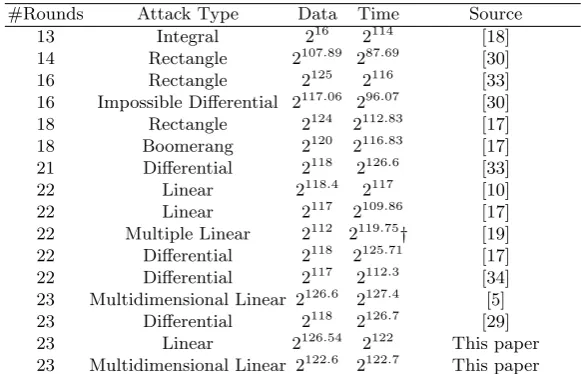
This paper improved the best previous linear cryptanalysis of block cipher SMS4, a summary of some primary cryptanalytic results, as well as our results on SMS4 is given in Table 4. Note that, since the attacks are neither applied to the full cipher nor practical, they do not harm the security of the full SMS4.
Table 4.Summary of the Attacks on SMS4 #Rounds Attack Type Data Time Source
13 Integral 216 2114 [18]
14 Rectangle 2107.89 287.69 [30] 16 Rectangle 2125 2116 [33] 16 Impossible Differential 2117.06 296.07 [30] 18 Rectangle 2124 2112.83 [17] 18 Boomerang 2120 2116.83 [17] 21 Differential 2118 2126.6 [33] 22 Linear 2118.4 2117 [10] 22 Linear 2117 2109.86 [17] 22 Multiple Linear 2112 2119.75† [19] 22 Differential 2118 2125.71 [17] 22 Differential 2117 2112.3 [34] 23 Multidimensional Linear 2126.6 2127.4 [5] 23 Differential 2118 2126.7 [29] 23 Linear 2126.54 2122 This paper 23 Multidimensional Linear 2122.6 2122.7 This paper
†The complexity is 2124.21 arithmetic operations in the original paper, we convert it to the number of 22-round encryptions by assuming that one arithmetic operation is equivalent to one-round SMS4 encryption, which is quite overestimated. Hence it is reasonable.
Acknowledgement
The authors would like to thank the anonymous reviewers of IET Information Security for their valu-able comments. The work is supported by the National Natural Science Foundation of China (Grant No.61202493 and No. 61103237).
References
1. Biham, E.: On Matsui’s Linear Cryptanalysis. In: Santis, A.D. (ed.) Advances in Cryptology - EUROCRYPT ’94. Lecture Notes in Computer Science, vol. 950, pp. 341–355. Springer (1995)
2. Biham, E., Shamir, A.: Differential Cryptanalysis of DES-like Cryptosystems. In: Menezes, A., Vanstone, S.A. (eds.) Advances in Cryptology - CRYPTO ’90. Lecture Notes in Computer Science, vol. 537, pp. 2–21. Springer (1991)
3. Biryukov, A., Canni`ere, C.D., Quisquater, M.: On Multiple Linear Approximations. In: Franklin, M.K. (ed.) Advances in Cryptology - CRYPTO 2004. Lecture Notes in Computer Science, vol. 3152, pp. 1–22. Springer (2004)
4. Bogdanov, A., Tischhauser, E.: On the Wrong Key Randomisation and Key Equivalence Hypotheses in Matsui’s Algorithm 2. In: FSE 2013 (2013)
5. Cho, J.Y., Nyberg, K.: Improved Linear Cryptanalysis of SMS4 Block Cipher. In: Symmetric Key Encryption Workshop 2011 (SKEW 2011) Lyngby, Denmark, 16-17 February 2011 (2011), http://skew2011.mat.dtu. dk/proceedings/Improved%20Linear%20Cryptanalysis%20of%20SMS4%20Block%20Cipher.pdf
6. Collard, B., Standaert, F.X., Quisquater, J.J.: Improving the Time Complexity of Matsui’s Linear Cryptanal-ysis. In: Nam, K.H., Rhee, G. (eds.) ICISC 2007. Lecture Notes in Computer Science, vol. 4817, pp. 77–88. Springer (2007)
8. Daemen, J., Rijmen, V.: The Design of Rijndael. Springer-Verlag New York, Inc., Secaucus, NJ, USA (2002) 9. Diffie, W., Ledin, G. (translators): SMS4 Encryption Algorithm for Wireless Networks. Cryptology ePrint
Archive, Report 2008/329 (2008),http://eprint.iacr.org/
10. Etrog, J., Robshaw, M.J.B.: The Cryptanalysis of Reduced-Round SMS4. In: Avanzi, R.M., Keliher, L., Sica, F. (eds.) Selected Areas in Cryptography 2008. Lecture Notes in Computer Science, vol. 5381, pp. 51–65. Springer (2009)
11. Hermelin, M., Cho, J.Y., Nyberg, K.: Multidimensional Linear Cryptanalysis of Reduced Round Serpent. In: Mu, Y., Susilo, W., Seberry, J. (eds.) ACISP 2008. Lecture Notes in Computer Science, vol. 5107, pp. 203–215. Springer (2008)
12. Hermelin, M., Cho, J.Y., Nyberg, K.: Multidimensional Extension of Matsui’s Algorithm 2. In: Dunkelman, O. (ed.) FSE 2009. Lecture Notes in Computer Science, vol. 5665, pp. 209–227. Springer (2009)
13. Hermelin, M., Nyberg, K.: Dependent Linear Approximations: The Algorithm of Biryukov and Others Re-visited. In: Pieprzyk, J. (ed.) Topics in Cryptology - CT-RSA 2010. Lecture Notes in Computer Science, vol. 5985, pp. 318–333. Springer (2010)
14. Ji, W., Hu, L.: New Description of SMS4 by an Embedding over GF(28). In: Srinathan, K., Rangan, C.P., Yung, M. (eds.) INDOCRYPT 2007. Lecture Notes in Computer Science, vol. 4859, pp. 238–251. Springer (2007)
15. Kaliski, B.S., Robshaw, M.J.B.: Linear Cryptanalysis Using Multiple Approximations. In: Desmedt, Y. (ed.) Advances in Cryptology - CRYPTO ’94. Lecture Notes in Computer Science, vol. 839, pp. 26–39. Springer (1994)
16. Kaliski, B.S., Robshaw, M.J.B.: Linear Cryptanalysis Using Multiple Approximations and FEAL. In: Preneel, B. (ed.) FSE 1994. Lecture Notes in Computer Science, vol. 1008, pp. 249–264. Springer (1995)
17. Kim, T., Kim, J., Hong, S., Sung, J.: Linear and Differential Cryptanalysis of Reduced SMS4 Block Cipher. Cryptology ePrint Archive, Report 2008/281 (2008),http://eprint.iacr.org/
18. Liu, F., Ji, W., Hu, L., Ding, J., Lv, S., Pyshkin, A., Weinmann, R.P.: Analysis of the SMS4 Block Cipher. In: Pieprzyk, J., Ghodosi, H., Dawson, E. (eds.) ACISP 2007. Lecture Notes in Computer Science, vol. 4586, pp. 158–170. Springer (2007)
19. Liu, Z., Gu, D., Zhang, J.: Multiple Linear Cryptanalysis of Reduced-Round SMS4 Block Cipher. Chinese Journal of Electronics 19(3), 389–393 (2010)
20. Lu, J.: Attacking Reduced-Round Versions of the SMS4 Block Cipher in the Chinese WAPI Standard. In: Qing, S., Imai, H., Wang, G. (eds.) ICICS 2007. Lecture Notes in Computer Science, vol. 4861, pp. 306–318. Springer (2008)
21. Matsui, M.: Linear Cryptoanalysis Method for DES Cipher. In: Helleseth, T. (ed.) Advances in Cryptology -EUROCRYPT ’93. Lecture Notes in Computer Science, vol. 765, pp. 386–397. Springer (1994)
22. Mouha, N., Wang, Q., Gu, D., Preneel, B.: Differential and linear cryptanalysis using mixed-integer linear programming. In: Wu, C., Yung, M., Lin, D. (eds.) Inscrypt 2011. Lecture Notes in Computer Science, vol. 7537, pp. 57–76. Springer (2012)
23. Nguyen, P.H., Wu, H., Wang, H.: Improving the Algorithm 2 in Multidimensional Linear Cryptanalysis. In: Parampalli, U., Hawkes, P. (eds.) ACISP 2011. Lecture Notes in Computer Science, vol. 6812, pp. 61–74. Springer (2011)
24. Nyberg, K., Hermelin, M.: Multidimensional Walsh Transform and a Characterization of Bent Functions. In: Information Theory for Wireless Networks, 2007 IEEE Information Theory Workshop on. pp. 1–4 (2007) 25. Office of State Commercial Cryptography Administration: Announcement of 6 Cryptographic Standards. (in
Chinese),http://www.oscca.gov.cn/News/201204/News 1228.htm
26. Office of State Commercial Cryptography Administration: Specification of SMS4, block cipher for WLAN products-SMS4. (in Chinese),http://www.oscca.gov.cn/UpFile/200621016423197990.pdf
27. SAGE:http://www.sagemath.org/.
28. Sel¸cuk, A.A.: On Probability of Success in Linear and Differential Cryptanalysis. J. Cryptology 21(1), 131–147 (2008)
29. Su, B., Wu, W., Zhang, W.: Security of the SMS4 Block Cipher Against Differential Cryptanalysis. J. Comput. Sci. & Technol. 26(1), 130–138 (2011)
30. Toz, D., Dunkelman, O.: Analysis of Two Attacks on Reduced-Round Versions of the SMS4. In: Chen, L., Ryan, M.D., Wang, G. (eds.) ICICS 2008. Lecture Notes in Computer Science, vol. 5308, pp. 141–156. Springer (2008)
31. Yarlagadda, R., Hershey, J.: Hadamard Matrix Analysis and Synthesis: with Applications to Communica-tions and Signal/Image Processing. Kluwer international series in engineering and computer science, Kluwer Academic Publishers (1997)
32. Zhang, B., Jin, C.: Practical Security Against Linear Cryptanalysis for SMS4-like Ciphers with SP Round Function. Sci China Inf Sci 55(9), 2161–2170 (2012)