Project Report
Case Study #3 (of 3) – Water Purification in the ACT
A report of a study funded by the
Australian Water Recycling Centre of Excellence
Case Study #3 (of 3) – Water Purification in the ACT
This report has been prepared as part of the National Demonstration, Education and Engagement Program (NDEEP). This Program has developed a suite of high quality, evidence-based information, tools and engagement strategies that can be used by the water industry when considering water recycling for drinking purposes. The products are fully integrated and can be used at different phases of project development commencing at “just thinking about water recycling for drinking water purposes as an option” to “nearly implemented”.
Project Leader
Dr John Marsden, Director Rod Carr, Associate Director Marsden Jacob Associates 3/683 Burke Rd
Camberwell VIC 3124 AUSTRALIA Telephone: +61 3 9882 1600
Contact: Dr John Marsden [[email protected]] Rod Carr [[email protected]]
About the Australian Water Recycling Centre of Excellence
The mission of the Australian Water Recycling Centre of Excellence is to enhance management and use of water recycling through industry partnerships, build capacity and capability within the recycled water industry, and promote water recycling as a socially, environmentally and economically sustainable option for future water security.
The Australian Government has provided $20 million to the Centre through its National Urban Water and Desalination Plan to support applied research and development projects which meet water recycling challenges for Australia’s irrigation, urban development, food processing, heavy industry and water utility sectors. This funding has levered an additional $40 million investment from more than 80 private and public organisations, in Australia and overseas.
ISBN 978-1-922202-12-3
© Australian Water Recycling Centre of Excellence
Date of publication: [November 2013]
Publisher:
Australian Water Recycling Centre of Excellence Level 5, 200 Creek St, Brisbane, Queensland 4000 www.australianwaterrecycling.com.au
This report was funded by the Australian Water Recycling Centre of Excellence through the Australian Government’s National Urban Water and Desalination Plan.
Disclaimer
C
ASE
S
TUDY
N
OVEMBER
2013
Governance, Decision Processes and Pricing: Implications for Purified Water
Projects
Case Study #3 (of 3) –Water Purification in the ACT
Marsden Jacob Associates
Financial & Economic Consultants
ABN 66 663 324 657 ACN 072 233 204
Internet: http://www.marsdenjacob.com.au E-mail: [email protected]
Melbourne office:
Postal address: Level 3, 683 Burke Road, Camberwell Victoria 3124 AUSTRALIA
Telephone: +61 3 9882 1600 Facsimile: +61 3 9882 1300
Brisbane office:
Level 5, 100 Eagle St, Brisbane Queensland, 4000 AUSTRALIA Telephone: +61 7 3229 7701 Facsimile: +61 7 3229 7944
Sydney Office:
119 Willoughby Road, Crows Nest NSW 2065, AUSTRALIA
Telephone: +61 4 1876 5393
Perth office:
Level 6, 731 Hay St, Perth (Gledden Building) Western Australia, 6000 AUSTRALIA
Telephone: +61 8 9324 1785 Facsimile: +61 8 9322 7936
Contact: Rod Carr, Principal Marsden Jacob Associates Email: [email protected]
Mobile: 0418 765 393
This report has been prepared in accordance with the scope of services described in the contract or agreement between Marsden Jacob Associates Pty Ltd ACN 072 233 204 (MJA) and the Client. Any findings, conclusions or recommendations only apply to the aforementioned circumstances and no greater reliance should be assumed or drawn by the Client. Furthermore, the report has been prepared solely for use by the Client and Marsden Jacob Associates accepts no responsibility for its use by other parties.
Table of Contents
1 Key Findings 2
2 Introduction and Approach 6
2.1 Introduction 6
2.2 Approach 7
2.3 Research Method 8
2.4 Case Study Structure 8
3 Water Sources and Supply Management in the ACT 9
3.1 Water Sources in the ACT 9
3.2 Water Supply in the ACT 11
3.3 Key Findings 14
4 Water Source Planning in the ACT 15
4.1 Institutional arrangements 15
4.2 Timelines 16
4.3 Key Finding: Engagement is Critical 22
4.4 Key Finding: Efficient decision-making 23
5 Key Lessons 25
1
Key Findings
Summary The water supply in the Australian Capital Territory (ACT) was drought affected from the mid-1990s to 2010. In 2003, when the ACT bushfire’s struck, the water supply reached crisis point.
In response to the water security crisis, the ACT Government decided (in 2007) to undertake the Cotter Dam enlargement, Murrumbidgee to Googong Water Transfer pipeline and Tantangara transfer projects.
These projects were selected in preference to the construction of a purified water facility. The ACT seriously considered the development of a purified water facility and this alternative was progressed to a preliminary design stage. Instead, ‘climate dependent’ alternatives were selected because they were more cost-effective. The ACT’s drought response differed from most other capital cities that developed desalination and purified water infrastructure (Sydney, Brisbane, Melbourne, Adelaide and Perth).
Despite not having developed the purified water facility there are a number of useful lessons that can be drawn from the ACT experience, in particular:
All cities and towns need to consider the full spectrum of water supply risks and have well developed response strategies. Rainfall isn’t the only source of water security risk that needs to be planned for and managed. The 2003 ACT bushfires seriously impacted the ACT’s water supply in both the short-term (Mt Stromlo Water Treatment Plant had to be temporarily closed) and medium-term (increased transpiration from regenerating vegetation reduced storage inflows).
Purified water infrastructure is the only ‘climate independent’ water source for inland cities as desalinating and transporting seawater from the coast is not economically viable.
Being located high on the Great Dividing Range meant the ACT could reduce its water security risk by diversifying across a number of catchments. Most other inland cities do not have this option.
Disposal of the brine stream from purified water facilities is high cost and a significant technical constraint for inland locations.
In the absence of direct potable reuse being a viable option, purified water infrastructure must be located near an adequately large storage location (dam or aquifer). Otherwise, the cost of pumping and the lack of ‘natural treatment’ time may undermine project viability.
the case of the ACT there was some uncertainty around decision authority, which interviewees believe led to competitive engagement between the parties.
Regulations, policies and decision-making processes need to be coherent and integrated. When designing the
regulatory regime for water purification it needs to be economical and trust building, with decision-makers in each of the sectors focused on their specific issues.
Infrastructure decision-making by governments can be paralyzed by a lack of detailed consideration of alternative options. An incremental approach to infrastructure development with key decision triggers has been demonstrated by the Water Corporation in Perth to be a time and cost-efficient strategy. In the case of the ACT, uncertainty led to: multiple strategies and reviews being initiated; and the formation of new advisory bodies (such as the Chief Executives Water Group and the Expert Panel on Health). These activities undoubtedly improved the information available to decision-makers, but the delays inadvertently contributed to the depth of the water crisis.
Infrastructure priorisation decisions should be based on cost-benefit analysis and risk analysis at preliminary and detailed design stages, particularly if cost estimates increased significantly when detailed designs are completed. This is important because the ACT Government has been regularly criticized, in the media and parliament, over cost escalations (from $145 to $410 million) to the Cotter Dam enlargement project.
Scope and objectives of the research
In September 2010, the Australian Water Recycling Centre of Excellence commissioned a research consortium to help examine, understand and remove impediments to the acceptance of purified water in Australia.
The research, which commenced in November 2011, examines the extent that local policies and public perceptions facilitate or prevent purified water from being considered for drinking water use.
Another key aim of the research is to work with the water industry to develop a national demonstration education and engagement program that supports successful public engagement and addresses stakeholder concerns (in particular the media, policy makers, community and politicians) through the provision of contemporary information on purified water as a viable supply option.
The aim of the Marsden Jacob research is to identify governance (i.e. power and decision-making, both formal and informal) and pricing related impediments to investment in purified water facilities, compared with alternative water supplies. A central part of the Marsden Jacob research is three case studies that involve developing a decision-making timeline, storyline and narrative, for each case study location
Five best practice principles were selected to provide a focus for the research. These criteria are based on best practice governance frameworks developed by Australian National Audit Office (ANAO), Global Water Partnership and OECD:
Accountability: Obligations are relevant, adequate and matched.
Efficiency: Actions needs to be balanced based on their economic, social and environmental efficiency.
Coherent and integrated: Regulations, policies and decision-making processes need to be coherent and integrated.
Responsive and sustainable: Regulatory and policy settings deliver what is needed on the basis of current demand and future impact. Institutions should be built with an eye to longer term sustainability.
This is the third case study report and it focuses on the ACT purified water facility, also known as Water2WATER.
Demonstration Water Purification Plant
(Water2WATER initiative)
In October 2007, the ACT Government announced a range of new water supply projects for the region, including the design (with a view to development) of a Demonstration Water Purification Plant.
ACTEW completed the preliminary design for the Demonstration Water Purification Plant, but construction was not initiated.
However, as a number of interviewees stated “having the design for a plant ready means that the ACT is prepared in case we need to look to water purification in future”.
Key Findings: Decision-Making
(Keep all options on the table until they have been robustly assessed)
Priorisation decisions need to be based on detailed cost and benefit estimates. If these are unavailable then all options should be kept on the table until this information is available and the analysis has been completed.
The case study highlights the risks associated with committing to infrastructure alternatives without detailed designs, costing, risk assessment and analysis.
The ACT Government has been regularly criticized, in the media and in parliament, over the cost escalations in the Cotter Dam enlargement project. These criticisms arise from the project cost having increased from $145 to $360 million (prior to construction commencing), with the final project cost up to $410 million.
This is not to say the ACT Government should have opted for purified water, because the Expert Panel on Health found that the original Cotter Dam was too small (4 GL) to be used as a storage point for the purified water as there would be inadequate “natural treatment” time. So, the Cotter Dam would have had to be enlarged anyway. However, if the true cost of the Cotter Dam enlargement were known it may have resulted in a different water security project mix being implemented.
Furthermore, while pricing of purified water has not emerged as a significant issue in the case study, because the
Key Finding: Governance (Engagement: Decision Responsibilities and Institutional Expertise are critical)
There are two key lessons that relate to decision-maker engagement. Decision making responsibilities need to be well understood. Decision-making can be facilitated by well informed and balanced advice from institutions.
Between 2002 and 2007, the ACT Government’s deliberations on water security improving infrastructure included numerous announcements, strategies, reviews and options projects:
No New Dams (2002)
Think Water, Act Water Strategy (2004)
Future Water Options project (commenced 2004)
Water Security Review (2006)
Water Security for the ACT and Region: Recommendations to ACT Government (2007)
Future Water Options Review: Water Security Program (2007)
Enlarged Cotter Dam and Murrumbidgee to Googong Pipeline Transfer projects announced (2007)
When we asked interviewees why the decision process was so protracted, and why were there so many projects undertaken? Two responses emerged:
First, while decision-making responsibility clearly resided with the Executive (Government Ministers and Cabinet), there was a lack of role clarity for the various government agencies: ACTEW, the regulators (health and economic) and water policy areas. Consequently, at times they were competing for decision-making power.
Secondly, the relatively small size of the institutions involved (compared particularly to those in other capital cities) constrained the pool of expertise and experience. So, considerable time and funding had to be invested in developing the necessary expertise and knowledge. For instance, in 2007 (at the height of the water security crisis) senior staff from ACT Health and Territory and Municipal Services (TAMS):
“went to Singapore, Belgium, the United Kingdom and the United States to meet with regulators and treatment plant operators within these countries to discuss drinking water recycling to ensure that the ACT Government received the most up to date information relevant to the project’s risks and necessary regulatory controls for both environmental and health related matters.” (ACT Health (2007))
Stakeholders note that this process might have been streamlined by more cooperative engagement between decision-makers and utilities, that focused on:
depoliticising water purification;
understanding (mapping) the regulatory and decision pathways;
revealing and addressing any role uncertainties; and
2
Introduction and Approach
Key Points
This AWRCoE Research Project aims to understand and dismantle impediments to the acceptance of purified water in Australia.
The Marsden Jacob research is investigating governance and pricing impediments.
This case study is on the ACT Demonstration Water Purification Plant.
2.1
Introduction
In September 2010, the Australian Water Recycling Centre of Excellence commissioned a research consortium to help examine, understand and remove impediments to the acceptance of purified water in Australia.
The research, which commenced in November 2011, examines the extent that local policies and public perceptions facilitate or prevent purified water from being considered for drinking water use.
Another key aim of the research is to work with the water industry to develop a national demonstration, education and engagement program that supports successful public engagement and addresses stakeholder concerns (in particular the media, policy makers, community and politicians) through the provision of contemporary information on purified water as a viable supply option.
The aim of the Marsden Jacob research is to identify governance (i.e. power and decision-making, both formal and informal) and pricing related impediments to investment in purified water facilities, compared with alternative water supplies. A central part of the Marsden Jacob research is three case studies that involve developing a decision-making timeline, storyline and narrative, for each case study location, with a view to ‘as clearly as possible’ identifying:
When key decisions were taken.
Who made the decisions and how were they informed.
Whether any impediments to implementation arose.
How these impediments were resolved.
Whether pricing and governance arrangements can be improved.
2.2
Approach
This research project is being undertaken in three phases: phase one involved a literature review; phase two involves three case studies; phase three involves a high-level review of the policy implications.
Governance Best Practice Framework and Research Questions
In the literature review phase of this project:
1. The following working definition of governance was adopted for this project: Governance encompasses political, regulatory, policy and institutional arrangements at all levels of water resource planning (both formal and informal) in Australia.
2. Five best practice principles were selected to provide a focus for the research. These criteria are based on best practice governance frameworks developed by the Australian National Audit Office, Global Water Partnership and Organisation for Economic Cooperation and Development:
Transparency: Is a guiding principle, such that governance arrangements should operate in an open manner, using language which is accessible. In addition all decisions and decision-making processes should be transparent to insiders and outsiders.
Accountability: Obligations are relevant, adequate and matched.
Efficiency: Actions needs to be balanced based on their economic, social and environmental efficiency.
Coherent and integrated: Regulations, policies and decision-making processes need to be coherent and integrated.
Responsive and sustainable: Regulatory and policy settings deliver what is needed on the basis of current demand and future impact. Institutions should be built with an eye to longer term sustainability.
3. The framework provided by the above principles was supplemented by criteria relating to institutional arrangements, namely:
Clarity of objectives/roles;
Adequate and matched authority and accountability;
Financial (and organisational) capacity and sustainability; and
Appropriate incentives.
Pricing and Willingness to Pay
The literature phase of the project did not identify any significant pricing impediments to providing purified water.
2.3
Research Method
To inform this case study Marsden Jacob:
reviewed the publically available information;
identified interview candidates: based on our previous experience and through consultation key parties;
developed a semi-structured interview questionnaire to guide the interviews; and
conducted face-to-face semi-structured interviews.
To enable frank and open insights, all quotes in the case study are unattributed. Our thanks go to all interviewees for participating in the project:
Gary Bickford – (formerly) Manager Strategic Planning, ACTEW
David Butt – Executive Manager, Water Policy, ACT Government Environment and Sustainable Development Directorate
Ross Knee – (formerly) Executive Management Strategy, ACTEW
Stewart Chapman – Senior Manager, Water Policy, ACT Government Environment and Sustainable Development Directorate
Associate Professor Paul Dugdale – (formerly) Chief Health Officer and Executive Director, Population Health Division, ACT Health
Emeritus Professor Ian Falconer – University of Adelaide, (formerly) Chair Expert Panel on Health (EPOH)
Paul Baxter – (formerly) ACT ICRC Commissioner
2.4
Case Study Structure
Section 1 – Key Findings
Section 2 – Introduction and Approach
Section 3 – Water Sources and Supply Management in the ACT
Section 4 – Water Source Planning in the ACT
Section 5 – Key Lessons
3
Water Sources and Supply Management in the ACT
This section presents the water source and supply management arrangements and challenges in the ACT. Key points, include: the climate signal in the ACT has been unclear;
the ACT is a landlocked riverine city;
emergency water supply plans are critical to address short-term water supply risks; and
while institutional arrangements in the ACT have been relatively stable, decision roles on purified water facilities were not clearly assigned.
3.1
Water Sources in the ACT
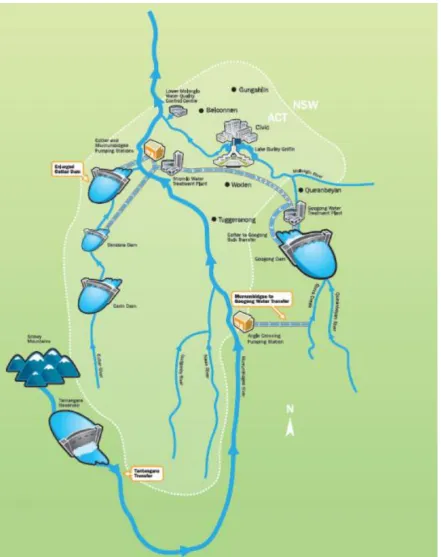
The ACT is a landlocked riverine city. The major rivers of the ACT are the Murrumbidgee, Molonglo, Queanbeyan and Cotter Rivers. All rivers and creeks in the ACT drain to the Murrumbidgee River, which originates in the alpine region to the south of the ACT and flows to the north–west to join the Murray River.
Because of its location, high in Australia’s Great Dividing Range, the ACT draws its water supply from three catchment systems. The ACT has considered the desalination of seawater as a ‘climate independent’ source, but distance and elevation means the cost is prohibitive (GHD 2007).
Figure 1 schematically outlines the source and supply network of water for the ACT and Queanbeyan. The three catchments are the:
Cotter River catchment, located within the ACT. The Cotter River storages are the Cotter Dam completed in 1912 (4 GL), Bendora Dam completed in 1961 (12 GL) and Corin Dam completed in 1968 (71 GL). In addition, the Cotter Dam enlargement project was completed in 2013 and the dam capacity increased to 78 GL.
Queanbeyan River catchment, located wholly within NSW, which is the site of Googong dam completed in 1979 (121 GL). Googong dam supplies water to Queanbeyan (in NSW) and the ACT.
Figure 1: ACT Water Supply
Source: Office of the Environmental Commissioner1
3.2
Water Supply in the ACT
The climatic challenge
The climatic signal in the ACT, like other eastern cities in Australia, shows periods of dry and wet. On average inflows to the ACT’s dams are well above average demand. Over the last 20 years, the “combined dam inflows have averaged 148 gigalitres per annum (GL/a) compared to about 57 GL/a average demand” (ICRC 2012 p4)2, with approximately 25 to 30 GL returned each year.
The problem is that the ACT periodically experiences prolonged periods of below average rainfall (drought) which translates into low inflows and storage volumes in its dams. For instance, average inflows over the period 1994-2007 were 96 GL per annum. This is well below the 1871-1993 average of 200 GL per annum for Corin, Bendora and Googong Reservoirs (see Figure 2). So, in the absence of ‘climate independent’ source (seawater or groundwater
desalination or water purification), the ACT must store considerably more water to manage for unpredictable fluctuations in rainfall.
Figure 2: Inflows to Corin, Bendora and Googong Dams 1871–2007
Source: ACTEW (2008) Water Security for the ACT and Region: Progress Report and Recommendations to ACT Government
In this case study we specifically focus on the water security pressures experienced in the ACT over the period 1997 to 2012.
1997 – 2005: ACT water supply seriously impacted by drought and bushfire
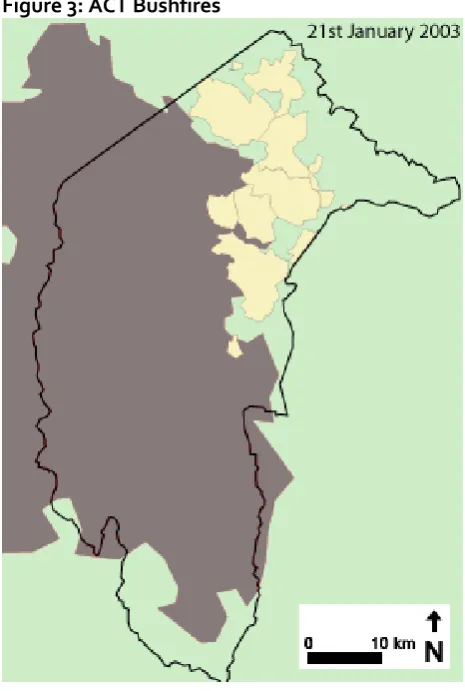
Figure 2 shows that the Millennium Drought started in the late 1990s, when inflows to the ACT’s dams were consistently below the long-run average of 200 GL per annum. But, it wasn’t until the 2003 ACT bushfires – when almost 70% of the ACT’s pastures, forests, parks were severely damaged and more than 500 homes were severely damaged or destroyed – that the ACT started to experience serious water security risk. Drought and bushfire impacts meant that the ACT dam levels fell from 80% (January 2002) to 43% (June 2003)
While the impact of the drought cannot be under-estimated, the ACT bushfires seriously compounded the water supply situation:
The first impact was to increase the ACT’s reliance on the Googong Dam, because poor water quality due to ash run-off into the Cotter catchment meant the Mt Stromlo Water Treatment Plant was unable to treat the water.
The second and ongoing impact was a lasting “reduction in stream-flows in ACT catchments, and consequently instream-flows into ACT dams” (ICRC 2012 p15)3. Stream-flows fell because vegetation that is
recovering from the bushfire has elevated evapotranspiration.
3 http://www.icrc.act.gov.au/archives/water-and-sewerage-list/#inquiry-into-secondary-water-use-release-of-final-report
Figure 3: ACT Bushfires
Source: McLeod Inquiry (2003)4
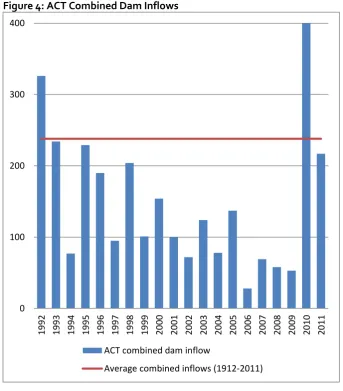
Fortunately for the ACT, in 2005 there was a temporary reprieve as a return to average rainfall (see Figure 4) and reduced water demand saw dam capacity increase to 67% (January 2005).
4 http://www.cmd.act.gov.au/__data/assets/pdf_file/0008/113939/McLeodInquiry.pdf,
2006 – 2009: ACT water supply worsens
Following the temporary reprieve in 2005, in 2006 and 2007 the ACT’s water security situation again declined rapidly with dam storage
plummeting to a low of 31% in mid-2007. Dam capacity fell dramatically because of very low rainfall and residual bushfire impacts. The combined effect was extremely low dam inflows over the period 2006 to 2009 (see Figure 3).
Furthermore, the rainfall outlook was dire. In 2006, a fundamental change to previous climate change assumptions was identified. ACTEW started discussing the possibility that a “new climate pattern with greatly reduced rainfall averages had emerged”, because work undertaken by CSIRO was predicting that by 2030 runoff into the storages would decrease by 30 per cent (on average). Putting this in context, over the previous six years runoff had decreased by more than 60 per cent and by approximately 90 per cent in 2006.
In response to the water security crisis in 2007 the ACT Government announced a range of water supply augmentation projects (see Section 4).
2010 – 2012: Drought breaks
In 2010, the Millennium Drought broke due to a strong La Nina event that developed in spring. The ACT received 960 millimetres of rainfall, well above the historical average of 617 millimetres. Dam inflows were estimated to be 404 GL, well above the long-term average and combined dam storage volumes rose from 52% to 100% by December 2010.
Figure 4: ACT Combined Dam Inflows
Source: ICRC (2012)
0 100 200 300 400 19 92 19 93 19 94 19 95 19 96 19 97 19 98 19 99 20 00 20 01 20 02 20 03 20 04 20 05 20 06 20 07 20 08 20 09 20 10 20 11
ACT combined dam inflow
3.3
Key Findings
The ACT’s water supply over the period from 1997 to 2009 suffered a number of setbacks:
The ACT experienced a period of prolonged drought which commenced in the early 1990s (see Figure 2), but impacts were most keenly felt from 2003 to 2007.
The 2003 bushfires resulted in the temporary closure of the Mt Stromlo Water Treatment Plant, a key source of drinking water for the ACT.
ACT dams storage volumes suffered from a lasting reduction in dam inflows, as vegetation regrowth increased evapotranspiration.
It must be noted that the climate signal in the ACT is similar to other east Australian cities, but distinctly different from Perth (see WA Groundwater Replenishment case study) where the inflows have been progressively falling since 1975 (see Figure 5 and Figure 6).
Figure 5: Yearly streamflow for major surface water sources, Perth
Source: www.watercorporation.com.au/D/dams_streamflow.cfm, accessed 6 February 2013
Figure 6: Water flowing into Melbourne's main water supply reservoirs (annual totals)
Source:
4
Water Source Planning in the ACT
Key Points
Water Purification was identified in the ACT as a source augmentation option, but was not implemented as more cost-effective alternatives were identified.
Infrastructure priorisation decisions should be based on cost-benefit analysis and risk analysis at preliminary and detailed design stages, particularly if cost estimates increase significantly when detailed designs are completed.
Regulations, policies and decision-making processes need to be coherent and integrated.
Lack of thorough consideration of the infrastructure options can paralyse decision-making and lead to inefficient outcomes.
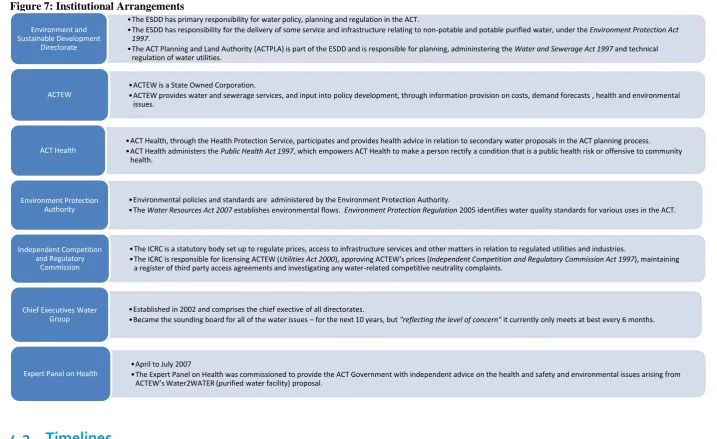
As discussed in Chapter 3, the ACT’s water supply over the period 1997 to 2010 suffered multiple setbacks. In response, water supply assumed heightened importance in the political, policy and regulatory spheres of government. This section explores the institutional arrangement and the decision-making timeline, narrative and lessons from the ACT.
4.1
Institutional arrangements
Figure 7: Institutional Arrangements
4.2
Timelines
Our research has identified that a considerable number of announcements, strategies, reviews and assessment projects were undertaken between 2002 and 2007. This confirms that the Millennium drought, compounded by the 2003 bushfire, meant the ACT Government had to scramble to develop a response to a
•The ESDD has primary responsibility for water policy, planning and regulation in the ACT.
•The ESDD has responsibility for the delivery of some service and infrastructure relating to non-potable and potable purified water, under the Environment Protection Act 1997.
•The ACT Planning and Land Authority (ACTPLA) is part of the ESDD and is responsible for planning, admininstering the Water and Sewerage Act 1997 and technical regulation of water utilities.
Environment and Sustainable Development
Directorate
•ACTEW is a State Owned Corporation.
•ACTEW provides water and sewerage services, and input into policy development, through information provision on costs, demand forecasts , health and environmental issues.
ACTEW
•ACT Health, through the Health Protection Service, participates and provides health advice in relation to secondary water proposals in the ACT planning process.
•ACT Health administers the Public Health Act 1997, which empowers ACT Health to make a person rectify a condition that is a public health risk or offensive to community health.
ACT Health
•Environmental policies and standards are administered by the Environment Protection Authority.
•The Water Resources Act 2007 establishes environmental flows. Environment Protection Regulation 2005 identifies water quality standards for various uses in the ACT.
Environment Protection Authority
•The ICRC is a statutory body set up to regulate prices, access to infrastructure services and other matters in relation to regulated utilities and industries.
•The ICRC is responsible for licensing ACTEW (Utilities Act 2000), approving ACTEW's prices (Independent Competition and Regulatory Commission Act 1997), maintaining a register of third party access agreements and investigating any water-related competitive neutrality complaints.
Independent Competition and Regulatory
Commission
•Established in 2002 and comprises the chief exective of all directorates.
•Became the sounding board for all of the water issues – for the next 10 years, but "reflecting the level of concern" it currently only meets at best every 6 months.
Chief Executives Water Group
•April to July 2007
•The Expert Panel on Health was commissioned to provide the ACT Government with independent advice on the health and safety and environmental issues arising from
ACTEW’s Water2WATER (purified water facility) proposal.
made planning even more challenging in the ACT. Figure 8 summarises the key water projects and decisions that occurred over the period. These projects and decisions are discussed in more detail below.
Figure 8: Decision Timelines
2002 - 2003: No New Dams
In 2002, the ACT water supply was secure as dams were at 80%. However, inflows had fallen dramatically so the ACT Government began to seriously consider water supply security issues.
In December 2002, Minister Bill Wood, the Minister for Urban Services released a ministerial statement about the development of an ACT water resource strategy. The Minister announced an aspiration ‘to avoid the building of another dam’, and stated that they needed to ‘continue taking a series of small steps, with the expectation that we continue to improve our water management until those steps have grown large enough to avoid building that dam’ (p 4121)5:
“We need to determine if it is practical for the ACT to adopt a clear and unequivocal aim not to build a new dam for the water supply. We will ensure that the vital issue of water resources is addressed now, in partnership with the community, in a far-reaching engagement process aimed at setting clear directions for sustainable water management and preparing a long-term water resource strategy for the ACT.”
However, by June 2003 the ACT’s water supply situation had shifted dramatically, with combined dams at 43% and Mt Stromlo Water Treatment Plant temporarily taken off line as it was unable to treat bushfire affected water.
In response, Stage 1 and Stage 2 temporary water restrictions were implemented by ACTEW, this reduced demand from 192 to 148 kL per year over 2002 to 2003.
2004 – 2005: Think water act water and Future Water Options projects
In 2004, the ACT’s water security situation was increasingly critical. A temporary reprieve in 2005 meant that combined storage levels rose to 67%.
In April 2004, the ACT Government released its water strategy “Think water act water”. Consistent with the 2002 Ministerial statement, Think water act water focused on ensuring the ACT has a secure water supply, without the need for new dams. Think water act water focused on the integration of stormwater, water supply and wastewater elements, to address key targets that included:
reducing per capita use of mains (drinking supply) water by 12 per cent by 2013, and 25 per cent by 2023;
increasing wastewater reuse from 5 per cent to 20 per cent by 2013;
ensuring the level of nutrients and sediments entering ACT waterways is no greater than from a well-managed rural landscape; and
reducing the intensity and volume of urban stormwater flows to pre-development equivalents.
5 Wood B (2002) water resource ministerial statement. Week 14 Hansard 10 December 2002, ACT Legislative Assembly, Canberra ACT,
In April 2005, ACTEW presented its Future Water Options project report to the ACT Government. The report was produced at the request of the ACT Government and identified ACTEW’s preferred approach for additional water supply in the ACT, if it is required. In contrast to the Ministerial statement and Think water act water priorities (which focused on water saving and reuse projects) the key recommendations were:
immediate implementation of the $40 million Murrumbidgee to Googong Pipeline project; and
retention of the Enlarged Cotter Dam and Tennent Dam projects as future viable options.
The recommended options were selected from an extensive list of options that included (both individually and in combination): water purification plant (25 and 50 ML/day); Tennent dam (159 GL); Tennent dam (43 GL); enlarged Cotter dam (from 4GL to 78 GL); Tantangara releases (25 GL / year); non-potable effluent reuse and accelerated demand reduction.
Cotter Dam at 4GL capacity, Source: ACTEW
The ACT government, having bought some time through other initiatives – the Cotter to Googong Bulk Water Transfer project and upgraded the Mt Stromlo Treatment Plant (discussed below) – did not accept the recommendations from the Future Water Options project. Critically, an interviewee commented that “The Government was unable to look sensibly at the options, because they had lost key people in the bureaucracy”. Instead the ACT Government announced that it would seek independent technical advice, conduct a whole-of-government review of the report and consult with the ACT community before making a decision on the report6.
To help alleviate the water security risk from the drought, in 2004 ACTEW implemented the Cotter to Googong Bulk Transfer project and the Mt Stromlo Treatment Plant upgrade. The Cotter to Googong Bulk Transfer project enabled the transfer of up to 12 GL of water from the Cotter catchment (that would otherwise spill over the dam walls) to the Googong Dam and bought the ACT some time. In addition, the Mt Stromlo Water Treatment Plant was upgraded so that it could treat poor quality water that had been affected by bushfires.
2006 – 2009: Water Security Review, Demonstration Water Purification Plant (concept) and Enlarged Cotter Dam
In February 2006, the ACT Government announced it would not proceed with ACTEW’s Future Water Options recommendations. Chief Minister Stanhope said:
“With the new Cotter-Googong Bulk Transfer program poised to play a bigger-than-anticipated part in securing Canberra’s water supply, the ACT Government has decided to keep its options open concerning future supply strategies for the Territory.”
“ACTEW now advises me that there is no immediate need to commit to the Angle Crossing option until it has prepared detailed analyses of the comparative merits of the two locations, examining issues such as public health, environmental impact, and economic and social costs and benefits”.7
However (as discussed in Section 3), in 2006 ACTEW identified a fundamental change to previous climate change assumptions. In response, ACTEW initiated the Water Security Review. The Water Security Review report was presented by ACTEW to the ACT Government in July 2007. At this time the combined dam capacity had fallen to 31%.
The Water Security Review report again recommended enlarging the Cotter Dam from 4 to 78 GL and the Murrumbidgee to Googong Pipeline project. The Tennent Dam was dropped from the list of recommended projects. The report recommended further analysis be undertaken on:
a purified water facility; or
the Tantangara Transfer project.
Because purified water is the ACT’s key ‘climate independent’ water source alternative the ACT Government was very interested in the potential for this project. In March 2007, the ACT Government established an Expert Panel on Health to investigate the water purification plant alternative. The Expert Panel on Health led a series of community forums and a survey, in 2007, which identified that 75% of community were positive (53%) or conditionally positive (22%) towards the water purification plan proposal.
In July 2007, the Expert Panel on Health delivered its report to the ACT Government. The key finding was that:
“The panel considers that a reverse osmosis-based water purification plant is feasible as a method of increasing the water supply for Canberra, subject to stringent health and safety requirements being met as set out in the draft AGWR and the approval of ACT Health as the regulatory body responsible.”
At the time the ACTEW had been arguing that activated carbon was the best option, particularly as it is much lower cost than reverse osmosis. The Expert Panel on Health recommended that ACTEW only proceed with a dual membrane water purification plant and that an alternative treatment train using ozone and biologically activated carbon not be considered further.
Because it was proposed that treated water should be put into the Cotter Dam the Expert Panel also recommended the enlargement of Cotter Dam to enable adequate dilution and natural treatment time for the purified water. The Cotter Dam at the time had a storage capacity of less than 4GL.
Based on an international study tour, related research and water sampling the ACT Health regulator agreed with the findings of the Expert Panel on Health, that activated carbon was not as effective as reverse osmosis and as interviewees noted “arguments in favour of inferior technology would become less and less powerful over time and could ultimately mean that you lose the project”.
In October 2007, three years after they were originally proposed, the ACT Government announced that ACTEW would undertake the enlarged Cotter Dam, Murrumbidgee to Googong Pipeline and Tantangara Dam projects.
Chief Minister Stanhope said: “The range of water security measures that will be implemented include:
1. enlarging the Cotter Dam from 4 gigalitres (GL) to 78 GL, with planning and design work to begin immediately and work expected to be completed within three to five years (at a capital cost of about $145 million);
2. the installation of infrastructure to increase the volume of water transferred from the Murrumbidgee River to the Googong Dam (about $70 million);
3. pursuing the possibility of purchasing water from Tantangara Dam (about $38 million);
4. design of a demonstration Water Purification Plant, with the water produced during demonstration to be used for purposes other than drinking (about
$6 million will be spent during the year-long design phase)”8
The announcement by the ACT Government recognised that water purification is less climate dependent than other sources and so approval was granted to develop a pilot demonstration plant for research and monitoring purposes:
“Water purification is the measure that is least subject to fluctuations in climate and therefore provides the greatest reliability. However, the Water Security Taskforce, the Expert Panel on Health and the e-Water Cooperative Research Centre all believe that purification warrants further analysis. The Government has therefore approved the design of a pilot demonstration plant for research and monitoring. The water from during demonstration will not be added to the drinking supply.” 9
At the time it was estimated that the average household water bill would increase by $70 per year for the enlarged Cotter Dam, $100 per year for the enlarged Cotter Dam including Murrumbidgee pumping, and by $250 per year for the enlarged Cotter Dam combined with the larger water purification plant (Water Security for the ACT and Region: Recommendations to ACT Government, July 2007).
In late 2008, the demonstration water purification plant was put on hold, with the preliminary designs having been completed.
2010 – 2013: Drought breaks, Murrumbidgee to Googong pipeline constructed, enlarged Cotter dam constructed, Demonstration Water Purification Plant on hold
In 2010, the Millennium Drought broke and the combined dam levels reached 100% by December 2010. In early 2011, ACTEW commenced the
Murrumbidgee to Googong pipeline project and it was completed in October 2012 and the enlarged Cotter Dam project was completed in October 2013.
8 http://info.cmcd.act.gov.au/archived-media-releases/media999c.html?v=6079&s=233, accessed 11 July 2013
4.3
Key Finding: Engagement is Critical
A recurring theme across the interviews, that informed this case study, was the critical role of cooperative engagement between ACTEW, politicians, decision-makers, regulators and key thought leaders. Interviewees maintained that engagement needs to be a two-way dialogue, long-term and deliberately involve all decision-makers. In the case of the ACT, Interviewees noted that a lack of role clarity undermined this cooperation and made the decision-making process more politicised and protracted.
Role Clarity and Cooperation
The series of reviews and strategies, that were developed between 2002 and 2007 highlight that the ACT Government’s deliberations on water security improving infrastructure could have benefited from earlier and better informed engagement. The reviews and strategies included:
No New Dams (2002)
Think Water, Act Water Strategy (2004)
Future Water Options project (2004)
Water Security Review (2006)
Water Security for the ACT and Region: Recommendations to ACT Government (2007)
Future Water Options Review: Water Security Program (2007)
Enlarged Cotter Dam and Murrumbidgee to Googong Pipeline Transfer projects announced (2007)
When we asked interviewees why the decision process was so protracted, and why were there so many projects undertaken? Two responses emerged:
First, while decision-making responsibility clearly resided with the executive, there was a lack of role clarity for the different agencies. Consequently, ACTEW, the regulators (health and economic) and water policy areas were often competing for decision-making power.
Secondly, the relatively small size of the institutions involved (compared particularly to those in other jurisdictions) constrained the pool of expertise and experience. So, considerable time and money was invested in developing the necessary expertise and knowledge. For instance, in 2007 (at the height of the water security crisis) senior staff from ACT Health and Territory and Municipal Services (TAMS):
“went to Singapore, Belgium, the United Kingdom and the United States to meet with regulators and treatment plant operators within these countries to discuss drinking water recycling to ensure that the ACT Government received the most up to date information relevant to the project’s risks and
necessary regulatory controls for both environmental and health related matters.” (ACT Health (2007))
This confirms the importance of cooperative engagement between decision-makers and utilities that focuses on:
understanding (mapping) the regulatory and decision pathways;
revealing and addressing any role uncertainties; and
Depoliticising decision making
A central objective of engagement needs to be the depoliticising of water source decision-making, particularly where purified water is concerned. In the ACT, water source planning became a politically important topic as dam storages fell, but as several interviewees noted:
“Decision-makers didn’t know who to rely on for information.”
In Perth, engagement with decision-makers, regulators and politicians on the concept of groundwater replenishment started as early as 1995 (when groundwater replenishment was included in Perth’s Water Future).
In the ACT engagement on the potential for a purified water facility really only ramped up in 2007, when the ACT Government appointed the Expert Panel on Health and the health and environmental regulators did an international study tour to learn from the lessons from international experience.
Active and early engagement across the relevant agencies, regulators and utility could have helped ensure that when issues were brought to the attention of politicians they had be carefully assessed, which would increase decision-maker confidence and ultimately should help to depoliticise the decision process.
4.4
Key Finding: Efficient decision-making
The case study also identifies that well informed project decision-making, in particular a detailed understanding of the costs, benefits and risks of the
alternatives options, is critical to achieving optimal outcomes. All options should be kept on the table until detailed design and analysis has been completed, particularly if costs increase significantly between the preliminary and detailed design project stages.
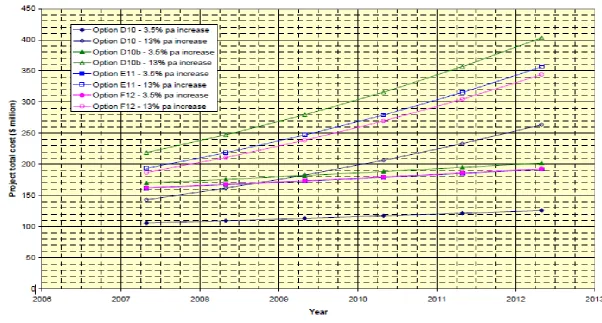
For instance, the project cost of the Cotter Dam enlargement increased from $145 million (2007) to $360 million (2010), before construction had commenced and ultimately to $410 million (2013), which aligns with the upper bound of ACTEW’s cost estimates in 2007 (Figure 9). While it is quite normal to see cost escalations over the course of a project as it moves from concept to construction phases, the scale of the increase highlights that it is critical that project costs are fully understood before prioritisation decisions are finalised.
“It is clear to the Commission (ICRC) that the $145 million estimate was deficient for the purposes of approving the ECD project due to the preliminary nature of the estimates as well as an absence of market testing of the costs assumed in 2007.”10
Conceivably it is possible that the ACT Government might have announced a different drought response if the true cost of the Cotter Dam enlargement project had been known in 2007. A perspective that appears to be shared by the ICRC: “The Commission is concerned that the $145 million estimate was used in the decision to recommend the dam in 2007 to the ACT Government.” (ICRC 2007 pg X)
For instance, it may have been more cost-effective to build a larger Murrumbidgee to Googong pipeline or expedite the Tantangara Dam entitlement purchase or even build the water purification facility11with a Cotter Dam sized to enable adequate natural treatment time.
Figure 9: Potential increase in total cost for the Cotter Dam enlargement project
Source: ACTEW (2007a)
5
Key Lessons
Over the course of the Millennium Drought (late 1990s to 2010) the ACT’s water supply was severely impacted by both reduced rainfall and massive
bushfires. The ACT Government considered a variety of water source options to augment the ACT water supply. The only ‘climate independent’ alternative for the ACT was purified water as the ACT does not have ready access to seawater or substantial groundwater resources.
The ACT Government opted for climate dependent infrastructure: enlarging the Cotter Dam from 4GL to 78 GL, building the Murrumbidgee to Googong pipeline and the Tantangara Dam project. Preliminary design of a Demonstration Water Purification Plant was also completed, but construction is currently on hold.
Key lessons for other entities involved in source development.
Despite the ACT not having developed the purified water facility there are a number of useful lessons that can be drawn from the ACT Government’s deliberations:
Rainfall isn’t the only source of water security risk. The 2003 ACT bushfires seriously impacted the ACT’s water supply in both the short-term (Mt Stromlo Water Treatment Plant had to be temporarily closed) and medium-term (reduced inflows because of increase transpiration from regenerating vegetation). All cities and towns need to consider the full spectrum of water supply risks and have well developed response strategies.
Purified water infrastructure is the only ‘climate independent’ water source for inland cities as transporting and desalinating seawater from the coast is unlikely to be economically viable.
Being located high on the Great Dividing Range meant the ACT could reduce its water security risk by diversifying across a number of catchments. Most other inland cities do not have this option.
Disposal of the brine stream from purified water facilities is high cost and a significant technical constraint.
In the absence of direct potable reuse being a viable option, purified water infrastructure must be located near an adequately large storage location (dam or aquifer), otherwise the cost of pumping and the lack of ‘natural treatment’ time may undermine project viability.
Governance, Decision-making and Engagement
The case study confirms the importance of governance, decision-processes and engagement:
Transparency around decision responsibilities is important to achieving time and cost efficient decision-making. In the case of the ACT there was considerable uncertainty around decision authority, which interviews advised led to competitive engagement between the parties.
Infrastructure decision-making by governments can be paralysed by a lack of detailed consideration of alternative options. An incremental approach to infrastructure development with key decision triggers has been demonstrated by the Water Corporation in Perth to be a time and cost-efficient strategy. Our case study on the WA Groundwater Replenishment Trial identified that Perth’s water supply planning is now based on the event triggers, such as if supply falls below 3 years then water conservation measures are activated and if supply falls below 2 years than a new supply augmentation project is activated. In the case of the ACT, water security emergency and lack of prior agreement on source development resulted in: multiple strategies and reviews being initiated; and the formation of new advisory bodies (such as the Chief Executives Water Group and the Expert Panel on Health) which all impacts on decision efficiency.
Infrastructure priorisation decisions should be based on cost-benefit analysis and risk analysis at preliminary and detailed design stage, particularly if the costs increase significantly between these stages. This is important because the ACT Government has been regularly criticized, in the media and
parliament, over cost escalations (from $145 to $410 million) to the Cotter Dam enlargement project.
These lessons challenge ‘accepted’ positions, including:
1. Large utilities and Departments are undesirable as they are inefficient and have too much power. A key question emerges from this case study: Can you have lean and a small water supply utility which has the internal capacity to build and maintain trust with decision-makers and customers?
6
References
ACT Health (2006) Sustainable, Healthy Development – the ACT way: A forum of keynote speakers invited to the ‘Focus On Business’ Conference, Canberra, Wednesday 13 September 2006, Health Series, Number 41
ACT Health (2007) Health, Environment and Regulatory aspects of Water Recycling: International Study Tour Report,
http://www.thinkwater.act.gov.au/more_information/documents/IPUTripMay2007MV10.pdf
ACTEWAGL (2004) Options for the next ACT water source, by Technical and Consulting Service Branch ACTEWAGL, Water Division
ACTEW (2005) Future Water Options for the Act Region
ACTEW (2008) Water Security for the ACT and Region: Progress Report and Recommendations to ACT Government
ACTEW (2007) Water Security for the ACT and Region: Recommendations to ACT Government
ACTEW (2007a) Enlarged Cotter Dam – Review and Update of Cost Estimates and Comparisons
ACTEW (2007b) Future Water Options Review: Water Security Program
ACT Government (2004 and 2013) Think Water Act Water, http://www.thinkwater.act.gov.au/permanent_measures/the_act_water_strategy.shtml
CH2M Hill (2007) Technical Feasibility Assessment of a Water Purification Plant at Lower Molonglo Water Quality Control Centre
CH2M Hill (2007a) Water Purification Plant Options Assessment Study - Volume 1
CIE (2005) Economic benefit-cost analysis of new water supply options for the ACT
Ewater CRC (2007) Indirect Potable Use and Expansion of the Cotter Reservoir, ACT,
http://www.thinkwater.act.gov.au/more_information/documents/eWater_CRC_W2W_environment_issues_paper_May2007.pdf Expert Panel on Health (2007) Health, Environmental and Regulatory aspects of water recycling,
http://www.thinkwater.act.gov.au/more_information/documents/IPUTripMay2007MV10.pdf
Expert Panel on Health (2007a) Health and Public Safety in Water Purification: An issues paper on the Water2WATER project,
http://www.thinkwater.act.gov.au/more_information/documents/HealthIssuesPaper25May07.pdf
Expert Panel on Health (2007b) Public Health and Safety in relation to Water Purification for Drinking Water Supplies,
http://www.actew.com.au/~/media/Files/ACTEW/Reports%20Archive/5%20Expert%20Panel%20on%20Health%20Public%20Health%20and%20Safety%20 on%20Water%20Purification%20Jul%202007.ashx?dl=true
Independent Competition and Regulatory Commission (2010) Final Report Enlarged Cotter Dam Water Security Project, http://www.icrc.act.gov.au/wp-content/uploads/2013/03/Report_9_of_2010_June_2010.pdf
Independent Competition and Regulatory Commission (2011) Context Paper: Water in the ACT, http://www.icrc.act.gov.au/wp-content/uploads/2013/03/Report_8_of_2011_-_Context_Paper_November_2011_FINAL.pdf
Independent Competition and Regulatory Commission (2012) Secondary water use in the ACT Report, http://www.icrc.act.gov.au/wp-content/uploads/2013/02/Report_6_of_2012_July_2012.pdf
Manidis Roberts (2007) Community Consultation Report: Report on the community consultation undertaken on the Water2WATER proposal,
http://www.actew.com.au/News%20and%20Publications/Reports%20and%20Publications/Key%20Publications.aspx McLeod (2003) Inquiry into the Operational Response to the January 2003 Bushfires in the ACT,
http://www.cmd.act.gov.au/__data/assets/pdf_file/0008/113939/McLeodInquiry.pdf
Melbourne Water (nd) Water flowing into Melbourne's main water supply reservoirs (annual totals),
www.melbournewater.com.au/content/water_storages/water_report/water_report.asp?bhcp=1
Office of the Commissioner for Sustainability and the Environment (2011) ACT State of the Environment Report 2011,
http://www.envcomm.act.gov.au/actsoe2011/index.html
Stanhope (2005) Government Receives Final Report on Water Options, http://info.cmcd.act.gov.au/archived-media-releases/media0ec1.html?v=3265&s=342 Stanhope (2006) Transfer scheme lets ACT keep water options open, http://info.cmcd.act.gov.au/archived-media-releases/mediafa1d.html?v=4180&s=311 Stanhope (2007) Enlarged Cotter Dam, Murrumbidgee extraction and pilot purification plant highlights of water plan, http://info.cmcd.act.gov.au/archived-media-releases/media999c.html?v=6079&s=233
Water Corporation (nd) Dams Streamflow, www.watercorporation.com.au/D/dams_streamflow.cfm
Wood B (2002) water resource ministerial statement. Week 14 Hansard 10 December 2002, ACT Legislative Assembly, Canberra ACT,