LHash: A Lightweight Hash Function (Full Version)
⋆Wenling Wu, Shuang Wu, Lei Zhang, Jian Zou, and Le Dong
Institute of Software, Chinese Academy of Sciences, Beijing 100190, P.R. China {wwl,zhanglei}@tca.iscas.ac.cn
Abstract. In this paper, we propose a new lightweight hash function supporting three different digest sizes: 80, 96 and 128 bits, providing preimage security from 64 to 120 bits, second preimage and collision security from 40 to 60 bits. LHash requires about 817 GE and 1028 GE with a serialized implementation. In faster implementations based on function T, LHash requires 989 GE and 1200 GE with 54 and 72 cycles per block, respectively. Furthermore, its energy consumption evaluated by energy per bit is also remarkable. LHash allows to make trade-offs among security, speed, energy consumption and implementation costs by adjusting parameters. The design of LHash employs a kind of Feistel-PG structure in the internal permutation, and this structure can utilize permutation layers on nibbles to improve the diffusion speed. The adaptability of LHash in different environments is good, since different versions of LHash share the same basic computing module. The low-area implementation comes from the hardware-friendly S-box and linear diffusion layer. We evaluate the resistance of LHash against known attacks and confirm that LHash provides a good security margin.
Keywords:lightweight, hash function, sponge function, Feistel, security, performance.
1 Introduction
RFID products have been widely implemented and deployed in many aspects in our daily life, e.g.automated production, access control, electronic toll collection, parking management, identification and cargo tracking. The need for security in RFID and sensor networks is dramatically increasing, which requires secure yet efficiently imple-mentable cryptographic primitives including secret-key ciphers and hash functions. In such constrained environments, the area and power consumption of a primitive usu-ally comes to the fore, and standard algorithms are often prohibitively expensive to implement. Hence, lightweight cryptography has become a hot topic. A number of lightweight cryptographic algorithms are proposed, such as stream cipher Trivium [11] and Grain [16], block cipher PRESENT [5], HIGHT [18], LBlock [35], LED [15], Piccolo [31] and PRINCE [7]. Recently, some significant works on lightweight hash functions have also been performed. In [6], the proposed lightweight hash function is constructed from block cipher PRESENT in Hirosei’s double-block mode [17]. The ARMADILLO [2] hash function proposed at CHES 2010 was found to be insecure. Then a new version of ARMADILLO (version 3) [33] was proposed at CARDIS 2012. QUARK [1] uses sponge structure [3] and internal permutation similar to feedback shift registers used in Grain. PHOTON [14] proposed at CRYPTO 2011 and Spongent [4] proposed at CHES 2011 also use sponge structure, but different internal permutations, which are based on AES-like and PRESENT-like structures, respectively. Moreover, Kavun et al [20] presented a lightweight implementation of Keccak at RFIDSec 2010. In this paper, we propose a new lightweight hash function LHash with digest sizes from 80 to 128 bits. LHash is based on extended sponge functions framework, which al-lows trade-offs among security, speed, energy consumption and implementation cost by
⋆
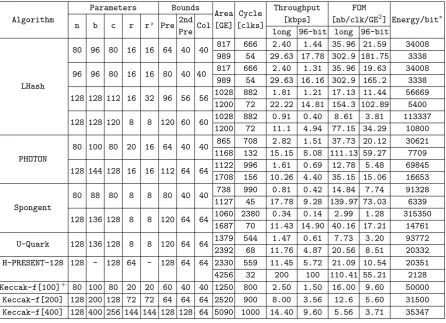
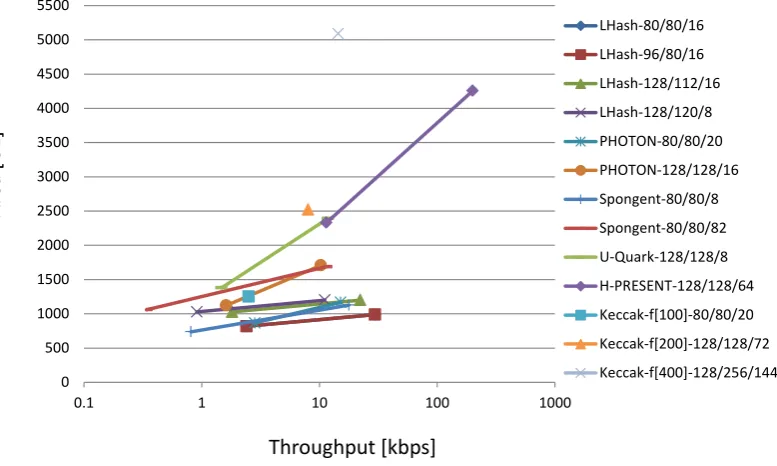
adjusting parameters. The internal permutation is designed using a structure, named as Feistel-PG, which is an extended variant of improved generalized Feistel. Feistel-PG has faster diffusion, shorter impossible differential paths and integral distinguishers than similar structures. The S-box and MDS linear layer used in the internal permuta-tion are designed to be hardware-friendly. Both of them have very compact hardware implementation. The MDS linear layer has an iterated implementation, which is simi-lar to and even more compact than the linear layer used in PHOTON. We present that LHash achieves remarkably compact implementation in hardware. In our smallest im-plementation, the area requirements are 817 and 1028 GE with 666 and 882 cycles per block, respectively. Meanwhile, its efficiency on energy consumption evaluated by the metric of energy per bit proposed in [31] is the smallest class among current lightweight hash functions in literature. Especially, for the competitors with similar preimage and collision resistance levels, it also compete well in terms of area and throughput trade-off as shown in Figure 7. Comparative results regarding the hardware efficiency for lightweight hash functions are summarized in Table 1. Regarding security, the internal permutation of LHash provides a good security margin against all kinds of attacks, including differential attack, impossible differential attack, zero-sum distinguisher, re-bound attack etc. Since LHash is built on the internal permutation using extended sponge structure, we believe that the security bounds claimed can be reached.
Table 1.Comparison of LHash with existing lightweight hash functions
Parameters Bounds
Area Cycle Throughput FOM Algorithm
n b c r r’ Pre 2nd Col [GE] [clks] [kbps] [nb/clk/GE
2
] Energy/bit∗
Pre long 96-bit long 96-bit
LHash
80 96 80 16 16 64 40 40 817 666 2.40 1.44 35.96 21.59 34008 989 54 29.63 17.78 302.9 181.75 3338
96 96 80 16 16 80 40 40 817 666 2.40 1.31 35.96 19.63 34008 989 54 29.63 16.16 302.9 165.2 3338
128 128 112 16 32 96 56 56 1028 882 1.81 1.21 17.13 11.44 56669 1200 72 22.22 14.81 154.3 102.89 5400
128 128 120 8 8 120 60 60 1028 882 0.91 0.40 8.61 3.81 113337 1200 72 11.1 4.94 77.15 34.29 10800
PHOTON
80 100 80 20 16 64 40 40 865 708 2.82 1.51 37.73 20.12 30621 1168 132 15.15 8.08 111.13 59.27 7709
128 144 128 16 16 112 64 64 1122 996 1.61 0.69 12.78 5.48 69845 1708 156 10.26 4.40 35.15 15.06 16653
Spongent
80 88 80 8 8 80 40 40 738 990 0.81 0.42 14.84 7.74 91328 1127 45 17.78 9.28 139.97 73.03 6339
128 136 128 8 8 120 64 64 1060 2380 0.34 0.14 2.99 1.28 315350 1687 70 11.43 14.90 40.16 17.21 14761
U-Quark 128 136 128 8 8 120 64 64 1379 544 1.47 0.61 7.73 3.20 93772 2392 68 11.76 4.87 20.56 8.51 20332 H-PRESENT-128 128 - 128 64 - 128 64 64 2330 559 11.45 5.72 21.09 10.54 20351 4256 32 200 100 110.41 55.21 2128
Keccak-f[100]+ 80 100 80 20 20 60 40 40 1250 800 2.50 1.50 16.00 9.60 50000 Keccak-f[200] 128 200 128 72 72 64 64 64 2520 900 8.00 3.56 12.6 5.60 31500 Keccak-f[400] 128 400 256 144 144 128 128 64 5090 1000 14.40 9.60 5.56 3.71 35347
∗: Energy/bit = (Area[GE]×required cycles for one block process)/block size[bit]. [31]
This paper is organized as follows. Specification of LHash is given in Section 2. Section 3 describes the design rationale. Sections 4 and 5 provide results on security and implementation evaluations, respectively. Finally, we conclude in Section 6.
2 Specification of LHash
2.1 Notations
In the specification of LHash, we use the following notations:
− M: The original message
− n: The digest size
− b: The block size of internal permutation
− F96, F128: The 96(128)-bit internal permutation
− Ci: Thei-th round constant
− Pb: Nibble permutation on b/2 bits state
− s: 4×4 S-box
− S: Concatenation of four S-boxes
− T: Non-linear function on 16-bit word
− Gb: Concatenation ofb/32 functionT
− A: 4×4 MDS linear transformation on 16-bit word
− ⊕: Bitwise exclusive-OR operation
− ×2,×4: Constant multiplications on finite fieldF2[x]/x4+x+ 1
2.2 Domain Extender
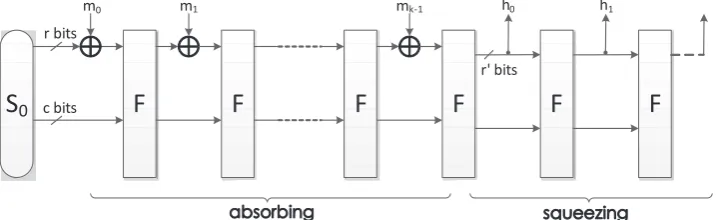
In LHash, we choose the extended sponge function [3] as illustrated in Figure 1. The message is padded and split into r-bit blocks, each of which is XORed to part of the state and enter the permutation. After the message blocks are all processed, output r′ bits of the state as a digest block and continue iterating the permutation until the output digest size is reached.
S
0F
F
rbits
cbits
m0 m1
F
F
mk!1
r'bits
F
h0
F
h1
DEVRUELQJ VTXHH]LQJ
Fig. 1.Extended sponge function
In Figure 1, mi is the i-th message block split from the padded message andhi is
permutation andr′is the output size for each output digest block.S0is the initial value for the iteration. For different versions, the initial values are different. We set initial values as the concatenation of 8-bit binary expressions of the four parametersn, b, rand r′ and fill zeros in the higher bits if the size is not enough,i.e.S0= 0||...||0||n||b||r||r′. The padding works as follows. If the length of the original message islen, then the padding rule is to append one bit of “1” and x bits of “0”, where x is the smallest non-negative integer such that x+ 1 +len≡0 mod r.
As shown in Table 2, four versions of LHash are constructed based on two permu-tationsF96andF128with sizes of 96 and 128 bits. The parameters and security bounds can be found in Table 2. We refer to its various parameterizations as LHash-n/b/r/r′ for different digest sizes n, block sizesb, absorbing sizesr and squeezing sizesr′.
Table 2.Suggested parameters and security bounds of LHash
n b c r r′ collision 2nd preimage preimage 80 96 80 16 16 240 240 264 96 96 80 16 16 240 240 280 128 128 112 16 32 256 256 296 128 128 120 8 8 260 260 2120
2.3 Internal Permutation
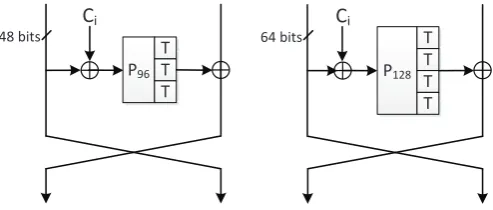
The internal permutations F96 and F128 are constructed using an 18-round Feistel structure. The round transformations are shown in Figure 2. The permutation works as follows.
First split theb-bit input (b=96 or 128) into two halves X1||X0. Then for i= 2,3, ...,19, calculate
Xi=Gb(Pb(Xi−1⊕Ci−1))⊕Xi−2
At last,X19||X18 is the output of the permutation.
Here the transformation Gb is the concatenation of b/32 function T which is the
non-linear transformation on 16-bit word. The details of functionT will be introduced in the following paragraphs. Pb is a simple permutation on b/8 nibbles, as defined in
Table 3.
P128
T T
T T
Ci
P96
T T T
Ci
48 bits 64 bits
Table 3.Nibble permutationP96andP128
i 0 1 2 3 4 5 6 7 8 9 10 11 P96(i) 6 0 9 11 1 4 10 3 5 7 2 8 i 0 1 2 3 4 5 6 7 8 9 10 11 12 13 14 15 P128(i) 3 6 9 12 7 10 13 0 11 14 1 4 15 8 5 2
Table 4.S-box used in LHash
x 0 1 2 3 4 5 6 7 8 9 10 11 12 13 14 15 s(x) 14 9 15 0 13 4 10 11 1 2 8 3 7 6 12 5
The function T is defined as
T(x3, x2, x1, x0) =A(S(x3, x2, x1, x0))
where S is the concatenation of four S-boxes:
S(x3, x2, x1, x0) =s(x3)||s(x2)||s(x1)||s(x0).
The definition of the 4-bit S-box is shown in Table 4.
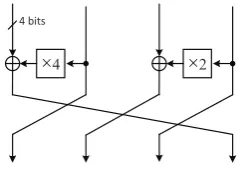
The linear layer A is an 4×4 MDS transformation on 16-bit word, and it is calculated as four iterations of the linear transformationBas shown below,i.e.A=B4. In this figure ×2 and×4 are constant multiplications on finite fieldF2[x]/x4+x+ 1.
4 2
4 bits
Fig. 3.Linear transformationB
The round constantsCi are used in bothF96andF128. In each round,Ci is XORed
to the most significant 16 bits of the state. The round constants are generated by a 5-bit LFSR. The initial state is zero: x4 = x3 = x2 = x1 = x0 = 0, for i > 4, xi = xi−3 ⊕xi−5 ⊕1. Let ai = xi||xi+1||xi+2||xi+3, a′i = xi||xi+1||xi+2||xi+3, bi =
xi+1||xi+2||xi+3||xi+4 and b′i = xi+1||xi+2||xi+3||xi+4. Then Ci = ai||bi||a′i||b′i. xi+3 stands for the complement of the bitxi+3. The values ofCi are listed in Table 5.
3 Design Rational
3.1 Extended Sponge Function and the Choice of Paramenters
Table 5.Round constants
round 0 1 2 3 4 5 6 7 8
Ci 0012 0113 1301 3725 7E6C ECFE C9DB 9280 2436
round 9 10 11 12 13 14 15 16 17 Ci 485A 8193 1200 2537 5A48 A5B7 5B49 B7A5 7F6D
– Sponge function is based on fixed permutation. The cost of key expansion in block ciphers can be avoided. For encryption, the same secret key are used multiple times. As a result, the key expansion is done once and the subkeys can be stored and used again and again. But for block cipher based hash, we need to do the key expansion for every new message block.
– Avoiding feeding forward operation and saving storage. The cost of storage is high in lightweight computing environment. Thus for lightweight hash, we need to use as less storage as possible. In block cipher based hash, the feeding forward mode is necessary, thus the plaintext/key needs to be stored after the encryption is fin-ished. If we need optimal resistance of second preimage attack, the capacity in sponge function needs to be of twice the size as the digest length and the storage requirement is similar to the block cipher based hash. But for sponge function, we can sacrifice the second preimage resistance by adjusting the parameters and reduce the storage requirement to about the same as the digest size.
– The security reduction of Sponge function has been proved. Thus we only need to analyze the security of the internal permutation. If the internal permutation doesn’t have any flaw, we can have confidence in the security of the hash based on it in sponge mode.
3.2 Internal Permutation
Structure. The structure of the internal permutation is as shown in Figure 5 in Appendix II.Pnis a vector permutation whose unit size is the same as the size of sbox
and Gis the concatenation of several functionT′s. This structure is a kind of Feistel-type and combines the advantage of generalized Feistel structure. Its basic non-linear module T is small and parallelable, which make LHash can be implemented efficiently in both software and hardware.
Compared to traditional Feistel structure, the diffusion effect of generalized Feistel structure is slower and hence more rounds are needed to achieve the desired secu-rity level. In order to overcome the disadvantage, we propose an extended variant of improved generalized Feistel structure which represented as Feistel-PG. We utilize a permutation layerPn on nibbles to improve the diffusion effect. The unit size ofPn is
the same as the size of the S-box and requires no extra hardware area cost. However, the choice ofPnhas impact on the security. After a lot of attempts and tests, we decide
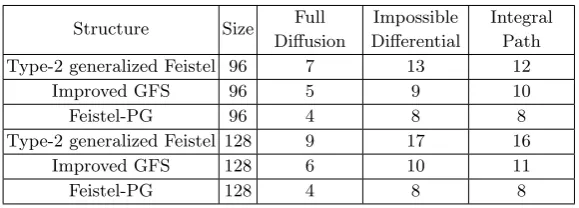
to choose current permutations since they are the best ones we found. Assuming the same block length and size of non-linear module T, compared to traditional gener-alized Feistel structure such as Type-2 GFS and improved GFS [32], Feistel-PG can achieve full diffusion [32] in less rounds which means its diffusion speed is faster, and the attackable round number of impossible differential and integral path is fewer. The comparison between different structures are listed in Table 6.
proper-Table 6.Comparison of structures
Structure Size Full Impossible Integral Diffusion Differential Path Type-2 generalized Feistel 96 7 13 12
Improved GFS 96 5 9 10
Feistel-PG 96 4 8 8
Type-2 generalized Feistel 128 9 17 16
Improved GFS 128 6 10 11
Feistel-PG 128 4 8 8
ties. Therefore, most of the hash function attack techniques suitable for the property of SP-type structure, such as the most famous rebound attack, super-sbox techniques etc, will be less effective. Therefore, we believe that Feistel-type internal permutation can achieve good immunity against known attacks, and later in Section 4 we will evaluate the security of LHash against known attacks in detail.
S-box. On the pursuit of hardware efficiency, we use 4×4 S-boxess : F4
2 → F24 in LHash. Compared with the regular 8×8 S-box, small S-box has much more advantage in hardware implementation. For example, to implement the S-box of AES in hardware more than 200 GE are needed. On the other hand, the S-box used in LHash requires two AND operations, two ORs, one NOT and six XORs. The area costs for AND, OR, NOT and XOR are 1.33 GE, 1.33 GE, 0.5 GE and 2.67 GE. Thus the S-box costs 21.84 GE in total. Furthermore, in the aspect of security, the S-box used in LHash is complete, has no fixed points, optimal differential and linear characteristics probability of 2−2 and algebraic degree of 3.
Linear Diffusion Layer. The diffusion of the internal permutation is achieved by both the nibble permutation Pn and the linear layer A used in function T. Their
combination results in good security. The lower bound for the active S-boxes for 17 out of 18 rounds ofF96and F128 are 48 and 64, respectively.Pnis the nibble permutation
with no hardware cost. Ais a linear transformation on 16 bits, the branch number of A regarding 4 nibbles is 5, which is optimal.
A follows the 4-branch generalized Feistel structure, the round function uses con-stant multiplications ×2 and×4 onF2[x]/x4+x+ 1. After four iterations, the branch number of 5 can be reached. The linear transformationA has two advantages:
– Easy to invert. The reason why we consider the inversion is for compact hardware implementation, which will be explained in the following sections. Since generalized Feistel structure is used to implement A, we only need to change the permutation of the round function to invert it and the round function can be reused.
– Low area cost for hardware implementation. In the generalized Feistel structure, there are two XOR operations between 4-bit branches, which requires 8 bits of XORs. The multiplication by 2 and 4 can be implemented using 1 and 2 bits of XORs. The total area cost of A is 11 bits of XORs and is less than the iterated MDS layer used in PHOTON, which requires 15 bits of XORs.
4 Security Evaluation
Since extended sponge function is used, the desired security of the internal permutation is that the permutation is indistinguishable with a random permutation with no more than 2c/2 queries. The parameter r is small for all versions of LHash. Thus for the adversary, the controllable freedom degree is small (no more than 16 bits for each permutation). It is difficult for the adversaries to take advantage of the vulnerability of the internal permutation and turn it into an attack on the hash function. Based on the reasoning above, we only propose analysis of the internal permutation. All analyses in this section are based on the stronger assumption that the input can be completely controlled by the adversary.
4.1 Generic Security Bounds
With the assumption that the internal permutation is ideal, the security bounds for extended sponge function are as follows [14].
– Collision bound:min{2n/2,2c/2}.
– Second preimage bound:min{2n,2c/2}.
– Preimage bound:min{2min{n,b}, max{2min{n,b}−r′,2c/2}}.
According to our analysis on the internal permutations F96 and F128, we believe the bounds shown in Table 2 can be reached.
4.2 Differential Analysis
For differential analysis of LHash, it is highly dependent on the maximum differential characteristic probability of the internal permutations F96 and F128. Considering the internal permutations are built based on block cipher structure, we can adopt the regular method of searching least number of active sboxes to evaluate the upper bound of differential characteristic probability for F96 and F128. This method is widely used in security evaluation of Feistel cipher against differential analysis such as Camellia and CLEFIA.
The search program is usually a truncated differential path search with Viterbi algorithm. Considering that the sbox is a bijective and deterministic nonlinear function, its input and output differences can be truncated to 1-bit. Namely if its input and output differences are not zero, then we call it an active sbox and denote it as ”1” in the truncated differential path. Otherwise, if the input and output differences are both zero, then we call it a passive sbox and denote it as ”0”. Notice that for a passive sbox its differential probability DPS = 1, and for an active sboxDPS =p < 1. Therefore,
by counting the minimum number of active sboxes, we can evaluate the upper bound of differential characteristic probability. In the truncated differential path search, we start from input state ∆D(0), and transit toward output state ∆D(r) round by round so as to minimize the number of active sboxes at every round as follows.
For every possible truncated differential path (∆D(i)→∆D(i+1)), assign the right-hand value to left-right-hand if the inequation is satisfied where z(∆D(i+1)) is a temporal variable of the minimum active sbox number.
Table 7.The guaranteed minimum number of active sboxes forF96 andF128
round 2 3 4 5 6 7 8 9 10 11 12 13 14 15 16 17 18 19 20
F96 1 2 6 10 14 18 22 24 26 29 32 36 40 42 46 48 51 54 58
F128 1 2 6 10 16 22 27 31 35 37 41 45 51 54 61 64 67 71 75
where ASmin(∆D(i)) is the total minimum active sbox number of the truncated path
from the first round to ∆D(i), and AS(∆D(i) → ∆D(i+1)) denotes the active sbox number of truncated path (∆D(i)→∆D(i+1)). Then the temporal variablez(∆D(i+1)) after finishing the above steps becomes ASmin(∆D(i+1)). Finally, the minimum result
of ASmin(∆D(r)) is the guaranteed minimum number of active sboxes for r-round.
After searching the guaranteed minimum number of active sboxes for internal per-mutations F96 and F128 by computer program, the results are listed in Table 7. Since the maximal probability for differential distribution of the sbox is 2−2, 17 rounds of F96andF128cannot be distinguished from a random permutation by using differential paths. Thus we believe LHash is secure regarding differential attack.
4.3 Rebound Attack
Rebound attack was proposed in 2009 [26], which was very effective against AES-like structures. Till now, lots of works have been done to improve it [27, 19, 23–25, 34, 30, 28]. The original rebound attack works on AES structure itself, which cannot be directly applied to LHash. Sasaki tried to analyze the resistance of Feistel-SP structure against rebound attack [29]. Here we propose the preliminary rebound attack on LHash.
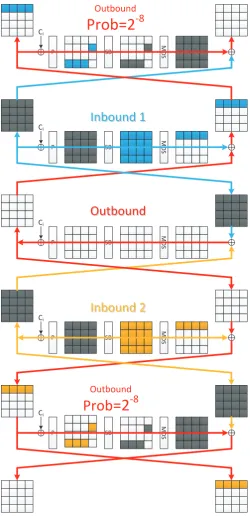
11-round rebound distinguishers on the internal permutations. In Figure 8, 5-round inbound paths for both F96 and F128 are given. Then the full 11-round path can be obtained by extending the inbound rounds 3 rounds backward and 3 rounds forward as shown in Figure 10. The attack steps are similar forF96andF128. Therefore we only choose the attack on F128 for the demonstration in Figure 9. The attack steps are:
Step 1. Determine the difference of gray nibbles. Noticed that the differences in gray nibbles are related. Once we fix the difference of the gray nibbles after the S-boxes in the first round, the differences of all the remaining gray nibbles are fixed. Step 2. The first inbound. Choose random difference for the blue nibbles such that
they match at the S-boxes in the first and the second rounds. We can determine the value of the blue lines from the matches. The probability for the match is 2−16. We expect to find 216 solutions with 216 complexity.
Step 3. The second inbound. The process is similar with the first inbound. Choose random difference for the yellow nibbles and match at the S-boxes in round 4 and round 5. 216 solutions are expected with 216 complexity.
Step 4. The outbound. XOR the values of the blue and the yellow lines at the third round to get the value of the red lines. Calculate forward and backward following the red lines. The conditions introduced by the active S-boxes can be fulfilled with probability of 2−16.
to the 11-round path is 216. For a random permutation, finding a solution fulfilling the input and output truncated differences is a limited birthday problem [13]. Though the input and output are both full active, the difference of one half is generated by 16-bit difference and can be regarded as having 12 non-active nibbles. On the other hand, the complexity to solve this limited birthday problem for a random permutation is max{248/2,248/2,248+48−128} = 224, which is higher than the complexity using our differential path. That is how this distinguisher works. ForF96, it takes 212complexity to find one solution, which is lower than the generic case (218).
Remarks on Super-Sbox technique. Super-Sbox technique [13] exploits the in-dependency between columns in 2 rounds of AES-like structure and improves the attackable rounds of rebound attack. In Feistel-PG structure, there is no independent structure like this. Therefore, we believe super-sbox technique doesn’t work on LHash.
4.4 Zero-sum Distinguisher
For a given permutation F, zero-sum distinguisher aims to find a partition of the input values X such that ⊕x∈Xx = ⊕x∈XF(x) = 0 with low complexity. Here we consider another kind of distinguisher called half zero-sum distinguisher. Sup-pose permutation F is 2n bits, we aim to find set X such that ⊕x∈XT runc1n(x) =
⊕
x∈XT runc2n(F(x)) = 0, where T runc1n and T runc2n are truncation functions with
half of the state size.
We have measured the algebraic degree of F96 and F128, using the technique pro-posed by Bouraet al.[8–10]. ForF96, half of the state doesn’t reach maximal algebraic degree of 95 after 7 rounds. Then we can propose a 15-round half zero-sum distinguisher forF96.
Choose 20 nibbles (except the first 4 nibbles of left branch) to be active, and then we can obtain 8 independent active nibbles after 3 rounds. When we choose one bit from the other part of the state and fix it, the 8 nibbles will go over all the 232 values no matter which bit value we choose besides the 8 nibbles. Then we can deduce that the algebraic degree of half of the state after another 5 rounds is no more than 27 and the sum of these bits will be zero. Therefore, in the forward direction, we have an 8-round half zero-sum distinguisher. Similarly, we can deduce that it is a 7-round half zero-sum distinguisher in the backward direction when we select the same active nibbles. Combining the forward and backward paths, we get a 15-round half zero-sum distinguisher forF96, and the data complexity is 280. Apply the same technique onF128, we can find a 15-round half zero-sum distinguisher with 296, which can be improved using the algebraic bounding techniques. In the forward direction, we choose all the nibbles on the left side(64 bits) and 63 bits on the right side as active bits. In the forward direction, we can ensure that after 9 rounds, half of the state is balanced(with zero-sum). In the backward direction, we can only go back for 8 rounds. As a result, we have a 17-round half zero-sum distinguisher on F128 with 2127 data complexity.
4.5 Slide Attacks
to construct MACs, e.g. HMAC and NMAC, and sponge function itself can be used to construct MACs, we need to consider this type of attacks.
We have two different types of slide attacks: sliding on round transformations in-side the internal permutation and sliding on iterations of the internal permutations, i.e. sliding message blocks. Firstly, slide inside the internal permutation is prevented by adding different round constants in each round. Secondly, slide attack between it-erations of the internal permutations can be prevented if our padding rule ensures the last message block to be always non-zero. The padding rule of LHash fulfills this property. Thus we can conclude that slide attack doesn’t work on LHash.
4.6 Other Attacks
Rotational distinguisher. Rotational distinguisher [21, 22] was proposed to analyze ARX structures. Calculate the output of a rotational pair and check if the rotational condition is still fulfilled. In the design based on S-boxes and MDS linear layer, rota-tional distinguisher doesn’t work well. The using of S-boxes ensure that if the rotarota-tional amount is not multiple of the size of the S-box, the rotational relation will be destroyed. The only possible way to apply rotational distinguisher on LHash, is to use a rotational amount as multiple of 4. Furthermore, the rotational pair will be destroyed by the nib-ble permutation layers. Based on this reason, we conclude that LHash is immune to rotational distinguisher.
Self differential attack. In a self differential attack, the difference between different partitions of a single value is considered, instead of the difference between a pair of values. The best collision attack on Keccak is based on this kind of attack [12]. The self similarity property can be found in AES, if there is no constants, the similarity can be preserved forever. In LHash, the nibble permutation can destroy the self similarity and ensures LHash immune to this kind of attack.
5 Implementation
5.1 Hardware Implementation
We evaluate hardware implementation of LHash using the Virtual Silicon(VST) stan-dard cell library based onUMC L180 0.18µm 1P6M logic process (UMCL18G212T3). We propose two different hardware implementations: 1) minimal area (serialized) im-plementation and 2) imim-plementation based on functionT. In the second implementa-tion, the area cost is higher while the speed is significantly increased and the energy consumption is significantly reduced.
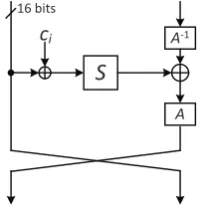
following calculations, which is bad for compact implementations. In order to achieve compact serialized implementation, we introduce an equivalent expression of the round transformation. Fig. 4 shows the equivalent round transformation with one T module. It can be expressed as follows, and the equation ensures that we don’t need to store the intermediate output value of sbox during the calculation.
A(S(Pn(Xi−1⊕Ci)))⊕Xi−2 =A(S(Pn(Xi−1⊕Ci))⊕A−1(Xi−2))
16 bits
S
ci A-1
A
Fig. 4.Equivalent round transformation
First, we applied the inversion of the linear layer,i.e.A−1, to the right branch of the state. The updated value is stored at the original storage unit. Then we calculate the constant addition, nibble permutation, and sbox operation of the left branch nibble by nibble and XOR the output of the sbox into the right branch storage. After all sboxes have been processed, the linear transformation Ais applied to the right branch again and we get the value ofXi. During the calculation, no extra storage is required.
After finishing all the nonlinear T modules in one round, another operation is needed to swap the left and right branches.
Table 8.Software performances in cycles per byte of the LHash variants
LHash-80/96/16/16 LHash-96/96/16/16 LHash-128/128/16/32 LHash-128/128/8/8
139c/B 139c/B 156c/B 312c/B
all the control signals and logic circuits. The Controller module is realized by a Finite State Machine and its gate varies depending on the size of internal permutation: about 74 GE for F96 and 93 GE forF128.
In summary, for F96, the round transformation contains three function T’s. Each of them requires 4 cycles for A−1, 4 cycles for the combination operation of constant addition, S-box and 4-bit XOR, and another 4 cycles for A. After the calculation of three functionT, another 1 cycle is required to swap the left and right branches. Thus the round transformation requires 12×3 + 1 = 37 cycles andF96requires 37×18 = 666 cycles in total. The area cost of F96 is about 817 GE, including 576 GE for 96-bit storage, 53.4 GE for five 4-bit XORs, 22 GE for the sbox, 29.37×2 GE for bothA−1 and A, 32.75 GE for the constant generator(5-bit storage, one XNOR and one NOT) and about 74 GE for logic circuits. For F128, the round transformation contains four T modules. It takes (12×4 + 1)×18 = 882 cycles to finish the calculation. The area cost of the serialized implementation of F128 is 1028 GE, including 768 GE register storage, 166.89 GE for the round transformation, and about 93 GE for logic circuits.
Function T based implementation. SinceF96and F128 share the same moduleT, thus we only need to implement it once. In order to finish the calculation of function T in one cycle, we need eight 4-bit registers, constant generator and 16-bit XOR. The function T requires about 515.17 GE, including 192 GE for eight 4-bit storage, 32.75 GE for the constant generator, 88 GE for four S-boxes, 29.37×4 = 117.84 GE for A and 2.67×32 = 85.44 GE for 32-bit XOR. Both F96 and F128 can share the same function T and we only need extra storage for both of them. Therefore F96 requires 515.17 + 384 = 899.17 GE, with additional 89.8 GE control logic circuits, and the total area cost is about 989 GE. It takes 3×18 = 54 cycles to finish the calculation of F96. Similarly, F128 costs about (515.17 + 576 + 108.8)≈1200 GE and 72 cycles.
5.2 Software Implementation
We give in Table 8 our software implementation performances for the LHash variants. The processor used for the benchmarks is an Intel Core i7-3612QM @2.10GHz. We have also benchmarked other lightweight hash function designs. QUARK reference code [1], which is very likely to be optimized, runs at 8k, 30k and 22k cycles per byte respectively for U-QUARK, D-QUARK and S-QUARK. The speed for PHOTON-80/20/16 and PHOTON-128/16/16 [14] are 96 and 156 cycles per byte, respectively.
6 Conclusion
to be secure and suitable for hardware implementations. Serialized implementation of the internal permutation in LHash requires 817 and 1028 GE. LHash has the lowest energy consumption among existing lightweight hash functions. We offer the trade-offs among security, speed, energy consumption and implementation cost by adjusting the parameters. We also evaluate the security of LHash and our cryptanalytic results show that LHash achieves enough security margin against known attacks. In the end, we strongly encourage the security analysis of LHash and helpful comments.
Acknowledgement. We wish to thank Florian Mendel for his kind communication and many useful suggestions, and also the anonymous reviewers for their helpful com-ments. This work is partly supported by the National Basic Research Program of China and the National Natural Science Foundation of China.
References
1. Aumasson, J.-P., Henzen, L., Meier, W., Plasencia, M.N.: Quark: A Lightweight Hash. J. Cryp-tology, 26(2):313-339 (2013)
2. Badel, S., Dagtekin, N., Nakahara, J., Ouafi, K., Reff´e, N., Sepehrdad, P., Susil, P., Vaudenay, S.: ARMADILLO: A Multi-purpose Cryptographic Primitive Dedicated to Hardware. In Mangard, S., Standaert, F.-X. (eds.) CHES 2010. LNCS, vol. 6225, pp. 398-412. Springer, (2010)
3. Bertoni, G., Daemen, J., Peeters, M., Assche, G.V.: Sponge Functions. Ecrypt Hash Worksop, (2007)
4. Bogdanov, A., Knezevic, M., Leander, G., Toz, D., Varici, K., Verbauwhede I.: spongent: A Lightweight Hash Function. In Preneel, Takagi (eds.) CHES 2011. LNCS, vol. 6917, pp. 312-325. Springer, (2011)
5. Bogdanov, A., Knudsen, L.R., Leander, G., Paar, C., Poschmann, A., Robshaw, M.J.B., Seurin, Y., Vikkelsoe, C.: PRESENT: An Ultra-Lightweight Block Cipher. In Paillier, P., Verbauwhede, I. (eds.) CHES 2007. LNCS, vol. 4727, pp. 450-466. Sringer, (2007)
6. Bogdanov, A., Leander, G., Paar, C., Poschmann, A., Robshaw, M.J.B., Seurin, Y.: Hash Functions and RFID Tags: Mind the Gap. In Oswald E., Rohatgi, P., (eds.) CHES 2008. LNCS, vol. 5154, pp. 283-299. Sringer, (2008)
7. Borghoff, J., Canteaut, A., G¨uneysu, T., Kavun, E.B., Knezevic, M., Knudsen, L.R., Leander, G., Nikov, V., Paar, C., Rechberger, C., Rombouts, P., Thomsen, S.S., Yal¸cin T.: Prince - A Low-latency Block Cipher for Pervasive Computing Applications (full version). http://eprint. iacr.org/2012/529.pdf, (2012)
8. Boura, C., Canteaut, A.: Zero-sum Distinguishers for Iterated Permutations and Application to Keccak-fand Hamsi-256. In Biryukov, A., Gong, G., Stinson, D.R. (eds.) SAC 2010. LNCS, vol. 6544, pp. 1-17. Sringer, (2010)
9. Boura, C., Canteaut, A.: On the Influence of the Algebraic Degree of f-1 on the Algebraic Degree of gf. IEEE Transactions on Information Theory, 59(1):691-702, (2013)
10. Boura, C., Canteaut, A., Canni`ere, C.D.: Higher-order Differential Properties of Keccak andLuffa. In Joux, A., (ed.) FSE 2011. LNCS, vol. 6733, pp. 252-269. Sringer, (2011)
11. Canni`ere, C.D., Preneel, B.: Trivium. In Robshaw, Billet (eds.) New Stream Cipher Designs -The eSTREAM Finalists. LNCS, vol. 4986, pp. 244-266. Springer, (2008)
12. Dinur, I., Dunkelman, O., Shamir, A.: Self-differential Cryptanalysis of Up to 5 Rounds of SHA-3.
http://eprint.iacr.org/2012/672.pdf, (2012)
13. Gilbert H., Peyrin, T.: Super-sbox Cryptanalysis: Improved Attacks for AES-like Permutations. In Hong, Iwata (eds.) FSE 2010. LNCS, vol. 6147, pp. 365-383. Springer, (2010)
14. Guo, J., Peyrin, T., Poschmann, A.: The PHOTON Family of Lightweight Hash Functions. In Rogaway (ed.) CRYPTO 2011. LNCS, vol. 6841, pp. 222-239. Springer, (2011)
15. Guo, J., Peyrin, T., Poschmann, A., Robshaw, M.J.B.: The LED Block Cipher. In Preneel, Takagi (eds.) CHES 2011. LNCS, vol. 6917, pp. 326-341. Springer, (2011)
17. Hirose, S.: Some Plausible Constructions of Double-Block-Length Hash Functions. In Robshaw, M. J. B. (ed.) FSE 2006. LNCS, vol. 4047, pp. 210-225. Springer, (2006)
18. Hong, D., Sung, J., Hong, S., Lim, J., Lee, S., Koo, B., Lee, C., Chang, D., Lee, J., Jeong, K., Kim, H., Kim, J., Chee, S.: HIGHT: A New Block Cipher Suitable for Low-Resource Device. In Goubin, L., Matsui, M. (eds.) CHES 2006. LNCS, vol. 4249, pp. 46-59. Springer, (2006)
19. Jean, J., Naya-Plasencia, M., Peyrin, T.: Improved Rebound Attack on the Finalist Grøstl. In Canteaut, A. (ed.) FSE 2012. LNCS, vol. 7649, pp. 110-126. Springer, (2012)
20. Kavun, E.B., Yalcin, T.: A Lightweight Implementation of Keccak Hash Function for Radio-Frequency Identification Applications. In S.B. Ors Yalcin (ed.) RFIDSec 2010. LNCS, vol. 6370, pp. 258-269. Springer, (2010)
21. Khovratovich, D., Nikolic, I.: Rotational Cryptanalysis of ARX. In Hong, Iwata (eds.) FSE 2010. LNCS, vol. 6147, pp. 333-346. Springer, (2010)
22. Khovratovich, D., Nikolic, I., Rechberger, C.: Rotational Rebound Attacks on Reduced Skein. In Abe, M. (ed.) ASIACRYPT 2010. LNCS, vol. 6477, pp. 1-19. Springer, (2010)
23. Lamberger, M., Mendel, F., Rechberger, C., Rijmen, V., Schl¨affer, M.: Rebound Distinguishers: Results on the Full Whirlpool Compression Function. In Matsui (ed.) ASIACRYPT 2009. LNCS, vol. 5912, pp. 126-143. Springer, (2009)
24. Lamberger, M., Mendel, F., Rechberger, C., Rijmen, V., Schl¨affer, M.: The Rebound Attack and Subspace Distinguishers: Application to Whirlpool.http://eprint.iacr.org/2010/198.pdf. Accepted for publication inJ. Cryptology.
25. Matusiewicz, K., Naya-Plasencia, M., Nikolic, I., Sasaki, Y., Schl¨affer, M.: Rebound Attack on the Full Lane Compression Function. In Matsui (ed.) ASIACRYPT 2009. LNCS, vol. 5912, pp. 106-125. Springer, (2009)
26. Mendel, F., Rechberger, C., Schl¨affer, M., Thomsen, S.S.: The Rebound Attack: Cryptanalysis of Reduced Whirlpool and Grøstl. In Dunkelman, O. (ed.) FSE 2009. LNCS, vol. 5665, pp. 260-276. Springer, (2009)
27. Naya-Plasencia, M.: How to Improve Rebound Attacks. In Rogaway (ed.) CRYPTO 2011. LNCS, vol. 6841, pp. 188-205. Springer, (2011)
28. Rijmen, V., Toz, D., Varici, K.: Rebound Attack on Reduced-round Versions of JH. In Hong, Iwata (eds.) FSE 2010. LNCS, vol. 6147, pp. 286-303. Springer, (2010)
29. Sasaki, Y.: Double-sp is Weaker than Single-sp: Rebound Attacks on Feistel Ciphers with Several Rounds. In Galbraith, S.D., Nandi, M. (ed.) INDOCRYPT 2012. LNCS, vol. 7668, pp. 265-282. Springer, (2012)
30. Sasaki, Y., Wang, L., Wu, S., Wu, W.: Investigating Fundamental Security Requirements on Whirlpool: Improved Preimage and Collision Attacks. In Wang, X., Sako, K. (eds.) ASIACRYPT 2012. LNCS, vol. 7658, pp. 562-579. Springer, (2012)
31. Shibutani, K., Isobe, T., Hiwatari, H., Mitsuda, A., Akishita, T., Shirai, T.: Piccolo: An Ultra-Lightweight Blockcipher. In Preneel, Takagi (eds.) CHES 2011. LNCS, vol. 6917, pp. 342-357. Springer, (2011)
32. Suzaki, T., Minematsu, K.: Improving the Generalized Feistel. In Hong, Iwata (eds.) FSE 2010. LNCS, vol. 6147, pp. 19-39. Springer, (2010)
33. Susil, P., Vaudenay, S.: Multipurpose Cryptographic Primitive ARMADILLO3. In Mangard, S. (ed.) CARDIS 2012. LNCS, vol. 7771, pp. 203-218. Springer, (2013)
34. Wu, S., Feng, D., Wu, W.: Practical Rebound Attack on 12-Round Cheetah-256. In Lee, D., Hong, S. (eds.) ICISC 2009. LNCS, vol. 5984, pp. 300-314. Springer, (2009)
35. Wu, W., Zhang, L.: LBlock: A Lightweight Block Cipher. In Lopez, J., Tsudik, G. (eds.) ACNS 2011. LNCS, vol. 6715, pp. 327-344. Springer, (2011)
Appendix I: Test Vectors
Test vectors for LHash are shown in hexadecimal notation as follows.
Message FF FE FD FC FB FA F9 F8 F7 F6 F5 F4 F3 F2 F1 F0
EF EE ED EC EB EA E9 E8 E7 E6 E5 E4 E3 E2 E1 E0
LHash-80/96/16/16 4A BD BA E1 44 7F C8 E4 5B 58
LHash-96/96/16/16 55 EC 4F FE 99 2A 32 94 F1 F7 90 61
LHash-128/128/16/32 38 E9 1A E1 8F 11 5A 0B 27 79 68 22 A9 0B 1C 5A
LHash-128/128/8/8 0A D6 35 B4 8F E3 BD 84 F9 58 7C 68 B0 CA DA E0
Pn
T
...
T
n/2 bits
Fig. 5.Feistel-PG structure
1 bit 1 bit
Fig. 6.Circuits for multiplications by 2 and 4 onF2[x]/x4+x+ 1
Throughput [kbps]
0 500 1000 1500 2000 2500 3000 3500 4000 4500 5000 5500
0.1 1 10 100 1000
LHash-80/80/16
LHash-96/80/16
LHash-128/112/16
LHash-128/120/8
PHOTON-80/80/20
PHOTON-128/128/16
Spongent-80/80/8
Spongent-80/80/82
U-Quark-128/128/8
H-PRESENT-128/128/64
Keccak-f[100]-80/80/20
Keccak-f[200]-128/128/72
Keccak-f[400]-128/256/144
A
re
a
[GE
]
SB
MDS
P
Ci
SB
MDS
P
Ci
SB
M
DS
P
Ci
SB
M
DS
P
Ci
SB
MDS
P
Ci
SB
MDS
P
Ci
SB
MDS
P
Ci
SB
M
DS
P
Ci
SB
M
DS
P
Ci
SB
MDS
P
Ci
SB
MD
S
P Ci
SB
M
D
S
P Ci
SB
M
D
S
P Ci
SB
M
D
S
P Ci
SB
M
D
S
P Ci
Inbound 1
Inbound 1
Inbound 2
Inbound 2
Outbound
Outbound
Outbound
Prob=2
-8Outbound
Prob
=2
-8S
B
M
D
S
Pn
Ci
S
B
M
D
S
Pn
Ci
S
B
M
D
S
Pn
Ci
S
B
M
D
S
Pn
Ci
S
B
M
D
S
Pn
Ci
S
B
M
D
S
Pn
Ci