Results from the first missions of the JEM-EUSO program
MarioBertaina1,2∗On behalf of the JEM-EUSO Collaboration
1Department of Physics, University of Turin - Italy
2National Institute for Nuclear Physics (INFN) - Turin, Turin - Italy
Abstract.The origin and nature of Ultra-High Energy Cosmic Rays (UHECRs) remain unsolved in contempo-rary astroparticle physics. To give an answer to these questions is rather challenging because of the extremely low flux of a few per km2per century at extreme energies such as E>5×10¹⁹eV. The objective of the
JEM-EUSO program, Extreme Universe Space Observatory, is the realization of a space mission devoted to scientific research of cosmic rays of highest energies. Its super-wide-field telescope will look down from space onto the night sky to detect UV photons emitted from air showers generated by UHECRs in the atmosphere. The JEM-EUSO program includes different missions using fluorescence detectors to make a proof-of-principle of the UHECR observation from space and to raise the technological level of the instrumentation to be employed in a space mission. EUSO-TA, installed at the Telescope Array site in Utah in 2013, is in operation. It has already detected 9 UHECRs in coincidence with Telescope Array fluorescence detector at Black Rock Mesa. EUSO-Balloon flew on board a stratospheric balloon in August 2014. It measured the UV intensity on forests, lakes and the city of Timmins as well as proved the observation of UHECR-like events by shooting laser tracks. EUSO-SPB was launched on board a super pressure balloon on April 25thand flew for 12 days. It proved the
functionality of all the subsystems of the telescope on a typical duration of a balloon flight; observed the UV emission on oceans and has a self-trigger system to observe UHECRs with energy E>3×10¹⁸eV. TUS, the
Russian mission on board the Lomonosov satellite in orbit since April 28th2016, is now included in the
JEM-EUSO program and has detected so far in the UHECR trigger-mode a few interesting signals. Mini-JEM-EUSO is in its final phase of integration in Italy, where several performance tests are being held. Mini-EUSO will be installed inside the International Space Station (ISS) in 2019. The main results obtained so far by such missions are summarized and put in prospect of future space detectors such as K-EUSO and POEMMA.
1 Introduction
The origin and nature of Ultra-High Energy Cosmic Rays (UHECRs) remain unsolved in contemporary astroparti-cle physics [1]. To give an answer to these questions is rather challenging because of the extremely low flux of a few per km2 per century at extreme energies such as E > 5×10¹⁹ eV (EECRs). The objective of the JEM-EUSO program, Extreme Universe Space Observatory, is the realization of a space mission devoted to scientific re-search of EECRs [2]. Its super-wide-field telescope will look down from space onto the night sky to detect UV pho-tons emitted from Extensive Air Showers (EAS) generated by EECRs in the atmosphere.
The JEM-EUSO program includes several missions from ground (EUSO-TA [3]), from stratospheric balloons (EUSO-Balloon [4], EUSO-SPB [5, 6]), and from space (TUS [7], Mini-EUSO [8]) employing fluorescence detec-tors to make a proof-of-principle of the EECR observation from space and to raise the technological level of the in-strumentation to be employed in space missions such as K-EUSO [9] and POEMMA [10] . A general description of the JEM-EUSO program and its scientific objectives is reported in [11]. A space project devoted to the study of
∗e-mail: [email protected]
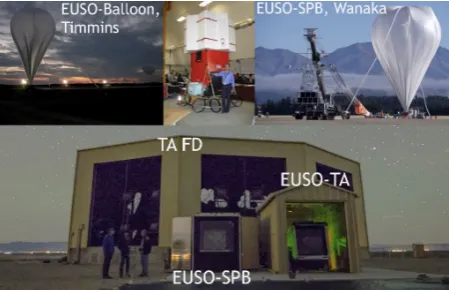
Figure 1. EUSO-TA and stratospheric balloon missions of the
JEM-EUSO program. See text for details.
2 EUSO-TA
EUSO-TA is a ground-based telescope, installed at the TA site in Black Rock Mesa, Utah, USA. This is the first detector to successfully use a Fresnel lens based optical system and Multi-Anode Photomultipliers (MAPMT, 64 channels per tube, 2304 channels encompassing a 10.6◦×
10.6◦field of view - FoV) for detection of UHECRs. The telescope is located in front of one of the fluorescence de-tectors of the TA experiment (see Fig. 1). Since its op-eration in 2015, the detector has observed several UHE-CRs and, in addition, meteors among other atmospheric phenomena such as lightning. The detection of meteors is important in view of the search for particular types of Strange Quark Matter such as nuclearites which will be performed with the upgraded version of the detector which is going to start taking data in 2019. By summing up con-secutive frames (∼3 ms), it was possible to reach the lim-iting magnitude of 5.5 to the detection of these kind of slow events. Measurements of the UV night sky emis-sion in different conditions and moon phases have been performed. These observations serve as a proof of con-cept for the future application of this detector technology for space-based missions. The key results of EUSO-TA in view of the measurements of UHECRs from space is re-ported in the following. A detailed review of EUSO-TA results and its prospects can be found in [12].
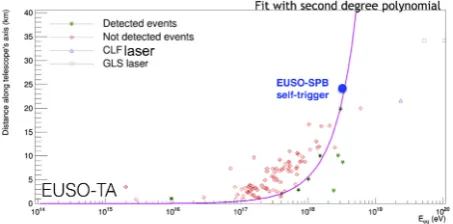
Fig. 2 shows an example of a UHECR which has been detected by EUSO-TA, using TA external trigger. It can be seen that re-binning of the images significantly in-creases the visibility of the tracks – making EUSO-TA data more similar to those of ground-based UHECR telescopes, which have much larger pixel sizes. However, such a pixel size is not suited for space-based observations, to which EUSO-TA has been tuned. Simulations of the events made with the OffLine package [13] are also presented. The shower image can be reproduced to very fine detail, taking into account the uncertainties in EAS reconstruction by the Fluorescence Detector of Telescope Array (TAFD) and in-trinsic modeling of the detector response. With the imple-mentation of the external trigger, data is collected for each TAFD event. Therefore, an event is considered as detected if a linear trace is found in the EUSO-TA data and a corre-sponding event in TAFD results. To date, 9 UHECR events (see Fig. 3) have been identified in 130 hours of UHECR-dedicated observations. The distances of these events from the detector vary between approximately 1 and 9 km, while the energy is between 1017.7- 1018.8eV, according to the TAFD reconstruction. In 2016, simulations were per-formed, using the updated detector parameters and ESAF (EUSO Simulation and Analysis Framework) simulation code [13], resulting in 8 predicted events, consistent with the 9 UHECRs observed to date, even though some inde-pendent assumptions had to be made on EUSO-TA intrin-sic sensitivity to UHECRs. Nevertheless, this result con-firms the general understanding of the detector response through simulations. The proximity of the events and the dead time between frames makes events visible in the de-tector for a duration of 1 or 2 frames. EUSO-TA does not usually observe the EAS maximum, but a late stage
Figure 2. Example of a UHECR observed by EUSO-TA (E
∼1018eV, impact parameter 2.5 km with respect to the telescope,
zenith angle of the axis of 35◦
and azimuth angle of 7◦
) with dif-ferent pixel binning and comparison with simulations. The left plot shows the real data in photoelectron counts, in the centre 2×2 rebinning of the data is shown and in the right plot the simulation made with the OffLine package [13].
Figure 3.All UHECRs detected by TAFD in the EUSO-TA FoV
during its operation with non-detected events and laser shots su-perimposed. The vertical axis shows the distance to the shower axis. The horizontal axis shows the events equivalent energy. The fit to the detected points suggests an estimate of EUSO-TA de-tection energy threshold. The blue point indicates the estimated energy threshold of EUSO-SPB determined during the field tests.
over-all detector efficiency is ∼2 times better than EUSO-TA (see details in section 4). In other words the energy shift between the sensitivity to an UHECR, recognized by the external trigger of a more performing detector, and the au-tonomous capability of trigger UHECR events is a factor
∼2.
3 EUSO-Balloon
EUSO-Balloon [4] was launched by CNES from the Tim-mins base in Ontario (Canada) on the moonless night of August 25, 2014 UT. After reaching the floating altitude of∼38 km, EUSO-Balloon imaged the UV intensity in the wavelength range 290 - 430 nm for more than 5 hours be-fore descending to ground. The refractor telescope con-sisted of a similar apparatus as EUSO-TA (two Fresnel lenses of∼1 m2size and a Focal Surface (FS) filled with MAPMTs). The spatial and temporal (GTU) resolutions of the detector were 130 m and 2.5µs, respectively. The full FoV in nadir mode was∼ 11◦. During 2.5 hours of EUSO-Balloon flight, a helicopter circled under the bal-loon operating UV flashers and a UV laser to simulate the optical signals from UHECRs, to calibrate the appara-tus, and to characterise the optical atmospheric conditions. During flight EUSO-Balloon took more than 2.5 million images that have been analysed to infer different informa-tion: study of the performance of the different parts of the detector; response of the detector to the UV flasher and laser events; UV radiance from the Earth atmosphere and ground in different conditions: clear and cloudy atmo-sphere, forests, lakes, as well as city lights.
The measurement of UV light intensity is relevant for a JEM-EUSO-like mission as it is one of the key parameters to estimate the exposure curve as a function of energy [14]. However, EUSO-Balloon uses a very different approach compared to previous measurements as it is based on an wide-FoV and wide-bandwidth optical refractive system with very fine spatial and temporal resolutions, which re-quires a careful computation of the optics and detector response to translate the detected counts into an absolute measurement. From the point of view of the capability of a space-based observatory for EECRs the essential point is the number of counts per GTU at pixel level which is the pedestal that should be dark enough to detect a EECR track on top. Fig. 4 shows the average normalized count rateshNˆias a function of the packet time (breaks are due to technological tests foreseen for this flight). The count rate, ˆN0, for clear atmosphere conditions is an input pa-rameter to the EAS simulations used to estimate the refer-ence aperture for EECR observations. The corresponding absolute intensity (I0) is useful for the design of any space-based EECR observatory, independent of the configuration of the instrument. In EUSO-Balloon, only the back-scattered light from the airglow and extraterrestrial light contributes to the measured diffuse light. The reflectiv-ity of the clouds is expected to be higher than clear atmo-spheric conditions. Thus, the interval and area with lowest count rates is assumed to represent clear atmosphere. Such conditions were assumed to be present between 04:38 and 04:52. Based on the average of the distribution in that time
Figure 4. Average normalized count rateshNˆias a function of
the packet time [15].
x pixel id
0 16 32 48
y pixel id
0 16 32 48
counts
0 10 20 30 40 50 60 70
Entries 91
Mean 91.46
RMS 3.31
0
Ψ
40 50 60 70 80 90 100 110 120 130 140
°
events/0.5
0 2 4 6 8 10 12
Entries 91
Mean 91.46
RMS 3.31
Figure 5. Left: Example of a laser track detected by
EUSO-Balloon. Right: Zenith angle reconstruction of the helicopter laser shots with the 2-parameter fit method and laser energy of 15 mJ [16].
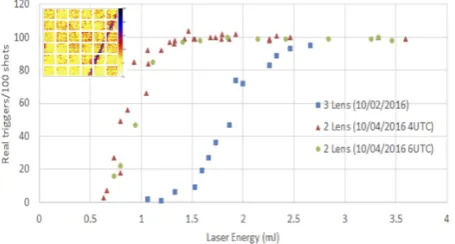
Figure 6.EUSO-SPB trigger efficiency as a function of GLS en-ergy with 2 and 3 lens system for vertical shots during the field tests in Utah. An example of GLS track (2 mJ energy) is dis-played on the top-left corner.
band. This value is in the band of previous measurements and confirms a good understanding of the detector perfor-mance also in this respect, which is very important in view of JEM-EUSO. A detailed description of the results related to the UV nightglow measurements during EUSO-Balloon flight can be found in [15].
The helicopter events revealed to be extremely useful to understand the system’s performance and to test the ca-pability of EUSO-Balloon to detect and reconstruct EAS-like events. Laser tracks are used to test the reconstruction algorithms [16]. The analysis is based on the geometry of the triggered pixels. The typical time fit of a laser event and the direction reconstruction are shown in Fig. 5 af-ter requiring basic quality cuts: a) a set of events of same energy (15 mJ, equivalent to∼1020 eV EAS); b) a track lasting at least 4 GTUs. It is important to remember that the read-out period of 2.5µis optimised for JEM-EUSO, which is expected to detect EAS at∼400 km distance, in-stead of∼35 km as in case of EUSO-Balloon.
4 EUSO-SPB
EUSO-SPB1 was launched April 25 2017 from Wanaka New Zealand as a mission of opportunity on a NASA SPB (Super Pressure Balloon) test flight planned to circle the southern hemisphere [5]. The primary scientific goal was to make the first observation of UHECR-EASs by look-ing down on the atmosphere with an optical fluorescence detector from the near space altitude of 33 km. After 12 days 4 hours aloft, the flight was terminated prematurely in the Pacific Ocean about 300 km SE of Easter Island due to a leak in the balloon. The telescope was similar to EUSO-Balloon. An autonomous internal trigger was im-plemented according to [17] to detect UHECRs. About 30 hours of useful data have been collected during night time. In October 2016, the fully assembled EUSO-SPB de-tector was tested for a week at the EUSO-TA site to mea-sure its response and to calibrate it by means of a portable GLS. Observations of CLF, stars, meteors were performed. Fig. 6 shows an example of a GLS track detected by EUSO-SPB as well as the trigger efficiency curve of the 2 and 3 lens system as a function of GLS energy. With the
Figure 7. Trigger rate (top) and average count rate measured at
pixel level (bottom) measured by EUSO-SPB in flight.
2 lens system, which is the one that flew from Wanaka, the ∼50% trigger efficiency is reached at laser energies whose luminosity is equivalent to ∼45◦ inclined EAS of
E∼3×10¹⁸eV seen from above by a balloon flying at 33 km altitude. This condition is represented by the blue point displayed in Fig. 3. Fig. 7 shows the average pixel count and trigger rates during flight. The pixel count rate will be used to determine the exposure and the UV intensity as performed for EUSO-Balloon. The different intensity levels are due to clear atmosphere, clouds and presence of moon light. The trigger rate was typically a few Hz, which is compliant with JEM-EUSO requirements. A more de-tailed description of the trigger performance on flight and in Utah can be found in [18]. The analysis of the collected data is on going. Tracks of CRs directly crossing the de-tector have been recognized. However, no EAS track has been clearly identified yet. Simulations post-flight indicate that the number of expected events is∼1 in the available data sample independently of the balloon height and UV level confirming pre-flight expectations for such a flight duration. Analyses are on going to take properly into ac-count the role of clouds and search for candidates. A de-tailed description of the analysis on the role of clouds and on the estimation of the exposure is reported in [19].
5 TUS & Mini-EUSO
The Track Ultraviolet Setup (TUS) detector was launched on April 28, 2016 as a part of the scientific payload of the Lomonosov satellite. TUS [7] is the world’s first or-bital detector aiming at detecting EECRs. The satellite has a sun-synchronous orbit with an inclination of 97.3◦, a
period of ∼94 min, and a height of 470 - 500 km. The telescope consists of two main parts: a modular Fres-nel mirror-concentrator with an area of∼2×2 m2and 256 PMTs arranged in a 16×16 photo-receiver matrix located in the focal plane of the mirror. The pixel’s FoV is 10 mrad, which corresponds to a spatial spot of∼5 km×5 km at the sea level from a 500 km orbit height. Thus, the full area observed by TUS at any moment is ∼80 km ×
80 km. TUS is sensitive to the near UV band with a time resolution of 0.8µs in a full temporal interval of 256 time steps. During its operation TUS has detected about 8×10⁴ events that have been subject to an offline analysis to select among them those satisfying basic temporal and spatial criteria of EECRs. A few events passed this first screen-ing. To perform a deeper analysis of such candidates, a dedicated version of ESAF as well as a detailed model-ing of TUS optics and detector are bemodel-ing developed [21]. One event is right now subject to deep analysis. A detailed study of this event is presented elsewhere [20] which in-cludes also the study of weather conditions and presence of artificial lights. This example shows the importance of TUS measurements to determine analysis strategies in view of K-EUSO.
Mini-EUSO [8] is a UV telescope to be placed in 2019 inside the ISS, looking down on the Earth from a nadir-facing window in the Russian Zvezda module. Mini-EUSO will map the earth in the UV range (290 - 430 nm) with a spatial and temporal resolutions of∼5 km (like TUS) and 2.5µs, respectively. Mini-EUSO has a FS simi-lar to EUSO-TA. The optical system consists of 2 Fresnel lenses of 25 cm diameter with a large FoV of∼19◦. A
mul-tiple level trigger [22] will allow the measurement of UV transients at different time scales, complementing TUS ob-servations. Laboratory experiments with Mini-EUSO en-gineering model and simulations confirm the sensitivity of Mini-EUSO to EECR-like transients around 1021eV. The Engineering Model of Mini-EUSO has been tested suc-cessfully in laboratory (TurLab facility) and in night ob-servations to check the trigger performance, the response to anthropogenic lights such as airplanes, city lights and satellites reflecting sun light during astronomical twilight, as well as to natural lights from stars, UV nightglow and meteors to determine its sensitivity.
6 Conclusions
Different missions from ground, stratospheric balloon and from space have been developed within the JEM-EUSO program to address relevant key aspects in view of a main mission, such as K-EUSO and POEMMA: a) raise the Technological Readiness Level (TRL) of the different components of the JEM-EUSO detector; b) prove the ca-pability of the JEM-EUSO approach to detect UHECRs
from space; c) verify the quality of the reconstruction of EAS parameters; d) define methodologies to evaluate the instantaneous exposure of the instrument in different at-mospheric and observational conditions. The current TRL of the electronics and optics is around 7. The flight of Mini-EUSO will further increase the TRL of the system.
The capability of the JEM-EUSO approach to detect UHECR from space was checked by means of EUSO-TA and EUSO-SPB in Utah, as well as EUSO-Balloon in space. EUSO-TA detected 9 UHECRs in coincidence with TA in the energy range 1017.7 - 1018.8 eV. This re-sult is consistent with simulations, indicating the quality of the simulation software to provide reliable expectations also for the space observations of UHECRs. It is impor-tant to underline that EUSO-TA detected EAS at a few km distance from the detector, while the instrument was fine tuned to detect events at several hundreds km distance. EUSO-TA detected also artificial events designed to mock up EAS cascades generated by means of laser shots at dif-ferent distances from the detector (between 20 km and 100 km). While EUSO-TA detected real EASs in a passive way, through a trigger induced by the Telescope Array experiment, the EUSO-SPB calibration campaign in Utah allowed to test the same trigger logic developed for JEM-EUSO. In this case, artificial tracks were used by means of a mobile laser system and the central laser facility of TA. Simulations successfully reproduced the laser inten-sity of events within 20% systematic difference. Extrapo-lations indicated that EUSO-SPB flying on a stratospheric balloon would have been sensitive to EAS of energy E>3
×1018eV. By taking into account the different size of the instruments, the background light intensity and the EAS distance, these results translate into an energy threshold for JEM-EUSO of E ∼5 ×10¹⁹ eV (∼50% trigger effi -ciency). Such value is only∼50% higher than expectations from simulations. The difference can be easily bridged by the EUSO-SPB2 which will employ higher performing electronics and optics. And it is important to remind here that the balloon observation still suffers from the relatively close distance of EAS, for which the JEM-EUSO instru-mentation is not optimized. This is an important result and provides a solid base for the expected performance of a space-based mission like K-EUSO or POEMMA.
The quality of the direction reconstruction of the events was performed using EUSO-TA and EUSO-SPB detected laser tracks in Utah as well as the helicopter-based laser events for EUSO-Balloon. The angular re-construction of EUSO-TA and EUSO-SPB detected laser tracks have an uncertainty of∼0.5 deg. This is much better than the requirements for JEM-EUSO (≤2.5 deg for 1020 eV EAS). The advantage here is due to the knowledge of the position of the light source. In the case of EUSO-Balloon the quality decreased to ∼3.1 deg. This result is however promising for JEM-EUSO, because EUSO-Balloon was expected to show a poorer angular resolution, due to the close distance of the EAS and the relatively long time-bin integration, which doesn’t match the high-speed movement of the track through the detector.
EUSO-Balloon and EUSO-SPB flight measurements, as well as the data collected by TUS, revealed to be ex-tremely useful to define methodologies to evaluate the in-stantaneous exposure of the instrument in different atmo-spheric and observational conditions. The EUSO-Balloon flight proved to be autonomously capable to recognize the presence of anthropogenic fixed and pulsed lights all along the trajectory. In some cases, lights were found in places not recorded in NASA satellite data. In the case of EUSO-SPB, to determine the exposure all along the flight, Weather Research and Forecasting model is being used to establish the presence of clouds, their optical depth and the resulting limitations of the nominal exposure of the instru-ment. Similar methodology is being applied to TUS data for the search of UHECRs and nuclearites. Such results are being cross-checked and validated with satellite data and appear to be promising. In this context, Mini-EUSO will be extremely useful, because it will allow to comple-ment the observations of TUS using a more performant electronics, a wider coverage area, and an instrumentation similar to that of K-EUSO and POEMMA.
7 Acknowledgments
This work was partially supported by Basic Science Inter-disciplinary Research Projects of RIKEN and JSPS KAK-ENHI Grant (22340063, 23340081, and 24244042), by the Italian Ministry of Foreign Affairs and International Cooperation, by the Italian Space Agency through the ASI INFN agreement n. 2017-8-H.0, by contract contract 2016-1-U.0, by NASA award 11-APRA-0058 in the USA, by the Deutsches Zentrum für Luft- und Raumfahrt, by the French space agency CNES, the Helmholtz Alliance for Astroparticle Physics funded by the Initiative and Net-working Fund of the Helmholtz Association (Germany), and by Slovak Academy of Sciences MVTS JEMEUSO as well as VEGA grant agency project 2/0132/17. Russia
is supported by ROSCOSMOS and the Russian Founda-tion for Basic Research Grant No 16-29-13065, and the Olle Engkvist Byggmästare Foundation.
References
[1] B.R. Dawson, M. Fukushima and P. Sokolski P., Prog. Theor. Exp. Phys.1212A107 (2017).
[2] J.H. Adams et al (JEM-EUSO Coll.), Experimental Astronomy403 (2015).
[3] G. Abdellaouiet al(JEM-EUSO Coll.), Astroparticle Physics10298 (2018).
[4] J.H. Adams et al (JEM-EUSO Coll.), Experimental Astronomy40281 (2015).
[5] L. Wiencke and A. Olinto for the JEM-EUSO Coll., PoS(ICRC2017),1097(2017).
[6] J.H. Adamset al, ArXiv e-prints [[arXiv]1703.04513 (2017).
[7] P. Klimovet al(TUS Coll.), Space Science Reviews8 1 (2017).
[8] F. Capel et al, Advances in Space Research 10.1016/j.asr.2017.08.030 (2017).
[9] M. Casolino M. et al (JEM-EUSO Coll.), PoS(ICRC2017)368(2017).
[10] A. Olinto et al(POEMMA Coll.), PoS(ICRC2017) 542(2017).
[11] E. Parizotet al(JEM-EUSO Coll.), This Conference Proceedings (2018).
[12] F. Biscontiet al(JEM-EUSO Coll.), This Conference Proceedings (2018).
[13] F. Bisconti F. et al (JEM-EUSO Coll.), PoS(ICRC2017)463(2017).
[14] J.H. Adams et al(JEM-EUSO Coll.), Astroparticle Physics4476 (2013).
[15] G. Abdellaouiet al(JEM-EUSO Coll.), Astroparticle Physics, 10.1016/j.astropartphys.2018.10.008 (2018). [16] G. Abdellaouiet al(JEM-EUSO Coll.), J. of
Instru-mentation1305023 (2018).
[17] G. Abdellaouiet al(JEM-EUSO Coll.), Nucl. Instr. & Meth. A866150 (2017).
[18] M. Battistiet al(JEM-EUSO Coll.), Nucl. Instr. & Meth. A, 10.1016/j.nima.2018.11.002 (2018).
[19] K. Shinozakiet al(JEM-EUSO Coll.), This Confer-ence Proceedings (2018).
[20] P. Klimovet al(TUS Coll.), This Conference Pro-ceedings (2018).
[21] M. Bertainaet al(TUS Coll.), This Conference Pro-ceedings (2018).
![Figure 4. Average normalized count rates ⟨ Nˆ⟩ as a function ofthe packet time [15].](https://thumb-us.123doks.com/thumbv2/123dok_us/8007153.1330604/3.595.314.530.259.562/figure-average-normalized-count-rates-function-ofthe-packet.webp)