_____________________________________________________________________________________________________
*Corresponding author: E-mail: [email protected], [email protected]; www.sciencedomain.org
Lycopene Embedded into Cocoa Butter Micelles of
Dark Chocolate Causes Dose-dependent Decrease
in Serum Lipids of Hypercholesterolemic Volunteers
Ivan M. Petyaev
1*, Pavel Y. Dovgalevsky
2, Natalia E. Chalyk
2,
Victor A. Klochkov
2and Nigel H. Kyle
11
Lycotec Ltd, Granta Park Campus, Cambridge, CB21 6GP, United Kingdom.
2
Institute of Cardiology, 12 Chernyshevskogo Str, 410028 Saratov, Russia.
Authors’ contributions
This work was carried out by collaborative efforts among all authors. Author IMP designed the study, wrote the protocol and first draft of the manuscript. Authors PYD, NEC and VAK conducted patient enrolment and all other work with volunteers, contributed to draft at all stages of its preparation. Author NHK was responsible essential in biochemistry work, statistical analysis and writing the manuscript. All authors read and approved the final manuscript.
Article Information
DOI: 10.9734/BJMMR/2016/23623 Editor(s): (1) C. Cameron Yin, Department of Hematopathology, UT MD Anderson Cancer Center, Houston, TX, USA. Reviewers: (1) Ana Carolina Oliveira da Silva, Universidade Federal Rural de Pernambuco, Brazil. (2)Alexandre Sergio Silva, Federal University of Paraiba, Brazil. Complete Peer review History:http://sciencedomain.org/review-history/13377
Received 10th December 2015 Accepted 21st January 2016 Published 22nd February 2016
ABSTRACT
Aim: To investigate if different amounts of lycopene embedded into cocoa butter micelles of dark
chocolate affect serum lipid profile of hypercholesterolemia patients.
Study Design: 32 clinically healthy volunteers with borderline hyperlipidemia were enrolled in a 4
week dietary trial. The study participants ingested daily one 10 g bar of L-tug dark chocolate (DC) which contained 0, 2, 3.5 or 7 mg of lycopene with no other restrictions/modifications to their habitual diet. Serum specimens were collected at the outset and after the second and fourth weeks of the trial. The study was conducted at the Saratov’s Institute of Cardiology (Russian Federation) using dark chocolate specimens provided by Lycotec Ltd (Cambridge, UK) during January-March 2013 under approved and registered protocol.
statistically significant (p<0.05) decline in the total cholesterol value at the end of the trial [from a median of 230.5 mg/dl (95% CI: 243.6, 204.8) to 210.5 mg/dl (95%CI: 221.7, 200.1)]. Consumption of higher amounts of lycopene embedded into L-tug DC caused an even more significant step-wise decline in total cholesterol values which were observable from the second week of the trial. There was a corresponding decline in LDL-cholesterol and triglyceride values. Consumption of L-tug DC with the highest amount of lycopene (7 mg) caused a small but statistically significant (P<0.05) increase in HDL values at the end of the interventional period [from a median of 40 mg/dl (95% CI: 43.65, 39) to 42 (95%CI: 43.65, 40.35)].
Conclusion: Lycopene-containing L-tug DC can be used for dietary management of abnormalities
of lipid homeostasis in mild hyperlipidemia.
Keywords: Dark chocolate; lycopene; cholesterol; serum lipids.
1. INTRODUCTION
Dietary factors are among the most important modalities affecting cardiovascular health and the outcomes of cardiovascular disease [1,2]. Epidemiological evidence suggests that diets rich in fruit and vegetables promote cardiovascular function in healthy individuals and improve prognosis in cardiovascular patients [3,4]. These effects are largely attributed to the class of chemical compounds called flavonoids which are present in grapes, soy, wine, cocoa, tea and some other plant-derived products [5]. Among others, cocoa-derived products seem to possess the most distinct and reproducible effects on a number of cardiovascular parameters including blood pressure [6], vascular flow [7] and hemostasis [8]. The majority of these can be reproduced under in vivo and in vitro [9] conditions by supplementation and/or addition of cocoa flavonoids commonly referred to as cocoa flavanols [10]. Although the molecular actions of cocoa on human health remain to be fully investigated, the anti-oxidant properties of cocoa flavanols and their impact on nitric oxide production are believed to be essential to the cardio-vascular benefits of cocoa consumption [11].
Dark chocolate characterized by high cocoa flavanol content seems to hold outstanding promise for human health and receives the most attention from medical researchers. Despite the unquestionable health benefits of dark chocolate as verified in many clinical trials, practical recommendations relating to dark chocolate consumption for health purposes are not defined as yet. Commercial brands of dark chocolate available to consumers differ significantly in cocoa flavanol/polyphenol content. There are no strict guidelines for their quantification in cocoa-derived products. At the same time, cardiovascular effects of cocoa products and
cocoa flavanols appear in a dose-dependent manner. It has been reported that an intake of at least 1000 mg of cocoa flavanols is required to achieve any measurable health benefit from dark chocolate consumption [12].
On the other hand, dietary supplementation with defined amounts of cocoa flavanols seemingly does not guarantee the appearance of the health benefits of dark chocolate since cocoa flavanols have a limited absorption rate and there is variability in their metabolic processing in different individuals [13]. Chocolate matrix composition, food additives and background diet are all known to affect the ability of the human body to ingest cocoa flavanols [14]. Therefore the search for dark chocolate formulations with standardized cocoa flavanol content and improved absorption rate is an urgent task for medical nutrition science and the food industry.
We have shown in our previous work [15] that 1 month’s consumption of proprietary lycosome formulation of dark chocolate L-tug containing lycopene is accompanied by a statistically significant reduction of total cholesterol and triglycerides in the serum of healthy pre-hypertensive volunteers. In the present paper we investigate the relationship between serum lipid profile and the amount of L-tug lycopene incorporated into cocoa butter micelles of the dark chocolate consumed by healthy hypercholesterolemic volunteers.
2. MATERIALS AND METHODS
2.1 Study Protocol
The study was conducted by Lycotec Ltd at the Institute of Cardiology, the Ministry of Health of the Russian Federation (Saratov, RF).
(ACTRN12613000966796). All volunteers were aware of the purpose of the study and signed a written consent form regarding their participation in the study. All volunteers were evaluated on their medical history and underwent physical examination as well as blood and urine tests. Those who had borderline hyperlipidaemia, elevated total cholesterol >200 mg/dL and LDL cholesterol 150 md/dL and above, were recruited for the study.
The selected 32 volunteers (age 44-71) years were randomized in four groups (Table 1). Two of the originally selected participants were not able to complete for non-health related reasons. They were replaced with other eligible volunteers. Eligibility for the study was determined by the inclusion/exclusion criteria listed below.
Inclusion Criteria:
• Caucasian male or female subjects 40-75 years old
• Signed informed consent
• Non or moderate smokers (≤ 10 cigarettes daily)
• Serum total cholesterol level >200 mg/dL, LDL cholesterol 150 md/dL and above • No anti-hypertensive, lipid-lowering or any
other cardio-vascular drugs
• Willingness and ability to comply with the protocol for the duration of the study
Exclusion Criteria:
• Unwillingness to sign informed consent • Unable to comply with the protocol for the
duration of the study
• Significant chronic or newly diagnosed medical condition (s) that would impact safety considerations
• Compulsive alcohol abuse (> 10 drinks weekly), or regular exposure to other substances of abuse
• Participation in other nutritional or pharmaceutical studies
• Positive test for tuberculosis, HIV or hepatitis B
The volunteers were asked to refrain from
consumption of cocoa and tomato based products for 10 days before beginning the trial. After completion of the run-in period patients were given the trial chocolate
products.
2.2 Trial Design
After recruitment and randomization, the 8 participants from the first group received a two-week supply of 14 blind control chocolate bars containing no lycopene. Participants from the second, third and fourth groups received their two-week supply of 14 bars of L-tug chocolate containing 2, 3.5 and 7 mg of lycopene respectively. All participants were instructed to ingest one chocolate bar once a day as part of their main meal.
The participants were instructed to keep their chocolate packaging and bring it to the following clinic visit. After verification of compliance, the packaging was exchanged for a fresh 14-day supply of products. The trial lasted for 4 weeks. At the mid-point of the trial (14th day), when participants received the second batch of products, they received a clinical examination and blood test. A similar examination and blood test was performed at the end point of the trial (28th day).
2.3 Products
2.3.1 Control dark chocolate
10 g dark chocolate bars with 85% cocoa (Green & Black’s Organic, UK) were used. Nutritional parameters, catechin, theobromine and caffeine contents of these chocolate products have been described previously [16]. The chocolate was melted, treated and tempered in exactly the same way as the L-tug chocolate but without lycopene incorporation.
2.3.2 Lycosome L-tugTM formulation of dark chocolate
The dark chocolate used for the preparation of L-tug chocolate was the same as in the control and from the same production batch. The final concentrations of lycopene in the composite lycosome formulation were 2 mg, 3.5 mg and 7 mg per 10 g piece of chocolate.
2.4 Methods
2.4.1 Body mass index (BMI), pulse rate and Blood pressure (BP)
Pulse rate and systolic and diastolic blood pressure were measured three times in the left arm of seated participants after 15 minutes of
rest. The time between measurements was no less than 2 minutes. The mean value for
each parameter was calculated. All parameters were measured in the morning between 8 and 10 am.
2.4.2 Blood collection
Blood was collected in the morning after night fast from arm veins of the participants. Serum was separated from the rest of the clotted mass by centrifugation and aliquots were stored at - 80°C prior to analysis.
2.4.3 Serum lipids
Total cholesterol (TC), low density cholesterol (LDL), high density cholesterol (HDL) and triglycerides (TG) were measured using commercially available analytical kits according to the manufacturer’s instructions (BioSystems Inc). Moreover, determination of alanine- and aspartataminotransferases (ALT and AST) as well as C-reactive protein (CRP) were also performed.
2.4.4 Statistics
For assessment of normally distributed parameters the Shapiro-Wilk method was used. Student’s t-test was then applied both for paired and unpaired samples. Between-group
differences at one time point were evaluated by Wilcoxon-Mann-Whitney test (continuous
variables) and Fisher’s exact test (categorical variables). Confidence interval values (Cis) were calculated for each variable.
Data analysis was performed using Stata SE, version 12.1. All statistical tests were two-sided and statistical significance level alpha was set at 0.05 for all analysis.
3. RESULTS
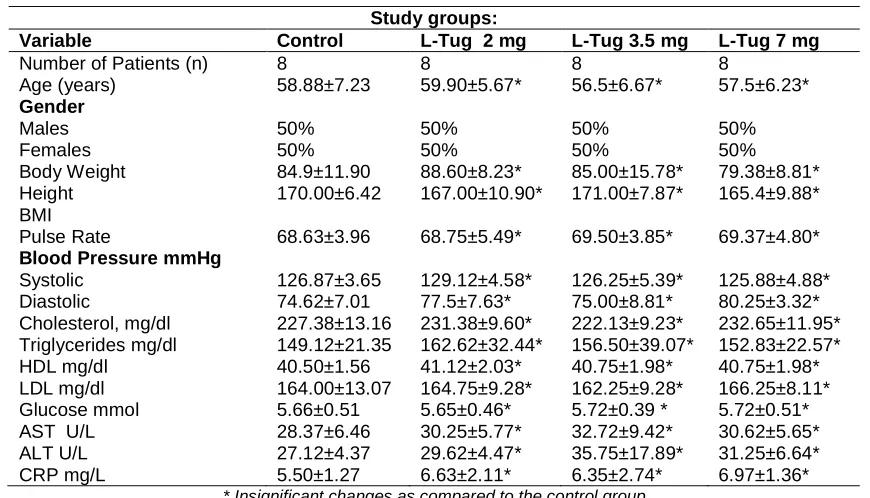
As discernible from Table 1, there was a reasonable randomization of volunteers among the study groups. No statistically significant differences were seen when between-the-groups analysis on age, gender, body weight, pulse, blood pressure and total cholesterol was performed. Due to specific aims of the study and inclusion criteria, all patients enrolled had borderline increases in total cholesterol, triglycerides and LDL. Other serum biochemical parameters (HDL, glucose, ALT, AST and CRP) were in the normal range of values and did not differ among the groups.
Statistical analysis of the changes in the systemic blood pressure and pulse rate did not reveal any significant changes among study groups neither at the mid-point nor at the end point of clinical trial.
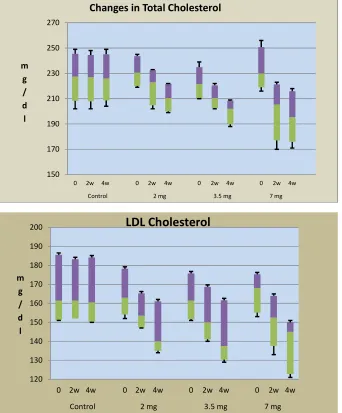
As can be seen from Tables 2 and 3, there was a dose-dependent decline in the total cholesterol level at both the mid- and end point of the study. In particular, even a lowest concentration of lycopene tested (2 mg) caused a small but statistically significant decline (by 13.2% from the control median value) in the total cholesterol concentration (Table 2) after 4 weeks of consumption in 8 out of 8 (8/8) volunteers. Such a decline was more distinct at 3.5 mg of lycopene concentration when total cholesterol reduction in serum was observed in all volunteers after 2 weeks of dark chocolate consumption (reduction in median by 4.9%) and became even more considerable (reduction in median by 11.9%) at the end-point of the study. A statistically significant reduction in total cholesterol values reached a maximum magnitude in all participant of the study at 7 mg concentration of lycopene in the dark chocolate when total cholesterol values dropped by 19.37±8.55 mg/dl and 27.32±12.21 mg/dl on day 14 and day 28 of the trial respectively (reductions in medians by 10.6% and 15.0%). There were no changes in total cholesterol concentration in the serum of volunteers who consumed control formulation of dark chocolate with “0” lycopene content.
Table 1. Baseline characteristics of the enrolled patients
Study groups:
Variable Control L-Tug 2 mg L-Tug 3.5 mg L-Tug 7 mg
Number of Patients (n) 8 8 8 8
Age (years) 58.88±7.23 59.90±5.67* 56.5±6.67* 57.5±6.23*
Gender
Males 50% 50% 50% 50%
Females 50% 50% 50% 50%
Body Weight 84.9±11.90 88.60±8.23* 85.00±15.78* 79.38±8.81* Height 170.00±6.42 167.00±10.90* 171.00±7.87* 165.4±9.88* BMI
Pulse Rate 68.63±3.96 68.75±5.49* 69.50±3.85* 69.37±4.80*
Blood Pressure mmHg
Systolic 126.87±3.65 129.12±4.58* 126.25±5.39* 125.88±4.88* Diastolic 74.62±7.01 77.5±7.63* 75.00±8.81* 80.25±3.32* Cholesterol, mg/dl 227.38±13.16 231.38±9.60* 222.13±9.23* 232.65±11.95* Triglycerides mg/dl 149.12±21.35 162.62±32.44* 156.50±39.07* 152.83±22.57* HDL mg/dl 40.50±1.56 41.12±2.03* 40.75±1.98* 40.75±1.98* LDL mg/dl 164.00±13.07 164.75±9.28* 162.25±9.28* 166.25±8.11* Glucose mmol 5.66±0.51 5.65±0.46* 5.72±0.39 * 5.72±0.51* AST U/L 28.37±6.46 30.25±5.77* 32.72±9.42* 30.62±5.65* ALT U/L 27.12±4.37 29.62±4.47* 35.75±17.89* 31.25±6.64* CRP mg/L 5.50±1.27 6.63±2.11* 6.35±2.74* 6.97±1.36*
* Insignificant changes as compared to the control group
Similar step-wise decline in LDL cholesterol values also took place in the volunteers who ingested L-tug formulations of dark chocolate with 3.5 and 7 mg of Lycopene. In quantitative terms the degree of LDL cholesterol reduction in these two groups at the fourth weeks of the trial was very similar (Table 3). Median reduction value for LDL cholesterol in these L-tug chocolate groups varied in a narrow diapason from 11 mg/dl to 11.5 mg/dl after 2 weeks of L-tug chocolate consumption and became more prominent at the end point of the study (variations from 22 mg/dl to 23 mg/dl, Table 3). Highest lycopene concentration (7 mg) caused a most significant reduction of LDL cholesterol in serum of all volunteers. In contrast, ingestion of L-tug dark chocolate with “0” lycopene concentration had no impact on LDL cholesterol values.
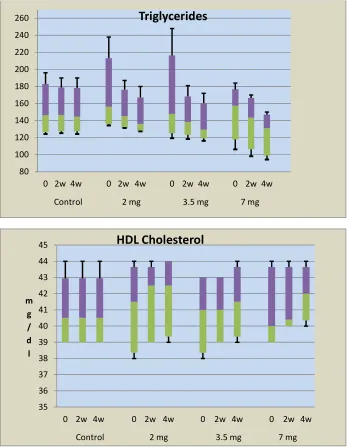
Similarly there was no change in triglyceride concentration in volunteers who consumed L-tug dark chocolate with no lycopene embedded (Tables 2, 3). However 6/8 study participants who consumed L-tug chocolate with 2 mg of lycopene had a statistically significant reduction of serum triglycerides at second and fourth weeks of the interventional period (reduction of medians by 7.06% and 12.8% respectively).
Similar decline in triglyceride level took place in volunteers who consumed L-tug dark chocolate
formulations with 3.5 and 7 mg of lycopene (Table 3).
No statistically significant changes were seen in the HDL cholesterol values among the study participants. However at highest lycopene concentration tested (7 mg per chocolate bar) there was a small but statistically significant increase in HDL which was observed at the 4th week of the trial (Tables 2 and 3).
4. DISCUSSION
ingested daily) did lower LDL, total cholesterol and triglyceride values in serum of the healthy volunteers with borderline hypercholesterolemic at the end of observational period, whereas the consumption of dark chocolate with higher amounts of L-tug lycopene (7 mg daily) reduced the total cholesterol values in serum in more significant manner.
Therefore, the lipid-lowering ability of L-tug chocolate is clearly attributable to lycopene content since other constituents of L-tug
chocolate remained constant for all other groups of the study. Despite an obvious dose-dependency traced for total cholesterol content in all major groups of the study, there was no strict linearity in the serum lipid reduction in volunteers consuming L-tug dark chocolate with the increasing lycopene content. In particular, the triglyceride values in serum of volunteers consuming 3.5 mg of lycopene were very close in quantitative terms to triglyceride levels detectable
in two adjacent groups of the study (2 mg and 7 mg of lycopene).
Fig. 1. Box-and-whisker analysis of serum cholesterol changes in volunteers ingesting L-TUG dark chocolate
150 170 190 210 230 250 270
0 2w 4w 0 2w 4w 0 2w 4w 0 2w 4w
Control 2 mg 3.5 mg 7 mg
m g / d l
Changes in Total Cholesterol
120 130 140 150 160 170 180 190 200
0 2w 4w 0 2w 4w 0 2w 4w 0 2w 4w
Control 2 mg 3.5 mg 7 mg
m g / d l
7
Table 2. Median and 5/95% CIs values for serum LIPIDS
Total cholesterol LDL cholesterol Triglycerides HDL cholesterol
Median 95%CL p Median 95%CL p Median 95%CL p Median 95%CL p
Control
Pre-Treatment 227 208.3 151.35 185.55 146.5 126.45 39 42.95
245.5 161.5 183.05 40.5
2Weeks 227 207.95 >0.05 152 183.25 >0.05 146.7 127.45 >0.05 39 42.95 >0.05
244.5 161 178.8 40.5
4Weeks 226 208.6 >0.05 150.35 184.2 >0.05 144.5 127.5 >0.05 39 42.95 >0.05
245.2 160.5 178.1 40.5
2mg
Pre-Treatment 230.5 220.05 163 154.1 156 135.75 41.5 38.35
243.6 178.25 213.15 43.65
2Weeks 223 204.8 >0.05 153.5 147.35 >0.05 145 131.35 >0.05 42.5 39 >0.05
232.7 165.25 176.15 43.65
4Weeks 210.5 200.1 >0.05 140 135.05 >0.05 136 127.35 >0.05 42.5 39.45 >0.05
221.7 161.05 167.05 44
3.5mg
Pre-Treatment 221.5 210.35 161.5 151.7 148 125.3 41 38.35
234.8 175.8 216.5 43
2Weeks 210.5 202.7 >0.05 150 141.05 >0.05 138.5 123.25 >0.05 41 39 >0.05
220.6 168.7 168.4 43
4Weeks 202 189.75 >0.05 137.5 130.4 >0.05 129.5 119.15 >0.05 41.5 39.35 >0.05
208.3 161.7 160.45 43.65
7mg
Pre-Treatment 230 219.15 168 155.1 157.5 117.9 40 39
250.75 175.3 176.6 43.65
2Weeks 205.5 177 >0.05 152.5 137.55 >0.05 143.5 106.4 >0.05 40.4 40 >0.05
221.25 164 166.5 43.65
4Weeks 195.5 175.9 >0.05 145 122.8 >0.05 131 98.9 >0.05 42 40.35 >0.05
213.5 150 143.25 43.65
Table 3. Median values and 5/95% CIs for serum LIPID reduction
Total Cholesterol LDL Cholesterol Triglycerides HDL Cholesterol Median 95%CL Median 95%CL Median 95%CL Median 95%CL Control
2 weeks -1 0.65 -1 1 1 1 0 0
-1 -2.3 -4.25 -0.65
4 weeks -1 1.3 -1.5 0.3 -1 0.7 0 0.65
-3 -3.65 -4.95 0
2mg
2 weeks -8 -7 -10 -5.4 -8 7.3 0 1.65
-19.5 -13 -38.05 0
4 weeks -20 -16 -20 -14.75 -18 -11.9 0 1.65
-30.15 -26.95 -46.8 0
3.5 mg
2 weeks -9 -6.35 -11.5 -6.05 -9.5 -1.6 0 1
-18.95 -13 -48.1 0
4 weeks -21 -17.35 -22 -13.45 -16 -3.9 0.5 2.69
-28.6 -26.3 -59.9 -1.95
7mg
2 weeks -29 -7 -11 -4.7 -11.5 -4.5 0.5 1
-55.55 -30.45 -26.49 -0.78
4 weeks -39 -13 -23 -9.7 -21 -12.3 1 2.65
-57 -47 -54.96 0
It is very important that changes in serum lipid spectrum reported above develop in a time-dependent manner. For the most parameters studied, a longer duration of L-tug chocolate consumption was accompanied by more profound reduction in total serum cholesterol, LDL cholesterol and serum triglycerides values. It is also extremely important in our view that both the dose- and time-dependency patterns in the serum lipid profile changes were most evident for total cholesterol values. According to our results, the reduction in LDL cholesterol and triglycerides merely followed the pattern of total serum cholesterol changes and were less significant in the quantitative terms.
Our study has some significant limitations. First of all, it is unclear what and why changes in cocoa butter micelles, caused by embedment of lycopene, were responsible for serum lipid reduction observed in our study. Both cocoa flavanols and lycopene have been shown to have moderate lipid-lowering effects [19,20]. However, since lycopene content was the only variable changed among the major groups of the study, the cholesterol-reducing capacity of L-tug chocolate is rather attributable to lycopene than to the cocoa-derived compounds. Our preliminary data indicate that ingestion of L-tug chocolate, where lycopene was embedded into cocoa butter micelles, resulted in the formation of
chylomicrons, which were also enriched with this carotenoid. They were smaller in size than chylomicrons from the control chocolate, contained less cholesterol, and were eliminated faster from the postprandial plasma (unpublished data).
Nevertheless, other potential mechanism could be involved. For example, lycopene complexes with cocoa butter micelles might have a different location and, or metabolic profile of the absorption site of the carotenoid and cocoa triglycerides. This may affect lycopene isomerization which and result in changes of its anti-oxidant properties, which in turn may further protect cocoa flavanols, and possibly other compounds, from their modification during intestinal absorption, or via its well-known direct effects on hepatic cholesterol synthesis. Possible interplay of cocoa-derived compounds and lycopene isomers in the regulation of serum lipid profile needs to be evaluated in future studies.
Fig. 2. Box-and-whisker analysis of serum triglycerides and HDL cholesterol changes in volunteers ingesting L-TUG dark chocolate
Finally, it is unclear from our study, if any further increase of intake, beyond 7 mg in lycopene content may provide more profound lipid-lowering and perhaps other health beneficial changes for L-tug chocolate consumers.
And lastly, all volunteers enrolled in the study were normotensive individuals. No changes in blood pressure were seen during the trial. For that reason, we were not able to evaluate if lycopene content is an important variable affecting blood pressure and possibly other
parameters of cardio-vascular health in volunteers consuming L-tug dark chocolate. Therefore the potency of L-tug dark chocolate with different level of lycopene embedment into its cocoa butter micelles in the regulation of the systemic blood pressure needs to be examined in a suitable cohort of volunteers. This perspective becomes an important option for future studies due to our current results [15], revealing moderate blood pressure reduction in pre-hypertensive individuals treated with L-tug chocolate.
80 100 120 140 160 180 200 220 240 260
0 2w 4w 0 2w 4w 0 2w 4w 0 2w 4w
Control 2 mg 3.5 mg 7 mg
Triglycerides
35 36 37 38 39 40 41 42 43 44 45
0 2w 4w 0 2w 4w 0 2w 4w 0 2w 4w
Control 2 mg 3.5 mg 7 mg
m g / d l
5. CONCLUSION
Lycopene embedded into cocoa butter micelles of dark chocolate causes dose-dependent
decrease in serum lipids (total cholesterol, LDL-cholesterol and triglycerides) of
hypercholesterolemic patients. Lycopene-containing L-tug DC can be used for dietary management of abnormalities of lipid homeostasis in mild hyperlipidemia.
COMPETING INTERESTS
Authors have declared that no competing interests exist.
REFERENCES
1. Estruch R, Ros E, Salas-Salvadó J, Covas MI, Corella D, Arós F, Gómez-Gracia E, Ruiz-Gutiérrez V, Fiol M, Lapetra J, Lamuela-Raventos RM, Serra-Majem L, Pintó X, Basora J, Muñoz MA, Sorlí JV, Martínez JA, Martínez-González MA.
Primary prevention of cardiovascular disease with a Mediterranean diet. N Engl J Med. 2013;368(14):1279-90.
DOI: 10.1056/NEJMoa1200303. Epub 2013 Feb 25.
2. Lagiou P, Sandin S, Lof M, Trichopoulos D, Adami HO, Weiderpass E. Low carbohydrate-high protein diet and incidence of cardiovascular diseases in Swedish women: Prospective cohort study. BMJ. 2012;344:e4026.
DOI: 10.1136/bmj.e4026
3. Huang T, Yang B, Zheng J, Li G, Wahlqvist ML, Li D. Cardiovascular disease mortality and cancer incidence in vegetarians: A meta-analysis and systematic review. Ann Nutr Metab. 2012;60(4):233-40.
DOI: 10.1159/000337301
4. Yang SY, Li XJ, Zhang W, Liu CQ, Zhang HJ, Lin JR, Yan B, Yu YX, Shi XL, Li CD, Li WH. Chinese lacto-vegetarian diet exerts favorable effects on metabolic parameters, intima-media thickness, and cardiovascular risks in healthy men. Nutr Clin Pract. 2012;27(3):392-8.
5. d'El-Rei J, Cunha AR, Burlá A, Burlá M, Oigman W, Neves MF, Virdis A, Medeiros F. Characterization of hypertensive patients with improved endothelial function after dark chocolate consumption. Int J Hypertens. 2013;2013:985087.
DOI: 10.1155/2013/985087 Epub 2013 Mar 5.
6. Fogleman CD. Effect of cocoa on blood pressure. Am Fam Physician. 2013;87(7): 484.
7. Latif R. Chocolate/cocoa and human health: A review. Neth J Med. 2013;71(2): 63-8.
8. Stote KS, Clevidence BA, Novotny JA, Henderson T, Radecki SV, Baer DJ. Effect of cocoa and green tea on biomarkers of glucose regulation, oxidative stress, inflammation and hemostasis in obese adults at risk for insulin resistance. Eur J Clin Nutr. 2012;66(10):1153-9.
9. Rodríguez-Ramiro I, Ramos S, López-Oliva E, Agis-Torres A, Bravo L, Goya L, Martín MA. Cocoa polyphenols prevent inflammation in the colon of azoxymethane-treated rats and in TNF-α -stimulated Caco-2 cells.Br J Nutr; 2012. 10. Fernández-Murga L, Tarín JJ,
García-Perez MA, Cano A. The impact of chocolate on cardiovascular health. Maturitas. 2011;69(4):312-21.
11. Ramirez-Sanchez I, Aguilar H, Ceballos G, Villarreal F. (-)-Epicatechin-induced calcium independent eNOS activation: Roles of HSP90 and AKT. Mol Cell Biochem. 2012;370(1-2):141-50.
12. Davison K, Berry NM, Misan G, Coates AM, Buckley JD, Howe PR. Dose-related effects of flavanol-rich cocoa on blood pressure. J Hum Hypertens. 2010;24(9): 568-76.
13. Li M, Hagerman AE. Interactions between plasma proteins and naturally occurring polyphenols. Curr Drug Metab; 2013. [Epub ahead of print]
14. Rodriguez-Mateos A, Oruna-Concha MJ, Kwik-Uribe C, Vidal A, Spencer JP. Influence of sugar type on the bioavailability of cocoa flavanols. Br J Nutr. 2012;108(12):2243-50.
15. Petyaev IM, Dovgalevsky PY, Chalyk NE, Klochkov VI, Kyle NH. Reduction in the systemic blood pressure and serum lipids by lycosome L-tug formulation of dark chocolate in pre-hypertension. Food Sci Nutr. 2014;2(6):744-50.
16. Cocoa-Based Food Products. GB Patent Application No. 1120772.7, PCT/GB2012/052973, 30.11.2012.
18. Petyaev IM, Pristenskiy D, Bandaletova T, Chalyk NE, Klochkov VI, Kyle NH. Coco-Lycosome increases absorption of chocolate catechins and
augments their inflammatory and anti-oxidant properties: pharmacokinetic - Postprandial cross-over clinical study. In press; 2015.
19. Jia L, Liu X, Bai YY, Li SH, Sun K, He C, Hui R. Short-term effect of cocoa product consumption on lipid profile: A meta-analysis of randomized controlled trials. Am J Clin Nutr. 2010;92(1):218-25.
20. Wang XD. Lycopene metabolism and its biological significance. Am. J. Clin. Nutr. 2012;96(5):1214S-22S.
_________________________________________________________________________________ © 2016 Petyaev et al.; This is an Open Access article distributed under the terms of the Creative Commons Attribution License
(http://creativecommons.org/licenses/by/4.0), which permits unrestricted use, distribution, and reproduction in any medium,
provided the original work is properly cited.