Published in Journal of Homosexuality
http://www.tandfonline.com/doi/full/10.1080/00918369.2013.773819
Agreements about extra-dyadic sex in gay men’s relationships: Exploring differences in
relationship quality by agreement type and rule breaking behaviour
Warwick Hosking* Victoria University
Abstract
Research comparing the quality of monogamous and non-monogamous (“open”) relationships among gay men has produced mixed findings. In addition, little is known about the consequences of breaking the rules of relationship agreements about extra-dyadic sex. Results from a survey of 229 gay men in a romantic relationship showed that open
relationships were less passionate, but no less intimate or committed, than monogamous or “threesome only” relationships. However, men who broke rules reported lower relationship quality overall, regardless of relationship agreement. Thus, it is less the nature of the
agreement itself than adhering to the conditions of it that influences relationship quality. (Word count: 100)
For most heterosexual romantic couples, sexual monogamy is implicitly expected and viewed as an essential ingredient for a successful, satisfying, and committed relationship. Although behaviour that violates this expectation is remarkably common (Laumann, Ellingson, Mahay, Paik, & Youm, 2004; Smith, 1991), sexual infidelity is nonetheless disapproved of (Lieberman, 1988), stigmatized (Treas & Giesen, 2000), seen as a major rule violation (Sheppard, Nelson, & Andreoli-Mathis, 1995), and is associated with relationship dissatisfaction (Atkins, Baucom, & Jacobsen, 2001; Glass & Wright, 1985). In contrast, the expectation of monogamy is far from universal among gay male couples. Studies have shown that although some gay men expect and desire their romantic relationships to be monogamous (Adam, 2006; LaSala, 2001; Worth, Reid, & McMillan, 2002), a sizeable proportion of them are “open”; that is, they are based on either an implicit or explicit
agreement that both partners are free to engage in extra-dyadic sexual encounters (Hickson et al., 1992; Hoff & Beougher, 2010; LaSala, 2004a, 2004b; Wagner, Remien, & Carballo-Diéguez, 2000).
relationships. However, a recent quantitative study of 566 gay male couples in San Francisco revealed that although monogamous and open relationships were equally satisfying, men in monogamous relationships reported higher levels of various other relationship characteristics, such as intimacy, commitment, and trust, than those in open relationships (Hoff, Beougher, Chakravarty, Darbes, & Neilands, 2010). Thus, given that more recent studies have not resolved the mixed findings reported in earlier research, it is still unclear whether open and monogamous relationships are equivalent in terms of a range of relationship characteristics, with the possible exception of satisfaction (see also Bonello, 2009, for a review).
This issue is not only of theoretical interest, but it also has important practical implications. Any relationship interventions, such as couple therapy, need to be sensitive to the diversity of relationship models adopted by gay couples (LaSala, 2004a). If, as some research suggests, it is the case that relationship quality does not differ between monogamous and open relationships, it is imperative for counsellors and other professionals not to assume automatically that a given relationship agreement is the cause of relationship problems. Rather, it may be more appropriate to target specific aspects of the agreement (such as negotiating the boundaries of an open agreement) that may be improved or changed to the benefit of the relationship. In contrast, if open and monogamous relationships are
systematically different with respect to relationship quality, professionals should take this into account where appropriate. Thus, further research examining the quality and functioning of monogamous and open relationships among gay men is required.
satisfying than monogamous ones (Bonello, 2009), the fact that they differ in one crucial aspect (i.e., outside sex is allowed), and potentially on other dimensions of relationship quality such as commitment and intimacy (Hoff et al., 2010), suggests they may fit a somewhat different profile of relationship characteristics. To examine this possibility, the present research draws on Sternberg’s (1986) triangular theory of love.
Triangular Theory of Love
Sternberg’s (1986) triangular theory provides a useful framework for examining different aspects of relationship quality in gay men’s relationships, as it describes distinct kinds of “love” in relationships that differ according to the relative presence or absence of three dimensional elements. Intimacy refers to feelings and behaviours associated with warmth, affection, interpersonal trust, and a sense of emotional connectedness in a
relationship. Passion, in contrast, draws on motivational arousal and is largely associated, though not completely synonymous, with physical arousal and sexual fulfilment. Finally, commitment is the decisional component of love characterised by a subjective attachment to the relationship and the long-term orientation towards maintaining it. This conceptualisation of commitment is similar to others that have been advanced in the literature (e.g., Rusbult, 1980; Rusbult & Buunk, 1993). The relative presence or absence of each of these three components determines the particular kind of love that may characterise a given relationship. For instance, a relationship fuelled only by passion is considered infatuated love, whereas the combination of high intimacy and commitment with relatively low passion is considered companionate love (Sternberg, 1986).
intimacy, respectively) have evolved as separate biological systems that have different underlying goals. As such, Diamond argued that it is possible for individuals to experience romantic love without sexual desire, and vice versa. This perspective explains how
individuals can engage in sexual encounters without any emotional involvement. Thus, with this in mind, Sternberg’s triangular theory provides a useful framework that describes three functionally independent dimensions of relationship quality.
Research on heterosexual romantic couples shows that passion wanes over time (Tucker & Aron, 1993), and this is likely true for gay male couples as well. Indeed, preventing the relationship from becoming stifling or “stale” has been cited in qualitative studies as a reason why some gay couples open their relationship (Hoff & Beougher, 2010; LaSala, 2004b), although open agreements do not always come about after a period of monogamy (Blasband & Peplau, 1985). Given the independence of passion and intimacy, being consensually non-monogamous appears to be a solution to declining passion (or especially high needs for passion) that allows gay male partners to satisfy their desires for sexual diversity whilst maintaining a close emotional bond within the primary relationship. Research consistently shows that men are more able than women to view sex and emotional attachment as separate things (Banfield & McCabe, 2001; Duncombe & Marsden, 1999; Glass & Wright, 1985, 1992; Lawson, 1988), and that men have a greater propensity to engage in extra-dyadic sexual encounters without emotional involvement (Buss & Schmitt, 1993; Townsend, 1995). It is not surprising, then, that this solution of non-monogamy is adopted more frequently by gay male couples than by lesbian or heterosexual couples (Blumstein & Schwartz, 1983; Bryant & Demian, 1994; Solomon, Rothblum, & Balsam, 2005).
monogamy because they viewed it as inseparable from intimacy and commitment.
Monogamy has also been cited as a strategy for preventing the transmission of HIV and other infections, by both American (Hoff et al., 2010) and Australian (Prestage et al., 2008) gay men. Whatever the reason for choosing monogamy, it is possible that in monogamous relationships, generally speaking, men are motivated to sustain sexual passion with their partners. This is because, according to their agreement, they have no other outlet for satisfying their sexual needs other than to resort to infidelity, which can threaten the wellbeing of the relationship (LaSala, 2004a; Wagner et al., 2000). Of course, not all men have strong needs for passion or even for sex at all, but to the extent that men in
monogamous relationships do have these needs, their agreement is such that they can only realistically be fulfilled by their relationship partners. In contrast, men in open relationships may be motivated to sustain relationship passion to a lesser degree, as they can satisfy their needs for sexual fulfilment with extra-dyadic partners. Thus, in the context of Sternberg’s (1986) triangular theory, one would expect levels of passion in open relationships, on average, to be lower than those in monogamous relationships.
emotional fulfilment and security of having a long-term romantic partner represents similarly high stakes for men who desire sexual diversity. In addition, it likely requires a high degree of trust, which is an essential element of intimacy, for partners to decide upon an open agreement in the first place. It is reasonable to argue that partners would need to feel secure in their relationship to be comfortable with the idea of not being sexually exclusive, and to trust that extra-dyadic involvements will not pose any threat to their relationship. Indeed, some men in Hoff and Beougher’s (2010) study mentioned that having an open agreement made them feel secure in their relationship. Therefore, one may expect similar levels of intimacy and commitment in open and monogamous relationships. Nevertheless, the somewhat conflicting findings in the literature call for further research on this issue.
Rules in Relationships
Qualitative research in both the United States (e.g., LaSala, 2004b) and the United Kingdom (e.g., Hickson et al., 1992) has revealed that gay men in open relationships
establish rules regarding what is acceptable extra-dyadic sexual behaviour. Such rules include not bringing a casual partner into the house, limiting the number of times it is acceptable to see the same casual partner and, mostly commonly, disallowing emotional involvement with casual partners (Hickson et al., 1992; LaSala, 2004b). In some open couples, partners
emphasise the importance of being open and honest about their activities with casual partners, or, conversely, keeping it secret (Hickson et al., 1992). There is a large degree of
LaSala (2004a) showed that cheating is linked to lower relationship quality in monogamous gay relationships. However, very little research has directly examined the whether there is a similar association between breaking rules in open relationships and reduced relationship quality. In a recent qualitative study of gay couples in San Francisco, Hoff et al. (2009) found that men in open relationships did not break the rules of their agreement any more frequently than men with monogamous agreements, but they did not report whether there were any differences in relationship quality as a function of breaking rules. Hoff and Beougher (2010) addressed this issue in further qualitative research, also in San Francisco, which showed that men breaking their agreements reported emotional distress and perceptions of decreased closeness and trust in the relationship. Given that rules are intended to protect the integrity of an open relationship, it is not surprising that breaking them has a negative impact on the relationship, or perhaps is symptomatic of a relationship that is already distressed. However, no research to date has systematically examined the particular dimensions of relationship quality that are negatively affected by breaking rules in
relationships, or directly compared the magnitude of such effects in monogamous and open relationships.
rules, as they may be more interested in fulfilling their personal desires than adhering to agreed relationship boundaries.
A similar argument applies to intimacy. Key aspects of intimacy include emotional bonding and mutual trust (Reis & Shaver, 1988; Sternberg, 1986). Therefore, men who are highly intimate with their romantic partners may be more inclined to resist temptations to break a relationship rule, for fear of betraying their partner’s trust and causing them distress. Intimacy also involves close communication and mutual self-disclosure (Altman & Taylor, 1973). Thus, partners who regularly self-disclose to each other may review and renegotiate the rules of their open relationship when they feel the current rules are no longer appropriate, rather than break an existing rule first if the opportunity arises. In contrast, men who do not readily self-disclose to their partners may feel more inclined to break a rule if the opportunity presents itself, rather than discuss changing the rules with their partners first. Of course, some decisions to break rules may be made spontaneously without consideration of their consequences; in these situations, men may subsequently regret their actions and experience reduced intimacy, as was the case for men breaking agreements in Hoff and Beougher’s (2010) qualitative study. Thus, in short, men breaking rules in open relationships may be expected to report being less intimate with their partners than men who do not break the rules.
men have open relationships is to satisfy their needs for sexual diversity (LaSala, 2004b), relatively low passion in an open relationship may not, of itself, motivate the breaking of an agreed rule regarding the pragmatics or restrictions around sex with casual partners. Thus, while open relationships overall may be characterised by lower passion compared with monogamous relationships, as argued earlier, it is reasonable not to expect passion to vary as a function of breaking a rules in an open relationship as it may in a monogamous relationship. Whether or not any reduction in intimacy and commitment associated with breaking rules is of similar magnitude in both open and monogamous relationships, however, is a question of both theoretical and practical importance, and one which the present research was designed to explore.
It is important to acknowledge at this point that lower relationship quality may be the outcomes as much as the antecedents of breaking the rules in both monogamous and open relationships. However, establishing causality is beyond the scope of the present cross-sectional research.
One additional factor to consider in the context of breaking rules is satisfaction with the relationship agreement. In a recent quantitative study of 380 gay men in the San
Francisco Bay area, Neilands, Chakravarty, Darbes, Beougher, and Hoff (2010) reported that men who were more invested in their relationship agreements (as determined by levels of commitment to, satisfaction with, and value attached to the agreement) were less likely to break them. This is not surprising, as people who are satisfied with their agreement should have little motivation to break a rule. For example, men who are completely satisfied having a monogamous agreement may be relatively unlikely to have sex with an outside partner, whereas others who are unsatisfied with this agreement, possibly because of feeling
have established with their partners should have little reason to cross them, whereas those who feel the boundaries are too restrictive may be more likely satisfy their desires in ways that do not fall within these boundaries. Thus, consistent with Neilands et al.’s (2010) findings, men who break relationship rules are expected to be less satisfied with their relationship agreement.
The Present Research
The present study had several aims. The first of these, using Sternberg’s (1986) triangular theory of love, was to compare levels of intimacy, commitment, and passion in monogamous and open relationships, in an attempt to resolve previously conflicting findings in the literature. The second main aim was to build on the work of Hoff and colleagues (Hoff et al., 2010; Hoff & Beougher, 2010) by examining whether these three specific dimensions of relationship quality vary as a function of breaking agreed relationship rules, and whether the magnitude of such variations differs between open and monogamous relationships. A further general aim of this research was to provide an Australian context to gay men’s relationship agreements, as the vast majority of previous research in this area has taken place in the United States and may not apply in other countries and cultures.
Method
Participants
Two hundred and twenty nine Australian males ranging from 18 -70 years of age (M = 35.33, SD = 11.15) participated in this study. All self-identified as being gay or homosexual and reported being in an ongoing romantic relationship. The majority of participants were from New South Wales (39%) or Victoria (34%). The other participants were from Queensland (6%), Western Australia (3%), Australian Capital Territory (2%), South Australia (2%), or an unspecified location (14%).
Relationship duration ranged from 0.5 to 29 years (M = 6.51, SD = 6.43). Almost half the participants (47.2 %) reported being older than their partner, with 6.6% reporting no age difference. The largest age difference was 42 years (M = 6.11, SD = 6.52, Mdn = 4.00). Three-quarters (75.1%) of the participants were in cohabiting relationships. Close
examination of this demographic information revealed a possible eight couples among the 229 participants. This dependence in the data could potentially have affected the results. However, these 16 cases were retained, as excluding them yielded identical patterns of results to those ultimately reported herein.
Measures
Demographic characteristics. The first section of the survey requested information
regarding the age of the participants and their partners (in years), relationship duration (in years), cohabitation (living together or not), and state of residence.
Relationship agreement. Participants indicated which of three categories best
partner to have sexual contact with men outside your relationship”), threesome only (“It is okay for you and your partner to have sexual contact with men outside your relationship, but ONLY in threesomes or groups that include BOTH of you”), or open (“It is okay for you and your partner to have sexual contact with men outside your relationship”). A similar
classification has been used in previous research (LaSala, 2004a). Following this,
participants indicated whether this agreement was “unspoken” or had been reached through open discussion. Participants also indicated whether their agreement had been in place since the beginning of the relationship, and if not, how long (in months or years) it had been in place. Finally, participants indicated how satisfied they were with their relationship
agreement using a 5-point scale (1 = not at all satisfied; 5 = completely satisfied). It is noted here that Neilands et al’s (2010) “Sexual Agreement Investment Scale”, which contains a measure of relationship agreement satisfaction, could not be used in the present study as it was not published at the time of data collection.
Rules of open relationships. Participants in open relationships were asked about the
rules they believe apply to their agreement. This was to ensure that when being asked about rule breaking later in the survey, participants had an explicit notion of what constituted breaking a rule in their relationship. First, a 6-item checklist assessed the kinds of sexual activities permitted with casual partners: kissing, mutual masturbation, giving oral sex, receiving oral sex, insertive anal sex, and receptive anal sex. Space was given for participants to indicate whether any other sexual activities were or were not allowed.
not the relationship was cohabiting); not staying overnight at a casual partner’s house; not having casual sex at sex-on-site venues; and not engaging in non-sexual activities (e.g., having “dates”) with casual partners. These rules were drawn from qualitative research on the boundaries gay men typically set in open relationships (e.g., Hickson et al., 1992; LaSala, 2004b), and from informal discussion between the author and members of the gay
community. For each rule presented, participants indicated whether it applied their
relationship, and indicated using a 5-point scale (1 = not at all; 5 = completely) how certain they were that their partner shares their belief about the rule. Finally, participants answered ‘yes’ or ‘no’ to indicate whether they had discussed each rule explicitly with their partner. Because these eight rules are not exhaustive of the range of possible rules, space was given for participants to describe any additional rules that apply to their open relationship.
Rule breaking in all relationships. All participants indicated “yes” or “no” as to
whether they had ever broken a rule of their relationship agreement (whether the rule of monogamy or any other rule that applied to their relationship agreement). If “yes”,
participants indicated whether it had occurred in the past 6 months. Those indicating “yes” to the latter were asked how frequently they had broken rules in the past 6 months (only once, a few times, about once a month, about once a week, more than once a week). As an additional measure of interest, the subjective seriousness of rule breaking was assessed. Participants breaking a rule (or rules) in the past 6 months were asked to indicate how serious they believed this transgression to be, using a 5-point scale (1 = not at all serious; 5 = extremely serious).
Intimacy, passion, and commitment. The Sternberg Triangular Love Scale (SLTS;
relationship with my partner is passionate”; and commitment items include “I am committed to maintaining my relationship with my partner”. Participants indicated their level of
agreement with each statement on 7-point scales (1 = not at all true; 7 = very true). Scores for each subscale were taken as the mean of the relevant 15 items, with higher scores indicating higher levels of relationship intimacy, passion, and commitment. The scales had high internal consistency, Cronbach’s α = .96, .95, and .97, respectively.
Procedure
The survey was advertised via notices and news articles in the GLBTI press in Melbourne and Sydney. These provided the URL for the online survey and specified that participants must identify as homosexual or gay (not bisexual), have been in their current relationship a minimum of 6 months, be at least 18 years of age, and be an Australian citizen or permanent resident. Banner advertisements on national GLBTI community websites contained direct links to the survey where eligibility criteria were restated. In addition, during interviews about the study on two Melbourne community radio stations, the first author referred interested listeners to the websites where they could find direct links to the survey.
Results
Descriptive Summary
Relationship agreement. One hundred and twenty-eight participants (56%) indicated
they were in a monogamous relationship. Of the remaining participants, 61 (27%) were in open relationships and 40 (17%) were in threesome-only relationships. Open relationships were significantly longer in duration (M = 8.59, SD = 6.74) than were monogamous relationships (M = 5.31, SD = 6.00) but not threesome-only relationships (M = 7.14, SD = 6.55), F(2, 226) = 5.81, p = .003, partial η2 = .05. The majority of men (73%) reported having reached their relationship agreement through explicit discussion with their partners, although a significantly greater proportion of monogamous relationships (40%) were unspoken than were open (10%) or threesome-only (10%) relationships, χ2(2, N = 229) = 25.90, p < .001. Most men (72%) reported having had their current relationship agreement since the beginning of the relationship, but this was the case for a significantly higher proportion of monogamous relationships (94%) than of open (54%) and threesome-only (28%) relationships, χ2(2, N = 229) = 78.36, p < .001.
Rules in open relationships. Each of the six listed sexual activities were allowed
with casual partners in the vast majority of cases (kissing = 92%, mutual masturbation = 98%, giving oral sex = 100%, receiving oral sex = 98%, insertive anal sex = 92%, receptive anal sex = 90%). Further, 85% of men in open relationships indicated that all of the listed sexual activities were allowed with casual partners. No participant reported any additional restrictions on specific sexual activities with casual partners.
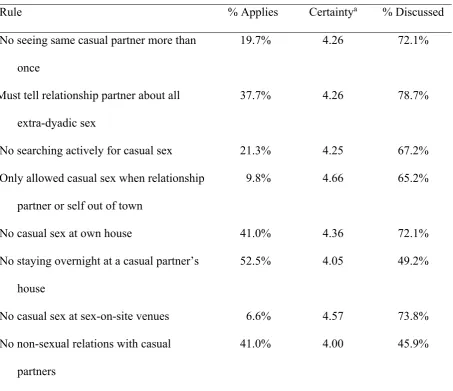
their open relationship agreement. The only exception to this was not staying overnight with a casual partner, which was endorsed by just over half the participants. However, the
majority (83%) indicated that at least one of the listed rules applied to their relationship. Further, almost all (97%) had discussed at least one of the listed rules with their partners, with six of the eight rules having been discussed between the majority of participants and their partners. Additional rules reported in response to the open-ended question included enforcing safe sex, not discussing sexual encounters with casual partners, terminating associations with casual partners if emotional involvement became an issue, and generally behaving in ways that are respectful to each partner.
> Table 1 about here <
On average, participants were very certain that their partners shared their beliefs about whether or not each rule applied to their agreement (see Table 1). Independent samples t-tests indicated that for all rules, those who said they had discussed the rule with their partner were more certain it applied (Ms = 4.52 – 4.90) than those who had not (Ms = 3.31 – 4.19), all ps < .02.
Relationship quality in all relationships. Overall levels of the three Sternberg
Given the correlations of the Sternberg variables with relationship duration, and the fact that open relationships were significantly longer than were monogamous ones, duration may have acted as a confounding variable. However, the patterns of findings reported below did not change as a result of including duration as a covariate; therefore, duration was not considered further.
Relationship Agreements and Relationship Quality
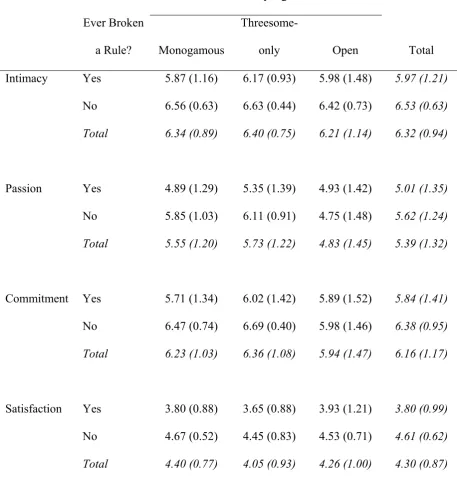
Table 2 displays the means and standard deviations of intimacy, passion,
commitment, and satisfaction with agreement as a function of relationship agreement. One-way ANOVAs revealed a significant main effect of relationship agreement on passion, F(2, 226) = 8.29, p < .001, partial η2 = .07, but not on intimacy, F(2, 226) = 0.50, p > .05,
commitment, F(2, 226) = 1.87, p > .05, or satisfaction with agreement, F(2, 226) = 2.57, p > .05. Post-hoc tests revealed that passion was significantly lower in open relationships than both monogamous and threesome-only relationships, but the latter two groups were not significantly different from each other.
> Table 2 about here <
Rule Breaking and Relationship Quality
Relationship agreement was not associated with either the likelihood of breaking a rule in the past six months, χ2(2, N = 87) = 1.06, p > .05, or with the frequency of rule breaking in the past six months, F(2, 46) = 0.78, p > .05. The latter variable was negatively correlated with satisfaction with agreement, r(49) = -0.36, p = .012, but unrelated to intimacy, passion, and commitment. Among those who had broken a rule in the past 6 months, the subjective seriousness of their “most serious” transgression was moderate (M = 3.33, SD = 1.20). This did not vary significantly by relationship agreement, F(2, 46) = 0.39, p > .05, nor was it significantly correlated with any of the relationship quality variables, all rs(49) < .19, ps > .05.
To examine differences in relationship quality as a function of rule breaking, 3
(relationship agreement: monogamous, threesome-only, open) × 2 (ever broken rule: yes, no) ANOVAs were performed. The main effect of relationship agreement was only significant for passion, consistent with the finding reported above, but the main effect of having ever broken a rule was significant for intimacy, F(2,223) = 15.23, p < .001, partial η2 = .06, passion, F(2,223) = 7.68, p = .006, partial η2 = .03, commitment, F(2,223) = 8.76, p = .003, partial η2 = .04, and satisfaction with agreement, F(2,223) = 41.92, p < .001, partial η2 = .16, which were all significantly lower for those who had ever broken a relationship rule (see Table 2). The ANOVA for passion also revealed a significant interaction between
relationship agreement and ever broken a rule, F(2,222) = 4.33, p = .014, partial η2 = .04. An analysis of simple effects indicated, as expected, that passion did not differ as a function of rule breaking in open relationships. No other interactions were significant.
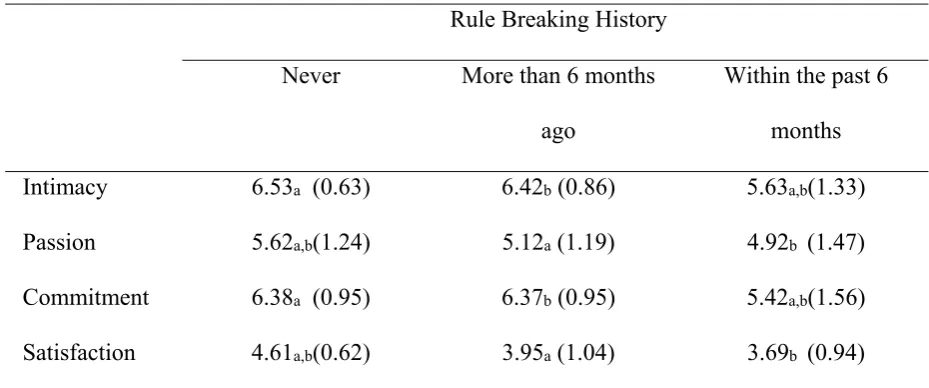
agreement) × 3 (rule breaking history) ANOVA was not possible. Thus, one-way ANOVAs were performed on intimacy, passion, commitment, and satisfaction with agreement with rule breaking history as the sole between-subjects factor. These analyses revealed a significant effect of rule breaking on all four dependent variables: intimacy, F(2,226) = 20.27, p < .001, partial η2 = .15; passion, F(2,226) = 6.40, p = .002, partial η2 = .05; commitment, F(2,226) = 14.24, p < .001, partial η2 = .04; and satisfaction with agreement, F(2,226) = 29.86, p < .001, partial η2 = .21. Post-hoc tests indicated that recent rule-breakers reported significantly lower levels of all four variables than non-breakers (see Table 3). Further, recent rule-breakers reported significantly lower intimacy and commitment, but not passion or satisfaction with agreement, than did distant past rule-breakers. Finally, distant past rule-breakers reported significantly lower passion and satisfaction with agreement than non-breakers, but these two groups did not differ in levels of intimacy or commitment.
> Table 3 about here <
Discussion
Many gay male couples choose not to conform to the conventional heterosexual model of sexual monogamy, and instead have an understanding that casual sex with men outside the relationship is acceptable. However, decades of studies examining the quality of open compared with monogamous relationships among gay men have yielded mixed
world. The present research involving Australian gay men in relationships was designed to fill these gaps in the research literature, and several hypotheses generated from both theory and prior research were supported by the findings.
First, open relationships were no less intimate or committed than were relationships with monogamous or “threesome-only” agreements. All three types of agreement were also equally satisfying. These findings are consistent with previous research showing open and monogamous relationships to be equally committed (Blasband & Peplau, 1985), and corresponds more generally with other research findings that open relationships are just as satisfying, loving, and well-adjusted as are monogamous ones (Kurdek, 1988; LaSala,
2004a). The lack of any differences in this respect suggests that allowing extra-dyadic sexual involvements does not signify partners’ waning interest in their primary relationship. Rather, it seems to reflect an act of strong trust and dedication to sustaining the emotional bond between primary partners while accommodating sexual variety with casual partners.
concur with past research conducted elsewhere, there is clearly a need for further research examining how different geographical locations or cultural contexts may influence gay men’s relationship issues.
As hypothesised, the one relationship dimension that distinguished open from monogamous and threesome-only relationships in the present study was passion, which was significantly lower in open relationships. Waning passion may result in an open agreement as a way of preserving the relationship while accommodating the sexual needs of the partners. However, as the majority of men in open relationships reported having had their agreement from the beginning, it seems more likely that the ability to satisfy sexual desires with casual partners somewhat reduces the motivation to maintain passion with their primary partners. Although men in threesome-only relationships are also able to partake in casual sex with other men, this is only allowed in the context of groups that include the primary partner. Thus, the passion these men experience with casual partners is shared, in a sense, with the primary partner, which may explain why there was no difference in passion between monogamous and threesome-only relationships.
primary relationship may be an acceptable trade-off. Indeed, our results indicated that men in open relationships were no less satisfied with their agreement than those in monogamous or threesome-only relationships.
What appears to play a more important role in relationship quality than the agreement itself is the adherence to the rules associated with it. The cardinal rule in monogamous relationships, of course, is not to engage in any outside sexual activity, whereas in open relationships, the rules dictate a variety of conditions regarding what is acceptable with casual partners. For the majority of open relationships in the present study, no boundaries were placed on the specific kinds of sexual activities that were acceptable with casual partners, but at least one rule regarding other kinds of behaviour applied, and had been openly discussed between partners. The most common of these were the conditions of not staying overnight with or “dating” a casual partner, which are most likely adopted as a precaution against becoming too involved with a casual partner. Consistent with previous research (e.g., Hickson et al., 1992; LaSala, 2004b), this suggests that open relationships are not a “free for all” where anything goes, but rather they are circumscribed by at least (and sometimes more than) one condition or rule which, for the most part, the members of the couple have
discussed and agreed upon.
These rules appear not to be trivial. In support of the second hypothesis, and building on qualitative findings reported by Hoff and Beougher (2010), men in open relationships who had broken a rule, especially recently, reported lower intimacy and commitment than those who had not. Interestingly, this was to the same extent as men in monogamous relationships having cheated on their partner. The subjective seriousness of recently committed
contribution to the literature, and suggest that rules regarding extra-dyadic sex, no matter what they involve, effectively serve the same purpose in all relationship agreements, and that is to protect the integrity of the primary relationship. Violating these rules is considered serious and either reflects an existing disengagement from the relationship or results in this situation.
Because this research is cross-sectional, whether lower intimacy and commitment are the causes or the outcomes of breaking relationship rules cannot be established. Breaking rules is associated with subsequent emotional and couple distress (Hoff & Beougher, 2010), but low relationship quality may equally put partners at risk of breaking rules. Relationship commitment, in particular, is associated with devaluing alternative partners (Johnson & Rusbult, 1989) and resisting opportunities to be unfaithful (Drigotas et al., 1990). It follows, then, that individuals manifesting lower relationship commitment are less concerned about engaging in behaviours that may sabotage the wellbeing of their relationship, and find it difficult to resist opportunities to break rules as they arise.
As expected, there was no difference in passion as a function of rule breaking in open relationships. Because men in such relationships are already free, to an extent, to engage in passionate sexual encounters with casual partners, it seems unlikely that a lack of passion in the primary relationship would be the cause or outcome of crossing boundaries regarding the exact nature of what is allowed with casual partners. The most frequently occurring rules in the open relationships in this study related somehow to preventing an ongoing or emotional involvement with casual partners, consistent with previous research (Hickson et al.; Hoff & Beougher, 2010; LaSala, 2004b). Thus, breaking such rules is more likely due to a relative lack of intimacy or commitment in the primary relationship, rather than of passion, and this is what the present results seem to indicate.
In addition, rule breaking men in this study were less satisfied with their agreement, regardless of what the agreement involved, than those who had not broken a rule.
Furthermore, although there was no difference in satisfaction between those who had recently broken a rule and those who had done so in the more distant past, lower satisfaction was associated with more frequent rule breaking in the past six months. These results clearly suggest that it is not the nature of the agreement itself that relates to the likelihood or frequency of rule breaking, consistent with findings from Hoff et al. (2009), but rather how satisfied an individual is with their agreement.
couples having difficulty managing their agreement may either be assisted with renegotiating the boundaries, or perhaps be encouraged to consider sexual exclusivity. The important thing is to identify and take into account the particular situation and needs of each individual couple. Furthermore, considering that rule breaking was the main factor influencing relationship quality, it is essential for both researchers and practitioners to consider the reasons that lead men to break the rules of their agreement, whether it be uncertainty regarding the rules or disengagement from the relationship.
Limitations and Future Directions
It is important to bear in mind a number of limitations to this research. Firstly, as mentioned previously, the cross-sectional nature of this study does not allow causal explanations to be made. Longitudinal research could establish whether rule breaking precedes reductions in relationship quality, or whether low relationship quality puts
individuals at risk of breaking relationship rules (or both). This may help counsellors target their intervention efforts appropriately, whether to repair the damage done by crossing boundaries or to prevent it happening in distressed couples in the first place. Changes in relationship agreements over time could also be examined in longitudinal research.
Secondly, only individuals’ reports of their relationship agreement were obtained. A small minority of men reported that their agreement was implicit, which could be problematic in cases where partners hold different beliefs about their relationship agreement. This
certainly occurs (Hoff et al., 2010), and because it has potential implications both for
examining individuals’ perceptions of relationship quality is still worthwhile, as they likely inform decisions regarding relationship behaviour (such as whether or not to break a rule).
Thirdly, the present findings may be limited in how much they generalise to all gay relationships. The recruitment methods possibly resulted in a sample consisting largely of men who identify with the urban GLBTI community, and therefore the results may not apply easily to men or couples that are geographically or socially isolated. Future research
employing broader sampling techniques may address this issue.
In the present study, the subjective seriousness of rule breaking did not differ between relationship agreements, and was unrelated to relationship quality. However, it is possible that breaking particular kinds of rules compared to others (e.g., in an open relationship, having an emotional affair with another man compared to having sex with the same casual partner more than once) has a systematically greater impact on relationship quality,
independent of subjective seriousness. Future research could profitably investigate this issue. More generally, it is worth examining other factors that either promote or hinder the success of open relationships. A range of variables, such as personality, may play a vital role. For instance, a disposition towards jealousy has been cited as a reason for not engaging in an open relationship, or leaving an open relationship in pursuit of a monogamous one (LaSala, 2001, 2004b). Therefore, for those currently in an open relationship, dispositional jealousy may be related to low satisfaction with the agreement. Various other factors that reduce agreement satisfaction may in turn lead to relationship conflict and possible dissolution, so it is important for future research efforts to pay closer attention to these factors.
Conclusion
heterosexist expectations of monogamy. What seems to be important is for couples to reach an agreement that is satisfactory, and for each partner to respect the conditions of that
Acknowledgments
This research was supported by the Victoria University Research Development Grants Scheme 2009. The authors would like to thank the men who participated in the survey, Stuart Todd for his invaluable research assistance, and Leah Kaufmann and four anonymous
References
Adam, B. D. (2006). Relationship innovation in male couples. Sexualities, 9, 5-26. Altman, I., & Taylor, D. (1973). Social penetration: The development of interpersonal
relationships. New York: Holt.
Atkins, D. C., Baucom, D. H., & Jacobson, N. S. (2001). Understanding infidelity: Correlates in a national random sample. Journal of Family Psychology, 15, 735–749.
Banfield, S., & McCabe, M. P. (2001). Extra-dyadic involvement among women: Are they different from men? Archives of Sexual Behavior, 30, 119-142.
Bell, A., & Weinberg, M. (1978). Homosexualities: A study of diversity among men and women. New York: Simon & Schuster.
Blasband, D., & Peplau, L. (1985). Sexual exclusivity versus openness in gay male couples. Archives of Sexual Behavior, 14, 395-412.
Blumstein, P., & Schwartz, P. (1983). American couples: Money, work, sex. New York: Morrow.
Bonello, K. (2009). Gay monogamy and extra-dyadic sex: A critical review of the theoretical and empirical literature. Counselling Psychology Review, 24, 51-65.
Bryant, A. S., & Demian. (1994). Relationship characteristics of American gay and lesbian couples: Findings from a national survey. Journal of Gay & Lesbian Social Services, 1(2), 101-117.
Buss, D. M., & Schmitt, D. S. (1993). Sexual strategies theory: An evolutionary perspective on human mating. Psychological Review, 100, 204-232.
Diamond, L. M. (2003). What does sexual orientation orient? A biobehavioral model distinguishing romantic love and sexual desire. Psychological Review, 110, 173-192. Drigotas, S. M., Safstrom, C. A., & Gentilia, T. (1999). An investment model prediction of
Duncombe, J., & Marsden, D. (1999). Love and intimacy: The gender division of emotion and “emotion work”: A neglected aspect of sociological discussion of heterosexual relationships. In G. Allan (Ed.), The sociology of the family: A reader (pp.91-110). Malden, MA: Blackwell.
Glass, S. P., & Wright, T. L. (1985). Sex differences in type of extramarital involvement and marital dissatisfaction. Sex Roles, 12, 1101-1120.
Glass, S. P., & Wright, T. L. (1992). Justifications for extramarital relationships: The
association between attitudes, behaviours, and gender. The Journal of Sex Research, 29, 361-387.
Hickson, F. C., Davies, P. M., Hunt, A. J., Weatherburn, P., McManus, T. J., & Coxon, P. (1992). Maintenance of open gay relationships: Some strategies for protection against HIV. AIDS Care, 4, 409-419.
Hoff, C. C., & Beougher, S C. (2010). Sexual agreements among gay male couples. Archives of Sexual Behavior, 39, 774-787.
Hoff, C. C., Beougher, S. C., Chakravarty, D., Darbes, L. A., & Neilands, T. B. (2010). Relationship characteristics and motivations behind agreements among gay male
couples: Differences by agreement type and couple serostatus. AIDS Care, 22, 827-835. Hoff, C. C., Chakravarty, D., Beougher, S. C., Darbes, L. A., Dadasovich, R., & Neilands, T.
B. (2009). Serostatus differences and agreements about sex with outside partners among gay male couples. AIDS Education and Prevention, 21, 25-38.
Johnson, D. J., & Rusbult, C. E. (1989). Resisting temptation: Devaluation of alternative partners as a means of maintaining commitment in close relationships. Journal of Personality and Social Psychology, 57, 967-980.
Kurdek, L. A., & Schmitt, P. (1985). Relationship quality of gay men in closed or open relationships. Journal of Homosexuality, 12, 85-99.
LaSala, M .C. (2001). Monogamous and not: Understanding and counselling gay male couples. Families in Society, 82, 605-611.
LaSala, M. C. (2004a). Extra-dyadic sex and gay male couples: Comparing monogamous and nonmonogamous relationships. Families in Society, 85, 405-412.
LaSala, M. C. (2004b). Monogamy of the heart: Extra-dyadic sex and gay male couples. Journal of Gay & Lesbian Social Services, 17, 1-24.
Laumann, E., Ellingson, S., Mahay, J., Paik, A., & Youm, Y. (2004). The sexual organisation of the city. Chicago: The University of Chicago Press.
Lawson, A. (1988). Adultery: An analysis of love and betrayal. NY: Basic Books. Lieberman, B. (1988). Extrapremarital intercourse: Attitudes toward a neglected sexual
behavior. Journal of Sex Research, 24, 291–299
Neilands, T. B., Chakravarty, D., Darbes, L. A., Beougher, S. C., & Hoff, C. C. (2010). Development and validation of the sexual agreement investment scale. Journal of Sex Research, 47, 24-37.
Prestage. G., Jin, F., Zablotski, I., Grulich, A., Imrie, J., Kaldor, J., Honnor, G., & Kippax, S. (2008). Trends in agreements between regular partners among gay men in Sydney, Melbourne and Brisbane, Australia. AIDS and Behavior, 12, 513-520.
Reis, H. T., & Shaver, P. (1988). Intimacy as an interpersonal process. In S. Duck (Ed.), Handbook of personal relationships (pp. 367-389). Chichester, UK: Wiley.
Rusbult, C. E. (1980). Commitment and satisfaction in romantic associations: A test of the investment model. Journal of Experimental Social Psychology, 16, 172-186.
Saghir, M. T., & Robins, E. (1973). Male and female homosexuality: A comprehensive investigation. Baltimore: Williams and Wilkins.
Sheppard, V., Nelson, E., & Andreoli-Mathis. (1995). Dating relationships and infidelity: Attitudes and behaviour. Journal of Sex and Marital Therapy, 21, 202–212.
Smith, T. (1991). Adult sexual behavior in 1989: Numbers of partners, frequency of intercourse and risk of AIDS. Family Planning Perspectives, 23, 102-107.
Solomon, S. E., Rothblum, E. D., & Balsam, K. F. (2005). Money, housework, sex, and conflict: Same-sex couples in civil unions, those not in civil unions, and heterosexual married siblings. Sex Roles, 52, 561-575.
Sternberg, R. J. (1986). A triangular theory of love. Psychological Review, 93, 119-135. Sternberg, R. J. (1997). Construct validation of a triangular love scale. European Journal of
Social Psychology, 27, 313-335.
Townsend, J. M. (1995). Sex without emotional involvement: An evolutionary interpretation of sex differences. Archives of Sexual Behavior, 24, 173-206.
Treas, J., & Giesen, D. (2000). Sexual infidelity among married and cohabitating Americans. Journal of Marriage and the Family, 62, 48-60.
Tucker, P., & Aron, A. (1993). Passionate love and marital satisfaction at key transition points in the family life cycle. Journal of Social and Clinical Psychology, 12, 135-147. Van Lange, P. A. M., Rusbult, C. E., Drigotas, S. M., Arriaga, X. B., Witcher, B. S., & Cox,
C. L. (1997). Willingness to sacrifice in close relationships. Journal of Personality and Social Psychology, 72, 1373-1395.
Table 1
Rules About Extra-dyadic Encounters in Open Relationships
Rule % Applies Certaintya % Discussed
No seeing same casual partner more than once
19.7% 4.26 72.1%
Must tell relationship partner about all extra-dyadic sex
37.7% 4.26 78.7%
No searching actively for casual sex 21.3% 4.25 67.2%
Only allowed casual sex when relationship partner or self out of town
9.8% 4.66 65.2%
No casual sex at own house 41.0% 4.36 72.1%
No staying overnight at a casual partner’s house
52.5% 4.05 49.2%
No casual sex at sex-on-site venues 6.6% 4.57 73.8%
No non-sexual relations with casual partners
41.0% 4.00 45.9%
Table 2
Means and Standard Deviations of Intimacy, Passion, Commitment, and Satisfaction with Agreement as a Function of Relationship Agreement and Ever Breaking a Rule
Relationship Agreement
Ever Broken
a Rule? Monogamous
Threesome-only Open Total
Intimacy Yes 5.87 (1.16) 6.17 (0.93) 5.98 (1.48) 5.97 (1.21) No 6.56 (0.63) 6.63 (0.44) 6.42 (0.73) 6.53 (0.63) Total 6.34 (0.89) 6.40 (0.75) 6.21 (1.14) 6.32 (0.94)
Passion Yes 4.89 (1.29) 5.35 (1.39) 4.93 (1.42) 5.01 (1.35) No 5.85 (1.03) 6.11 (0.91) 4.75 (1.48) 5.62 (1.24) Total 5.55 (1.20) 5.73 (1.22) 4.83 (1.45) 5.39 (1.32)
Commitment Yes 5.71 (1.34) 6.02 (1.42) 5.89 (1.52) 5.84 (1.41) No 6.47 (0.74) 6.69 (0.40) 5.98 (1.46) 6.38 (0.95) Total 6.23 (1.03) 6.36 (1.08) 5.94 (1.47) 6.16 (1.17)
Table 3
Means and Standard Deviations of Intimacy, Passion, Commitment, and Satisfaction with Agreement as a Function of Rule Breaking History
Rule Breaking History Never More than 6 months
ago
Within the past 6 months
Intimacy 6.53a (0.63) 6.42b (0.86) 5.63a,b(1.33)
Passion 5.62a,b(1.24) 5.12a (1.19) 4.92b (1.47)
Commitment 6.38a (0.95) 6.37b (0.95) 5.42a,b(1.56)
Satisfaction 4.61a,b(0.62) 3.95a (1.04) 3.69b (0.94)