One-time-password-authenticated key exchange
Kenneth G. Paterson
Information Security Group, Royal Holloway, University of London, Egham, Surrey, UK
Douglas Stebila
Information Security Institute, Queensland University of Technology, Brisbane, Australia
September 4, 2009
Abstract
To reduce the damage of phishing and spyware attacks, banks, governments, and other security-sensitive industries are deployingone-time passwordsystems, where users have many passwords and use each password only once. If a single password is compromised, it can be only be used to impersonate the user once, limiting the damage caused. However, existing practical approaches to one-time passwords have been susceptible to sophisticated phishing attacks.
We give a formal security treatment of this important practical problem. We consider the use of one-time passwords in the context of password-authenticated key exchange (PAKE), which allows for mutual authentication, session key agreement, and resistance to phishing attacks. We describe a security model for the use of one-time passwords, explicitly considering the compromise of past (and future) one-time passwords, and show a general technique for building a secure one-time-PAKE protocol from any secure PAKE protocol. Our techniques also allow for the secure use of pseudorandomly generated and time-dependent passwords.
1
Introduction
Many security attacks on the Internet today, such as phishing and spyware, aim to compromise a user’s password. As a result, some businesses and government agencies are deployingone-time passwordsystems. In these systems, users carry a sheet of paper listing passwords, or use an electronic device that generates passwords, and use a different password each time they log in. Ideally, without obtaining this physical list of passwords (or the device generating them), an attacker should be unable to impersonate the user.
However, most deployments of one-time passwords have not used them in the strongest way possible. In a typical usage, Alice visits a bank’s website in her browser, views a challenge on the website indicating which one-time password to use, and enters that one-time password into her browser, which transmits the one-time password to the website. This type of usage remains susceptible to the same attacks that threaten regular passwords today: if Alice did not really have an encrypted link with her actual bank, then an attacker may be able to learn the one-time password and impersonate Alice. Unfortunately, average users are not very good at telling if an SSL connection is really encrypted and authenticated.
More advanced cryptographic protocols, such aspassword-authenticated key exchange(PAKE), can allow us to use passwords in a secure way that reveals no useful information about the password to a phishing or man-in-the-middle attacker. These protocols can provide strong mutual authentication as well: not only does the bank learn whether Alice really knew her password, but Alice learns whether the bank really knew her password.
One-time password systems are being deployed by banks, governments, and corporate virtual private networks (VPNs) to reduce the damage of passwords compromised through phishing and some spyware attacks. To date, however, they have not been formally studied using techniques from provable security; one existing work[ACP05a]presents a PAKE protocol that uses pseudorandom passwords, but does not consider how the security properties of one-time passwords or pseudorandom passwords differ from normal long-term passwords. The goal of this work is to describe and formalize security properties for one-time password systems, especially in the context of authenticated key exchange protocols.
We emphasize that one-time password schemes are practical, as numerous deployments[RSA,Nat09,Nor,
cards or sheets of paper could benefit from the greater security offered by our techniques by upgrading their back end systems without needing to deploy new password data to users; however, clients would need to upgrade their browsers or VPN clients to support these new protocols.
Contributions. In this work, we aim to answer three questions on the security of one-time password schemes:
1. How should we model the security of one-time password schemes? 2. How should we build secure one-time password schemes?
3. Are existing one-time password schemes secure?
To answer the first question, we describe in Section2an extension to the Bellare-Pointcheval-Rogaway [BPR00]PAKE security model that adds one-time passwords and handles the compromise of other past or future one-time passwords.
For the second question, we give a general construction in Section3for building a one-time-PAKE protocol from any PAKE protocol and show that this transformation preserves security. The transformation itself is straightforward and efficient, and allows for extensions to the basic functionality of one-time passwords: the secure use of pseudorandomly generated passwords (Section4), time-dependent passwords (Section5), and verifier-based one-time passwords, in which the server stores a one-way transformation of the passwords, not the passwords themselves (Section2.2).
Existing uses of one-time passwords over SSL connections can be troublesome as they require a public key infrastructure and users often have difficulty validating public keys. To our knowledge, the only existing consideration of one-time passwords in PAKE is theOPKeyXprotocol[ACP05a], which requires the one-time passwords be of a particular form (namely, a hash chain), and that future passwords not be revealed. We discuss the security ofOPKeyXin Section6, noting that our model is stronger and allows for arbitrary passwords to be revealed.
Outline. The rest of this paper is organized as follows. In Section1.1, we describe related work. Section2 deals with the security of one-time password protocols: it introduces the general properties we seek, and then presents a security model encompassing those properties. In Section3, we give our central theoretical result that secure one-time-authenticated key exchange protocols can be built out of secure password-authenticated key exchange protocols. We then discuss the use of pseudorandom (Section4) and time-dependent (Section5) passwords. We conclude with a brief discussion of how this work relates to the existing OPKeyXprotocol in Section6and some general conclusions in Section7.
1.1
Related work
Many businesses, especially banks, have adopted one-time passwords in their authentication procedures. One-time passwords can be efficiently deployed using electronic tokens[RSA], using a chip-and-pin card in combination with a reader device as some British banks are doing[Nat09], or on sheets of paper as some European banks do[Nor]; interestingly, there have subsequently been phishing attacks specifically targeting these sheets of one-time passwords[F-S05]. One-time passwords are also being used for stronger authentication in virtual economies such as World of Warcraft[Bli09]. The Internet Engineering Task Force (IETF) has standardized various mechanisms for deriving[Hal95,HMNIS98]and using[Kau05,Nys07,KS08]
one-time passwords. While all of these systems may generate and deploy one-time passwords securely, none of them proceed to use one-time passwords in cryptographically secure way.
Password-authenticated key exchangewas first introduced by Bellovin and Merritt in 1992[BM92]as a protocol in which the client and server share a plaintext password and exchange encrypted information to allow them to derive a shared session key. A later variant[BM93], often calledverifier-based, removed the requirement that the server have the plaintext password, instead having a one-way transformation of the password.
The most extensively used model for the security of PAKE protocols is the Bellare-Pointcheval-Rogaway (BPR) model[BPR00]and its extension[GMR05]for verifier-based protocols. This model is the starting point of our model for the security of one-time-PAKE protocols. One particular such protocol is thePAKprotocol [BMP00a,Mac02], which is the basis of our construction in the full version of this paper.
2
Security of one-time-password protocols
The main security property that protocols employing one-time passwords should achieve is: strong mutual authentication based on knowledge of one-time passwords. Our work will address one-time passwords in the context of PAKE protocols, which provide an additional property: secure key exchange.
The motivation for using one-time passwords is that the compromise of one password should not affect the security of sessions involving another password. The one-time password serves to mutually authenticate the client and the server; there are no other long-term values like public keys or certificates. Authentication is based on knowledge of the shared password. Informally, a protocol will provide secure mutual authentication if no honest partyAˆaccepts a session as being with partyBˆ unlessBˆparticipated in the protocol, and vice versa. We want a one-time-password protocol to give secure mutual authentication for the current session even if other one-time passwords have been revealed.
In addition to mutually authenticating two parties to each other, we want a protocol that will also output a session keythat can be used to encrypt and protect the integrity of future communications between those two parties. This is a common feature required of many secure communication protocols.
The traditional use of one-time passwords – sending the password over an SSL connection – is not compatible with our approach. Using SSL to establish an authentic channel requires that the user can obtain and properly use an authentic public key for the server. In other words, it requires a public key infrastructure, whereas one-time-PAKE only needs shared passwords.
2.1
Security model
In the most widely adopted security model for PAKE, that of Bellare, Pointcheval, and Rogaway[BPR00], when the adversary corrupts a party it learns all of the party’s authentication secrets at once. In the one-time password setting, we want to model the situation where users have multiple passwords and the attacker can learn the passwords one-by-one. This more closely models the functionality, design goals, and capabilities of the adversary in many one-time password scenarios.
Participants. An instance of the protocol takes place between two interacting parties, each of which is a member of the setParties; each party is identified by a unique fixed length string. Each pair of distinct parties {A,ˆ Bˆ}shares a set of one-time passwords{pwA,ˆˆB,ch}indexed bych∈Indices(we use the notationchto suggest that the one-time password may be selected in response to a challenge, although the model does not assume that need be the case). We note thatpwA,ˆB,ˆch=pwB,ˆA,ˆch(this is the symmetric setting; in Section2.2, we discuss how to model verifier-based one-time passwords). The size of the setIndicesdetermines the maximum number of passwords shared between each pair of parties. Each one-time password is chosen uniformly at random from the setPasswords.1
Protocol execution. The protocol is a message-driven protocol. During execution, a partyUˆ may have multiple instances of the protocol running; each instance is modelled as an oracle and is denoted byΠUˆ
( ˆU0,ch): it is indexed by the values( ˆU0,ch)∈Parties×Indices, whereUˆ0is its purported partner andchis the one-time password index for that instance. A partyUˆ must beactivatedto act as an initiator or a responder withUˆ0 for a particular instance by having oracleΠUˆ
( ˆU0,ch)be sent a message of the form “initiator” or “responder”, respectively. An instance for a particular partner-index pair can only be activated once. This restriction can be achieved by having each party maintain a record of used one-time passwords. In practice, this is easy to achieve: for example, a user could cross out a one-time password on a piece of paper once it has been used, or increment a counter if pseudorandomly generated passwords are used.
There are distinguished instancesΠUˆ
( ˆU0,⊥)which can be sent messages of the form “initiator” or “responder”;
ˆ
Uthen picks an unused one-time password indexchand activates the corresponding instanceΠUˆ
( ˆU0,ch)with the given role.
There is a sequence of messages, orflows, specified by the protocol, starting with a flow from the initiator to the responder, then from the responder to the initiator, and so on. After some number of flows, an instance mayaccept, at which point it holds asession keysk,partner idpid, andsession idsid, and, possibly after some additional flows,terminate. Alternatively, at any point in time, an instance mayreject(note that instances that reject have not terminated; accepting is a precondition for terminating). Two instancesΠA(ˆpid,ch)andΠ(ˆBpid0,ch0) are said to bepartneredif they both accept, hold(pid,sid,sk)and(pid0,sid0,sk0), respectively, withpid= ˆB,
1One common complaint about models for PAKE protocols is the typical assumption that passwords are uniformly distributed. In
pid0= ˆA,sid=sid0,sk=sk0, andch=ch0, and no other instance accepts with session id equal tosid. It is likely that the session identifier will include the one-time password indexch.
Queries allowed. The protocol is determined by how participants respond to inputs from the environment, and the environment is considered to be controlled by the adversary, which is a probabilistic algorithm that issues queries to parties’ oracle instances and receives responses. For a protocol P, the queries that the adversary can issue are as follows (where clear by the setting, we may omit the subscriptP). The first two queries model normal operation of the protocol:
• ExecuteP(ˆA,B,ˆ ch): This query activates initiator instanceΠ(ˆAˆB,ch)and responder instanceΠB(ˆˆA,ch)with one-time password indexed bych, causes them to faithfully execute protocolP, and returns the resulting transcript.
• SendP( ˆU,( ˆU0,ch),M): Send message M to user instance ΠU( ˆˆU0,ch), which performs the appropriate portion of protocolPbased on its current state and the messageM, updates its state, and returns any resulting messages.
The next two queries model the compromise of information by the adversary:
• RevealSessionKeyP( ˆU,Uˆ0,ch): If instanceΠU( ˆˆU0,ch)has accepted, then it returns the session keyskheld byΠU( ˆˆU0
,ch).
• RevealPWP( ˆU,Uˆ0,ch): Returns the one-time passwordpwU,ˆUˆ0,ch.
TheRevealPWquery models the adversary learning the authentication secrets, which corresponds to weak corruption in the Bellare-Pointcheval-Rogaway model. The adversary cannot modify stored authentication secrets (also called strong corruption). We note that theRevealPW( ˆU,Uˆ0,ch)query allows the adversary to reveal any password, regardless of whether it has been used in a session.
The final query is used to define the task that the adversary has to achieve in order for the session key security of the protocol to be considered broken. To define security, the adversary will interact with achallenger who, simulating the parties, answers all the queries above, as well as this one:
• TestP( ˆU,Uˆ0,ch): If instanceΠU( ˆˆU0,ch)has accepted, then the following happens: the challenger chooses b∈R{0, 1}; ifb=1, then it returns the session key held byΠU( ˆU0,ch), otherwise it returns a random string of the same length as the session key. This query may only be asked once.
Freshness. We adapt the notion of freshness in the Bellare-Pointcheval-Rogaway model to allow the adversary to compromise one-time passwords from any session except the target session.
Definition 1(Freshness). In a one-time-PAKE protocol, an instanceΠUˆ
( ˆU0,ch)isfresh(with forward-secrecy) if and only if none of the following events occur:
1. aRevealSessionKey( ˆU,Uˆ0,ch)query occurs; 2. aRevealSessionKey( ˆU0,U,ˆ ch)query occurs;
3. either of the following queries occur before theTestquery: (a)RevealPW( ˆU,Uˆ0,ch)or (b)RevealPW( ˆU0,U,ˆ ch); andSend( ˆU,( ˆU0,ch),M)occurs for some string M .
Adversary’s goals. The adversary’s goals are to break either the confidentiality of the session key or the security of the mutual authentication.
For confidentiality, the goal of an adversary is to guess the bitbused in theTestquery of a fresh session: this corresponds to the ability of an adversary to distinguish the session key from a random string of the same length. LetSucc1P×ake(A)be the event that the adversaryAmakes a singleTestquery to some fresh instance ΠUˆ
( ˆU0,ch)that has accepted andAeventually outputs a bitb
0, whereb0=bandbis the randomly selected bit
in theTestquery. The 1×ake-advantageofAattackingPis defined to be
Adv1P×ake(A) =
2 Pr
Succ1×Pake(A)−1
. (1)
We can define a similar notion formutual authentication. LetSucc1P×ma(A)be the event that the adversaryA causes a participant instanceΠUˆ
( ˆU0,ch)with partner idUˆ0and one-time password indexchto terminate without a partnered instance, before either of theRevealPWqueries in part 3 of Definition1. The 1×ma-advantageof AattackingPis defined to beAdv1P×ma(A) =PrSucc1P×ma(A).
We overload theAdvnotation as follows: for a security notionN, let
AdvNP(t,qse,qex,qpw,qro) =max
A {Adv
N
where the maximum is taken over all adversaries running in time at mostt, making at mostqseSendP queries, qex ExecuteP queries,qpwRevealPWP queries, andqrorandom oracle queries (if the security argument uses the random oracle model).
Definition 2(Security). Letλbe a security parameter. A protocol P is asecure one-time-password-authenticated key agreement protocolif for all adversariesArunning in time polynomial inλand making at most qseSendP queries, there exists a constantδand a negligibleε(λ)such that
Adv1P×ake(A)≤ δqse
|Passwords|+ε(λ) , (3)
and a similar bound applies forAdv1P×ma(A).
This notion of security says that no polynomially-bounded adversary can do negligibly better than randomly guessing an unknown password in each online attempt and can gain no advantage by doing an offline dictionary attack.
This bound is of the same form as bounds for the security of PAKE. One might expect that we could do better in the one-time password setting, since passwords are not reused. However, the adversaryalwayshas a password guessing strategy each time it participates in the protocol, leading to theqse/|Passwords|factor. Hence, this bound is effectively the best possible, up to makingδorε(λ)smaller. The advantage of one-time password systems comes from their robustness in the face of richer models of compromise.
2.2
Verifier-based one-time passwords
In the verifier-based model, the server stores averifier, which is a one-way transformation of the client’s password that cannot be used to impersonate the user. This offers increased security against server database compromise. The security of verifier-based PAKE protocols is defined by the extension of the BPR model given by Gentryet al.[GMR05]. The main difference is that an instance can remain fresh even if either the password or the verifier (but not both) is compromised. This necessitates the introduction of a new query for revealing the verifier. Additionally, it allows for the separate definitions of client-to-server and server-to-client authentication. In this section, we follow that approach and modify the security model of Section2.1to define the security of a verifier-based one-time password-authenticated key exchange protocol.
Participants. We distinguish between two types of parties:ClientsandServers, withParties=Clients∪˙Servers. Each distinct client-server pair ( ˆC,Sˆ) ∈ Clients×Servers has a set of one-time password-verifier pairs {(pwC,ˆˆS,ch,VC,ˆS,ˆch)}indexed bych. Each of the one-time passwordspwC,ˆˆS,chis chosen uniformly at random from the setPasswords, andVC,ˆS,ˆchis the verifier for the corresponding password, the derivation of which is specified by the registration phase of the protocol. The client stores the one-time passwords and the server stores the one-time verifiers.
Queries allowed. The allowed queries are modified as follows. TheRevealPWquery is modified to model the compromise of the client’s one-time password, and a newRevealVquery is introduced to model the comprise of the server’s one-time verifier.
• RevealPWP(ˆA,B,ˆ ch): IfAˆ∈ClientsandBˆ∈Servers, then it returns the one-time passwordpwU,ˆUˆ0,ch; otherwise, it returns an error.
• RevealVP(ˆA,B,ˆ ch): IfAˆ∈ClientsandBˆ∈Servers, then it returns the one-time verifierVA,ˆB,ˆch; otherwise, it returns an error.
Freshness. The notion of freshness for verifier-based one-time-password-authenticated key exchange proto-col is adapted as follows.
Definition 3(Freshness, verifier-based). In a verifier-based one-time-password authenticated protocol, an instanceΠUˆ
( ˆU0,ch)isfresh(with forward-secrecy) if and only if none of the following events occur: 1. aRevealSessionKey( ˆU,Uˆ0,ch)query occurs;
2. aRevealSessionKey( ˆU0,U,ˆ ch)query occurs;
3. ifUˆ∈Clients, either of the following queries occur before theTestquery: (a) RevealPW( ˆU,Uˆ0,ch), or
andSend( ˆU,( ˆU0,ch),M)occurs for some string M .
4. ifUˆ ∈Servers,RevealPW( ˆU0,U,ˆ ch)occurs before theTestquery, andSend( ˆU,( ˆU0,ch),M)occurs for some string M .
Adversary’s goals. The adversary’s goal related to confidentiality is the same, usingAdv1P×ake(A).
The adversary’s goals related to authentication are modified as follows. We introduce separate notions of client-to-server,server-to-client, andmutualauthentication. LetSucc1P×c2s(A)be the event that the adversary Acauses a server instanceΠSˆ
( ˆC,ch)with partner idCˆto terminate without a partnered instance, before the RevealPWorRevealVqueries in part 3 of Definition3. LetSucc1×Ps2c(A)be the event that the adversary Acauses a client instanceΠCˆ
(ˆS,ch) with partner idSˆ to terminate without a partnered instance, before the RevealPWquery in part 4 of Definition3. Finally, letSucc1P×ma(A) =SuccP1×c2s(A)∨Succ1×Ps2c(A). We define the corresponding advantagesAdv1×Pc2s(A),Adv1×Ps2c(A), andAdv1P×ma(A)analogously to Section2.1.
Definition 4(Security, verifier-based). A protocol P is asecure verifier-based one-time-password-authenticated key exchange protocolifAdv1P×ake(A)is bounded as in equation (3), and similar bounds apply forAdv1P×c2s(A), Adv1P×s2c(A), andAdv1P×ma(A).
3
A generic construction for one-time password protocols
We now describe a technique for building a one-time-PAKE protocol, 1(P), out of any PAKE protocolP, and then show that the one-time-password protocol is at least as secure as the password protocol out of which it is built.
3.1
Construction of
1
(
P
)
from
P
The basic idea of the construction is as follows. For each client-server-index combination( ˆC,S,ˆ ch)in the one-time-password protocol, we will construct a new pair of users with compound names( ˆC,S,ˆ ch)and (ˆS,C,ˆ ch)in the password protocol, and pass the queries against the session in the one-time-password protocol down to the new pair of users in the underlying password protocol. Since every PAKE protocol should be secure even if each pair of users is used only once, this constructed one-time-PAKE protocol should also be secure.
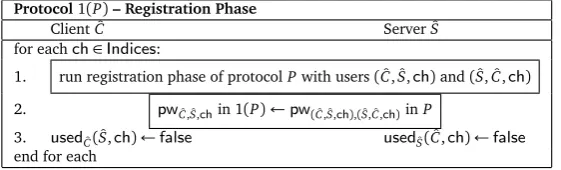
We now describe the technique to construct a one-time-PAKE protocol 1(P)from a PAKE protocolP. There are two phases: theregistration phase, in which pairs of clients and servers establish passwords, and thelogin phase, in which pairs of clients and servers attempt to establish a secure session.
Registration phase.The registration phase of the 1(P)protocol is specified in Figure1below. For every client-server pair( ˆC,Sˆ)∈Parties×Parties, and for each one-time-password indexch∈Indices, initiate the registration phase of P with the users( ˆC,S,ˆ ch)and (ˆS,C,ˆ ch), and set pwC,ˆS,ˆch in 1(P)equal to the corresponding password inP.
Although one might be concerned about the time that it takes to complete the registration phase ifIndices is large, the registration phase of any one-time password protocol can not, in general, be completed in less time asymptotically if truly one-time passwords are used. In other words, this is effectively the same complexity as password establishment in currently deployed one-time password schemes, and hence is quite practical. Moreover, the registration for each challenge can be run in parallel to reduce the number of communication rounds.
Protocol1(P)– Registration Phase
ClientCˆ ServerSˆ
for eachch∈Indices:
1. run registration phase of protocolPwith users( ˆC,Sˆ,ch)and(ˆS,Cˆ,ch)
2. pwCˆ,Sˆ,chin 1(P)←pw( ˆC,ˆS,ch),(ˆS,Cˆ,ch)inP
3. usedCˆ(ˆS,ch)←false usedSˆ( ˆC,ch)←false
end for each
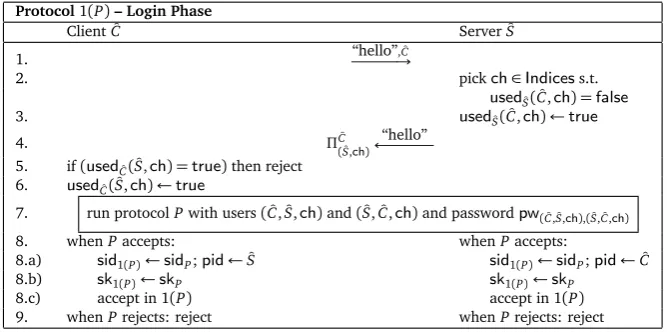
Login phase. The login phase of the 1(P)protocol is specified in Figure2below. Each partyUˆ maintains a set of tablesusedUˆ( ˆU0,ch), where each entry in the table is eithertrueorfalseand indicates whether the one-time-password indexed bychhas been used byUˆ withUˆ0.
To initiate the protocol, instanceΠCˆ
(ˆS,⊥)of userCˆsends a message(“hello”,Cˆ)to instanceΠ ˆ S
( ˆC,⊥)of party ˆ
S. When a partySˆreceives a message(“hello”,Cˆ), it picks a one-time-password indexchfromIndicessuch thatusedˆS( ˆC,ch) =false. Then it setsusedSˆ( ˆC,ch)←trueand activatesΠˆS( ˆC,ch). Finally, it sends “hello” to
instanceΠCˆ
(ˆS,ch)of partyC. It then waits to engage in a single instance of protocolˆ Pacting as user(ˆS,C,ˆ ch) interacting with party( ˆC,S,ˆ ch). When the corresponding instantiation of protocolPaccepts, the instance in 1(P)sets its session key to the session key in Pand then accepts. When it rejects inP, it rejects in 1(P); when it terminates inP, it terminates in 1(P)as well.
When instanceΠCˆ
(ˆS,ch)of partyCˆ receives a message(“hello”), it checks to see ifusedCˆ(ˆS,ch) =true; if so, then it rejects; if not, then it setsusedCˆ(ˆS,ch)←true. It then initiates the login phase of protocolPacting as user( ˆC,S,ˆ ch)interacting with party(ˆS,C,ˆ ch). It follows protocolPuntil it accepts or rejects. When the corresponding instantiation of protocolPaccepts, the instance in 1(P)sets its session key to the session key in Pand then accepts. When it rejects inP, it rejects in 1(P); when it terminates inP, it terminates in 1(P)as well.
Protocol1(P)– Login Phase
ClientCˆ ServerˆS
1. −−−−−→“hello”,Cˆ
2. pickch∈Indicess.t.
usedˆS( ˆC,ch) =false
3. usedˆS( ˆC,ch)←true
4. ΠCˆ
(ˆS,ch) “hello”
←−−−−−
5. if(usedCˆ(ˆS,ch) =true)then reject 6. usedCˆ(ˆS,ch)←true
7. run protocolPwith users( ˆC,Sˆ,ch)and(ˆS,Cˆ,ch)and passwordpw( ˆC,ˆS,ch),(ˆS,Cˆ,ch)
8. whenPaccepts: whenPaccepts:
8.a) sid1(P)←sidP;pid←Sˆ sid1(P)←sidP;pid←Cˆ
8.b) sk1(P)←skP sk1(P)←skP
8.c) accept in 1(P) accept in 1(P)
9. whenPrejects: reject whenPrejects: reject
Figure 2: Protocol 1(P)– Login Phase; can use a public, unauthenticated channel.
3.2
Security of
1
(
P
)
Theorem 1. Let P be a secure password-authenticated key exchange protocol. Then1(P)is a secure one-time-password-authenticated key exchange protocol.
The basic idea of the argument is as follows. We will show that attacks against 1(P)correspond to attacks againstP. As a result, if an adversary could break 1(P), it could breakP. Thus, an adversary could use the 1(P)construction, which is efficient, as part of its algorithm for breaking P. But sinceP is a secure password-authenticated key exchange protocol, no adversary should be able to attack P, and hence no adversary should be able to attack 1(P)either. The security argument is a straightforward simulation involving creating separate user instances inPfor each instance of 1(P).
Proof. In order to show that 1(P)is a secure one-time-password-authenticated key exchange protocol, we need to show that it provides secure key exchange and secure mutual authentication.
First, we construct a 1(P)simulator in which the adversary’s queries to 1(P)are translated into queries on aPchallenger as follows:
• Execute1(P)(ˆA,B,ˆ ch): Return the result ofExecuteP((ˆA,B,ˆ ch), 1,(ˆB,A,ˆch), 1).
• Send1(P)( ˆU,( ˆU0,ch),M): If messageM is for one of the two flows added by the 1(P)construction, then respond as indicated in Figure2. If messageMis for one of the flows fromP, then return the result of SendP(( ˆU,Uˆ0,ch), 1,M).
• RevealSessionKey1(P)( ˆU,Uˆ0,ch): ReturnRevealSessionKeyP(( ˆU,Uˆ0,ch), 1).
• Test1(P)( ˆU,Uˆ0,ch): ReturnTestP(( ˆU,Uˆ0,ch), 1).
Next, we show that a fresh session in the 1(P)simulator corresponds to a fresh session in thePchallenger. Then we show that a session-key distinguisher for a fresh session of 1(P)is a session-key distinguisher for a fresh session ofP, and hence 1(P)provides secure key agreement.
SupposeΠ( ˆ1U,Uˆ0,ch)with partner id( ˆU0,U,ˆ ch)is not a fresh instance in thePchallenger. We will show that ΠUˆ
( ˆU0,ch)is not a fresh instance in the 1(P)simulator.
IfΠ( ˆ1U,Uˆ0,ch)with partner id( ˆU0,U,ˆ ch)is not a fresh instance in thePchallenger, then one of the following must have occurred:
• RevealSessionKeyP(( ˆU,Uˆ0,ch), 1) occurred. ARevealSessionKey1(P)( ˆU,Uˆ0,ch)query must have oc-curred, since no other query in 1(P)leads to this query inP. Hence,ΠUˆ
( ˆU0,ch)is not fresh in 1(P). • RevealSessionKeyP(( ˆU0,U,ˆ ch), 1)occurred, whereΠ( ˆ
U0,U,ˆch)
1 is the partner instance ofΠ ( ˆU,Uˆ0ch)
1 inP. In this case, aRevealSessionKey1(P)( ˆU0,U,ˆ ch)query must have occurred, since no other query in 1(P) leads to this query inP. Hence,ΠU( ˆˆU0
,ch)is not fresh in 1(P).
• RevealPWP(( ˆU,ch),( ˆU0,ch))occurred before theTestP query andSendP(( ˆU,ch), 1,M)occurred for some messageM. In this case,RevealPW1(P)( ˆU,Uˆ0,ch)must have occurred in 1(P)before theTest1(P) query andSend1(P)( ˆU,( ˆU0,ch),M)must have occurred, since no other sequence of queries in 1(P)leads to this sequence of queries inP. Hence,ΠUˆ
( ˆU0,ch)is not fresh in 1(P). Thus,Π( ˆ1U,Uˆ0,ch)with partner id( ˆU0,U,ˆ ch)is a fresh instance inP.
Having shown that fresh sessions in the 1(P)simulator are also fresh in the P chappenger, we now show that breaking session key security of the 1(P)simulator leads to breaking session key security of theP challenger.
We first note that, since each one-time passwordpwC,ˆˆS,chfor 1(P)was chosen according to the distribution
PasswordsforP, the distribution of passwords with whichPis initialized satisfied the protocol requirements ofP.
By the argument above, every fresh session in 1(P)corresponds to a fresh session inP. Since the session key in 1(P)is equal to the session key inPand since the output ofTest1(P)is equal to the output ofTestP, a session key distinguisher for fresh sessions of 1(P)will also distinguish session keys forP. Thus, an adversary’s 1×ake-advantage in 1(P)cannot be better than its ake-advantage inP:
Adv11×(akeP) (t,qse,qex,qpw,qro)≤AdvakeP (t,qse,qex,qpw,qro) . (4)
Finally, we show that the ability of an adversary to break authentication in 1(P)is related to its ability to break authentication in P, in a manner analogous to the discussion above for key agreement security. Suppose an instance of 1(P)terminates without a partnered instance, before any of the queries in part 3 of Definition1. Instances in 1(P)terminate if and only if the corresponding instance in Phas terminated. Moreover, none of the prohibited queries in the definition of mutual authentication for password-authenticated key exchange could have occurred since otherwise one of the prohibited queries for mutual authentication of one-time-password-authenticated key exchange must have occurred. Hence, mutual authentication must have been broken forP as well. Thus, an adversary’s 1×ma-advantage in 1(P)cannot be better than its ma-advantage inP:
Adv11×ma(P)(t,qse,qex,qpw,qro)≤AdvmaP (t,qse,qex,qpw,qro) . (5)
Thus 1(P)is a secure one-time-PAKE protocol ifPis a secure PAKE protocol.
We note that the converse does not necessarily hold, namely, that it is not necessarily the case that, if 1(P) is secure, so isP. For example, an attacker trying to attackP may do so by causing the users inPto run multiple sessions. If the adversary causes a pair of users( ˆC,S,ˆ ch)and(ˆS,C,ˆ ch)to run multiple sessions inP, then there is no way of mapping this to an allowable instance of 1(P), and we cannot translate the attack on Pinto an attack on 1(P).
Example instantiation. Suppose we were to construct a one-time-password-authenticated key exchange protocol using the 1(P)construction where the underlying password-authenticated key exchange protocol is the (symmetric, non-verifier-based) protocolPAK[BMP00a]. The specification for the example 1(PAK) protocol is given in AppendixA.
number ofSendqueries. Assuming the hardness of solving the elliptic curve computational Diffie-Hellman problem (using estimates in[BCC+08]), we can achieve this security level using 10-digit numerical passwords (Passwords={0, . . . , 9}10) and a 348-bit elliptic curve group. (See AppendixA.1for the full analysis.)
3.3
Efficiency and Practicality of
1
(
P
)
Login phase and computational efficiency. During the login phase, the 1(P)construction provides no loss of efficiency in terms of the number of expensive operations (such as group exponentiations) or security level ofP, since the reduction is tight. 1(P)does add two additional message flows to the length of the protocol, but depending on the message flow of protocolPit may be possible to combine some flows without affecting security.
One might think that designing a one-time-password protocol from scratch may lead to greater efficiency, since some of the effort in designing PAKE protocols goes to preventing the transcript of one session leaking information about the password and in a one-time-password protocol we may not have to worry as much about leaking information about passwords during a protocol run. However, many PAKE protocols are already highly efficient in terms of number of operations. For example, the Diffie-Hellman-basedPAK[Mac02]protocol can be run with just 2 group exponentiations on each side (plus a group inversion on the client side, which is inexpensive in many groups like elliptic curve groups), which is very close to the operation count of the basic, unauthenticated Diffie-Hellman protocol (2 group exponentiations for both parties). The main efficiency to be gained, then, would be in improving the tightness in the security reduction to the underlying Diffie-Hellman problem so as to allow smaller group sizes.
Registration phase. The registration phase of 1(P)obviously requires establishing many more passwords than a single instance ofP, butanyone-time password scheme requires establishing many more passwords than a long-term password scheme. The 1(P)registration phase calls the registration phase ofPmany times. Depending on the PAKE protocolP, the registration phase can be quite efficient: for example, in the PAK protocol[Mac02], the registration phase can be optimized to consist of just one hash function evaluation.
Password storage. In practice it is important to consider how clients will store a list of one-time passwords, especially if they wish to log in to a site while away from their normal computer. One method is to provide a piece of paper with a list of one-time passwords; for example, the Swedish bank Nordea provides its customers with a “scratch sheet” of 120 one-time passwords[Nor]. Alternatively, one-time passwords could be delivered through an out-of-band channel such as an SMS message to the user’s mobile phone (for example,[Mob]). Passwords can also be stored on or generated by an electronic token device, for example the RSA SecurID [RSA], or even in a smart card built into credit cards[Pri08].
We can further reduce the complexity of the registration phase and password storage by using pseudoran-dom or time-based one-time passwords, which we describe in the following sections.
3.4
Verifier-based protocols
The construction of 1(P)can be modified in the obvious way to support verifier-based protocols as well. Using an argument similar to the one for Claim1, we can easily show the following claim:
Theorem 2. Let P be a secure verifier-based password-authenticated key exchange protocol. Then1(P), modified to support verifier-based protocols, is a secure verifier-based one-time-password-authenticated key exchange protocol.
4
Using pseudorandom passwords
To improve the efficiency of password registration and storage, it may be desirable to pseudorandomly generate passwords instead of truly random ones. For example, users may be given a hardware token[RSA,Bli09]
with a preprogrammed private seed which iteratively generates one-time passwords, or the device may accept a challenge as an input and then output a response from a pseudorandom function based on the seed and that challenge. We show that pseudorandomly generated passwords can be safely used in one-time-PAKE protocols. Suppose P is secure one-time-PAKE protocol. We construct a new protocol ˜P based on P that uses pseudorandomly generated passwords as follows.
The login phase of ˜Pis exactly as inP, except that the passwords chosen in the modified registration phase above are used. For the purposes of the security model in Section2.1, theRevealPWqueries work exactly as before and only reveal an individual passwordpwA,ˆˆB,ch. No query revealsseedA,ˆBˆ.2
The only difference between ˜PandPis that pseudorandom passwords are being used instead of random passwords. It is then easy to see that any efficient adversaryAthat can defeat session key security or mutual authentication in ˜Pcan be used to build either an adversaryA1that breaks session key security or mutual authentication inP, or an algorithmA2that acts as a polynomial-time distinguisher for the pseudorandom function familyF. Thus ˜Pis secure ifPis, and we see that pseudorandomly generated one-time passwords can be safely used in any secure one-time-PAKE protocol.
5
Using time-dependent passwords
A further refinement to the use of pseudorandomly generated passwords is to use passwords that also depend on the current time. This allows the client and server to agree upon a challenge – the current time – without any communication, while easily enforcing the one-time use of passwords.
For example, consider a hardware token for partyAˆinteracting with partyBˆwhich has a pseudorandom functionFseedˆ
A,Bˆ∈F and an onboard clock. It generates one-time passwords as follows. Lettbe the hardware
token’s current time. Treattas the one-time password indexch, and then compute
pwA,ˆˆB,t =FseedA,ˆBˆ(t) . (6)
UserAˆthen participates in the one-time-PAKE protocol usingpwA,ˆB,tˆ .
Whenever clocks are used by two parties, one must consider the issue ofclock skew, in which the two clocks may not be perfectly synchronized. For example, ordinary quartz clocks drift at a rate of approximately 10−6seconds per second, or about 1 second every 12 days.
One solution is to have a common network time server that both parties use for synchronization. This is problematic for two reasons: (1) the network time server must be trusted (or at least dealt with in the security model); (2) all of the parties participating must have a way of synchronizing with the clock server; an inexpensive, credit-card-sized hardware token may not be connected to the network, making synchronization difficult or impossible.
Another method for dealing with clock skew is to have the server accept multiple passwords from a small window around the server’s current time (say, plus or minus 60 seconds). However, this is a problem for PAKE protocols, as the server never receives the client’s password directly. Rather, each party uses what it believes to be the password in the protocol, and at the end the two parties know that the same password was used if and only if they arrive at the same session key. This prevents the server from accepting multiple passwords as valid. (Traditional one-time password systems often avoid this problem by having the client send the password itself to the server over an existing encrypted but not mutually authenticated channel.)
A simpler alternative mechanism for dealing with clock skew is for one party (the initiator) to just tell the other party (the responder) what timetit used in the protocol. If the time used by the initiator is acceptable to the responder (say within plus or minus 60 seconds of the responder’s clock) then the responder continues the protocol using the specified time. This provides a simple mechanism for ensuring both sides use the same time-dependent password while accommodating clock skew.
Adjusting the model. In order to accommodate this alternate mechanism in the security model described in Section2.1, the definition of freshness would need to be adapted (in part 3.(a) and 3.(b) of Definition1) so that a responder instanceΠUˆ
( ˆU0,t)is fresh provided that noRevealPW( ˆU,Uˆ0,t
0)orRevealPW( ˆU0,U,ˆ t0)query
was issued for any time t0in the valid time window ofΠUˆ
( ˆU0,t). This captures the notion that the authentication should be secure as long as none of the currently valid passwords have been revealed.
With this modified security definition, and assumingF is a secure family of pseudorandom functions, one-time time-based passwords generated in equation (6) can be safely used in a secure one-time-PAKE protocol as a result of the discussion about pseudorandom passwords in Section4.
2We could add a further query, sayRevealPWSeed(ˆA,Bˆ), that does reveal the valueseed
ˆ
A,ˆBand then add an additional constraint
6
Analysis of the
OPKeyX
protocol
TheOPKeyXprotocol[ACP05a]is a PAKE protocol that uses a sequence of passwords derived via a hash chain from a single seed. The protocol is a verifier-based protocol, meaning that the compromise of the value stored on the server should not allow someone to impersonate the client. We note that[ACP05a]omits a complete analysis ofOPKeyX: it gives a proof for a non-verifier-based PAKE protocol in the BPR model but no proof thatOPKeyX, a verifier-based hash-chain variant of the protocol, is also secure.
The sequence of passwords in OPKeyXis as follows. Each client Cˆ picks, for each server S, a seedˆ passwordpw. LetNmaxbe the maximum number of login sessions for the seedpw. During the registration phase, the client gives the server its verifierVNmax←f
Nmax+1(pw), where f is a random oracle and fidenotes
thei-fold application of f. The parties each maintain internal countersnof the current login phase, starting fromn=Nmaxand decreasing to 1. During login phase with internal counter equal ton, the client and server do an encrypted key exchange where the Diffie-Hellman ephemeral public keys are encrypted using a value derived from the verifierVn=fn+1(pw). Then, the client encryptsfn(pw)under a valuesderived from the shared Diffie-Hellman key (but distinct from the session keysk) and sends it to the client. The server decrypts to obtainV0, verifiesVn= f(V0), and setsVn−1←V0andn←n−1.
OPKeyXrelies on the correct sequence of passwords being used. In the security model for verifier-based one-time-PAKE in Section2.2, we allow the adversary to reveal one-time passwords in any order. As a result, OPKeyXcannot be a secure verifier-based one-time-PAKE protocol in the sense of Section2.2. For example, an adversary could reveal the password for session with counteri, which is fi+1(pw), and then be able to derive the password for the earlier session with counteri+1 (recalling that counters decrease as time passes), which is fi+2(pw) =f(fi+1(pw)). To describe the security ofOPKeyX, we would need to further restrict our model so that a session is not fresh if the password or verifier of a subsequent session has been revealed which, although weaker from a theoretical perspective, still models a plausible practical scenario. The situation is even more complicated ifRevealSessionKeyis deemed to reveal the values(which encrypted the next verifier V0and is in some sense a “session key”) in addition tosk, in which case no earliersvalue for the target users can have been revealed before theTestquery.
7
Conclusions
One-time password systems are already being widely deployed by banks, governments, and corporate virtual private networks (VPNs) to reduce the effects of password compromise. Bank customers today are using sheets of paper with lists of one-time passwords. Online shoppers and gamers today are using hardware one-time password generators. The money being spent on deploying one-time passwords is wasted if these passwords are not being used safely and securely.
By using one-time passwords in one-time-PAKE protocols, as we have proposed in this paper, we can be assured that one-time passwords are being used in a more secure way. We have presented a model for the secure use of one-time passwords in PAKE protocols, taking into account the idea that such protocols should be secure even if previous or future one-time passwords have been compromised. We have given a generic technique for constructing secure one-time password protocols. Our construction can be used with pseudorandomly generated one-time passwords or time-based one-time passwords, providing greater efficiency in one-time password distribution.
As with all cryptographic protocols, an essential precondition to security isgetting users to use the protocol. If an adversary can trick a user into entering their password in a non-secure manner so that the secure protocol is never used – a so-calledchosen protocol attack– then the cryptographic countermeasures are bypassed. For any PAKE protocol to succeed, user training and user interface design will be very important.
Spyware remains a significant threat to password security. In the face of passive spyware, such as a keystroke logger which collects information and occasionally relays it back to the attacker, both traditional one-time password schemes and one-time-PAKE are useful since used one-time passwords are useless to an attacker. If the spyware is active – it captures a one-time password, terminates the user’s connection, and immediately sends the password to the attacker – the captured password may still be useful to an attacker, and it seems that neither traditional one-time password schemes nor one-time-PAKE can do much unless time-dependent passwords are used with careful expiration procedures.
An additional challenge is widespread deployment of such secure protocols. Passwords, as they are used in HTTP and SSL on the Internet today, remain susceptible to phishing attacks. The huge installed base of web browsers and web servers has significantly slowed efforts to deploy PAKE.
Many corporate VPNs use one-time passwords now, albeit in a less secure way than we have proposed. Moreover, both endpoints – the user’s computer and the VPN server – are often under control of the same organization and using software from the same vendor, making it easier to deploy enhancements. An interesting avenue of future research is the integration of secure PAKE and one-time-PAKE protocols into IPsec for use in corporate VPNs. Indeed, IKEv2 (one of the key exchange protocols for IPsec) notes the need for password authentication: after showing how to derive a shared key for authenticated Diffie-Hellman key exchange in IKEv2, the RFC goes on to say: “... deriving the shared secret from a password is not secure. This construction is used because it is anticipated that people will do it anyway”[Kau05, p. 30]. One-time-password-authenticated key exchange is one way in which one-time passwords can be used more securely.
References
[ACP05a] Michel Abdalla, Olivier Chevassut, and David Pointcheval. One-time verifier-based encrypted key exchange. In Serge Vaudenay, editor,Public Key Cryptography (PKC) 2005,LNCS, volume 3386, pp. 47–64. Springer, 2005. DOI:10.1007/b105124. Full version available as[ACP05b].
[ACP05b] Michel Abdalla, Olivier Chevassut, and David Pointcheval. One-time verifier-based encrypted key exchange, 2005.URLhttp://www.di.ens.fr/~mabdalla/papers/ACP05-letter.pdf. Extended abstract pub-lished as[ACP05a].
[BCC+08] Steve Babbage, Dario Catalano, Carlos Cid, Orr Dunkelman, Christian Gehrmann, Louis Granboulan, Tanja Lange, Arjen Lenstra, Phong Nguyen, Christof Paar, Jan Pelzl, Thomas Pornin, Bart Preneel, Christian Rechberger, Vincent Rijmen, Matt Robshaw, Andy Rupp, Nigel Smart, and Michael Ward. ECRYPT yearly report on algorithms and keysizes (2007–2008), July 2008.URLhttp://www.ecrypt.eu.org/documents/D. SPA.28-1.1.pdf.
[Bli09] Blizzard Entertainment. Blizzard authenticator, 2009. URL http://eu.blizzard.com/support/ article.xml?locale=en_GB&articleId=28152.
[BM92] Steven M. Bellovin and Michael Merritt. Encrypted key exchange: Password-based protocols secure against dictionary attacks. InProceedings of the 1992 IEEE Computer Society Conference on Research in Security and Privacy. IEEE, May 1992.DOI:10.1109/RISP.1992.213269.
[BM93] Steven M. Bellovin and Michael Merritt. Augmented encrypted key exchange: a password-based protocol secure against dictionary attacks and password file compromise. InProc. 1st ACM Conference on Computer and Communications Security (CCS), pp. 244–250. ACM, 1993. DOI:10.1145/168588.168618.
[BMP00a] Victor Boyko, Philip MacKenzie, and Sarvar Patel. Provably secure Password-Authenticated Key exchange using Diffie-Hellman. In Preneel[Pre00], pp. 156–171. DOI:10.1007/3-540-45539-6_12. Full version
available as[BMP00b].
[BMP00b] Victor Boyko, Philip MacKenzie, and Sarvar Patel. Provably secure Password-Authenticated Key exchange using Diffie-Hellman, 2000. EPRINThttp://eprint.iacr.org/2000/044. Short version published as [BMP00a].
[BPR00] Mihir Bellare, David Pointcheval, and Phillip Rogaway. Authenticated key exchange secure against dictionary attacks. In Preneel[Pre00], pp. 139–155.DOI:10.1007/3-540-45539-6_11.
[CSH05] Olivier Chevassut, Frank Siebenlist, and Mike Helm. Secure (one-time-) password authentication for the Globus toolkit. InGlobusWorld Conference, February 2005. URLhttp://acs.lbl.gov/Projects/ OPKeyX/Talks/GlobusWorld05/GlobusWorld05.html.
[F-S05] F-Secure. Weblog: More on international phishing, October 2005. URL http://www.f-secure.com/ weblog/archives/00000689.html.
[FMCS04] Liang Fang, Samuel Meder, Olivier Chevassut, and Frank Siebenlist. Secure password-based authenticated key exchange for web services. InProc. 2004 Workshop on Secure Web Service (SWS), pp. 9–15. ACM, 2004.
DOI:10.1145/1111348.1111350.
[GGM86] Oded Goldreich, Shafi Goldwasser, and Silvio Micali. How to construct random functions. Journal of the ACM,33(4):792–807, October 1986. DOI:10.1145/6490.6503.
[GMR05] Craig Gentry, Philip MacKenzie, and Zulfikar Ramzan. PAK-Z+, August 2005. URLhttp://grouper. ieee.org/groups/1363/WorkingGroup/presentations/pakzplusv2.pdf. Contribution to the IEEE P1363-2000 study group for Future PKC Standards.
[Hal95] Neil Haller. The S/KEY one-time password system, February 1995. URLhttp://www.ietf.org/rfc/ rfc1760.txt. RFC 1760.
[HMNIS98] Neil Haller, Craig Metz, Philip J. Nesser II, and Mike Straw. A one-time password system, February 1998.URL
[Kau05] Charlie Kaufman. Internet Key Exchange (IKEv2) protocol, December 2005.URLhttp://www.ietf.org/ rfc/rfc4306.txt. RFC 4306.
[KS08] Sunil Kumar and Abhishek Sing. One time password in IKE version 2 (non-EAP based), November 2008.URL
http://tools.ietf.org/id/draft-sunabhi-otp-ikev2-03.txt. Inernet-Draft.
[Mac02] Philip MacKenzie. The PAK suite: Protocols for password-authenticated key exchange. Technical Report 2002-46, DIMACS Center, Rutgers University, 2002.URLhttp://dimacs.rutgers.edu/TechnicalReports/ abstracts/2002/2002-46.html.
[Mob] Mobile-OTP Project. Mobile one time passwords.URLhttp://motp.sourceforge.net/.
[Nat09] Nationwide Building Society. Card reader security, May 2009. URLhttp://www.nationwide.co.uk/ rca/.
[Nor] Nordea Bank. Netbank security. URL http://www.nordea.ee/Private+customers/E-channels+ +Netbank/Netbank/Netbank+Security/936612.html.
[Nys07] Magnus Nystroem. The EAP protected one-time password protocol (EAP-POTP), February 2007. URL
http://www.ietf.org/rfc/rfc4793.txt. RFC 4793.
[Pre00] Bart Preneel, editor.Advances in Cryptology – Proc. EUROCRYPT 2000,LNCS, volume 1807. Springer, 2000.
DOI:10.1007/3-540-45539-6.
[Pri08] Mark Prigg. The new credit card with keypad that promises to fight online fraud, November 2008. URL http://www.dailymail.co.uk/sciencetech/article-1085642/ The-new-credit-card-keypad-promises-fight-online-fraud.html?ITO=1490. The Daily Mail Online.
[RSA] RSA Security Inc. RSA SecurID.URLhttp://www.rsa.com/node.aspx?id=1156.
[Sho99a] Victor Shoup. On formal models for secure key exchange. Report RZ 3120, IBM Research, April 1999.URL
http://www.zurich.ibm.com/security/publications/1999/Shoup99.ps.gz.
[Sho99b] Victor Shoup. On formal models for secure key exchange (version 4), November 1999.URLhttp://shoup. net/papers/skey.pdf. Earlier version appeared as[Sho99a].
[Ste09] Douglas Stebila.Classical Authenticated Key Exchange and Quantum Cryptography. PhD thesis, University of Waterloo, 2009.EPRINThttp://hdl.handle.net/10012/4295,URLhttp://www.douglas.stebila. ca/research/papers/ste09/.
A
1
(
PAK
)
: a one-time-password-authenticated key exchange protocol
In this section, we present the protocol 1(PAK), an adaptation of thePAKprotocol to use one-time passwords using the 1(P)construction of Section3.1. In the presentation, the notation has been simplified from the 1(P)construction where appropriate (for example, we avoid the repetitive subscriptingpw( ˆC,S,ˆch),(ˆS,C,ˆch)and simplify to the unambiguouspwC,ˆS,ˆch). ThePAKprotocol was introduced by Boyko, MacKenzie, and Patel [BMP00a]. It is a symmetric, or non-verifier-based, protocol. The original paper[BMP00a]gave a proof that PAKwas secure in the simulation model of Shoup[Sho99b]and was later shown to be secure in the BPR model by MacKenzie[Mac02].
LetGbe a finite cyclic group of orderqand letgbe a generator ofG. LetAcceptable:G→ {true,false} such thatAcceptable(z) =trueif and only ifz∈G, whereGis a specified abelian group which hasGas a subgroup. H1is a full-domain random hash function returning elements ofG;H2,H3, andH4are random hash functions returning suitably large bit strings.
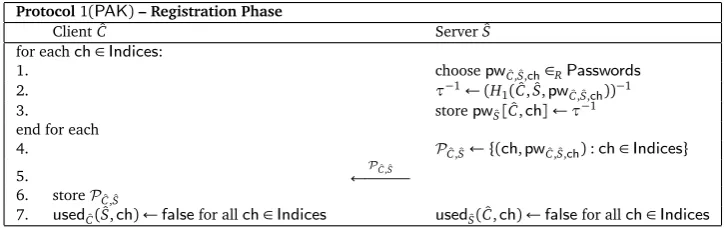
The user registration phase of the 1(PAK)protocol is given in Figure3. For each one-time password index ch∈Indices, the serverSˆuniformly at random picks a passwordpwC,ˆˆS,ch∈RPasswordsand stores a related valueτ−1. Then, using a private, authenticated channel, the server provides all the one-time passwords to the clientCˆwho stores them. Alternatively, the set of one-time passwords for each client-server pair could be selected by each client and supplied to the server over a secure channel; the end result would be the same.
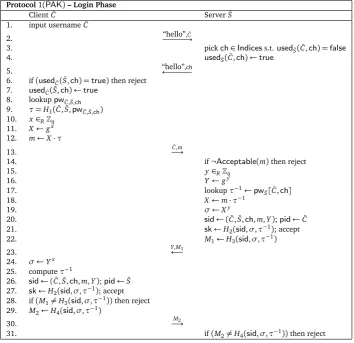
The login phase of the 1(PAK)protocol is given in Figure4. In this phase, the client sends a “hello” message to the server to obtain the one-time password indexchand, provided that one-time password index is unused. follows the user login phase of thePAKprotocol, which includes mutual authentication based on the shared passwordpwC,ˆˆS,ch and the computation of a shared session keyskbased on the Diffie-Hellman shared secret.
Protocol1(PAK)– Registration Phase
ClientCˆ ServerSˆ
for eachch∈Indices:
1. choosepwCˆ,ˆS,ch∈RPasswords
2. τ−1←(H1( ˆC,Sˆ,pwCˆ,ˆS,ch))−1
3. storepwSˆ[ ˆC,ch]←τ−1
end for each
4. PCˆ,ˆS← {(ch,pwCˆ,Sˆ,ch):ch∈Indices}
5. ←−−−−−PC,ˆˆS
6. storePCˆ,Sˆ
7. usedCˆ(ˆS,ch)←falsefor allch∈Indices usedˆS( ˆC,ch)←falsefor allch∈Indices
Figure 3: Protocol 1(PAK)– Registration Phase. This phase must use a private, authenticated channel.
Lemma 1. Let G be a finite cyclic group generated by g and let texpdenote the running time of exponentiation in G. Assume passwords are uniformly distributed among the setPasswords. LetAbe an adversary that runs in time t and makes at most qseand qexqueries of typeSendandExecute, respectively, and at most qroqueries to the random oracles. Then, for t0=t+ (4qro2 +qse+2qex)texp,
Adv11×ake(PAK)(A)≤ qse
|Passwords|+ε , (7)
where
ε=2qseAdvCDHG,g
t0,q2ro+2(qse+qex)(qro+qse+qex)
|G| (8)
andAdvCDHG,g (t,`)is the advantage an adversary running in time t and outputting a list of`items has in solving
the (list) computational Diffie-Hellman (CDH) problem. Moreover, the same bound applies forAdv1×1(PAKma )(A).
A.1
Parameter sizes for example instantiation
As a consequence of Theorem1, we can pick a desired security level and under a suitable assumption on the difficulty of solving CDH, choose a set of parameters that achieve that security level.
Suppose we wish for an adversary running in time 260to have an ake advantage of at most 2−20against 1(PAK).
To give an example instantiation, we have to pick appropriate values for the various parameters in the statement of the theorem. We chooseqse=210,q
ex=220,qro=240,t=280, andtexp=220. We need qse
|Passwords|≤2
−21. Suppose each one-time password is comprised solely of numerical characters
0-9. We need|Passwords| ≥231which can be achieved by using uniformly distributed 10 digit numerical passwords (since 1010≈233.2).
We also need ε≤ 2−21. Of the two terms in expression (8), the latter is dominated by the former. Noting thatt0=282, we require that 211AdvCDH
Protocol1(PAK)– Login Phase
ClientCˆ ServerSˆ
1. input usernameCˆ
2. −−−−−→“hello”,Cˆ
3. pickch∈Indicess.t.usedSˆ( ˆC,ch) =false
4. usedˆS( ˆC,ch)←true
5. “hello”←−−−−−,ch
6. if(usedCˆ(ˆS,ch) =true)then reject 7. usedCˆ(ˆS,ch)←true
8. lookuppwCˆ,ˆS,ch
9. τ=H1( ˆC,Sˆ,pwCˆ,Sˆ,ch)
10. x∈RZq
11. X←gx
12. m←X·τ
13. −→Cˆ,m
14. if¬Acceptable(m)then reject
15. y∈RZq
16. Y←gy
17. lookupτ−1
←pwˆS[ ˆC,ch]
18. X←m·τ−1
19. σ←Xy
20. sid←( ˆC,ˆS,ch,m,Y);pid←Cˆ
21. sk←H2(sid,σ,τ−1); accept
22. M1←H3(sid,σ,τ−1)
23. Y←−,M1
24. σ←Yx
25. computeτ−1
26. sid←( ˆC,Sˆ,ch,m,Y);pid←ˆS
27. sk←H2(sid,σ,τ−1); accept
28. if(M16=H3(sid,σ,τ−1))then reject
29. M2←H4(sid,σ,τ−1)
30. −→M2
31. if(M26=H4(sid,σ,τ−1))then reject