RISK MANAGEMENT TECHNIQUES AND FINANCIAL PERFORMANCE OF ISLAMIC BANKS IN KENYA
ADANNUR IBRAHIM ABDI D53/OL/CTY/24460/2014
A RESEARCH PROJECT SUBMITTED TO SCHOOL OF BUSINESS IN PARTIAL FULFILLMENT OF THE REQUIREMENT FOR THE AWARD OF DEGREE OF MASTERS OF BUSINESS ADMINISTRATION IN FINANCE OF
KENYATTA UNIVERSITY
ii
DECLARATION
I declare that this research project is my original work and has not been presented for a degree in any other university.
Sign: ……….. Date: ………
ADANNUR IBRAHIM ABDI D53/OL/CTY/24460/2014
This research project has been submitted for examination with my approval as a University supervisor
Signature………. Date………
DR. J. N. MUNGAI
iii
DEDICATION
iv
ACKNOWLEDGEMENTS
v
TABLE OF CONTENTS
DECLARATION... ii
DEDICATION... iii
ACKNOWLEDGEMENTS ... iv
TABLE OF CONTENTS ... v
LIST OF TABLES ... ix
LIST OF FIGURES ... x
OPERATIONAL DEFINITION OF TERMS ... xi
ABBREVIATIONS AND ACRONYMS ... xii
ABSTRACT ... xiii
CHAPTER ONE ... 14
INTRODUCTION... 14
1.1 Background of the Study ... 14
1.1.1 Financial Performance of Islamic Banks ... 16
1.1.2 Risk Management and Financial Performance ... 17
1.1.3 Islamic Banking ... 18
1.2 Statement of the Problem ... 19
1.3 Objectives of the Study ... 20
1.3.1 General Objective ... 20
1.3.2 Specific Objectives ... 20
1.4 Research Hypothesis ... 21
1.5 Significance of the Study ... 21
1.6 Scope of the Study... 21
vi
1.8 Study Organization ... 22
CHAPTER TWO ... 23
LITERATURE REVIEW ... 23
2.1 Introduction ... 23
2.2 Theoretical Framework ... 23
2.2.1 Enterprise Risk Management Theory ... 23
2.2.2 Capital Asset Pricing Theory ... 24
2.2.3 Arbitrage Pricing Theory ... 24
2.3 Empirical Review ... 25
2.4 Critique of Existing Literature ... 26
2.5 Summary of Literature Review and Research Gaps ... 27
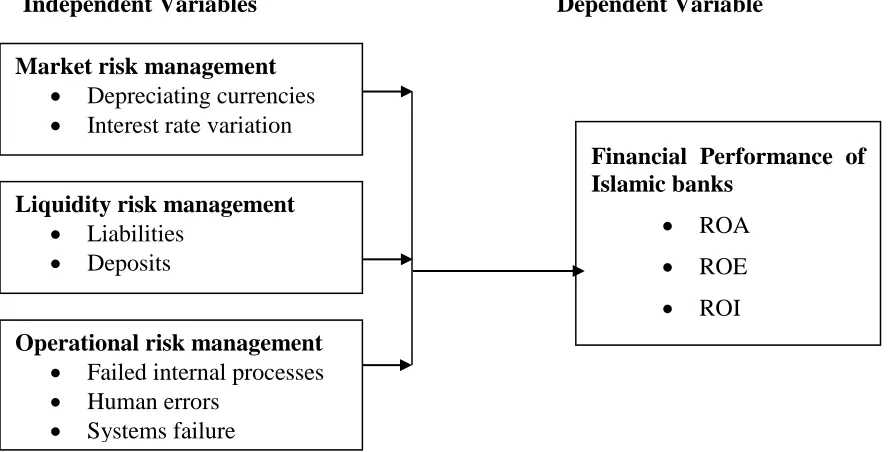
2.6 Conceptual Framework ... 29
CHAPTER THREE ... 31
RESEARCH METHODOLOGY ... 31
3.1 Introduction ... 31
3.2 Research design ... 31
3.3 Target Population ... 31
3.4 Sampling Technique and Sample Size ... 32
3.4.1 Sampling Technique ... 32
3.4.2 Sample Size ... 32
3.5 Data Collection Instruments and Procedure ... 33
3.6 Pilot Testing ... 34
3.7 Validity and Reliability ... 34
vii
3.7.2 Reliability ... 35
3.8 Data Analysis and Presentation ... 36
CHAPTER FOUR ... 37
DATA ANALYSIS AND INTERPRETATION ... 37
4.0 Introduction ... 37
4.1 Response Rate ... 37
4.3 Demographic Information ... 37
4.3.1 Gender of the Respondents ... 37
4.3.2 Level of Education of the Respondents ... 38
4.3.3 Respondents Work Experience ... 39
4.4 Descriptive Statistics ... 39
4.4.1 Market Risk Management and Financial Performance of Islamic Banks in Kenya ... 39
4.4.2 Liquidity Risk Management and Financial Performance of Islamic Banks in Kenya ... 41
4.4.3 Operational Risk Management and Financial Performance of Islamic Banks in Kenya ... 44
4.4.4 Financial Performance of Islamic Banks ... 47
4.5 Inferential Statistics ... 47
CHAPTER FIVE ... 52
SUMMARY, CONCLUSIONS AND RECOMMENDATIONS ... 52
5.1 Introduction ... 52
5.2 Summary of the Findings ... 52
viii
5.2.2 Liquidity Risk Managemnt ... 52
5.2.3 Operational Risk Management ... 53
5.3 Conclusion ... 53
5.4 Recommendations ... 53
5.5 Suggestions for Further Research ... 54
REFERENCES ... 55
APPENDICES ... 58
Appendix I: Letter of Introduction ... 58
ix
LIST OF TABLES
Table 3.1 Target Population ... 32
Table 3.2 Sample Size... 33
Table 4.1 Reliability and Validity ... 35
Table 4.2 Market Risk and Financial Performance of Islamic Banks in Kenya ... 40
Table 4.3 Influence of Market Risk Management on Financial Performance ... 41
Table 4.4 Liquidity Risk Influence on the Financial Performance of Islamic Banks ... 42
Table 4.5 Liquidity Risk Management and Financial Performance of Islamic Banks ... 43
Table 4.6 Operational Risk Management and Financial Performance of Islamic Banks . 46 Table 4.7 Financial Performance of Islamic Banks ... 47
Table 4.8 Regression Model Summary ... 49
Table 4.9 Analysis of Variance (ANOVA) ... 49
x
LIST OF FIGURES
Figure 2.1 Conceptual Framework ... 30
Figure 4.1 Gender of the Respondents ... 38
Figure 4.2 Respondents Level of Education ... 38
Figure 4.3 Respondents Work Experience ... 39
Figure 4.4 Market Risk Influence ... 40
Figure 4.5 Liquidity Risk Influence ... 42
xi
OPERATIONAL DEFINITION OF TERMS
Credit Risk: Credit risk as the chance that a debtor or issuer of a financial instrument whether an individual, a company, or a country will not repay principal and other investment-related cash flows according to the terms specified in a credit agreement.
Financial Performance: is the degree to which financial objectives being or has been accomplished. It is the process of measuring the results of a firm's policies and operations in monetary terms. It is used to measure firm's overall financial health over a given period of time.
Islamic Banking: is a system of banking activity which is consistent with the practices and principles of Islamic Shariah law and its application to the development of Islamic economics. Liquidity Risk: Liquidity as the ability of a bank to fund increases in assets
and meet obligations as they become due, without incurring unacceptable losses.
Market Risk: This is the risk of asset valued change associated with systematic factor.
Operational Risk: Direct or indirect loss resulting from inadequate or failed internal processes, people and systems or from external events.
xii
ABBREVIATIONS AND ACRONYMS
IB Islamic Bank
IIFM International Islamic Financial Market RMP Relative Market Power hypothesis SCP Structure -Conduct- Performance SPSS Statistical packages for social sciences
UAE United Arab Emirates
USA United State of America
xiii ABSTRACT
14
CHAPTER ONE INTRODUCTION 1.1 Background of the Study
Islamic banks are financial institutions that rely totally in their operations on Shari'ah legislations which prohibit all kinds of interest, uncertainty, and gambling. This industry has witnessed a significant growth in the last 30 years. According to McKinsey (2007), since its revival in the late 1970s, more than 500 institutions were established in the world with an average asset growth of 15 to 20 percent each year, making Islamic banking the fastest growing industry in the financial sector is the world's second largest religion after Christianity with 1.3 to 1.8 billion adherents, comprising 20 to 25 percent of the world population. Islamic Banking is a very attractive industry for investment and research for both Muslims and non-Muslims. The establishment of Islamic banks has been considered as an alternative solution for Muslims who want to liberate themselves from interest. Currently, Islamic banks are expanding to a new level of development by establishing full and innovative financial solutions that serve competitively in the financial sector and thus providing their clients with most of their financial needs. This development made Islamic banks attractive to different sectors of the society, even for non-Muslims. Some countries such as Iran and Sudan transformed their banking system to fully comply with the Shari’ah. Others such as Pakistan, Indonesia, Bahrain and Malaysia established a parallel Islamic financial system to move alongside with its current financial system. This trend encouraged major banks such as HSBC, Citibank, ABN AMRO and many others to open windows that comply with Shari'ah principles (Ahmed, 2008).
15
bank was formed as the first fully fledged Islamic bank that offered financial services for individuals according to the Islamic legislations. From its formation until now, more than 500 institutions are offering Islamic financial services (Shaer, 2009).
According to International Islamic Financial Market (IIFM, 2009), 25 countries with the most advanced Islamic financial systems are Malaysia, Kuwait, Saudi Arabia, United Arab Emirates, Bahrain and Qatar. Those countries are on the level of business innovation and continuous market expansion. Countries like Brunei, Indonesia, South Africa, Morocco, Turkey and Pakistan are at the level of matching competition, and they are trying to reach the first group. Other countries that started developing Islamic finance include Lebanon, Syria, USA, Germany and Singapore. Others such as China, India, Hong Kong and Australia are still waiting and monitoring the industry. According to Shaer (2009), Islamic banks are also considered as development banks aimed at mobilizing and channeling resources to fund individuals to achieve common interest, not only between the parties, but primarily for the advancement of society. The goal in establishing Islamic banks is to create grounds for Islamic economy where the goal is not limited to “for-profit” only.
Banks are part and parcel of financial intermediaries that mobilize savings from surplus economic units to deficit economic units. They are also considered to be special financial intermediaries that mobilize funds between depositors and borrowers participating in an economy (Heffernan, 1996 in Yuqi, 2008). How well they perform this intermediary function has direct linkage with banks profitability and economic health of a nation. Profitability of banks has effects on growth and development of an economy. Because of this reason, banking regulatory authorities in many nations worldwide came up with various banking reforms agenda with specific emphasis on variables determining banks profitability.
16
and conversion of building societies into banks; United States of America responded to its banking crisis which spanned between 1982 and 1990 by consolidation through mergers and acquisitions; Spain responded to its banking crisis by establishment of the bank hospital known as the Guarantee fund; and Malaysia responded to its banking crisis by major banking consolidation exercises in 1999 with gradual removal of the barrier to the entry of foreign banks (Dogarawa, 2006; Karwai, 2006 and Yuqi, 2008).
Banks play a very important role as a primary lender to both big and small businesses. By its nature, banks face a number of challenges within internal and the external business environment. The nucleus of banks is intertwined with risks which include among others credit risk that arises as a result of lending to customers; market risk, which is due to changes in the economic environment that it operates; interest rate risk, being a risk due to changes in prime lending rate and banks’ lending rate; and operational risk, which arises as a result of poor management that causes failure or allow loopholes for fraud penetration (Yuqi, 2008). The risks faced by banks if not properly managed have the potentials to affect the profitability of the banks and at extreme cases leads to their failure. According to Khan and Ahmed (2001), the survival and success of financial organizations depend critically on the efficiency of managing these risks. Good risk management is highly relevant in providing better returns to shareholders Al-Tamimi & Al-Mazrooei, (2007). Among the various components of risk, credit risk has received more attention from the banks; they mostly have credit risk management unit and regulators setting standards for minimizing credit loss.
1.1.1 Financial Performance of Islamic Banks
17
deposits, total interest income, total interest expense, other costs and other indicators are used in measuring performance of an Islamic bank.
Metwally (1997) concluded that the two groups of banks may be differentiated in terms of liquidity, leverage and credit risk, but not in terms of profitability and efficiency. Samad and Hassan (1999) found that liquidity risk arises because of pre mature withdrawal by account holders due to a mismatch between investor’s expectations of return and the actual return. Therefore Islamic banks are required to keep adequate cash or cash equivalents to meet the demand. Ibrahim and Vijaykumar (2003) revealed that the profitability of Islamic banks is low due to short term investments and low equity base. In case of Islamic banks, short term debt financing includes Murabaha, Salam, and Qard fund and long term debt financing includes Sukuk, leasing and Istisna. According to Safiullah (2010) Islamic banks are not suffering from excess liquidity and are more cost effective and profitable than their conventional counterparts.
1.1.2 Risk Management and Financial Performance
Risk management has mainly been on controlling and for regulatory compliance, as opposed to enhancing financial performance (Banks, 2004). However, this risk management often leads to enhanced financial performance as regulatory compliance and control of risks enables the organization to save on costs. Banks (2004) further suggests that by managing risks, the managers are able to increase the value of the firm through ensuring continued profitability of the firm.
18 1.1.3 Islamic Banking
The historic Islamic financial system dates back to the mid-1940s. Models for Islamic banking appeared in the mid-1950s, but comprehensive and detailed concepts for interest-free banking only appeared in the late 1960s. The earliest references to the reorganization of banking on the basis of profit-sharing rather than interest are found in the writings of Qureshi ([1946]1991), Siddiqi (1948), Ahmad (1952), and Mawdudi (1961) which are outlined by Siddiqi (1980) and surveyed more recently by Gafoor (1995). Over the next two decades interest-free banking attracted more attention. This was in part because of the political interest it attracted in Pakistan, in part because of the emergence of young Muslim economists, but also because the involvement of institutions and governments resulted in the establishment of the first interest-free banks. The Islamic Bank (IB) as an international financial institution established in pursuance of the Declaration of Intent issued by the Conference of Finance Ministers of Muslim Countries held in Jeddah, Saudi Arabia in December 1973. The Inaugural Meeting of the Board of Governors took place in July 1975, and the Bank was formally opened on October 20th, 1975. The member states of the Organization of the Isla Conference (OIC) became members of the IB. The IB helped to establish a number of Islamic banks in various countries McKinsey (2009).
Several countries afterwards undertook various efforts, including the establishment of Islamic banks, to support and realize these ambitions. Measures to ‘Islamize’ the financial system were introduced in such countries as Egypt, Saudi Arabia, Kuwait, Sudan, the United Arab Emirates (UAE), Bahrain, Jordan, Malaysia and, of course, Pakistan and Iran (Ilhan-Muktar, 2010).
19
Islamic banks in Kenya account for one per cent of gross assets in the banking sector, the Central Bank of Kenya (CBK). Gulf African Bank and First Community Bank, two Islamic banks currently operating in Kenya have a combined loan portfolio of KShs 4.9 billion, customer deposits of Ksh7.5 billion and 27, 270 deposit accounts. The banks appeal not just to Kenya’s Muslim population but also to non-Muslims who are looking for an alternative to conventional banking (CBK, 2013).
Islamic banking is based on the principles of the Sharia, which prohibits the collection or payment of interest on money loaned and imposes the sharing of profit and loss (CBK, 2012). Gulf African Bank is the brainchild of a group of Kenyans who in 2005 decided to establish a bank offering only Sharia-compliant products. It was licensed in late 2007 and began offering services. It currently has 12 branches countrywide and plans to increase this number (CBK, 2012).
1.2 Statement of the Problem
Despite the banking sector registering a 30.4 per cent growth in profits as at 30th June 2012, some banks reported decline in profits while others reported losses. Wide interest margins, high inflation and foreign exchange rates as witnessed in Kenya are all signs of a repressed and inefficient financial sector (Odour, 2011). The cost of credit and interest rates spread remains high, the spread is a major challenge in the banking sector because it acts as an impediment to expansion of credit, development of financial risk and signals inefficiency in the sector (ROK, 2011).
20
Despite the well-established literature on the conventional financial institutions, studies on the relationship between risk management techniques and the financial performance in banks remain scanty. The growing market demand and attention given to the Islamic banks has escalated the research interest in this area as well. Previous study has focus on liquidity risk in oil companies in Kenya For instance Okuto (2011) studied the management of financial risks exposure of fuel price changes in the Airlines while Kairu (2011) carried a study on the impact of risk management on profitability of the Kenya power and lighting companies staff retirement benefits scheme. Despite the Islamic banks financial environment operate in, no study that has been carried out to determine the impact of financial risk management techniques adopted by the oil companies on financial performance. This study therefore seeks to determine the effects of risk management on financial performance of Islamic banks in Kenya.
However the above studies did not address the risk management and financial performance of Islamic banks in Kenya. Therefore, the omissions of studies on risk management and financial performance of Islamic banks in Kenya forms the research gap that this study wishes to address. This study therefore intends to fill in this research gap by investigating the effects of risk management techniques on financial performance of Islamic banks in Kenya.
1.3 Objectives of the Study 1.3.1 General Objective
To investigate the effects of risk management techniques on financial performance of Islamic banks in Kenya
1.3.2 Specific Objectives
The specific objectives of the study were to;
i. To determine the effects of market risk management on the Financial performance of Islamic banks in Kenya
21
iii. To assess the effects of operational risk management on the Financial performance of Islamic banks in Kenya
1.4 Research Hypothesis
i. H01: Market risk management has no significant impact on financial performance of Islamic banks in Kenya.
ii. H02:Liquidity risk management has no significant impact on Financial performance of Islamic banks in Kenya
iii. H03:Operational risk management has no significant impact on Financial performance of Islamic banks in Kenya
1.5 Significance of the Study
This study will be significant to Islamic banks, general public, students and the Islamic regulators as it will offer valuable contributions from both a theoretical and practical theoretically, it will contribute to the general understanding of risk management practices and their effect on financial performance. The study will enable Islamic banks in Kenya to improve their risk management process and to adopt efficient strategies to improve firm financial performance through the risk management processes. This will enable the insurance companies to perform better and to grow their businesses and maintain a competitive advantage.
1.6 Scope of the Study
This study was limited to assess the effects of risk management techniques on the financial performance of Islamic banks. The study, due to its limited scope concentrated on Kenyan Islamic banks since the researcher does not have the capacity to cover the whole banking sector. The study was carried out between the months of February and March 2016.
1.7 Limitation of the Study
22
accessing such vital information was a challenge because respondents may not be willing to share information due to the fear of victimization. The researcher assured respondents that the information collected was treated with utmost confidentiality and was for academic purposes only. The respondents gave inadequate information regarding the study and this was mitigated by having a questionnaire with both closed and open ended questions.
1.8 Study Organization
23
CHAPTER TWO LITERATURE REVIEW 2.1 Introduction
This chapter sought to explore the effects of risk management techniques on the financial performance of Islamic banks a case study of Kenyan Islamic banks. Specifically it covered the theoretical reviews which looked into some aspects on the subjects like Islamic banking theory. It relates the independent variables, credit risk, market risk, liquidity risk, operational risk and the dependent variables, financial performance of Islamic banks. It looked at the conceptual framework, theoretical review, empirical review and the research gap.
2.2 Theoretical Framework
According Kothari (2004), a theory is a coherent group of tested propositions commonly regarded as correct that can be used as principles of explanation and prediction for class of phenomena. In line with this definition, the study will use theories that will help explain the arguments advanced in this study. The theoretical review presents the theories which explain why the problem under study exists - it is but a theory that serves as a basis for conducting research.
2.2.1 Enterprise Risk Management Theory
According to Tseng (2007), Enterprise Risk Management (ERM) is a framework that focuses on adopting a systematic and consistent approach to managing all of the risks confronting an organization. Gordon et al. (2009) on the other hand defines ERM as the overall process of managing an organization’s exposure to uncertainty with particular emphasis on identifying and managing the events that could potentially prevent the organization from achieving its objective. ERM is an organizational concept that applies to all levels of the organization.
24
potential events that may affect the entity, and manage risk to be within its risk appetite, to provide reasonable assurance regarding the achievement of entity objectives.
2.2.2 Capital Asset Pricing Theory
William Sharpe (1964) published the capital asset pricing theory (CAPM). Parallel work was also performed by Treynor (1961) and Lintner (1965). CAPM extended Harry Markowitz's portfolio theory to introduce the notions of systematic and specific risk. CAPM decomposes a portfolio's risk into systematic and specific risk. Systematic risk is the risk of holding the market portfolio. As the market moves, each individual asset is more or less affected. To the extent that any asset participates in such general market moves, that asset entails systematic risk.
The treatment of risk in the CAPM refines the notions of systematic and unsystematic risk developed by Harry M. Markowitz in the (1950s). Unsystematic risk is the risk to an asset's value caused by factors that are specific to an organization, such as changes in senior management or product lines. For example, specific senior employees may make good or bad decisions or the same type of manufacturing equipment utilized may have different reliabilities at two different sites. In general, unsystematic risk is present due to the fact that every company is endowed with a unique collection of assets, ideas and personnel whose aggregate productivity may vary (Markowitz, 1952).
2.2.3 Arbitrage Pricing Theory
25
Arbitrage pricing theory does not rely on measuring the performance of the market. Instead, APT directly relates the price of the security to the fundamental factors driving it. The problem with this is that the theory in itself provides no indication of what these factors are, so they need to be empirically determined. Obvious factors include economic growth and interest rates. For companies in some sectors other factors are obviously relevant as well - such as consumer spending for retailers. The potentially large number of factors means more betas to be calculated. There is also no guarantee that all the relevant factors have been identified. This added complexity is the reason arbitrage pricing theory is far less widely used than CAPM (Sharpe, 1992).
2.3 Empirical Review
Ahmed (2011) conducted a study on risk management practices and Islamic Banks. The authors’ aim was to determine the firm’s level factors which have significantly influenced the risk management practices of Islamic banks in Pakistan. The study used credit, operational and liquidity risks as dependent variables while size, leverage, NPLs ratio, capital adequacy and asset management are utilize as explanatory variable for the period of four years from 2006 to 2009. The study concluded that size of Islamic banks have a positive and statistically significant relationship with financial risks (credit and liquidity risk), whereas its relation with operational risk is found to be negative and insignificant. The asset management establishes a positive and significant relationship with liquidity and operational risk. The debt equity ratio and non-performing loans (NPLs) ratio have a negative and significant relationship with liquidity and operational risk. In addition, capital adequacy has negative and significant relationship with credit and operational risk, whereas it is found to be positive and with liquidity risk. The study differs from this study since their study concentrated on the Asian market while this study will focus on the Kenyan market on
Kithinji (2010) conducted a study on credit risk management and profitability of commercial
banks in Kenya using the non-performing loan portfolio (the independent variable) as an
indicator of the effectiveness of credit management practices. The intervening variable was
the amount of credit as indicated by loans and advances normalized by the total assets. The
26
concluded that there was no significant relationship between credit risk management
(non-performing loan portfolio), amount of credit and profitability. The study by Kithinji (2010)
differs from this study in several respects;-the author used secondary data only while this
study will use primary data from questionnaires and secondary data from the Islamic banks.
In addition, the study concentrated on commercial banks while this study is on Islamic
banks. The study also concentrated on credit risk only and failed to recognize the effects of risk management on financial performance of Islamic banks in Kenya.
In a study that was carried out by Steven (2003), he found out that corporate financial risk management seeks to manage a companies’ exposure to currencies, interest rates, energy, commodities and other factors driven by the financial market. It should be viewed as an ongoing process that continually evolves with the companies as it encounters new and unforeseen risks. However, in reality, many companies that have identified various risks in their businesses do not have formal risk policies or strategies in place to manage these risks within a corporate approved process (Baldoni, 2001; Jalilvand, 2000). Many companies regard financial risk management as a series of unrelated transactions tied to a specific event or process. With this transactional approach to managing risk, one begins with a blank sheet of paper each time a new issue or problem arises, and then develops an independent solution for each disparate problem. While the dangers of this kind of approach seem obvious, it is surprising how many companies rely on transactional approach. Clearly, companies would benefit from a process that is woven into their overall business strategies and management process. 2.4 Critique of Existing Literature
27
Angbazo (1997) asserts that by testing the influence of risk factors in determining banks’ performance, the study finds that default risk is a determinant of banks’ net interest margin (NIM) and the NIM of super-regional banks and regional banks are sensitive to interest rate risk as well as default risk. The study by Saunders and Schumacher (2000) provides further support to the importance of controlling risks to financial performance. By investigating the determinants of NIM for 614 banks of 6 European countries and US from 1988 to 1995, the study finds that interest rate volatility has a positive significant impact on the banks performance. However, the study was done almost a decade ago in developed countries like European countries and US and a more recent study on the implication of risk management and financial performance of Islamic banks in Kenya is of essence.
The study by Drzik (2005) shows that following the 1991 recession, financial institutions invested heavily in risk management capabilities. These investments targeted financial (credit, interest rate, and market) risk management. And shows that these investments helped reduce earnings and loss volatility during the 2001 recession, particularly by reducing name and industry-level credit concentrations. He also suggests that the industry now faces major risk challenges (better treatment of operational, strategic, and reputational risks and better integration of risk in planning, human capital management, and external reporting) that are not addressed by recent investments and that will require development of significant new risk disciplines. However, the study was done on the 1991 recession, were they found out that financial institutions invested heavily in risk management capabilities. While the current study tries to investigate the implication of risk management and financial performance of Islamic banks in Kenya: This study has enriched the current study but a recent perspective from Kenya is of much essence.
2.5 Summary of Literature Review and Research Gaps
28
Kenya to establish the effects of risk management on the financial performance of Islamic banks for example Ariffin and Kassim (2009) analyze the relationship between risk management practices and financial performance in the Islamic banks in Malaysia. In achieving this objective, the study assesses the current risk management practices of the Islamic banks and links them with the banks’ financial performance. The study uses both the primary (survey questionnaires) and secondary data (annual reports). The results of the study shed some lights on the current risk management practices of the Islamic banks in Malaysia. By assessing their current risk management practices and linking them with financial performance, the study hopes to contribute in terms of recommending strategies to strengthen the risk management practices of the Islamic banks so as to increase the overall competitiveness in the Islamic banking industry. Islamic banking has been growing at an impressive rate. Its presence in Kenya as a financial intermediary can be viewed positively as a compliment to conventional banking. It has created an environment of competition and we expect that there was an improvement of the overall services provided by the banks. The government has to come up with improved policies for an enabling environment to foster for a friendly investment conditions. There are lot of opportunities to be tapped with rich oil producing Middle-East countries were the hub of Islamic banking is concentrated. The government can immensely benefit through the issue of Islamic bonds (Sukuk) which they can be used to finance various infrastructures projects. Islamic banking also provides for an opportunity for those pious individuals who will find their conscience at peace when banking with Islamic banks.
29
quality of the asset at the end of the period is unknown when the lease conditions are made up, and the market related price is also unknown. More creativity and innovation is required to come up with products which are Shariah compliant and at the same time friendlier and cost effective.
The literature has reviewed the implication of effect of risk management on the financial performance of Islamic banks in Kenya. It has reviewed market risk management, liquidity risk management, operational risk management and government policy as a moderating variable. It is clear that the financial performance of Islamic banks in Kenya largely depends on the quality of assets held by them, and quality of the assets relies on the financial health of their borrowers. It is also evident that the risk management is considered as a yard stick for determining failure or success of a financial institution. Despite many study on risk management on financial performance of Islamic banks, there is still a notable gap in this research study that has been undertaken to date in the context of risk management which will help firm to improve on financial performance. This study therefore aims at investigating and widening their scope on the effects of risk management on financial performance of Islamic banks in Kenya. The study will provide scholars with useful information on how to avert the exposure in their research. It will also be of use to financial managers who have the responsibility of managing the risk associated with foreign exchange exposure, credit risks and other transactional risks. To this end most research on the effects of risk management on financial performance of Islamic banks in Kenya has focused on the exposure of multinational companies and most of the focus has been financial institutions. This body of research has found mixed results regarding significant effects of risk management on financial performance of organizations. This will study seek to fill the existing research gap by determining the effects of risk management on financial performance of Islamic banks in Kenya.
2.6 Conceptual Framework
30
or model of what is to be studied. The function of the conceptual framework is to assess and refine goals, develop realistic and relevant research questions, select appropriate methods, and identify potential validity threats to the conclusions. It also helps in justifying the research (E&Y, 2009).
Independent Variables Dependent Variable
Figure 2.1 Conceptual Framework Source: Author (2016)
Market risk management
• Depreciating currencies
• Interest rate variation
Liquidity risk management
• Liabilities
• Deposits
Operational risk management
• Failed internal processes
• Human errors
• Systems failure
Financial Performance of Islamic banks
• ROA
• ROE
31
CHAPTER THREE RESEARCH METHODOLOGY
3.1 Introduction
This chapter highlights the research design, the study population, sampling techniques and sample size determination, construction of research instruments, pilot testing, validity and reliability of the instruments, methods of data collection and data analysis. 3.2 Research design
A descriptive research design was used in this study. The design was chosen since it was more precise and accurate as it involves description of events in a carefully planned way (Babbie, 2002). This research design also portrays the characteristics of a population fully (Chandran, 2004). The research design was both quantitative and qualitative with the aim of determining the effects of risk management techniques on the financial performance of Islamic banks a case study of Kenyan Islamic banks.
3.3 Target Population
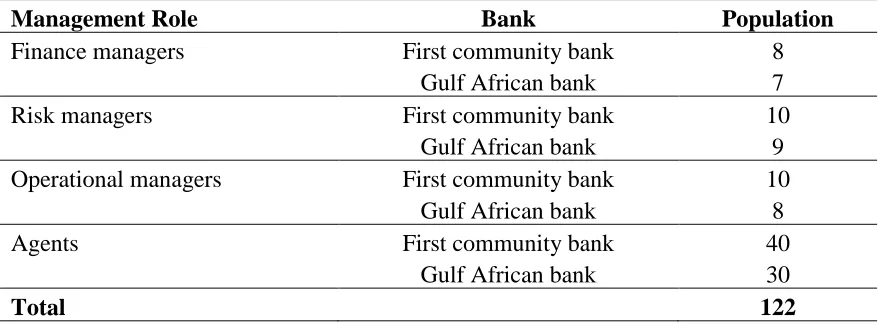
32 Table 3.1 Target Population
Management Role Bank Population
Finance managers First community bank 8
Gulf African bank 7
Risk managers First community bank 10
Gulf African bank 9
Operational managers First community bank 10
Gulf African bank 8
Agents First community bank 40
Gulf African bank 30
Total 122
3.4 Sampling Technique and Sample Size
Sampling is taking a portion of a population as a representative of that population and using it as a basis for making conclusion about the population. A sample is a part of the population that is drawn using means that ensure that it is as representative of the population as possible (Gay, 1992).
3.4.1 Sampling Technique
The study adopted purposive sampling to select the banks and respondents. According to Kombo and Tromp (2005), purposive sampling is a method whereby the researcher purposely targets a group of people believed to be reliable for the study. Therefore, in the current study, purposive sampling was used because the researcher was interested in getting data from respondents who have information about the phenomenon under study which is risk management and financial performance. These comprised of bank managers, channels supervisors and bank agents.
3.4.2 Sample Size
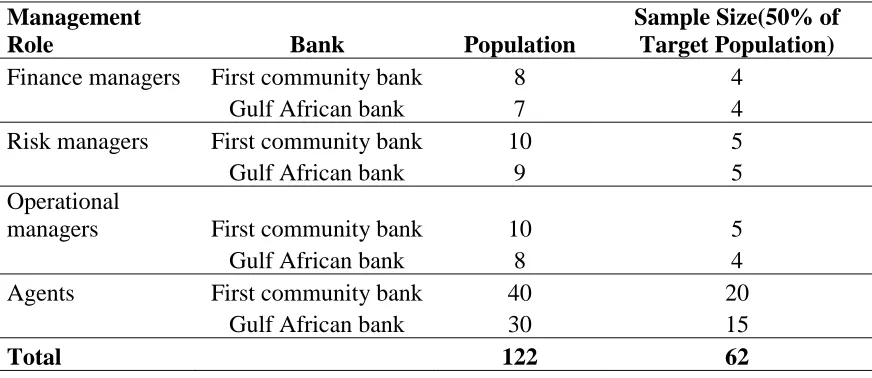
33
banks staff which are Gulf African Bank and First Community Bank. These compromised of 7 finance managers, 9 Risk managers, 9 Operational managers and 35 Agents. Hence a total sample of 60 was used.
Table 3.2 Sample Size Management
Role Bank Population
Sample Size(50% of Target Population)
Finance managers First community bank 8 4
Gulf African bank 7 4
Risk managers First community bank 10 5
Gulf African bank 9 5
Operational
managers First community bank 10 5
Gulf African bank 8 4
Agents First community bank 40 20
Gulf African bank 30 15
Total 122 62
Source: First Community Bank and Gulf African Bank (2016) 3.5 Data Collection Instruments and Procedure
Creswell (2002) defines data collection as a means by which information is obtained from the selected subjects of an investigation. Primary data collection instruments included questionnaires containing open ended and close ended questions. Close ended questions have the advantage of collecting viable quantitative data while open-ended questions allow the respondents freedom of answering questions and the chance to provide in-depth responses.
34
getting data objectively; information on facts, attitudes, motivation and knowledge can be obtained easily.
Secondary data involved the collection and analysis of published material and information from other sources such as annual reports, published data. The research administered a questionnaire to each member of the target population. The questionnaire were designed and tested with a few members of the population for further improvements. This was done in order to enhance its validity and accuracy of data to be collected (Creswell, 2002).
3.6 Pilot Testing
Prior to actual collection of data, a pilot testing was conducted to obtain some assessment of the questions’ validity and the likely reliability of the data that was collected. It is during the pre-test of the instrument that the researcher was be able to assess the clarity of the instrument and the ease of use of the instrument (Mugenda & Mugenda, 2009).Pilot testing was used to test design or instruments prior to carrying out research (Saleemi, 2009; Gupta, 2007). It helped to show the adequacy of research instruments and whether research protocol is realistic and workable (Mugenda, 2008; Saleemi, 2009; Gupta, 2007). It helps to ascertain the validity (the extent to which data produced truly measures what is purported to measure and reliability (consistency of data collected).
3.7 Validity and Reliability 3.7.1. Validity
"common-35
sense" assessment, as well as being reliant on knowledge of the way people respond to survey questions and common pitfalls in questionnaire design.
Content validity was used to assess whether all important aspects of the construct are covered. The research based clear definitions of the construct from the conceptual framework and literature review and sought to find out whether the questions and the results were successful in predicting the relationship established. To assess the validity of the scores by the respondents, the researcher used criterion or predictive validity. Lastly, the researcher adopted formative validity which was applied to outcome assessments to assess how well a measure was able to provide information to help improve the program under study.
3.7.2 Reliability
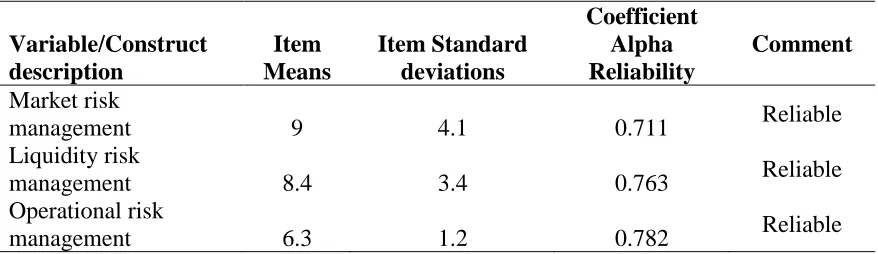
Reliability is the measure of the consistency of the results from the tests of the instruments. It is a measure of the degree to which a research instrument yields consistent results or data after repeated trials. It is influenced by random error. Reliability of the research instrument will be tested using Cronbach’s alpha coefficient of reliability. The Cronbach’s alpha coefficient ranges from 0 to 1. The higher the score, the more reliable the generated scale is. Statistical programme SPSS was used as the tool of analysis to test the relationship between the dependent variable and the three independent variables Cronbach’s alpha of well above 0.7 implies that the instruments were sufficiently reliable for the measurement. Most item total correlations were reasonably high, the construct validity of the instruments was considered reasonable. Table 4.1 Reliability and Validity
Variable/Construct description Item Means Item Standard deviations Coefficient Alpha Reliability Comment Market risk
management 9 4.1 0.711 Reliable
Liquidity risk
management 8.4 3.4 0.763 Reliable
Operational risk
36 3.8 Data Analysis and Presentation
The questionnaires were checked for completeness and consistency of information at the end of every field data collection day and before storage. Data capturing was done using Excel software. The data from the completed questionnaires was cleaned, re-coded and entered into the computer using the statistical packages for social sciences (SPSS version 21) for Windows for analysis. The SPSS computer program was commanded to produce frequency tables, graphs, pie charts and the necessary measures of variances for interpretation. Data was presented in the form of frequency distribution tables, graphs and pie charts that facilitated description and explanation of the study findings. Correlation was used to analyze the degree of relationship between the variables in the study. Inferential statistics through the use of Multiple Linear Regression model was employed to establish the significance of the independent variables on the dependent variable. The findings were presented using tables and charts. The following multiple regression model was applied
Y= a + B1*X1 + B2*X2 + B3*X3+ e Where;
Y= Financial performance of Islamic banks a = Constant
37
CHAPTER FOUR
DATA ANALYSIS AND INTERPRETATION 4.0 Introduction
This chapter presents analysis and findings of the study as set out in the research methodology. The study findings show the effects of risk management on financial performance of Islamic banks in Kenya.
4.1 Response Rate
The sample of the study comprised of 62 respondents. The research instruments were administered to the respondents. Out of 62 questionnaires that were administered, 51 were duly filled and returned. This was a response rate of 82.69%. This response rate was excellent and conforms to Mugenda and Mugenda (2003) argument that a response rate of above 70% is excellent for generalization of findings to the whole population. 4.3 Demographic Information
4.3.1 Gender of the Respondents
38 Figure 4.1 Gender of the Respondents 4.3.2 Level of Education of the Respondents
From the descriptive statistics shown in figure 4.3, 26% of the respondents reported to be postgraduates, 38% of them were graduates while 28% of the respondents were diploma holders/certificate holders. The findings of the study concur with that of Tafor (2010) who observed that each bank institution has its own management organization structure with a matching head count budget to support the business and the persons assigned various duties should possess requisite professional and academic qualifications.
Figure 4.2 Respondents Level of Education
46%
54%
Men
Female
0% 10% 20% 30% 40%
Certificate/Diploma Graduate Postgraduate
28%
38%
39 4.3.3 Respondents Work Experience
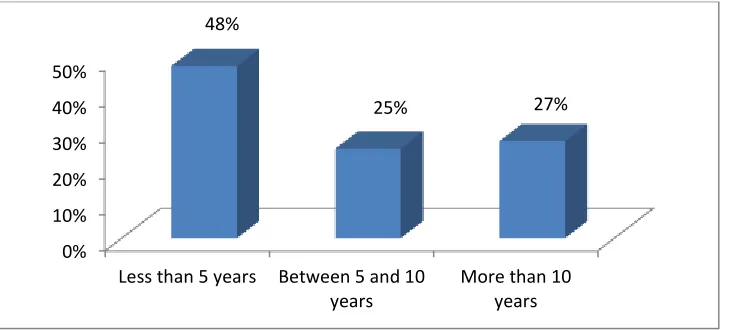
The study found it necessary to find out the respondents’ work experience as staff members in the Islamic banking so as to find out the relationship between work experience and financial performance of Islamic banks in Kenya. The findings of the study are displayed in figure 4.4. Based on the findings, 25% of the respondents had 5 and 10 years’ experience while 48% had less than 5 years. It was also revealed that 27% had experience of more than 10 years.
Figure 4.3 Respondents Work Experience
From the findings therefore, majority of the respondents were experienced and hence were highly informative on issues that relate to financial performance of Islamic banks in Kenya Given that majority of the respondents had substantial work experience, it was therefore expected that the financial performance of Islamic banks in Kenya would be good.
4.4 Descriptive Statistics
4.4.1 Market Risk Management and Financial Performance of Islamic Banks in Kenya
The respondents were asked whether market risk management influenced the financial performance of Islamic banks in Kenya. The majority (74%) of the respondents indicated that market risk influenced the financial performance of Islamic banks in Kenya while 26% disagreed. The findings of the study are displayed in figure 4.4.
0% 10% 20% 30% 40% 50%
Less than 5 years Between 5 and 10 years
More than 10 years 48%
40 Figure 4.4 Market Risk Influence
The objective was to determine the extent to which market risk management influence the financial performance of Islamic banks in Kenya. From the findings in Table 4.2, majority (42%) of the respondents indicated that market risk influence the financial performance of Islamic banks in Kenya to a large extent, 29% to a very large extent, 15% to a moderate extent, 8% to a small extent and 6% Not at all. These findings correspond with that of Gallati (2003) who found out that exposure to market risk may arise as a result of the bank taking deliberate speculative positions or may come from the bank’s market-making, dealer, activities. For example, operating margins can be eroded due to the rising prices of raw materials or depreciating currencies in countries in which a company has foreign sales (direct market risk impact). The study implied that market risk can impact on a company’s business in many different ways.
Table 4.2 Market Risk and Financial Performance of Islamic Banks in Kenya
Market risk Frequency Percent
To a very large extent 15 29
To a large extent 22 42
To a moderate extent 8 15
To a small extent 4 8
Not at all 3 6
Total 52 100
The respondents were also asked to respond to some statements on market risk management. According to the findings, market risk by its nature can be hedged but cannot be diversified away completely: 54.3% of the respondents strongly agreed; 32%
74% 26%
Yes
41
agreed; 4% were neutral; 6.2% disagreed; 3.5% strongly disagreed that employees are always involved in decisions that directly affect how their work is done; 39% of the respondents strongly agreed that market risks are of concern to the banking sector are interest rates and relative value of currencies; 41% agreed; 8% were neutral; 10% disagreed; while 2% strongly disagreed. Majority 45.1% of the respondent strongly agreed that they measured and managed the firm’s vulnerability to interest rate variation as well 38.6% agreed; 8.3% were neutral; 6% disagreed while 2% strongly disagreed and 30.7% strongly agreed that exposure to market risk may arise as a result of the bank taking deliberate speculative positions 33% agreed; 14.2% were neutral; 18% disagreed while 4.1% strongly disagreed as indicated by the mean 3.8, 3.5, 4.1, and 4.0 respectively.
These findings relate with the literature review where Santomero (1997) found out that exposure to market risk may arise as a result of the bank taking deliberate speculative positions or may come from the bank’s market-making, dealer, activities.
Table 4.3 Influence of Market Risk Management on Financial Performance
Statement Strongly agree (%) Agree (%) Neutral (%) Disagree (%) Strongly disagree
(%) Mean
Market risk can be hedged but
cannot be diversified 0.354 32 4 6.2 3.5 3.8
Market risks related to banks are interest rates and relative
value of currencies 39 41 8 10 2 3.5
Market risk measures and manage the firm's vulnerability
to interest rate variation 45.1 38.6 8.3 6 2 4.1
Exposure to market risk arise when banks take deliberate
speculative positions 30.7 33 14.2 18 4.1 4
4.4.2 Liquidity Risk Management and Financial Performance of Islamic Banks in Kenya
42
liquidity risk influenced the financial performance of Islamic banks in Kenya while 5% disagreed. The findings of the study are displayed in figure 4.5 below.
Figure 4.5 Liquidity Risk Influence
The objective of the study was to determine the extent to which liquidity risk management influenced the financial performance of Islamic banks in Kenya. From the findings in Table 4.4, majority (42%) indicated that liquidity risk influenced the financial performance of Islamic banks in Kenya i.e. high, 27% very high, 15% to a moderate extent, 10% low and 6% very low extents. These echoed findings by Greuning and Bratanovic (2009) that the price of liquidity is conversely a function of market conditions and the market‘s perception of the inherent riskiness of the borrowing institution. The study concluded that liquidity shortfall at a single bank can have system-wide repercussions and hence liquidity risk management is of paramount importance to both the regulators and the industry players.
Table 4.4 Liquidity Risk Influence on the Financial Performance of Islamic Banks
Innovativeness Frequency Percent
Very High 14 27
High 22 42
Moderate 8 15
Low 5 10
Very Low 3 6
Total 52 100
The respondents were further asked to indicate the extent to which they agreed to various statements on liquidity risk.
43
Table 4.5 Liquidity Risk Management and Financial Performance of Islamic Banks
Statement Strongly agree (%) Agree (%) Neutral (%) Disagree (%) Strongly disagree
(%) Mean
Banks face liquidity risk when they don’t efficiently
accommodate the redemption of deposits and other liabilities and to cover funding increases in the loan and investment portfolio
50 34.1 7.2 7.1 1.6 3.5
Liquidity risk management is of paramount importance to both the regulators and the industry players
43.7 19.5 14.3 18.4 4.1 4.4
Financial market developments have increased the complexity of liquidity risk and its management
15 74.6 6.0 2.4 2 4.4
Loans make banks inherently vulnerable to liquidity risk. The price of liquidity is conversely a function of market conditions and the market‘s perception of the inherent riskiness of the borrowing institution
40.8 31 15.9 8.2 4.1 4.1
44
were neutral 8.2% disagreed while 4.1% strongly disagreed. As shown by mean of 3.5, 4.4, 4.4, and 4.1 respectively.
These findings concurred with June (2008) who asserts that the fundamental role of banks in the maturity transformation of short-term deposits into long-term loans makes banks inherently vulnerable to liquidity risk, both of an institution-specific nature and that which affects markets as a whole.
4.4.3 Operational Risk Management and Financial Performance of Islamic Banks in Kenya
The respondents were asked whether operational risk influenced the financial performance of Islamic banks in Kenya. The majority (81%) of the respondents indicated that operational risk influenced the financial performance of Islamic banks in Kenya while 19% disagreed. The findings of the study are displayed in figure 4.6 below.
Figure 4.6 Operational Risk Influence on Financial Performance of Islamic Banks The objective of the study was to determine the extent to which operational risk influence the financial performance of Islamic banks in Kenya. From the findings in Table 4.6, a majority of the respondents (44%) indicated that operational risk influenced the financial performance of Islamic banks in Kenya to high extent, 23% to a very large extent, 17% to a moderate extent, 12% to low extent and 4% very low extent.
81% 19%
Yes
45
Table 4.6: Extent to which Operational Risk Influence the Financial Performance
Operational risk Frequency Percent
Very High 12 23
High 23 44
Moderate 9 17
Low 6 12
Very low 2 4
Total 52 100
46
Table 4.6 Operational Risk Management and Financial Performance of Islamic Banks Statement Strongly agree (%) Agree (%) Neutral (%) Disagree (%) Strongly disagree
(%) Mean
Operational risk is the risk of direct or indirect loss
resulting from inadequate or failed internal processes
55 22 14 5.2 4.0 3.7
Operational risks, appears at different levels, such as human errors, processes, and technical and information technology
14 3 21 45 17 3.9
Operational risk has led to an increased attention on the development of sound operational risk management systems by banks
2.5 6.1 4.1 22 65.3 4.3
Operational risks result in increases in the bank’s operating cost
14.3 4.1 18.4 34.7 28.5 3.6
Operational risks interact with credit and market risk
13 4 22 44 17 3.9
47 4.4.4 Financial Performance of Islamic Banks
The study aimed to establish the key factors that determine financial performance of Islamic banks. These factors included turnover/sales, expenditure, surplus/deficit, fixed assets, and current assets. From the findings in Table 4.8, turnover/sales had a mean score of 4.523, expenditure had a mean score of 4.309, surplus/deficit had a mean score of 4.642, fixed asset had a mean score of 4.744, and current asset had a mean score of 4.882. These findings were in line with those of Druncker (2010) who found out that financial performance of Islamic banks of banks is determined by increases in turnover/sales, current asset and fixed asset. Inferences revealed that fixed asset, current asset, expenditure to a large extent determines financial performance of Islamic banks in Kenya
Table 4.7 Financial Performance of Islamic Banks
Profitability factors N Mean Std. Deviation Variance
Turnover/sales 52 4.523 0.7404 0.548
Expenditure 52 4.309 0.7152 0.512
Surplus/deficit 52 4.642 0.6176 0.382
Fixed asset 52 4.744 0.6273 0.387
Current asset 52 4.882 0.6419 0.392
Average 52 4.492 0.6911 0.48
4.5 Inferential Statistics
48 Y= a + B1*X1 + B2*X2 + B3*X3+ e
For this model, financial performance of Islamic banks was used as the dependent variable (Y) and independent variables included (X1) market risk management, (X2) liquidity risk management, and (X3) operational risk management. The relationships between the dependent variable and independent variables, and the results of testing significance of the model were also respectively interpreted. In interpreting the results of multiple regression analysis, the three major elements considered were: the coefficient of multiple determinations, the standard error of estimate and the regression coefficients. R squared was used to check how well the model fitted the data. R squared is the proportion of variation in the dependent variable explained by the regression model. These elements and the results of multiple regression analysis were presented and interpreted accordingly in table 4. 9, table 4.10 and table 4.11.
49 Table 4.8 Regression Model Summary
Model R R Square
1 .949 .901
Predictors: (Constant), X1, X2, X3
The study further used one way Analysis of Variance (ANOVA) in order to test the significance of the overall regression model. Green and Salkind (2003) posit that one way Analysis of Variance helps in determining the significant relationship between the research variables. Table 4.10 hence shows the regression and residual (or error) sums of squares. The variance of the residuals (or errors) is the value of the mean square which is 2.280. The predictors X1, X2, and X3 represent the independent variables notably; (X1) market risk management, (X2) liquidity risk management, and (X3) operational risk management as the major factors influencing financial performance of Islamic banks. Table 4.10 presents the results of ANOVA test which reveal that all the independent variables notably; (X1) market risk management, (X2) liquidity risk management, and (X3) operational risk management had a significance influence on financial performance of Islamic banks. Since the P value was actual 0.00 which was less than 5% level of significance. Table 4.10 also indicates that the high value of F (84.353) with significant level of 0.00 is large enough to conclude that all the independent variables significantly influenced financial performance of Islamic banks.
Table 4.9 Analysis of Variance (ANOVA)
Model Sum of
Squares
df Mean Square F P-Value.
1 Regression 9.119 4 2.280 84.351 .000
Residual 1.000 37 .027
Total 10.119 41
50 b. Dependent Variable: Y
Table 4.11 presents the results of the test of beta coefficients which indicates that the significant relationship between independent variables notably; (X1) market risk management, (X2) liquidity risk management, and (X3) operational risk management and dependent variables Y= Financial performance of Islamic banks. As presented in Table 4.11, (X1) market risk management coefficient of 0.898 was found to be positive at significant level of 0.001 and this indicates that market risk has a positive influence on financial performance of Islamic banks. (X2) liquidity risk management coefficient of 0.544 was found to be positive at significant level of 0.004 and this indicates that liquidity risk management has a positive influence on financial performance of Islamic banks. (X3) operational risk management adoption coefficient of 0.644 was found to be positive at significant level of 0.003 and this indicates that operational risk management adoption has a positive influence on financial performance of Islamic banks. This clearly demonstrates that all the independent variables significantly influenced financial performance of Islamic banks but the relative importance of each independent variable was different. However, since the significance values were less than 0.005, all the coefficients were significant an thus the regression equation was;
Y=0.217 + 0.898X1 + 0.544X2 + 0.644X3+ e Table 4.10 Coefficients of Variables
B- Coefficients Std. Error Sig F
(Constant) 0.217 .211 .005
X1 0.898 .184 .001
X2 0.544 .168 .004
X3 0.644 .170 .003
51
52
CHAPTER FIVE
SUMMARY, CONCLUSIONS AND RECOMMENDATIONS 5.1 Introduction
This chapter gives a summary of the major findings on the effects of risk management techniques on financial performance of Islamic banks in Kenya The chapter draws the study conclusions and discuses major recommendations and gives suggestion for further studies.
5.2 Summary of the Findings
The main objective of this study was to establish the effects of risk management techniques on financial performance of Islamic banks in Kenya the study found out that a bank faces liquidity risk when it does not have the ability to efficiently accommodate the redemption of deposits and other liabilities and that operational risks appears at different levels, such as human errors, processes, and technical and information technology. The study also established that the major factors that influenced financial performance of Islamic banks included; market risk management, liquidity risk management, and operational risk management.
5.2.1 Market Risk Management
The objective of the study was to determine the effects of market risk management on the financial performance of Islamic banks in Kenya. The study findings showed that there was a positive and significant relationship between market risk management and financial performance of Islamic banks. The results showed that a unit increase in market risk management leads to a 0.898 increase in financial performance of Islamic banks. These findings relate with the literature review where Santomero (1997) found out that exposure to market risk may arise as a result of the bank taking deliberate speculative positions or may come from the bank’s market-making, dealer, activities. 5.2.2 Liquidity Risk Managemnt
53
that liquidity risk management and financial performance of Islamic banks were positively and significantly related. A unit increase in liquidity risk management led to 0.544 increases in financial performance of Islamic banks in Kenya. These findings concurred with June (2008) who asserts that the fundamental role of banks in the maturity transformation of short-term deposits into long-term loans makes banks inherently vulnerable to liquidity risk, both of an institution-specific nature and that which affects markets as a whole.
5.2.3 Operational Risk Management
The third objecctive of the study was to assess the effects of operational risk management on the Financial performance of Islamic banks in Kenya. The study found that operational risk management had a positive and significant effect on the financial performance of Islamic banks in Kenya. A unit increase in operational risk management leads to 0.644 increases in financial performance of Islamic banks.
5.3 Conclusion
The study findings showed that there was a great influence of all the three variables notably; market risk, liquidity risk, and operational risk on financial performance of Islamic banks in Kenya. The study found out that there was 94.9% corresponding change in financial performance of Islamic banks for every change in all the three predictor variables jointly. Test of overall significance of all the three variables jointly, market risk, liquidity risk, and operational risk using ANOVA at 0.05 level of significant found the model to be significant. The study finally found out that the key factors that determined the state of financial performance of Islamic banks included; fixed assets, current asset expenditure influenced the financial performance of Islamic banks. This was in line with Druncker (2010) performance of many commercial banks is determined by increases in fixed asset, current asset and expenditure.
5.4 Recommendations
54
The study also recommends that the management of the Islamic banks should strive to achievean optimal capital structure for their Islamic banks in order to enhance their banks’
value henceleading to an increase in their’ financial performance.
It is recommended that the Islamic banks should involve executive management risk management policies in the process of financial risk management on financial performance of Islamic banks. Training should be organized for staff so that they learn more about the concept of risk management on financial performance. Effective communication with employees to make them aware of the risks management in the companies is highly recommended as it will help them understand the way around risk management. The study also recommends that risk management techniques should be emphasized and made more effective in the Islamic banks.
5.5 Suggestions for Further Research
55 REFERENCES
Ahmed, H. (2008). Risk management assessment system: An application to Islamic banks.
Akkizidis, I., & Khandelwal, S. K. (2008). Financial risk management for Islamic banking and finance. Palgrave Macmillan, First Ed.
Al-Tamimi, H., & Al-Mazrooei, M. (2007Banks’ risk management: A comparison study of UAE national and foreign banks. The Journal of Risk Finance,8(4), 394-409. Babbie, E. (2002). Survey research methods (2nded.). Belmont: Wodsworth.
Bernstein, P. (1996). Against the Gods. New York: John Willey & Sons.
Central Bank of Kenya. (2013). Developments in the Kenyan Banking Sector for the Quarter ended 30th June, 2012.
Chandran, E. (2004). Research Methods. Nairobi: Starbright Services Limited. Chew, L. (1994). Shock treatment. Risk, 7(9), 63-70.
Cooper, D., & Schindler, P.S. (2003). Business research methods (8thed). New Delhi: Tata McGraw-Hill Publishing Company. India.
Croupy, M., Galai, D., & Mark, R. (2001). Risk management, McGraw-Hill, New York. Davies, J., & Haubenstock, M., (2002). Building effective indicators to monitor
operational risk. The RMA Journal, 84(4), 40-43.
Diamond, D. W., & Rajan, R. G. (2001). Liquidity risk, liquidity creation, and financial fragility: A theory of banking. The Journal of Political Economy, 19(2), 287-327. Dogarawa, A. B. (2006). Challenges of banking consolidation to the Central Bank of Nigeria: A descriptive analysis. Journal of Business Administration, Ahmadu Bello University Zaria, 1(2): 7-13.
Gallati, R. (2003). Risk management and capital adequacy, New York: McGraw Hill. Hoffmann, D. G. (2002). Managing operational risk, John Wiley and Son, Inc, New
York.