Multi-Party Privacy-Preserving Set Intersection with
Quasi-Linear Complexity
Jung Hee Cheon1, Stanislaw Jarecki2, Jae Hong Seo1
1
Department of Mathematical Sciences, Seoul National University,
{jhcheon,jhsbhs0}@snu.ac.kr
2Department of Computer Science, University of California, Irvine [email protected]
Abstract. Secure computation of the set intersection functionality allowsnparties to find the intersection between their datasets without revealing anything else about them. An efficient pro-tocol for such task could have multiple potential applications, in commerce, health-care, and security. However, all currently known secure set intersection protocols for n >2 parties have computational costs that are quadratic in the (maximum) number of entries in the dataset con-tributed by each party, rendering secure computation of set intersection impractical on anything but small datasets.
In this paper we describe the first multi-party protocol for securely computing the set intersec-tion funcintersec-tionality with both the communicaintersec-tion and the computaintersec-tion costs that are quasi-linear in the size of the datasets. Specifically, our protocols require O(n2kλ) bits of communication and ˜O(n2λ+ (nλ+n2)k) group multiplications per player in the malicious adversary setting, wherek is the size of each dataset and λis security parameter. Our protocol follows the basic idea of the protocol proposed by Kissner and Song [16], but we gain efficiency by using different representation of the polynomials associated with users’ datasets, and careful employment of algorithms that interpolate or evaluate polynomials on multiple points more efficiently. Keywords:multi-party set intersection, privacy-preserving set operation
1 Introduction
Privacy-Preserving Set Intersection (PPSI) is one of the most interesting and useful invention of multi-party computations.PPSIprotocol enables each user to broadcast her encoded private dataset and to obtain only intersection of all users’ private sets at the end of protocol. It can be used when several commercial companies want to share intersection of their customer lists while their own list except the set intersection is protected.
There are general multi-party computations that implement secure computation for any function to be able to express as a circuit [26, 12], so that they can be solutions forPPSI. In general, however, the overall overheads is often unacceptable since the complexity is depending on the size of circuit and the protocol requires expensive operations such as several oblivious transfers. Especially, the complexity of general multi-party computation is more higher in the presence of the malicious adversary (who can do anything arbitrarily) than the honest-but-curious adversary (who follows protocol’s directions correctly).
In the case for multiple participants more than two (we simply call the multi-party case), the improvement with respect to the complexity has gradually be done, compared with the two-party case. Kissner and Song [16, 17] first addressed PPSIin the multi-party case using outstanding techniques basing on the work by Freedman et al. Recently Sang and Shen [21, 22] advanced Kissner and Song’s result by reducing complexity in terms of the number of players. In contrast with the two-party case, however, all proposed protocols for PPSI in the multi-party case have quadratic complexity in the size of private dataset, and finding a efficient solution for PPSI with linear complexity in the input size in the multi-party case remains still open (even in the honest-but-curious adversary model).
In multi-party cryptography against the malicious adversary, the robustness has been considered as an important property [3, 7]. When a corrupted player’s malicious behavior is detected, a non-robust protocol will stop, and then the protocol should restart excluding a corrupted player. On the other hand, a robust protocol can output the desired result without restarting even if some subset of corrupted players’ malicious behaviors are detected.
In this paper our contributions are two folds. First, we present aPPSIprotocol and show that each player in our PPSIprotocol requires to transferO(n2k) encryptions and to compute
˜
O(n2λ+(nλ+n2)k) group multiplications. (k: the size of user’s dataset,n: the number of users, λ: security parameter) Especially, if we focus on the online computation (that is, computations except the local computations used for input/output data representation conversions), each player is required to computeO(n2λ+(nλ+n2)k) group multiplications. Second, we prove that the proposed PPSI protocol is robust in the presence of malicious adversary. That is, even if corrupted players leave before the end of protocol, our protocol outputs set intersection among players who proved that their input datasets are well-formed.
Technical Overview Let us explain key ideas of our construction. When one employs a polynomial to represent her private dataset, multiplications over encrypted polynomials and their zero-knowledge proofs are the most expensive in the system. In particular, all previous works dealing withPPSIin the multi-party setting by using polynomials to represent datasets consider a polynomial as a tuple of its coefficients, so that a multiplication over encrypted polynomials impose quadratic computational and communicational complexities in the degree of polynomials [16, 17, 20–22].
Our approach to reduce the complexity is to represent a polynomialf(x) by several points on the curvey=f(x). This gives us two benefits: one is that polynomial multiplications can be efficiently performed and the other is that it allows simple zero-knowledge proofs for mul-tiplications over encrypted polynomials. For the first part, if we write polynomialsf(x) and g(x) by{(s, f(s))}s∈S and {(s, g(s))}s∈S, respectively for an index set S, a multiplication of
two polynomials is simply done by{(s, f(s)·g(s))}s∈S.Hence the computational complexity
of the protocol except the input/output data representation conversions becomes linear. Be-cause of the simple computation for a polynomial multiplication, we can construct a simple zero-knowledge proof for a multiplication over encrypted polynomials. It impose only linear computation and communication overheads to the protocol.
be dominated by cryptographic operations such as encryptions, exponentiations, etc. In our protocol, however, each player should perform polynomial arithmetics such as evaluation and interpolation when coefficients or values are given in the exponent. For example, given a set of group elements {ga0,· · ·, gak} and a field element α one should compute gf(α) where
f(x) =Pk
i=0aixi and g is a group generator. In this case, for polynomial arithmetics group
multiplications and group exponentiations should be used instead of field additions and scalar multiplications. Therefor the cost for polynomial arithmetics in our protocol is as significant as that of cryptographic operations. We will deal with a way how to speed up these conversions, and show that the way is appropriate to our protocol.
The goal of robustPPSIprotocol is to compute set intersection among players who proved their well-formed input (i.e. a set of pairs of a point and an encrypted value {(s, cs)}s∈S
satisfies that for eachs∈S an equality cs=Encpk(h(s)) holds for some k-degree polynomial
h(x) where an index set S is given by the protocol.) even when some subset of corrupted players leave protocol after proving their well-formed input. One may think that this problem is easily solved by using Verifiable Secret Sharing (VSS) scheme, such as Pedersen VSS (Ped-VSS) [19]. It is, however, difficult to deal with encryptions that are shared by VSS. More precisely, it is uneasy to construct zero-knowledge proofs on encrypted messages that are shared by VSS before recovering shared encryption. For example, letc be an encryption of m, and suppose that a dealer wish to share c by using Ped-VSS. Then, the dealer should encodec as an element of some fieldFq of size q and commitGcHd whereG, H are elements
in some group of order q and d is chosen at random at random from Fq. If we used an
additive homomorphic encryption to encryptm forc, then usually the message is located in the exponent of encryption. (For example, messages are located in exponents of encryptions if we use Paillier encryption [18] and the modified ElGamal encryption which is explained in the section 2.) Then,m in the shared encryption should be located in the exponent of exponent of committed value GcHd. To the best of our knowledge, there is no known zero-knowledge proofs for the relation associated with such m, e.g. zero-knowledge proof for knowledge of suchm.
We construct a robust protocol in the presence of the malicious adversary by proposing simple VSS scheme which allows to share encryptions and supports zero-knowledge proofs on shared encryptions. To share an encryption Encpk(m) the dealer can broadcast Com0ck(c)
and Encpk(m+c) where Com0ck is an additive homomorphic trapdoor commitment, Encpk
is an additive homomorphic encryption, and c is a random integer. Thereafter, the dealer verifiably secret-shares c by using VSS. To recover Encpk(m), all players recover c and next
computeEncpk(m+c)⊕Encpk(−c) where⊕denotes an add operation between corresponding
plaintexts. Since both Com0ck and Encpk have the additive homomorphic property, we can
efficiently construct zero-knowledge proofs for the statement associated with m, e.g. zero-knowledge proof for zero-knowledge of m. Furthermore, in the security proof, the simulator can equivocate onm as it can equivocate on c if it has a trapdoor of Com0ck. Therefore, we can construct a robustPPSIprotocol by using such a simple VSS.
It is worth to note that ourPPSIprotocol uses a so-called ‘common reference string’ since we use Pedersen commitment scheme as a building block to design PPSI protocol, and we assume that there exists a broadcast channel.
secure in the malicious adversary model using general zero-knowledge proof techniques [17]. Sang and Shen [20–22] proposed protocols having better efficiency than [17]. However, they only reduced the complexity in terms of the number of players, and their protocols still keep quadratic complexity in the input size.
In the two-party case of PPSI, there are several notable researches. Freedman, Nissim, and Pinkas proposed the first asymmetric two-party set intersection protocol using oblivious polynomial evaluation [8]. However, their schemes are only secure against malicious client, or secure against malicious server (not both). Dachman-Soled et al. improved security so that proposed a protocol secure against both malicious parities [5]. Hazay and Nissim advanced complexity so that they attains almost linear complexity in the input size [14]. Camenisch and Zaverucha considered the case that no malicious adversaries can choose arbitrary their private inputs [2]. Using an oblivious pseudorandom function, Hazay and Lindell [13] provided two-party protocols which are secure in the standard model against covert parties [1]. Jarecki and Liu [15] improved its security so that secure in the standard model against both malicious parties. Cristofaro and Tsudik [4] presented two-party protocols with linear complexity by extending privacy-preserving information transfer, and they also proposed the authorized set intersection protocol which allows the set intersection only for authorized private set.
Outline We give definitions and tools of cryptography. In Section 3 we propose a new repre-sentation, callpoint representation, to describe private datasets, and possible operations over point representation. We present two protocols, each for different adversary models, so-called Honest-But-Curious adversary and the malicious adversary, in Section 4. In Section 5 we show how to speed up local computations of protocols, and analyze the complexities of the proposed protocol.
2 Definitions and Primitives
Notations Throughout this paper we will use several notations. Let n be the number of players participating in the protocol, k be the number of entries in each player,1 Zp be a
finite field with prime p of size 2λ, Zp[x] be a polynomial ring over Zp, Zdp[x] be a set of all
polynomials of degree at mostdin Zp[x]. For a setA,a $
←A denotes ais uniformly chosen at random from A. [a, b] denotes a set{α∈Z|a≤α≤b}.
Adversary Model In this paper we are interested in the malicious adversary model rather than the Honest-But-Curious (HBC) adversary model, but we present a HBC protocol as an intermediate protocol to obtain a malicious one. In HBC adversary model, the adversary follows protocol’s prescribed directions and he can utilize all information obtained during the protocol procedure for purpose to gain other information than the protocol’s desired result, set intersection in PPSI protocol. In contrast to HBC adversary model, malicious adversary may corrupted some subset of players less than half and gain full controls over the corrupted players. She may not follow the given prescribed actions of protocol and may behave arbitrarily. We cannot prevent refusing of malicious adversary to participate in the protocol, running the protocol along with arbitrary values as his private input, or prematurely aborting the protocol.
Informally, we say anPPSIprotocol is secure in the presence of malicious adversary if for any malicious adversary fully controlling a set of colluders in the real world, there exists a probabilistic polynomial running-time algorithm that translates all strategies of a malicious adversary in the real world to the strategies in the the ideal world, and follows in the ideal world. Furthermore, the real execution is computationally indistinguishable from the execu-tion in the ideal world to the malicious adversary. We refer to [11] for the formal definiexecu-tions for the HBC adversary model and the malicious adversary model.
Additive Homomorphic Encryption Our construction utilizes an additive homomorphic encryption scheme. In particular we describe our protocol by using the modified encryption scheme widely used in the set intersection protocol [8, 2, 5].
The modified ElGamal encryption consists of three algorithms.
• Setup(λ): Group generating algorithm takes the security parameter λand generates group description (G, g,1G, p) wheregis a generator of a cyclic groupGof prime order p, and 1G is
the identity element in G. Choose a random integerx fromZp and set pk← {gx},sk← {x}.
• Encpk(m;r):CT ←(gr, pkrgm).
• Decsk(CT): Parse CT as (C0, C1) and output C1·C0−sk.
This modified ElGamal encryption is additively homomorphic on message, and random-ness as well:
Encpk(m1;r1)⊕Encpk(m2;r2) =Encpk(m1+M2 modp;r1+r2 modp)
where ⊕ operation denotes component-wise group multiplications. To denote additions of several ciphertextsCTi fori∈[1, `], we use a notation ⊕i∈[1,`]CTi. A scalar multiplication is
also easily allowed by repeatedly computing⊕operation, that is, given a scalar c∈Zp,
Encpk(m;r)⊕ · · · ⊕Encpk(m;r)
| {z }
c times
=Encpk(cmmodp;crmodp)
For a ciphertext CT and an integer c we simply denote a scalar multiplication of CT by c as CTc. Since Dec algorithm outputs gm instead of the plaintext m, it does not support a complete decryption. However, its the additive homomorphic property still allows to enjoy our PPSIprotocol without a complete decryption algorithm. Further, the modified ElGamal encryption allows that ciphertexts can be re-randomize without the secret key.
Distributed Key Generation and Threshold Decryption We use the threshold version of the modified ElGamal encryption for which there exists efficient distributed key generation and the threshold decryption protocols which are secure in the malicious adversary setting. We take the distributed key generation protocol, denoted DKG, from [10]. For the threshold decryption protocol, denoted TDec, we use the protocol of [6], amended by the use of a zero-knowledge proof of correctness of partial decryption. We use the distributed version of this zero-knowledge proof which is suitable to the multi-party computation setting, as we explain in Section 4.2. For completeness we note that the proof of correctness of partial decryption is a proof of discrete-logarithm equality, which is actually a simplification of the proofHVZKPK-P we explain in that section.
3 Representation for Efficient Private Data Manipulation
Let Xi ⊂ Zp be the set of private inputs of a player Pi. We associate the set Xi with a
polynomial fi(x) =Qaj∈Xi(x−aj), called the private polynomial ofPi.
All previous protocol [8, 16, 2, 5] that use polynomials to encode private datasets utilize the coefficient representation: a set of coefficients of the private polynomial. When we adopt the coefficient representation, a multiplication between two polynomials f(x) = Pk
i=0aixi
and g(x) =Pk
i=0bixi is given by
f(x)·g(x) =
2k
X
`=0
X
i+j=`
aibjx`.
This makes the computational complexity be quadratic in k. Furthermore, the zero-knowledge proof proving this computation makes the communication complexity be quadratic in k, too.
To achieve linear complexity in k, we propose a new representation for private datasets, called Point Representation(PR).
Point Representation Given a setX, and a public index set S of size `, we definePR ofX
by the result of conversion ConvStoP on input X and S where ConvStoP is defined as follows: To compute ConvStoP, we construct a polynomial f having X as a set of roots, and next we evaluatef at all elements inS as{f(s)}s∈S. Then, the resulting a set of pairs of a point inS
and a corresponding value on f,{(s, f(s))}s∈S is PRof XwithS. We denote this conversion
by
ConvStoP:Zkp×Z`p→ Z2p`
(X, S) 7→ {(s, f(s))}s∈S
where k < `.
Before considering about the conversion that is a return fromPRto a set, let us consider the last format of interactions in our protocol that will be described in the next section. We will use the modified ElGamal encryption which does not support a complete decryption. It causes each participants in the protocol to obtain PR of some polynomial (precisely, the intersection polynomial explained below) in the exponent instead of PR itself at the end of interactions among players in the protocol. In other words, {s, gf(s)}s∈S is given instead PR
{s, f(s)}s∈S for some polynomialf(x) wheregis a generator of some cyclic group. Therefore
we need to convert PRinto a set whenPR is given in the exponent.
Now we explain how to convert into a set from given PR in the exponent {(s, gfs)} s∈S
where g is a generator of a cyclic group G. We can find {gai}i∈[0,`−1] by using polynomial
interpolation wheref(x) =P`−1
i=0aixi and f(s) =fs. Since polynomial interpolation consists
of additions and scalar multiplications, we can apply polynomial interpolation even when PR is in the exponent. Then, we make an effort to extract all f(x)’s roots in Zp such that all
roots are in P, where Pis a domain of private data and exactly defined below. If we have a set A containing all roots of f, then we can decide whether each element a∈A is a root of f by evaluatinggf(a). Ifgf(a)= 1G where 1G is the identity element ofG, thenais a root of
f. Otherwise, ais not a root of f. We know that such a setAexists since at least Zp can be
exponential time in the security parameter.) In ourPPSIprotocol we will use a smaller set of size k < `thanZp asA. We denote this conversion by
ConvPtoS: (Zp×G)` → Z`p−1
{(s, gf(s))}
s∈S7→ {x∈P|f(x) = 0}
To reduce a chance that a random element belongs to a private dataset accidentally in the midst of the protocol, private data is restricted to choose from a subset ofZp, denoted by P, which has a special encoding. For instance, we can definePa set of the formak0λ whereλ is the security parameter. We usually set the size ofpis equal to 2λ, so thus the chance that a random element hitsPis negligible inλ.
This restriction ofPgives some advantage: Letfi be a private polynomial of Pi and ri be
a random polynomial for each i. Then, a set of all roots of the polynomial P
ifi·ri, called
the intersection polynomial, is equal to intersection ofPiwith overwhelming probability inλ.
Lemma 1 prove above and show thatP
ifi·ri leaks no information except for set intersection.
Lemma 1 ([16]) Let f, h∈Zαp[x] and gcd(f, h) = 1, and r, s $
← Zβp[x] where β ≥α. Then,
f·r+h·s =gcd(f, h)·u where u uniformly distributes in Zαp+β[x].2
Arithmetic Operations on Point Representation If PRs of two k-degree polynomials f and h,{(s, f(s))}s∈S and{(s, h(s))}s∈S respectively, are given, an addition and a
multipli-cation of two polynomials are simply done by{(s, f(s) +h(s))}s∈S and {(s, f(s)·h(s))}s∈S,
respectively where|S| ≥2k+1. They require|S|operations which is linear in degreek. This is our key observation to reduce complexity from quadratic to linear duringOnlinephase. (Online phase contains all processes in the protocol except the local computation for input/output data conversions and distributed key generations.) Moreover, to prove this linear operations, zero-knowledge proof also requires only linear size communications and computations.
Arithmetic Operations on Encrypted Polynomials LetEncpk(·) be an additive
homo-morphic encryption with a public keypk, andS be a public index set for PR. Whenfi is the
private polynomial ofPi, we denote the encryption of PR of fi by EncSpk(fi) that is a set of
pairs{(s,Encpk(fi(s)))}s∈S. We define two operations over encryptedPR:
(1) ⊕i∈[1,n]EncSpk(fi) : Given encrypted PRs {EncSpk(fi)}i∈[1,n], we can compute the sum of
encrypted PRs as {(s,⊕i∈[1,n]Encpk(fi(s)))}s∈S = {(s,Encpk(Pi∈[1,n]fi(s)))}s∈S and denote
it by ⊕i∈[1,n]EncSpk(fi)
(2) h⊗EncSpk(f) : Given an unencrypted PR {(s, h(s))}s∈S and an encrypted PR EncSpk(f),
we can compute the product as {(s,Encpk(f(s))h(s))}s∈S = {(s,Encpk(h(s)·f(s)))}s∈S and
denote it byh⊗EncSpk(f).
4 Application to PPSI Protocols
Point representationis useful to designPPSIprotocols. In this section we present two protocols to perform intersection of players’ private sets with preserving each player’s privacy.
2 The original lemma in [16] states for arbitrary ring satisfying some conditions that
Public Parameters: The number of players n, maximum threshold of corrupted players t satisfying 2t+ 1≤n, maximum size of each datasetk, setS of size at least 2k+ 1, and descriptions ofEncpk(the modified ElGamal),G(a base group), andP⊂Zp(the encoding for private inputs).
Private Input of PlayerPi:A setXiofkvalues inP.
(Initialization). All players perform the DKG protocol to generate a public key pk of Encpk. Private output of playerPiis denotedski.
(Input Data Conversion). Each playerPicarries out local computations.
(1). ComputeConvStoP(Xi, S) ={(s, fi(s))}s∈Sand encrypt them toEncSpk(fi).
(2). Choose randomk-degree polynomials{ri`(x)∈Zp[x]}`∈[1,n], encode them to{{ri`(s)}s∈S}`∈[1,n].
(Onlinephase). Each playerPicarries out computing an encryption of the intersection polynomialI(x) =
P
i,`∈[1,n]ri`f`, and then performs the threshold decryption protocol.
(1). SendEncS
pk(fi) to all players.
(2). For each`∈[1, n], computeCi`=ri`⊗EncSpk(f`) and broadcast them to all players. (3). ComputeC=⊕i,`Ci`={(s,Encpk(Pi,`∈[1,n]ri`f`(s)))}s∈S.
(4). Perform the threshold decryption protocol TDecon each ciphertext inC to obtain a set of values
{(s, gI(s))}s∈S.
(Output Data Conversion). Each playerPi computesConvPtoS({(s, gI(s))}s∈S).
Fig. 1.PPSI-HBCprotocol against HBC adversary
4.1 Construction in HBC Adversary Model
We give a PPSI-HBCprotocol secure against HBC adversary in the figure 1.
Look intoOutput Data Conversion:After finishingOnlinephase each playerPihas{(s, gI(s))} s∈S
where I(x) is the intersection polynomial of degree 2k. ConvPtoS should output all roots in I(x) which are contained inP. Therefore, to extract all roots ofI(x) which are contained P, firstPi performs polynomial interpolation to recover{gai}
i∈[0,2k]whereI(x) =
P
i∈[0,2k]aixi,
second he carries out multiple evaluations gI(α) at all elements α ∈ Xi, and then concludes for∀α∈Xi,
α∈
∩j∈[1,n]Xj ifgI(α)= 1G
(∩j∈[1,n]Xj)c otherwise Correctness:Lemma 1 saysI(x) =P
i,`∈[1,n]ri`·f` is equal to gcd(f1,· · · , fn)·u for some
random polynomialu(x). Each root ofuwill be included inPwith only negligible probability inλ, and hence a set of all roots of I(x) that are contained in P is equal to ∩j∈[1,n]Xj with
overwhelming probability in λ. Since ∩j∈[1,n]Xj ⊂ Xi for ∀i, each player Pi can find set
intersection inOutput Data Conversion phase with overwhelming probability in λ.
Security: As we use a semantically secure encryption Encpk and all private inputs are
encrypted by Encpk, no player can obtain non-trivial information about other player’s
pri-vate inputs during the protocol PPSI-HBC with non-negligible probability. The intersection polynomialP
i,`∈[1,n]ri`·f` leaks no information except for set intersection. This comes from
Lemma 1 and the fact that for∀`,P
i∈[1,n]ri` is indistinguishable from a random polynomial
inZkp[x] in the point of view of a coalition of HBC adversaries less thann. Therefore no HBC
4.2 Distributed Zero-Knowledge Proofs
To adaptPPSI-HBCprotocol in HBC model to the malicious adversary model we need zero-knowledge proofs for the following statements involving polynomials encrypted by an additive homomorphic encryptionEncpk:
•P[EncSpk(f1),EncSpk(f2),EncSpk(f3)] holds ifEncSpk(f3) =f1⊗EncSpk(f2).
•D[EncSpk(f)] holds iff ∈Zkp[x].
•DO[Comck(EncSpk(f))] holds if f ∈Zkp[x] and f(1) = 1 (i.e.f 6= 0)
where Comck(EncSpk(f)) is a commitment to an encrypted polynomial EncSpk(f) defined as
follows:
Comck(EncSpk(f)) ={(s,Com0ck(cs),Encpk(f(s) +cs))}s∈S forcs←$ Zp
whereCom0ck is a trapdoor commitment,ckis public parameter ofComck, andcsis a random
integer. We would use Pedersen commitment scheme [19] as Com0ck in this paper. To open committed encryption, for∀s∈S opencs, then the receiver can recoverEncSpk(f) by
comput-ingEncpk(f(s) +cs)⊕Encpk(−cs; 0). If Com0ck is perfectly hiding, then Comck also perfectly
hides an encrypted polynomial, and ifCom0ck is computationally binding, then Comis, too.3 Moreover, if Com0 is an additive homomorphic commitment, thenComis, too as Encpk is an
additive homomorphic encryption.
For each statement we construct a so-called sigma protocol, i.e. a 3-round public-coin interactive proof with special honest-verifier zero-knowledge and special strong soundness. We denote these sigma protocols as, respectively, HVZKPK-P, HVZKPK-D, HVZKPK-DO. We relegate the descriptions of these sigma protocols to Appendix A since these proof sys-tems are simple extensions of well-known sigma protocols for proving knowledge of discrete logarithms, representations, and arithmetic relations between these representations. For ex-ample the sigma protocol forHVZKPK-P[Encpk(f1),Encpk(f2),Encpk(f3)] is a conjunction of
|S| instances, one for each s ∈ S, of a sigma protocol for proving knowledge of plaintexts f1(s), f2(s), f3(s) encrypted in Encpk(f1(s)),Encpk(f2(s)),Encpk(f3(s)), which satisfy relation
f1(s)·f2(s) is equal tof3(s) as an element inZp, the plaintext domain.
We use a generic conversion from a sigma protocol to a ‘distributed zero-knowledge proof’ protocol for the same statement: First, the prover broadcasts the initial message of the sigma protocol. Then the challenge is generated by a distributed coin-toss, i.e. each player in parallel verifiably secret-shares a random value inZp, each sharing is then reconstructed in parallel,
and the challenge is the sum of the shared values. (Moreover, using the VSS of Pedersen [19] homomorphic onZp one can first add all the VSS instances and reconstruct the result.)
Finally, the prover broadcasts its response to this challenge, and each player verifies the proof. We denote the distributed proofs for the above statements asD-ZKPK-P,D-ZKPK-D, D-ZKPK-DO. It is easy to see that the distributed proof protocol has an efficient straight-line simulator (the simulator who controls more players than the half of protocol participants can steer the distributed coin-toss to hit a random challenge of its choice, and therefore it can use the specialHVZKsimulation of the underlying sigma protocol) and an efficient extraction of adversary’s witnesses (the simulator can run a second execution on the side which produces different challenges then the main execution path, and sigma protocol guarantees witness extraction from successful responses to two different challenges).
3 Com
ckdoes not hide the randomness used inEncpk, but, the randomness does contain no information about
4.3 Construction in Malicious Adversary Model
We give a protocolPPSI-MALsecurely computing multi-party set intersection in the presence of malicious adversary in the figure 2.PPSI-MALis based on PPSI-HBCpresented in Section 4, with the following essential changes made: We add distributed protocols for zero-knowledge proofs of statementsDO[Comck(EncSpk(fi))],D[EncSpk(ri`)], andP[EncSpk(ri`),EncpkS (f`),EncSpk(ri`·
f`)], we rely on the fact that the distributed key generation and the threshold decryption
pro-tocolsDKGandTDecof [10, 6] are secure in the malicious model, and furthermore, to prevent players from setting their private polynomials to zero polynomials, we add a constraint that every private polynomial must pass point (1,1). Namely, every playerPi, given its private set
Xi, constructs its private polynomial as fi(x) = (
Y
at∈Xi
(x−at)(1−at)−1)
It is easy to see thatfi(1) = 1. Since the zero-knowledge proofs ofDO[Encpk(fi)] ensures that
fi(1) = 1 (and that the degree offi is at most k), it follows that fi cannot be equal a zero
polynomial.
Furthermore, PPSI-MAL has the robust property. That is, even if corrupted players be-have maliciously, our protocol outputs set intersection among players who proved that their input data is well-formed (DO[Comck(EncSpk(fi))]). Each player makes an encrypted private
polynomial and next verifiably secret-shares his encrypted private polynomial, and then proves shared encryption is well-formed, i.e., runs DO[Comck(EncSpk(fi))]. More precisely, to
share an encrypted polynomialEncSpk(fi) for private polynomial fi of player Pi, Pi commits
to Comck(EncSpk(f)) = {(s,Com0ck(cs),Encpk(f(s) + cs;rs))}s∈S, and verifiably secret-share
{cs}s∈S by using Ped-VSS. Then, zero-knowledge proofs for the statement that f is
well-formed can be easily done byD-ZKPK-DO[Comck(EncSpk(f))]. If a corrupted playerPi leaves
after passingD-ZKPK-DO[Comck(EncpkS (fi))], then remaining players can recoverEncSpk(fi) by
recovering {cs}s∈S and then computing {Encpk(f(s) +cs;rs)⊕Encpk(−cs; 0)}s∈S. Therefore
our protocol is robust against corrupted players’ leaving.
Correctness: Since EncSpk(P
i∈R,`∈Mri`·f`) = {(s,Encpk(Pi∈R,`∈M(ri`·f`)(s)))}s∈S and
|S| is larger than degree of polynomial 2k, it is an encryption of valid PR of a polynomial P
i∈R,`∈Mri`·f`. M is a set of indices of all players being proved their well-formed input
and R is a set of indices of all players being passed all zero-knowledge proofs protocols. For
∀`∈M,P
i∈Rri` is a random polynomial in the view of corrupted players since we assume
that honest players are majority, and hence by Lemma 1P
i∈R,`∈Mri`·f` is the intersection
polynomial of all playersPi such that i∈M.
Security: The following theorem proves PPSI-MAL protocol is secure in the presence of the malicious adversary when we assume the majority of honest players.
Theorem 1 (Security of PPSI-MAL) If Encpk is semantically secure additive homomorphic encryption, protocolPPSI-MALis a secure computation protocol for computing thePPSI func-tionality in the presence of any coalitionC of t corrupt players such that 2t+ 1≤n. Specif-ically, for any arbitrarily malicious adversarial algorithm A controlling players in C, there exists an efficient simulatorS such that for any set of inputs {Xi}i6∈C to the honest players, the outputs of adversary A and of the honest players interacting in the PPSI-MAL protocol are computationally indistinguishable from the outputs of S and of the honest players in the ideal world interacting with the idealPPSIfunctionality fPPSI.
Public Parameters: The number of players n, maximum threshold of corrupted players t satisfying 2t+ 1≤n, maximum size of each datasetk, setS of size at least 2k+ 1, and descriptions ofEncpk (the modified ElGamal),G(a base group),Comck(commitment scheme using Pedersen commitment scheme), andP⊂Zp(the encoding for private inputs).
Private Input of PlayerPi:A setXiofkvalues inP.
(Initialization). All players perform the DKG protocol to generate a public key pk of Encpk. Private output of playerPi is denotedski.
(Input Data Conversion). EachPiperforms the following local computations: (1). ComputeConvStoP(Xi, S) ={(s, fi(s))}s∈Sfor private polynomialfi(x) = (Qa
t∈Xi(x−at)(1−at)
−1 ), and encrypt them toEncSpk(fi).
(2). Choosenrandom polynomials inZkp[x],{ri`(x)}`∈[1,n] and encrypt them to{EncSpk(ri`)}`∈[1,n].
(Onlinephase). Each playerPicomputes an encryption of the intersection polynomialI(x) =Pi∈R,`∈Mri`·
f`, where M is a set of indices of players proving their well-formed input (that is, verifiably secret-share their input and pass the proofD-ZKPK-DO), andRis a set of index of players passing all zero-knowledge proofs protocols. Next,Pidecrypts it via threshold decryption protocol together with other players:
(1). SetM = [1, n] andR= [1, n], commit toEncSpk(fi) to all players, (that is, sendComck(Enc S pk(fi)) =
{(s,Com0ck(cis),Encpk(fi(s)+cis))}s∈S), and verifiably secret-share{cis}s∈S. If playerPjfails verifiable secret-sharing of his input, then setM:=M\ {j}andR:=R\ {j}.
(2). Play the prover part in proof protocol D-ZKPK-DO[Comck(EncS
pk(fi))] and the verifier part in
D-ZKPK-DO[Comck(EncSpk(fj))] for j ∈ M \ {i}. All n instances of this distributed proof protocol proceed in parallel. If playerPj fails to passD-ZKPK-DO[Comck(EncSpk(fj))], then setM :=M\ {j} andR:=R\ {j}.
(3). EachEncSpk(fj) forj∈M is computed by recovering shared values{cjs}s∈S.
(4). Compute {Ci` = ri`⊗Encpk(f`)}`∈M and broadcast them together with {Encpk(ri`)}`∈M to all players.
(5). RunD-ZKPK-D[EncS
pk(ri`)] andD-ZKPK-P[EncSpk(ri`),EncSpk(f`), Ci`] protocols as the prover for`∈
M, and also play the verifier part inD-ZKPK-D[EncpkS (rj`)] andD-ZKPK-P[Enc S
pk(rj`),Enc S
pk(f`), Cj`] protocols forj∈M\ {i}, `∈M. Allninstances of this distributed proof protocol proceed in parallel. If playerPjfails to passD-ZKPK-D[EncSpk(rj`)] orD-ZKPK-P[EncSpk(rj`),EncSpk(f`), Cj`], then setR:=
R\ {j}.
(6). ComputeC=⊕i∈R,`∈MCi`=EncSpk(
P
i∈R,`∈Mri`·f`).
(7). Participate in|S|parallel instances of the threshold decryption protocolTDec, using its private input
ski, on each ciphertext inC, to obtain the set of values{(s, gI(s))} s∈S.
(Output Data Conversion). Each playerPicomputeConvPtoS({(s, gI(s))}s∈S).
Fig. 2.PPSI-MALprotocol against the malicious adversary
5 Refinement for Efficiency’s Sake
We use notations exp and mul to respectively denote the number of exponentiations and multiplications in G. In PPSI-MAL protocol except Input/Output Data Conversion phases,
For local computations in PPSI-MAL, each player performs O(nk2) multiplications inZp
for conversions andO(nk)exp for encryptions inInput Data Conversionphase, andO(k2) exp for conversions inOutput Data Conversionphase. ForInput/Output Data Conversionphases we need to calculate polynomial interpolation, and we need to evaluate polynomial at multiple points, such that both computation require quadratic operations in degree of a polynomial. The one of the best known algorithm to perform polynomial interpolation or evaluation is using the Fast Fourier Transform (FFT) such that polynomial interpolation/evaluation using FFT requireO(k(logk)2) field operations fork-degree of polynomial. We refer to [24, 25] for details. We note that FFT can be applied to polynomials even when values or coefficients of polynomials are in the exponent since FFT uses only scalar multiplications and additions. Similarly, polynomial evaluation at multiple points or polynomial interpolation using FFT can be also applied to polynomials even when polynomial coefficient or values are in the exponent. Therefore we can utilize FFT inOutput Data Conversionphase.
In fact, to utilize FFT we need a restriction for Zp such that Zp has a primitive 2m-th
root of unity where 2m is larger than 2k. The existence of a primitive 2m-th root of unity in
Zp is equivalent to 2m|p−1. If we takep= 2m·r+ 1 for a random rand perform a primality
test until obtaining a prime, we will get such a prime inO(logp) trials. (That is, the running time to generate an prime p appropriate to FFT is linear in the security parameter, O(λ).) Hencermust be at leastO(logp), which means that m <logp−log logp. It does not restrict our protocol’s parameters sincepis much larger than 2k. The security of ElGamal encryption does not depend on the specific prime p. Lower bound of generic attacks to the decisional Diffie-Hellman problem whose hardness is equivalent to the semantic security of ElGamal encryption is independent of a format ofp [23]. If we use an elliptic curve group, then there is not known non-generic attack to the decisional Diffie-Hellman problem. Therefore we can assume that the modified ElGamal encryption is still semantically secure when we are working onZp supporting FFT.
Remark. The most expensive operations in Input/Output Data Conversion are polynomial arithmetics when values are given in the exponent. If we use Paillier encryption [18] instead of the modified ElGamal encryption as an additive homomorphic encryption, then we do know need these expensive polynomial arithmetics for the case of values being in the exponent since Paillier encryption support a complete decryption. Then, if we use Paillier encryption, and do not use FFT and hence polynomial arithmetics are quadratic ink, polynomial arithmetics are field operations dominated by cryptographic operations such as encryption and exponentia-tions, so that we may obtainPPSIprotocol with linear complexity. However, in the security proof ofPPSI-MALprotocol the simulator should factor polynomials to extract their roots, but factoring a polynomial overZN whereN is RSA modulus is an intractable problem. Therefore
Estimated Complexity By applying FFT to Input/Output Data Conversionphases, we can reduce computational overhead toO(nk(logk)2) multiplications inZp andO(nk+k(logk)2)
exp, so that the total computational complexity of PPSI-MAL is O(n2λ+ (nλ +n2)k+ λk(logk)2)mulandO(nk(logk)2) multiplications inZp. It can be simply written by ˜O(n2λ+
(nλ+n2)k)mul.
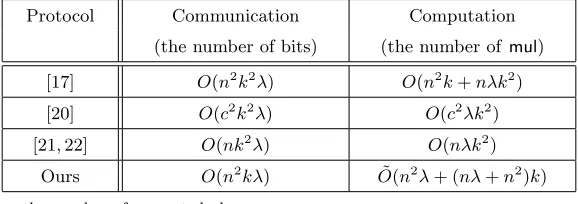
To estimate the communication overhead is easier than the computational overhead. Each player inPPSI-MALis required to transferO(n2k) encryptions in (4) and (5) of Onlinephase. Since other steps’ communication overhead in Online phase is smaller than these steps, the overall communication overhead is O(n2k). We compare our PPSI protocol secure against malicious adversary with previous works in Table 1.4
Protocol Communication Computation (the number of bits) (the number ofmul) [17] O(n2k2λ) O(n2k+nλk2) [20] O(c2k2λ) O(c2λk2) [21, 22] O(nk2λ) O(nλk2)
Ours O(n2kλ) O˜(n2λ+ (nλ+n2)k) c: the number of corrupted players
Table 1.ComparisonsPPSIin the presence of malicious adversary
6 Conclusion and Further Work
In this paper we proposed a privacy-preserving set intersection protocol satisfying (1) linear communication and quasi-linear computation overheads in the size of data input, (2) the robustness property in the presence of malicious adversary. The proposed protocol attains linear/quasi-linear complexities, however, there are some open issues.
One interesting open problem is to construct a PPSI protocol with linear complexity in both the size of data input and the number of players. Sang and Shen [22] attain linear complexity in the number of players, and our protocol achieves quasi-linear complexity in the size of data input. There is, however, noPPSIprotocol with linear or quasi-linear complexity in both parameters.
Finding practical solutions for other privacy-preserving set operations, such as set union [9] and threshold set union [16], are also interesting open problems.
4
References
1. Y. Aumann and Y. Lindell. Security against covert adversaries: efficient protocols for realistic adversaries.
InTCC 2007, LNCS, pages 137–156. Springer-Verlag, 2007.
2. J. Camenisch and G. M. Zaverucha. Private intersection of certified sets. InFinancial Cryptography 2009, LNCS. Springer-Verlag, 2009.
3. J. Cohen and M. Fischer. A robust and verifiable cryptographically secure election scheme. In FOCS, 1985.
4. E. D. Cristofaro and G. Tsudik. Practical private set intersection protocols with linear complexity. In
Financial Cryptography, LNCS, pages 143–159. Springer, 2010.
5. D. Dachman-Soled, T. Malkin, M. Raykova, and M. Yung. Efficient robust private set intersection. In M. A. et al., editor,ACNS 2009, volume 5536 ofLNCS, pages 126–142. Springer-Verlag, 2009.
6. Y. Desmedt and Y. Frankel. Threshold cryptosystems. InCRYPTO, volume 435 ofLNCS, pages 307–315. Springer, 1989.
7. P. Feldman. A practival scheme for non-interactive verifiable secure sharing. InIEEE Annual Symposium
on Foundations of Computer Science, pages 427–437, 1987.
8. M. Freedman, K. Nissim, and B. Pinkas. Efficient private matching and set-intersection. In C. C. et al., editor,Advances in Cryptology-EuroCrypt’04, volume 3027 ofLNCS, pages 1–19. Springer-Verlag, 2004. 9. K. B. Frikken. Privacy-preserving set union. InACNS, LNCS, pages 237–252. Springer, 2007.
10. R. Gennaro, S. Jarecki, H. Krawczyk, and T. Rabin. Secure distributed key generation for discrete-log based cryptosystems. InJournal of Cryptology, volume 20(1), pages 51–83. Springer New York, 2007. 11. O. Goldreich. The Foundations of Cryptography, volume 2. Cambridge University Press, 2004.
12. O. Goldreich, S. Micali, and A. Wigderson. How to play any mental game or a completeness theorem for protocols with honest majority. InACM STOC, pages 218–229, 1987.
13. C. Hazay and Y. Lindell. Efficient protocols for set intersection and pattern matching with security against mailicious and covert adversaries. InTCC 2008, LNCS, pages 155–175. Springer-Verlag, 2008.
14. C. Hazay and K. Nissim. Efficient set operations in the presence of malicious adversaries. InPublic Key
Cryptography, LNCS, pages 312–331. Springer, 2010.
15. S. Jarecki and X. Liu. Efficient oblivious pseudorandom function with applications to adaptive ot and secure computation of set intersection. InTCC 2009, LNCS. Springer-Verlag, 2009.
16. L. Kissner and D. Song. Privacy-preserving set operations. In V. Shoup, editor,Advances in Cryptology-Crypto’05, volume 3621 ofLNCS, pages 241–257. Springer-Verlag, 2005.
17. L. Kissner and D. Song. Privacy-preserving set operations. Technical Report CMU-CS-05-133, Carnegie Mellon University, 2006.
18. P. Paillier. Public-key cryptosystems based on composite degree residuosity public-key cryptosystems based on composite degree residuosity classes. In J. Stern, editor,Advances in Cryptology-EuroCrypt’99, volume 1592 ofLNCS, pages 223–238. Springer-Verlag, 1999.
19. T. Pedersen. Non-interactive and information-theoretic secure verifiable secret sharing. InAdvances in Cryptology-Crypto’91, volume 576 ofLNCS, pages 129–140. Springer-Verlag, 1991.
20. Y. Sang and H. Shen. Privacy preserving set intersection protocol secure against malicious behaviors. In
Proceedings of the Eighth International Conference on Parallel and Distributed Computing, Applications
and Technologies, pages 461–468, Washington, DC, USA, 2007. IEEE Computer Society.
21. Y. Sang and H. Shen. Privacy preserving set intersection based on bilinear groups. InProceedings of the thirty-first Australasian conference on Computer science, volume 74, pages 47–54, Darlinghurst, Australia, Australia, 2008. Australian Computer Society, Inc.
22. Y. Sang and H. Shen. Efficient and secure protocols for privacy-preserving set operations. In ACM
Transactions on Information and Systems Security, 2009.
23. V. Shoup. Lower bounds for discrete logarithms and related problems. InEUROCRYPT, pages 256–266. Springer, 1997.
24. V. Shoup. A Conputational Introduction to Number Theory and Algebra. Cambridge University Press, 2005.
A Honest-Verifier Zero-Knowledge Proofs
In this section we describe the sigma protocol, i.e. (special) honest verifier zero-knowledge proof systems with (special) strong soundness, for the statements P,D,DO needed in the PPSI-MAL protocol, as described in section 4.2. These proof systems are simple extensions of well-known sigma protocols for proving knowledge of discrete logarithms, representations, and arithmetic relations between these representations. For example the sigma protocol for HVZKPK-P[Encpk(f1),Encpk(f2),Encpk(f3)] is a conjunction of |S| instances, one for each
s∈S, of a sigma protocol for proving knowledge of plaintextsf1(s), f2(s), f3(s) encrypted in
Encpk(f1(s)),Encpk(f2(s)), Encpk(f3(s)), which satisfy relation f1(s)·f2(s) is equal to f3(s)
as an element inZp, the plaintext domain.
We use notationEncpk(·;·) and Com0ck(·;·) instead ofEncpk(·) and Com0ck(·), respectively,
to indicate randomizers in addition to messages in a encryption and a commitment scheme, respectively. We assume that bothEncpk and Com0ck have the additively homomorphic
prop-erty on both message and randomness, for example the modified ElGamal encryption and Pedersen commitment scheme, respectively.
Sigma Protocol for Product Relation HVZKPK-P: We show a sigma protocol for relation HVZKPK-Pbetween the proverPand the verifierV, namely to prove equalityEncSpk(f3) =f1⊗
EncSpk(f2) for given encrypted polynomialsEncSpk(f1),EncSpk(f2),EncSpk(f3), is just a
conjunc-tion of|S|proof systems, one for each triple of ciphertextsEncpk(f1(s)),Encpk(f2(s)),Encpk(f3(s))
for eachs∈S. Therefore we giveSHVZKfor the statement that for givenA=Encpk(a;ra), B=
Encpk(b;rb), C = Encpk(c;rc), (A, C) ∈ LB where LB={ (A, C) | A = Encpk(a;ra), B =
Encpk(b;rb), C =Encpk(a·b;a·rb+r) for a,ra,r∈Zp }.
HVZKPK-P
Common Input: Description of homomorphic encryption Enc including the plaintext domain Zp, a public key pk, and A =Encpk(a;ra), B = Encpk(b;rb), C = Encpk(a·b;a·
rb+r).
Prover Input:a,ra and r.
Goal: Prove that (A, C)∈LB.
P → V: P chooses a0, r0a, r0 ←$ Zp. P computes A0 := Encpk(a0;r0a) and C0 := Ba
0 = Encpk(a0·b;a0·rb+r0), and then, sendsV A0, C0.
V→P:V choosese←$ Zp, and then sends etoP.
P→V:P computes ˜a:=a0+e·a, ˜ra:=ra0 +e·ra, and ˜r:=r0+e·r, and then sends V
˜ a,r˜a, ˜r.
V:Vaccepts if (1) Encpk(˜a; ˜ra) ?
=A0⊕Ae and (2) B˜a⊕Encpk(0; ˜r) ?
=C0⊕Ce.
Completeness:straightforward.
(Special) Honest-Verifier Simulation:GivenA, B, Cande, the simulator picks ˜a, ˜ra and
˜
r at random, and computes correspondingA0 and C0 as follows; A0=Encpk(˜a; ˜ra)⊕A−e.
Then,A0 =Encpk(˜a−e·a; ˜ra−e·ra) andC0 =Encpk((˜a−e·a)·b; (˜a−e·a)·rb+ ˜r−e·r). Hence
a0 = ˜a−ea,r0a= ˜ra−eraandr0 = ˜r−er. In the simulated distribution (a0, r0a, r0, A0, C0,˜a,r˜a,r),˜
˜
a,r˜a, and ˜r are uniformly distributed, and others are uniquely determined, in particular,
there are only one corresponding (a0, r0a, r0, A0, C0) for each (˜a,r˜a,r). Let us consider real˜
distribution (a0, ra0, r0, A0, C0,a,˜ r˜a,r) generated by the prover. In real distribution˜ a0, r0a, and
r0 are uniformly distributed, and others are calculated using a0, r0a and r0. If we consider the restricted distribution (˜a,˜ra,r), then (˜˜ a,r˜a,r) are uniformly distributed. Furthermore, there˜
exists one-to-one correspondence between (a0, r0a, r0) and (˜a,˜ra,˜r). Therefore the simulated
distribution is perfectly same to the real distribution.
(Special) Strong Soundness: We show that if there exist (e,˜a,r˜a,r) and (e˜ ∗,a˜∗,r˜∗a,˜r∗)
such that (1)e6=e∗
(2)A0⊕Ae=Encpk(˜a; ˜ra) andC0⊕Ce =B˜a⊕Encpk(0; ˜r)
(3)A0⊕Ae∗ =Encpk(˜a∗; ˜ra∗) andC0⊕Ce
∗
=Ba˜∗⊕Encpk(0; ˜r∗), then (A, C)∈LB. Moreover,
the witnessacan be efficiently extracted from the above two distinct related proof transcripts. Let us show how to extract a. First, compute ((A0 ⊕Ae)⊕(A0⊕Ae∗)−1)(e−e∗)−1 where (e−e∗)−1 is the multiplicative inverse element of (e−e∗) in the ring Zp. Then,
A
= ((A0⊕Ae)⊕(A0⊕Ae∗)−1)(e−e∗)−1
=Encpk((e−e∗)−1(˜a−˜a∗); (e−e∗)−1(˜ra−˜ra∗))
SinceEncpk(·;·) is a one-to-one mapping,a= (e−e∗)−1(˜a−a˜∗) andra= (e−e∗)−1(˜ra−r˜∗a).
Therefore we can extract the witnessa.
Now we remain to show that (A, C)∈LB. Compute C as follows:
C
= ((C0⊕Ce)⊕(C0⊕Ce∗)−1)(e−e∗)−1
=Encpk((˜a−˜a∗)b; (˜a−a˜∗)rb+ (˜r−r˜∗))(e−e
∗)−1
Since a= (e−e∗)−1(˜a−˜a∗) andEncpk(·;·) is a one-to-one mapping,C is an encryption
ofabwith a randomnessarb+ (e−e∗)−1(˜r−r˜∗).
Sigma Protocol for Product RelationHVZKPK-D: We let L(k,S)={ EncSpk(f) | f ∈Zk p[x]} be
HVZKPK-D
Common Input: Description of homomorphic encryption Enc including the plaintext domain Zp, a public keypk, and EncSpk(f) := {(s, Cs)}s∈S where S is an arbitrary index
set such that |S| ≥k+ 1, f is a k-degree polynomial f, and Cs = Encpk(f(s);rs) for a
randomrs∈Zp.
Prover Input:f and{rs}s∈S.
Goal: Prove thatEncSpk(f)∈L(k,S).
P → V: P chooses f0 ←$ Zkp[x] and r0s $
← Zp for s ∈ S. P computes EncSpk(f0) =
{(s, Cs0)}s∈S, where Cs0 :=Encpk(f0(s);rs0), and sendsEncSpk(f0) to V.
V→P:V choosese←$ Zp, and then sends etoP.
P→ V:P computes ˜f := f0+e·f and ˜rs := r0s+e·rs for ∀s∈ S, and then, sends V
˜ f ,˜rs.
V:Vaccepts if (1) ˜f ∈Zkp[x] and (2)Encpk( ˜f; ˜rs) =Cs0 ⊕Cse for∀s∈S.
Completeness:It is straightforward.
(Special) HVZK Simulatability:Given{Cs}s∈S, e, the simulator picks a polynomial ˜f(x)
of degree less than or equal to k, and integers {r˜s}s∈S at random. Then, computes
corre-sponding{Cs0}s∈S as follows;
Cs0 =Encpk( ˜f(s); ˜rs)⊕Cs−e.
Cs0 is equal toEncpk( ˜f(s)−e·f(s); ˜rs−e·rs), and thusf0(s) = ˜f(s)−e·f(s) andr0(s) = ˜rs−e·rs.
Sincef and ˜f are degree less than or equal tok,f0is, too. In the simulated distribution of pro-tocol transcripts ({Cs0}s∈S,f ,˜ {r˜s}s∈S), ˜f and {r˜s}s∈S are uniformly distributed, but{Cs0}s∈S
is uniquely determined by ˜f and {r˜s}s∈S. In real protocolf0 and {r0s}s∈S are chosen at
ran-dom, and then ˜f and {r˜s}s∈S are computed. If we consider only the distribution of ˜f and
{˜rs}s∈S, it is uniformly distributed, and there exists one-to-one correspondence between ( ˜f,
{˜rs}s∈S) and (f0,{rs0}s∈S). Therefore, there exists unique values of (f0,{rs0}s∈S,{Cs0}s∈S) for
each ( ˜f,{˜rs}s∈S), so that the simulated distribution is identical to the real distribution.
(Special) Strong Soundness:We show that if there exist (e,f ,˜{˜rs}s∈S) and (e∗,f˜∗,{r˜s∗}s∈S)
such that (1). e6=e∗, (2).f˜∈Zk
p[x] andEncpk( ˜f; ˜rs) =Cs0 ⊕Cse for∀s∈S,
(3).f˜∗ ∈Zkp[x] and Encpk( ˜f∗; ˜rs∗) =Cs0 ⊕Ce
∗
s for∀s∈S,
then EncSpk(f)∈L(k,S). Moreover, polynomial f can be extracted given the above two proof
transcripts.
From (2) and (3) we know fors∈S,
Cs0 ⊕Cse=Encpk( ˜f(s); ˜rs),
Cs0 ⊕Cse∗ =Encpk( ˜f∗(s); ˜r∗s).
Compute Cs as follows:
Cs
= ((Cs0 ⊕Cse)⊕(Cs0 ⊕Cse∗)−1)(e−e∗)−1
Since ˜f ,f˜∗ ∈Zk
p[x], (e−e∗)−1( ˜f−f˜∗)∈Zkp[x], too. Therefore{Cs}s∈Sis also an encryption of
a polynomial inZkp[x], and we can extract the witness polynomial by computing (e−e∗)−1( ˜f−
˜
f∗).
Sigma Protocol for Product Relation HVZKPK-DO: ProtocolHVZKPK-DOis a trivial modi-fication of the above protocol HVZKPK-D: The prover chooses a polynomialf0 s.t.f0(1) = 0, and usesCominstead ofEncpk. Then, the verifier accepts only if ˜f(1) =e.
We let LO(k,S)={ EncSpk(f) |f ∈Zkp[x] and f(1) = 1} be a set of valid encrypted
polyno-mials passing a point (1,1) of degree less than or equal tok. We use the Pedersen commitment schemeCom0ck, and use the notation Com0ck(cs;ds) to indicate randomizerds as well as
mes-sagecs.
HVZKPK-DO
Common Input: Description of Comck, Encpk including Zp, ck, and pk, and
Comck(EncSpk(f)) := {(s, Ds, Cs))}s∈S, where Ds = Com0ck(cs;ds), Cs = Encpk(f(s) +
cs;rs), S is an index set such that |S| ≥ k+ 1, f is a k-degree polynomial f, and rs is
chosen at randomZp.
Prover Input:f,{(cs, ds, rs)}s∈S.
Goal:EncSpk(f)∈LO(k,S).
P→V:P chooses f0 ←$ Zk
p[x] passing a point (1,0) andr0s, c0s $
←Zp fors∈S, and then computes Comck(EncSpk(f0)) ={(s, D0s, Cs0)}s∈S, where Cs0 :=Encpk(f0(s) +c0s;r0s) and
D0s=Com0ck(c0s;ds0), and then sendsComck(EncSpk(f0)) toV.
V→P:V choosese←$ Zp, and then sends etoP.
P→V:P computes ˜f :=f0+e·f, ˜rs:=rs0 +e·rs, ˜cs :=c0s+e·cs, and ˜ds:=d0s+e·ds
for ∀s∈S, and then, sends Vf ,˜r˜s,c˜s,d˜s.
V:V accepts if (1) ˜f ∈ Zk
p[x], (2) ˜f(1) = e, and (3) Encpk( ˜f(s) + ˜cs; ˜rs) = Cs0 ⊕Cse for
∀s∈S (4)Com0ck(˜cs; ˜ds) =D0s⊕Dse for∀s∈S .
Completeness:It is straightforward.
(Special) HVZK Simulatability: Given{Ds, Cs}s∈S, e, the simulator picks a polynomial
˜
f(x) ←$ Zk
p[x] passing a point (1, e) and integers {˜cs,d˜s,r˜s}s∈S at random, and computes
corresponding{Ds0, Cs0}s∈S as follows;
Ds0 =Com0ck(˜cs; ˜ds)/Des,
Cs0 = Encpk( ˜f(s) + ˜cs; ˜rs)/Cse.
Ds0 is equal to Comck(˜cs−e·cs; ˜ds−e·ds), and thus c0s = ˜cs−e·cs and d0s = ˜ds−e·ds.
Thus,Cs0 is equal toEncpk( ˜f(s)−e·f(s) +c0; ˜rs−e·rs), and thusf0(s) = ˜f(s)−e·f(s) and
r0(s) = ˜rs−e·rs. Since bothf and ˜f are in Zkp[x], so f0 is, and since f(1) = 1 and ˜f(1) =e,
f0(1) = 0 as desired.
In the simulated distribution of protocol transcripts ({Ds0, Cs0,˜cs,d˜s,r˜s}s∈S,f˜), ˜f and
In real protocol f0 and {c0s, d0s, r0s}s∈S are chosen at random, and then ˜f and {˜cs,d˜s,r˜s}s∈S
are computed.
Let us consider the restricted distribution of ˜f and{c˜s,d˜s,˜rs}s∈S in the real distribution.
Since f0 = (x−1)·h0 forh0 ←$ Zk−1
p and f = (x−1)·h+ 1 for someh∈Zkp−1[x], ˜f is equal to
f0+ef = (x−1)(h0+eh)+e, and hence ˜f is uniformly distributed inZkp[x] with passing a point
(1, e). We can easily check that ˜cs,d˜s,r˜s are uniformly distributed in Zp. Since there exists
one-to-one correspondence between ( ˜f, {c˜s,d˜s,˜rs}s∈S) and (f0, {c0s, ds0, r0s}s∈S). Therefore,
there exists unique values of (f0, {c0s, ds0, rs0}s∈S) for each ( ˜f, {c˜s,d˜s,r˜s}s∈S). For each (f0,
{c0s, d0s, rs0}s∈S), there exists unique values forD0=Com0ck(c0s;d0s) andEncpk(f0(s) +c0s;r0s), so
that the real distribution is identical to the simulated distribution.
(Special) Strong Soundness:We show that if there exist (e,f ,˜ {˜cs,d˜s,r˜s}s∈S) and (e∗,f˜∗,
{˜c∗s,d˜∗s,r˜s∗}s∈S) such that
(1). e6=e∗, (2).f˜∈Zk
p[x] passing (1, e),Com0ck(˜cs; ˜ds) =Ds0 ⊕Dse, andEncpk( ˜f(s) + ˜cs; ˜rs) =Cs0⊕Csefor
∀s∈S,
(3).f˜∗ ∈Zkp[x] passing (1, e∗),Com
0
ck(˜c∗s; ˜d∗s) =Ds0⊕De
∗
s , andEncpk( ˜f∗(s) + ˜c∗s; ˜r∗s) =Cs0⊕Ce
∗
s
for∀s∈S,
thenEncSpk(f)∈LO(k,S). Moreover, polynomial f can be extracted given the above two proof transcripts.
From (2) and (3) we know fors∈S,
D0s⊕Des=Com0ck(˜cs; ˜ds),
Ds0 ⊕Des∗=Com0ck(˜c∗s; ˜d∗s). Cs0 ⊕Cse=Encpk( ˜f(s) + ˜cs; ˜rs),
Cs0 ⊕Cse∗=Encpk( ˜f∗(s) + ˜c∗s; ˜rs∗).
ComputeDs as follows:
Ds
= ((Ds0 ⊕Des)⊕(D0s⊕Dse∗)−1)(e−e∗)−1
=Com0ck((e−e∗)−1(˜cs−˜c∗s); (e−e∗)−1( ˜ds−d˜∗s))
Then, we can extractcs and ds ascs= (e−e∗)−1(˜cs−c˜∗s) and ds = (e−e∗)−1( ˜ds−d˜∗s).
Compute Cs as follows:
Cs
= ((Cs0 ⊕Cse)⊕(Cs0 ⊕Cse∗)−1)(e−e∗)−1 =Encpk( ˜f(s)−f˜∗(s) +cs; ˜rs−r˜∗s)(e−e
∗)−1
Since ˜f ,f˜∗∈Zk
p[x], ˜f(1) =eand ˜f(1)∗ =e∗, (e−e∗)−1( ˜f−f˜∗)∈Zkp[x] with passing a point
(1,1). Therefore {Cs}s∈S is also an encryption of a polynomial in Zkp[x] with passing (1,1),
and we can extract the witness polynomial by computing (e−e∗)−1( ˜f−f˜∗). B Security Proof of Theorem 2
exists an efficient simulatorS such that for any set of inputs {Xi}i6∈C to the honest players, the outputs of adversary A and of the honest players interacting in the PPSI-MAL protocol are computationally indistinguishable from the outputs of S and of the honest players in the ideal world interacting with the ideal PPSIfunctionality fPPSI.
Proof. We describe the simulator S, which interacts with adversaryA who controls the set of corrupted players C. Let H be the remaining honest players. Let{Xi}i∈H be the private
inputs of the honest players. Let X=fPPSI(X1, ...,Xn) denote the multi-party set intersection
function, i.e. X=X1∩...∩Xn. The simulator’s goal is two-fold: To extract the effective inputs
{Xi}i∈C which the corrupted players enter into the PPSI computation, and to simulate the
same view that Awould see when interacting with the honest players on inputs{Xi}i∈H but
given only these extracted adversarial inputs {Xi}i∈C and the output X=fPPSI(X1, ...,Xn). Simulator Description:
[1].S runs, on behalf of players inH,Input Data Conversion by settingfi = 1 for∀i∈H, and
steps (1)-(2) of Online phase in the protocol. Let δ0,δ1 and δ2 be the random coins that S
uses in, respectively, Input Data Conversion, and (1)-(2) of Online phase in this execution. [2].S runs until the end of the step (2). LetDbe the set of players inC that correctly carry out verifiable secret sharing procedure in the step (1) and pass D-ZKPK-DOproof in the step (2). That is, D=C∩M.S rewindsA and runs it repeatedly until that for each playerP in D it finds a corresponding execution such that P pass, and a challenge on proof is different from original one. In each run,S performsInput Data Conversionand step (1) of Onlinephase on coinsδ0andδ1, respectively, and step (2) on fresh random coins. (Claim 4 below show that
the expected number of such rewindings is polynomial in security parameter λ.) Using the strong soundness property of theD-ZKPK-DOproof,S extracts the witnessesfi for players in
D.S factors these polynomials to compute{Xi}i∈D0 (Factoring polynomials inZp[x] requires quadratic operations in k, so that it takes polynomial in the security parameterλ.), and sets
Xi ← φ for∀i∈C\D, then sends {Xi}i∈C to the ideal PPSIfunctionality, and receives the
output X=fPPSI(X1, ...,Xn).
[3].The simulator S rewinds A to the end of step (2) on coinsδ0,δ1,δ2, and performs step
(3) to reconstruct encrypted polynomials {EncSpk(fi0)}i∈H where each fi0,i∈ H, encodes the
set X. Pedersen VSS allows S to equivocate on the reconstructed secret {cis}s∈S, and hence
EncSpk(f).
[4].The simulator just performs the rest of the protocol on behalf of the players in H using random coinsδ4−7 and outputs execution, i.e. an execution betweenAand players inH using
inputs {fi0}i∈H and coins δ0, δ1, δ2, δ4−7.
Claim:The expected number of rewindings in the step [2] in Simulator Description above is polynomial in λ.
Proof. The simulation rewindsAuntil that for eachP ∈Dit finds a corresponding execution such that 1) P pass, and 2) a challenge on proof is different from original one. Since 2) is satisfied with overwhelming probability if S choose a random coin independently per each run, we focus on 1).
Let 2C be a set of power subsets of C, i.e. 2C ={∀ Dsuch that D⊂C}, the probability that a set of corrupted players D ⊂ C pass D-ZKPK-DO be D where the probability goes
Then the expected number of runs for eachδ0, δ1 is as follows:
P
∀D∈2CDP∀P∈D(P0 ·1 + (1−0P)0P·2
+· · ·+ (1−0P)k−10P·k+· · ·)
=P
∀D∈2CD
P ∀P∈D
0 P
P∞
k=1k(1−
0 P)k−1
=P
∀D∈2C
P ∀P∈D(
D 0
P)
=P
∀D∈2CDP∀P∈D( 1 0P)
=P
∀P∈C
P
∀D3P(D0 P)
=P
∀P∈C 10 P
P
∀D3PD
=P ∀P∈C 1 0P 0 P =P
∀P∈C1
=|C|=poly(λ)
for some polynomial poly(·). Let us explain why the fourth equality holds. The summation P
D∈2C
P
P∈D is same to
P
(D,P)∈S0 where S0 = {(D,P)|∀D ∈ 2
C, and ∀P such that P ∈
D}. On the other hand, the summation P P∈C
P
D3P is same to P
(P,D)∈S1 where S1 =
{(P, D)|∀P ∈C, and ∀Dsuch thatD3 P}. For every (D,P)∈S0,P is an element of D, so
that (P, D) is also contained S1. That is, S0 ⊂S1. For every (P, D) ∈ S1,D contains P, so
that S0 also has (D,P). That is, S1 ⊂S0. Therefore S0 = S1 and the fourth equality holds.
Other equalities can be easily verified. Therefore we complete the proof of claim.
Since simulator’s other steps than [2] can be run, the overall running time ofS is polynomial inλ.
Now we argue that inA’s view,S’s simulated transcript is indistinguishable from the real protocol’s transcript. First, we consider the random space over whichS uses randomness. In the step [1] of simulationS choosesδ0, δ1, δ2 at random, and runs until the end of step (2).
In step [3] of simulation S rewinds A to the end of step (2) on coins δ0, δ1, δ2, and then it
performs the rest of the protocol using randomness δ4−7. Therefore, S simulation uses all
random uniformly.
Next, we show that the simulated transcript is indistinguishable from the real protocol’s transcript. In the step [1]S commits encrypted constant polynomials as honest players’ input instead of k-degree polynomials. A, however cannot distinguish because of perfectly hiding property ofComck. Further,S can simulate all players inH to pass D-ZKPK-DOin the step
[2] sinceD-ZKPK-DOis straight-line simulatable ZKPK protocol. In the step [3] of simulation is indistinguishable from the real protocol because of trapdoor opening property of Pedersen commitment scheme. SinceS follows the description of the protocol in the step [4], adversarial view is identical in the both simulation and real protocol. At the end of simulation we have the polynomialI(x) that is distributed as a product of a|X|-degree polynomial which encodes
Xand a random polynomial of degree 2k− |X|, which is the same as the distribution ofI(x) in the real protocol betweenAand the honest players on inputs{Xi}i∈H by Lemma 1. Therefore
the simulated transcript is indistinguishable from the real protocol’s transcript.
At the end of protocol the adversary cannot obtain other information about honest players’ input than set intersection, and affect the result of the protocol to be wrong. Therefore we