
Linear-Complexity Private Set Intersection Protocols
Secure in Malicious Model
∗Emiliano De Cristofaro1, Jihye Kim2, Gene Tsudik1
1Computer Science Department, University of California, Irvine 2Department of Mathematical Sciences, Seoul National University
Abstract
Private Set Intersection (PSI) protocols allow one party (“client”) to compute an intersection of its input set with that of another party (“server”), such that the client learns nothing other than the set inter-section and the server learns nothing beyond client input size. Prior work yielded a range of PSI protocols secure under different cryptographic assumptions. Protocols operating in the semi-honest model offer better (linear) complexity while those in the malicious model are often significantly more costly. In this paper, we construct PSI and Authorized PSI (APSI) protocols secure in the malicious model under stan-dard cryptographic assumptions, with bothlinearcommunication and computational complexities. To the best of our knowledge, our APSI is the first solution to do so. Finally, we show that our linear PSI is appreciably more efficient than the state-of-the-art.
1
Introduction
Private set intersection (PSI) protocols allow two parties – a server and a client – to interact on their re-spective input sets, such that the client only learns the intersection of the two sets, while the server learns nothing (beyond the client input set size). (InmutualPSI protocols instead, both interacting parties learn the intersection.) PSI addresses several realistic privacy issues. Typical application examples include:
1. Aviation Security: The U.S. Department of Homeland Security (DHS) needs to check whether any
passenger on each flight from/to the United States must be denied boarding or disembarkation, based on so-calledTerror Watch List. Today, airlines surrender their entire passenger manifests to DHS, together with other sensitive information, such as credit card numbers. Besides privacy implications, this modus operandi poses liability issues with regard to (for the most part) innocent passengers’ data and concerns about potential data losses. Ideally, DHS would obtain informationonly pertaining to passengers on the list, while not disclosing any information to the airlines.
2. Healthcare: Insurance companies often need to obtain information about their insured patients from other parties, such as other insurance carriers or hospitals. The former cannot disclose the identity of inquired patients, whereas, the latter cannot provide any information on other patients.
3. Law Enforcement:Investigative agencies (e.g., the FBI) need to obtain information on suspects from other agencies, e.g., local police departments, the military, DMV, IRS, or employers. In many cases, it is dangerous (or simply forbidden) for the FBI to disclose subjects of investigation. For their part, other parties cannot disclose their entire data-sets and need the FBI to access only desired information. Also, the FBI requests might need to be pre-authorizedby some appropriate trusted authority (e.g., a federal judge, via a warrant). This way, the FBI can only obtain information related to legitimate requests.
∗
Other examples include recent developments incollaborative botnet detection techniques [NMH+10] and denial-of-service attacks identification [ARF+10].
1.1 Adversaries in PSI
Over the last years, PSI-related research has yielded several PSI constructs, with a wide range of adversarial models, security assumptions, and efficiency characteristics. One major distinguishing factor is the adversar-ial model which is typically either semi-honest or malicious. (Note that, in the rest of this paper, the term
adversaryrefers to insiders, i.e., protocol participants. Outside adversaries are not considered, since their actions can be mitigated via standard network security techniques.)
Following Goldreich’s definition [Gol04], protocols secure in the presence ofsemi-honest adversaries (or honest-but-curious) assume that parties faithfully follow all protocol specifications and do not misrep-resent any information related to their inputs, e.g., set size and content. However, during or after protocol execution, any party might (passively) attempt to infer additional information about the other party’s input. This model is formalized by considering an ideal implementation where a trusted third party (TTP) receives the inputs of both parties and outputs the result of the defined function. Security in the presence of semi-honest adversaries requires that, in the real implementation of the protocol (without a TTP), each party does not learn more information than in the ideal implementation.
Therefore, the actual “degree” of security provided by PSI-s secure against semi-honest adversaries may depend on the specific setting. For instance, it may be reasonable to consider only semi-honest adversaries if parties are subject to auditing and could face severe penalties for non-compliance, e.g., in the aforementioned “aviation security” scenario. Nonetheless, it is unclear how their security arguments are affected when parties deviate from the protocol. In other words, security focuses on (strictly) privacy guarantees: a party cannot learn more information about the other party’s set (beyond the intersection). However, it might be unclear what occurs if the format of one party’s input is artificially manipulated. Can such input exploit some protocol characteristics and be used toextractinformation about the other party’s input set?
In contrast, security in the presence ofmalicious partiesallowsarbitrarydeviations from the protocol. In general, however, it does not prevent parties from refusing to participate in the protocol, modifying their private input sets, or prematurely aborting the protocol. Security in the malicious model is achieved if the adversary (interacting in the real protocol, without the TTP) can learn no more information than it could in the ideal scenario. In other words, a secure PSI emulates (in its real execution) the ideal execution that includes a trusted third party. This notion is formulated by requiring the existence of adversaries in the ideal execution model that can simulate adversarial behavior in the real execution model, and thus provide the same security of general two-party computation.
1.2 Authorized (Client) Input
Malicious parties cannot be prevented from modifying their input sets, even if a protocol is proven secure in the malicious model. Considering that the client learns the intersection while the server learns nothing, this appears a severe threat to server’s privacy. For instance, suppose that a malicious client faithfully follows the protocol, but populates its input set with its best guesses of the server set (especially, if the set is easy to exhaustively enumerate). This would maximize the amount of information it learns. In the extreme case, the client could even claim that its set contain all possible elements. Although the server could impose a limit on this size, the client could still vary its set over multiple protocol runs.
As discussed above, input authorization ensures that malicious clients cannot manipulate their inputs to harm server privacy. However, this does not help at all as far as manipulation of server inputs. One way towards security against malicious servers would be to introduce authorization for server input, along the same lines as client input authorization. Although this would likely yield protocols secure in the malicious model, we choose not to pursue this direction. The main reason is that, it is more natural for the client (who learns the intersection) to be authorized on its input, than for the server (who learns nothing). However, though it is outside the scope of this paper, we believe that enforcing both server and client input authorization is a subject worth investigating. Finally, we leave as an open question whether we can reduce security of PSI in the malicious model to authorization of both client and server inputs.
1.3 Technical Roadmap and Contributions
Over the last few years, several elegant (if not always efficient) PSI and APSI protocols have been pro-posed, that are secure in the malicious model, under standard assumptions [KS05, HL08, DSMRY09, CZ09, CKRS09, HN10]. Only [JL09] presentd a linear-complexity PSI protocol secure in the malicious setting. Its proof requires that the domain of inputs to be restricted to polynomial in the security parameter and requires a Common Reference String model (CRS), where the reference string, including a safe RSA modulus, must be generated by a mutually trusted third party. Other results (such as [DT10]) construc linear-complexity PSI and APSI protocols secure in the semi-honest model, under assumptions of theone-more-XXXtype [BNPS03], with much lower computational and communication complexity. (Note that we overview prior work in Sec-tion 2). As shown in [DT10], via both analysis and experiments, there is an appreciable efficiency gap between the two “families” of PSI/APSI protocols: those secure in the malicious and in the semi-honest models. In this paper, our main goal is to construct efficient PSI and APSI protocols secure under standard assumptions, with malicious participants (both server and client).
Our starting point are the linear-complexity protocols from [DT10] (specifically, Figure 2 and 3), which are secure only in the semi-honest model. First, we modify the APSI construct of [DT10] and obtain APSI protocol secure in the malicious model, under the standard RSA assumption (in ROM). Then, we modify its PSI counterpart: while the linear-complexity PSI protocol in [DT10] is secure under the One-More-Gap-DH assumption [BNPS03] against semi-honest parties, our modified variant is secure in the malicious model under the standard DDH assumption (again, in ROM). We present formal proofs for all proposed protocols.
Contributions of our work are:
1. To the best of our knowledge, our APSI protocol is the first result with linear communication and computational complexity, in the malicious model. (Previous work achieved quadratic computational complexity.)
2. Our PSI protocol also offers linear complexity. Although some prior work (i.e., [JL09]) also achieves the same asymptotic bound, we do not require the CRS model and our proof does not restrict input domain size. We also show that our protocol incurssignificantly reducedconstant factors.
3. We prove security of proposed protocols, in presence of malicious adversaries, under standard crypto-graphic (RSA and DDH) assumptions, in ROM.
2
Related Work
This section overviews prior work on PSI and APSI.
2.1 Prior Work on PSI
It is well known that PSI could be realized via general secure two-party computation [Yao82]. However, it is usually far more efficient to have dedicated protocols (see [FNP04, KS05]); which is the direction we pursue in this paper. From here on, we consider PSI as an interaction between a serverSand a clientC. The server set containswitems, while the client set –v.
Freedman, et al. [FNP04] introduce the concept of PSI and presented protocols based onOblivious Poly-nomial Evaluation(OPE) [NP06]. The basic idea is to represent a set as a polynomial, with individual ele-ments as its roots. The construction for the semi-honest setting incurs linear communication, and quadratic computational, complexity. Using Horner’s rule and balanced bucket allocation, the number of modular ex-ponentiations can be reduced toO(wlog logv)exponentiations for the server andO(w+v)exponentiations for the client. [FNP04] also gives constructions for a malicious client and semi-honest server. This proto-col uses a cut-and-choose strategy, thus, the overhead is increased by a statistical security parameter. Also presented is a protocol secure in the presence of a malicious server and a semi-honest client in ROM.
Kissner and Song [KS05] propose OPE-based protocols for mutual PSI (as well as for additional set operations), and may involve more than two players. Protocols are secure in the standard model against semi-honest and also malicious adversaries. The former incurs quadratic(O(vw))computation (but linear communication) overhead. The latter uses (expensive) generic zero-knowledge proofs to prevent parties from deviating to the protocol. Later, Dachman-Soled, et al. [DSMRY09] present an improved PSI construction, based on [KS05]. Their construction incorporates a secret sharing of polynomial inputs. Since Shamir’s secret sharing [Sha84] implies Reed Solomon codes, they do not need generic zero-knowledge proofs. Com-plexity of their protocol amounts toO(wk2log2(v))in communication andO(wvklog(v) +wk2log2(v))in computation, beingkthe security parameter.
Another family of protocols rely on so-calledOblivious Pseudo-Random Functions(OPRF-s). An OPRF is a two-party protocol (between a sender and a receiver) that securely computes a pseudorandom function fk(·)on keykcontributed by the sender and inputxcontributed by the receiver, such that the former learns
nothing from the interaction, and the latter learns only the valuefk(x). OPRF-based PSI-s work as follows:
ServerS holds a secret random keyk. Then, for eachsj ∈ S,S computesuj =fk(sj), and publishes (or
sends the client) the setU = {u1,· · · , uw}. Then,C andS engage in an OPRF computation offk(ci)for
eachci ∈ C(of sizev), such thatSlearns nothing aboutC(except the size) andC learnsfk(ci). Finally,C
obtainsci ∈ C ∩ S if and only iffk(ci) ∈ U. The idea of using OPRFs for PSI protocols is due to Hazay
and Lindell [HL08], who propose one solution with security against malicious adversaries with one-sided simulatability, and one – against covert adversaries [AL07].
This protocol has been later improved by Jarecki and Liu [JL09], who proposed a protocol secure in the standard model in the presence of both malicious parties, based on the Decisional q-Diffie-Hellman Inversion assumption, in the Common Reference String (CRS) model, where a safe RSA modulus is generated by a trusted third party. Encryption operations are performed using an additively homomorphic encryption scheme, such as Camenisch and Shoup [CS03]. As pointed out in [JL09], this approach can be further optimized, based on the concurrent work in [BCC+09]. In fact, the OPRF construction can operate in groups with a 160-bit prime order unrelated to the RSA modulus, instead of the more expensive composite order groups. Assuming such improved construction, [JL09] incurs the following computational complexity: Let mbe the number of bits needed to represent each set item; the server performs at leastO(w)PRF evaluations, i.e., bothm-bit and group exponentiations, plusO(v)group exponentiations, whereas, the client at leastO(v)
later in the paper. Finally, note that the proof in [JL09] requires the ability to exhaustively search over the input domain, i.e., the input domain size of the PRF should be polynomial in the security parameter.
As shown in [DT10], the above protocols, though secure in the standard model, are relatively inefficient in practice, since their asymptotic complexities hide constants that, in reality, prevent these protocols from scaling to large sets.
A recent result by Hazay and Nissim [HN10] presents an improved construction of OPE-based PSI based on [FNP04], but without ROM. Specifically, it introduces zero-knowledge proofs that allow client to demon-strate that encrypted polynomials are correctly produced. Also, it uses a technique based on a perfectly hiding commitment scheme with an OPRF evaluation protocol to prevent the server from deviating from the protocol. The PSI protocol in [HN10] incursO(v+w(log logv+m))computational andO(v+w·m)
communication complexity, wheremis the number of bits needed to represent a set item. Note that execu-tion of the underlying OPRF in [HN10] requiresmoblivious transfer invocations, and henceO(m)modular exponentiations, for each set item. However, such overhead can be avoided by instantiating the protocol in ROM. This protocol can be also optimized if the size of the intersection is allowed to be leaked to the server, in contrast to our strict privacy definitions (see Section 3.3). Nonetheless, the resulting protocol is of sending O(v+|S ∩ C| ·m)and computingO(v+w·log logv+|S ∩ C| ·m), which is still not linear. (Also recall that it is not clear how to enable convert the PSI construct of [HN10] into APSI.)
In another recent result, [DT10] (Fig.4) presents an adaptive PSI protocol based on blind-RSA signa-tures [Cha83], secure in the semi-honest model, under the One-More-RSA assumption [BNPS03], in ROM. Specifically, during an initialization phase, the server generates RSA keys(N, e, d)and commits to its set, by publishing the hash of the RSA signature of each item. During the interaction, the client obtains blind-RSA signatures of its items from the server. Thus, the server needs to computeO(w)RSA signatures during the initialization phase, andO(v)online. Whereas, the client (assuminge= 3) only computesO(v) multiplica-tions, thus making this construct particularly appealing for clients running on limited-resource devices.
[DT10] (Fig.3) includes another PSI secure in the presence of semi-honest adversaries, under the One-More-Gap-DH assumption, in ROM. Common inputs are primesp, q(withq|p−1, the order of a subgroup ofZ∗p) and a generator of the subgroup,g. First, the client computes the accumulatorP CH =
Qv
i=1(H(ci))
and sendsX =P CH·gRcforR
crandom inZ∗q. Also, fori= 1, . . . , v, it computesP CHi=P CH/H(ci)
and sendsxi =P CHi·gRc:i forRc:iinZ∗q. The server picks a randomRsinZ∗q, sendsZ =gRs, and, for
eachxi, sends back x0i = xiRs. Then, forj = 1, . . . , w, it computesTs:j = H0((X/H(sj))Rs). Finally,
the client computesTc:i = x0i ·ZRc ·Z−Rc:i, and learns that ci ∈ C ∩ S if Tc:i = Ts:j. Computational
complexity of this protocol isO(w+v)andO(v)exponentiations (with short exponents) for the server and client, respectively.
2.2 Prior Work on APSI
Authorized Private Set Intersection (APSI) is defined in [DT10] to extend PSI to supportauthorization of client inputs. Each client input must be authorized (via signing) by some trusted authority, e.g., a CA. Recall the third example in Section 1: to obtain information on a suspect from her employer, the FBI needs to be duly authorized. APSI represents an authorization using a digital signature. Note that authorizations obtained from the CA are private to the client and cannot be disclosed to the server.1
[DT10] shows that the PSI protocol (reviewed in Section 2.1 above) can be instantiated in a RSA setting, where client input is a set of RSA signatures and the server obliviously verifies them by slightly modifying the protocol. Specifically, the clientC needs to obtain from the CA signaturesσi = H(ci)d (for input set
1
C={c1, . . . , cv}).Ccomputes the accumulatorP CH∗ =Qvi=1σiand sendsX =P CH∗·gRcfor random
Rc. Also, it computesP CHi∗=P CH∗/σiand sendsxi =P CHi∗·gRc:ifor randomRc:i. The server picks
a randomRs, sendsZ =geRs, and, for eachxi, sends backx0i=xieRs. Then, forj= 1, . . . , w, it computes
Ts:j =H0((Xe/H(sj))Rs). Finally, the client computesTc:i =x0i·ZRc·Z−Rc:i, and learns thatci∈ C ∩ S
ifTc:i =Ts:j. Asymptotic complexity of this solution is the same as that of the standard PSI presented above,
i.e.,O(w+v)andO(v)exponentiations for the server and client, respectively. (Although short exponents are replaced with “RSA” exponents.) The resulting protocol is secure in the semi-honest model, under the standard RSA assumption, in ROM. Note that the use of “authorized” client inputs seems to increase server privacy: under the RSA assumption, the client does not learn any information about server inputs, unless it holds a valid RSA signature. In other words, there appears to be a strong correlation between server privacy and client’s difficulty of forging signatures.
A similar concept (adaptable to APSI) is Public-Key Encryption with Oblivious Keyword Search pro-posed by [CKRS09]. It proposes an Identity-based cryptosystem (inspired by PEKS in [BDOP04]), where the client obtains authorized search trapdoors from a CA, and uses them to search over data encrypted by the server. The client learns only the information matching the authorized trapdoors, whereas, the server learns nothing. The protocol is secure in the presence of malicious adversaries in the standard model, under the De-cision Bilinear Diffie-Hellman assumption [BF03]. It uses a modification of the Boyen-Waters IBE [BW06]. Even without taking into account zero-knowledge proofs, the server would computeO(w) encryptions of [BW06] (each requiring 6 exponentiations and a representation of 6 group elements). The client would need to test each of theO(w) PEKS against its O(v) trapdoors, hence performing O(w·v) decryptions (each requiring 5 bilinear map operations).
Finally, [CZ09] introduces another similar notion – Private Intersection of Certified Sets. This construct allows a trusted third party to ensure that all protocol inputs are valid and bound to each protocol partici-pant. The proposed protocol ismutual(i.e., both parties receive the intersection) and builds upon oblivious polynomial evaluation and achievesquadraticcomputation and communication overhead.
3
Preliminaries
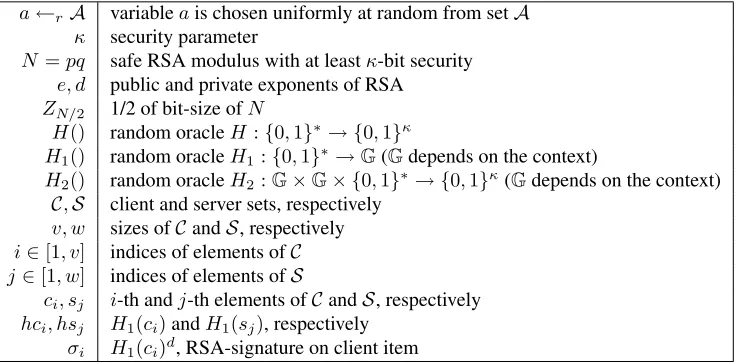
In this section, we present our cryptographic assumptions and tools, as well as security model. We introduce our notation in Table 1.
a←rA variableais chosen uniformly at random from setA
κ security parameter
N =pq safe RSA modulus with at leastκ-bit security
e, d public and private exponents of RSA
ZN/2 1/2 of bit-size ofN
H() random oracleH :{0,1}∗→ {0,1}κ
H1() random oracleH1:{0,1}∗→G(Gdepends on the context)
H2() random oracleH2:G×G× {0,1}∗→ {0,1}κ(Gdepends on the context) C,S client and server sets, respectively
v, w sizes ofCandS, respectively
i∈[1, v] indices of elements ofC j∈[1, w] indices of elements ofS
ci, sj i-th andj-th elements ofCandS, respectively
hci, hsj H1(ci)andH1(sj), respectively
σi H1(ci)d, RSA-signature on client item
3.1 Cryptographic Assumptions
Definition 1 LetGbe a cyclic group and letgbe its generator. Assume that the bit-length of the group size isl. The DDH problem is hard inGif for every efficient algorithmAthe probability:
Pr[x, y←r {0,1}
l:A(g, gx, gy, gxy) = 1]−Pr[x, y, z←
r{0,1}l:A(g, gx, gy, gz) = 1]
is a negligible function ofκ.
Definition 2 LetRSA-Gen(1κ)be an algorithm that outputs so-called “safe RSA instances”, i.e. pairs(n, e)
wheren =pq,eis a small prime such thatgcd(e, φ(n)) = 1, andp, qare randomκ-bit primes subject to the constraint thatp= 2p0+ 1,q = 2q0+ 1for primep0, q0,p0 6=q0. The RSA problem is hard if, for every efficient algorithmA, the probability:
P r[(n, e)←RSA-Gen(1κ), z ←Zn∗ :A(n, e, z) =ys.t.ye=z (modn)]
is a negligible function ofκ.
3.2 Tools
In this section, we consider signature of knowledge of a discrete logarithm and equality of two discrete logarithms in a cyclic groupG=hgi. In particular, we considerGwhere either the order ofGis known or
the order ofGis unknown but its bit-lengthl is publicly known. Fujisaki and Okamoto [FO97] show that
(under the strong RSA assumption) standard proofs of knowledge that work in a group of known order are also proofs of knowledge in this setting. We define discrete logarithm ofy∈Gwith respect to basegas any integerx∈Zsuch thaty=gxinG. We assume a security parameter >1.
Definition 3 (ZK of DL over a known order group) Lety, g ∈ Gof order q. A pair(c, s) ∈ {0,1}κ× Zq verifyingc=H(y||g||gsyc||m)is a signature of knowledge of the discrete logarithm ofy=gxw.r.t. baseg, on messagem∈ {0,1}∗.
Definition 4 (ZK of DL over an unknown order group) Lety, g∈Gwhere the group order is unknown, but
its bit-length is known aslbits. A pair(c, s)∈ {0,1}κ× ±{0,1}(l+κ)+1verifyingc=H(y||g||gsyc||m)is a signature of knowledge of the discrete logarithm ofy=gxw.r.t. baseg, on messagem∈ {0,1}∗.
The player in possession of the secretx = loggycan compute the signature by choosing a randomt ∈Zq (or±{0,1}(l+κ)) and then computingcandsas:c=H(y||g||gt||m)ands=t−cxin
Zq(or inZ).
Definition 5 (ZK of EDL over a known order group) Lety1, y2, g, h∈Gof orderq. A pair(c, s)∈ {0,1}κ× Zqverifyingc=H(y1||y2||g||h||gsy1c||hsy2c||m)is a signature of knowledge of the discrete logarithm of both
y1=gxw.r.t. basegandy2 =hxw.r.t. baseh, on messagem∈ {0,1}∗.
Definition 6 (ZK of EDL over an unknown order group) Let y1, y2, g, h ∈ G where the group order is
unknown, but its bit-length is known as l bits. A pair (c, s) ∈ {0,1}κ × ±{0,1}(l+κ)+1 verifying that
c = H(y1||y2||g||h||gsyc1||hsy2c||m)is a signature of knowledge of the discrete logarithm of both y1 = gx w.r.t. basegandy2 =hxw.r.t. baseh, on messagem∈ {0,1}∗.
The player in possession of the secretx= loggy1 = loghy2can compute the signature by choosing a random
t∈Zq(or±{0,1}(l+κ)) and then computingcandsas: c=H(y
3.3 Security Model
We assume a malicious adversary that behaves arbitrarily. Informally, a protocol is secure in this model if no adversary interacting in the real protocol (where no TTP exists) can learn any more from a real execution than from an execution that takes place in the ideal world. In other words, for any adversary that successfully attacks a real protocol, there exists a simulator that successfully attacks the same protocol in the ideal world. We now define ideal functionalities of PSI and APSI. In particular, in contrast to PSI, APSI employs an (off-line) CA with algorithms(KGen, Sign, Ver). The CA generates a key-pair(sk, pk)←KGen, publishes its public keypk, and, on client inputci, it issues a signatureσi=Sign(sk, ci)such thatVer(pk, σi, ci) = 1.
Definition 7 The ideal functionalityFAPSI of an APSI protocol betw. server S on inputS = {s1,· · · , sw} and clientCon inputC={(c1, σ1),· · · ,(cv, σv)}is defined as:
FAPSI : (S,C)→(⊥,S ∩ {ci|ci ∈ C ∧ Ver(pk, σi, ci) = 1})
wherew, vare the public input toFAPSI.
Definition 8 The ideal functionalityFPSIof a PSI between serverSon inputS ={s1,· · · , sw}and clientC on inputC={c1,· · · , cv}is defined as follows:
FPSI : (S,C)→(⊥,S ∩ C)
wherew, vare the public input toFPSI.
4
APSI Protocol
We now present our protocol for secure computation of authorized set intersection. We start from the APSI protocol of [DT10] (reviewed in Section 2.2), secure in the semi-honest model. We describe a modified version that securely implements theFAPSIfunctionality in themaliciousmodel, in ROM, under the RSA and
DDH assumptions.
The CA (trusted third party that authorizes client input) is realized with the following algorithms:
• KGen: On input of security parameterκ, this algorithm generates safe RSA modulusN =pqwhere
p = 2p0 + 1,q = 2q0 + 1and picks a random elementg, g0 s.t. h−1i × hgi ≡ h−1i × hg0i ≡ Z∗N. RSA exponents(e, d)are chosen in the standard way:eis a small prime andd=e−1modφ(N). The algorithm also fixes hash functionH1 :{0,1}∗ →Z∗N andH2 :Z∗N ×Z∗N× {0,1}∗ → {0,1}κ. The
secret key is(p, q, d)and the public parameters are: N, e, g, g0, H1(), H2().
• Sign:On input ofci, this algorithm issues an authorizationσi =H1(ci)dmodN.
• Ver:On input of(σi, ci), this algorithm verifies whetherσie=H1(ci) modN.
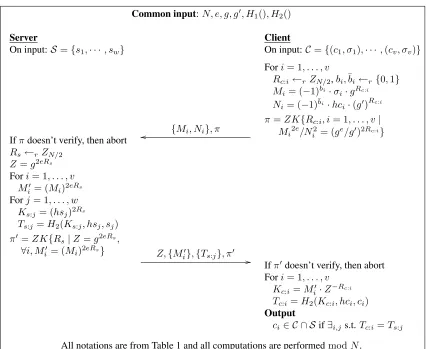
The resulting protocol is presented inFigure 1.
Theorem 1. If RSA and DDH problems are hard, andπ, π0are zero-knowledge proofs, then the protocol in Figure 1 is a secure computation ofFAPSI, in ROM.
Proof.[Construction of an ideal worldSIMsfrom a malicious real-world serverS∗]
The simulatorSIMsis built as follows:
• Setup:SIMsexecutesKGenand publishes public parametersN, e, g, g0.
• Hash queries toH1 andH2: SIMs constructs two tablesT1 = (q, hq) andT2 = ((k, h0q, q0), t) to
Common input:N, e, g, g0, H1(), H2()
Server Client
On input:S={s1,· · ·, sw} On input:C={(c1, σ1),· · ·,(cv, σv)} Fori= 1, . . . , v
Rc:i←rZN/2,bi,¯bi←r{0,1}
Mi= (−1)bi·σi·gRc:i
Ni= (−1) ¯ bi·hc
i·(g0)Rc:i
π=ZK{Rc:i, i= 1, . . . , v|
Mi2e/Ni2= (ge/g0)2Rc:i}
{Mi, Ni}, π
o
o
Ifπdoesn’t verify, then abort
Rs←rZN/2
Z =g2eRs Fori= 1, . . . , v
Mi0= (Mi)2eRs Forj= 1, . . . , w
Ks:j = (hsj)2Rs
Ts:j =H2(Ks:j, hsj, sj)
π0 =ZK{R
s|Z =g2eRs,
∀i, Mi0= (Mi)2eRs} Z,{M0
i},{Ts:j}, π0 //
Ifπ0doesn’t verify, then abort Fori= 1, . . . , v
Kc:i=Mi0·Z−Rc:i
Tc:i=H2(Kc:i, hci, ci)
Output
ci∈ C ∩ Sif∃i,js.t.Tc:i=Ts:j All notations are from Table 1 and all computations are performedmodN.
Figure 1:Our APSI Protocol with linear complexity secure against malicious adversaries.
– On query q to H1, SIMs checks if ∃(q, hq) ∈ T1: If so, it returns hq, otherwise it responds
hq←rZ∗N, and stores(q, hq)toT1.
– On query(k, h0q, q0)toH2,SIMschecks if∃((k, h0q, q0), t) ∈ T2: If so, it returnst, otherwise it
respondst←r{0,1}κtoH
2, and stores((k, h0q, q0), t)toT2.
• Simulation of the real-world clientCand the ideal-world serverS:
1. SIMs picksMi0 ←r Z∗N, Ni0 ←r Z∗N and computesMi = (Mi0)2, Ni = (Ni0)2 for eachi =
1,· · · , v.
2. SIMssends{Mi, Ni}i=1,...,vand simulates the proofπ.
3. After getting(Z,{Mi0}i=1,...,v,{Ts:j}j=1,...,w), and interacting withS∗as verifier in the proofπ0,
if the proofπ0 verifies,SIMsruns the extractor algorithm forRs. Otherwise, it aborts.
(a) For eachTs:j,SIMs checks if∃(q, hq) ∈ T1 and∃((k, h0q, q0), t) ∈ T2, s.t. q = q0, hq =
h0q, k= (hq)2Rsandt=Ts:j. If so, addqtoS; otherwise, add a dummy item intoS.
(b) ThenSIMsplays the role of the ideal-world server, which usesS to respond to ideal client
C’s queries.
clientC and theπproof system is zero-knowledge, S∗’s views when interacting with the real clientC and with the simulatorSIMsare indistinguishable.
[Output of (honest) real clientCinteracting withS∗]
Now we consider the output of the honest real clientC interacting withS∗. By soundness of proofπ0, messageZ andMi0 sent byS∗isZ =geRs andM0
i = (Mi)eRsfori= 1,· · ·, v. Then,C’s final output is a
set containing allci’s, such thatH2(Mi0·Z−Rc:i, hci, ci)∈ {Ts:j}. In other words, for eachci,Coutputsci
if∃js.t.H2(Mi0·Z
−Rc:i, hc
i, ci) =Ts:j. SinceH2 is a random oracle, there are two possibilities:
1. S∗computesTs:jfromH2((hsj)2Rs, hsj, sj)forsj =ci. SinceSIMsdescribed above extractssj =ci
and addssj inS, the ideal worldCalso outputci on its inputci.
2. S∗did not queryH2on(Mi0·Z−Rc:i, hci, ci)butH2(Mi0·Z−Rc:i, hci, ci)happens to be equal toTs:j.
This event occurs with negligible probability bounded byv· w· 2−κ.
Therefore, with probability1−v· w· 2−κ, the real-world clientCinteracting withS∗and the ideal-world clientCinteracting withSIMsyield identical outputs.
[Construction of an ideal worldSIMcfrom a malicious real-world clientC∗] The simulatorSIMcis formed as follows:
• Setup and hash queries toH1andH2:Same as Setup andH1andH2responses described above in
construction ofSIMs.
• Authorization queries: On inputm, SIMcresponds with (m, σ)where σ = (H1(m))d and stores
(m, σ)to tableT3.
• Simulation of real-world serverS and ideal-world clientC:
1. After getting{Mi, Ni}i=1,...,v, and interacting withC∗ as verifier in the proofπ,SIMc checks
if proofπ verifies. If not, it aborts. Otherwise, it runs the extractor algorithm for {Rc:i} and
computes±(hci, σi)s.t.hci =σe.
2. For each±(hci, σi):
- If@(q, hq) ∈ T1 s.t. hq = ±hci then add a dummy item (δ, σδ)toC where δ andσδ are
randomly selected from the respective domain.
- If∃(q, hq)∈T1s.t.hq=±hci, but@(m, σ)∈T3s.t.σ=±σithen outputfail1and abort.
- If∃(q, hq)∈T1s.t. hq =±hci and∃(m, σ)∈T3s.t. σ =±σi, then add(q,±σ)to the set
C.
3. SIMcplays the role of the client in the ideal-world. On inputC={(c1, σ1),· · · ,
(cv, σv)},SIMcinteracts with the ideal-world serverS¯through the TTP.
4. On getting intersectionL={c01,· · · , c|0L|}, with|L| ≤vfrom the ideal-world interaction,SIMc
formsS=Πc01,· · ·, c0|L|, δ10,· · · , δw0 −|L|+1, whereδ0’s are dummy items andΠis a permuta-tion funcpermuta-tion.
5. SIMcpicksRs←rZN/2, and computesZ =g2eRs andMi0 = (Mi)2eRsfori= 1, ..., v.
6. For eachsj ∈ S:
- Ifsj ∈L, computeTs:j =H2((hsj)2Rs, hsj, sj).
- Ifsj ∈/ L, computeTs:j ←r{0,1}κ.
Claim 1.If eventfail1occurs with non-negligible probability, thenC∗can be used to break the RSA
assump-tion.
We describe the reduction algorithm using a modified simulator algorithm calledCh1that takes an RSA
challenge(N0, e0, z)as an input and tries to outputz(e0)−1.Ch1follows theSIMcas described above, except:
• Setup: On input(N0, e0, z),Ch1 setsN =N0,e =e0 and picks generatorg,g0 ←r Z∗N. (Note that
randomginZ∗N matches that chosen by a real key generation with probability about 1/2.)
• Authorization queries:On inputm,Ch1 responds with(m, σ)withσ←r Z∗N, assignH1(m) =σe,
and records(m, σ)toT3.
• Hash queries to H1: On query H1 on q, if @(q, hq) ∈ T1 then Ch1 responds hq = z(rq)e where
rq←rZN, and stores(q, rq, hq)toT1. (Sincerqis uniformly distributed inZN, the distribution ofhq
is also uniformly distributed inZN.)
Assume thatfail1 occurs on(hci, σi). Then,Ch1 extracts entry(q, rq, hq) ∈ T1 s.t. hq = hci and outputs
σi/rq, which breaks the RSA assumption.
Now unless the fail1 event occurs, the views interacting with the SIMc and with the real protocol are
different only in the computation ofTs:j forsj ∈ Sbutsj ∈/ L. Letfail2 be the event thatC∗queriesH2on
((hsj)2Rs, hsj, sj)forsj ∈ S andsj ∈/ L.
Claim 2. If event fail2 occurs with non-negligible probability, then C∗ can be used to break the DDH
assumption.
We describe reduction algorithm Ch2 that takes a DDH challenge(N0, f, α = fa (modN0), β = fb
(modN0), γ) as input and outputs the DDH answer using C∗. Ch2 follows the SIMc algorithm as we
describe above, except that:
• Setup: On input(N0, f, α, β, γ),Ch2 setsN = N0,g = f and picks generatorg0 ←r Z∗N and odd
e←r ZN.
• Authorization queries:Same as inCh1simulation.
• Hash queries toH1: On queryq toH1, if@(q, hq) ∈ T1 thenCh2 responds withhq = βgrq where
rq←rZN/2, and records(q, rq, hq)toT1. (Sincerqis randomZN/2, the distribution ofhqis
compu-tationally indistinguishable from the uniform distribution ofZ∗N.)
• In computation forZ,{Mi},{Ts:j}:
– Ch2setsZ =A2eand computesMi0 =γ2(α)2rq+2eRc:i fori= 1, . . . , v(instead of pickingRs
and computingZ =g2eRs andM0
i = (Mi)2eRs).
– For eachsj ∈ S, ifsj ∈L,Ch2computesTs:j =H2(γ2(α)2rq, hsj, sj).
Givenα =ga(=gRs)andβ =gb, we replacegabbyγin the above simulation ofM
i andTs:j. Thus,C∗’s
views when interacting with the real serverS and with the simulatorCh2 are indistinguishable under that
DDH assumption. Assume thatfail2 occurs, i.e.,C∗ makes a query toH2 on((hsj)2Rs, hsj, sj)forsj ∈ S
butsj ∈/ L. Ch2checks if∃(q, rq, hq)∈T1 and∃((k, h0q, q0), t)∈T2s.t. q=q0,hq=h0q,k=γ2(α)2rq for
eachq ∈ Sbutq /∈L. If so,Ch2outputs True. Otherwise,Ch2 outputs False. Thus, the DDH assumption is
broken.
Therefore, sincefail1 andfail2 events occur with negligible probability,C∗’s view in the protocol with
the real-world serverSand in the interaction withSIMcis negligible.
Finally, the real-worldS interacting withC∗ in the real protocol outputs⊥and the ideal-worldS¯ inter-acting withSIMcgets⊥. This ends proof of Theorem 1.
Our APSI protocol differs from the one in [DT10] in the following:
• We modify inputs to the protocol and add efficient zero-knowledge proofs to prevent client and server from deviating from the protocol and to enable extraction of inputs.
• We multiply client inputs by−1to a random bit to: (1) ensure that they are uniformly distributed in QRN, and (2) simplify reduction to the RSA problem.
• We do not use “accumulated” values, such asP CHi∗, as they are not needed either for protocol security or for input extraction during simulation.
5
PSI Protocol
This section presents our protocol for secure computation of set intersection. It is a modified version of the PSI protocol of [DT10] (reviewed in Section 2.1), secure in the semi-honest model under the One-More-Gap-DH assumption (in ROM). We amend it to obtain a protocol that securely implementsFPSI in themalicious
model under the DDH assumptions (in ROM). We assume thatKGengeneratesp, q, g, g0, g00wherepandq are primes, such thatq|p−1andg, g0, g00are generators ofZ∗q.
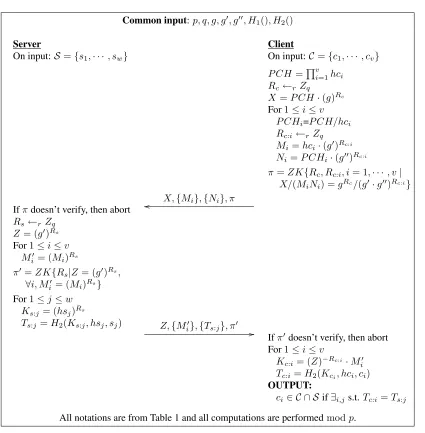
The resulting protocol is presented inFigure 2.
Theorem 2. If the DDH problem is hard andπ, π0 are zero-knowledge proofs, the protocol in Figure 2 is a secure computation ofFPSI, in ROM.
Proof.[Construction of an ideal worldSIMsfrom malicious real-world serverS∗] SimulatorSIMsis built as follows:
• Setup:SIMsexecutesKGenand publishes public parametersp, q, g, g0, g00.
• Queries H1 and H2: SIMs creates two tables T1 = (q, hq) and T2 = ((k, h0q, q0), t) to answer,
respectively,H1andH2 queries. Specifically,
– On query q to H1, SIMs checks if ∃(q, hq) ∈ T1: If so, it returns hq, otherwise it responds
hq←rZ∗p, and stores(q, hq)toT1.
– On query(k, h0q, q0)toH2,SIMschecks if∃((k, h0q, q0), t) ∈ T2: If so, it returnst, otherwise it
respondst←r{0,1}κtoH2, and stores((k, h0q, q0), t)toT2.
• Simulation of real-world clientCand ideal-world serverS:
1. SIMspicksX←rZp∗and{Mi, Ni|Mi ←r Z∗p, Ni ←r Z∗p}(fori= 1, . . . , v).
2. SIMssendsX,{Mi, Ni}i=1,...,v and simulates proofπ.
3. After getting(Z,{Mi0}i=1,...,v,{Ts:j}j=1,...,w), and interacting withS∗ as verifier in proofπ0, if
π0verifies,SIMsruns the extractor algorithm forRs. Otherwise, it aborts.
(a) For eachTs:j,SIMs checks if∃(q, hq) ∈ T1 and∃((k, h0q, q0), t) ∈ T2, s.t. q = q0, hq =
h0q, k= (hq)Rs andt=Ts:j. If so, addqtoS; otherwise, add a dummy item intoS.
(b) ThenSIMsplays the role of the ideal-world server, which usesS to respond to ideal client
Common input:p, q, g, g0, g00, H1(), H2()
Server Client
On input:S={s1,· · · , sw} On input:C={c1,· · ·, cv}
P CH =Qv
i=1hci
Rc←rZq
X =P CH·(g)Rc For1≤i≤v
P CHi=P CH/hci
Rc:i←rZq
Mi=hci·(g0)Rc:i
Ni=P CHi·(g00)Rc:i
π=ZK{Rc, Rc:i, i= 1,· · ·, v|
X/(MiNi) =gRc/(g0·g00)Rc:i}
X,{Mi},{Ni}, π
o
o
Ifπdoesn’t verify, then abort
Rs←rZq
Z= (g0)Rs For1≤i≤v
Mi0 = (Mi)Rs
π0=ZK{Rs|Z = (g0)Rs,
∀i, Mi0= (Mi)Rs}
For1≤j≤w Ks:j= (hsj)Rs
Ts:j=H2(Ks:j, hsj, sj) Z,{Mi0},{Ts:j}, π0 //
Ifπ0doesn’t verify, then abort For1≤i≤v
Kc:i= (Z)−Rc:i·Mi0
Tc:i=H2(Kci, hci, ci)
OUTPUT:
ci∈ C ∩ Sif∃i,js.t. Tc:i=Ts:j All notations are from Table 1 and all computations are performedmodp.
Figure 2:Our PSI Protocol with linear complexity secure against malicious adversaries.
Since the distribution ofX,{Mi, Ni}i=1,...,vsent bySIMsis identical to the distribution produced by the real
clientC and theπproof system is zero-knowledge,S∗’s views when interacting with real clientCand with simulatorSIMsare indistinguishable.
[Output of the honest real clientCinteracting withS∗]
Now we consider output of honest real clientC interacting withS∗. By soundness of π0, message Z andMi0 sent by S∗ is Z = (g0)Rs andM0
i = (Mi)Rs for i = 1,· · ·, v. Then C’s final output is a set
containing allci’s such thatH2(Mi0Z−Rc:i, hci, ci)∈ {Ts:j}. In other words, for eachci,Coutputsciif∃j
s.t.H2(Mi0Z−Rc:i, hci, ci) =Ts:j. SinceH2is a random oracle, there are two possibilities:
1. S∗computesTs:jfromH2((hsj)2Rs, hsj, sj)forsj =ci. SinceSIMsdescribed above extractssj =ci
and addssj inS, ideal worldCalso outputci on its inputci.
2. S∗ did not queryH2 on(Mi0Z−Rc:i, hci, ci) butH2(Mi0Z−Rc:i, hci, ci) happens to be equal toTs:j.
This event occurs with negligible probability bounded byv· w· 2−κ.
interacting withSIMsproduce identical output.
[Construction of ideal worldSIMcfrom malicious real-world clientC∗]
SimulatorSIMcis formed as follows:
• Setup and hash queries toH1andH2:Same as Setup andH1andH2responses described above in
construction ofSIMs.
• Simulation of real-world serverS and ideal-world clientC:
1. After getting(X,{Mi},{Ni}), and interacting withC∗ as verifier in proofπ,SIMcchecks ifπ
verifies. If not, it aborts. Otherwise, it runs the extractor algorithm forRc,{Rc:i}and computes
hc1,· · ·, hcv.
2. For eachhci, if∃(q, hq) ∈ T1 s.t. hq = hci then addq to the setC. Otherwise, add a dummy
item toC.
3. SIMcplays the role of the client in the ideal-world. On inputC = {c1,· · · , cv},SIMcinteracts
with the ideal-world serverS¯through the TTP.
4. On getting intersectionL={c01,· · · , c|0L|}, with|L| ≤vfrom the ideal-world interaction,SIMc
formsS=Πc01,· · ·, c0|L|, δ10,· · · , δw0 −|L|+1, whereδ0’s are dummy items andΠis a permuta-tion funcpermuta-tion.
5. SIMcpicksRs←rZq, and computesZ=gRsandMi0 = (Mi)Rs}fori=1,...,v.
6. For eachsj ∈ S:
– Ifsj ∈L, computeTs:j =H2((hsj)Rs, hsj, sj).
– Ifsj ∈/ L, computeTs:j ←r{0,1}κ.
7. SIMcreturnsZ,{Mi0},{Ts:j}toC∗and simulates proofπ0.
Letfailbe the event thatC∗queriesH2on((hsj)Rs, hsj, sj)forsj ∈ S andsj ∈/L. Similar to the argument
in the proof of Theorem 1, iffailevent does not occur, since theπ0 is zero-knowledge, we argue thatC∗’s views in the real game with real-world serverSand in the interaction with simulatorSIMcconstructed above
are indistinguishable .
Claim. If eventfailoccurs with non-negligible probability, thenC∗ can be used to break the DDH assump-tion.
We describe the reduction algorithm calledChthat takes a DDH problem(p0, q0, f, α=fa (modp0), β=
fb (modp0), γ)as an input and tries to output the answer usingC∗. Ch follows theSIMcalgorithm as we
describe above, except that:
• Setup:On input(p0, q0, f, α, β, γ),Ch2setsp=p0,q =q0,g0=fand picks generatorg,g00←r Z∗q.
• Hash queries toH1: On queryqtoH1, if@(q, hq)∈T1 thenCh2 responds withhq=β(g0)rq where
rq←rZq, and records(q, rq, hq)toT1.
• In computation forZ,{Mi0},{Ts:j}:
– Ch2setsZ =Aand computesMi0 =C(A)rq+Rc:i.
– For eachsj ∈ S, ifsj ∈L,Ch2computesTs:j =H2(C(A)rq, hsj, sj).
C∗ makes a query toH2 on((hsj)Rs, hsj, sj)forsj ∈ S butsj ∈/ L. Ch checks if∃(q, rq, hq) ∈ T1 and
∃((k, h0q, q0), t) ∈T2 s.t. q =q0,hq =h0q,k =C(A)rq for eachq ∈ S andq /∈ L. If so,Choutputs True.
Otherwise,Ch2outputs False. Thus,Chsolves the DDH problem.
Sincefailoccurs with negligible probability,C∗’s view in the protocol with the real-world serverS and in interaction withSIMcis negligible.
[Output of honest real serverSinteracting withC∗]
Finally, real-world S interacting with C∗ in the real protocol outputs ⊥and ideal-world S¯interacting withSIMcgets⊥.
6
Protocols Efficiency
In this section, we analyze the efficiency of our protocols and compare them to prior results. We summarize different features and estimated asymptotic complexities of prior work on Authorized Private Set Intersection and Private Set Intersection, respectively, as well as those of our protocols, in Table 2 and 3. Recall that we usew and v to denote the number of elements in the server and client input sets, respectively. For each solution, we choose parameters that achieve similar degrees of security. We also list several features of the protocols, such as the underlying assumptions, and whether they are in the standard model or ROM, in malicious or semi-honest adversary model. Also, we specify whether they can support the extension fordata transfer– a PSI variant introduced in [DT10] and discussed in details in Appendix A.
Protocol Standard Malicious Assumption Communication Server Client Data Model Model Complexity Transfer
[CKRS09] ! ! BDH O(w) O(w)enc’s O(w·v)dec’s ! of [BW06] of [BW06]
[CZ09] ! ! Strong O(w+v) O(w·v) O(w·v) %
RSA exps exps
Fig.2 of
% % RSA O(w+v) O(w+v) O(v) !
[DT10] exps exps
Our APSI % ! RSA O(w+v) O(w+v) O(v) ! exps exps
Table 2:Comparison of Authorized Private Set Intersection protocols.
Protocol Standard Malicious Assumption Communication Server Client Data Model Model Complexity Transfer
[FNP04] ! % Homom. O(w+v) O(wlog logv) O(w+v) !
Encr. exps exps
[KS05] ! ! Homom. O(w+v) O(w·v) O(w·v) %
Encr. exps exps
[JL09] ! ! Decisional O(w+v) O(w+v) O(v) !
q-DH, CRS exps exps
[HN10] ! ! DDH O(w+v) O(wlog logv) O(w+v) %
exps exps
Fig.3 of
% % One-More O(w+v) O(w+v) O(v) !
[DT10] Gap-DH exps exps
Fig.4 of
% % One-More O(w+v) O(w+v) O(v) !
[DT10] RSA exps mults
Our PSI % ! DDH O(w+v) O(w+v) O(v) !
exps exps
Table 3:Comparison of Private Set Intersection protocols.
Comparing our PSI [Fig. 2] to [JL09].Our PSI protocol achieves the same (linear) asymptotic overhead as in prior work [JL09], although, in ROM. However, the underlying cryptographic operations of [JL09], hidden in the big O() notation, are much more expensive than those in Figure 2, as we discuss below.
First, recall that, on average, eachq-bit multi-exponentiation modpinvolves(1.5· |q|)multiplications of p-bit numbers. Whereas, eachq-bit fixed-based exponentiation modpincurs only(0.5· |q|)multiplications. From now on, we denote withma modular multiplication ofp-bit numbers, and we assume|p|= 1024.
Observe that the PSI protocol in Figure 2, in the malicious model, incurs the total cost of(240w+960v)m. To ease presentation, we refer to Appendix B for all the details of our estimation.
In order to count the number of operations of [JL09], we use the optimized OPRF construction due to [BCC+09] and we use standard non-interactive ZK in ROM. We select set items to be drawn from a 40-bit domain.2 The total cost of [JL09], in the malicious model, amounts to (80w+ 81320v)m. (Again, refer to Appendix B for the details).
Selecting, for instance,w =v, protocol in Figure 2 would requireas low as 1.5%of the total modular multiplications incurred by [JL09] (even with the optimized OPRF construction and using non-interactive ZK in ROM). Only whenw/v >> 500, [JL09] incurs lower cost. Furthermore, note that, although secure in the standard model, the PSI constrcut in [JL09], when compared to ours, has three major drawbacks: (1) The size of set items should be polynomial in the security parameter, whereas, in our protocol, items can be taken from{0,1}∗, (2) It requires Decisional q-DH assumption and Common Reference String (CRS) model, where a safe RSA modulus must be generated by a mutually trusted party, and (3) It is not clear how to convert it into APSI.
We conclude that, though in ROM (as opposed to [JL09]), our PSI protocol significantly improves per-formance of prior PSI results, secure in the malicious model, while avoiding several restrictions.
7
Conclusion
In this paper, we presented PSI and APSI protocols secure in the malicious model under standard crypto-graphic assumptions, with linear communication and computational complexities. Proposed protocols offer better efficiency that prior work. In particular, our APSI protocol is the first technique to achieve linear computational complexity. Our efficiency claims are supported by detailed performance comparison.
Acknowledgements. This research was supported by the US Intelligence Advanced Research Projects
Ac-tivity (IARPA) under grant number FA8750-09-2-0071 as well as by the Basic Science Research Program through the National Research Foundation of Korea, funded by the Ministry of Education, Science and Tech-nology (2009-0070095) and by ’Developing Future Internet Network Model - Mathematical Approach’ of the National Institute for Mathematical Sciences. Jihye Kim is the corresponding author for this paper. We also would like to thank Xiaomin Liu and Jae Hong Seo for their helpful comments.
References
[AL07] Y. Aumann and Y. Lindell,Security Against Covert Adversaries: Efficient Protocols for Real-istic Adversaries, TCC, 2007, pp. 137–156.
[ARF+10] Benny Applebaum, Haakon Ringberg, Michael J. Freedman, Matthew Caesar, and Jennifer Rexford,Collaborative, privacy-preserving data aggregation at scale, PETS’10, 2010.
2
[BCC+09] Mira Belenkiy, Jan Camenisch, Melissa Chase, Markulf Kohlweiss, Anna Lysyanskaya, and Hovav Shacham, Randomizable Proofs and Delegatable Anonymous Credentials, CRYPTO, 2009, pp. 108–125.
[BDOP04] Dan Boneh, Giuseppe Di Crescenzo, Rafail Ostrovsky, and Giuseppe Persiano, Public key Encryption with Keyword Search, Eurocrypt, 2004, pp. 506–522.
[BF03] Dan Boneh and Matthew K. Franklin,Identity-based encryption from the weil pairing, SIAM Journal of Computing32(2003), no. 3, 586–615.
[BNPS03] Mihir Bellare, Chanathip Namprempre, David Pointcheval, and Michael Semanko, The one-more-RSA-inversion problems and the security of Chaum’s blind signature scheme, Journal of Cryptology16(2003), no. 3, 185–215.
[BW06] Xavier Boyen and Brent Waters,Anonymous Hierarchical Identity-Based Encryption (Without Random Oracles), CRYPTO, 2006, pp. 290–307.
[Cha83] David Chaum,Blind signatures for untraceable payments, CRYPTO, 1983.
[CKRS09] Jan Camenisch, Markful Kohlweiss, Alfredo Rial, and Caroline Sheedy,Blind and Anonymous Identity-Based Encryption and Authorised Private Searches on Public Key Encrypted Data, PKC, 2009, pp. 196–214.
[CS03] Jan Camenisch and Victor Shoup, Practical verifiable encryption and decryption of discrete logarithms, CRYPTO, 2003, pp. 126–144.
[CZ09] Jan Camenisch and Gregory Zaverucha,Private intersection of certified sets, Financial Cryp-tography and Data Security, 2009, pp. 108–127.
[DJKT09] Emiliano De Cristofaro, Stanislaw Jarecki, Jihye Kim, and Gene Tsudik, Privacy-Preserving Policy-Based Information Transfer, PETS, 2009, pp. 164–183.
[DSMRY09] Dana Dachman-Soled, Tal Malkin, Mariana Raykova, and Moti Yung,Efficient Robust Private Set Intersection, ACNS, 2009, pp. 125–142.
[DT10] Emiliano De Cristofaro and Gene Tsudik, Practical Private Set Intersection Protocols with Linear Complexity, Financial Cryptography and Data Security, 2010.
[FNP04] Michael J. Freedman, Kobbi Nissim, and Benny Pinkas, Efficient private matching and set intersection, Eurocrypt, 2004, pp. 1–19.
[FO97] Eiichiro Fujisaki and Tatsuaki Okamoto,Statistical zero knowledge protocols to prove modular polynomial relations, CRYPTO, 1997, pp. 16–30.
[Gol04] Oded Goldreich, Foundations of cryptography: Basic applications, Cambridge Univ. Press, 2004.
[HL08] Carmit Hazay and Yehuda Lindell,Efficient protocols for set intersection and pattern matching with security against malicious and covert adversaries, TCC, 2008.
[JL09] S. Jarecki and X. Liu,Efficient Oblivious Pseudorandom Function with Applications to Adap-tive OT and Secure Computation of Set Intersection, TCC, 2009.
[KS05] Lea Kissner and Dawn Song,Privacy-preserving set operations, CRYPTO, 2005.
[NMH+10] Shishir Nagaraja, Prateek Mittal, Chi-Yao Hong, Matthew Caesar, and Nikita Borisov, Bot-Grep: Finding Bots with Structured Graph Analysis, Usenix Security’10, 2010.
[NP06] Moni Naor and Benny Pinkas,Oblivious polynomial evaluation, SIAM Journal on Computing 35(2006), no. 5, 1254–1284.
[Sha84] A. Shamir,Identity-based cryptosystems and signature schemes, CRYPTO, 1984.
[Yao82] Andrew C. Yao,Protocols for secure computations, FOCS, 1982, pp. 160–164.
Appendix
A
(Authorized) Set Intersection with Data Transfer
The protocols presented in Section 4 and 5 are designed to address several privacy-related problems. We argue, however, that, in many realistic examples the client needs not only to obtain the mere intersection of the private sets, but also additional data associated to those items in the intersection. Consider the law enforcement scenario (described in Section 1), involving, for instance, the FBI and an employer. The private sets—whose intersection is to be computed—are, for instance, identifiers, such as Social Security Numbers. However, beyond the identifiers intersection, the FBI needs to obtain the records associated to suspects. To this end, [DT10] defines the concept ofAuthorized Set Intersection with Data Transfer, that we redefine as follows:
Definition 9 The ideal functionality FAPSI-DT of an APSI with Data Transfer protocol, between serverS on
inputS ={(s1, D1),· · · ,(sw, Dw)}and clientCon inputC={(c1, σ1),· · ·,(cv, σv)}is defined as:
FAPSI-DT : (S,C)→(⊥,{(sj, Dj)|∃(ci, σi)∈ C s.t. ci =sj andVer(pk, σi, ci) = 1})
wherew, vare the public input toFAPSI-DT.
We now show how to extend the protocol in Fig. 1 to support data transfer. The intuition, similar to that of [DT10], is to let the server encrypt records using a symmetric key (for a symmetric cipher, such as AESused with a proper mode of operation to guarantee CPA security) derived from the inputs to the random oracleH2.
Let us redefineH2asH2 :G×G×{0,1}∗×{0,1} → {0,1}κ. In other words, we add an extra bit as the input
ofH2to specify whetherH2is to be used to compute{Tc:i}and{Ts:j}, or to derive encryption keys. Hence,
at server side, we modifyTs:j =H2(Ks:j, hsj, sj,0), and at client side,Tc:i =H2(Kc:i, hci, ci,0). Finally,
the server encrypts (for every j = 1, . . . , w): CTj = Enc[H2(Ks:j,hsj,sj,1)](Dj). For its part, the client
decrypts: Di =Dec[H2(Kc:i,hci,ci,1)](CTi)ifTc:i =Ts:j, i.e.,ci ∈ S ∩ C. Note that the client can compute
decryption keys (hence, decrypt) only for those items in the set intersection. As a nice consequence on the performance, the client does not decrypt allwciphertexts received by the server, but only those associated to items in the intersection. As long as the underlying encryption scheme is CPA-secure, this extension does not affect our security arguments. We argue that adapting our proof toFAPSI-DT is straightforward, thus, we
Similar to Authorized Set Intersection with Data Transfer, it is natural to envision theSet Intersection with Data Transferfunctionality. Clearly, applying the technique (based on symmetric key encryption) described above for Authorized Set Intersection to its Set Intersection counterpart is straightforward. Thus, we avoid its presentation in this version of the paper.
B
Detailed Performance Analysis
PSI in [JL09].We now present the details of our performance analysis for [JL09]. We denote withwandv the size of server’s and client’s set, respectively.
We refer to Figure 3 of [JL09] for a detailed description of the set intersection construction: (1) The server computeswPRF evaluations on its private set, and (2) Server and client engage inv OPRF computations on client private set. (In the following, we do not take into account operations to generate keys and public parameters). Each of server’s PRF computation incurs one fixed-base 160-bit exponentiation mod 1024.
Then, we refer to Figure 1 of [JL09] for their OPRF construction. We consider the optimization (dis-cussed at page 581) using the faster construction of the samefk(x) function, given by [BCC+09]: one can
use multiplicative rather than additive sharing of the exponent value, and groups with 160-bit prime order unrelated to the RSA modulus. Also, we assume standard Non-Interactive ZK in ROM. Hence, for each OPRF computation, the server performs: the verification ofπ2 (i.e.,41000-bit exp mod 2048), one [CS03]
decryption (i.e., 1000-bit exp mod 2048), one exponentiation to compute vs (i.e., 160-bit fixed-based exp
mod 1024), and the computation ofπ3(i.e.,11000-bit exp mod 2048 and11000-bit mod 1024). Whereas,
the client performs: one [CS03] encryption to computeCa(r)(i.e.,31000-bit fixed-base exp mod 2048), one
[CS03] encryption to encrypt its private input (i.e.,21000-bit and140-bit fixed-base exps mod 2048), two exponentiations to computeCβ(s)(i.e.,2160-bit exp mod 2048), the computation ofπ2 (i.e.,41000-bit exp
mod 2048), then also the verification ofπ3 (i.e.,11000-bit exp mod 2048 and11000-bit mod 1024), and
one final exponentiation to computevr(i.e., 160-bit fixed-base exp mod 1024). (Recall that with [BCC+09]
construction there is no client [CS03] decryption).
As a result, the total number of operations is estimated as follows. Let mdenote a multiplication of 1024-bit numbers. Multiplications of 2048-bit numbers count for 4m. Modular multi-exponentiations with q-bit exponents modulo 1024-bit count for(1.5|q|)m. If the base of the exponentiations is fixed, then they count for(0.5|q|)m. Then, we obtain the total number of(80w+ 81320v)multiplications.
PSI in Fig. 2. We now discuss the details of our performance analysis for the PSI in Figure 2. We use
the same notation and conventions as above. Recall that all exponentiations involve 160-bit exponents and 1024-bit moduli. The server performs the following operations: first, it verifiesπ(3vfixed-based exp), then it computes Z (1 exp), {Mi0} (v exps), and π0 (v fixed-based exps), and calculates{Ks:j}(wexps). The
client computesX (1 exp),{Mi}(vfixed-base exps),{Ni}(vfixed-base exps),π(v+ 1fixed-base exps),
then it verifiesπ0 (v fixed-base exps) and computes{Kc:i}(vfixed-base exps). Hence, we obtain the total
![Fig.3 of[DT10]](https://thumb-us.123doks.com/thumbv2/123dok_us/1870779.1243428/15.612.80.533.496.655/fig-of-dt.webp)